Symposium | Beyond Chinoiserie, c. 1795–1911
From the symposium website:
Beyond Chinoiserie: A Workshop-symposium on Artistic Exchanges
between China and the West during the Late Qing Dynasty, c. 1795–1911
Seton Hall University, South Orange, New Jersey, 30–31 October 2015
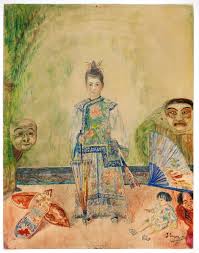 The mid 1790s witnessed the abdication of the Qianlong Emperor, who had ruled China for more than sixty years (1735–1796), as well as the last Western Embassy that traveled to China, organized by the Dutch East-India Company in 1794–95. Moreover, the decade saw the rapid rise of the opium trade, leading to an edict forbidding its use by the Jiaqing Emperor in 1799. The year 1911 marked the end of the Qing dynasty. By addressing the ‘long’ nineteenth century, the workshop is intended to explore a subject that has received comparatively less attention than East-West artistic relations during the eighteenth century, when most exchanges took place between the Beijing and European courts.
The workshop is aimed at investigating what happened when political relations between China and the West soured and when artistic contacts were no longer situated at the courts but largely took place in the context of international commerce and middle-class culture. By choosing a format that is less formal than a conference or symposium, we hope to attract to the Seton Hall workshop more speakers on a topic that has in the last few years emerged as one that is crucial for our understanding of East-West relations, and of international relations generally.
Held under the auspices of the American Council of Learned Societies, with funding from the Chiang Ching-kuo Foundation for International Scholarly Exchange, the workshop is co-sponsored by the University of Sydney and Seton Hall University. Its steering committee is comprised of Petra Chu (Seton Hall University), Yachen Ma (National Tsing Hua University), and Jennifer Milam (University of Sydney).
Attendance to the workshop is free, but registration is required. A simple registration form is found on the symposium website. Alternatively, call 973-761-7966.
◊ ◊ ◊ ◊ ◊
F R I D A Y , 30 O C T O B E R 2 0 1 5
8:30 Coffee
9:30 Opening of Proceedings
Welcome: Deirdre Yates, Dean, College of Communication and the Arts, SHU
Aims of the Workshop: Petra Chu (SHU) and Jennifer Milam (U of Sydney)
10:00 Keynote Address
Introduction of Keynote speaker: Dietrich Tschanz (Rutgers University)
Keynote: Elizabeth Chang (University of Missouri), Cultivating Chinoiserie: Organic Life and Exotic Design
11:15 Coffee Break
11:30 Panel Discussion
Cross-Disciplinary and Cross-Cultural Approaches: The Question of Exchange from the Chinese and Western Perspectives with Jennifer Milam (University of Sydney); Elizabeth Chang (University of Missouri); Stacey Sloboda (Southern Illinois University)
12:30 Lunch
1:30 Session 1: Chaired by Juergen Heinrichs, Seton Hall University
• Patricia Johnston (College of the Holy Cross, Worcester MA), The China Trade and Emerging Imperial Aesthetics in Federal America
• Kristel Smentek (Massachusetts Institute of Technology), Etienne Délécluze: Chinese Painting and Nineteenth-Century French Art
• Joyce Lindorff (Temple University), The Role of Music in George Macartney’s Embassy to China
Questions and Discussion (with coffee break)
3:30 Session 2: Chaired by Martha Easton, Seton Hall University
• Meredith Martin (New York University), Staging China and Siam in 1860s Paris
• Elizabeth Emery (Montclair State University), Appraising French Women ‘Collectors’ of Chinese Art in Fin-de-siècle France: Methods and Challenges
Questions and Discussion
5:00 Reception
S A T U R D A Y , 3 1 O C T O B E R 2 0 1 5
8:30 Coffee
9:30 Session 3: Chaired by Charlotte Nichols, Seton Hall University
• Maggie Cao (Columbia University), Copying in Reverse: China Trade Painting
• Sarah Cheang (Royal College of Art, London), Fashion and Chinoiserie: Material Translations between China, Japan, and Britain
• Tara Zanardi (Hunter College), Fabricating the ;Manton de Manila’ as National Dress
Questions and Discussion (with coffee break)
11:30 Panel Discussion
Introduction (Katherine Paul), Some Ching Enameled Vases in the Newark Museum
The Centrality of the Object in Artistic Relations between China and the West, with Petra Chu, (Seton Hall University); Katherine Paul (Newark Museum); Kristel Smentek (M.I.T.); Mei Rado (Metropolitan Museum of Art)
12:30 Lunch
1:30 Session 4: Chaired by Dong Dong Chen, Seton Hall University
• Roberta Wue (University of California, Irvine), Xugu Abstracts
• William Ma (University of California, Berkeley), Carving between Cultures: The Woodcarving Workshop at the Shanghai Jesuit Orphanage
Questions and Discussion
3:30 Visit Newark Museum Asian collections with Dr. Katherine Paul, Curator of Asian Art, Newark Museum (transportation on your own).
Call for Papers | European Portrait Miniatures
From H-ArtHist:
European Portrait Miniatures: Artists, Functions and Collections
The Tansey Miniatures Foundation, Celle, 11–13 November 2016
Proposals due by 31 March 2016
In January 2013 the Tansey Miniatures Foundation held its first conference on European portrait miniatures. At the time a conscious decision was made to cover a broad spectrum. It is precisely the consideration of miniature painting from various viewpoints that opens up an in-depth understanding of this special form of portraiture. The 2016 conference will therefore once again cover a wide range of aspects:
• Individual miniaturists, specific workshop contexts, and places of production
• Use of both court and private types and their protagonists
• Iconographic aspects in the context of representation or intimacy
• Evolution of techniques and materials
• Less well-known collections in museums
The symposium will be held on the occasion of the planned opening of the sixth exhibit of the Tansey Miniatures Foundation and the publication of the accompanying catalogue, Miniatures from the Baroque Period in the Tansey Collection. The conference will be in English. Lectures should not exceed 25 minutes and are to be published separately following the conference (information on the publication of the 2013 lectures is available here). The Tansey Miniatures Foundation will assume travelling expenses, accommodations, and meals. Exposés should be in English and no longer than 1500 characters. They should be submitted by March 31, 2016, including name, address, and, if applicable, institution, and be sent to bernd.pappe@miniaturen-tansey.de.
Organisation
Bernd Pappe, Berne (Art Historian and Restorer)
Juliane Schmieglitz-Otten, Celle (Head of the Residence Museum at Celle Castle)
Exhibition | Tromelin: The Island of the Forgotten Slaves
Now on view at Château des Ducs de Bretagne:
Tromelin: L’île des esclaves oubliés / The Island of the Forgotten Slaves
Château des Ducs de Bretagne, Nantes, 17 October 2015 — 30 April 2016
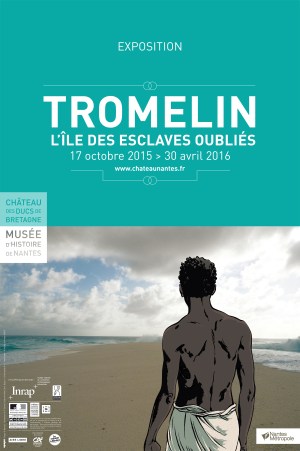 After leaving Bayonne on November 17, 1760, the Utile, a ship belonging to the French East India Company washed up on the Île de Sable (today: Tromelin Island—a 1-square-kilometer desert isle off the coast of Madagascar) on July 31, 1761. The ship was transporting 160 Malagasy slaves who were smuggled out of the country, intended to be sold to Île de France (now Mauritius). The crew returned to Madagascar on a raft, leaving 80 slaves on the island, with the promise to return and rescue them. Only fifteen years later, on November 29, 1776, did the ensign and future knight, Tromelin, return at the helm of the corvette La Dauphine. He rescued the eight surviving slaves: seven women and one eight-month child.
The goal of this exhibition is to recall an important period of maritime history along with the question of slavery and slave-trading in the Indian Ocean, illustrated by this shipwreck and the Malagasy survivors who tried to survive for nearly fifteen years on this tiny, inhospitable island.
The exhibition was developed in collaboration with the GRAN (Group Recherche en Archéologie Navale) and the INRAP (Institut National de Recherche Archéologique Préventive) for the excavations they performed on the island and underwater. Research on this shipwreck and the life of those who were ultimately rescued has been the focus of a multidisciplinary study with the aim of shedding light on the circumstances behind the tragic event. It also documents the living conditions of those who survived the best they could.
New Book | From the Shadows: Nicholas Hawksmoor
Published by Reaktion and distributed by The University of Chicago Press:
Owen Hopkins, From the Shadows: The Architecture and Afterlife of Nicholas Hawksmoor (London: Reaktion Books, 2015), 304 pages, ISBN: 9781780235158, £25 / $40.
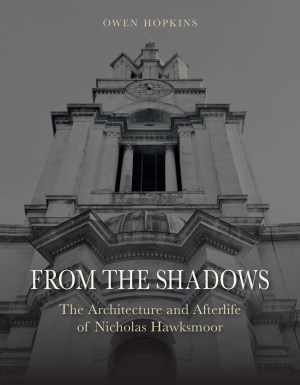 Nicholas Hawksmoor (1662–1736) is considered one of Britain’s greatest architects. He was involved in the grandest architectural projects of his age and today is best known for his London churches: six idiosyncratic edifices of white Portland stone that remain standing today, proud and tall in the otherwise radically changed cityscape. Until comparatively recently, however, Hawksmoor was thought to be, at best, a second-rate talent—merely Sir Christopher Wren’s slightly odd apprentice, or the practically minded assistant to Sir John Vanbrugh. This book brings to life the dramatic story of Hawksmoor’s resurrection from the margins of history.
Charting Hawksmoor’s career and the decline of his reputation, Owen Hopkins offers fresh interpretations of many of his famous works—notably his three East End churches—and shows how over their history Hawksmoor’s buildings have been ignored, abused, altered, recovered and celebrated. Hopkins also charts how, as Hawksmoor returned to prominence during the twentieth century, his work caught the eye of observers as diverse as T. S. Eliot, James Stirling, Robert Venturi and, most famously, Peter Ackroyd, whose novel Hawksmoor (1985) popularized the mythical association of his work with the occult. Meanwhile, passionate campaigns were mounted to save and restore Hawksmoor’s churches, reflecting the strange hold his architecture can have over observers. There is surely no other body of work in British architectural history with the same capacity to intrigue and inspire, perplex and provoke as Hawksmoor’s has done for nearly three centuries.
Owen Hopkins is a writer, historian and Architecture Programme Curator at the Royal Academy of Arts. He is the author of Reading Architecture: A Visual Lexicon (2012) and Architectural Styles: A Visual Guide (2014) and regularly leads a variety of walking tours of London architecture.
◊ ◊ ◊ ◊ ◊
C O N T E N T S
Introduction: The Man and the Myth
1 Emergence
2 Achievement
3 Falling into Shadow
4 Neglect and Rehabilitation
5 Into the Light
6 Rebirth
7 Hawksmoor Today
References
Select Bibliography
Acknowledgements
Photo Acknowledgements
Index
Exhibition | Watteau’s Soldiers: Scenes of Military Life
Press release (23 October 2015) from The Frick:
Watteau’s Soldiers: Scenes of Military Life in Eighteenth-Century France
The Frick Collection, New York, 12 July — 2 October 2016
Curated by Aaron Wile
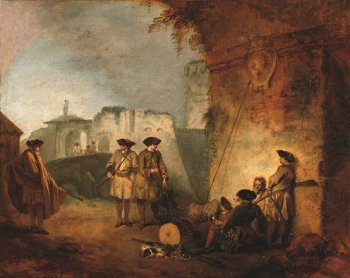
Jean-Antoine Watteau, The Portal of Valenciennes (La Porte de Valenciennes), ca. 1711−12, oil on canvas, 12 3/4 x 16 inches (New York: The Frick Collection; photo by Michael Bodycomb)
It would be difficult to think of an artist further removed from the muck and misery of the battlefield than Jean-Antoine Watteau (1684–1721), who is known as a painter of amorous aristocrats and melancholy actors, a dreamer of exquisite parklands and impossibly refined fêtes. And yet, early in his career, Watteau painted a number of scenes of military life, remarkable for their deeply felt humanity and intimacy. These pictures were produced during one of the darkest chapters of France’s history, the War of the Spanish Succession (1701–14). But the martial glory on which most military painters of the time trained their gaze—the fearsome arms, snarling horses, and splendid uniforms of generals glittering amid the smoke of cannon fire—held no interest for Watteau, who focused instead on the most prosaic aspects of war: the marches, halts, encampments, and bivouacs that defined the larger part of military life. Inspired by seventeenth-century Dutch and Flemish genre scenes, the resulting works show the quiet moments between the fighting, when soldiers could rest and daydream, smoke pipes and play cards.
Watteau produced about a dozen of these military scenes, but only seven survive. Though known primarily only to specialists, they were once counted among the artist’s most admired works and owned by such prominent figures as Catherine the Great and the Prince of Conti. Presented exclusively at The Frick Collection in the summer of 2016, Watteau’s Soldiers is the first exhibition devoted solely to these captivating pictures, introducing the artist’s engagement with military life to a larger audience while offering a fresh perspective on the subject. Among the paintings, drawings, and prints are four of the seven known paintings—with the Frick’s own Portal of Valenciennes as the centerpiece—as well as the recently rediscovered Supply Train, which has never before been exhibited publicly in a museum. Also featured are about twelve studies of soldiers in red chalk, many directly related to the paintings on view.
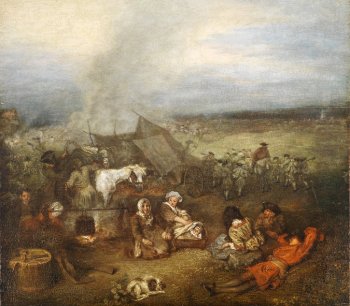
Jean-Antoine Watteau, The Supply Train (Escorte d’équipages), ca. 1715, oil on panel, 11 1/8 x 12 3/8 inches (Private collection)
The works on display offer a rare opportunity to study the drawings and paintings together and probe Watteau’s complex and remarkable working methods. Unlike most of his contemporaries, Watteau did not proceed methodically from compositional sketches, studies, and full-scale models to the final painting. Instead, his process followed the whims of his imagination and the demands of the moment. He began by drawing soldiers from life, without a predetermined end in mind. These drawings provided him with a stock of figures, often used multiple times, that he would arrange in an almost spontaneous fashion on the canvas. As a result, figures previously isolated in his sketchbook were brought together and juxtaposed in new social relationships on the canvas, producing the ambiguous, dreamlike effects that make his paintings so intriguing.
The exhibition is rounded out by a selection of works by Watteau’s predecessors and followers: the Frick’s Calvary Camp by Philips Wouwerman, a typical example of the seventeenth-century Dutch paintings after which Watteau modeled his own; a study of a soldier by Watteau’s follower Jean-Baptiste Pater, from the Fondation Custodia, Paris; and a painting of a military camp by his other great follower, Nicolas Lancret, from a private collection. These works shed light on the ways in which Watteau transformed the painting of military life in Europe, demonstrating his pivotal influence on the genre.
Aaron Wile, Watteau’s Soldiers: Scenes of Military Life in Eighteenth-Century France (London: D. Giles, 2016), 112 pages, ISBN: 978-1907804793, £25 / $40.
Published by The Frick Collection in association with D Giles, Ltd., London, the book accompanying the exhibition is the first illustrated catalogue of all Watteau’s works related to military subjects.
Additional works included in the exhibition are illustrated here»
PhD Studentships in French Studies at the University of Exeter
Niklaus-Cartwright PhD Studentships
University of Exeter
Proposals due by 15 November 2015
Through the generosity of Professor Michael Cartwright (French, Exeter 1960), and the Professor Robert Niklaus fund, established to support and strengthen eighteenth-century French studies, the Department of Modern Languages at Exeter is delighted to be offering excellent funding opportunities for exceptional researchers in the area of French Studies. Three Doctoral Studentships (open to UK/EU students only) will provide full tuition fees and an annual maintenance grant for three years. The maintenance grant will be £14,057 per year. At least one studentship is expected to be awarded in the field of eighteenth-century French studies.
The Department prides itself on its vigorous research culture, in which postgraduate research students play central roles. Our academic staff produce excellent research across a wide variety of disciplines including European and other global literature and culture, Art History and Visual Culture, Film, Linguistics, Medieval studies, Gender studies, and Translation. Modern Languages at Exeter is ranked in the Top Ten within the UK and in the top 150 language departments worldwide. Committed to providing outstanding, research-led teaching, the department maintained its momentum in the 2014 Research Excellence Framework (REF) with nearly a third of its research classified as ‘world-leading’—more than double that of the previous assessment. The REF also underlined what a great place Exeter is to pursue research in languages and culture: the department was rated 100% for providing ‘an environment that is conducive to producing research of world-leading (70%) or internationally excellent (30%) quality’. In French we have a wide range of research specialists and research interests, covering many aspects of French literary and visual culture from the medieval to the contemporary, linguistics, and French thought.
Research interests in French
•Specialists in linguistics carry out research in the sociolinguistics and linguistic variation of contemporary French.
•Recent and contemporary writing: including biographical fiction, women’s writing, and modern critical theory.
•Medieval French literature and culture
•Renaissance thought and literature
•French and Francophone cinema
•Seventeenth century literary studies
•Eighteenth and nineteenth-century visual art and literature.
Research carried out by staff in French deals with issues including the reception of Classical myth, sexuality, gender, war and trauma, and questions of ‘race’, citizenship, and national identity.
Entry criteria
We invite applications from candidates with a strong academic background and a clear and engaging research proposal which can be developed through available research supervision. Successful applicants normally have a good first degree (at least 2.1, or international equivalent) in Modern Languages or a Humanities discipline, and have obtained, or are currently working towards, a Masters degree at Merit level, or international equivalent, in Modern Languages or a Humanities discipline. If English is not your native language then you will also need to satisfy our English language entry requirements.
There is a French language requirement for candidates taking up these opportunities. All candidates will have achieved at least A-level French or equivalent.
To apply
To be considered for these doctoral awards, you must complete an online web form where you must submit personal details and upload a full CV, research proposal, transcripts, details of two referees and, if relevant, proof of your English language proficiency, by 15 November 2015. In addition you must also ensure that your referees email their references to the Postgraduate Administrator at humanities-pgadmissions@exeter.ac.uk by 15 November 2015. Please note that we will not be contacting referees to request references and so you must arrange for them to be submitted to us by the deadline. References should be submitted by your referees to us directly in the form of a letter. Referees must email their references to us from their institutional email accounts. We cannot accept references from personal/private email accounts, unless it is a scanned document on institutional headed paper and signed by the referee.
Please note that if you have already submitted references to support your application to one of our MPhil/PhD programmes you may re-use these to support your funding application. However, this is not automatic and you must email us at humanities-pgadmissions@exeter.ac.uk to confirm that we have two references on file to support your application, and to request that they be used to support your funding application.
All application documents must be submitted in English. Certified translated copies of academic qualifications must also be provided.
For more information contact:
Dr Matt Barber, Graduate School Administrator
humanities-pgadmissions@exeter.ac.uk
College of Humanities Graduate School, University of Exeter
Queen’s Building, The Queen’s Drive
Exeter, Devon, EX4 4QH
For informal enquiries, contact Professor Melissa Percival, M.H.Percival@exeter.ac.uk
Exhibition | Greece’s Enchanting Landscape
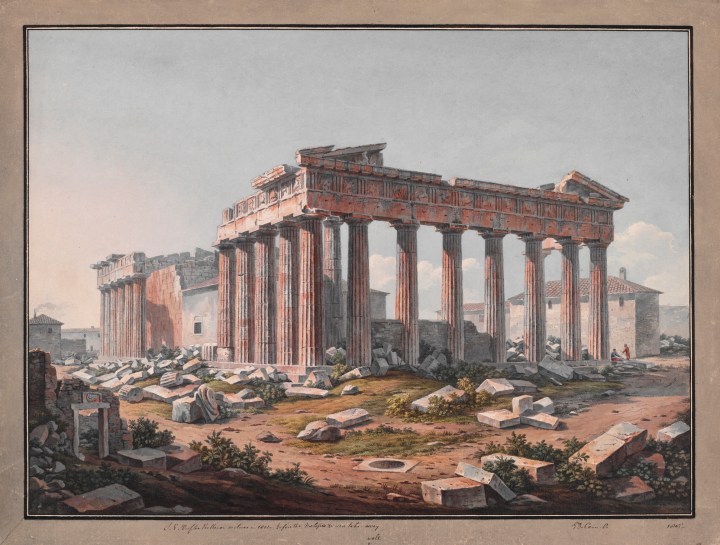
Edward Dodwell, The Parthenon, Athens, after 1805, watercolor, framed: 58.4 × 73.7 cm (The Packard Humanities Institute, Accession No. VEX.2015.1.35).
◊ ◊ ◊ ◊ ◊
Press release (12 October 2015) from The Getty:
Greece’s Enchanting Landscape: Watercolors by Edward Dodwell and Simone Pomardi
The J. Paul Getty Museum, Getty Villa, Pacific Palisades (Los Angeles), 21 October 2015 — 15 February 2016
Curated by David Saunders
“Almost every rock, every promontory, every river, is haunted by the shadows of the mighty dead,” wrote the English antiquarian Edward Dodwell of his travels in Greece at the beginning of the nineteenth century. During this time, he and the Italian artist Simone Pomardi traversed the country, producing around one thousand watercolors and drawings of the ancient Greek countryside.
On view at the Getty Villa October 21, 2015 – February 15, 2016, Greece’s Enchanted Landscapes: Watercolors by Edward Dodwell and Simone Pomardi presents, for the first time in the United States, a selection of 44 magnificent illustrations from the expansive archive acquired by the Packard Humanities Institute, as well as four photographs from the Getty Museum’s photographs collection and six prints from the collection of the Getty Research Institute. They depict picturesque landscapes infused with memories of the classical past, often in striking juxtaposition with the realities of Greek life under Ottoman rule. The exhibition culminates in a series of monumental panoramas of Athens, each over thirteen-feet-long, that are both sweeping in scope and rich in scrupulous detail.
“These captivating drawings represent one of the most beautiful and compelling manifestations of Europe’s fascination with modern and ancient Greece—its landscape, archaeological sites and social customs—in the years before its independence from Ottoman rule,” says Timothy Potts, director of the J. Paul Getty Museum. “Displaying them at the Getty Villa, alongside our unparalleled collections of Greek, Roman, and Etruscan art, will allow visitors to experience these unique images in a particularly appropriate setting.” Potts adds: “We are particularly grateful to David Packard and the Packard Humanities Institute, not only for their generosity in supporting this exhibition, but for the decades of work they have done in researching, preserving, and publishing this extraordinary body of work that serves as an important record of Greece’s ancient past.”
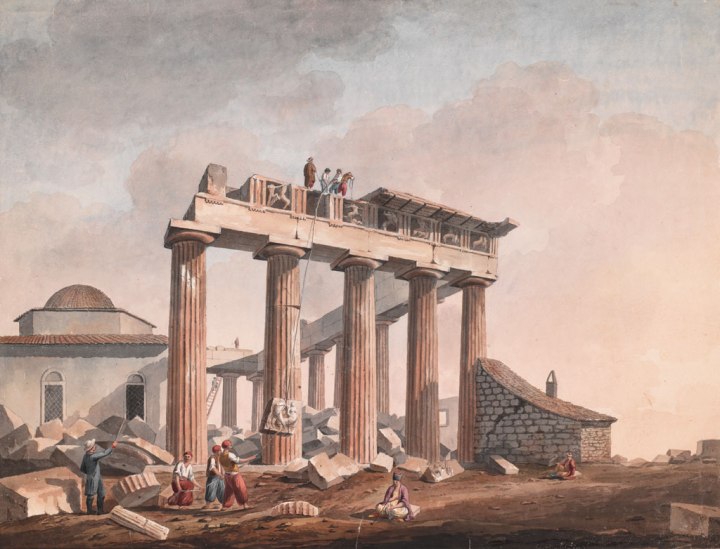
Edward Dodwell and/or Simone Pomardi, Removal of Sculptures from the Parthenon by Lord Elgin’s Men, after 1801, watercolor (The Packard Humanities Institute). Read Dodwell’s description here
◊ ◊ ◊ ◊ ◊
Edward Dodwell (1777/78–1832) was one of an increasing number of travelers in the nineteenth century who combined Hellenism—an erudite passion for the legacy of Greek antiquity—with documentary intent. He first traveled through Greece in 1801, and then returned in 1805 with the Italian artist Simone Pomardi (1757–1830). They toured the country for fourteen months, drawing and documenting the landscape in all its aspects. Dodwell described the objective of his travels in Greece as “to leave nothing unnoticed,” and the illustrations—many never published—are a valuable record of the country and its monuments in the years at the beginning of the nineteenth century.
“The sight of ancient temples lying in ruin, or of the Greek people under Turkish rule, contrasted poignantly with nostalgic imaginings of the classical past. Yet for Dodwell and Pomardi, such juxtapositions only magnified the lost splendor of Greek antiquity,” says David Saunders, curator of the exhibition.
For many of their illustrations, the artists made extensive use of the camera obscura, an optical device that Dodwell described as “that infallible medium of truth and accuracy.” This is most fully apparent with the panoramas of Athens. Combining expansive vistas and topographical exactitude on a grand scale, the four monumental illustrations in this exhibition are the most complete expression of Dodwell and Pomardi’s project to document Greece, and capture what Dodwell referred to as “the delights of the present, and recollections of the past.” Also, included in the exhibition is a portable tent camera obscura from the Getty’s collection. Dodwell and Pomardi would have used a similar camera obscura during their travels.
Greece’s Enchanted Landscapes: Watercolors by Edward Dodwell and Simone Pomardi is curated by David Saunders, associate curator of antiquities at the J. Paul Getty Museum. This exhibition is made possible through the generous support of the Packard Humanities Institute
New Essays | Corrélations: les objets du décor au siècle des Lumières
A presentation of the book is scheduled for Wednesday, November 18, in Paris at the Institut national d’histoire de l’art (INHA) in conjunction with the seminar Penser le décor : quelques hypothèses sur ses fonctions dans l’histoire de l’art, which will run from noon to 4:00. From the book flyer and Éditions de l’Université de Bruxelles:
Anne Perrin Khelissa, ed., Corrélations: les objets du décor au siècle des Lumières (2015), 264 pages, ISBN 978-2800415857, 28€ [Études sur le XVIIIe siècle 43 (Octobre 2015)].

D’après Jean-Baptiste Oudry, La jeune veuve. Fable cxxiv, gravure illustrant Jean de La Fontaine, Fables choisies, Paris, chez Desaint et Saillant, 1755, t. ii, Bibliothèque municipale de Toulouse, Res A xviii 1(2) (Bibliothèque municipale de Toulouse)
Expositions, nouvelles présentations muséographiques, colloques internationaux, programmes de recherche, travaux universitaires, publications : les arts du décor connaissent ces dernières années un vaste regain d’intérêt. Le présent volume répond à une actualité. Il entend également porter un regard renouvelé sur l’ameublement des demeures, en interrogeant la qualité artistique et technique des objets, mais aussi leurs significations sociales et culturelles. Autour d’une réflexion commune, professeurs des universités et jeunes chercheurs, conservateurs, spécialistes des arts décoratifs, de peinture, d’architecture, de littérature et d’histoire du genre font le point sur les mutations épistémologiques récentes et ouvrent la discussion.
Loin d’être un amas désaccordé de bibelots, les intérieurs du xviiie siècle proposent un système unitaire co- hérent, où arts manufacturés et beaux-arts cohabitent. Quels liens ces artefacts de nature et de statut hétérogènes entretiennent-ils entre eux et avec leur environ- nement ? Comment le principe d’harmonie fonctionne- t-il et s’adapte-t-il à la variété des aménagements et à la succession rapide des goûts ? Quel écart existe-t-il entre ce que les traités et la critique esthétique du temps préconisent et ce qu’attendent les commanditaires et les acheteurs ? Telles sont les questions que soulèvent les auteurs du recueil, à partir d’exemples célèbres ou méconnus de décors réalisés en France, en Grande-Bretagne, en Italie et en Suisse, entre la fin du xviie siècle et le début du xixe siècle.
◊ ◊ ◊ ◊ ◊
T A B L E D E S M A T I È R E S
 • Roland Mortier et les Études, Hervé Hasquin
• Pour une mise en corrélation des arts et des savoirs : introduction à l’étude des intérieurs domestiques, Anne Perrin Khelissa
I Principes et logiques structurants
• Le système d’ameublement des élites françaises au xviiie siècle, Christian Michel
• Decorated Interiors : Gender, Ornament, and Moral Values, Mary Sheriff
• L’appartement au xviiie siècle : un espace diversifié au service d’une convivialité nouvelle, Claire Ollagnier
II Normes et pratiques sociales
• Une application de la théorie du décorum : le décor textile de la chambre du roi au palais de l’archevêché de Reims, le jour du sacre de Louis xv, Pascal-François Bertrand
• Declaring an interest : the decoration of Norfolk House, London (1748–1756), Sarah Medlam
• « Trop doré pour la Suisse » : canon parisien et convenance neuchâteloise, Carl Magnusson
III Dispositions et assemblages plastiques
• Le cabinet du Régent au château de Saint-Cloud : un décor pour une collection de petits bronzes. Essai de reconstitution, Michaël Decrossas
• Du « tact flou et séduisant des couleurs » chez Jullienne ou l’art de marier tableaux, porcelaines, laques, statuettes, meubles, et autres effets, Isabelle Tillerot
• La rencontre des matériaux au service de l’harmonie du décor ? L’exemple du salon Martorana du palais Comitini à Palerme (1765–1770), Sandra Bazin-Henry
IV Imaginaires et incarnations sensuels
• « L’amour égalisait tout » : l’unité du décor des intérieurs libertins du roman des Lumières, Fabrice Moulin
• Le succès du boudoir au xviiie siècle ou les prestiges de l’intime, Alexia Lebeurre
• La nature dans le boudoir, Bérangère Poulain
Bibliographie générale
Notices biographiques des auteurs
◊ ◊ ◊ ◊ ◊
Une présentation du livre est organisée le mercredi 18 novembre à l’INHA (salle Walter Benjamin) dans le cadre du séminaire « Penser le décor : quelques hypothèses sur ses fonctions dans l’histoire de l’art » qui se déroulera de 12 h à 16 h.
Exhibition | Wicked Wit: Darly’s Comic Prints
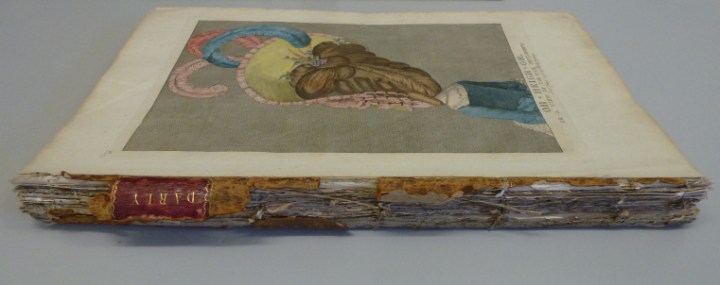
Album of Darly prints in the Chester Beatty Collection (Wep 0494), with its much deteriorated eighteenth-century binding, as photographed in the Library’s conservation studio in 2015. More information is available at the Chester Beatty Conservation Blog.
◊ ◊ ◊ ◊ ◊
Now on view at the Chester Beatty Library:
Wicked Wit: Darly’s Comic Prints
Chester Beatty Library, Dublin Castle, Dublin, 11 September 2015 — 14 February 2016
Curated by Jill Unkel
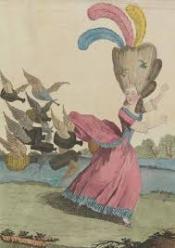 Drawing on the Library’s own collections, this exhibition features over 100 hand-coloured, eighteenth-century etchings by the husband and wife team, Mary and Matthew Darly. From the time of their marriage, they worked in tandem designing, engraving and publishing prints using the signature, MD or MDarly.
This printer-publisher team produced well over 500 comic images of Caricatures, Macaronies, and Characters from no. 39 Strand (London) between 1770 and 1780. At the height of their fame, carriages lined the streets so their occupants could titter at the images on display in Darly’s Comic Exhibitions, held every spring from 1773 to 1778. By the end of the decade, they had become so popular that their publications were available throughout Great Britain and Ireland, Europe and even America. The name Darly became synonymous with the humorous images they produced.
◊ ◊ ◊ ◊ ◊
The catalogue is available for purchase through the Beatty Library’s shop:
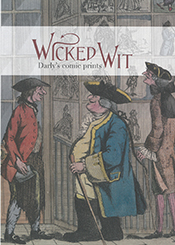 Jill Unkel, Wicked Wit: Darly’s Comic Prints (Dublin: Chester Beatty Library, 2015), 80 pages, ISBN: 978-0957399822, 20€.
This fully illustrated catalogue is divided into a number of themes and opens with a general introduction to Mary and Matthew Darly. It then examines more specifically their comic prints, publications, and exhibitions. This is followed by a more detailed exploration of the various subjects presented in their comic images: stereotyped characters (and their relation to theatre), caricatures of notable contemporaries, satires of the dress of young macaroni (akin to a dandy or fop) men and their feathered-feminine counterparts, and finally the impolitical satires related to the war with the American Colonies.
Symposium | Rembrandt and Printmaking
From the Miriam and Ira D. Wallach Art Gallery:
Rembrandt and Printmaking: New Views on a Golden Age
Columbia University, New York, 5 November 2015
Presented by the Miriam and Ira D. Wallach Art Gallery in conjunction with the exhibition Rembrandt’s Changing Impressions and the International Fine Print Dealers Association Print Fair, this symposium will spark a new and closer look at Rembrandt’s astonishing print practice, its context, and its contributions.
Thursday, 5 November 2015, 3–6pm
612 Schermerhorn Hall, Columbia University, 116th Street & Broadway, New York City
• “Hercules Segers and Rembrandt: Direct Influence or Kindred Spirits?” Nadine M. Orenstein, Drue Heinz Curator in Charge, Department of Drawings and Prints, The Metropolitan Museum of Art, New York
• “St. Jerome in Darkness and Light,” Clifford S. Ackley, Ruth and Carl J. Shapiro Curator of Prints and Drawings, Museum of Fine Arts, Boston
• “Rembrandt and the Faust Tradition,” Robert Fucci, exhibition curator
• “Edme-François Gersaint as Chroniqueur of Knowledge about Rembrandt’s Etchings,” Erik Hinterding, Curator of Prints, Rijksmuseum, Amsterdam
• “Desire and Disgust: Collecting Rembrandt’s Etchings in Georgian England,” Stephanie Dickey, Professor of Art History and Bader Chair in Northern Baroque Art, Queen’s University, Kingston, Ontario
• “Rembrandt as Experimental Etcher,” Jan Piet Filedt Kok, former Curator of Prints and Director of Collections, Rijksmuseum, Amsterdam
Reception and viewing of the exhibition to follow at 6pm at The Wallach Art Gallery
◊ ◊ ◊ ◊ ◊
 Rembrandt’s Changing Impressions, on view through December 12, is curated by art history PhD candidate Robert Fucci. This extraordinary project highlights Rembrandt’s most dramatically altered prints. It gathers 52 seventeenth-century impressions from 14 major U.S. collections to best examine his manipulations and transformations, and is an unprecedented opportunity to examine the range, power, and nuance of Rembrandt’s fine prints. A fully illustrated, 160-page catalogue, co-published by The Wallach Art Gallery and Verlag der Buchhandlung Walther König, Köln is available for $35.
This exhibition and related programming received generous support from the Netherland-America Foundation, the Dutch Culture USA program by the Consulate General of the Netherlands in New York, the IFPDA Foundation, and the European Institute at Columbia University. We are especially grateful for our collaboration with the European Institute and the Department of Art History and Archaeology in presenting this symposium.










 Enfilade
leave a comment