Exhibition | Mavericks: Breaking the Mould of British Architecture

William Hodges and William Pars, The Pantheon, Oxford Street, London, 1770–72, by James Wyatt, oil on canvas (Leeds Museums and Art Galleries / Temple Newsam House)
◊ ◊ ◊ ◊ ◊
Press release (8 December 2015) from the RA:
Mavericks: Breaking the Mould of British Architecture
Royal Academy of Arts, London, 26 January – 20 April 2016
Curated by Owen Hopkins
Mavericks: Breaking the Mould of British Architecture is an installation that will chart the course of British architecture from the sixteenth century to the present day through the work of twelve maverick architects: Robert Smythson, Sir John Vanbrugh, James Wyatt PRA, Sir John Soane RA, Charles Robert Cockerell RA, Charles Rennie Mackintosh, Charles Holden, H. S. Goodhart-Rendel, James Stirling RA, Cedric Price, FAT and Zaha Hadid RA.
Each of the twelve mavericks has charted his or her own course, often deliberately ignoring prevailing taste, fashion and ways of working. The installation comprises of images and photographs of these maverick architects’ work, situating their work within the broader context of architectural history, through an arresting colour-gradated design by Scott-Whitby Studio. Celebrating the original and the unorthodox, the installation will pose an intriguing alternative narrative to the history of British architecture.
◊ ◊ ◊ ◊ ◊
Owen Hopkins, Mavericks: Breaking the Mould of British Architecture (London: Royal Academy Publications, 2016), 128 pages, ISBN: 978-1910350393, £13 / $28.
The history of architecture is a story of continual innovation, and at certain points within that story come architects whose visions completely defy convention. Mavericks focuses on 12 such figures from the history of British architecture, including Sir John Soane, Charles Rennie Mackintosh, Cedric Price, and Zaha Hadid. From the stripped-back classicism of Soane’s Dulwich Picture Gallery to Hadid’s neofuturistic London Aquatics Centre for the 2012 Olympics, the architects’ work is bold, frequently controversial, and often radical. It is architecture that actively resists being pigeonholed into a particular style or period. What connects this naturally disparate group of free creative spirits is the way each has charted his or her own course, often deliberately evading conventions of taste, fashion, and ways of working. This book offers a fresh take on their creations, establishing new and sometimes surprising historical connections while proposing an intriguing alternative narrative to the history of British architecture.
Owen Hopkins is Architecture Programme Curator at the Royal Academy of Arts, London, and has written widely on architecture for The Burlington Magazine, The Architectural Review, Apollo, Dezeen, RA Magazine, C20 Magazine, The Oxonian Review, Architects’ Journal and Building Design. He is author of Reading Architecture: A Visual Lexicon (Laurence King, 2012), Architectural Styles: A Visual Guide (Laurence King, 2014) and From the Shadows: The Architecture and Afterlife of Nicholas Hawksmoor (Reaktion, 2015).
◊ ◊ ◊ ◊ ◊
E V E N T S
All events take place at the Geological Society, Piccadilly; £12 / reductions £6
Does Architecture Need Mavericks?
Thursday 4 February, 6.30–8pm
Owen Hopkins introduces the Mavericks book and installation and chairs a debate exploring the role of unorthodox approaches and original thinking in architecture.
Maverick Architects – A Thing of the Past?
Thursday 25 February, 6.30–8pm
Faced with the crushing weight of student debt and an increasingly risk-averse building industry, the panel explore if there is any future for mavericks in architecture.
After the Age of ‘Starchitects’
Monday, 7 March, 6.30–8pm
What might life be like after the signature-style, icon-obsessed—and male-dominated—age of the ‘starchitect’? The panel explores.
The Artist as Maverick Architect
Monday, 21 March, 6.30–8pm
Sean Griffiths, co-founder of FAT, one of the architects featured in Mavericks, chairs this discussion exploring the different perspectives artists can bring to the making of architecture.
Britain’s Greatest Maverick Building – The Debate
Monday, 18 April, 6.30–8pm
Do you have a favourite quirky or unusual building? Let us know on Twitter for a chance for it to be included in this debate looking for Britain’s greatest maverick building: @architecture_RA #Mavericks

Study Day | Exploring Lee Priory: A Child of Strawberry Hill

◊ ◊ ◊ ◊ ◊
From Eventbrite:
Exploring Lee Priory: A Child of Strawberry Hill
Taddington Manor, Taddington, Near Cutsdean, Gloucestershire, 1 March 2016
Organized by Peter Lindfield
This study day, based at Architectural Heritage, Taddington Manor, Gloucestershire, explores the architecture of James Wyatt (1746–1813), the most famous architect of late Georgian Britain. The day will feature talks by experts on the architecture, interiors and furniture by James Wyatt, including the development of his architecturally-aware Gothic style at Lee Priory, Kent, before his most famous house, Fonthill Abbey, Wiltshire.
The relationship between Lee Priory and the most famous Gothic Revival house in Georgian Britain, Horace Walpole’s Strawberry Hill, will also be addressed. The conservator who worked on Strawberry Hill and a second, previously unknown, room saved from Lee Priory before its demolition in 1953, will speak about Wyatt’s work.
The highlight of the day will be the close examination of the second surviving room from Lee Priory, the Library Ante-Chamber. This room is currently for sale and the study day offers perhaps the last chance to be able to get up close and examine, under the guidance of experts, one of the most exciting Wyatt-related discoveries of the recent past.
Registration (£25) includes lunch and refreshments at Taddington Manor. Please do not hesitate to get in contact with the organiser, Dr Peter N. Lindfield, at: peter.lindfield@stirling.ac.uk. At time of booking, please advise of dietary or access requirements. Tuesday, 1 March 2016 from 10:30 to 16:30.
Art Institute of Chicago Receives $35Million Gift
Dorothy Braude Edinburg, a life-long collector and longtime supporter of the Art Institute of Chicago died last year at the age of 94. Her estate has just given more than $35million dollars to the museum, building upon earlier donations that established the Harry B. and Bessie K. Braude Memorial Collection in honor of her parents, who themselves were collectors—initially of eighteenth-century French furniture, Chinese porcelain, and artists books (additional information is available at Crain’s).
From Art Daily:
Douglas Druick, President and Eloise W. Martin Director of the Art Institute of Chicago announced today the largest bequest of funds in the museum’s history. The gift from long-time, generous benefactor and collector Dorothy Braude Edinburg provides more than $35 million to acquire new works of art to build on the Art Institute’s strong holdings in Prints and Drawings and Asian Art. Coming on the heels of the largest gift of art in the museum’s history, the Edlis/Neeson Collection in April 2015, the Edinburg gift offers exciting new momentum and opportunity to realize the museum’s ambitious long-range plan.

Dorothy Braude Edinburg (1920–2014)
“It was my great privilege to know and work with Dorothy for more than two decades, and we are thrilled and immensely grateful to receive this unparalleled bequest,” said Druick. “Together, with the leadership of Chair and Curator of Prints and Drawings Suzanne Folds McCullagh and our curatorial teams, we proudly embraced Dorothy’s extraordinary collection, and we will use this incredible funding to carry Dorothy’s vision forward—to inspire, educate, and delight future generations through the collection and presentation of exceptional art.”
David Hilliard, long-time Trustee of the Art Institute of Chicago and collector and connoisseur of prints and drawings, shared, “It was inspiring to see Dorothy build such an important and world-class collection—over the course of 23 years, Dorothy gifted the museum more than 1,500 works across six centuries and from many fields. This generous bequest ensures her collection will continue to inspire and educate the public, and embodies the excellence and mission of the Art Institute. It’s an honor to support the stewardship of her legacy.”
In 2013, through a landmark gift of more than 1000 works of art to the museum, Dorothy Braude Edinburg established the Harry B. and Bessie K. Braude Memorial Collection in her parents’ honor. The collection’s breadth and scope of European prints and drawings, Chinese and Korean stonewares and porcelains, and Japanese printed books, continues to spark a deeper artistic dialogue across and within the museum’s permanent collection.
New Book | Giambattista Bodoni: His Life and His World
On the occasion of the publication of Valerie Lester’s Giambattista Bodoni: His Life and His World, the first English biography of the great typographer, PRPH Rare Books and David R. Godine, Publisher invite you to an exhibit of selected Bodoni masterworks at our New York Gallery, a five-minute walk from The Grolier Club, Wednesday, January 27, 2016, 7.30–10.00pm. Light refreshments will be served. Please RSVP to news@prphbooks.com. PRPH Rare Books, 26 East 64th Street, 3rd Floor , New York, NY 10065.
A brief catalogue of nineteen items related to Bodoni is available as a PDF file here»
◊ ◊ ◊ ◊ ◊
From David R. Godine:
Valerie Lester, Giambattista Bodoni: His Life and His World (Boston: David R. Godine, 2015), 280 pages, ISBN: 978-1567925289, $40.
 A lively, lavishly illustrated biography of the great printer Bodoni, vividly describing his work, life, and times while justifying his reputation as the ‘prince of typographers’.
This is the first English-language biography of the relentlessly ambitious and incomparably talented printer Giambattista Bodoni (1740–1813). Born to a printing family in the small foothill town of Saluzzo, he left his comfortable life to travel to Rome in 1758 where he served as an apprentice of Cardinal Spinelli at the Propaganda Fide press. There, under the sponsorship of Ruggieri, his close friend, mentor, and protector, he learned all aspects of the printing craft. Even then, his real talent, indeed his genius, lay in type design and punchcutting, especially of the exotic foreign alphabets needed by the papal office to spread the faith.
His life changed when in 1768 at age 28 he was invited by the young Duke of Parma to abandon Rome for that very French city to establish and direct the ducal press. He remained in Parma, overseeing a vast variety of printing, some of it pedestrian, but much of it glorious. And all of it making use of the typefaces he personally designed and engraved.
This fine book goes beyond Bodoni’s capacity as a printer; it examines the life and times in which he lived, the turbulent and always fragile political climate, the fascinating cast of characters that enlivened the ducal court, the impressive list of visitors making the pilgrim- age to Parma, and the unique position Parma occupied, politically Italian but very much French in terms of taste and culture. Even the food gets its due (and in savory detail). The illustrations—of the city, of the press, of the types and matrices—are compelling enough, but most striking are the pages from the books he designed. And especially, pages from his typographic masterpiece, the Manuale Tipografico, painstakingly prepared by his wife Ghitta, posthumously published in two volumes, and displaying the myriad typefaces in multiple sizes that Bodoni had designed and engraved over a long and prolific career.
Intriguing, scholarly, visually arresting, and designed and printed to Bodoni’s standards, this title belongs on the shelf of any self-respecting bibliophile. It not only makes for compelling reading, it will be considered the biography of record of a great printer for years to come.
Valerie Browne Lester is an independent scholar, writer, and translator living in Boston. She is the author of Phiz: The Man Who Drew Dickens (2004), a biography of Hablot Knight Browne, Dickens’s principal illustrator who was also her great-great-grandfather. She translated Alain-Fournier’s Le Grand Meaulnes (The Magnificent Meaulnes, 2009), and has written poetry, plays, and articles.
New Book | Jacques-François Blondel
From Librairie Droz:
Aurélien Davrius, ed., Jacques-François Blondel, un architecte dans la « République des Arts » (Geneva: Librairie Droz, 2016), 752 pages, ISBN: 978-2600019514, 89€.
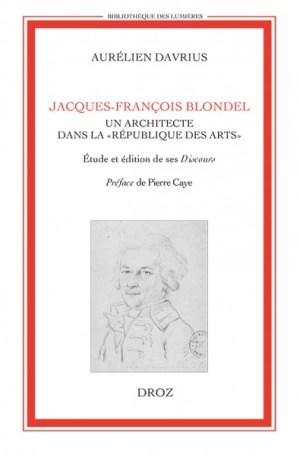 Au XVIIIe siècle, de nombreux architectes ont publié des traités ou des « Cours » sur leur art. L’un d’eux se distingue par la quantité et la qualité des livres qu’il publie : Jacques-François Blondel (1708/9–1774). Auteur majeur de la théorie architecturale, Blondel a su, au cœur des Lumières, redonner une actualité à l’architecture classique, en s’opposant à l’art rocaille qui domine alors. Pour Blondel, l’architecture possède une dimension encyclopédique – il mobilise à la fois les savoirs techniques et les différents arts –, mais aussi sociale – chacun est appelé à y participer. Les écrits de Blondel sont par ailleurs indissociables de son action pédagogique : avec la fondation de son Ecole des Arts, qui se propose de centraliser la diversité des compétences, il opère une véritable révolution pédagogique. Cet ouvrage rassemble les discours, mémoires, articles pour L’Encyclopédie et autres textes de Blondel, dans lesquels le professeur développe ses idées sur le « bon goût » en architecture. Pour la majeure partie inédits, ou jamais réédités depuis le XVIIIe siècle, ces documents renseignent sur les enjeux de l’art de bâtir au siècle des Lumières, ainsi que sur la transmission de la tradition nationale.
◊ ◊ ◊ ◊ ◊
Table des matières (more…)
Exhibition | China Observed
As noted at Art Daily:
China Observed: Historical Pictures by Chinese and Western Artists, 1750–1970
Hong Kong Maritime Museum, 7–14 October 2015
Mallett, New York, 21–31 January 2016

Chinese artist, late 18th century, one of a pair of paintings picturing Chinese Women Accompanied by Pipes and Pets, gouache on paper, 80 x 59 cm (London: The Martyn Gregory Gallery)
The world’s foremost expert in Chinese Export paintings, The Martyn Gregory Gallery of London, will exhibit 70 of these paintings (also known as China Coast or China Trade paintings), January 21–31, 2016, at Mallett, 929 Madison Avenue (at 74th Street). An exhibitor since 1990 at the annual Winter Antiques Show in New York, the gallery presents its first independent exhibition in the city with China Observed. These highly detailed works by Cantonese artists were bought by ships’ officers and merchants who came to trade at Canton (modern Guangzhou) in the 18th and early 19th centuries. Also on view will be paintings by Western artists who travelled to the East.
“New York has been one of the principal centers of the China Trade ever since America won its independence from Britain,” commented Martyn Gregory, “and the city still contains a wealth of China Trade pictures and keen collectors. We have always enjoyed coming to New York, and we look forward to meeting old friends and new enthusiasts in our new venue. We are bringing with us the finest collection of China Trade paintings to be found on the market at the present time, and perhaps for the foreseeable future.”
Among the most spectacular of the paintings by Chinese artists included in China Observed are detailed scenes of the ports visited by the Westerners: notably Canton, Hong Kong and Shanghai. One such example is The Hongs of Canton by an unknown Chinese artist, c. 1804. This oil on canvas (32 x 50 in.) is a large, impressive and finely detailed view of the hongs, or ‘Factories’, at Canton that commemorates the early years of direct trade between the United States and China. It also records a brief period when seven different nations (Great Britain, America, France, Sweden, Denmark, the Netherlands and Spain) were all actively trading at Canton, the only Chinese port at which Western trade was permitted.
Another large and unusually well-painted harbor painting is Hong Kong from the Harbour by an unknown Chinese artist, late 1850s (oil on canvas, 26 x 44 in.). Here, the island of Hong Kong is pictured before the erection of the signaling station on the Peak in 1861. Less than 20 years had elapsed since the British hoisted the Union Jack on the shore of Hong Kong Island, but in the intervening period, most of the waterfront between Western District and East Point had been developed. Several well-known structures are included in the landscape, including the tower of St. John’s Cathedral, which can be seen above the smaller paddlesteamer, with Government House uphill to its right. In the harbor, a great variety of vessels can be seen, including a coastal junk, Tanka boats operated by blue-robed women, covered hulks (superannuated sailing ships converted for use as naval base), small sidewheelers and three-masted sailing ships flying the flags of Britain, France and the United States. A curiosity of the painting is the presence, towards the right of the harbor, of a junk-rigged vessel with additional jib and topsails in the Western fashion.
A Panoramic View of the Bund at Shanghai, with a Regatta in Progress, an oil on canvas (16¾ x 55¾ in.) by an unknown Chinese artist, is apparently the earliest detailed view of the Shanghai Bund. The picture, which is known in several versions, would have been executed no earlier than July 1849, when the British consulate was first established on this site (far right) and not later than 1851, by which time Jardine, Matheson had replaced the Chinese-roofed building seen here (to the left of the British consulate) by a larger structure with a Western-style roof.
Also to be seen in China Observed will be remarkable Chinese export portraits of Western visitors to China and painted ‘in the Western manner’. Portrait of William Read of Philadelphia by the Cantonese artist known as Spoilum (fl. c.1774–c. 1805), an oil on canvas (24 x 20 in.) is an outstanding example of this artist’s distinctive work. The sitter, William Read (1767–1846), made several voyages to China. His father, George Read, was one of the signers of the Declaration of Independence.
Trampling Down Loose Tea in Tea Chests at Canton, a gouache by a late 18th-century unknown Chinese artist (12½ x 10 in.; 31.7 x 25.4 cm.) is another highlight of China Observed. This painting is one of a set of eight scenes illustrating the production of tea from the earliest stages—picking tea in the mountains—to the late stage seen here, in which dark-suited Westerners sample the tea as animated Chinese figures press down the tea within the chests in which it will be exported to the West.
An unusual and early pair of suave Chinese women holding long tobacco pipes—one shown with a dog and the other with a green-eyed cat—are also included in the exhibition. A Pair of Paintings of Chinese Women accompanied by Pipes and Pets by a late eighteenth-century Chinese artist (gouache on paper, each 31½ x 23¼ in.; 80 x 59 cm) depicts in each scene a woman beside a latticework shutter, as if at a window, with flowering shrubs and birds beyond. Each woman wears a fur-lined robe and flower-bedecked headdress and holds up a long tobacco pipe. One woman is accompanied by a small dog, the other by a green-eyed cat; both are placed within painted trompe-l’oeil frames of differing design. These unusual pictures are precursors perhaps of the more standardized ‘beauties’, painted in oils, which were exported in the mid-nineteenth century.
China Observed will be on view from 10:00 to 6:00 daily. During the exhibition, inquiries can be directed via Mallett at 212.249.8783.
The catalogue is available as a PDF file for download here»
◊ ◊ ◊ ◊ ◊
Martyn Gregory, the proprietor for whom the gallery is named, has been an art dealer for more than 50 years. In 1977 the gallery held its first exhibition relating to the China Trade (Catalogue 18) following the discovery of an album containing over one hundred works relating to China at the time of the Second Opium War. It was from this beginning that the gallery developed its interest in the ever-intriguing subject of the China Trade and in the many artistic connections between China and the West. In addition to Mr. Gregory, Dr. Patrick Conner is a director of the gallery. He is a historian and lecturer and former Keeper of Fine Art at the Royal Pavilion in Brighton; he is also the author of the definite work on the legendary artist of the China Coast, George Chinnery and more recently a book on the ‘Hongs of Canton’, a study of the pictorial icons of the China Trade and the merchants who traded there.
The Martyn Gregory Gallery sells works that are often both historically significant and highly decorative. At least once a year, the gallery produces illustrated and scholarly catalogues on this area of specialty. For over 40 years it has been located at 34 Bury Street, St James’s in the West End of London.
Exhibition | Trading China: Paintings of the Porcelain Production Process
From the Hong Kong Maritime Museum:
Trading China: Paintings of the Porcelain Production Process in the Qing Dynasty
Hong Kong Maritime Museum, 23 October 2015 — 1 May 2016
 This special exhibition showcases a series of 34 paintings recently acquired by the Museum that document the process of making and trading porcelain from the famous Jingdezhen kilns, from mining the clay to selling the porcelain to foreign merchants through local dealers. Painted for the Western market, these illustrations vividly capture the work of the many specialised labourers as well as the way in which the trade and transport of the finished porcelain was arranged.
From the 16th century, Western demand for Chinese porcelain, exported through Guangzhou, grew. The technique of overglaze enamel painting, which originated in the imperial workshops, was used at Jingdezhen from the early 18th century for the production of imperial, domestic and export wares, reinforcing its role as China’s largest porcelain production centre. This style was very popular and led to innovations in ceramic production in Europe.
The Hong Kong Maritime Museum is grateful to the late Susan Chen Hardy for her generous donation of this collection of paintings. Susan was a long-time supporter of the Museum and a passionate connoisseur and collector of Chinese art. She and her husband Anthony Hardy have made significant contributions to the Museum and we are very pleased to welcome this exceptional series of paintings into our permanent collection.
◊ ◊ ◊ ◊ ◊
The bi-lingual catalogue is available here
Trading China: Paintings of the Porcelain Production Process in the Qing Dynasty (Hong Kong: Hong Kong Maritime Museum, 2015), 88 pages, ISBN: 978-9881823380, HK$100.
This catalogue features a series of 34 paintings recently acquired by the Museum. The paintings document the process of making and trading porcelain from the famous Jingdezhen kilns in the 18th century. Introductory articles and appendices on surveys of Qing paintings on the porcelain production process in other collections are also included.
◊ ◊ ◊ ◊ ◊
A set of twelve Chinese pictures depicting the porcelain production process (from about 1803 and formerly belonging to Lord Grenville, Prime Minister of the United Kingdom) was shown at the Indianapolis Museum of Art as part of The Luxury of Tea and Coffee: An Exhibition of Chinese Export Porcelain from a Private Collection (April 2011 – March 2012). That set of gouaches has since been sold by Thomas Coulborn & Sons.
Call for Papers | Paragons and Paper Bags: Early Modern Prints
From the Rijksmuseum:
Paragons and Paper Bags: Early Modern Prints from the Consumer’s Perspective
Rijksmuseum, Amsterdam, 9 June 2016
Proposals due by 1 March 2016
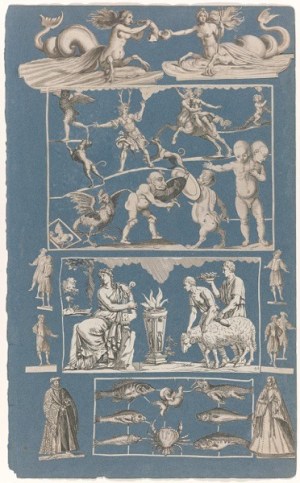
Blue album sheet with cut out prints of various printmakers, ca. 1690–1720
The scholarly research on early modern printmaking has evolved from a focus on the Romantic concept of the Peintre-Graveur to studies of artists and printmakers in their specific cultural and socioeconomic context. In addition, the idea that publishers played a vital role in artistic, commercial, and organisational aspects of printmaking is now widely accepted. Both art-historical and art-technical research on these matters have resulted in reference works and exhibition catalogues of high standard. In these studies, however, the position of the consumer has often been ignored or dealt with only briefly. In addition, print collections in the past have often failed to recognise the importance of contemporary adaptations, signs of usage, and collecting conditions.
However, for a proper understanding of early modern culture, it is crucial to study the consumption of printed images and the socioeconomic and artistic processes behind it. Prints were a widespread and artistically diverse medium and the creative process of a print did not stop after printing. Researching the creative afterlife of prints is therefore an essential development in the study of early modern visual culture. Although the consumption and reception of early modern books has received increasing attention in the past decades, only some scholars such as Peter Schmidt (Gedruckte Bilder in handgeschriebenen Büchern. Zum Gebrauch von Druckgraphik im 15. Jahrhundert, 2003), Jan van der Waals (Prints in the Golden Age: From Art to Shelf Paper, 2006), Kathryn Rudy (Virtual Pilgrimages in the Convent: Imagining Jerusalem in the Late Middle Ages, 2011), and Suzanne Karr Schmidt (Altered and Adorned: Using Renaissance Prints in Daily Life, 2011) have integrated the consumer’s side of the print market and the concrete use of prints in their research.
In order to stimulate this promising evolution, the Rijksmuseum Amsterdam is organising an international conference on early modern prints, ranging from precious artistic prints that were carefully collected to cheap printed images that were used and discarded. Paragons and Paper Bags: Early Modern Prints from the Consumer’s Perspective will take place at the Rijksmuseum on Thursday 9 June 2016. The aim of this symposium is to further develop this new approach in order to achieve new insights on target audiences, the application and usage of prints, and special collection practices.
The organisers particularly welcome object-based proposals regarding printed pictorial material or written primary sources. Topics for discussion may include, but are not limited to:
Techniques
• Prints with particular engraving or printing techniques, colouring, or multi-sheet compositions, resulting in a special visual or practical experience
Usage and manipulation
• Prints that were applied to objects, furniture or walls
• Prints that were altered by the consumer, deviating from the printmaker’s intentions such as censoring, colouring, and cutting
• Manuscripts and printed books in which prints were added and integrated
• Prints as a source of inspiration for other forms of art
• Prints depicted on other works of art
• Printed primary sources or archival documents on the intended use of specific prints
Target audiences and collection practices
• Print albums that reveal particular contemporary collection practices or the target market for specific prints or print genres
• Prints or primary sources on prints that were created on the initiative of a private individual or professional organisation with a particular purpose in mind
• The appreciation and appraisal of specific prints and printed oeuvres
• Printed primary sources or archival documents on the consumers of early modern prints
• Printed primary sources or archival documents on target audiences of specific prints
The organisation will consider proposals for 20-minute papers, presenting the findings of new or ongoing research. The application, consisting of a proposal abstract (maximum 300 words and an image) and a concise curriculum vitae, should be sent to j.luyckx@rijksmuseum.nl before 1 March 2016. The final program of the conference will be announced later that month.
Scientific Committee
Thomas Döring (Herzog Anton Ulrich-Museum, Braunschweig), Erik Hinterding (Rijksmuseum Amsterdam), Huigen Leeflang (Rijksmuseum Amsterdam), Ger Luijten (Fondation Custodia, Paris), Jeroen Luyckx (Rijksmuseum Amsterdam/ Illuminare – University of Leuven), Mark McDonald (The Metropolitan Museum of Art, New York), Jane Turner (Rijksmuseum Amsterdam), An Van Camp (Ashmolean Museum, Oxford), Peter van der Coelen (Museum Boijmans Van Beuningen, Rotterdam), Jan Van der Stock (Illuminare – University of Leuven), Joris Van Grieken (Royal Library of Belgium, Brussels), Joyce Zelen (Rijksmuseum Amsterdam/ Radboud University Nijmegen)
Exhibition | Body Image in French Art and Visual Culture
From Harvard Art Museums:
Body Image in French Art and Visual Culture, 18th and 19th Centuries
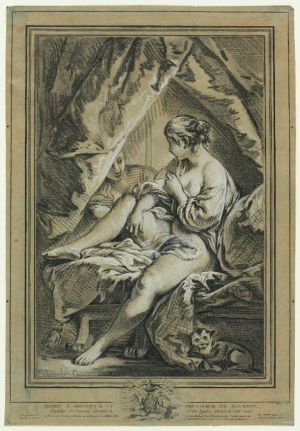
Louis-Marin Bonnet, after François Boucher, Young Woman in Bed / Figure de femme sur un lit, 1767, crayon manner etching printed in black and white on blue paper, 43.5 x 29.9 cm. Signed: L. Bonnet sculp. (Cambridge: Harvard Art Museums/Fogg Museum, M14332)
The goal of this installation is to consider the role of different artists and mediums (drawing, sculpture, print) in producing the modern understanding of the body. Spanning the period from rococo to post-impressionism, the installation addresses the issues of artistic instruction, the formation of gender and sexual identity and ethnic/racial stereotypes, the representation of history and modern life, the political and social critique, and the subjective vision. The 20 works on view include drawings by Degas and Seurat; prints by Gauguin, Manet, and Toulouse-Lautrec; and a bronze sculpture by Rodin.
This installation complements a course taught by Ewa Lajer-Burcharth, the William Dorr Boardman Professor of Fine Arts. The University Teaching Gallery serves faculty and students affiliated with Harvard’s Department of History of Art and Architecture. Semester-long installations are mounted in conjunction with undergraduate and graduate courses, supporting instruction in the critical analysis of art.
Display | A Room for Damascus
This posting is about nine months late, but the display is still on view at the V&A:
A Room from Damascus
Victoria & Albert Museum, London, 17 April 2015 — 15 April 2016
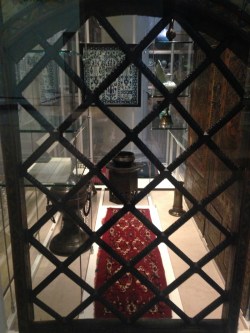 In the 18th century, the main reception rooms in Syrian upper-class houses began to be highly decorated with colourful painted wooden panelling. These rooms were the focus of hospitality, but the objects displayed there also announced a family’s wealth and status. When cities began to modernise in the late 19th century, many of these decorative interiors were removed for sale. The V&A was the earliest western collection to acquire one. This display will present some of the panelling and a selection of the objects that once dressed this room.
Mariam Rosser-Owen, the curator responsible for the Arab World collections at the V&A, provides a blog posting, available here, on the installation of the display.
Her earlier posting details the history of the room as it came to the V&A.










leave a comment