Study Day | Maria Hadfield Cosway
This colloquium accompanies a two-day conference (16-17 October) held in Bergamo on Luigi Marchesi, the international castrato singing superstar, who was portrayed by Richard Cosway in London and who had a close musical friendship with Maria Cosway in both London dung the late 1780s and in northern Italy during the early 1790s. From the flyer:
Maria Hadfield Cosway: Musa e benefattrice nell’età di Luigi Marchesi (1754–1829)
Fondazione Maria Cosway, Lodi, 18 October 2015
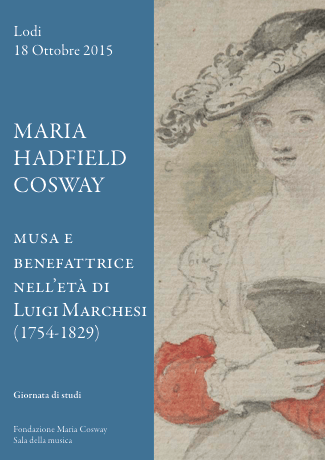 10.00 Saluti istituzionali: Francesco Chiodaroli (Fondazione Maria Cosway, Lodi), Angelo Bianchi (Università Cattolica del Sacro Cuore, Milano), Gabriella Molina (Fondazione Ospedale Marchesi, Inzago)
• Riccardo Benzoni, Napoleone a scuola: rinnovamento dell’istruzione e celebrazione del potere negli anni del Primo Impero (1804–1814)
• Cristina Cenadella, «Figlie di tutti sono le figlie di nessuno». L’orfanotrofio della Stella di Milano e le scuole di formazione interne
• Laura Giuliacci, Donne e società in Italia e in Francia ai tempi di Maria Cosway: l’educazione distinta
• Giliola Barbero, L’Europa di Maria Cosway nella sua biblioteca.
13.00 Pausa pranzo
14.30 Sessione pomeridiana
• Rosa Cafiero, L’insegnamento della musica nel Collegio delle dame inglesi: modelli europei per Maria Cosway
• Stephen Lloyd, ‘Wonderment for the table-talk of the town’: Regency London’s social and artistic context for Richard Cosway’s portrait of Luigi Marchesi (1790)
• Stefano Aresi, «If you want to hear what Italian Singing is, come to London»: Marchesi, Londra e il rapporto con Maria Cosway
16.00 Presentazione volume
Gian Carlo Sciolla presenta il nuovo volume di Tino Gipponi, La veridica storia di Maria Hadfield Cosway e il ritratto ritrovato (Lodi: PMP Editore, 2015).
Conference | Luigi Marchesi: Career of a Castrato
From the conference flyer (with more information about The Luigi Marchese project available here). . .
Luigi Marchesi (1754–1829): “L’ Oceano dei soprani” carriera di un evirato cantore
Casa Natale di Gaetano Donizetti, Bergamo, 16-17 October 2015
1 6 O T T O B R E 2 0 1 5
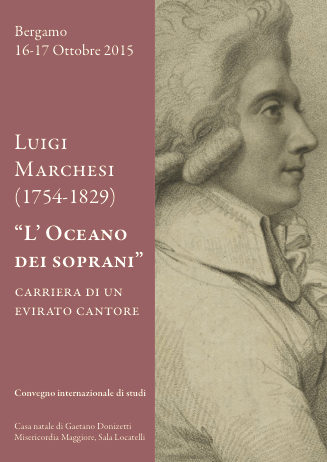 14.00 Apertura dei lavori
Interventi di benvenuto ed introduzione
• Damien Colas (Centre National de la Recherche Scientifique), Alla ricerca delle esecuzioni perdute: come far rivivere oggi l’arte di Luigi Marchesi?
• Lorenzo Mattei (Università degli Studi ‘Aldo Moro’, Bari), La mia Cecchina è un castrato! L’opera buffa degli evirati cantori
• Teresa M. Gialdroni (Università di Roma ‘Tor Vergata’)
• Giulia Giovani (Centro Studi sulla Cantata Italiana), Luigi Marchesi a Roma: echi nella stampa coeva
• Paola De Simone (Conservatorio ‘C. G. da Venosa’, Potenza), Mito e storia per una voce alla corte di Napoli: Luigi Marchesi nei ruoli di Amore e Arbace nella stagione 1780–1781 al Real Teatro di San Carlo
• Lucio Tufano (Napoli), Marchesi in concerto
• Nastasja Gandolfo (Hochschule für Musik, Würzburg), Il ruolo di Luigi Marchesi nell’Ezio di Josef Mysliveček per la corte elettorale di Monaco (1777)
• Annarita Colturato (Università degli Studi di Torino), Luigi Marchesi musico soprano a corte
• Luca Benedetti (Bergamo)
• Federico Zavanelli (Cremona), Comunicazioni bibliografiche: aggiornamenti da Bergamo e Londra
18.00 Villa Facheris, Inzago, Milano
Aperitivo presso la Villa Facheris e visita alla mostra ivi dedicata a Marchesi. Visita della villa appartenuta al cantante. Cena dei convegnisti e degli sponsor presso il ristorante Enotavola Pietra- santa in Treviglio (Bergamo).
1 7 O T T O B R E 2 0 1 5
9.30 Presiede: Giulia Giovani
• Nicholas Baragwanath (University of Nottingham), Alla ricerca dell’arte d’improvvisare di Marchesi: le revisioni per il debutto londinese nel ruolo di Giulio Sabino (1788)
• Simone Laghi (University of Cardiff), Le esibizioni di Luigi Marchesi a Londra (1788-1790): i castrati e il true taste
• Giovanni Polin (Conservatorio ‘C. G. da Venosa’, Potenza), «Sempre uguale a sé stesso nel dilettare e sorpren- dere»: note sulla carriera veneta di Luigi Marchesi
• Marilena Laterza (Università degli Studi di Milano), «Arietta grata che intorno spiri»: Luigi Marchesi compositore
• Livio Aragona (Fondazione Donizetti, Bergamo)
• Rosa Cafiero (Università Cattolica del Sacro Cuore, Milano), Da Lodoiska a Lovinski: Camilla Balsamini nei panni di Marchesi
• Giacomo Sances (Università di Roma ‘Tor Vergata’), «Il nostro amicone Zingaro deve essere superbo d’un così bravo scolare». Luigi Marchesi e il suo «veridico sentimento» per Bellini
15.00 Presiede: Claudio Toscani (Università degli studi di Milano)
• Marco Beghelli (Università degli Studi di Bologna), «Nella sua voce fa sentire tre voci diverse»: la voce multipla dei castrati
• Roberto Scoccimarro (Hochschule für Musik und Tanz, Köln), Luigi Marchesi nel ruolo di Achille: Ifigenia in Aulide e Achille in Sciro
• Paolo Russo (Università degli Studi di Parma) Marchesi, il ‘disertore’
• Livio Marcaletti (Universität Bern), Le «variazioni» di Luigi Marchesi: trascrizioni di un’esecuzione o esercizi didattici?
• Stefano Aresi (Stile Galante, Amsterdam), Gli abbellimenti vocali di Luigi Marchesi: possibili approcci alle fonti
Lecture | Kathleen Wilson, Performing ‘The Wonder’ in Sumatra
Next month at The Newberry:
Kathleen Wilson, Performing The Wonder in Sumatra:
East India Company Peripheries and the History of Modernity
The Newberry Library, Chicago, 17 October 2015
Registration due by October 16
How did theatrical performance work to stage larger English encounters with alterity in far-flung colonial sites? Professor Wilson will examine that question from the point of view of colonial residents of Sumatra and Saint Helena, who used English theatrical and social performances to reflect upon their own presence and status as agents of British modernity.
One such entrepreneur, East India Company Secretary William Marsden, wrote an epilogue to a staging of The Wonder at Fort Marlborough that reflected upon the temporal and cultural politics of British imperial rule in ways that anticipated his History of Sumatra, a work that stages English and Malay culture as part of a narrative of ‘world history’ that Britain had inaugurated.
Kathleen Wilson is Past President of the American Society for Eighteenth Century Studies. Her scholarship addresses issues of identity and difference in eighteenth-century Britain and empire. In addition to numerous peer-reviewed articles, her books include The Sense of the People: Politics, Culture and Imperialism in England, 1715–1785; The Island Race: Englishness Empire and Gender in the Eighteenth Century; A New Imperial History: Culture, Identity and Modernity in Britain and the Empire 1660–1840; and Strolling Players of Empire: Theatre, Culture and Modernity in the English Provinces. She is a series editor of Critical Perspectives on Empire for Cambridge University Press and has been awarded fellowships from the John Simon Memorial Guggenheim Foundation, the National Endowment for the Humanities, the American Council of Learned Societies, and the Huntington Library, among others.
Saturday, October 17, 2015, 1:00pm, Towner Fellows Lounge, with a reception to follow the seminar.
Center for Renaissance Studies Programs and Eighteenth-Century Seminar
Organized by Timothy Campbell, University of Chicago; Lisa A. Freeman, University of Illinois at Chicago; Richard Squibbs, DePaul University; and Helen Thompson, Northwestern University.
This program is free and open to the public, but space is limited and registration in advance is required. Register online here. Registrations will be processed through 10:00am Friday, October 16.
New Book | The Hanoverian Succession
From Ashgate:
Andreas Gestrich and Michael Schaich, eds., The Hanoverian Succession: Dynastic Politics and Monarchical Culture (Farnham: Ashgate, 2015), 304 pages, ISBN: 978-1472437655, $135.
 The Hanoverian succession of 1714 brought about a 123-year union between Britain and the German electorate of Hanover, ushering in a distinct new period in British history. Under the four Georges and William IV Britain became arguably the most powerful nation in the world with a growing colonial Empire, a muscular economy and an effervescent artistic, social and scientific culture. And yet history has not tended to be kind to the Hanoverians, frequently portraying them as petty-minded and boring monarchs presiding over a dull and inconsequential court, merely the puppets of parliament and powerful ministers. In order both to explain and to challenge such a paradox, this collection looks afresh at the Georgian monarchs and their role, influence and legacy within Britain, Hanover and beyond.
Concentrating on the self-representation and the perception of the Hanoverians in their various dominions, each chapter shines new light on important topics: from rivalling concepts of monarchical legitimacy and court culture during the eighteenth century to the multi-confessional set-up of the British composite monarchy and the role of social groups such as the military, the Anglican Church and the aristocracy in defining and challenging the political order. As a result, the volume uncovers a clearly defined new style of Hanoverian kingship, one that emphasized the Protestantism of the dynasty, laid great store by rational government in close collaboration with traditional political powers, embraced army and navy to an unheard of extent and projected this image to audiences on the British Isles, in the German territories and in the colonies alike. Three hundred years after the succession of the first Hanoverian king, an intriguing new perspective of a dynasty emerges, challenging long held assumptions and prejudices.
Andreas Gestrich is Director of the German Historical Institute London. His present research interests comprise the history of family, childhood and youth, the history of poverty and poor relief, media history and the social history of religious groups. His publications include, among others, Absolutismus und Öffentlichkeit: Politische Kommunikation in Deutschland zu Beginn des 18. Jahrhunderts (1994), Familie im 19. und 20. Jahrhundert (1999) and (ed. with Christiane Eisenberg) Cultural Industries in Britain and Germany: Sport, Music and Entertainment from the Eighteenth to the Twentieth Century (2012).
Michael Schaich is Deputy Director of the German Historical Institute London. His current research focuses on the symbolic representation of the British monarchy and state during the seventeenth and eighteenth centuries. His publications include Staat und Öffentlichkeit im Kurfürstentum Bayern der Spätaufklärung (2001), (ed.) Monarchy and Religion: The Transformation of Royal Culture in Eighteenth-Century Europe (2007) and (ed. with R.J.W. Evans and Peter H. Wilson) The Holy Roman Empire, 1495–1806 (2011).
◊ ◊ ◊ ◊ ◊
C O N T E N T S
1 Introduction, Michael Schaich
I. Dynastic Legacies
2 The Hanoverian Monarchy and the Legacy of Late Stuart Kingship, Ronald G. Asch
3 The House of Brunswick-Lüneburg and the Holy Roman Empire: The Making of a Patriotic Dynasty, 1648–1714?, Martin Wrede.
II. Representing Protestantism
4 George I, the Hanoverian Succession, and Religious Dissent, David Wykes
5 Hanover-Britain and the Protestant cause, 1714–1760, Andrew C. Thompson
6 The Hanoverians and the Colonial Churches, Jeremy Gregory
III. Image Policies
7 The Hanoverian Monarchy and the Culture of Representation, Tim Blanning
8 ‘Every Inch Not a King’: The Bodies of the (First Two) Hanoverians, Robert Bucholz
9 Monarchy, Affection and Empire: The Hanoverian Dynasty in Eighteenth-Century America, Brendan McConville
10 Visions of Kingship in Britain under George III and George IV, G.M. Ditchfield
IV. Contested Loyalties
11 The Hanoverian Succession and the Politicisation of the British army, Hannah Smith
12 Jacobitism and the Hanoverian Monarchy, Gabriel Glickman
13 The Alternative to the House of Hanover: The Stuarts in Exile, 1714–1745, Edward Corp
14 Radical Popular Attitudes to the Monarchy in Britain during the French Revolution, Amanda Goodrich
Index
Call for Papers | Gillray after Gillray: Echoes and Influences
From H-ArtHist:
Gillray after Gillray: Echoes and Influences in Rude Britannia, Then and Now
Institut national d’histoire de l’art, Paris, 29 January 2016
Proposals due by 15 October 2015
The year 2015 witnessed a number of exhibitions and conferences devoted to James Gillray’s bicentenary and the artist’s graphic work. But Gillray after Gillray is a study day aimed at discussing Gillray’s posterity and visual heritage across several areas of British and European culture in the course of a century. British caricaturists frequently claim to work in the wake of Gillray’s satirical spirit (Ralph Steadman, Gerald Scarfe, Martin Rowson, Steve Bell) and as such manifest their debt to the artist’s approach to the body and to politics. Other artistic forms, on the other hand, may be derived from the Georgian era but in a less obvious manner, for instance, The Chapman Brothers’ envisioning of Capricios is indebted to Goya’s series, but the title Like a Dog Returns to its Vomit twice appears to be closer to motifs such as digestive discomforts and uncontrolled regurgitation recurrently exploited by Gillray in his prints and drawings. Looking at graphic afterlives and avatars of Gillray’s caricatures and his particularly vitriolic sense of satire is also an opportunity to extend current critical views from editorial cartooning and contemporary art onto a whole range of satirical forms in mass media. Issues that may be raised, though not exclusively so, may range from art-historical approaches to case studies of post Georgian era reception.
Submissions are invited that engage with examples of graphic satire dating from any point across the last 250 years and that address the following questions, among others:
• What traces of Gillray can be identified in contemporary painting, installation art, video or even TV?
• How can we engage with the notion of morbid comic as for instance demonstrated in the works of the Young British Artists?
• Public space and the aesthetics of graphic satire
• Politeness, decorum and Rude Britannia from 1790 to nowadays
• British tabloids as part of Gillray’s influence and heritage
• What exactly is « rude » in British visual and mass media culture?
• How far can Gillray be viewed as a founding father of a specific approach to visual satire?
• Art, visual satire as something deliberately spectacular and shocking
• Art, commerce and visual satire then and now
Please send proposals (of no more than 250 words) for 20-minute papers to Brigitte Friant-Kessler and Morgan Labar before 15 October 2015. This study day will be held in French and English.
Brigitte Friant-Kessler
Maître de conférences en langues et cultures anglophones
CALHISTE EA 4343
Université de Valenciennes
Brigitte.Friant-Kessler@univ-valenciennes.fr / b.friant@free.fr
Morgan Labar
Doctorant contractuel en Histoire de l’art (ED441)
HiCSA, Université Paris 1 Panthéon-Sorbonne
morganlabar@gmail.com
Symposium | Penser le Rococo, XVIIIe–XXIe siècles
From the symposium programme:
Penser le Rococo (XVIIIe–XXIe siècles) / Reconsidering the Rococo
Université de Lausanne, 5–6 November 2015
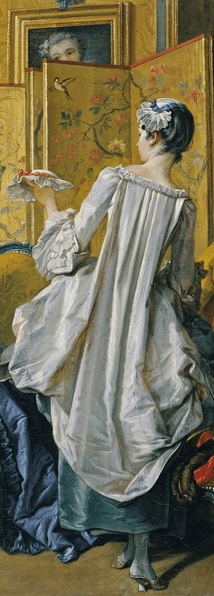 Le rococo, en dépit de la méfiance ou de l’ironie qu’il suscite, occupe une place centrale dans l’historiographie. En tant que catégorie stylistique et critique, il structure notre appréhension de l’art du XVIIIe siècle et détermine le regard que l’on porte sur celui-ci. Ce colloque, conçu en écho aux stimulantes recherches de ces vingt dernières années sur le rococo, vise à développer une réflexion épistémologique sur une notion protéiforme. La perspective privilégée pour ce colloque est celle, critique, de l’étude d’une notion devenue catégorie, le rococo, appelant à réfléchir sur son apparition, sa sédimentation, sa diffusion. Quelles sont les premières formulations de ce terme ? Sur quels présupposés se fonde-t-il ? Comment devient-il un canon formel et esthétique ? De quelles sources se nourrit-il ? En fonction de quels enjeux établit-on les frontières et les corpus du rococo ? Comment la situation d’énonciation des exégètes, aux XIXe, XXe et XXIe siècles, a-t-elle orienté la mise en récit de son histoire ? Comment les idées véhiculées dans leurs travaux agissent-elles sur la production tardive d’objets imitant le XVIIIe siècle ? Comment ces revivals agissent-ils en retour sur notre compréhension du rococo ?
Despite the scepticism or irony which it provokes, the notion of the Rococo occupies a central position within the historiography of 18th-century art. It structures our understanding of this epoch and determines the way in which we see it. This symposium, planned as an answer to the stimulating research of the last twenty years on the Rococo, aims at an epistemological reflection on a protean notion which was progressively defined as a style during the 19th century. This symposium therefore favours a critical approach to this notion, urging contributors to reconsider how it emerged, how it was formed and diffused. What were the first manifestations of the Rococo, on what preconceived ideas was it founded, and how did it become a formal and aesthetic canon? Which sources did it draw upon? What ideas and categories have been used to structure it? How were the boundaries of the Rococo established? How has the context in which interpreters have written about the Rococo oriented the formulation of narratives during the 19th, 20th and 21st centuries? How have the ideas upon which their work is founded inflected the production of imitations of 18th-century objects? How have these revivals, in turn, acted upon our understanding of the Rococo?
Organisation scientifique
Carl Magnusson (Université de Lausanne)
Marie-Pauline Martin (Aix-Marseille Université, UMR 7303 TELEMME-CNRS)
Comité scientifique
Jan Blanc (Université de Genève), Frédéric Dassas (Musée du Louvre), Michaël Decrossas (INHA, Paris), Peter Fuhring (Fondation Custodia, Paris), Christian Michel (Université de Lausanne)
Organisation logistique et contact
Geneviève Dutoit (Université de Lausanne) / genevieve.dutoit@unil.ch
◊ ◊ ◊ ◊ ◊
J E U D I , 5 N O V E M B R E 2 0 1 5
8.30 Accueil
8.45 Introduction par Carl MAGNUSSON et Marie-Pauline MARTIN
9.00 1 | Les champs du rococo, du décor à la sculpture
Président de séance : Peter Fuhring
• Carl MAGNUSSON (Université de Lausanne)—Le rococo, style «décoratif» par excellence
• David PULLINS (Harvard University)—«Quelques misérables places à remplir» : locating chantourné painting in eighteenth-century France
• Malcolm BAKER (University of California)—Reconsidering ‘Rococo’ sculpture
14.00 2 | Pertinence d’une catégorie ?
Président de séance : Frédéric Dassas
• Fabrice MOULIN (Université de Paris X-Nanterre)—Les « mauvais choix » en art et en amour : le rococo mis en fiction dans L’homme du monde éclairé par les arts (1773)
• Marie-Pauline MARTIN (Université d’Aix-Marseille)—Du sobriquet à la catégorie de style
• Floriane DAGUISÉ (Université de Paris-Sorbonne)—De l’usage du rococo dans la recherche en littérature
• Elisabeth FRITZ (Friedrich-Schiller-Unversität Jena)—La fête galante : un genre paradigmatique dans le discours ambigu du rococo
V E N D R E D I , 6 N O V E M B R E 2 0 1 5
9.00 3 | Mécanismes et composantes du rococo
Présidence de séance : Cyril Lécosse
• Bérangère POULAIN (Université de Genève)—Rococo et fugacité du regard: émergence et modifications de la notion de ‘papillotage’ (XVIIIe–XXIe siècle)
• Melissa HYDE (University of Florida)—Déjà-vu All Over Again ? Rococo, Then and Now
• Aleksandra WOJDA (Université Jagellon, Cracovie)—Du romantique au penseur d’un rococo moderne : Gautier et les ambiguïtés de la concrétion esthétique
14.00 4 | Les géographies éclatées du rococo
Président de séance : Christian Michel
• Jean-François BÉDARD (Syracuse University)—Fiske Kimball, diffuseur de la rocaille
• Étienne TORNIER (Université de Paris X-Nanterre / University of Minnesota)—Rococo revival ou l’élaboration du goût et du style américain (1850–1900)
• Raul C. SAMPAIO LOPES (Seoul National University)—Ce que l’historiographie des manifestations périphériques du rococo nous dit sur la construction de cette notion stylistique
17.30 Discussion et conclusions
Symposium | Asian Gardens in the West
From the symposium website:
Asian Gardens in the West
Haus der Universität Düsseldorf and Benrath Palace, Düsseldorf, 1–3 October 2015
Organized by the Department of Japanese Studies, University of Düsseldorf, and the Benrath Palace and Park Foundation
Many people in the West believe that Asian gardens are mystic places indicating a very special and subtle understanding of nature and a refined aestheticism. The symposium traces the history of these notions back to the 18th and 19th centuries and shows how Western and Asian pundits, gardeners and officials together created these visions of Asian gardens. We also ask about current trends in building and interpreting Asian gardens in the West.
 Japanese gardens come to mind as a prime example of Asian gardens in the West as they are one of the strongest symbols for Japan. Their long-lasting fashion started in the second half of the 19th century because Japanese governments used gardens to represent the country at world’s fairs, albeit with no clear comprehension of the concept of a ‘Japanese garden’. Only through the international appreciation did the Japanese begin to fully understand the merit of gardens for self-representation. As a consequence Japanese garden experts created a canonized idea of the aesthetic arrangement of Japanese gardens.
However, Japanese gardens are not the only example of the spatial staging of a national Asian identity. Already in the 18th century, Chinese garden art had become fashionable in Europe. Yet Chinese gardeners and garden experts were only very marginally involved in this vogue. Western garden enthusiasts—mostly aristocrats—built Chinese gardens following accounts of Asia which were written by Jesuits and merchants. In the last three to four decades many Chinese gardens have been built in North America and Europe once again.
As leading Asian countries, China and Japan are role models for self-representation through cultural diplomacy. Thus Chinese and Japanese gardens incite other Asian countries as well as Western garden experts to build Korean, Indonesian and Indian gardens.
◊ ◊ ◊ ◊ ◊
1 O C T O B E R 2 0 1 5
13:30 Introduction
14:00 Address by Vice President for International Relations, Andrea von Hülsen-Esch
14:20 Stefan Schweizer, Gardens and National Stereotypes
15:15 Panel I | China / The Representation of Asian Gardens in Asia
• James Bartos, China, Chinoiserie, and the English Landscape Garden Revisited
• Bianca Maria Rinaldi, The Invention of the Chinese Garden
• Christof Baier, Heritage Gardens: Singapore’s Asian Garden Representation at Gardens by the Bay as Third Space?
2 O C T O B E R 2 0 1 5
9:00 Excursion to the Japanese Garden in Leverkusen
13:30 Panel II | India
• Karin Seeber, Imaginary Gardens: Marie Luise Gothein’s Book on Indian Garden History (1926)
• Henry J. Noltie, The Indian Career of Hugh Cleghorn (1820–1895): Economic Botany and the Transfer of Knowledge through Botanical Gardens
15:30 Panel III | Japanese Gardens
• Wybe Kuitert, Context and Praxis: Thoughts on Japan and Gardens
• Tagsold, Christian, Japanese Gardens Unleashed: From Miniatures to Advertising
19:30 Keynote Lecture
John Dixon Hunt, Questions of Authenticity
3 O C T O B E R 2 0 1 5
10:00 Panel IV | Representing Japanese Gardens
• Katahira Miyuki, Constructing the Image of Japanese Gardens:
Analysis of the Discourse on Japanese Gardens in Japan and the West
• Elisabeth Scherer, Elaborate ‘Contact Spaces’: Staging Japanese gardens for Cinema
12:00 Final discussion
Abstracts are available here»
New Book | Scenes of Projection: Recasting the Enlightenment Subject
From the University of Minnesota Press:
Jill H. Casid, Scenes of Projection: Recasting the Enlightenment Subject (Minneapolis: University of Minnesota Press, 2014), 328 pages, ISBN: 978-0816646692 (cloth), $83 / ISBN: 978-0816646708 (paper), $28.
 Theorizing vision and power at the intersections of the histories of psychoanalysis, media, scientific method, and colonization, Scenes of Projection poaches the prized instruments at the heart of the so-called scientific revolution: the projecting telescope, camera obscura, magic lantern, solar microscope, and prism. From the beginnings of what is retrospectively enshrined as the origins of the Enlightenment and in the wake of colonization, the scene of projection has functioned as a contraption for creating a fantasy subject of discarnate vision for the exercise of ‘reason’.
Jill H. Casid demonstrates across a range of sites that the scene of projection is neither a static diagram of power nor a fixed architecture but rather a pedagogical setup that operates as an influencing machine of persistent training. Thinking with queer and feminist art projects that take up old devices for casting an image to reorient this apparatus of power that produces its subject, Scenes of Projection offers a set of theses on the possibilities for felt embodiment out of the damaged and difficult pasts that haunt our present.
Jill H. Casid is professor of visual studies at the University of Wisconsin–Madison. She is the author of Sowing Empire:
Landscape and Colonization (Minnesota, 2005).
◊ ◊ ◊ ◊ ◊
C O N T E N T S
Introduction: Shadows of Enlightenment
1 Paranoid Projection and the Phantom Subject of Reason
2 Empire through the Magic Lantern
3 Empire Bites Back
4 Along Enlightenment’s Cast Shadows
5 Following the Rainbow
Conclusion: Queer Projection, Theses on the ‘Future of an Illusion’
Acknowledgments
Notes
Index
Exhibition | The Italian Travels of Louis-François Cassas
Opening in November at the Musée des Beaux-Arts:
Voyages en Italie de Louis-François Cassas (1756–1827)
Musée des Beaux-Arts, Tours, 21 November 2015 — 22 February 2016
 Louis-François Cassas compte parmi les grands artistes voyageurs du XVIIIe siècle. L’exposition dévoile ici les dessins de l’artiste réalisés lors de son Grand Tour en Italie. Cette manifestation s’inscrit dans le thème transversal et séduisant du voyage et de l’Italie dans toute sa diversité archéologique, urbaine, insulaire… à la fin du Siècle des Lumières. La découverte récente de nombreux dessins inédits en Angleterre est venue confirmer l’opportunité de cette exposition : cinquante dessins prêtés par le National Trust et provenant de la collection du marquis de Bristol à Ickworth (Suffolk) seront montrés pour la première fois en France.
L’exposition s’articulera autour des deux grands voyages en Italie de L.-F. Cassas et de ses différents mécènes tous grands amateurs et collectionneurs, à l’origine de l’évolution de la carrière de l’artiste. Parmi les 116 œuvres exposées figurent des prêts de musées français et étrangers prestigieux : Paris : Bibliothèque Mazarine, Bibliothèque Nationale, Ecole Nationale Supérieure des Beaux-Arts, Fondation Custodia / New-York : Metropolitan Museum of Art / Londres : Victoria and Albert Museum, The National Trust : Ickworth (Suffolk), The Bristol Collection / Cologne : Wallraf-Richartz Museum / Vienne : Albertina Museum, et de collections privées.
Le premier voyage en Italie, 1778–83
Le Grand Tour pour le plaisir de dessiner
Grâce au mécénat du duc de Chabot, Cassas découvre l’Italie et peut obtenir une chambre d’externe à l’Académie de France à Rome. Seront évoquées les grandes étapes de cette pérégrination : Lyon, Genève, les Alpes, Bologne, Parme, Rome, Naples, Paestum… Invité à Venise au printemps 1782, puis à Trieste par le Baron Pittoni, Cassas travaille alors pour l’Empereur Joseph II jusqu’aux frontières de l’Empire ottoman. À l’automne 1782, Cassas part en Sicile travailler pour l’abbé de Saint-Non. Ses vues de Messine, de Catane, du Val di Noto… seront particulièrement remarquées.
Le second voyage en Italie, 1787–92
Les années romaines d’un artiste indépendant
Le nouveau mécène de Cassas, le comte de Choiseul- Gouffier (1752–1817), ambassadeur de France à Constantinople, permit à l’artiste de découvrir les provinces de l’Empire ottoman de 1784 à 1786. Désormais c’est dans son atelier à Rome, Piazza di Spagna, que Cassas accroche ses aquarelles de Palmyre, du Caire, de la Corne d’Or, de Chypre… qui suscitent l’admiration, notamment celle de Goethe, et des amateurs qui font le Grand Tour. Trois maquettes de monuments romains, provenant de la collection de Cassas, restaurées pour l’exposition : le Temple de la Fortune Virile, le Temple de Tivoli et l’Arc de Constantin, seront exceptionnellement présentées.
The catalogue will be available from Artbooks.com:
Sophie Join-Lambert, Louis-François Cassas (1756–1827): Ses Voyages en Italie et Ses Mécènes (Milan: Silvana Editoriale, 2015), 280 pages, ISBN: 978-8836631636, $65.
V&A Names Antonia Boström as Keeper of SMCG Department
V&A press release (15 September 2015). . .
 The V&A is pleased to announce that Antonia Boström, currently Director of Curatorial Affairs at the Nelson-Atkins Museum in Kansas City, USA, will join the Museum in January 2016 as Keeper of the Sculpture, Metalwork, Ceramics and Glass Department.
Paul Williamson, Keeper of the Sculpture, Metalwork, Ceramics and Glass (SMCG) Department since 2001, retires from the V&A in early 2016. This will follow a distinguished 37-year career at the Museum during which he also took on the roles of Director of Collections (2004–7) and Acting Deputy Director (2013).
As one of the six most senior curatorial roles in the Museum, the Keeper manages the Sculpture, Metalwork, Ceramics and Glass Department, and is responsible for promoting research, knowledge and enjoyment of the collection of over 110,000 objects reflecting European history and design. The department is in charge of several of the most visited and important galleries in the V&A, including the Medieval & Renaissance Galleries, The Cast Courts, the Hintze Galleries of British Sculpture, the Jewellery Gallery, the Sacred Silver and Stained Glass Gallery, the Silver Galleries, and the Ceramics and Glass Galleries.
Martin Roth, Director of the V&A said: “Paul Williamson has made a magnificent contribution to the V&A during his impressive career here. His loyalty in serving the Museum is unparalleled and we thank him warmly for all that he has done. We look forward to welcoming another world-leading expert, Antonia Boström, who brings with her significant scholarship and a wealth of experience across world-class collections including the J. Paul Getty Museum in Los Angeles, the Nelson-Atkins Museum in Kansas and the Detroit Institute of Arts back to the V&A where she began her career.”
Paul Williamson said: “I’ve been hugely privileged to work at the V&A for so long, to be responsible for a large part of its internationally-important collections and to be surrounded by brilliant and committed colleagues, both inside and outside the Museum; and it will be a great pleasure to continue this connection as Keeper Emeritus and Honorary Senior Research Fellow. I’m delighted to welcome Antonia Boström as my successor, and wish her every success in the years ahead.”
Antonia Boström said: “Having spent the last 19 years in the United States, I am extremely excited to be returning to the V&A, the museum where I first trained as a curator and whose collections are so meaningful to me. The V&A is at an important moment in its history; it is thrilling to witness its astonishing achievements over the last several years and to look forward to future projects. I look forward to contributing to those important initiatives and to leading a department of curators widely recognized as among the foremost experts in their fields.”
Paul Williamson has been Keeper of the Sculpture, Metalwork, Ceramics & Glass Department at the V&A since 2001 and was Director of Collections, 2004–7, and Acting Deputy Director in 2013. He joined the Museum in 1979 and was Chief Curator of Sculpture 1989–2001. He has published widely, principally on medieval art including the Pelican History of Art volume Gothic Sculpture 1140–1300 (Yale University Press, 1995) and, most recently, the V&A catalogues Medieval Ivory Carvings: Early Christian to Romanesque (2010) and Medieval Ivory Carvings 1200–1550 (the latter with Glyn Davies). He has been involved in the organisation of numerous exhibitions, including English Romanesque Art 1066–1200 (Hayward Gallery, 1984), Age of Chivalry: Art in Plantagenet England 1200–1400 (Royal Academy of Arts, 1987–88), Images in Ivory: Precious Objects of the Gothic Age (Detroit and Baltimore, 1997), Gothic: Art for England 1400–1547 (V&A, 2003–4), and Object of Devotion: Medieval English Alabaster Sculpture from the Victoria and Albert Museum, which toured to ten U.S. venues, 2010–14. He has served on many committees both inside and outside the V&A, has been Expert Adviser on Sculpture to the Reviewing Committee on the Export of Works of Art since 1989, was Vice-President of the Society of Antiquaries of London 1999–2003, and is a Trustee and Director of The Burlington Magazine. He is a Fellow of the Royal Historical Society.
Antonia Boström has been Director of Curatorial Affairs at the Nelson-Atkins Museum of Art, Kansas City, Missouri, USA since 2013. She was Senior Curator & Department Head, Sculpture & Decorative Arts Department, J. Paul Getty Museum, Los Angeles from 2004 to 2013, Assistant Curator, Department of European Sculpture and Decorative Art and research scholar at the Detroit Institute of Arts from 1996 to 2004 and previously held curatorial posts at the Royal Academy, London, 1995–96, V&A, 1980–85, and National Portrait Gallery in 1980. She has been involved with many exhibitions including Messerschmidt and Modernity (J. Paul Getty Museum, 2012); Cast in Bronze: French Sculpture from Renaissance to Revolution (J. Paul Getty Museum, Musée du Louvre and Metropolitan Museum of Art, 2009) and Magnificenza! The Medici, Michelangelo, and Art of Late Renaissance Florence (Florence, Palazzo Strozzi, Chicago, AIC, and Detroit Institute of Arts, 2002–4) as well as gallery installations including the sculpture and decorative arts galleries (J. Paul Getty Museum, 2006–10). She has written, edited and contributed to publications including Messerschmidt and Modernity (Getty Publications: Los Angeles, 2012), The Fran and Ray Stark Collection of 20th-Century Sculpture at the J. Paul Getty Museum (Getty Publications: Los Angeles, 2008) and The Encyclopedia of Sculpture, 3 vols. (Fitzroy Dearborn/Routledge: New York, 2004). She is fluent in five languages.










 Enfilade
leave a comment