Call for Papers | What Does Sculpture Do to a Garden? 17th–21st Century
From ArtHist.net, which includes the French version:
What Does a Sculpture Do to a Garden? What Does a Garden Do to a Sculpture?
Que fait une sculpture à un jardin? Que fait un jardin à une sculpture?, 17e–21e siècle
Musée Rodin, Paris, 6 June 2025
Proposals due by 31 March 2025

Edvard Munch, Le Penseur de Rodin dans le parc du Dr Max Linde à Lübeck, ca. 1907, oil on canvas, 143 × 98 cm (Paris: Musée Rodin).
Part of the 22nd edition of the Rendez-vous aux jardins taking place 6–8 June 2025 under the theme “Stone Gardens / Garden Stones,” the symposium is under the scientific direction of Emmanuelle Héran, Chief Curator and Head of Garden Collections at the Musée du Louvre. The event will be webcast live.
While closely linked since Antiquity, the relationship between sculpture and gardens was rekindled during the Renaissance. Rodin himself pondered this connection, as Paul Gsell recounts in Art: “Statues are usually placed in gardens to embellish them. For Rodin, gardens are here to adorn the statues. For him, Nature remains the supreme mistress, an infinite perfection.” And yet, works tracing the history of gardens often give little consideration to the statuary that inhabits them. Conversely, sculpture scholars rarely reflect on the unique setting of gardens, or on what a sculpture, in turn, can bring to a garden. In both fields, publications are frequently illustrated with tightly framed photographs of sculptures, isolating them as if displayed within a museum—or even entirely cut out from their surroundings. Yet, a garden is not a museum; it offers to three-dimensional works neither the neutrality of a ‘white cube’ nor even the illusion of a ‘green cube’ beneath an open sky.
Indeed, what could be more subject to change, more ephemeral, than a garden? As seasons pass, with the shifting hours of the day and the whims of the weather, the environment surrounding a sculpture is in constant flux. While there does exist a ‘museography’ for gardens—defined both as the art of displaying sculptures within them and as the composition of gardens incorporating sculpture—it has never been the subject of a comprehensive study. It is scarcely taught, neither to curators overseeing an ‘open-air sculpture museum’ nor to landscape architects and garden designers responsible for their creation and upkeep. In this regard, Louis Gevart’s dissertation broke new ground [1].
The question of meaning also arises. In royal and aristocratic parks and gardens, a sculptural ensemble may follow a coherent iconographic program, whose analysis reveals political intentions—such as the renowned Grande Commande of 1674 for Versailles. More often, however, groves and lawns host a disparate collection, whose coherence—if it ever existed—may have faded over time. The history of a collection displayed in a garden can mirror that of a museum. Yet it may also be entirely different, as the works placed in a garden are not necessarily commissioned pieces or first choices. Some may have arrived belatedly, by default, left outdoors for lack of a better option, or, when too damaged or vandalized, removed in haste.
It is thus possible that a restoration, conversion or ex nihilo creation project requires a landscape architect to address the difficult issue of sculptures. In the world of historical monuments, managing a set of statues does not always fall under the responsibility of the chief architect, but of a heritage curator. This separation of powers is worth examining: is it relevant or counterproductive? How can dialogue be established? The choice of materials, their adaptability and durability can all be considered. Site-specific works created in close collaboration with a garden can be cited, such as Giuseppe Penone and Pascal Cribier’s L’Arbre des voyelles in the Tuileries Gardens.
During the 20th century, sculpture parks and gardens—created with this intent—focused more on presenting a “living history of sculpture under construction” (Louis Gevart). Iconographic objectives may have been replaced by the production of a historical-stylistic narrative, without soliciting the help of a landscape architect. However, as the profound changes recently made to Middelheim Park in Antwerp and the recreation of entire programs at Stowe demonstrate, a return to iconographic coherence does seem to be taking place, in response to the public’s presumed expectations.
This symposium welcomes case studies of the same work in different sizes and materials, whose effect on a garden can be decisive for its composition or, on the contrary, become unremarkable. Think of copies of famous ancient sculptures—the Farnese Hercules, the Diana of Versailles—whose use, identified by Haskell and Penny in 1981 and recently revised, continues. Also welcome are examples of sculptures whose contribution to a garden does not appear to be essential, or of attempts that have proved inconclusive, or of bases that have been left empty or refilled. The crucial question remains that of the usefulness and relevance of a three-dimensional work within a garden environment. In other words, what does a sculpture do to a garden? And what does a garden do to a sculpture?
This call is addressed to art historians specializing in gardens or sculpture. It is also aimed at park and garden managers, heritage architects and landscape architects who have carried out preliminary studies or restoration work on historic gardens, so that they can share their thoughts and recent field practices, carried out in close collaboration with art historians and sculptors. It will focus on the following questions:
• What is the use of sculpture in a garden?
• Iconography: the search for coherence
• When the statue is missing / The empty base
• What materials are used in a garden?
• Landscape architects and sculptors / Site-specific works
Submissions—with a title, an abstract (1500–2000 characters), and a brief biographical note (500–1000 characters)—should be sent to colloques@musee-rodin.fr before 31 March 2025.
Research Committee
• Emmanuelle Héran, Chief Curator, Head of Garden Collections, musée du Louvre
• Amélie Simier, Chief Curator, Director, musée Rodin
• Véronique Mattiussi, Head of the Research Department, musée Rodin
• Franck Joubin, Researcher and Conference Coordinator, musée Rodin
[1] Louis Gevart, “La Sculpture et la terre. Histoire artistique et sociale du jardin de sculpture en Europe (1901–1968),” PhD thesis in art history, under the direction of Thierry Dufrêne, Université Paris Ouest La Défense, January 2017.
Exhibition | Designing the Future of The Nelson-Atkins
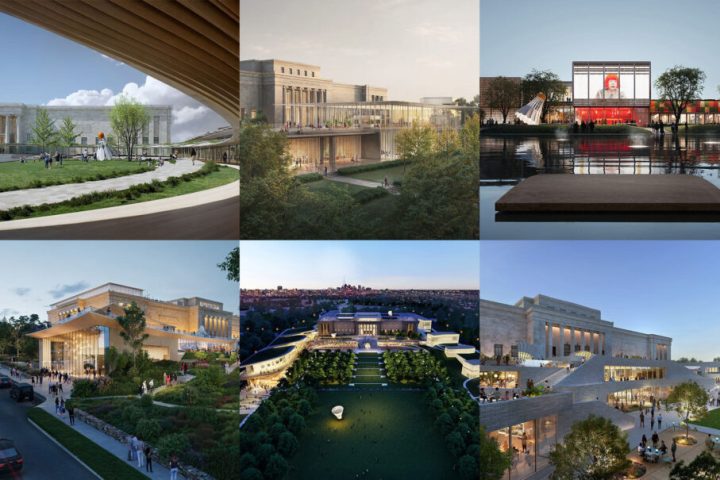
Proposals by the six finalists for The Nelson-Atkins Museum of Art, aimed at integrating the campus, the Donald J. Hall Sculpture Park, and the two existing buildings into a cohesive experience for new wider community engagement.
◊ ◊ ◊ ◊ ◊
It’s not an 18th-century story per se, but interesting to see a museum engage a strong classical facade and an iconic landscape in the 21st century. From the press release (13 March) for the exhibition, which includes an online component:
Building Belonging: Designing the Future of the Nelson-Atkins
The Nelson-Atkins Museum of Art, Kansas City, 15 March — 1 June 2025
The Nelson-Atkins Museum of Art this week revealed the concepts from six finalist teams in the competition to transform the museum with a dynamic, open, and inviting design. The expansion project’s goal is to attract new audiences by creating vibrant spaces for hosting more art, along with new immersive and interactive experiences for the community. The concepts—devised by some of the most respected designers working in museum architecture today—are now available to view in an online gallery here. They can also be seen in a free exhibition at The Nelson-Atkins Museum of Art, Building Belonging: Designing the Future of the Nelson-Atkins, until 1 June 2025. The public is invited to comment at the exhibition or through the portal available here.
The museum’s Architect Selection Committee (ASC) will meet in late spring to interview the finalists and make a recommendation to the Board of Trustees. Following ratification and the winning team’s appointment, the chosen design will be refined in close partnership with the museum and its stakeholders, including local communities. The Board of Trustees aims to broaden the conventions of the museum—which offers free general admission—so it continues evolving as a place where everyone feels they belong. The project will integrate the campus, the Donald J. Hall Sculpture Park, and the two existing buildings into a cohesive new experience. The first stage of the competition, which launched in October 2024, attracted 182 teams from 30 countries on six continents.
“These six concept designs articulate six unique visions of a new and even more dynamic Nelson-Atkins.” said Evelyn Craft Belger, Chair of the museum’s Board of Trustees and the Architect Selection Committee. “This is a thrilling moment for the museum and our community when we start to visualize an identity that will carry us through the coming decades. We encourage our community to visit the exhibition and share your thoughts—which proposal best realizes your aspirations?”
“We asked for bold, inspiring moves that also respected the existing museum campus and I’m so happy to say we’ve received them in these initial designs,’ said Julián Zugazagoitia, Director & CEO of the Nelson-Atkins, “Each is a fascinating response to a complex project brief, together they bring myriad perspectives. The teams have shone their beams of thought on our big questions: how do we synthesize our existing icons with a new proposition? How do we modernize and embrace the future but keep the best of our history? And, most of all, how do we create a museum that is transparent for all and instills a sense of belonging and well-being?”
In conjunction with this exhibition is the release of Director’s Highlights: Celebrating 90 Years of The Nelson-Atkins Museum of Art, which captures the richness and variety of the museum’s collection told through the eyes of the curators and Zugazagoitia himself. It includes about 200 works of art organized by the decade in which they entered the museum. Engaging stories, images, and colorful anecdotes accompany each work, along with historic photos and plans. The publication is available for purchase online and in the museum store.
More information about the six finalists can be found here»
• Kengo Kuma & Associates
• Renzo Piano Building Workshop
• Selldorf Architects
• Studio Gang
• Weiss/Manfredi Architecture/Landscape/Urbanism
• WHY Architecture

◊ ◊ ◊ ◊ ◊
Note (added 25 April 2025) — Weiss/Manfredi will lead the expansion, as announced in the press release:
The Nelson-Atkins Museum of Art has unanimously selected WEISS/MANFREDI Architecture/Landscape/Urbanism as the lead architect for the museum’s upcoming expansion and transformation project. Their guiding theme united the trilogy of architecture, landscape, and community as reciprocal elements that work together while maintaining the majestic south lawn view into the Donald J. Hall Sculpture Park. WEISS/MANFREDI’s concept is aligned with the museum’s goals for a dynamic, open, and inviting design that will create more spaces to present all forms of art, as well as new opportunities for immersive and creative experiences for audiences of every age. The museum’s Architect Selection Committee made the recommendation of WEISS/MANFREDI, describing the project as the best to fulfill the museum’s aspirations, and the team as sensitive to Kansas City while being engaging, smart, creative, and curious. The choice was ratified by the Board of Trustees shortly thereafter. Having selected the lead architect, the museum will now begin the months-long process of turning the concept into more specific and detailed plans to meet the long-term needs and goals of the community. . . .
The full press release is available here»
Call for Papers | Body Hair in Early Modern Visual Culture
From ArtHist.net and NIKI:
Hirsute, Downy, Hairless:
Meanings and Forms of Body Hair in Early Modern Visual Culture
Nederlands Interuniversitair Kunsthistorisch Instituut, Florence, 24–25 October 2025
Organized by Mathilda Blanquet, Michael Kwakkelstein, and Mandy Richter
Proposals due by 1 April 2025
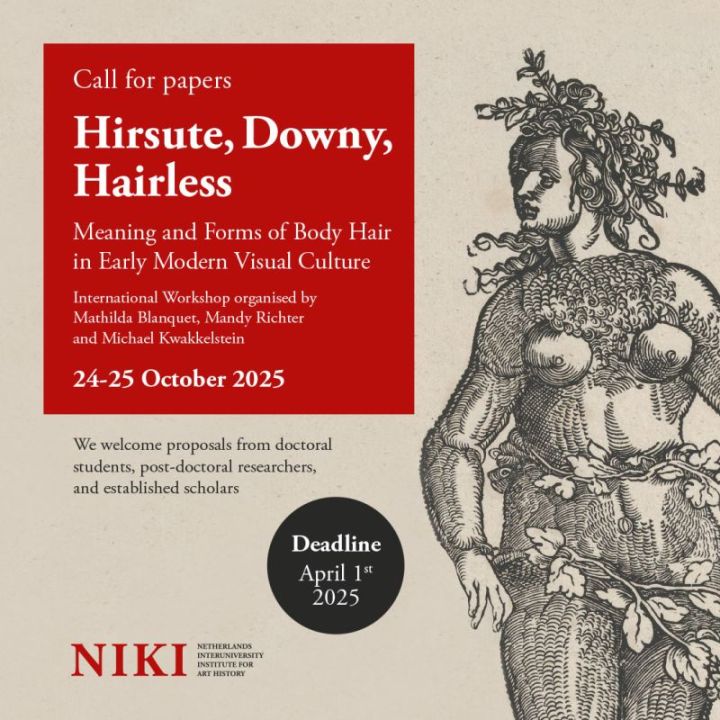 While long overlooked in art historical studies, over the past two decades body hair has emerged as a significant field of research, offering new perspectives on early modern visual culture. The presence or absence of body hair serves as an indicator of aesthetic (or artistic) preferences and prevailing social norms specific to certain periods and locations, revealing complex intersections between art and real life.
In profane art, the representation of male body hair tends to be quite common. It often points to idealized virility, strength, or even a natural state of being. However, its excess or misplacement might indicate mockery, degradation, or even alienation of the depicted subject. In comparison, female hirsuteness appears less frequently in artworks from the early modern period due to different canons of beauty associated with the female body. These rare instances of representation thus hold particular interest for this workshop.
In religious art, hair in general is of notable importance and this significance extends to body hair as well. Various iconographies of saints include these distinct features, raising questions not only about visual traditions in different cultural contexts but also querying particular hermeneutic meanings, such as notions of humanity, carnality, and spiritual transformation. In some cases, there could be a connection to preserved body hair relics of specific saints, which has never been part of a broader study thus far.
Technical challenges in representing hair are another point of interest. Artists and art theorists addressed these challenges across different media throughout the early modern period, as evidenced in theoretical treatises, anatomical studies, and workshop practices. Not only does this include the question of how to differentiate between human and animal hair but extends as well to artistic experiments in finding new and creative ways of treating or even avoiding body hair.
This two-day workshop aims to explore the multiple dimensions of body hair in visual culture through an interdisciplinary approach. Contributions may address, but are not limited to, the following themes:
1 Gender and Social Norms
• Male vs. female body hair in art
• Social and cultural implications of hair presence or absence
• Body hair as an indicator of social status and cultural norms
2 Religious and Symbolic Dimensions
• Hair in religious iconography
• Symbolic meanings in sacred versus profane contexts
• The role of body hair in representing humanity versus divinity
3 Artistic Theory and Practice
• Technical challenges in depicting body hair across different media
• Body hair in artistic treatises and anatomical studies
• Relationships between artistic theory and artistic practice
4 Cultural and Geographic Variations
• Comparative studies across European regions
• Cross-cultural perspectives on body hair representation
We welcome proposals from doctoral students, post-doctoral researchers, and established scholars. Papers may be presented in English or Italian. Please submit an abstract (300–500 words), a brief biographical note (150 words), your current institutional affiliation, and contact information to m.blanquet@udk-berlin.de and richter@khi.fi.it by 1 April 2025. Acceptance notifications should arrive by 15 April 2025.
Selected papers will be considered for publication in a peer-reviewed volume following the workshop. The workshop will be held at the Nederlands Interuniversitair Kunsthistorisch Instituut in Florence (NIKI). Accommodation and travel information will be provided to accepted participants. For any queries, please contact m.blanquet@hotmail.fr and richter@khi.fi.it.
Organizers
• Mathilda Blanquet, Universität der Künste in Berlin, Université Fédérale de Toulouse, Universität Hamburg
• Dr. Michael W. Kwakkelstein, Dutch University Institute for Art History in Florence (NIKI) – Utrecht University
• Dr. Mandy Richter, Kunsthistorisches Institut in Florenz – Max-Planck-Institut
New Book | Adventures in the Louvre
From Norton:
Elaine Sciolino, Adventures in the Louvre: How to Fall in Love with the World’s Greatest Museum (New York: W. W. Norton, 2025), 384 pages, ISBN: 978-1324021407, $30.
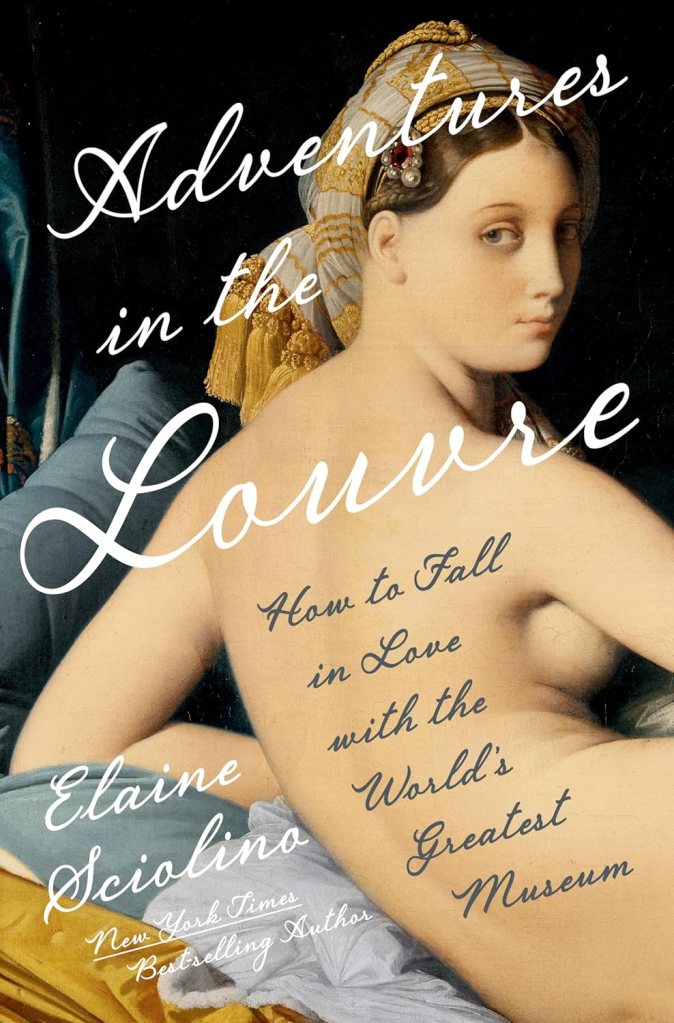 A former New York Times Paris bureau chief explores the Louvre, offering an intimate journey of discovery and revelation.
The Louvre is the most famous museum in the world, attracting millions of visitors every year with its masterpieces. In Adventures in the Louvre, Elaine Sciolino immerses herself in this magical space and helps us fall in love with what was once a forbidding fortress. Exploring galleries, basements, rooftops, and gardens, Sciolino demystifies the Louvre, introducing us to her favorite artworks, both legendary and overlooked, and to the people who are the museum’s lifeblood: the curators, the artisans producing frames and engravings, the builders overseeing restorations, the firefighters protecting the aging structure. Blending investigative journalism, travelogue, history, and memoir, Sciolino walks her readers through the museum’s front gates and immerses them in its irresistible, engrossing world of beauty and culture. Adventures in the Louvre reveals the secrets of this grand monument of Paris and basks in its timeless, seductive power.
Elaine Sciolino, contributing writer and former Paris bureau chief for The New York Times, is the author of The New York Times bestseller The Only Street in Paris, as well as The Seine and La Seduction. She lives in Paris.
Metropolitan Museum Journal 2024
The latest issue of The Met’s journal, with a reminder that digital copies are free! This year’s due date for submissions is 15 September; guidelines are available here.
Metropolitan Museum Journal 59 (2024)
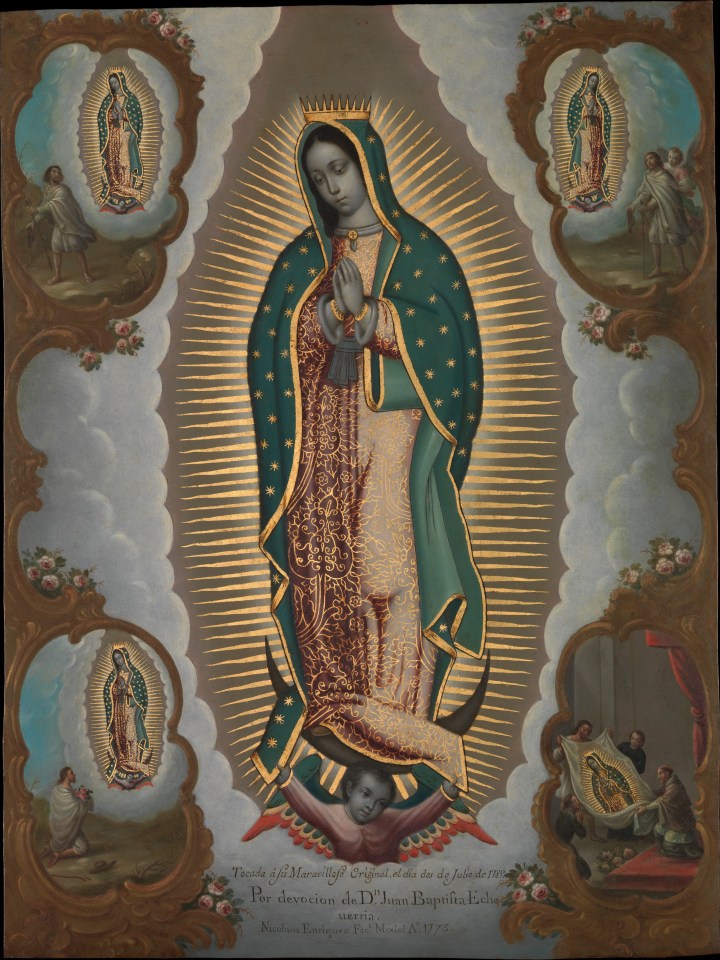
Nicolás Enríquez, The Virgin of Guadalupe with the Four Apparitions, 1773, oil on copper, 56.5 × 41.9 cm (New York: The Metropolitan Museum of Art, 2014.173).
a r t i c l e s
• Ally Kateusz, “Women at the Altar of Jesus’s Tomb in the Anastasis,” pp. 8–25.
• Melanie Holcomb, “The Architecture of ‘Playe’: Henry Hamlyn’s House in Tudor Exeter,” pp. 26–42.
• Ayşe AldemIr, “Ottoman Tastemaker Robert-Sadia Pardo and a Sixteenth-Century Prayer Rug in The Met,” pp. 43–57.
• Kelly Presutti, “Wood and Stone: Bernard Palissy’s Environmental Legacy,” pp. 58–72.
• Kristel Smentek and Christian Katschmanowski, “Oysters, Sauerkraut, and Pagods: Sibylla Augusta’s Chinese Banquet of 1729,” pp. 73–93.
• Ronda Kasl, “For the Devotion of Juan Bautista de Echeverría: Piety and Identity in Paintings by Nicolás Enríquez,” pp. 94–111.
• Nader Sayadi, “Imperial Threads: Kashmiri Shawls in Nineteenth-Century Iran,” pp. 113–29.
r e s e a r c h n o t e
• Rachel Lackner, Shirin Fozi, and Kisook Suh, “Julius Caesar from the Heroes Tapestries at The Met Cloisters: Dye Analysis and Molecular Insights,” 130–43.
Anna Jameson Lecture by Paris Spies-Gans
This evening at The National Gallery (the lecture is fully booked, but it will be live-streamed) . . .
Paris Spies-Gans | ‘The Spirit of a Particular Age’
Women Artists and the Challenges of an Integrated Art History
Online and in-person, The National Gallery, London, 13 March 2025, 6pm GMT

Elisabeth Louise Vigée Le Brun, Self Portrait in a Straw Hat, 1782 (London: The National Gallery).
Women artists are having a moment—featuring in exhibitions, headlines, and auctions. Art historians have, however, long known of their existence. Why do we continue to treat these creators as rare, exciting discoveries? This lecture will consider the complicated legacies surrounding women artists and notions of historical truth. Taking Anna Jameson’s concept of the ‘Spirit of a Particular Age’ as a jumping-off point, it will explore the tensions that often accompany studies of women in their own places and times and suggest a path towards a more integrated—and hopefully lasting—narrative of art: one that includes women as the prominent historical players they regularly were. Sometimes this entails uncomfortable work, such as questioning canonical narratives about women and art. However, embracing such complexities can ultimately lead to a deeper, fuller understanding of the cultural and gender dynamics that shaped the past—and continue to influence the present.
The lecture will also be live-streamed; please book tickets here»
Paris A. Spies-Gans holds a PhD in History from Princeton University, an MA in Art History from the Courtauld Institute of Art, and a BA from Harvard University. Her research has been supported by fellowships from the Harvard Society of Fellows and the J. Paul Getty Trust, among other institutions. Her first book, A Revolution on Canvas: The Rise of Women Artists in Britain and France, 1760–1830 (PMC/YUP 2022), has won several prizes in the fields of British art history and 18th-century studies and was named one of the top art books of 2022 by The Art Newspaper and The Conversation. She is currently working on her second book, A New Story of Art (US/Doubleday and UK/Viking).
Call for Applications | PhD Thesis on Spain and Ibero-America
From the Call for Expression of Interest, with the French version available here:
Doctoral Thesis on the History of Art and Visual Studies
Spain and Ibero-America, particularly New Spain, ca. 1650–1870
Directed by Tomas Macsotay and Émilie Roffidal
Applications due by 11 April 2025
This call is addressed to students wishing to prepare a doctoral thesis on aspects of the history of art and visual studies in Spain and Ibero-America, particularly New Spain, ca. 1650–1870. We will support the candidate in the preparation of a thesis proposal to be submitted in France. If the proposal is accepted, the candidate will benefit from the collaboration of two art history departments in Spain and France, enabling him or her to obtain a European doctorate.
p o s s i b l e t o p i c s
1 Artistic Academies in the Ibero-American Space
• Exchanges with Italy and France, artistic models
• Interpersonal and inter-institutional networks
• The relationship between the fine arts and the applied arts, in particular with the luxury and semi-luxury market; the role of the Juntaso de Commercio and Sociedades económicas de amigos del país
• The circulation of theoretical and archaeological knowledge
• Local heritage and the movement to create a Spanish artistic identity (casticismo, cultura andaluza)
2 Religious Art in Ibero-America
• Ecclesiastical interiors, furnishings, and religious sculpture as embodiments of the transformation of religious practice
• Text-image relationships, in particular through the study of printed sermons and panegyrics
• Relationships between ‘Baroque’ art and ‘neoclassicism’, between devotion in the private and public spheres
• The question of regional models and neoclassical reform (particularly neoclassicism in Madrid and Valencia)
• The place of antiquity in the vocabulary of forms
3 The Journey to Spain, published and unpublished
• Travelogues as an expression of the reception of Spanish art
• The reception of art (perception, intertextuality, and narrativity in commentaries on monuments and works of art)
• The journey as a search for a common artistic repertoire versus local identity
4 Engraving in the Ibero-American Space
• The use of engraving to show a diversity of images: landscapes, religious and/or political ceremonies, works of art, the population, everyday life, etc.
• Links between the real and the imaginary (compositions, recompositions, etc.)
• The question of violence, revolt, and upheaval
• Engravers and the image market
Candidates must have sufficient communication skills in French and Spanish (C1 or at least B2 levels). To apply, please send a cover letter, a thesis proposal on one of the proposed themes (3,000–6,000 characters), and a transcript of Master’s result list. Successful candidates will receive support in preparing their application for a doctoral contract (funded thesis) and in writing their final thesis proposal.
Directors
• Tomas Macsotay, associate professor, Pompeu Fabra University, tomas.macsotay@upf.edu
• Émilie Roffidal, senior researcher, Centre National de la Recherche Scientifique (FRAMESPA laboratory, UMR 5136, Toulouse), emilie.roffidal@univ-tlse2.fr
Exhibition | The Roman Drawings of José de Madrazo
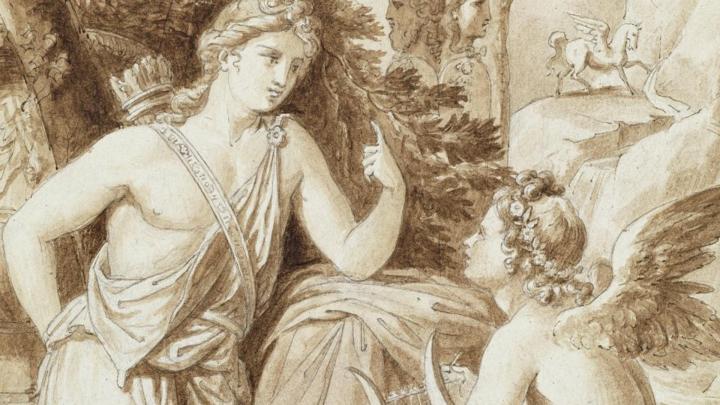
José de Madrazo y Agudo, The Dispute between Apollo and Cupid, detail, ca. 1812, pencil and grey-brown wash on wove paper, 29 × 22 cm
(Madrid: Prado, D006523)
◊ ◊ ◊ ◊ ◊
From press release for the exhibition:
Changing Forms: Myth & Metamorphosis in the Roman Drawings of José de Madrazo
Cambio de forma: Mito y metamorfosis en los dibujos romanos de José de Madrazo
Museo Nacional del Prado, Madrid, 10 March — 22 June 2025
Changing Forms: Myth and Metamorphosis in the Roman Drawings of José de Madrazo showcases the intriguing works of José de Madrazo y Agudo (1781–1859), the first artistic director of the Museo Nacional del Prado. The exhibition offers a unique glimpse into Madrazo’s fascination with classical mythology and its reflection of a turbulent era. During a time when Europe was reshaped by Napoleon and Goya captured the horrors of war, Madrazo, then in exile in Rome, explored the transformative power of myth.
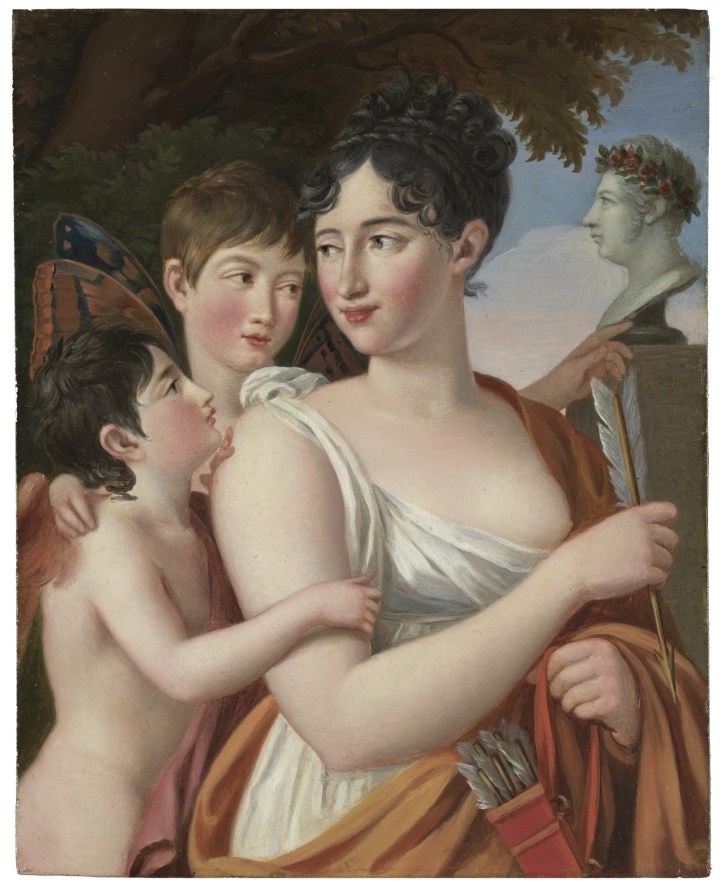
José de Madrazo y Agudo, Josefa Tudó with Her Sons Manuel and Luis Godoy, in a Garden, ca. 1812, oil on panel 20 × 16 cm (Madrid: Prado).
The exhibition features a collection of drawings and portraits from the Daza-Madrazo collection, acquired by the Prado in 2006, highlighting Madrazo’s ability to interpret ancient stories through a contemporary lens. The exhibition is structured around two distinct sets of works, prompting questions about their original purpose. One set appears to be preparatory sketches for engravings, while the other, semicircular compositions, suggests they were intended for decorative purposes, possibly for the exiled court of Charles IV in Rome. Themes like the contest between Apollo and Cupid are prominent, revealing Madrazo’s personal and scholarly approach to myth.
A notable inclusion is Madrazo’s Portrait of Josefa Tudó and Her Children, where they are depicted as mythological figures. This highlights how Madrazo incorporated mythological symbolism into his portraiture, adding layers of meaning to his works. The exhibition also delves into Madrazo’s self-representation, featuring his silhouette, a lithographic portrait, and a photograph, demonstrating his interest in evolving artistic technologies. These pieces span different periods of his life, showcasing his experimental nature.
Changing Forms goes beyond a simple display of technical skill, inviting visitors to consider the historical context in which Madrazo worked, a period marked by significant change. The exhibition emphasizes how Madrazo’s exploration of metamorphosis was not just a theme in his art, but a reflection of his own ability to adapt and reinvent himself. The Daza-Madrazo collection, a key resource for understanding Madrazo’s drawing practice, is central to the exhibition. It reveals his creative process, aesthetic choices, and the complexities of his Roman period.
Madrazo’s deep engagement with classical texts and art history is evident in his detailed drawings. He combined diverse sources to enrich his narratives, demonstrating a rigorous study of both past and present artistic trends. The exhibition aims to provide a deeper understanding of José de Madrazo’s artistic vision and his ability to navigate a time of significant historical and artistic change. Visitors are encouraged to explore the connection between myth, transformation, and the artist’s own journey.
Exhibition | Wild Apollo’s Arrows

Josef Abel, Klopstock’s Arrival in Elysium / Klopstocks Ankunft im Elysium, 1805
(National Gallery Prague)
◊ ◊ ◊ ◊ ◊
Now on view at Vienna’s Academy of Fine Arts:
Wild Apollo’s Arrows: Klopstock Cult & Ossian Fever
Die Pfeile des wilden Apollo: Klopstockkult & Ossianfieber
Akademie der bildenden Künste Wien, 7 March — 25 May 2025
Curated by Alexander Roob
The exhibition Wild Apollo’s Arrows: Klopstock Cult & Ossian Fever presents significant artistic works that exemplify the epochal shift from the Enlightenment to the irrationalism of the Storm and Stress movement and Romanticism, exploring for the first time the immense influence of the poet Friedrich Gottlieb Klopstock (1724–1803) on the fine arts and music of his own age.
Decades before the French Revolution, the Age of Enlightenment saw a sudden outbreak of irrational sentiment, expressed in exuberant emotions, notions of spiritualistic gender switching, and a fragmented, heroic, and introspective view of art. This was the onset of an epochal shift with consequences for pictorial art: reliance on the actual appearance of things gave way to the mystical and diffuse, accompanied by a greater interest in the realm of acoustics. Nothing seems to better define this ‘acoustic turn’ than the trope of the blind prophet and lyrical poet, which functioned as a literary model for this new epoch, as seen in the figures of Homer, Ossian, and John Milton. Milton’s grand inner images were proclaimed to be the perfection of the romantic sublime, and the myth of the lost and regained paradise to which he had given literary form was associated with Mesmer’s notion of lucid dreaming. In the early 1750s, German poet Friedrich Gottlieb Klopstock positioned himself as an heir to Milton, with his pietistic epic The Messiah: A Heroic Poem, and in this he issued a challenge to the self-proclaimed English national bard William Blake.
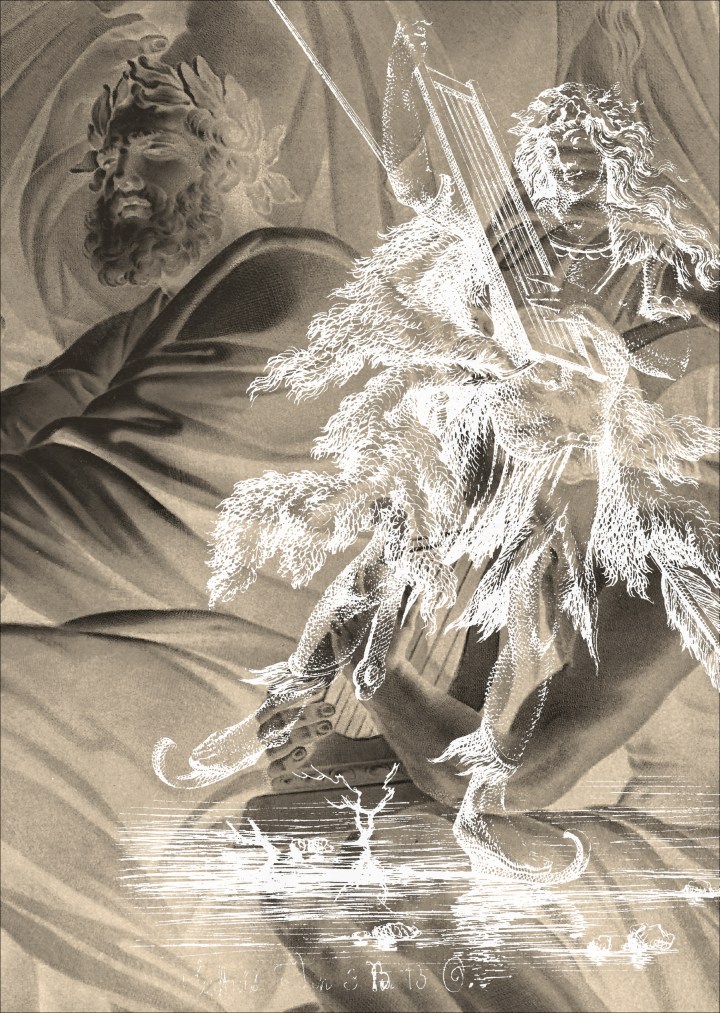
Motif combining works by Johann Peter Pichler after Heinrich Friedrich Füger, Homer Reciting, 1803 (Graphic Collection of the Academy of Fine Arts Vienna), and Carl Wilhelm Kolbe the Elder, Ice-skating Bard (‘Braga’), 1793–94 (Hamburger Kunsthalle, Kupferstichkabinett / bpk, photo by Julia Bau), design composite motif: Beton.
For cultural philosopher Johann Gottfried Herder, ‘wild Apollo’s arrows’ were the rousing sounds of an early folk movement and the Nordic dronescapes of a budding nationalist mysticism, which was all heralded in the pseudo-Celtic poem cycle Ossian. In the visions of the superstar poet Klopstock ‘wild Apollo’ appeared in a Celtic-Germanic mix, and the bard’s song and cosmic ice-dance put the world into creative turmoil. Klopstock, a keen ice-skater, who was nowhere more popular than in Austria, became a role-model for a sentimental skating trend that saw motion as a way to transcend limitations.
The exhibition presents art works that exemplify this epochal shift from the Enlightenment to the irrationalism of the Storm and Stress (Sturm und Drang) movement and Romanticism. For the first time, Klopstock‘s immense influence on the fine arts and music of his own age is explored. With interpretations of his work in art and music by Angelika Kauffmann, Heinrich Friedrich Füger, Josef Abel, and Franz Schubert, the republican poet Klopstock was surprisingly still very present in the Habsburg Empire at the time of the Napoleonic Wars. The exhibition blends works of Austrian classicism, evidence of international early romanticism, and the narcotic imagery of the Nazarenes to the accompaniment of music by Joseph Haydn, Christoph Willibald Gluck, and Franz Schubert.
Alongside works from the Paintings Gallery and numerous loans, this exhibition draws widely on works from the Academy of Fine Arts Vienna Graphic Collection. The project also integrates works by students from the Academy of Fine Arts Vienna, and it will be presented in the Exhibit Galerie and three rooms at the Paintings Gallery. A comprehensive publication with essays and illustrations will accompany the exhibition.
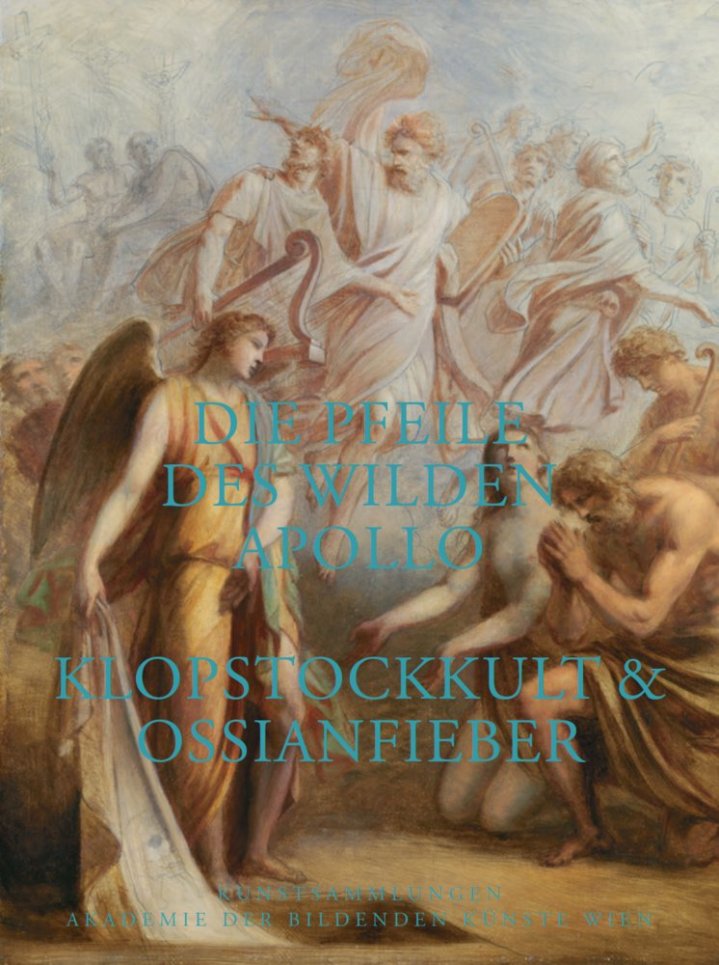 With works by Josef Abel, Edmund Aigner, Johann Wilhelm Baur, Thomas Blackwell, William Blake, Filippo Caporali, Thomas Chatterton, Daniel Chodowiecki, Edward ‘Celtic’ Davies, Josef Dorffmeister, Bonaventura Emler, Heinrich Friedrich Füger, Johann Heinrich Füssli, Hendrick Goltzius, Christoph Willibald Gluck, Johann Valentin Haidt, Joseph Haydn, Anton Herzinger, William Hogarth, Bartholomäus Hübner, Anne Hunter, Archduchess Maria Clementina of Austria, Johann Evangelist Scheffer von Leonhardshoff, Friedrich John, Owen Jones, Angelika Kauffmann, John Kay, Friedrich Gottlieb Klopstock, Joseph Anton Koch, Carl Wilhelm Kolbe the Elder, Simon Petrus Klotz, Leopold Kupelwieser, Johann Caspar Lavater, Johann Friedrich Leybold, William James Linton, Johann Heinrich Lips, Johann Hieronymus Löschenkohl, Josef Löwy, James Macpherson, Charles-François-Adrien Macret, Jacob Wilhelm Mechau, Heinrich Merz, Isaac Mills, Jean-Michel Moreau, Wilhelm Müller, Friedrich Olivier, Carl Hermann Pfeiffer, Johann Peter Pichler, Albert Christoph Reindel, Johan Christian Reinhart, Ferdinand Ruscheweyh, Luigi Schiavonetti, Julius Schnorr von Carolsfeld, Ludwig Ferdinand Schnorr von Carolsfeld, Franz Schubert, Moritz von Schwind, William Bell Scott, Franz Xaver Stöber, Joseph Sutter, Johanna Dorothea Sysang, Giambattista Vico, Marianne von Watteville, Josef Wintergerst, Franz Wolf, Nikolaus Ludwig von Zinzendorf, Felice Zuliani, and others.
Works after William Blake, Asmus Jakob Carstens, Johann Nepomuk Ender, Heinrich Friedrich Füger, Bonaventura Genelli, Gerdt Hardorff, G. W. Hoffmann, William Hogarth, Angelika Kauffmann, Nicaise de Keyser, Giuseppe Longhi, Johann Friedrich Overbeck, Raffaello Santi, genannt Raffael, Bertel Thorvaldsen, Angiolo Tramontini, Richard Westall.
Contemporary works by students of the Academy such as Christian Azzouni, Ina Ebenberger, Hicran Ergen, Eginhartz Kanter, Julia Kronberger, Prima Mathawabhan, Amar Priganica, Liese Schmidt, Pia Wilma Wurzer, and Ancient Britons Team (ABK Stuttgart).
Alexander Roob, with Sabine Folie, Die Pfeile des wilden Apollo: Klopstockkult & Ossianfieber (Hamburg: Textem Verlag), 248 pages, ISBN: 978-3864853340, €32.
Conference | Painted Ceilings: France and Germany, 1600–1800

This week in Munich, as noted at ArtHist.net:
Eine Verflechtungsgeschichte der Deckenmalerei: Frankreich und Deutschland, 1600–1800
Une histoire croisée des plafonds peints: France-Allemagne, 1600–1800
Carl Friedrich von Siemens Stiftung, München, 12–14 March 2025
Registration due by 11 March 2025
Ziel der Tagung ist es, das historische, kulturelle, formale und technische Phänomen der Verbreitung von gemalten und skulptierten Deckenausstattungen im Europa des 17. und 18. Jahrhunderts zu erforschen. Deutschland und Frankreich bieten sich für dieses Unterfangen an: Die zahlreichen punktuellen und verstreuten Studien der letzten 20 Jahre sollen in einem umfangreichen Unternehmen systematisiert und mit aktuellen Fragestellungen verknüpft werden. Die Zeit ist günstig: Auf beiden Seiten des Rheins entstanden in den letzten Jahren Datenbankinitiativen und es besteht dringender Handlungsbedarf, um gemeinsame digitale Werkzeuge zu entwickeln und die Relevanz und Interoperabilität zu erhöhen.
Le projet propose d’étudier le phénomène historique, culturel, formel et technique qu’a constitué la multiplication des décors de plafonds, peints et sculptés en Europe aux XVIIe et XVIIIe siècles. Les terrains français et allemands se prêtent à cette enquête : ils ont fait l’objet de nombreuses études ponctuelles et différentes depuis 20 ans et appellent aujourd’hui une vaste entreprise de systématisation du corpus et d’enrichissement du questionnaire. Le moment est opportun : des bases de données naissent de part et d’autre du Rhin ces dernières années et il est urgent d’engager une réflexion afin d’adopter des outils numériques communs, afin de gagner en pertinence et en interopérabilité.
Gefördert von der Deutschen Forschungsgemeinschaft (DFG), der Agènce Nationale de Recherche (ANR) und der Carl Friedrich von Siemens Stiftung.
Eine Anmeldung unter ist erforderlich.
Weitere Informationen zum Projekt.
Deutsch-Französische Forschungsdatenbank.
Projektkennung Deutsche Forschungsgemeinschaft (DFG) – Projektnummer 469528261
m i t t w o c h , 1 2 m Ä r z
14.00 Begrüßung / Mot de bienvenue
14.05 Matteo Burioni (LMU) — Einführung : Vom Kulturtransfer zur Verflechtungsgeschichte / Introduction : D’une histoire des transferts à l’histoire croisée
Moderation: Christine Tauber (Zentralinstitut für Kunstgeschichte)
14.30 Hendrik Ziegler (Universität Marburg) — Die Spiegelgalerie von Versailles als deutsch-französischer Erinnerungsort / La galerie des glaces de Versailles comme lieu de mémoire franco-allemand
15.15 Diskussion
15.30 Pause
16.00 Ulrike Seeger (Universität Stuttgart/LMU) — Die Aeneasgalerie von Matthäus Günther im Neuen Schloss in Stuttgart / La galerie d’Énée de Matthäus Günther au nouveau château de Stuttgart
16.20 Matthieu Lett (Université Bourgogne Europe, IUF) — Jean Girardet (1709–1778), peintre de plafonds : perspectives croisées entre le duché de Lorraine, l’Italie et Saint-Empire romain germanique / Jean Girardet (1709–1778), Deckenmaler: Eine Verflechtungsgeschichte zwischen dem Herzogtum Lothringen, Italien und dem Heiligen Römischen Reich Deutscher Nation
16.40 Anne Ilaria Weiß (LMU) — Das Paradeappartement Augusts des Starken im Dresdner Residenzschloss. Zwischen dem Streben nach der Kaiserwürde, goût français und dynastischer Verflechtung mit Frankreich / L’appartement de parade d’Auguste le Fort dans le château de la résidence de Dresde. Entre aspiration à la dignité impériale, goût français et liens dynastiques avec la France
17.00 Diskussion
17.30 Pause
18.00 Olivier Bonfait (Université Bourgogne Europe, IUF) — Matthieu Lett (Université Bourgogne Europe, IUF), Sandra Bazin-Henry (Université Marie et Louis Pasteur), Plafond-3D outre Rhin / Plafond-3D jenseits des Rheins
18.30 Matteo Burioni (LMU), Elisabeth Mayer (LRZ) — Anne Ilaria Weiß (LMU), Appartement und Deckenmalerei in Schloss Rheinsberg / Appartement et plafond peint au château de Rheinsberg
d o n n e r s t a g , 1 3 m Ä r z
Projektpräsentation / Présentation du projet
Moderation: Hubertus Kohle (LMU)
9.00 Olivier Bonfait (Université Bourgogne Europe, IUF), Matteo Burioni (LMU), Maximilian Kristen (LMU), Matthieu Lett (Université Bourgogne Europe, IUF), Florian Zacherl (LMU) — Die Forschungsdatenbank: Metadaten zur Deckenmalerei in Frankreich und Deutschland / Le portail commun: données sur les peintures de plafond en France et en Allemagne
9.50 Diskussion
10.15 Sandra Bazin-Henry (Université Marie et Louis Pasteur) — Les plafonds français et la quadratura : réflexions autour de vestiges illusionnistes / Die französische Deckenmalerei und die Quadratura: Überlegungen zu illusionistischen Relikten
10.30 Marine Roberton (Université Bourgogne Europe) — Sous les ciels de Rennes. Typologie et hiérarchie des fonds des plafonds du parlement de Bretagne / Typologie und Hierarchie der Deckenmalerei im Parlament der Bretagne in Rennes
10.45 Theresa Baumann (LMU) — Künstlerischer Austausch in der Patronage von Henriette Adelaide von Savoyen / Échange artistique sous le patronage d’Henriette Adélaïde de Savoie
11.00 Diskussion
11.30 Pause
12.00 Cordula Mauss / Sandra Bucher-Fiuza (Bayerische Verwaltung der staatlichen Schlösser, Gärten und Seen) — Die Restaurierung des Festsaales von Schloss Ansbach / La restauration de la salle de fête du château d’Ansbach
12.20 Mona Hess (Universität Bamberg) — Die 3D-Vermessung im Festsaal von Schloss Ansbach / Le relevé 3D dans la salle de fête du château d’Ansbach
12.45 Diskussion
14.00 Führung Nymphenburg / Visite guidée de Nymphenburg
Produktion: Denken in der dritten Dimension / Les savoir-faire : penser en 3D
Moderation: Eva-Bettina Krems (Universität Münster)
15.00 Stephan Hoppe (LMU) — Wolf Caspar von Klengel und das Palais im Großen Garten in Dresden. Produktionsgeschichte als modulare Verflechtungsgeschichte / Wolf Caspar von Klengel et le Palais du Grand Jardin à Dresde. L’histoire de la production comme histoire croisée
15.45 Diskussion
16.00 Pause
16.30 Etienne Faisant (Musée du Grand Siècle) — L’architecte, le peintre et le plafond. De l’invention des plafonds en France au XVIIe siècle / Der Architekt, der Maler und die Decke. Von der Erfindung der Deckenmalerei in Frankreich im 17. Jahrhundert
16.45 Maxime Bray (Sorbonne Université) — Réceptions ‘en superficie’ des plafonds peints. Les expertises, un autre lieu des relations entre peintres et architectes au XVIIe siècle / Die ‘Oberflächen’ der Deckenmalerei. Begutachtungen, ein weiterer Schauplatz der Beziehung zwischen Maler und Architekten im 17. Jahrhundert
17.00 Turner Edwards (INHA, Université Bourgogne Europe) — Penser l’ensemble à l’écrit : sémantique des plafonds et du décor dans la première moitié du XVIIIe siècle / Das Gesamtkunstwerk schriftlich denken: Semantik der Deckenmalerei und der Dekorationssysteme in der ersten Hälfte des 18. Jahrhunderts
17.15 Diskussion
f r e i t a g , 1 4 m Ä r z
Die Bildmacht der Deckenmalerei / L’efficace de la peinture de plafond
Moderation: Léa Kuhn (Zentralinstitut für Kunstgeschichte)
9.00 Christian Quaeitzsch (Bayerische Verwaltung der staatlichen Schlösser, Gärten und Seen) — Rekonstruktion barocker Deckenmalereien in der Münchner Residenz – zwischen Aktualisierung und Musealisierung / Reconstruction des peintures de plafond baroques dans la résidence de Munich – entre actualisation et muséalisation
9.45 Diskussion
10.00 Pause
10.30 Anna Klug (Zentralinstitut für Kunstgeschichte) — François Lemoynes Deckenmalerei im Salon d’Hercule von Schloss Versailles und ihre Rezeption im 18. Jahrhundert / Le plafond peint par François Lemoyne au salon d’Hercule du château de Versailles et sa réception critique au 18e siècle
10.45 Vladimir Nestorov (Université Bourgogne Europe) — Depuis les cieux de Paris. Des plafonds parisiens comme modèles pour les provinces au XVIIe siècle / Deckenmalereien in Paris als Vorbilder für die Provinzen im 17. Jahrhundert
11.00 Markus Castor (Deutsches Forum für Kunstgeschichte, Paris) — Die Götter verlassen den Himmel. Zu den Folgen der Säkularisierungstendenzen für die Deckenmalerei des 18. Jahrhunderts / Les dieux quittent le ciel. Sur les conséquences des tendances à la sécularisation pour les peintures de plafond du 18ème siècle
11.15 Diskussion
Moderation: Thomas Kirchner (ehemaliger Direktor des Deutschen Forums für Kunstgeschichte, Paris)
13.30 Olivier Bonfait (Université Bourgogne Europe, IUF) — Premiers apports de la recherche en France sur les plafonds peints, 1600–1800 / Vorüberlegungen zu einer Erforschung der Deckenmalerei in Frankreich, 1600–1800
13.45. Matteo Burioni (LMU) — Austauschprozesse, Materialität und formale Lösungen. Die Deckenmalerei in Deutschland, 1600–1800 / Processus d’échange, matérialité et solutions formelles. La peinture de plafond en Allemagne, 1600–1800
14.30 Diskussion
15.00 Pause
15.30 Eva-Bettina Krems (Universität Münster) — Von Räumen und Menschen: Transgression und Grenze in der höfischen Architektur und Ausstattung / Des espaces et des personnes : Transgression et frontière dans l’architecture et le décor des cours européennes
16.15 Diskussion
16.45 Schlußworte / Conclusion










 Enfilade
leave a comment