The Art Bulletin, March 2015
The eighteenth century in The Art Bulletin:
The Art Bulletin 97 (March 2015)
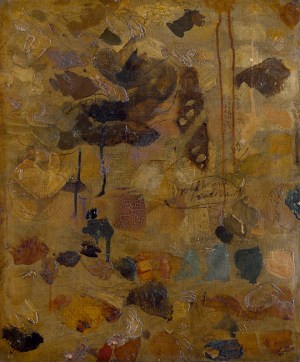
Joshua Reynolds, Studio Experiments in Colour and Media, ca. 1770–1790? (London: Royal Academy of Arts)
A R T I C L E S
• Matthew C. Hunter, “Joshua Reynolds’s ‘Nice Chymistry’: Action and Accident in the 1770s,” pp. 58–76.
The first president of Britain’s Royal Academy of Arts, Joshua Reynolds was described by contemporaries as a dangerously misguided chemist. Using a secretive laboratory of fugitive materials, he crafted visually striking images that came together quickly and stopped audiences dead in their tracks. But, just as rapidly, those paintings began to deteriorate as objects—flaking, discoloring, visibly altering in time. When framed around the “nice chymistry” he prescribed for aspiring artists in his famous Discourses, Reynolds’s risky pictorial enterprise can be situated within a broader problematic of making and thinking with temporally evolving chemical images in the later eighteenth century.
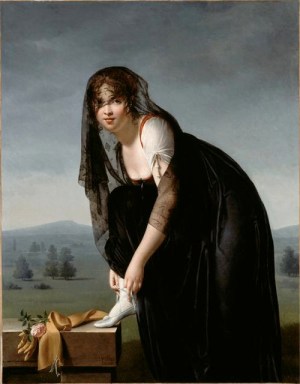
Marie-Denise Villers, Une étude de femme d’après nature, 1802 (Paris: Louvre)
• Susan L. Siegfried, “The Visual Culture of Fashion and the Classical Ideal in Post-Revolutionary France,” pp. 77–99.
In her little-known painting A Study of a Woman after Nature (1802), Marie-Denise Villers exploited a conjuncture between masculine-inflected ideals of Neoclassical art and feminine-inflected ideas of fashionability in the post-Revolutionary period in France by making a feature of female dress while emulating the standards of history painting. The artist’s confident synthesis of idioms is examined in the context of Albertine Clément-Hémery’s memoir of a women’s art studio. Walter Benjamin’s notion of gestus is enlisted as a means of understanding how the quite different image cultures invoked in this work communicated social ideas.
Exhibition | Made in the Americas: The New World Discovers Asia
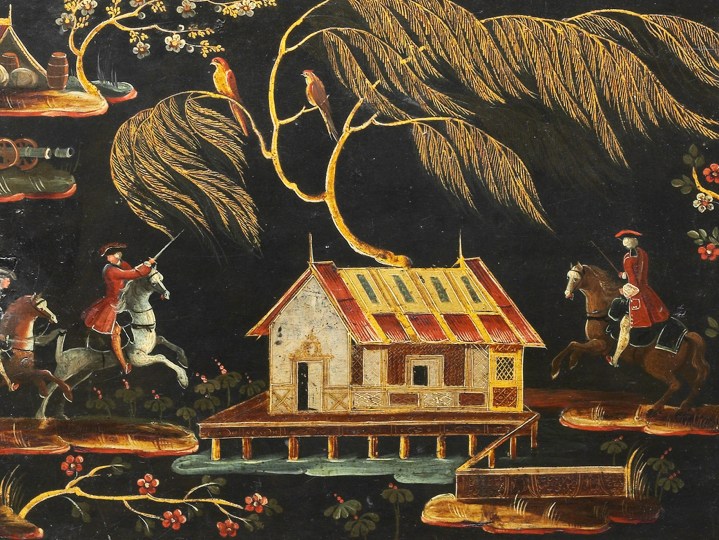
José Manuel de la Cerda, Desk-on-stand (detail), Pátzcuaro, Mexico, 18th century. Lacquered and polychromed wood with gilt decoration. On loan from The Hispanic Society of America, New York.
◊ ◊ ◊ ◊ ◊
From the MFA:
Made in the Americas: The New World Discovers Asia
Museum of Fine Arts, Boston, 18 August 2015 — 15 February 2016
Winterthur, Wilmington, Delaware, 26 March 2016 — 8 January 2017
Exquisite objects tell the story of the influence of Asia on the arts of colonial America.
Within decades of the ‘discovery’ of America by Spain in 1492, goods from Asia traversed the globe via Spanish and Portuguese traders. The Americas became a major destination for Asian objects and Mexico became an international hub of commerce. The impact of the importation of these goods was immediate and widespread, both among the European colonizers and the indigenous populations, who readily adapted their own artistic traditions to the new fashion for Asian imports.
Made in the Americas is the first large-scale, Pan-American exhibition to examine the profound influence of Asia on the arts of the colonial Americas. Featuring nearly 100 of the most extraordinary objects produced in the colonies, this exhibition explores the rich, complex story of how craftsmen throughout the hemisphere adapted Asian styles in a range of materials—from furniture to silverwork, textiles, ceramics, and painting. Exquisite objects from Mexico City, Lima, Quito, Quebec City, Boston, New York, and Philadelphia, dating from the 17th to the early 19th centuries, include folding screens made in Mexico in imitation of imported Japanese and Chinese screens, blue-and-white talavera ceramics copied from imported Chinese porcelains, and luxuriously woven textiles made to replicate fine silks and cottons imported from China and India.
The timing of the exhibition marks the 450th anniversary of the beginning of the Manila-Acapulco Galleon trade between the Philippines and Mexico, which was inaugurated in 1565 and ended in 1815, two and a half centuries later.
◊ ◊ ◊ ◊ ◊
From the MFA:
Dennis Carr, with contributions by Gauvin Alexander Bailey, Timothy Brook, Mitchell Codding, Karina H. Corrigan, and Donna Pierce, Made in the Americas: The New World Discovers Asia (Boston: Museum of Fine Arts, 2015), 160 pages, ISBN: 978-0878468126, $50.
 Made in the Americas reveals the largely overlooked history of the profound influence of Asia on the arts of the colonial Americas. Beginning in the sixteenth century, European outposts in the New World, especially those in New Spain, became a major nexus of the Asia export trade. Craftsmen from Canada to Peru, inspired by the sophisticated designs and advanced techniques of these imported goods, combined Asian styles with local traditions to produce unparalleled furniture, silverwork, textiles, ceramics, lacquer, painting, and architectural ornaments.
Among the exquisite objects featured in this book, from across the hemisphere and spanning the seventeenth to the early nineteenth centuries, are folding screens made in Mexico, in imitation of imported Japanese and Chinese screens; blue-and-white talavera ceramics copied from Chinese porcelains; luxuriously woven textiles, made to replicate fine silks and cottons from China and India; devotional statues that adapt Buddhist gods into Christian saints; and japanned furniture produced in colonial Boston that simulates Asian lacquer finishes. The stories these objects tell, compellingly related by leading scholars, bring to life the rich cultural interchange and the spectacular arts of the first global age.
Dennis Carr is Carolyn and Peter Lynch Curator of American Decorative Arts and Sculpture, Museum of Fine Arts, Boston.
Gauvin Alexander Bailey is Professor and Alfred and Isabel Bader Chair in Southern Baroque, Department of Art History and Art Conservation, Queen’s University, Kingston, Ontario.
Timothy Brook holds the Republic of China Chair in the Department of History and Institute of Asian Research, University of British Columbia, Vancouver.
Mitchell Codding is Executive Director, The Hispanic Society of America, New York.
Karina H. Corrigan is H. A. Crosby Forbes Curator of Asian Export Art, Peabody Essex Museum.
Donna Pierce is Frederick & Jan Mayer Curator of Spanish Colonial Art, Denver Art Museum.
Conference | The Enlightenment—Continuity, Challenge or Change?
From the forum flyer:
Benedictus Academic Research Forum 2015 | Continuity, Challenge or Change?
European Cultural and Intellectual Identity before and after the Enlightenment
Linnean Society, London, 19–20 June 2015
This year the Benedictus Academic Research Forum focuses on the Enlightenment, a pivotal moment in European culture and thought. Speakers from a wide range of disciplines including philosophy, music, art, theology and politics will introduce ideas and discuss contexts that enrich our understanding of the period and its continuing relevance. Tickets: £30 (both days), £15 (one day only) , includes entrance, drinks reception and Saturday lunch. Reservation essential; please email info@benedictus.org.uk or visit our website.
Sessions chaired by Thomas Pink (King’s College London), Anthony O’Hear (University of Buckingham), and Edward Chaney (Southampton Solent)
• Keynote presentation by Roger Scruton,
The Idea of a Secular Culture
• Adriano Aymonino (University of Buckingham),
The Classical Ideal from the Renaissance to the Nineteenth Century
• George Corbett (Trinity College Cambridge), Reframing the Seven Deadly Sins in the Christian Moral Life: Continuity and Change in Aquinas
• John Cottingham (Reading University
and Heythrop College London),
Descartes, God and Secularism
• Fernando Cervantes (University of Bristol),
The Ethics of Elfland: The Notion of Virtue in
Cervantes, Shakespeare and Montaigne
• Michael Lang (Heythrop College London),
Re-approaching Ritual and the Sacred in Late Modernity
• Peter Leech (Swansea University),
The Cultural Patronage of Cardinal Henry Benedict Stuart (1725–1807) in Rome
• Sebastian Morello (Centre for Catholic Formation),
Democracy and Royal Power: Nature and the Ideal of European Government
• Giuseppe Pezzini (Magdalen College, Oxford),
Receptions of Classical Texts from Late Medieval
to Early Modern Europe
• Clare Hornsby (Benedictus
) and Rafal Szepietowski (Manchester University),
Paintings of Astronomy in Early Eighteenth-Century Bologna
Young Scholars’ Competition
This year we launched the Benedictus Scholar’s Competition to give 6th form students the chance to present their ideas in front of an audience of international academics. Our two winners Shakil Karim (Harrow School) and Imogen Wade (Perse School) will be presenting their papers on Saturday morning.
New Book | George Romney: A Complete Catalogue of His Paintings
Scheduled for August publication by The Paul Mellon Centre for Studies in British Art:
Alex Kidson, George Romney: A Complete Catalogue of His Paintings (London: The Paul Mellon Centre for Studies in British Art, 2015), 960 pages, ISBN: 978-0300209693, $350.
 This magnificent catalogue, in three volumes and with nearly 2,000 illustrations, will restore George Romney (1734–1802) to his long-overdue position—with his contemporaries Reynolds and Gainsborough—as a master of 18th-century British portrait painting. The product of impressive and thorough research undertaken over the course of 20 years, Alex Kidson asserts Romney’s status as one of the greatest British painters, whose last catalogue raisonné was published over 100 years ago. In more than 1,800 entries, many supported by new photography, Kidson aims to solve longstanding issues of attribution, distinguishing genuine pictures by Romney from works whose traditional attribution to him can no longer be supported. The author’s insights are guided by rich primary source material on Romney—including account books, ledgers, and sketchbooks—as well as secondary sources such as prints after lost works, newspaper reports and reviews, and writings by Romney’s
contemporaries.
Alex Kidson is special projects fellow, Paul Mellon Centre for Studies in British Art, and was curator of the 2002 bicentennial exhibition George Romney 1734–1802.
Historic Buildings of Armagh and Monaghan in Context
◊ ◊ ◊ ◊ ◊
From the Irish Georgian Society:
Conservation without Frontiers: Historic Buildings of Armagh and Monaghan in Context
Armagh and Monaghan, 25–27 June 2015
For the first time, the joint Ulster Architectural Heritage Society and Irish Georgian Society summer school will bring together students, enthusiasts and practitioners to explore, discuss and debate issues relating to our shared Irish heritage in the context of Armagh and Monaghan. A key theme of the event is conservation and regeneration for community benefit which will demonstrate the critical importance of built heritage in maintaining the distinctive qualities of the region and supporting the growth of tourism, economic development and prosperity. The summer school will provide a platform to showcase the best that both counties have to offer in terms of their history and heritage. Leaders will include well known academics, architectural historians, architects, planners, conservation and heritage officers. The support of both councils will also reinforce the positive developing relationship between them and our respective organisations. An Eventbrite payment has been set up to facilitate online bookings in euro or sterling. The summer school director is Kevin V. Mulligan, author of The Buildings of Ireland: South Ulster.
◊ ◊ ◊ ◊ ◊
T H U R S D A Y , 2 5 J U N E 2 0 1 5
Armagh
• Conservation Areas — the legislation and implementation
• New work and reordering: current practice in England
• Tour of cathedrals with Alistair Rowan
• Tour of Mall and Market Square with Alastair Coey
• Presentation on the work of Thomas Cooley and Francis Johnston by Judith Hill at Armagh Public Library
• Tour of Palace Demesne with Edward McParland
Speakers: Patrick Duffy, Michael O’Neill, Frederick O’Dwyer, Andrew Derrick, Marcus Patton
F R I D A Y , 2 6 J U N E 2 0 1 5
Monaghan
• Tour of Castle Leslie
• Introduction to heritage and housing
• Discussion on cross border heritage initiatives
• The Buildings of Ireland Series
• Tour of Glaslough
• Visit Lady Anne Dawson Mausoleum, Dartrey, St. Peter’s Church, Laragh and St. Macartan’s Cathedral, Monaghan
• Walking tour of Monaghan with Kevin Mulligan
• Discussion and debate at Market House, Monaghan
Speakers: Dawson Stelfox, Andrew McClelland, Alistair Rowan, Bishop Joseph Duffy
S A T U R D A Y , 2 7 J U N E 2 0 1 5
Annaghmakerrig
• Tour of Annaghmakerrig House
• Debate: Contemplating the Contemporary — Modernist vs. traditional approach to building in the historic environment in the 21st century, chaired by Frank McNally with speakers Aidan McGrath, Liam Mulligan, Nicholas Groves-Raines
• Results and viewing of student competition
• Presentation of Summer School Student Awards
• Conclusion with celebratory lunch
This course is approved for CPD by the Royal Institute of Architects of Ireland; the programme is subject to change.
Exhibition | Turner’s Wessex: Architecture and Ambition
Press release for the exhibition now on view at Salisbury:
Turner’s Wessex: Architecture and Ambition
The Salisbury Museum, 22 May — 27 September 2015
Curated by Ian Warrell

J.M.W. Turner, The Choir of Salisbury Cathedral, 1797, watercolour, 65 x 51 cm (The Salisbury Museum)
Visitors to The Salisbury Museum this summer will be treated to a highly original and fascinating exhibition on J.M.W. Turner. Newly discovered facts and a wealth of material never previously assembled together revises the traditional outline of Turner’s formative years. Turner’s Wessex: Architecture and Ambition reveals new insights into Turner’s ambitious and innovative work as a very young man and his complex relationships with extremely wealthy patrons. “We are astonished to discover that Turner began his career here in Salisbury, painting the town, its magnificent cathedral and the extraordinary Fonthill Abbey nearby,” said Adrian Green, Director of The Salisbury Museum.
Building on recent successes with Constable and Cecil Beaton exhibitions, The Salisbury Museum showcases J.M.W. Turner’s meteoric rise at the turn of the nineteenth century, working for two of England’s wealthiest men as they embarked on extravagant building projects and historical research on a very grand scale in the Wessex region.
Salisbury is likely to be a magnet for visitors throughout 2015, as across the green from the museum at Salisbury Cathedral the Magna Carta celebrates its 800th anniversary. Exceptional National Trust properties such as Stourhead will be open to visitors nearby, and 20 minutes away the ancient monument of Stonehenge continues to cast its mysterious spell.
Turner first visited Salisbury in 1795 when he was 20 years old. As his career developed, he returned to paint Stonehenge and its surrounding landscape. Set in the vast Wessex plains, his depictions of the ancient stones proves to be among his most hauntingly atmospheric works.
The first of Turner’s patrons in the Salisbury area was Sir Richard Colt Hoare, a gentleman-antiquarian who inherited the Stourhead estate in 1784. In the late 1790s when Turner was barely out of his teens, Sir Richard commissioned him to paint a series of watercolours of Salisbury and its newly restored cathedral, which was then the subject of much controversy. Wiltshire owes much to Colt Hoare for his involvement in the first archaeological survey of the landscape around Salisbury and the books he published on the history of Ancient and Modern Wiltshire.
But it was another local patron, William Beckford, described by Byron as “England’s wealthiest son,” who from 1798 gave Turner his most valuable early commissions, and engaged him to paint the gothic folly he was building at Fonthill Abbey. With characteristic bravado, Turner worked on the largest sheets of paper available, bringing all his daring experimental skill to bear, always pushing at the boundaries of technical achievement. His depictions of Beckford’s legendary tower—part of which fell down in 1800—provide a unique record of its construction. The exhibition includes a series of sketches Turner made on site, usually held in the Tate archive.
The third part of the exhibition charts Turner’s delightful work in the wider Wessex region—spanning Wiltshire, the Dorset coast, Hampshire and the Isle of Wight. It includes surprising images such as his exquisite watercolours of fish, and witty caricatures made along with other members of the Houghton Club. Many of the waterolours relate to Turner’s popular topographical views, which reached a wide audience as engraved prints and continue to do so today. The exhibition culminates in a record of the historic visit made by the French King Louis Philippe to Queen Victoria in 1844—the first visit by a French King to England in roughly 500 years.
The exhibition has been selected by the distinguished Turner scholar Ian Warrell, working in collaboration with the team at Salisbury Museum, and builds a vibrant and dramatic picture of the brilliant young artist, driven by self-belief and limitless ambition, grafting his way in a complex world. The Salisbury Museum is proud that the unmatched collection of Turner watercolours of Salisbury cathedral at the heart of the exhibition is being seen together for the first time since 1883. The exhibition offers a unique view into how Wiltshire’s great patrons provided a crucial springboard to the career of one of England’s best-loved artists.
◊ ◊ ◊ ◊ ◊
From Scala:
Ian Warrell, Turner’s Wessex: Architecture and Ambition (London: Scala, 2015), 208 pages, ISBN: 978-1857599305, £25/ $40.
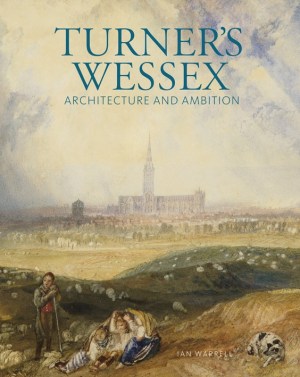 Turner was only 20 in 1795 when he first visited Salisbury. This book focuses on the important commissions that resulted from his contact with the region, which provided the foundations for his success. Reunited here are his inventive watercolours of Salisbury Cathedral painted for Sir Richard Colt Hoare, widely dispersed since 1883. Turner’s matchless ability to depict architecture also attracted the attention of the eccentric art lover and writer, William Beckford. The problematic construction of Beckford’s legendary but short-lived neo-gothic abbey at Fonthill was uniquely recorded in Turner’s sketches and watercolours.
As his career developed, Turner repeatedly revisited an area that captivated him. His depictions of Stonehenge, in particular, proved to be among his most hauntingly atmospheric works. In this beautifully illustrated book many rarely seen works are brought together, illuminating this formative and fascinating period in Turner’s output.
Ian Warrell is an independent curator, specialising in British art of the nineteenth century. He is the author of many books on Turner, most recently Turner’s Sketchbooks.
Getty Research Institute: Art and Materiality, 2015/2016
A selection of this year’s Getty scholars working on the eighteenth century:
Getty Research Institute: Art and Materiality, 2015/2016
In the past decade, a greater attention to the art object and its materiality has enhanced the study of art history, opening new avenues of investigation. Combined with more historical methodologies, the focus on the materiality of artworks is offering profound insights into their meanings. Artists across time and space have infused materials not only with ritual and symbolic significance but also social, political, and economic functions. Art historians, increasingly in collaboration with conservators and scientists, are gaining insight into the process of art making from raw material to finished object, the chaîne opératoire, as well as the strategic deployment of materials both for their aesthetic qualities and for their power to signify. The inquiry into an artwork’s materiality raises questions about procurement, trade, value, and manufacturing on the one hand, and, on the other, about the materiality of mechanically reproduced objects or of ephemeral, durational, and conceptual works. Finally, as artworks move between cultures, their materials—whether feathers, shells, marble, or oil paint—are given new meanings, thereby accumulating additional interpretive layers.
G E T T Y S C H O L A R
Corinna Gramatke is an independent scholar based in Düsseldorf, Germany. Her research concentrates on material-technical research and written art-technological sources from Spain and Latin America of the seventeenth and eighteenth centuries.
José Sánchez Labrador’s Manuscript Paraguay natural ilustrado (1771–76): Critical and Annotated Edition of the Chapters Dealing with Art Technological Materials and Indications for the Artistic Production in the Jesuit Missions in Paracuaria during the Seventeenth and Eighteenth Century
(April–June)
Fernando Guzmán is Associate Professor at the Universidad Adolfo Ibáñez, Santiago, Chile. He specializes in Spanish colonial art.
From Polychrome Wood to White Marble: Devotional Art in Santiago de Chile during the Eighteenth and Nineteenth Centuries
(January–March)
Gabriela Siracusano is Director of the Centro de Investigación en Arte, Materia y Cultura at the Universidad Nacional de Tres de Febrero, Buenos Aires, Argentina; Career Scientific Researcher at the Consejo Nacional de Investigaciones Científicas y Técnicas in Buenos Aires; and Professor of Theory and Historiography at the Universidad de Buenos Aires. Her research concerns Andean colonial artistic production and artistic materiality.
The Bowels of the Sacred
(January–March)
P O S T D O C T O R A L F E L L O W
Noémie Etienne received her doctorate in the Department of Art History from the University of Geneva, Switzerland, and University of Paris 1 Sorbonne, France.
A Material Art History? Paintings Restoration and the Writing of Art History
(September–June)
A full list is available here»
Lecture | Christoph Vogtherr on Karoline Luise of Baden
Later this summer at The Wallace Collection:
Christoph Vogtherr | Karoline Luise of Baden: Collector and ‘Amatrice’
The Wallace Collection, London, 7 August 2015
Karoline Luise, Markgräfin (Marchioness) of Baden was one of the greatest women collectors of the eighteenth century and an accomplished amateur artist. Her collection of paintings and drawings—including works by Chardin, Boucher and Liotard—forms the nucleus of the Kunsthalle in Karlsruhe in Southern Germany. Christoph Vogtherr will discuss the collecting and interests of this fascinating figure. The Wallace Collection is embarking on a collaboration with the Kunsthalle towards an exhibition of French drawings from the Karlsruhe collection.
Friday, 7th August, 2015 at 1:00pm; admission is free.
Exhibition | Korea Mania: A Traveller’s Tale
On view in Sèvres:
Corée Mania: Roman d’un Voyageur
Cité de la Céramique, Sèvres, 21 January — 20 July 2015
Curated by Stéphanie Brouillet
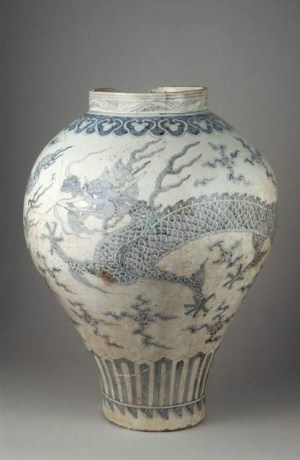
Dragon Jar, Korean, 18th century (MNC28154 Sèvres – Cité de la céramique / RMN)
Cité de la céramique célébre en 2015 les Années croisées France-Corée, en organisant deux expositions: l’une patrimoniale avec Roman d’un voyageur, l’autre contemporaine à travers la présentation des œuvres de Yik-Yung Kim et Yeun-Kyung Kim.
Du 21 janvier au 20 juillet, l’exposition Roman d’un voyageur s’articule autour de la figure emblématique du diplomate Victor Collin de Plancy (1853–1922), premier consul de France en Corée qui collecta de nombreux objets et œuvres d’art coréens. L’exposition invite à un double voyage : celui vers la péninsule coréenne, au cœur de l’Extrême-Orient, à la découverte d’une culture ancienne et raffinée, et l’autre sous la forme d’une plongée dans le temps, vers le « royaume ermite » de la fin de l’époque Choson, à la fin du XIXe siècle.
De nombreuses céramiques dont certaines exceptionnelles du 1er siècle de notre ère à nos jours, dont la grande jarre à décor de dragon du XVIIIe siècle, considérée comme un chef-d’oeuvre des collections nationales conservées par l’établissement, sont présentées ainsi que du mobilier, des instruments de musique, des objets quotidiens, des photographies, des peintures, des documents d’archives qui évoquent le pays et son art de vivre.
Une journée d’étude sur le céladon, à la fois sous l’angle historique mais aussi scientifique, prévue à l’automne, viendra ponctuer cette saison coréenne à la Cité de la céramique.
Le commissariat est assuré par Stéphanie Brouillet, conservatrice du patrimoine chargée des céramiques asiatiques à Sèvres. La scénographie est confiée au designer Vincent Dupont-Rougier.
A summary in English is available from the Asia Europe Museum Network (ASEMUS):
◊ ◊ ◊ ◊ ◊
The catalogue is published by Loubatières:
 Roman d’un Voyageur, Victor Collin de Plancy: L’histoire des Collections Coréennes en France (Carbonne: Loubatières, 2015), 263 pages, ISBN: 978-2862667195, 39€.
Victor Collin de Plancy fut le premier représentant de la France en Corée entre 1888 et 1906. Interprète puis diplomate, il se passionna pour l’histoire et l’art de ce pays resté longtemps fermé pour les Occidentaux. Désireux de le faire connaître en France, il rassembla un grand nombre d’objets—céramiques, manuscrits, livres, meubles ou costumes—dont il fit don à des institutions françaises au rang desquelles figure le Musée national de la céramique. Il fut également au cœur d’un petit groupe de voyageurs passionnés par la Corée qui, à leur tour, enrichirent les collections françaises.
A preview of the catalogue is available here»
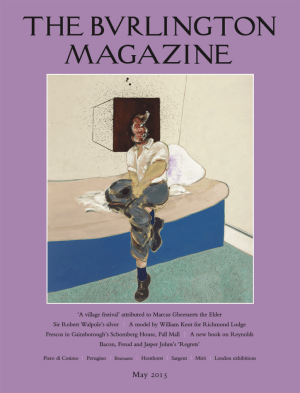
The Burlington Magazine, May 2015
The eighteenth century in The Burlington:
The Burlington Magazine 157 (April 2015)
 A R T I C L E S
• Tessa Murdoch, “Power and Plate: Sir Robert Walpole’s Silver,” pp. 318–24.
• Julius Bryant, “Queen Caroline’s Richmond Lodge by William Kent: An Architectural Model Unlocked,” pp. 325–30.
R E V I E W S
• Duncan Robinson, Review of Mark Hallet, Reynolds: Portraiture in Action (The Paul Mellon Centre for Studies in British Art, 2014), pp. 341–47. Available at The Burlington website for free.
• Stephen Lloyd, Review of Cory Korkow with Jon Seydl, British Portrait Miniatures: The Cleveland Museum of Art (D. Giles, Ltd., 2013), pp. 349–50.
• Richard Wolfe, Review of the exhibition Shifting Patterns: Pacific Barkcloth Clothing (British Museum, 2015), pp. 361–62.
• Jamie Mulherron, Review of two exhibitions: Charles de La Fosse: Le Triomphe de la Couleur (Versailles and Nantes, 2015) and Bon Boullogne (1649–1717): Un chef d’école au Grand Siècle (Dijon, 2014–15), pp. 365–67.










 Enfilade
leave a comment