Call for Papers | Fancy‒Fantaisie‒Capriccio: Diversions and Distractions
From the Call for Papers:
Fancy‒Fantaisie‒Capriccio: Diversions and Distractions in the Eighteenth Century
Toulouse, 3–4 December 2015
Proposals due by 31 March 2015
Keynote speaker: Professor Martin Postle, Deputy Director of Studies, Paul Mellon Centre for British Art
In conjunction with the exhibition of paintings, Fantasy Figures, to be held at the Musée des Augustins, Toulouse, the Université de Toulouse Jean Jaurès and the University of Exeter are pleased to announce a call for papers for an interdisciplinary colloquium.
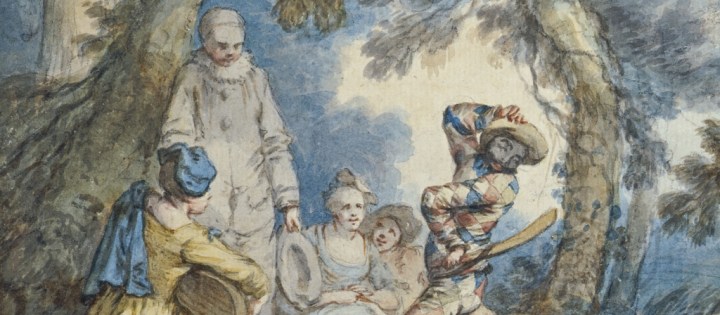
Associated with the imagination and not reason, fancy (fantaisie) in the eighteenth century was a sort of whimsical distraction from the everyday. For Voltaire it was ‘a singular desire, a passing whim’ (‘un désir singulier, un goût passager’), while for Samuel Johnson it was ‘something that pleases or entertains without real use or value’. Together with its near-synonym caprice (capriccio), fancy was part of a rich semantic network, connecting wit, pleasure, erotic desire, spontaneity, improvisation, surprise, deviation from norms, the trivial and inconsequential. Unpredictable and quirky, it offered many outlets for artistic creativity.
Papers are invited that investigate the expressive freedom of fancy (fantaisie, capriccio) in European culture during the eighteenth century—in figure and landscape painting, architecture and garden design, philosophy and fiction, theatre and music. Topics may include, but are not limited to the following:
• Tensions between fancy/capriccio and reason
• Fancy’s relationship to the imagination
• Fancy as a precursor of the Gothic and the fantastic
• The fancy picture or tête de fantaisie
• Capriccio in landscape, architectural painting, engraving
• Fancy in conjunction with a space, place or decorative schema
• Fantasia in musical composition or musical theatre
• Anecdote, imagination and desire in fiction
• The role of fancy in the discourse of love and seduction
• Creativity as a deviation from norms and rules
The colloquium will incorporate a guided visit of the fantasy figures exhibition with the curators. It is hoped that a volume of published essays will arise from the event. Participants should be prepared to meet their own travel and accommodation expenses. Refreshments will be provided on the day. Proposals (maximum 250 words in English or French) should be submitted to Professor Melissa Percival, University of Exeter, M.H.Percival@exeter.ac.uk by the 31 March 2015.
LACMA’s New Vicente Albán Paintings

Vicente Albán, Indian Woman in Special Attire (India en traje de gala), ca. 1783, Los Angeles County Museum of Art, purchased with funds provided by the Bernard and Edith Lewin Collection of Mexican Art Deaccession Fund.
◊ ◊ ◊ ◊ ◊
From LACMA’s Unframed (28 January 2015) . . .
LACMA’s New Vicente Albán Paintings from Ecuador Now on View
Ilona Katzew, Curator and Department Head, Latin American Art
Back in 1996, when I organized my first exhibition of Spanish colonial art in New York City, I included a group of fascinating works portraying racial types from Ecuador. The paintings were part of a set of six canvases, four of which had just been acquired by a private collector. The whereabouts of the two missing canvases was at the time unknown. Inscribed with the numeral 1 in the lower center, it was clear that this set was the first of two. The other series (bearing the numeral 2) is now in the Museo de América in Madrid and was shipped to Spain’s Royal Cabinet of Natural History in the late 18th century. It is signed by the Quito master Vicente Albán (active 1767–96). LACMA’s recent acquisition of the two missing paintings from the first set is thrilling. What makes these paintings exceptional? To start, there were only two sets created of Ecuadorean racial types (in contrast to the over 120 sets of the popular Mexican casta paintings that I have identified to date). Striking for their meticulous portrayal of local bounty and combination of indigenous and European textiles and jewels, the works are also eloquent documents of the Hispanic Enlightenment.

Vicente Albán, Noble Woman with Her Black Slave (Sra. principal con su negra esclava), ca. 1783, Los Angeles County Museum of Art, purchased with funds provided by the Bernard and Edith Lewin Collection of Mexican Art Deaccession Fund.
In Noble Woman with Her Black Slave, the white (or Spanish) woman wears an array of exquisite textiles, a string of pearls, and other jewels such as a gold crucifix and oval reliquary to signal that she is Catholic (and hence ‘civilized’). Her black slave (a conventional status symbol) is more modestly, if still lavishly, bedecked and is depicted barefoot. Worth noting are the ‘black’ flowers of the noblewoman’s skirt and hat. Scientific analysis has shown that they were originally painted in silver—a feature that would have bolstered the image of the colony as a land of unsurpassable riches. Though now irreversibly tarnished, it is not hard to imagine the impact that the painting once caused, peppered with abundant touches of gold and silver.
In Indian Woman in Special Attire, ancient indigenous costume elements—including a tupu (metal pin) fastening her lliclla (shoulder mantle), a belt with tocapus (geometric motifs associated with rank), which was an essential part of a coya, or queen’s dress, and a small chu’spa (a bag to carry coca leaves that gave energy and staved off hunger)—are combined with elements of European dress, such as the lavishly ornamented lace collar and sleeves of her blouse. Noticeable, too, is the black fabric laid over her skirt, fastened with a black sash. The X-radiograph clearly shows the large-sized pin, which is difficult to see due to the tarnishing of the metallic silver paint. It also reveals a delicate herringbone pattern on the woman’s mantle, now virtually undetectable to the naked eye. The pattern may suggest that this is a textile type known as tornasol (literally meaning ‘turns to the sun’). These shimmering silk fabrics were highly coveted in Europe and favored by the Spanish nobility. Colonial Andean weavers skillfully adapted them to their ancient textile traditions by combining a dark fiber warp (usually made of alpaca) and brighter contrasting weft (commonly silk). When the fabrics moved, they caught the light and created a glimmering two-tone effect. Contemporaneous travelers described this kind of pleated mantle as a distinct costume element worn by noble Indians.
One of the most salient elements of the paintings is the gigantic fruit placed next to the figures, making an explicit connection between the region’s inhabitants and its flora. The works convey a sense of American nature as extravagantly fertile. In Europe there existed the widespread idea that the Americas were an unusually hot place where nature and people—regardless of their racial makeup—ripened and spoiled quickly. These paintings counter such notion by representing local types from Ecuador dressed in lavish clothing and standing next to an assortment of giant tropical fruits, emphasizing the abundance of the land. An elaborate key in the lower section describes the trees and fruits, directing the viewer to selected parts of the canvases. This technology of production and reception of meaning was amply used in New World pictures (though it was by no means exclusive to it) to render ‘difference’ clear, transmit specific information, and reinforce the overall efficacy of messages.
Several scholars have linked the set at the Museo de América in Madrid with the Spanish botanist José Celestino Mutis (1732–1808), who led an important royal-sponsored expedition to the viceroyalty of Nueva Granada (1783–1816), and produced thousands of images of the region’s flora. (Nueva Granada refers to the Spanish colonial jurisdiction in northern South America, corresponding mainly to modern Colombia, Ecuador, Panama, and Venezuela.) This would explain the equal emphasis lavished on the racial types of the region and the precise botanical renditions that show both the exterior and the interior of local fruits. Throughout the 18th century, the Spanish Crown sponsored a number of expeditions to the Americas to gain better knowledge of their natural resources and exploit them for commercial ends. The production of images became an inherent part of these Enlightenment-era imperial taxonomic projects.
Despite the scant information about Vicente Albán (who signed the Madrid set), we know that he often collaborated with his brother, Francisco (1742–88), and that they both were regarded among the most prominent Quito painters of the day. Mutis may have commissioned Vicente to paint the Madrid set as a gift for Madrid’s Royal Natural History Cabinet, which was established in 1771. LACMA’s paintings, which are not signed, are very similar to the works in Madrid. But they also present intriguing formal and stylistic differences. The Madrid set, for example, is painted more freely and possibly by more than one hand, suggesting that it was created with workshop assistance. The figures in the LACMA pictures, on the other hand, seem to sit better in space and are more restrained in their handling of details (check back next week on Unframed to read more about the conservation process of these paintings). It is likely that Mutis also commissioned the set to which LACMA’s paintings belong as a gift for another important patron who supported his expedition. It is important to keep in mind, however, that LACMA’s set also could have been commissioned by another Enlightened royal functionary that remains unidentified. Commissioning replicas was part and parcel of the culture of image making at the time, and it was not uncommon among Spanish functionaries to request copies of the same image. In addition, artists often copied their own paintings, which had an important place in their workshops. Rich in detail, these two extraordinary pictures add an important dimension to our collection of viceregal art. A more complete study of the works will soon be published in a handbook of LACMA’s growing Spanish colonial collection.
Exhibition | Close-up and Personal: Eighteenth-Century Gold Boxes
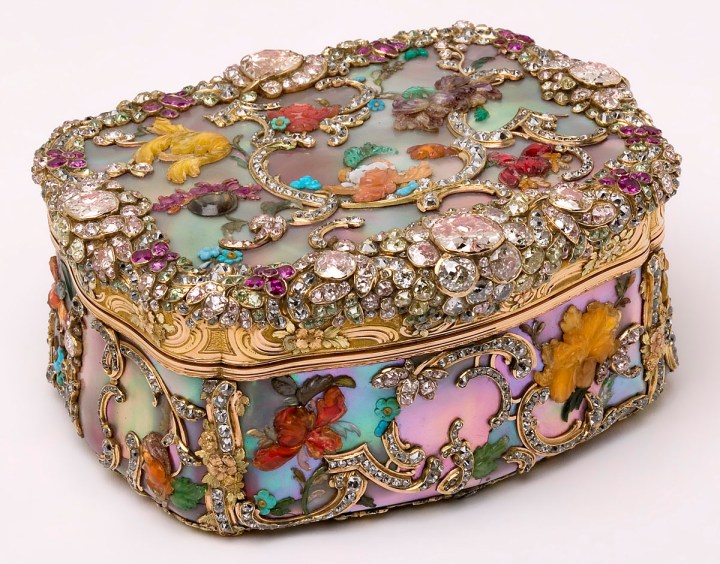
Snuffbox with Flowers, Berlin, Germany, ca. 1765, from the Rosalinde and Arthur Gilbert collection on loan to the Victoria and Albert Museum, London (formerly in the collection of Frederick II of Prussia, 1712–1786), photo Victoria and Albert Museum, London.
◊ ◊ ◊ ◊ ◊
A loan exhibition from the V&A, Close-Up and Personal includes 28 boxes in LA and nearly 60 in Cambridge. As reported by Paula Weideger for The Financial Times in 2009, the history of the fate of the collection is complicated, thanks partially to Arthur Gilbert’s conflicted relationship with LACMA, where he served as a member of the board of trustees. From LACMA:
Close-up and Personal: Eighteenth-Century Gold Boxes
from the Rosalinde and Arthur Gilbert Collection
Los Angeles County Museum of Art, 6 September 2014 — 1 March 2015
The Fitzwilliam Museum, Cambridge, 24 March — 6 September 2015
“So small a thing imposes on people,” remarked the notorious Giacomo Girolamo Casanova (1725–1798), who also carefully selected the type of tobacco to send inside such boxes when he presented them as gifts. Taking snuff and carrying it with you in an elaborate container was a universal practice in 18th-century Europe. A year before the death of the Elector of Cologne, one of the most powerful men in Europe at the time, Casanova had been given a snuffbox decorated with the Elector’s portrait. Going incognito to the Ridotto (the famous gambling halls of Venice), it was important that Casanova use an accessory he had not been seen with before. However, the very distinctive gold box with the Elector’s portrait eventually betrayed him when a former lover remembered it.
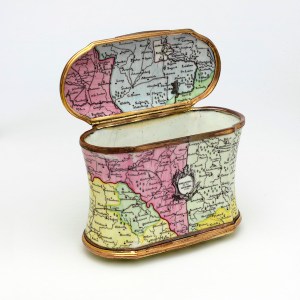
Double Snuffbox with Maps, ca. 1757, possibly Berlin, Germany, from the Rosalinde and Arthur Gilbert collection on loan to the Victoria and Albert Museum, London.
You yourself may recognize some of the gold boxes on view at LACMA through March 1, 2015. Carefully collected by Rosalinde and Arthur Gilbert in Los Angeles, they are here on loan from the Victoria and Albert Museum in London. Designed to carry just a small amount of powdered tobacco, the fine decorations of these pocket-sized containers have to be examined close up. The proximity of the viewing experience makes it very personal, intensifies the response, and can be a powerful experience when shared. Even today, a common reaction when examining them is wonderment, but these complex objects also have the potential to spark a wide range of emotions. Infinitely customizable, gold boxes became the most versatile form of gift in the 18th century.
Unlike the cups of precious metal that continue to lend themselves to specific types of acknowledgment such as loyalty of service or achievements in sport, these portable presents made it possible to communicate a spectrum of sentiments in a variety of social situations. While the double snuffbox covered with maps detailing maneuverings in the Seven Years’ War was probably made in Berlin or among the Prussian allies, other examples are less readily attributable to one side of the conflict. The same imagery would have been understood as a political statement and demonstration of allegiance by participants on either side.
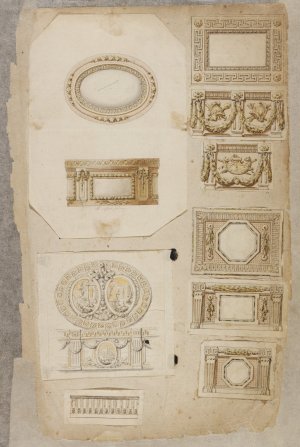
Pierre-Philippe Choffard, Design for an Oval Gold Box, 1759, Victoria and Albert Museum, London.
Elite production of the flashiest boxes was controlled by Frederick II, King of Prussia from 1740 to 1786, who banned imports from France (the unrivalled center of production at the time) “for the best [interest] of the gold workers in Berlin.” He presented some of his lavish commissions to courtiers and other sovereigns, and the local industry flourished under his patronage. Frederick’s personal enjoyment of these intensely bejeweled trinkets, and appreciation for their artistry, inspired him to engage with the manual process of designing them himself. Often the precious metal of the boxes is marked, revealing the places, names, and sometimes dates attached to their making and circulation. However, the designers, royal or otherwise, upon whose creativity all gold snuffboxes depend, cannot be as readily identified. A design on paper signed ‘Choffard fecit 1759’ for a box bearing the mark of maker Jean Ducrollay, is the great exception. However, we have very little information about Pierre-Philippe Choffard as a man or an artist.
Tantalizing details are a major characteristic of gold boxes, and eccentric examples have captivated many onlookers through their puzzling appearance. Like other curious objet d’art, such as the elephant supported musical vanity box (called a nécessaire), some snuffboxes were more than just containers. In the form of gadgets or figurines, they beg to be picked up and turned over in the hand. For example, a delicate box imitating a wicker basket reveals (when the lid is lifted) a cornucopia of fruit painted to fool the eye.
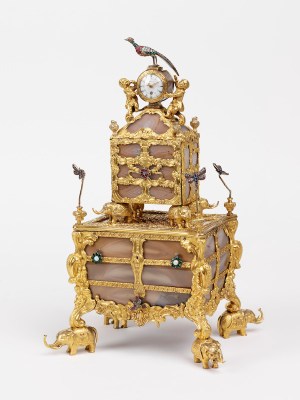
James Cox, Nécessaire, ca. 1770, from the Rosalinde and Arthur Gilbert collection on loan to the Victoria and Albert Museum, London.
You would have to travel to Strawberry Hill near London, the residence of Horace Walpole (1717–1797), to see a truly bizarre example of a snuffbox commissioned exclusively as a curiosity rather than a functional object. Exploiting the genre’s reputation for erudite encoding and connoisseurial delectation, it titillates through its command of wit. An elaborate ruse, it was conceived by the French patron of the arts Marie Anne de Vichy-Chamrond, marquise du Deffand (1697–1780) as a fake declaration of love from a social rival of hers to Walpole, the fourth Earl of Orford and a famous English collector. Her good friend was completely taken in by the exquisite portrait-clad box containing a flattering letter, and he wrote to the marquise about the excitement it gave him. Although the prank was at his expense, he seems to have been rather tickled by the incident. In the introduction to the catalog of his private collections, he recounts the practical joke as an enticement to his readers.
There can be no joking about the significance of the display of gold snuffboxes in the Koenig Gallery. Nothing prepares you for the power of these petite and precious masterpieces of extraordinary design and making. To really understand their attraction, you must encounter the real thing. And once you do, you will have an insider’s view of the preoccupations and passions of 18th-century aristocrats as well as an admiration for the genius of the best makers and designers of the period. With their curious shapes, elaborate surfaces, and the intriguing thoughts they express, gold boxes are some of the most delightful objects ever made.
New Book | Commercial Visions in the Dutch Golden Age
From The University of Chicago Press:
Dániel Margócsy, Commercial Visions: Science, Trade, and Visual Culture in the Dutch Golden Age (Chicago: The University of Chicago Press, 2014), 336 pages, ISBN: 978-0226117744, $40.
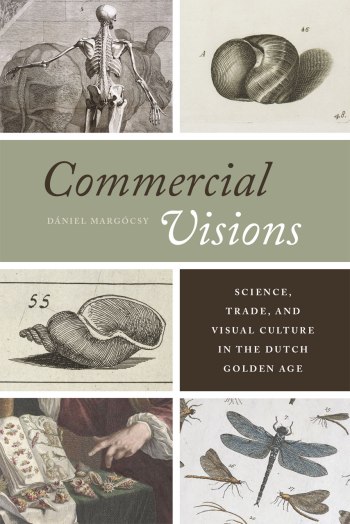 Entrepreneurial science is not new; business interests have strongly influenced science since the Scientific Revolution. In Commercial Visions, Dániel Margócsy illustrates that product marketing, patent litigation, and even ghostwriting pervaded natural history and medicine—the ‘big sciences’ of the early modern era—and argues that the growth of global trade during the Dutch Golden Age gave rise to an entrepreneurial network of transnational science.
Margocsy introduces a number of natural historians, physicians, and curiosi in Amsterdam, London, St. Petersburg, and Paris who, in their efforts to boost their trade, developed modern taxonomy, invented color printing and anatomical preparation techniques, and contributed to philosophical debates on topics ranging from human anatomy to Newtonian optics. These scientific practitioners, including Frederik Ruysch and Albertus Seba, were out to do business: they produced and sold exotic curiosities, anatomical prints, preserved specimens, and atlases of natural history to customers all around the world. Margócsy reveals how their entrepreneurial rivalries transformed the scholarly world
of the Republic of Letters into a competitive marketplace.
Margócsy’s highly readable and engaging book will be warmly welcomed by anyone interested in early modern science, global trade, art, and culture.
Dániel Margócsy is assistant professor at Hunter College, City University of New York.
◊ ◊ ◊ ◊ ◊
C O N T E N T S
List of Illustrations
1 Baron von Uffenbach Goes on a Trip: The Infrastructure of International Science
2 Shipping Costs, the Exchange of Specimens, and the Development of Taxonomy
3 Image as Capital: Forging Albertus Seba’s Thesaurus
4 Anatomical Specimens in the Republic of Letters: Scientific Publications as Marketing Tools
5 Commercial Epistemologies: The Anatomical Debates of Frederik Ruysch and Govard Bidloo
6 Knowledge as Commodity: The Invention of Color Printing
7 Peter the Great on a Shopping Spree
Acknowledgments
Abbreviations
Notes
Bibliography
Exhibition | Enlightenment: Carte Blanche of Christian Lacroix
◊ ◊ ◊ ◊ ◊
Press release from the Musée Cognacq-Jay:
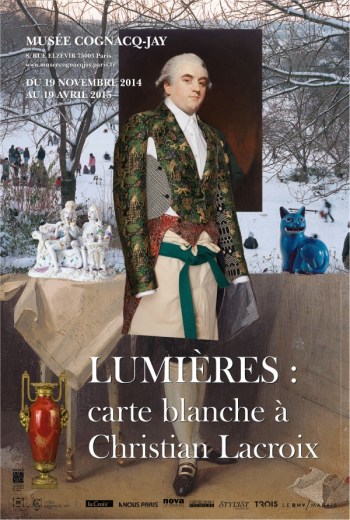
Lumières: Carte Blanche à Christian Lacroix
Musée Cognacq-Jay, Paris, 19 November 2014 — 19 April 2015
Curated by Christian Lacroix and Rose-Marie Mousseaux
In celebration of its grand reopening, the Musée Cognac-Jay has offered Christian Lacroix a creative carte blanche.
Established in 1928 by the founder of the La Samaritaine department store, Ernest Cognacq, in 1990 the museum was transferred to the Hôtel Donon, a recently-renovated sixteenth-century townhouse in the Marais district. The Musée Cognacq-Jay is home to a collection of emblematic eighteenth-century artworks, selected by its founder to be displayed in wood-panelled rooms representative of “the artistic décor of French life.”
Renowned for his creative collaborations with museums, Christian Lacroix has accepted the dual challenge of reimagining the ‘guiding narrative’ of the exhibition spaces while exploring a concept which has shaped his own approach to his art—the fascination exerted by the eighteenth century. He has curated contributions from over 40 contemporary artists, invited to reflect upon ten key themes identified in Ernest Cognacq’s collections with a view to enhancing our understanding of the Age of Enlightenment and its continued relevance in our own era.
◊ ◊ ◊ ◊ ◊
Christian Lacroix
Visions of the Enlightenment
 My perspective on the Age of Enlightenment is simply that of someone who is passionate about that era. It is an indirect perspective of the late 19th and early 20th century, when the Cognacqs built up their collection in consultation with ‘enlightened’ art historians. However, I admit that its influence on my work is less clear, as I see myself as more Dionysian than Apollinian. I can only gratefully advocate everything that the Enlightenment brought about in terms of social progress, political thinking, the fight against obscurantism, tolerance and a thirst for knowledge, as demonstrated by the encyclopaedists. All the more so given that, paradoxically, this seemingly unshakeable knowledge, these foundations that were thought to be the definitive basis of modern societies were suddenly undermined, disputed and denied in the early 21st century. If only for these reasons, it is interesting to make these connections between the 18th century and our own times. However, in my opinion we should also consider 19th-century taste—the ‘century of the pastiche’—when almost nothing new was created. Post-Napoleon III, decorative arts did nothing but ‘sample’ previous centuries, just as the Romantic period revived the medieval troubadour. There was no sign of pure, ex nihilo ‘contemporary creativity’, unlike what was emerging in England and the northern countries. From 1880 to 1910, people were expected to live in accordance with good taste—that is, past tastes—as the middle class post-Napoleon III adopted the style of the pre-Revolution enlightened aristocracy. I must confess that, beyond my appreciation and respect for the Age of Enlightenment, I am not impervious to all the rococo froth it created and inspired in the second half of the 19th century and beyond, with the somewhat risqué ‘marquise’, ‘shepherdess’ style, which was basically bourgeois and borderline kitsch. Contemporary artists often look back upon the 18th century from this angle.
◊ ◊ ◊ ◊ ◊
Rose-Marie Mousseaux, Director of the Musée Cognacq-Jay
A Return to the Museum’s Founding Vision
The Musée Cognacq-Jay is more than just a general collection of 18th-century art. It is an evocation of the taste in the 1900s for the Age of Enlightenment. The artistic collaboration with Christian Lacroix happened at exactly the same time as we were rethinking our vision of the Musée Cognacq-Jay, its place among Paris’s museums today, and what it has to offer in terms of revealing the appeal of the 18th century. To develop our 21st-century perspective, we had to go back to the founding vision of Ernest Cognacq, philanthropist and founder of the La Samaritaine department store who bequeathed the works to the City of Paris.
The exhibition design had not been reviewed since the museum moved premises in 1990, although the thematic display of the works had changed over time. This resulted in the creation of a temporary exhibition space but also led to an imbalance between the number of exhibits and the space in the rooms to display them. The empty galleries detracted from the ‘charm’ of the tour through the wood-panelled rooms. Finally, when the exhibits in the collection underwent the statutory inspection of their condition and physical integrity, we were able to look at each item in greater detail and consider its importance and meaning in the context of the collection as whole.
Today, the challenge is to make the museum’s layout clearer by structuring it around better defined themes. By giving Christian Lacroix carte blanche, we were able to identify ten recurring themes within the collection and structure them around two key aspects of 18th-century society—the importance of social occasions and the emergence of the individual. The layout has therefore been designed to go beyond the chronological limits of the temporary exhibition and incorporate several of the themes explored in the museum’s future permanent exhibition spaces. We adopted the same approach when deciding how to present each theme.
Christian Lacroix played a key role in presenting the collections in a way that was both physical and conceptual. The carte blanche that we gave him marks a highlight in the history of the Musée Cognacq-Jay. The temporary exhibition that he has curated combines contemporary works with historical exhibits and is an opportunity to reconsider our perspective of the Age of Enlightenment, its promises, and disappointments by inviting visitors to explore and reflect upon its legacy.
◊ ◊ ◊ ◊ ◊
The New Museum Layout
Thanks to Christian Lacroix’s input, we have been able to rethink how the museum’s collections are displayed and show the exhibits in a new light by presenting them in a more structured way that reflects the personalities of Ernest Cognacq and Marie-Louise Jay. The themes explored as part of this new layout reflect the different motifs found in the collection, which were influenced by the choices made by Ernest Cognacq and Marie-Louise Jay as collectors and by the major artistic movements of the 18th century.
The tour begins in the introductory room, which explains the history of the collection and its founders. After that, the exhibition is structured around ten different themes:
• Sensory experience and knowledge in the 18th century (room 2)
• Shows, balls, and sociability (rooms 3 and 4)
• Paris, capital of the Enlightenment (room 5)
• Europe’s artistic economy (rooms 6 and 7)
• 18th-century exoticism (room 8)
• The classical model (room 9)
• Childhood and education (rooms 10 and 11)
• Portraits and the emergence of the individual (rooms 12, 13 and 15)
• The age of Boucher (room 14)
• Fables, stories, and novels (room 17)
Throughout the exhibition, Christian Lacroix draws links between the museum’s collections and photographs, textiles, design pieces, and installations by contemporary artists. In doing so, he encourages visitors to reflect on how the Age of Enlightenment has influenced today’s society and gain a better understanding of its cultural legacy.
Details are available from the press kit, available as a PDF file here»
◊ ◊ ◊ ◊ ◊
It seems to me that the historiographical layers involved with the new presentation of the museum are also playing out in curious ways with the fate of La Samaritaine, the department store founded by Ernest Cognacq; Adan Gopnik provides commentary in “The View from a Bridge: Shopping, Tourism, and the Changing Face of Luxury,” The New Yorker (8 December 2014), pp. 42–47. –CH
The Prado Acquires the Juan Bordes Library
Press release (27 January 2015) from the Prado:

Trattato della Pittura di Leonardo da Vinci . . . di Stefano della Bella (Florence, 1792).
The Museo del Prado is providing detailed information on the content of one of its most recent acquisitions: the Juan Bordes Library. This is one of the most important bibliographical holdings in the world for the study of the human figure, consisting of treatises and drawing manuals from the 16th to the 20th centuries. Within this acquisition, the Museum has received as a donation a sketchbook by the studio of Rubens. It is currently considered the closest to the lost original by the master and also includes two original works by his hand.
The Juan Bordes Library is a unique example of a bibliographical holding specialised in the key areas within artists’ training and the theory of the human figure. Comprising around 600 volumes assembled by Bordes, the library focuses on texts and manuscripts that were used in the training of artists from the 16th to the 20th centuries. Due to their functional nature, these texts have not in the past merited the attention of bibliophiles or art historians. As Gombrich noted in his book Art and Illusion: “it is no mere paradox to say that the rarity of these books in our libraries is symptomatic of their past importance. They were simply, used, torn and handled in workshops and studios, and even surviving ones are often poorly bound and incomplete.” As a result, these manuals and treatises constitute an extremely valuable holding for a knowledge of the methods employed in the training of artists and amateurs in studios and academies. They also tell us about the evolution of aesthetics and the dissemination of artistic models.
 The Bordes Library is structured into six large sections, organised to reflect the key disciplines in an artist’s training, in addition to a group of manuscripts of different types, notably the sketchbook by Rubens received as a donation. The importance of this library is reflected in Juan Bordes’s own 2003 book, Historia de las teorías de la figura humana. El dibujo, la anatomía, la proporción, la fisionomía (History of the Theories of the Human Figure: Drawing, Anatomy, Proportion and Physiognomy), in which he studied the function and history of these books and their role and significance in artists’ training.
This bibliographic holding now joins other specialist libraries acquired by the Prado in recent years: the Cervelló Library, specialising in art theory and celebrations; the Correa Library, which focuses on the art of printmaking and the illustrated book; the Madrazo Library, an example of a library belonging to a dynasty of artists; the libraries of José Álvarez Lopera and Julian Gallego, which are characteristics libraries of art historians who primarily specialised in Spanish art; and the library of Félix de Azúa, centred on aesthetics and the philosophy of art. Through this strategy of acquiring specialist libraries, the Museo del Prado is not only helping to preserve the Spanish bibliographical heritage but also to provide its Study Centre with the research tools necessary for fulfilling its primary mission.
◊ ◊ ◊ ◊ ◊
S T R U C T U R E O F T H E B O R D E S L I B R A R Y
1. Drawing Manuals
This is undoubtedly one of the most important and valuable areas within the Bordes Library, both for the number of items and their rarity. The eminently functional nature of these manuals means that very few of them survived, on occasions only as single copies. Given that they were copied or republished in response to the different requirements of each moment, on many occasions they varied from one edition to another, so that each surviving copy is now almost unique. As a whole this group is extremely important as the study of it will reveal not only differences in the way of teaching drawing at different historical periods but also the models selected,thus reflecting taste of the time. It can be said that this group represents the systematic assembly of the largest surviving group of drawing manuals. Among its contents are three of the founding texts of this type by Fialetti, Cousin and Carracci, as well as examples of the most important ones from later centuries by Rubens, Ribera, Bloemaert etc.
2. Artistic Anatomies
Combining scientific knowledge and art, from Vesalius’s pioneering text onwards, treatises on anatomy reveal the key role of the study of the human figure in artists’ training. Together with life drawing and the copying of plaster casts, the study of anatomy through printed treatises, with particular attention to the study of bones and muscles, was one of the basic principles of an artist’s training. The increasing availability of images in the 19th century made high quality visual media available to students, encouraging a naturalistic approach to the representation of the human body in art. The Bordes Library is particularly rich in treatises from that century, copiously illustrated and with colour assuming a key role. Their relationship with the art of their time is striking, as evident, for example,in the numerous drawings by José Madrazo in the Prado’s collection. Particularly important was the interest in “anatomising classical sculptures,” in other words, anatomical models based on the great paradigms of classical sculpture, once again indicating the close links between science and art.
3. Proportion
As Michelangelo noted, having a compass in one’s eye for constructing harmonious, well-proportioned figures was one of the basic principles of artistic creation. Since Alberti and Dürer’s fundamental treatises, the quest for ideal human proportions within the variety of the human body has been an ongoing interest of artists, evolving in parallel to aesthetic changes. As a result, over the course of the centuries numerous treatises were published that offered artists a repertoire of proportions, either of real human models or of classical sculptures, determining the principles that should govern the construction of the human figure. Although fewer in number than the works in the previous sections, the Bordes Library has examples from different periods and centres, ranging from the 17th to the 20th centuries and from Europe to South America. These texts reveal the spread of a teaching model based on mathematics.
4. Physiognomy
Facial expressions were the subject of the fourth area of an artist’s training. Starting in the Renaissance with Della Porta’s Della Fisionomia dell’ Huomo, followed by the works of Le Brun and Lavater (also represented in this library by a manuscript) and concluding with 19th-century treatises such as Duchenne’s, physiognomy has been a subject of interest both to artists and writers. The Bordes Library contains a notable group of these works, with the principal authors represented by several different editions, allowing for an understanding of the evolution of artistic concerns.
5. Treatises on Painting and Drawing
Complementing the four fundamental areas outlined above, the Bordes Library also has treatises on the practice of drawing and painting, in which these disciplines are related to anatomy, proportion and physiognomy. These varied treatises were widely disseminated and of enormous theoretical importance. Leonardo, Alberti and Hogarth are among the authors represented in different editions. In other cases these treatises, published in different European countries, have hardly been the subject of study, although they must have provided the theoretical bases for many artists. The importance placed on art theory in recent years means that not only the major treatises but other works represented by fine copies in the Bordes Library are of enormous scholarly value.
6. Iconography
Repertoires of portraits and works of art, both paintings and sculptures, make up the smallest section within the library although one that represents a type of publication which was widely disseminated in the past. The fact that repertoires of this type were normally costly, large-format publications and thus not within the reach of all artists led Juan Bordes to focus on books which were more accessible to them, normally in small format and simply illustrated. Nonetheless, the library contains notable examples of visual repertoires, including Perrier’s on classical sculpture and Padre Nadal’s Imágines de la Historia Evangélica, which was exceptionally important for the dissemination of Counter-Reformation models.
7. Manuscripts
The Bordes Library includes a small but exceptional group of manuscript treaties. They are of equal rarity to many of the manuals referred to in the first section and can be classified into two principal groups: manuscripts that constitute the original of a subsequently published or unpublished text (Lavater and his treatise on physiognomy), and those that take the form of notebooks made in the context of the artist’s studio, copying sketches or other notebooks by the master.
Outstanding among them is the above-mentioned notebook by Rubens, known as the Bordes Manuscript. This is a remarkably important example as it constitutes the first proof of the existence of a lost notebook by Rubens in which he set out his ideas on anatomy, proportion, symmetry, optics, architecture and physiognomy and also made numerous drawings. The Bordes Manuscript is the most important of the four known copies, given that in addition to being a direct copy of the original it contains two drawings by Rubens himself. The Museo del Prado houses the largest and finest collection of paintings by Rubens.
Display | Prud’hon: Napoleon’s Draughtsman
Looking ahead to the summer at Dulwich:
Prud’hon: Napoleon’s Draughtsman
Dulwich Picture Gallery, London, 23 June — 15 November 2015
In coordination with London’s celebrations surrounding the 200th anniversary of the Battle of Waterloo, Dulwich Picture Gallery presents Prud’hon: Napoleon’s Draughtsman, the first UK exhibition devoted to Pierre-Paul Prud’hon (1758–1823), a painter and draughtsman who, through his distinctive and unconventional vision, emerged as one of the most exceptional talents working in post-Revolutionary Paris.

Pierre-Paul Prud’hon, Seated Nude with Arm Extended, black and white chalk on blue-tinted (Gray: Le Musée Baron Martin)
A selection of 13 works on paper will celebrate Prud’hon as court artist to Napoleon and Joséphine Bonaparte and as one of France’s greatest draughtsmen. The display will focus on the artist’s extraordinary life studies in white and black chalk, remarkable for their ethereal forms, subtlety of light and shade, and mastery of expression. Whether sketched quickly or finished to perfection, the drawings reveal Prud’hon’s working processes, exploring the constant experimentation that led to the unique blend of Romantic expression and Neoclassical forms that marked him out amongst his contemporaries.
Prud’hon, unlike many of his contemporaries, drew from the live model throughout his career giving him the freedom to focus on certain forms or details without the confines of specific commissions. His drawings, which range from preparatory studies for interior decoration to allegorical compositions (conveying meaning through symbolic figures, actions, imagery, and events) not only demonstrate his incredible skill but also provide a sense of contact with the heart and mind of the artist. On his preferred medium of thick blue paper you can catch a glimpse of his ideas unfolding beneath his chalk, an expression of his thoughts at the moment of creation.
◊ ◊ ◊ ◊ ◊
Known for its outstanding collection of drawings, pastels, and prints by Pierre-Paul Prud’hon, the Musée Baron Martin in Gray is housed in an eighteenth-century château (refurbished between 1777 and 1783), built on the site of a medieval fortress (the fourteenth-century tower remains). More information is available here.
Editorial | Digital Textbooks / Thomas Buser’s History of Drawing

Jacques-Louis David, The Intervention of the Sabine Women, 1794. Black chalk, pen and black ink, gray wash with white heightening on two sheets and five fragments of paper pasted together, 25.7 x 34 cm (Paris: Louvre; photo: T. Le Mage).
Click here for more information.
◊ ◊ ◊ ◊ ◊
As someone regularly faced with assigning new editions of textbooks that seem increasingly overpriced, I wonder how long it will be until resources such as the basic art history survey text are available digitally for free. Yes, these are choppy waters—pedagogically, methodologically, ideologically, and as business practice—further complicated by recent legislation, primarily from California: SB48 signed into law in 2010 along with SB 1052 and SB 10532 signed in 2012. But I think the stakes are high in our getting this right.
Thomas Buser’s History of Drawing, which surveys Western drawing from the fifteenth to twentieth centuries, seems worth noting to me as an early example of what we might see more of in the coming years. I imagine most instructors would assign pieces in conjunction with other materials, but the price (free) facilitates such flexibility. If students in a studio drawing course are introduced to eighteenth-century artists they otherwise wouldn’t know about, that seems useful to me. In the context of a survey, I can imagine building one or two individual class sessions around the topic of drawing with this as a starting point for students. While there aren’t notes—an all too common and unfortunate characteristic of the textbook genre that could be rectified in the digital realm—there is a reasonably extensive bibliography, excluding (at least presently) the twentieth century.
With permissions an ever moving target, we’ve made huge strides during the last decade toward more open policies. Buser has adopted an approach that likely wouldn’t work with publishers (or profits) involved, but again this strikes me as a gain. If the image selection is admirable, in most cases the image quality is not. On the other hand, Buser’s text is also a work in progress, one of the biggest advantages of this new format.
I don’t usually voice opinions too loudly here (I try not to voice many opinions even softly and I’m certainly not speaking on behalf of HECAA), but here’s my concern: if art history—and I have in mind a discipline much larger than the eighteenth century—doesn’t move toward more affordable digital options, we will be further marginalized, characterized as an intellectual luxury, available only to a small, elite segment of higher education. At least at its best, the museum as an institution is premised on public access; it’s time we find some way to extend this vision to introductory art history texts.
–Craig Hanson
◊ ◊ ◊ ◊ ◊
From Busser’s History of Drawing:
History of Drawing is a textbook and reference book available free to anyone who loves drawings. . . .Thomas Buser earned his doctorate in Art History from NYU’s Institute of Fine Arts in 1974. He taught courses in Baroque Art and the course History of Prints and Drawings at the University of Louisville until his retirement in 2005. He has published Religious Art in the Nineteenth Century in Europe and America (two volumes, 2002) and the textbook Experiencing Art Around Us (second edition, 2006).
The Art Bulletin, December 2014
The eighteenth century in The Art Bulletin:
The Art Bulletin 96 (December 2014)
A R T I C L E S
• Cheng-hua Wang, “Whither Art History? A Global Perspective on Eighteenth-Century Chinese Art and Visual Culture,” pp. 379–94.

The Chang Gate (left), 1734, and Three Hundred and Sixty Trades (right), woodblock prints produced in Suzhou, ink and colors on paper; each is 43 x 22 inches (Hiroshima: Umi-Mori Art Museum)
Here, I endeavor to engage the global turn by exploring the connectedness of the world in art that drew China and Europe together in the eighteenth century. My main purpose is to highlight the new scholarship on the art and visual culture of the High Qing dynasty (ca. 1680s–1795). These recent studies reveal that the extent to which the globalized situation was engaged in the art production of the High Qing court and local societies far exceeds previous expectations. Notwithstanding the revered legacy of traditional research on Sino-European artistic interactions of the early modern period, it did not pay much attention to the multiple routes, channels, and contact zones within a global context, nor did it make in-depth explorations into the agency of the Qing emperors, painters, printmakers, and consumers on the issue of how Qing art adopted European styles. Consequently, these new lines of thought have, on the one hand, increased the importance of the comparatively marginal subfield of early modern Sino-European artistic interactions in the studies of Chinese art and, on the other, generated a major revision—not merely a fine-tuning—of the dominant narrative of High Qing art and visual culture (379) . . .
• Nóra Veszprémi, “The Emptiness behind the Mask: The Second Rococo in Painting in Austria and Hungary,” pp. 441–62.
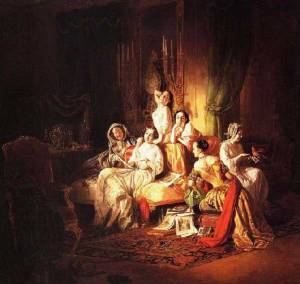
József Borsos, The Morning after the Masquerade (Girls after the Ball) 1850 (Budapest, Hungarian National Gallery)
At the time of its revival in mid-nineteenth-century Austria, the Rococo style was suffused with often contradictory meanings. Regarded as both outdated and fashionable, Austrian and French, simple and pompous, superficial and full of spiritual value, it prompted musings on time, history, and national identity. Closely connected to both the decorative arts and the imagery of popular prints, paintings of the Rococo revival often evoked contemporary concerns about the commodification of art in the industrialized modern world. The ambiguous responses engendered by the Rococo gained special significance in the context of the political tension between Austria and Hungary.
R E V I E W S
• Rebecca Zorach, Review of Andrea Feeser, Maureen Daly Goggin, and Beth Fowkes Tobin, eds., The Materiality of Color: The Production, Circulation, and Application of Dyes and Pigments, 1400–1800 (Ashgate, 2012); and Jeffrey Jerome Cohen, ed., Prismatic Ecology: Ecotheory beyond Green (University of Minnesota Press, 2013), pp. 489–91.
• Brian Kane, Review of Whitney Davis, A General Theory of Visual Culture (Princeton University Press, 2011), pp. 491–93.
Call for Papers | Artistic Correspondences: Rome and Europe, 1700–1900
From H-ArtHist:
Artistic Correspondences: Rome and Europe in the 18th and 19th Centuries
Rome, 15–16 June 2015
Proposals due by 1 March 2015
Epistolary correspondence among artists is a privileged source to unravel the dynamics of intellectual exchange across regional and national boundaries, as it requires a research agenda necessarily focused on ‘mobility’, and a transnational approach and methodology avoiding the rhetorical pitfalls of past European historiography. By focusing on the cosmopolitan context of 18th- and 19th-century Rome as a paradigmatic field of enquiry, the research network Artistic Correspondences: Rome and Europe in the 18th and 19th Centuries aims to recast epistolary exchanges among artists as an inescapable source of information on the transnational circulation of a shared stock of artworks, people, books, models, technical and critical skills across Europe. The organizing research team would like to meet other academics and research groups working on the same topic in order to explore new opportunities of collaboration at a European level.
The workshop to be held in Rome, 15–16 June 2015, is intended to explore new forms of research collaboration and dissemination of sources (e.g. networks, databases, digital repositories, etc.). The ultimate goal of the workshop is to initiate a debate leading to the construction of a digital platform of artists’ correspondences in the modern era. The workshop endorses a synchronic and diachronic approach to the study of artistic correspondences that will enable the mapping of geographical trajectories and cultural exchanges. We particularly welcome proposals illustrating the role of artists’ letters as a tool to study the history and historiography of collections from a comparative and interdisciplinary perspective; as a source offering new clues on the education and professional training of artists and their self promotion (e.g., the links between artists and institutions, artists and patrons, artists and intellectuals, etc.); as a document to trace the circulation of ideas and practices, rather than for sketching individual biographies (with a focus, therefore, on itineraries, geographies, social exchange, etc.); as a material providing insight on technical and specific terminology (e.g. words of practice, description of works of art, etc.).
Abstracts (maximum 200 words) for 25-minute papers should be submitted to Serenella Rolfi (serenella.rolfi@uniroma3.it) before 1 March 2015. We intend to provide travel allowance and/or accommodation for speakers with accepted papers.
Conference Committee: Serenella Rolfi (Dipartimento di Studi Umanistici, Università di Roma TRE), Giovanna Capitelli (Dipartimento di Studi Umanistici, Università della Calabria), Susanne Adina Meyer (Dipartimento di Scienze della formazione, dei beni culturali e del turismo, Università di Macerata), Ilaria Miarelli Mariani (Dipartimento di Lettere, Arti e Scienze Sociali, Università di Chieti), Christoph Frank and Carla Mazzarelli (Istituto di Storia e Teoria dell’arte e dell’architettura, Università della Svizzera Italiana), Maria Pia Donato (CNRS Institut d’Histoire Moderne et Contemporaine). With the cooperation of KNIR, Koninklijk Nederlands Instituut Rome and of the Svenska Institutet i Rom.










 Enfilade
leave a comment