Stuart Miniatures by Liotard on Offer at TEFAF 2015
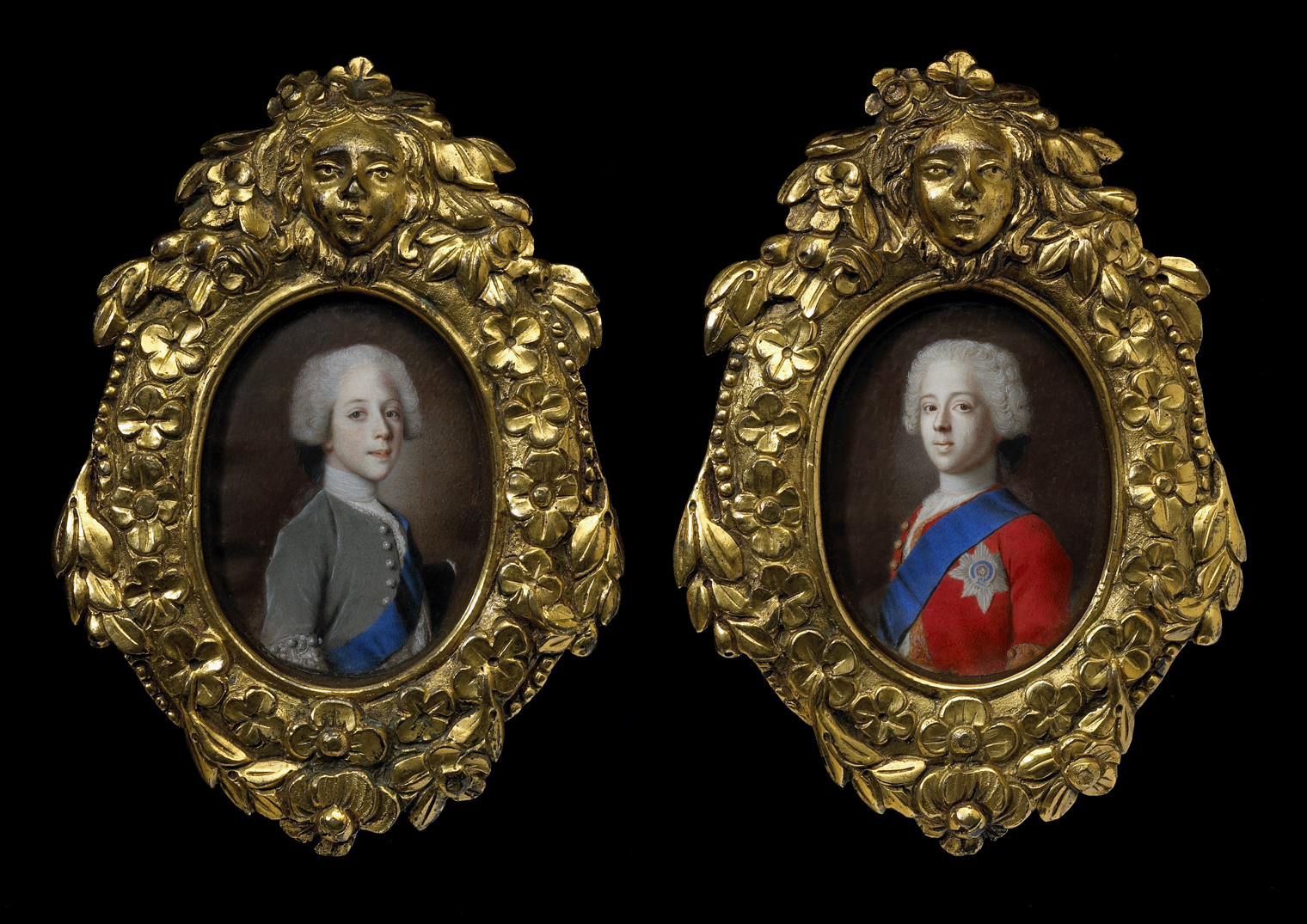
Jean-Étienne Liotard, Prince Henry Benedict Stuart (left) and Prince Charles Edward Stuart (right), ca. 1736–38, watercolour and gouache on vellum, 7.4cm high by 5.5cm wide (excluding frame), €275,000.
◊ ◊ ◊ ◊ ◊
From the press release:
Tomasso Brothers Fine Art at TEFAF
Maastricht, 13–22 March 2015
Recognised as leading dealers in the field of European sculpture, Tomasso Brothers Fine Art also specialises in Old Master paintings and objets d’art. At TEFAF 2015 the gallery unveils an exquisite pair of portrait miniatures by one of the most sought-after masters of the genre Jean-Étienne Liotard (1702–1789), which depict Princes Charles Edward Stuart (1720–1788) and Henry Benedict Stuart (1725–1807), last in the lineage of Stuart Kings in Scotland and England. The asking price for these miniature masterpieces is €275,000.
Born to French parents in Geneva, Jean-Étienne Liotard trained in Paris under the miniaturist and printmaker Jean-Baptiste Massé. While in Rome between 1736 and 1738, Liotard was commissioned by the exiled ‘Old Pretender’ James Edward Stuart (1688–1766) to paint portraits of his young sons Princes Charles and Henry. One of the most romantic figures in British history, celebrated in folklore as Bonnie Prince Charlie, Prince Charles Edward Stuart led the final Jacobite Rebellion of 1745 that was to end in defeat on the battlefield of Culloden.
Powerful and compelling imagery of the Stuart royal family—in the form of portrait miniatures, engravings and prints—was dispatched throughout Europe to garner loyalty and raise funds for the Jacobite cause to re-claim the throne of England. Evidence shows these particular miniatures may have been part of a group of three Stuart portraits sent to Vienna to be seen by Empress Elizabeth, wife of the Holy Roman Emperor Charles VI. A miniature of Prince Charles is also recorded as having been sent to Dorotea, Dowager Duchess of Parma and mother of the Queen of Spain. The attribution has been fully endorsed by Professor Marcel Roethlisberger, author of the definitive 2008 monograph on Jean-Étienne Liotard in which they are illustrated.
Dino Tomasso, one of the Directors of the gallery, comments: “We are delighted to be exhibiting two masterpieces by the highly esteemed Jean-Etienne Liotard. This exquisite pair of miniatures is unrivalled amongst Liotard’s Stuart portraits in terms of their quality, and the fact that they are executed on vellum strongly suggests that they were his primary portraits of the young princes.”
Based at Bardon Hall, Leeds, Tomasso Brothers Fine Art was established in 1993. A second gallery was opened in St. James’s, London in 2013. Dino and Raffaello are recognised internationally for specialising in important European sculpture from the early Renaissance to the Neoclassical periods, with particular expertise in European Renaissance bronzes, along with an in-depth knowledge of Old Master paintings and objets d’art. They have promoted and supported, through loans and exhibitions, major international institutions and were one of the sponsors of the landmark show Bronze at the Royal Academy of Arts, London, 2012. Significant sales have been made to some of the world’s most prestigious museums, including the Bode Museum, Berlin; The Liechtenstein Collection and the Kunsthistorisches Museum, Vienna; the Metropolitan Museum of Art, New York; the Yale Center for British Art, New Haven; and the Art Institute of Chicago.
Provenance
Possibly James Francis Edward Stuart, Palazzo Muti, Rome: whence Empress Elizabeth Christine of Brunswick-Wolfenbüttel, wife of the Holy Roman Emperor Charles VI, Vienna, by 1738.
Sir Alfred Chester Beatty, Clonmannon, Ashfrod, Co. Wicklow, Ireland, by 1968.
Private Collection, England.
Published
Marcel Roethlisberger and Renee Loché, Liotard: Catalogue Sources et Correspondance (Davaco 2008), Volume 1, pp. 257–58; Volume 2, cat. 46 & 49.
Related Literature
Edward Corp, The King over the Water: Portraits of the Stuarts in Exile after 1689 (National Galleries of Scotland, 2001), p.73
Additional information is available here»
New Book | The Buildings of Peter Harrison
From McFarland:
John Fitzhugh Millar, The Buildings of Peter Harrison: Cataloguing the Work of the First Global Architect, 1716–1775 (Jefferson, NC: McFarland, 2014), 244 pages, ISBN: 978-0786479627, $75.
 Perhaps the most important architect ever to have worked in America, Peter Harrison’s renown suffers from the destruction of most of his papers when he died in 1775. He was born in Yorkshire, England in 1716 and trained to be an architect as a teenager. He also became a ship captain, and soon sailed to ports in America, where he began designing some of the most iconic buildings of the continent.
In a clandestine operation, he procured the plans for the French Canadian fortress of Louisbourg, enabling Massachusetts Governor William Shirley to capture it in 1745. This setback forced the French to halt their operation to capture all of British America and to give up British territory they had captured in India. As a result, he was rewarded with commissions to design important buildings in Britain and in nearly all British colonies around the world, and he became the first person ever to have designed buildings on six continents.
He designed mostly in a neo–Palladian style, and invented a way of building wooden structures so as to look like carved stone—“wooden rustication.” He also designed some of America’s most valuable furniture, including inventing the coveted “block-front,” and introducing the bombe motif. In America, he lived in Newport, Rhode Island, and in New Haven, Connecticut, where he died at the beginning of the War of Independence.
Material-culture historian John Fitzhugh Millar has several books to his credit on architectural history, colonial ships, and historic dance; he also runs the historic Bed & Breakfast Newport House in Williamsburg, Virginia.
C O N T E N T S
Preface
1. Carl Bridenbaugh’s Account of Harrison
2. A New Narrative of the Life of Peter Harrison
3. The British Isles and Europe
4. Canada
5. New England
6. The Mid-Atlantic
7. The American South and Atlantic Islands
8. The Caribbean
9. Other Continents–South America, Africa, Asia and Australasia
10. Furniture
Appendices
A. Buildings Attributed to Harrison
B. Student to Teacher
C. Architectural Pattern Books in Harrison’s Library
Illustrated Glossary of Architectural Terms
Bibliography
Index
Louvre Aims to Purchase the Teschen Table
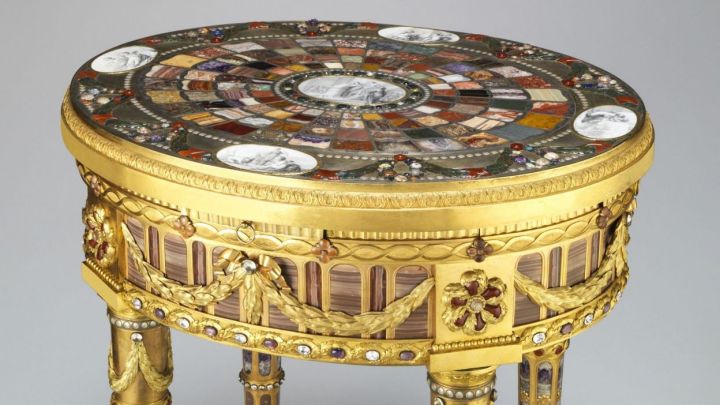
Johann Christian Neuber, Teschen Table, 1779, H. 81.5 cm; W. of tabletop: 70.5 cm, wooden core clad with gilt bronze, hardstones, Saxony porcelain (Photo by Philippe Fuzeau for the Musée du Louvre)
◊ ◊ ◊ ◊ ◊
Included in the exhibition Gold, Jasper, and Carnelian: Johann Christian Neuber at the Saxon Court, the Teschen Table was on view in 2012 at the Grünes Gewölbe (Dresden), the Frick Collection (New York), and the Galerie Kugel (Paris). The Louvre’s campaign to raise acquisition funds for the table runs until the end of January 2015.
Press release (17 October 2014) from the Louvre:
New Donation Campaign for the Acquisition of a ‘Work of Major Heritage Value’
In the wake of the Tous mécènes! (Become a patron!) donation campaigns launched by the museum in 2010 for a painting by Cranach, in 2011 for the restoration of two treasures from Cairo, in 2012 for the acquisition of two magnificent ivory statuettes thought lost, and in 2013 for the restoration of the Winged Victory of Samothrace, the Louvre is once again appealing to the generosity of the general public to raise one million euros to add to its national collection with the purchase of the famous Teschen Table, a masterpiece of 18th-century decorative arts and monument commemorating a key moment in European history.
 The Teschen Table, also known as the Breteuil Table or the Table of Peace, is the only work of its kind, made unique by its illustrious past and virtuoso craftsmanship. Both a table and a piece of jewelry, it was listed as a ‘National Treasure’ then as a ‘Work of Major Heritage Value’ by the French Consultative Commission for National Treasures. The table’s wooden structure, clad with gilt bronze, is inset with 128 numbered samples of semiprecious stones representing Saxony’s geological riches and Saxony porcelain medallions, allegorical celebrations of peace, on the table’s oval top. A booklet from 1780, kept in a drawer beneath the tabletop, identifies each numbered stone. By the precious nature of the materials used, likening it to the work of a jeweler, and the ‘stone cabinet’ layout of the tabletop, the table is a surprising and spectacular display of the rise and development of the natural sciences during the Enlightenment. It masterfully illustrates the secular tradition of decorative furniture made to the glory of European sovereigns.
The total budget for this exceptional acquisition is 12.5 million euros. Every donation, regardless of the amount, will be crucial to the success of the campaign to give the Teschen Table its rightful place in the Department of Decorative Arts. The Louvre is thus appealing to the generosity of the general public once again to raise one million euros before January 31, 2015. At the same time, the museum continues to seek funding from corporations and major donors, and will draw significantly on its own acquisition funds.
A Monument Commemorating European History
 The War of Bavarian Succession broke out in 1778, when Maximilian Joseph, Elector of Bavaria, died without a legitimate heir on December 30, 1777. The clash between contenders to the Bavarian throne, which also threatened the interests of the Prince-Elector of Saxony, centered round the rivalry between the Holy Roman Emperor Joseph II and King Frederick II of Prussia. For six months this conflict, gravely threatening the balance of European power, prompted impressive troop movements and intense diplomatic negotiations. The emperor’s brother-in-law Louis XVI played a dominant role in the ‘diplomatic war’ led by the French foreign minister, the Comte de Vergennes. The king wisely refused to involve France in an armed conflict. Louis-Auguste Le Tonnelier, Baron de Breteuil, his ambassador in Vienna, was charged with vigorously affirming France’s neutrality and offering to mediate.
During the peace negotiations in Teschen, a city now divided into two towns in the Czech Republic and Poland, Breteuil conducted himself courteously, discreetly, and skillfully. The Teschen Peace Treaty was signed on May 13, 1779, under the successful joint mediation of France and Russia. As a mark of gratitude for his ministrations, and particularly for safeguarding the interests of Saxony, Baron de Breteuil received as a gift from Frederick Augustus III, Elector of Saxony, this table decorated with semiprecious stones. The Teschen Table or Table of Peace, a genuine monument commemorating a key event in European history, has remained with his descendants until today. To many historians, the Teschen Table immortalizes the Treaty of Teschen, considered by diplomats to be the first modern treaty in which two nations, France and Russia, served as guarantors of peace between Austria and Prussia and, more globally, collective security in Europe.
A Masterpiece by Johann Christian Neuber, Goldsmith and Mineralogist
Johann Christian Neuber (1736–1808), a hardstone merchant and principal jeweler to the court of Saxony, finished his career as curator of the royal collections amassed in the Grünes Gewölbe (Green Vault) in Dresden by the electors of Saxony since the Renaissance. Herein undoubtedly lies the originality of an artist who was also a man of science and inventor of the ‘Zellenmosaic’ technique, or mosaic composed of hardstones and semiprecious stones extracted from Saxony’s mineral deposits. Neuber was renowned for his snuffboxes, genuine miniature mineral display cabinets captioned with numbers and accompanied with an explanatory booklet, keenly collected by scientists and scholars. The Louvre has twelve of these exceptional Steinkabinett Tabatieren on display in the new Department of Decorative Arts galleries devoted to the 18th century (room 56).
During the Enlightenment, while Paris was the undisputed capital of taste and fashion in Europe, Neuber distinguished himself by his personal, innovative style. With the Teschen Table, Neuber created one of the first neoclassical masterpieces in Germany: shaped feet, garland decoration, palmette friezes, fluted legs reinterpreted to exalt the goût grec (Greek taste). The grisaille medallions painted on Saxony porcelain by Johann Eleazar Zeissig, known as Schenau, are still in keeping with the rococo tradition, but the iconography is clearly inspired by the Antiquity and neoclassical in nature, particularly the central medallion depicting the closing gates of the temple of war and the flame reignited over the altar of Peace.
A New Masterpiece for the Recently Inaugurated 18th-Century Decorative Arts Galleries
Solemnly presented on January 1, 1780 to the Court of Dresden, and celebrated as far as Versailles upon its arrival in France in August, the Teschen Table has remained in the Breteuil family since the 18th century, and has rarely been exhibited outside the Château de Breteuil, in the Chevreuse Valley, 40 km west of Paris. In 2012, it was the focus of remarkable exhibitions at the Grünes Gewölbe (Dresden), the Frick Collection (New York), and the Galerie Kugel (Paris).
The addition of this exceptional table to the Louvre’s new 18th-century decorative arts galleries inaugurated in June 2014 would be a highlight of the museum. Showcased within the revamped museum space, the artwork would be given a worthy setting at the center of the neoclassical masterpieces. Its acquisition is a unique opportunity to welcome a masterpiece whose symbolic, historical, and artistic dimensions naturally resonate with the Louvre’s vocation as a national museum.
New Book | The First Frame: Theatre Space in Enlightenment France
From Cambridge UP:
Pannill Camp, The First Frame: Theatre Space in Enlightenment France (New York: Cambridge University Press, 2015), 299 pages, ISBN: 978-1107079168, $99.
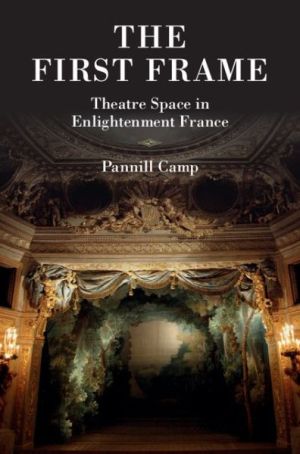 In the late eighteenth century, a movement to transform France’s theatre architecture united the nation. Playwrights, philosophers, and powerful agents including King Louis XV rejected the modified structures that had housed the plays of Racine and Molière, and debated which playhouse form should support the future of French stagecraft. In The First Frame, Pannill Camp argues that these reforms helped to lay down the theoretical and practical foundations of modern theatre space. Examining dramatic theory, architecture, and philosophy, Camp explores how architects, dramatists, and spectators began to see theatre and scientific experimentation as parallel enterprises. During this period of modernisation, physicists began to cite dramatic theory and adopt theatrical staging techniques, while playwrights sought to reveal observable truths of human nature. Camp goes on to show that these reforms had consequences for the way we understand both modern theatrical aesthetics and the production of scientific knowledge in the present day.
Pannill Camp is Assistant Professor of Drama at Washington University, St Louis. His research examines points of intersection between theatre history and the history of philosophy, especially in eighteenth-century France. Before joining the faculty of Washington University, he was a postdoctoral fellow at the Humanities Center at Harvard University and taught in Harvard’s Department of the History of Art and Architecture. At Brown University, he won the Joukowski Family Foundation’s Award for Outstanding Dissertation in the Humanities, and The Weston Award for theatre directing. His work has been published in journals including Theatre Journal, Performance Research, the Journal for Eighteenth-Century Studies, and the Journal of Dramatic Theory and Criticism.
◊ ◊ ◊ ◊ ◊
C O N T E N T S
Introduction: The ‘first frame’ of Enlightenment theatre space
1. The divided scene of theatre space in the Neo-classical era
2. The theatrical frame in French Neo-classical dramatic theory
3. Enlightenment spectators and the theatre of experiment
4. Theatre architecture reform and the spectator as sense function
5. Optics and stage space in Enlightenment theatre design
Epilogue: Modern spectatorial consciousness
Appendix: Dedicated public theatres built in France, 1752–90.
New Book | Fashion Victims
From Yale UP:
Kimberly Chrisman-Campbell, Fashion Victims: Dress at the Court of Louis XVI and Marie-Antoinette (New Haven: Yale University Press, 2015), 352 pages, ISBN: 978-0300154382, $60.
 This engrossing book chronicles one of the most exciting, controversial, and extravagant periods in the history of fashion: the reign of Louis XVI and Marie-Antoinette in 18th-century France. Kimberly Chrisman-Campbell offers a carefully researched glimpse into the turbulent era’s sophisticated and largely female-dominated fashion industry, which produced courtly finery as well as promoted a thriving secondhand clothing market outside the royal circle. She discusses in depth the exceptionally imaginative and uninhibited styles of the period immediately before the French Revolution, and also explores fashion’s surprising influence on the course of the Revolution itself. The absorbing narrative demonstrates fashion’s crucial role as a visible and versatile medium for social commentary, and shows the glittering surface of 18th-century high society as well as its seedy underbelly.
Fashion Victims presents a compelling anthology of trends, manners, and personalities from the era, accompanied by gorgeous fashion plates, portraits, and photographs of rare surviving garments. Drawing upon documentary evidence, previously unpublished archival sources, and new information about aristocrats, politicians, and celebrities, this book is an unmatched study of French fashion in the late 18th century, providing astonishing insight, a gripping story, and stylish inspiration.
Exhibition | A Look at 1700: Prints from the Viladegut Collection
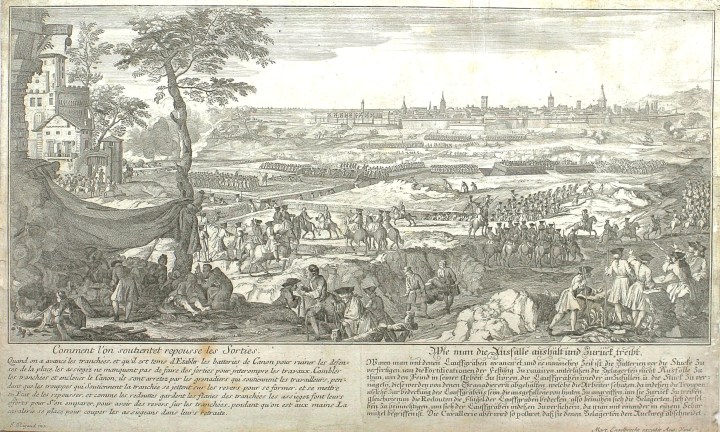
Jacques Rigaud and Martin Engelbrecht, Siege of Barcelona of 1714 (Comment l’on soutient et repousse les sorties), etching, Augsurg, ca.1750.
◊ ◊ ◊ ◊ ◊
From the Museu Frederic Marès:
Una Mirada al 1700: A partir dels gravats de la col·lecció Gelonch Viladegut
Una Mirada al 1700: A partir de los grabados de la colección Gelonch Viladegut
A Look at 1700: The Engravings of the Gelonch Viladegut Collection
Museu Frederic Marès, Barcelona, 16 June — 2 November 2014, extended until 11 January 2015
A partir del diàleg entre els gravats de la col·lecció Gelonch-Viladegut i les col·leccions del Museu Frederic Marès es vol oferir una galeria d’imatges sobre la Catalunya de començament del segle XVIII, concretament a la fi de la Guerra de Successió. L’exposició mostra com des del col·leccionisme també es pot aportar una visió del context sociocultural del país al voltant del 1714.
The press release (in Catalan) is available here»
◊ ◊ ◊ ◊ ◊
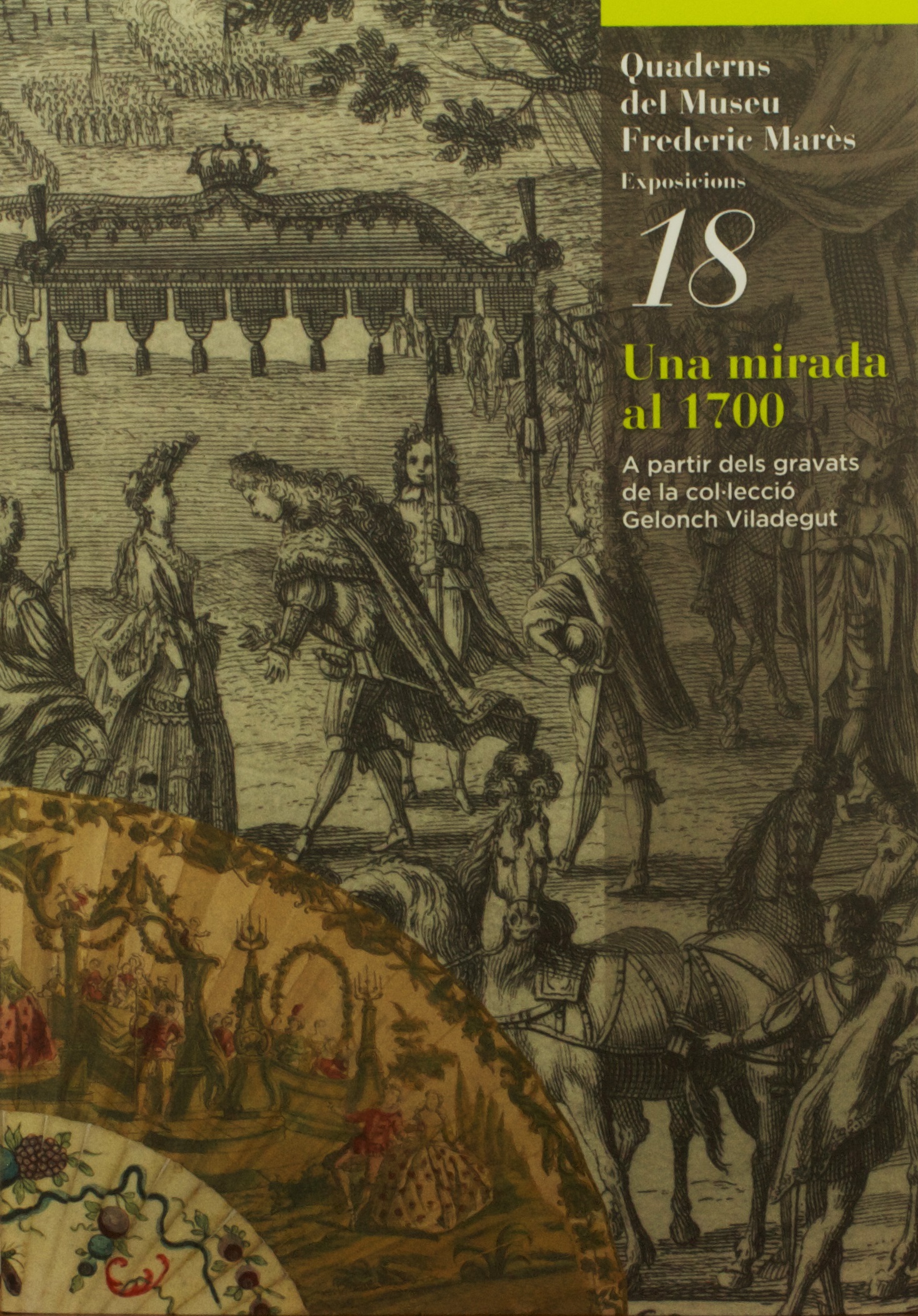 The catalogue is available from Artbooks.com:
Xevi Camprubi et al, Una mirada al 1700: A partir dels gravats de la col·lecció Gelonch Viladegut (Barcelona: Ajuntament de Barcelona, Institut de Cultura de Barcelona, 2014), 154 pages, ISBN: 978-8498505597, $38.
Organised into five areas, the exhibition offers a view of Catalonia in the context of the War of the Spanish Succession based on the testimonies from collectors: first, the engravings from that period from the collection of Antoni Gelonch Viladegut, and secondly the collections of the Frederic Marès Museum, from which some works from its sculpture and 18th-century object collection in its extensive Collector’s Cabinet have been chosen. The five areas show images of power, territory, war, everyday life, and devoutness.
Conference | Animating the 18th-Century Country House
From The National Gallery:
Animating the 18th-Century Country House
The National Gallery, London, 5 March 2015
When we visit a Georgian country house and wander through its interiors, the impression we get is of a moment frozen in time. In fact the country house was anything but a static, unchanging entity. This one-day scholarly conference encourages fresh thinking about 18th-century country houses as environments that were always evolving, animated by interactions between objects and people.
The conference will look at the ways in which objects, when placed on display within a particular space, entered into different kinds of dialogue with the contents, decoration and associations of that space. It will also explore the ways in which the evolving environment of the country house, and the forms of display found within it, were experienced; by those who lived in the house, by those who visited as tourists or invited guests, and by those who engaged vicariously through the process of ‘armchair travel’.
Organised by the National Gallery, Birkbeck (University of London), and the Paul Mellon Centre, the conference is designed for art historians and scholars of 18th-century fine and decorative arts, architecture, and garden history; curators and custodians of historic houses; and the general public interested in historic houses of the period.
• Buying, collecting and display: the purchase, commissioning, inheritance, gifting of works of art, furniture, books and other materials; picture hangs; room arrangements.
• The country house as a complete environment: the total effect of the 18th-century country house, and the ways in which its various elements—works of art, furniture, decorative schemes—worked together to create a complete experience.
• The country house and visitor experience: country house tourism; visitor experience of houses and gardens; the multifarious literature related to country houses, including guidebooks, regional guidebooks, and periodical articles.
Book tickets here»
◊ ◊ ◊ ◊ ◊
P R O G R A M M E
10.00 Registration
10.30 Welcome and Introduction by Nicholas Penny
10.45 Panel 1: Buying, Collecting and Display
Chair: Jonathan Yarker
• Silvia Davoli, Paul Mellon Centre Research Curator at Strawberry Hill and Susan Walker, Head of Public Services at the Lewis Walpole Library, Yale University, ‘Horace Walpole’s Strategies as a Collector and the Movement of Objects at Strawberry Hill over Fifty Years’
• Karin Wolfe, Research Fellow at the British School at Rome, ‘New Rome Animates Old Britain: The Contemporary Art Acquisitions Made in Rome by John Cecil, 5th Earl of Exeter (1648–1700), for Burghley House’
• Jon Stobart, Professor of Social History at the University of Northampton, ‘Remaking an English Country House: Craftsmen, Furnishings and Taste at Stoneleigh Abbey in the 1760s’
12.15 Lunch break
13.15 Panel 2: The Country House as a Complete Environment
Chair: Sebastian Edwards
• Richard Johns, Lecturer in History of Art at the University of York, ‘Mind the Step: Animating the Country House Staircase’
• Laurel O. Peterson, doctoral candidate in the History of Art at Yale University, ‘Decorating for the Decorated: Louis Laguerre’s Murals in the Saloon at Blenheim’
• Alison Yarrington, Professor of Art History, Dean of the School of Arts at Loughborough University, ‘Light, Camera, Action: The 6th Duke of Devonshire and the Evolution of Chatsworth’
14.45 Refreshment break
15.15 Panel 3: The Country House and Visitor Experience
Chair: Stephen Lloyd
• Anthony Geraghty, Senior Lecturer in History of Art at the University of York, ‘Experiencing Castle Howard’
• Stephen Bending, Senior Lecturer in English at the University of Southampton, ‘Experiencing the Country House Pleasure Garden’
• Jocelyn Anderson, Visiting Lecturer at the Courtauld Institute of Art, ‘Visitors’ Experiences and Travellers’ Writings: The 18th-Century Country House as Tourist Attraction’
16.45 Closing comments and thanks from Susanna Avery-Quash, Research Curator in the History of Collecting, National Gallery and Kate Retford, Senior Lecturer in Eighteenth- and Early Nineteenth-Century Art, Birkbeck, University of London
Call for Papers | Disseminating Dress: Britain and the Fashion World
From the conference website:
Disseminating Dress: Britain and the Fashion World
University of York, 28–30 May 2015
Proposals due by 15 January 2015
Disseminating Dress is a three-day international and interdisciplinary conference that explores how ideas and knowledge about dress have been shared, sought and communicated throughout history.
In bringing together academics, curators and industry professionals, this conference is an invitation for interdisciplinary discussion concerning methods of communicating concepts of what someone should, could, or would wear. Dress has been demonstrated to be central to the creation, expression, and subversion of cultural and national identity. However, what remains relatively unexplored is how these ideas were conveyed and perceived. If fashion is the result of a mixture of innovation and emulation, then we need to ask how these new ideas came to be circulated around and between societies.
From the London of the Blitz to Renaissance Italy, men and women have both sought out and been instructed in what to wear, forming personal, social and cultural aesthetics, while driving trade and mercantile success. This conference welcomes a broad interpretation of how dress has been disseminated throughout history, and will be an open forum for work undertaken from a variety of disciplinary and professional viewpoints.
Disseminating Dress invites proposals for 20-minute papers that explore the manifold media, methods, perceptions and motivations driving fashion dissemination across history. Paper topics might include, but are certainly not limited to, the following methods and media for transferring fashion ideas and information:
• Correspondence and social networks
• Global networks for trade and cultural exchange
• The written word—including novels, journals, and fashion magazines
• Costume books, home sewing patterns, and other instructional sources
• Visual and material culture, including both fine art and popular culture
• Advertising, the role of fashion designers, and branding
• Famous persons, from court culture to modern celebrities
• Film, television, the Internet, and modern social media including MMS-ography
• The history of taste, and the influence of outside cultural forces such as developments within architecture and the decorative arts on fashion
Abstracts of 250 words in length, with an accompanying 100-word biography should be sent to disseminatingdress@gmail.com no later than 15th January 2015.
Confirmed Keynote Speakers
Christopher Breward, University of Edinburgh & Edinburgh College of Art
Peter McNeil, University of Technology, Sydney, & University of Sweden
Marcia Pointon, University of Manchester
Jennie Batchelor, University of Kent
Ulinka Rublack, University of Cambridge
Anna Reynolds, The Royal Collection
Organised by: Anna Bonewitz (University of York), Serena Dyer (University of Warwick), Sophie Littlewood (University of York), Jade Halbert (University of Glasgow), and Elizabeth Bobbitt (University of York).
Supported by: The Paul Mellon Centre; and The British Art Research School, The Humanities Research Centre, The Centre for Modern Studies, The Centre for Eighteenth Century Studies, and The Centre for Renaissance and Early Modern Studies, University of York.
New Book | The Spiritual Rococo: Decor and Divinity
From Ashgate:
Gauvin Alexander Bailey, The Spiritual Rococo: Decor and Divinity from the Salons of Paris to the Missions of Patagonia (Aldershot: Ashgate, 2014), 454 pages, ISBN: 978-1409400639, $130.
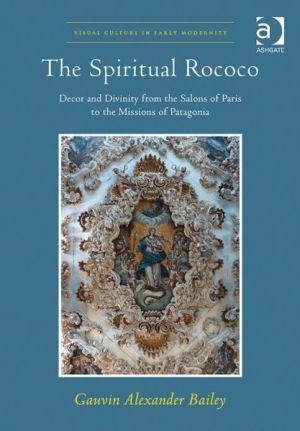 A groundbreaking approach to Rococo religious décor and spirituality in Europe and South America, The Spiritual Rococo addresses three basic conundrums that impede our understanding of eighteenth-century aesthetics and culture. Why did the Rococo, ostensibly the least spiritual style in the pre-Modern canon, transform into one of the world’s most important modes for adorning sacred spaces? And why is Rococo still treated as a decadent nemesis of the Enlightenment when the two had fundamental characteristics in common? This book seeks to answer these questions by treating Rococo as a global phenomenon for the first time and by exploring its moral and spiritual dimensions through the lens of populist French religious literature of the day-a body of work the author calls the ‘Spiritual Rococo’ and which has never been applied directly to the arts. The book traces Rococo’s development from France through Central Europe, Portugal, Brazil, and South America by following a chain of interlocking case studies, whether artistic, literary, or ideological, and it also considers the parallel diffusion of the literature of the Spiritual Rococo in these same regions, placing particular emphasis on unpublished primary sources such as inventories. One of the ultimate goals of this study is to move beyond the cliché of Rococo’s frivolity and acknowledge its essential modernity.
Thoroughly interdisciplinary, The Spiritual Rococo not only integrates different art historical fields in novel ways but also interacts with church and social history, literary and post-colonial studies, and anthropology, opening up new horizons in these fields.
Gauvin Alexander Bailey is Professor and Alfred and Isabel Bader Chair in Southern Baroque Art at Queen’s University, Kingston, Canada.
◊ ◊ ◊ ◊ ◊
C O N T E N T S
Introduction
1. ‘The Dream of Happiness’: The Literature of the Spiritual Rococo and the Christianity of Reason
2. ‘As Bizarre a Style as Ever Occurred’: Rococo in France
3. ‘Bright Shining as the Stars’: Spiritual Rococo in Central Europe
4. ‘Irregular Ornament in the Finest French Taste’: Spiritual Rococo in Portugal and Brazil
5. ‘O Happy Vision!’: Spiritual Rococo in Spain and Spanish South America
Epilogue: ‘Superfluous Stucco and Laughable Decoration’: Rococo, Religion, and the Global Enlightenment
Appendix A: French Spiritual Literature in Central European Collections
Appendix B: French Spiritual Literature in Luso-Brazilian Collections
Appendix C: French Spiritual Literature in the Spanish Southern Cone
Bibliography
Index
New Book | Rococo Echo
The latest volume of SVEC:
Melissa Lee Hyde and Katie Scott, eds., Rococo Echo: Art, History and Historiography from Cochin to Coppola (Oxford: Voltaire Foundation, 2014), 398 pages, ISBN: 978-0729411585, £65 / €82 / $102.
 Intermittently in and out of fashion, the persistence of the Rococo from the eighteenth century to the twenty-first is clear. From painting, print and photography, to furniture, fashion and film, the Rococo’s diverse manifestations appear to defy temporal and geographic definition. In Rococo Echo, a team of international contributors adopts a wide lens to explore the relationship of the Rococo with time.
Through chapters organised around broad temporal moments—the French Revolution, the First World War and the turn of the twenty-first century—contributors show that the Rococo has been viewed variously as modern, late, ruined, revived, preserved and anticipated. Taking into account the temporality of the Rococo as form, some contributors consider its function as both a visual language and a cultural marker engaged in different ways with the politics of nationalism, gender and race. The Rococo is examined, too, as a mode of expression that encompassed and assimilated styles, and which functioned as a surprisingly effective means of resisting both authority—whether political, religious or artistic—and cultural norms of gender and class. Contributors also show how the Rococo, from its birth in France, reverberated through England, Germany, Italy, Portugal and the South American colonies to become a pan-European, even global movement. The Rococo emerges from these contributions as a discourse defined but not confined by its original historical moment, and whose adaptability to the styles and preoccupations of later periods gives it a value and significance that take it beyond the vagaries of fashion.
Melissa Lee Hyde is Professor of eighteenth- and nineteenth-century European art at the University of Florida, and her work focuses on gender and visual culture in France. She is writing a monograph on Marie-Suzanne Roslin and is co-authoring a book with Mary D. Sheriff on women in French art.
Katie Scott is a professor at the Courtauld Institute of Art. She has written widely about the Rococo in relation to issues of class, race and gender and is currently writing a book on the origins of intellectual property in France before the 1793 Act of the Rights of Genius.
◊ ◊ ◊ ◊ ◊
C O N T E N T S
Foreword. Rococo Echo: Style and Temporality, Katie Scott
I. Rococo Revivals: The Nineteenth Century
1. The Uncomfortable Frenchness of the German Rococo, Michael Yonan
2. Rococo Republicanism, Elizabeth Mansfield
3. Scavenging Rococo: Trouvailles, Bibelots and Counter-Revolution, Tom Stammers
4. Vive l’amateur! The Goncourt House Revisited, Andrew McClellan
5. Pierrot’s Periodicity: Watteau, Nadar and the Circulation of the Rococo, Marika T. Knowles
6. Remembrance of Things Past: Robert de Montesquiou, Emile Gallé and Rococo Revival during the Fin de Siècle, Meredith Martin
7. Irregular Rococo Impressionism, Anne Higonnet
II. Rococo: The Eighteenth Century
8. Was There Such a Thing as Rococo Painting in Eighteenth-Century France?, Colin B. Bailey
9. ‘A Wild Kind of Imagination’: Eclecticism and Excess in the English Rococo Designs of Thomas Johnson, Brigid von Preussen
10. Out of Time: Fragonard, with David, Satish Padiyar
11. Rococo and Spirituality from Paris to Rio de Janeiro, Gauvin Alexander Bailey
III. New Rococo: The Twentieth Century and Beyond
12. Sedlmayr’s Rococo, Kevin Chua
13. Warhol’s Rococo: Style and Subversion in the 1950s, Allison Unruh
14. The New Rococo: Sofia Coppola and Fashions in Contemporary Femininity, Rebecca Arnold
15. Post-Colonial Rococo: Yinka Shonibare MBE Plays Fragonard, Sarah Wilson
16. The Rococo Revival and the Old Art History, Carol Duncan
Afterword. The Rococo Dream of Happiness as ‘a Delicate Kind of Revolt’, Melissa Lee Hyde
List of illustrations
Summaries
Select bibliography
Index
Details for ordering a copy are available (as a PDF file) here»
(more…)










 Enfilade
leave a comment