Recent Launch of the Association of Print Scholars
APS envisions a future for itself as a CAA affiliate society. As noted at H-ArtHist:
Introducing the Association of Print Scholars, a new group bringing together the print community
 We are excited to announce the launch of the Association of Print Scholars (APS). APS is a nonprofit members’ group for enthusiasts of printmaking that will bring together the diverse community of curators, collectors, academics, grad students, artists, paper conservators, critics, independent scholars, and dealers. APS’s goals are to encourage innovative and interdisciplinary study of printmaking and to facilitate dialogue among members.
Membership benefits will include
• Access to a searchable database of active members and their current activities
• Ability to update online membership profile with all print-related activities
• Announcements about events, exhibitions, calls for papers, and other news from the print world
• Opportunities to promote new projects to members on the APS website and listserv
• Participation in APS’s events, including lectures and scholarly conferences
• Grants for digital projects and research, and support for working/reading groups
For further information, please contact info@printscholars.org, or visit www.printscholars.org. In addition, please consider joining and donating to APS through our Indiegogo campaign. Your support will help us build our website, which will launch in early 2015.
Exhibition | Dining with the Tsars: Fragile Beauty from the Hermitage

Items from the Service of the Order of St George, Porcelain manufactory of Franz (Francis) Gardner in Verbilki, Dmitrovsky, Moscow Province, Russia. 1777–78 (State Hermitage Museum, St Petersburg)
◊ ◊ ◊ ◊ ◊
Press release from the Hermitage Amsterdam:
Dining with the Tsars: Fragile Beauty from the Hermitage / Breekbare schoonheid uit de Hermitage
Hermitage Amsterdam, 6 September 2014 — 1 March 2015
The Hermitage Amsterdam’s fifth anniversary exhibition Dining with the Tsars: Fragile Beauty from the Hermitage opens on 6 September 2014. Eight magnificent porcelain and creamware services from the collection of the Hermitage in St Petersburg will be exhibited in a setting that conveys what the balls and banquets of the Tsar’s court were like. Visitors will imagine they are guests, in possession of a coveted imperial invitation, climbing the steps of the Winter Palace, reviewing the rules of etiquette and preparing for a festive occasion. Finally they enter the main hall where the fine porcelain dinnerware is set out in a festive display.

Items from the Green Frog Service, Wedgwood, Etruria (Stoke-on-Trent). 1773–74 (State Hermitage Museum, St Petersburg)
The exquisite porcelain services, comprising no less than 1,034 pieces, exhibited on authentically laid tables with decorative centrepieces, reveal the enchanting grandeur of the Tsars’ banquets. The exhibition tells the story of the lavish ball and banqueting culture that reached its zenith under the reign (1762–1796) of Catherine the Great, Queen of Feasts, when hundreds of dishes would be served at a single banquet and thousands of guests attended the balls. The last tsar, Nicholas II (ruled 1894–1917) and his wife Alexandra, who organised the largest balls but were only present for as briefly as possible. With their abdication, the ball and banqueting customs that had once captured the imagination of all the courts of Europe came to an end.
The finest pieces are from the dinnerware collections of Catherine the Great, such as the Green Frog Service (Wedgwood, England), the Cameo Service (Sèvres, Paris, exhibited for the first time with silver gilt flatware), which at one time comprised nearly a thousand pieces, and the Berlin Dessert Service (Königliche Porzellan-Manufaktur Berlin). The services of later Tsars were no less impressive and significant for their connection to European history. The services are exhibited in accordance with the rules of etiquette, augmented with ornate centrepieces, gold-rimmed crystal glassware, candelabras, vases, detailed silverwork and wall decorations. The exhibition features a wide range of pieces, from ice buckets for liqueur bottles and ice-cream coupes to salt and pepper sets and table figurines.
The exhibition also offers a culinary view of imperial dining customs, in a culture where banquets of 300 dishes were no exception. Dessert was the highpoint of the meal and the ideal course for showing off the host’s wealth and refined taste. Richly decorated delicacies were served with exceptional inventiveness. There is attention for iconography and the diplomatic function of giving services as gifts and hosting state dinners in the eighteenth and nineteenth centuries. And the balls and performances, gossip and scandal also feature in the exhibition. Evidence of the excesses of the imperial court abounds. Particularly revealing are the quotes drawn from the memoires of Marie Cornélie van Wassenaer Obdam. She visited the Winter Palace in 1824 as a member of the retinue of Anna Paulowna and the later King Willem II.
The surpring final exhibit is the service given to Stalin by the Hungarian people in 1949, which has never been used or exhibited before. It illustrates the diplomatic role that dinnerware also played in the twentieth century.
Never before have so many porcelain dinnerware pieces from the Hermitage been exhibited in the Netherlands. The rich collection of European porcelain from the Hermitage in St Petersburg comprises over 15,000 items, purchased by or given as gifts to the Tsars of Russia between 1745 and the years prior to the First World War. The services, which include many unique pieces, were produced by leading porcelain manufacturers such as Meissen, Sèvres, Gardner and Wedgwood and decorated to the highest artistic standard.
Spatial designer Lies Willers and stylist Jeanine Aalfs joined forces to produce an innovative, festive, engaging, dreamlike and overwhelming scenography.
Dozens of high-resolution images are available here»
New Book | The Drawing Room: English Country House Decoration
From Rizzoli:
Jeremy Musson, foreword by Julian Fellowes with photographs by Paul Barker, The Drawing Room: English Country House Decoration (New York: Rizzoli, 2014), 272 pages, ISBN: 978-0847843336, $60.
 A highly detailed look at the most accomplished English country house interiors, exemplifying English decorating at its best. The English drawing room, a formal place within a house of status where family and honored guests could retire from the more public arena, is one of the most important rooms in an English country house, and thus great attention has been paid to preserving the decoration of this most elegant of spaces: the center of life in the English countryside and the epitome of English country house decoration. This book offers privileged access to fifty of the finest drawing rooms of country houses and historic townhouses—many still in private hands—including Althorp, Attingham, and Knepp Castle. Through these sumptuous rooms, readers experience a history of English decorating from the sixteenth century to the present day, including the work of design legends such as David Hicks, Nancy Lancaster, John Fowler, and David Mlinaric. Specially commissioned photographs capture the entirety of each room, as well as details of furniture, architectural elements, artwork, collections, and textiles, creating a visually seductive book that will inspire interior designers and homeowners interested in the widely popular classic English look.
Jeremy Musson is the former architectural editor of Country Life, the cowriter and presenter of the BBC television series The Curious House Guest, and the author of many books, including English Country House Interiors, The English Manor House, How to Read a Country House, and The Country Houses of Sir John Vanbrugh. Paul Barker is one of England’s premier interior and architectural photographers, whose books include English Country House Interiors, England’s Thousand Best Churches, and English Ruins. Julian Fellowes is the creator of the hit series Downton Abbey.
Exhibition | The Fabric of India
Next fall at the V&A (as noted by Courtney Barnes at Style Court) . . .
The Fabric of India
Victoria & Albert Museum, London, 3 October 2015 — 10 January 2016
Cincinnati Art Museum, 19 October 2018 — 6 January 2019
Curated by Rosemary Crill and Divia Patel
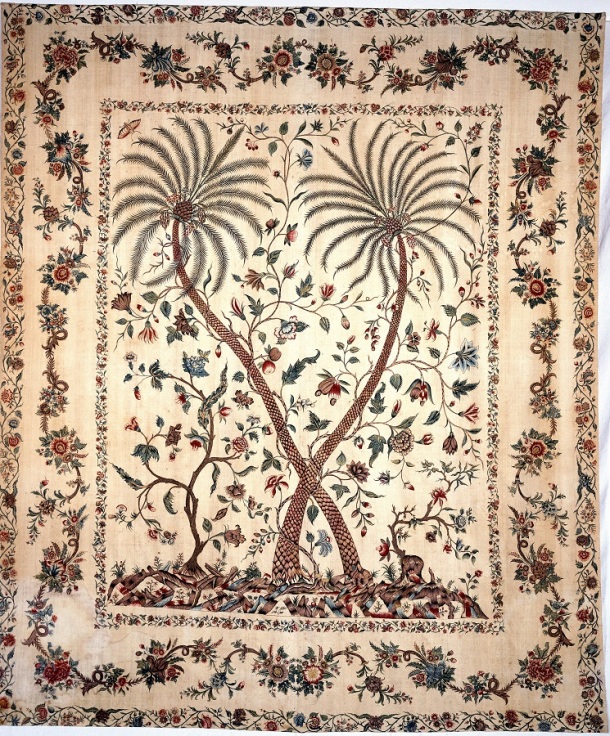
Chintz palampore, South-East India for export to Europe, ca. 1750–60 (London: V&A Museum no. IM 85-1937)
The highlight of the V&A’s India Season, this will be the first major exhibition to explore the dynamic and multifaceted world of handmade textiles from India from the 3rd to the 21st century. It will include a spectacular 18th-century tent belonging to Tipu Sultan, a stunning range of historic costume, highly prized textiles made for trade, and fashion by contemporary Indian designers such as Manish Arora and Rajesh Pratap Singh.
Over 200 objects will illustrate the skills, variety and adaptability of Indian textile makers and the enduring nature of techniques for dyeing, weaving and embroidery across India. Examples of textiles made for religious and courtly use will be shown alongside the finest pieces made for export to Europe, the Middle East and South-East Asia. The use of textiles and dress as a political tool of the Independence Movement and their relevance to Indian cultural identity will be explored, as will the impact of mass-production on handmade textiles.
The exhibition blog is available here»
Note (added 24 March 2015) — The original posting provided a slightly earlier beginning date for the exhibition (September 26th); it’s now been corrected.
Note (added 21 October 2018) –– The posting was updated to include the Cincinnati venue.
Albertine Books Opens in New York
◊ ◊ ◊ ◊ ◊
It’s an intriguing model for a what bookstore might be, a model that underscores the cultural and ideological work such a store can do, and this at a time when we seem to hear only about the economics of bookstores. William Grimes covers the story for The New York Times (9 October 2014). The next step will be getting the store to host an eighteenth-century festival. –CH
From the Albertine:
The Cultural Services of the French Embassy in New York is pleased to announce the opening of Albertine Books in French and English, the new reading room and bookshop devoted to works in French and in translation on Saturday September 27, 2014. Named after the beautiful, omnipresent and unknowable female character in Marcel Proust’s classic In Search of Lost Time, Albertine will offer the most comprehensive selection of French-language books and English translations in New York, with over 14,000 contemporary and classic titles from 30 French-speaking countries in genres including novels, non-fiction, art, comic, or children’s books.
Housed in one of the few remaining iconic Stanford White-designed mansions on Fifth Avenue, Albertine was designed and fashioned by French architect Jacques Garcia, in the model of a grand private French library. The two-floor space includes a reading room and inviting nooks furnished with lush sofas and armchairs.
Albertine will also be a venue for French-American and European-American debates and discussions on subjects varying from politics to economics to art, literature or sciences and will explore classical culture through a modern and global lens. To highlight its role as an exciting new hub for intellectual debate in New York City, Albertine will present a six-night festival from October 14–19, curated by cultural critic and author Greil Marcus, featuring French and American artists and thinkers.
The Albertine team looks forward to welcoming you to our bookshop!
Spread the word to all your francophile and francophone friends.
Albertine
972 Fifth Avenue (between 78th & 79th street)
Opening Hours
Monday to Thursday and Saturday: 11–7
Friday: 11–10
Sunday: 11–6
Follow Albertine on Facebook, Twitter and Instagram: @albertinebooks
Conference | Artistic Circulation between Rome and Lisbon
Projects, Models, and Artistic Circulation between Rome and Lisbon in the Eighteenth Century
Universidade Nova de Lisboa, 7 November 2014
This international workshop deals with the richness and complexity of the international relations between Lisbon and Rome in the eighteenth century. The transcendence of the Roman Paradigm is well documented in Portugal, but the Lusitanian Rome is still a topic of research that deserves better attention. From a multidisciplinary approach the participants of this workshop are trying to shed some light on a some sort of Iberian Grand Tour.
◊ ◊ ◊ ◊ ◊
From the conference programme:
Projectos, Modelos, e Circulação Artística entre Lisboa e Roma no Sécolo XVIII
Universidade Nova de Lisboa, 7 November 2014
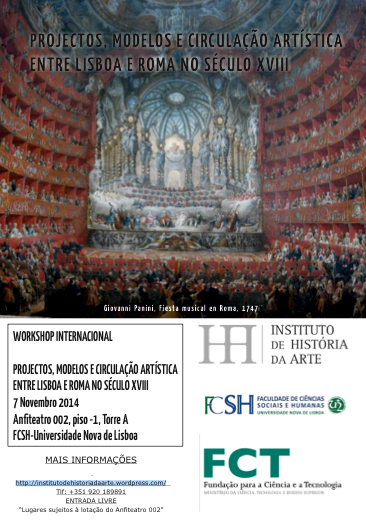 A partir de várias formas de produção artística, assim como de diferentes métodos de investigação, este seminário pretende apreender a complexidade do século XVIII como plataforma de circulação de modelos, actores e projectos, tendo como foco o eixo Roma-Lisboa. As relações entre ambas cidades são postas em relevo com o objectivo de determinar a presença e a importância do mundo ibérico no fenómeno transnacional do Gran Tour, bem como a sua possível participação na República das Letras, tendo em conta que a tradição historiográfica europeia costuma excluir o âmbito ibérico nessas áreas. Assim, o estudo dessas relações permitirá reconsiderar o papel delas no seio dos desafios europeus da época no domínio da arte.
Nessa perspectiva, os olhares cruzados entre estudos específicos e complementares nos campos da música, das artes visuais e da arquitetura pretendem consolidar uma abordagem multidisciplinar dos fenómenos artísticos duma forma global no século XVIII e favorecer um foro de discussão entre os diversos especialistas.
The conference flyer is available here»
The Huntington Acquires Fuseli’s The Three Witches

Henry Fuseli, The Three Witches or The Weird Sisters, ca. 1782, oil on canvas, 25 x 30 inches (San Marino: The Huntington Library, Art Collections, and Botanical Gardens)
◊ ◊ ◊ ◊ ◊
Press release (7 October 2014) from The Huntington:
The Huntington Library, Art Collections, and Botanical Gardens announced today the acquisition of one of the best-known compositions by the Anglo-Swiss painter Henry Fuseli (1741–1825). In private hands since its creation around 1782, The Huntington’s version of Fuseli’s The Three Witches or The Weird Sisters appears to be a finished, full-size study, presumably made before the two other known full-size, final versions Fuseli made of the subjects. These are in the collections of the Kunsthaus Zurich, and the Royal Shakespeare Company, Stratford-upon-Avon, England. After months of conservation treatment at The Huntington, the new acquisition will go on public view for the first time on October 11 in the Huntington Art Gallery.
“Given the fame of The Huntington’s collection of 18th-century British paintings, it may come as a surprise that we did not already have a painting by Henry Fuseli—one of the most celebrated, notorious, and inventive artists of the period,” said Kevin Salatino, Hannah and Russel Kully Director of the Art Collections at The Huntington. “Finally we do, and a great one, a picture full of mystery and suspense. Its powerful composition packs an incredible punch, second in impact only to the artist’s famous painting The Nightmare at the Detroit Institute of Arts, which is from the same period. The acquisition of The Three Witches now fills a major gap in our collection.”
Acquiring a Fuseli has been a longstanding goal at The Huntington, as the finest examples of his work rarely appear for sale. Catherine Hess, chief curator of European art at The Huntington, said that Fuseli’s work has been sought not only because of his importance to the history of art, but also because of his relationships with Sir Joshua Reynolds and, especially, William Blake, both of whom are well represented in Huntington collections. Also, Fuseli’s fascination with the work of William Shakespeare dovetails with The Huntington’s stature as one of the premiere collections of early Shakespeare folios and quartos in the world. The Three Witches reveals a great deal about how the artist worked, said Hess. “Its surface is thickly textured with paint, and the strokes are varied and energetic, betraying a freedom and immediacy that shows Fuseli at his most experimental and expressive.” The painting depicts the pivotal moment in Shakespeare’s tragedy Macbeth (act 1, scene 3) when the protagonist encounters the demonic trio who foretell his fate.
“Fuseli revels in the play’s ominous mood, isolating and tripling the motif of hooded head, extended hand, and sealed lips,” said Hess. The witches’ mannish features are taken directly from the playwright’s description: “… you should be women, And yet your beards forbid me to interpret / That you are so.” They may also have been modeled on the male actors who would have played them on stage in Fuseli’s day.
The Huntington’s painting includes a gilded frame (likely added by early owners) with a quote from Aeschylus’ ancient tragedy, The Eumenides: “These are women but I call them Gorgons.” The quote also appears written on the reverse of the painting and was almost certainly provided by Fuseli, who prided himself on his erudition.
◊ ◊ ◊ ◊ ◊
R E L A T E D I N S T A L L A T I O N S
Wrestling with Demons: Fantasy and Horror in European Prints and Drawings from The Huntington’s Art Collections
The Huntington Art Gallery, San Marino, CA, 30 August — 15 December 2014
This focused exhibition explores the darker side of the imagination through a variety of works on paper depicting death, witchcraft, and the demonic in European art. In this group of 15 works spanning the 16th to the 19th centuries, artists such as Albrecht Dürer, Jan Lievens, Francisco de Goya, and William Holman Hunt tap into human fascination with the macabre in works of art that demonstrate our attempt to wrestle with the unknown.
Eccentric Visions: Drawings by Henry Fuseli, William Blake, and Their Contemporaries
The Huntington Art Gallery, San Marino, CA, 22 November 2014 — 16 March 2015
In an age of great drawing, Anglo-Swiss painter Henry Fuseli (1741–1825) and his circle in Britain helped to push the medium into new areas of expressiveness, invention, and boldness of conception. This small exhibition consists of about 30 works from The Huntington’s exceptional holdings of drawings and watercolors by Fuseli, William Blake, and the artists most closely associated with them, including George Romney, John Flaxman, Joseph Wright of Derby, James Barry, John Brown, and Richard Cosway. It complements the installation of The Huntington’s newly acquired painting by Fuseli, The Three Witches.
Exhibition | Sade: Marquis of Shadows, Prince of the Enlightenment
To the d’Orsay’s exhibition on the Marquis de Sade we can add this one now on view at the Institut des Lettres et Manuscrits:
Sade: Marquis of Shadows, Prince of the Enlightenment
The Spectrum of Libertinism from the 16th to the 20th Century
Institut des Lettres et Manuscrits, Paris, 26 September 2014 — 18 January 2015
Curated by Pascal Fulacher and Jean-Pierre Guéno
Yes, I am a libertine, I admit it freely. I have dreamed of doing everything that it is possible to dream of in that line. But I have certainly not done all the things I have dreamt of and never shall. Libertine I may be, but I am not a criminal, I am not a murderer. –Donatien Alphonse François de Sade
Sade and the Spectrum of Libertinism
Donatien Alphonse François de Sade was doubly a man of letters: a great novelist, a great letter writer, but above all a victim of the very special letters that were the lettres de cachet, often commissioned from monarchs or their ministers by the families of those who wanted to have troublesome offspring removed from the public sphere. Even more than the Marquis of Shadows, even more than his escapades and fantasies of debauchery, it was the Prince of the Enlightenment who never ceased to embarrass both his family, who continually persecuted him, his social caste, and the leading figures of his time, to the point where this troublemaker became a kind of literary man in an iron mask who spent more than half his adult life in prison before dying there. Apart from the fact that he was sentenced to life imprisonment in 1768, and twice to death in 1772 and in 1794, De Sade spent nearly twenty-eight years in prison between 1763 and 1814, between the age of 23 and his death at age 74, and this under three different regimes: the Monarchy, the Republic and the Empire. From the tower at Vincennes to Charenton insane asylum, despite the material means he had to improve his everyday life, he lived mostly in “execrable slums,” in a dozen jails including those of Saumur castle, Pierre-Encise citadel in Lyon, For-l’Eveque prison in Paris, Miolans fort in Savoy, the Bastille fortress, Sainte-Pélagie prison and Bicêtre prison in Paris, not forgetting the gaols of the Revolution. During the seventy-four years and six months of his life as in the two centuries that separate us from his death, it may seem paradoxical that we have demonised the Marquis de Sade to such an extent, and that we have for so long mixed the man with his work, to the point of confusing the man and the novelist with the criminal characters in his fiction.
 Certainly he was a libertine who indulged in licentious and dissolute sexual practices, but the man who lent his name to today’s definition of the word Sadism, “the tendency to derive pleasure from physical or emotional pain intentionally inflicted on others” would have been just one more profligate among the aristocrats of his time, had he not been primarily the eye of a kind of consciousness that managed to convey not just the pain of living, but the “pain of the century” (“mal du siècle”) as defined by Musset in the 19th century: through his escapades and provocations, then through his political writings, as through his philosophical writings, letters and novels, but also by example, or by the counterexample of his life, did Sade ever cease to express the evil that devours men, mostly from the Renaissance to modern times, that is to say, during the second half of the second millennium?
For the last four centuries, are those who call themselves libertines actually Epicureans, delinquents or hyper-aware individuals? Bon vivants, criminals or cursed existentialists? From the Marquis de Sade to Dominique Aury (aka Pauline Réage), author of Histoire d’O (The Story of O), to Théophile de Viau, Crébillon, Choderlos de Laclos and his Liaisons Dangereuses (Dangerous Liaisons), Mirabeau, Casanova, the Chevalier d’Eon, Musset, Maupassant, Baudelaire, Rimbaud, Verlaine, Pierre Louÿs and Joë Bousquet, the great figures of literature, poetry and thought have never ceased to celebrate the cannibalistic wedding of vice and virtue. Vice that feeds on virtue when it transgresses and deflowers it. Virtue that feeds on vice when it denounces and demonises it.
At the boundaries of fantasy, revolution, transgression, emancipation and moral suicide, between the realities of purgatory, the fantasised or dreaded delights of hell and the mythical nostalgia for paradise lost, between cynicism, pragmatism and hope, between Epicureanism and cruelty, between enlightenment and barbarism, between the obsession with God and its denial, do the case studies that adorn the spectrum of libertinism not illustrate the entire tragedy of the human condition, and do they not resemble in this respect all the major intellectual earthquakes of the 19th and 20th centuries, from romanticism to existentialism through surrealism?
The Exhibition
 Long before becoming a moral emancipation movement, libertinism was a terribly subversive spiritual liberation movement, since it questioned the existence of God, the legitimacy of kings’ rule by divine right, and all the dogmas of religion, morals and absolute power. From the outset, the exhibition reveals “The spectrum of libertinism,” leading the visitor from “libertinism of the spirit to libertinism of morals” through a set of subversive texts including the Decameron by Boccaccio, Pensées (Thoughts) by Pascal, Dom Juan by Molière, Contes et nouvelles (Tales and Novels) by La Fontaine, Les Lettres persanes (Persian Letters) by Montesquieu and La Nouvelle Héloïse (The New Heloise) by J.-J. Rousseau. Libertinage in the time of De Sade is also discussed in the letters and works of Crébillon, Casanova, the Chevalier d’Eon, Restif de la Bretonne, Choderlos de Laclos, Mirabeau and more.
Then, pride of place is given to the Marquis de Sade and his masterpiece, Les 120 journées de Sodome ou l’École du libertinage (The 120 Days of Sodom, of the School of Libertinism): the handwritten scroll on which this still-scandalous novel was written is on display here for the first time ever in France. Several letters by De Sade, to his wife, his mother-in-law, his lawyer, an actress, etc. are also displayed around the scroll, and give a better understanding of this enigmatic and highly controversial figure.
The last two parts of the exhibition shed light on the rehabilitation of the Marquis de Sade and his work, as well as the development of libertinism in the 19th and 20th centuries, from romanticism to surrealism through existentialism. The exhibition Sade: Marquis de l’ombre, prince des Lumières, L’éventail des libertinages du XVIe au XXe siècle also features over 120 exceptional pieces, letters and autograph manuscripts, first editions and rare, valuable illustrated books, drawings, photographs, etc.
◊ ◊ ◊ ◊ ◊
From Flammarion:
Gonzague Saint Bris and Marie-Claire Doumerg-Grellier, Sade: Marquis de L’Ombre, Prince des Lumières, L’Eventail des Libertinages (Paris: Flammarion, 2014), 176 pages, ISBN: 978-2081353817, 29€.
Consacré à l’histoire du libertinage, cet album en lien avec l’exposition du même titre, rassemble et présente lettres, manuscrits, livres rares et précieux, portraits et dessins érotiques consacrés aux «Cent vingt journées de Sodome» du marquis de Sade.
Exceptions and the Market
It’s a point I try to make with my students: art historical narratives at the introductory level (perhaps within the field generally) are built around exceptional works—pieces, for instance, that are especially well executed, can boast a remarkable provenance, or mark a shift in style (if all three, then so much the better). Quality distinctions carry important market implications, too; and as Scott Reyburn reports for The New York Times, demand for lower- and mid-level priced antiques remains low, in contrast to the market for rare items—exemplified by the September sale of a ca. 1720 writing table by André-Charles Boulle, which sold for 3.15million USD, well beyond its estimate. –CH
From the article:
Scott Reyburn, “A Shift in the Antiques Market,” The New York Times (3 October 2014).
So the question on many collectors’ minds now is just how low can the price of period English furniture go? The British-based Antique Collectors’ Club’s Annual Furniture Index (AFI), based on a mix of auction and retail prices of 1,400 typical items, fell by 6 percent to 2,238 in 2013. The index has been on a slide for more than a decade after reaching a peak of 3,575 in 2002.
“For nice furnishing things, prices are as low as I can remember,” said Paul Beedham, an early oak specialist dealer in Derbyshire. “The professional classes who used to buy just don’t have the money any more. They’re struggling to pay their mortgages and car loans.”
The full article is available here»
Journée d’étude | Madame de Pompadour et l’art de la toilette
As noted at Histoire de Mode with details from the preliminary programme:
Madame de Pompadour et l’Art de la Toilette
Archives Nationales de France, Hôtel Soubise, Paris, 7 October 2014
L’association ART & LUXE prépare le nouvel évènement consacré à l’histoire du design, de la mode et du luxe, ainsi qu’à celle de ses métiers. Mardi 7 octobre 2014, à l’hôtel Soubise, rue des Francs Bourgeois à Paris, aura lieu à partir de 14.30 une nouvelle demie-journée d’étude consacrée à Madame de Pompadour, sur le thème de l’art de la toilette. Participation aux frais : 5 euros. Inscription préalable dans la limite des places disponibles à Association ART & LUXE 38 Boulevard Henri IV 75004 Paris, Art-luxe@live.fr.
P R O G R A M M E
14.00 Accueil
14.30 Lesley Ellis Miller (Victoria and Albert Museum, Londres), Trois portraits pour trois garde-robes de la marquise de Pompadour
15.00 Corinne Thépaut-Cabasset (Paris), Objets de modes et de toilette achetés pour madame de Pompadour chez Lazare-Duvaux rue Saint-Honoré à Paris
15.30 Georgina Letourmy-Bordier (Le Cercle de l’Eventail, Paris), D’or et de vent, la mode de l’éventail sous Louis XV
16.00 HERA Fashioning the Early Modern, Object in Focus : La « mouche » ou le matin
16.30 Discussion
17.00 Arlette Vermeiren Zucoli (Tournai), Installation éphémère dans le Grand Salon Ovale de l’appartement du prince de Soubise










 Enfilade
leave a comment