New Book | Selling Silks: A Merchant’s Sample Book
From the V&A:
Lesley Ellis Miller, Selling Silks: A Merchant’s Sample Book (London: V&A Publishing, 2014), 272 pages, ISBN: 978-1851777815, £35.
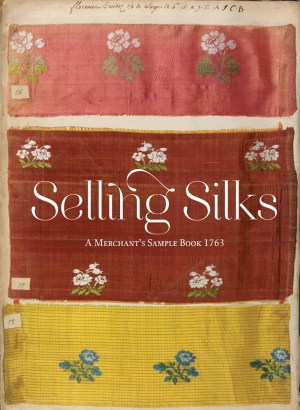 In 1764, British Customs confiscated a book containing hundreds of silk samples of different qualities from French agents who were attempting to sell them illegally in London. The merchant’s sample book acquired in 1972 by the V&A may be this very book, a fascinating record of the eighteenth-century French and English silk industries and their commercial practices.
Alongside a full and faithful reproduction of the whole album, Lesley Miller sets in context the role of the book as a marketing tool from the premier European silk-weaving centre of Lyon and as a model for Spitalfields manufacturers. This publication makes accessible the contents of an extremely rare and fragile object. Translations of French inscriptions, identification of how samples have migrated from one page to another, and technical analysis of some of the silks, as well as a glossary and biographical data on the Lyonnais suppliers make this an invaluable resource for historians, collectors and designers.
Lesley Ellis Miller is Senior Curator of Textiles and Fashion at the V&A. She is a specialist in the silk industry of eighteenth-century Lyon. She is author of a monograph on the fashion designer Cristobal Balenciaga (V&A 2007) and is currently working on the refurbishment of the V&A’s galleries of European seventeenth- and eighteenth-century decorative arts.
Sample pages are available here»
◊ ◊ ◊ ◊ ◊
From La Bibliothèque des Arts:
Lesley Ellis Miller, Soieries: Le livre d’échantillons d’un marchand français au siècle des Lumières, translated by Anne de Thoisy-Dallem (Lausanne: La Bibliothèque des Arts, 2014), 272 pages, ISBN: 978-2884531818, €49.
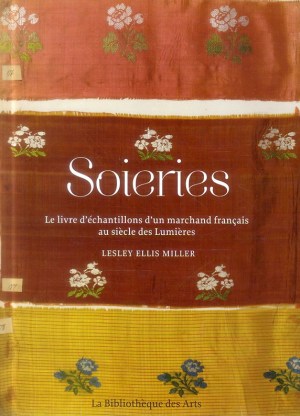 Par sa grande rareté, le livre d’échantillons reproduit ici pour la première fois et dont l’original est conservé au Victoria & Albert Museum de Londres, présente un intérêt unique. C’est une véritable révélation qui offre une source d’informations capitale sur la création des soieries en France au XVIIIe siècle.
La provenance de ce livre d’échantillons est originale à elle toute seule. En effet, il fut saisi en 1764 par les Douanes anglaises qui luttaient contre les importations illégales de textiles, qu’organisaient des agents français. Nous sommes aussi en plein roman d’espionnage et de contre –espionnage industriel, comme l’explique l’auteur Lesley E. Miller, conservatrice en chef du Département des Textiles et de la Mode au Victoria and Albert Museum. Son texte vivant nous immerge dans la vie quotidienne des soyeux lyonnais des années 1760. Elle apporte un éclairage très documenté sur la fabrication et sur le commerce des textiles à cette époque qu’elle a étudiée pendant plusieurs années. L’auteur brosse également un panorama illustré de la mode et de l’usage des soieries françaises en Europe sous l’Ancien Régime.
Une analyse technique rigoureuse de chacun des échantillons confère à ce livre le caractère d’un ouvrage de référence qui satisfera les attentes les plus exigeantes. Mais c’est le charme immense qui se dégage de la partie « fac-similé » qui fait de ce livre d’échantillons, reproduit intégralement, un véritable objet de séduction. L’original, relié en carton et en parchemin ne pèse pas moins de 8,400 kg ! Source inépuisable d’inspiration, ces centaines de «morceaux d’étoffe » aux noms pleins de poésie, aujourd’hui disparus, touchent par la fraîcheur de leurs tons et la richesse des motifs.
En dehors des spécialistes et des professionnels de la mode et des textiles, ce livre s’adresse également à tous les amateurs des arts décoratifs.
The French edition was recently featured at La Tribune de l’Art.
Conference | Political Portraiture in the United States and France
From the Smithsonian’s National Portrait Gallery:
Political Portraiture in the United States and France, 1776–1814
Smithsonian’s National Portrait Gallery, Washington, D.C., 25–26 September 2014
 The Montana State University Foundation and the Smithsonian’s National Portrait Gallery are pleased to invite scholars, students, connoisseurs, and friends of American-French cultural exchange to attend an international conference, Political Portraiture in the United States and France during the Revolutionary and Federal Eras, ca. 1776–1814.
The conference will mark the bicentennial of an important historical event: British capture of Washington, D.C. in 1814 and the burning of the Capitol along with Congress’s state portraits of Louis XVI and Marie-Antoinette. European and North American scholars from universities and museums will discuss aspects of diplomatic strategy, democratic representation, and republican identity as promoted in portraits.
The conference is made possible by generous support from the Terra Foundation for American Art, the Samuel H. Kress Foundation, and the Henry Luce Foundation. This event is free and open to the public. Seating is limited, so please make a reservation at your earliest convenience.
◊ ◊ ◊ ◊ ◊
T H U R S D A Y , 2 5 S E P T E M B E R 2 0 1 4
9:00 Welcome and Opening Remarks
Kim Sajet, Director of the National Portrait Gallery
Waded Cruzado, President of Montana State University
Brandon Brame Fortune, Chief Curator of the National Portrait Gallery
Todd Larkin, Associate Professor of Montana State University
9:45 Session 1. State Portraits in the United States and France
Chair: Olivier Bonfait, Professeur d’histoire de l’art moderne, Université de Bourgogne
• Cristina Martinez, University of Ottawa, “Allan Ramsay’s Portrait Enterprise: The Propagation and Reception of a Ruler’s Image”
• David O’Brien, University of Illinois, “Republicanism in Portraits of Napoleon Bonaparte”
• Heather McPherson, University of Alabama, “Man + Horse: Repurposing the Equestrian Portrait in the Post-Revolutionary Era”
11:30 Session 2. The Portrait Copy, Painted and Printed
Chair: Xavier Salmon, Conservateur général, Directeur du département des arts graphiques, Musée du Louvre
• Wendy Bellion, University of Delaware, “Romans in New York: British Statuary and Atlantic Revolutions”
• Laurent Hugues, Monuments historiques, Direction régionale des affaires culturelles de Languedoc-Roussillon, “Les dons de portraits du roi sous Louis XVI”
• Stéphane Roy, Carleton University, “Prints, Paintings and National Characters: Washington’s Likeness in a Transnational Perspective”
• Xavier Salmon, Musée du Louvre, “Portraiturer les souverains entre 1800 et 1831: L’exemple de François Gérard”
1:30 Lunch Break
3:00 Session 3. The Portrait as a Diplomatic Gift
Chair: Brandon Brame Fortune, Chief Curator, National Portrait Gallery, Washington, D.C.
• Ellen Miles, National Portrait Gallery, “Gilbert Stuart’s Lansdowne Portrait of George Washington: From Private Diplomatic Gift to State Portrait”
• Todd Larkin, Montana State University, “What Ever Happened to the U.S. Congress’s State Portraits of Louis XVI and Marie-Antoinette? The Politics of Pictorial Display, Displacement, and Destruction at the Capitol, 1800–1814”
• Gaye Wilson, Robert H. Smith International Center for Jefferson Studies, “Preparations for Diplomacy: Gilbert Stuart’s Pendant Portraits of President Jefferson and Secretary Madison”
• Cyril Lécosse, Université de Strasbourg, “Rivalries and Dissentions within the Maison de l’Empereur: The Portraitists of Napoleon and the Production of Diplomatic Gifts”
F R I D A Y , 2 6 S E P T E M B E R 2 0 1 4
9:00 Session 4. Republicanism and the Politician’s Portrait
Chair: Philippe Bordes, Professeur d’histoire de l’art moderne, Université de Lyon
• Matthew Fisk, Independent Scholar, “The Semiotic Origin—and Paradox—of the Federalist Ideal in John Trumbull’s Portrait of General George Washington (1780)”
• Guillaume Mazeau, Université de Paris, “The Physionotrace in Europe and North America (1780–1800): A Tool for Visualizing a New Political Culture”
• Gerrit Walczak, Technical University Berlin, “Representative Democracy and Popular Insurgency: Collective Portraiture under the National Convention”
• Kathryn Calley Galitz, Metropolitan Museum of Art, “Signs of Power: Bonaparte and the Concordat of 1801”
11:15 Session 5. Patriotism and the Family Portrait
Chair: Amy Freund, Assistant Professor of the History of Art, Texas Christian University
• Melissa Hyde, University of Florida, “Family Matters in French Royal Portraiture”
• Kevin Murphy, Vanderbilt University, “Family Ties in the Revolutionary Atlantic: The Lafayettes and Washingtons, LaGrange and Mt. Vernon”
• Marlen Schneider, University of Leipzig, “Politicizing Portraiture: Formal Aspects of French Family Portraits between the Ancien Régime and the Republic”
• Todd Porterfield, Université de Montréal, “Against Portraiture: Representative and Planetary Bodies”
1:15 Lunch Break
2:45 Session 6. The Face and Body of Paris, Philadelphia, New York, and Washington: Splendor and Squalor, Leisure and Labor in the Early Modern Metropolis
Chair: Margaretta Lovell, Professor of the History of Art, University of California
• Jeffrey A. Cohen, Bryn Mawr College, “A Tale of Four Cities: Representations, Fabric, and Ambitions”
• Min Kyung Lee, College of the Holy Cross, “From Portrait to Plan: Mapping Capital Cities in the Late Eighteenth Century”
• Laura Turner Igoe, Temple University, “Corruption and Failure in the Body Politic: John Lewis Krimmel’s Images of the Centre Square Waterworks and the Bank of Pennsylvania”
• Dell Upton, University of California, “On the Back of the Engraving: Obverse and Reverse in Philadelphia’s Federal-Era Urban Imagery”
4:45 Closing Remarks
Call for Papers | Arts décoratifs et transmissions des savoirs en France
From ApAhAu:
Arts décoratifs et transmissions des savoirs en France du XVIIe au XXIe siècle
Université Bordeaux Montaigne, 12 March 2015
Proposals due by 26 September 2014
En France, la création de l’Académie Royale de Peinture et de Sculpture en 1648 institutionnalise la primauté des beaux-arts sur les arts dits mécaniques. Alors que l’Académie et ses imitations provinciales instruisent les peintres et les sculpteurs, les artistes/artisans apprennent leurs métiers au sein des corporations, des manufactures ou bien encore des « écoles de dessin » qui se multiplient à partir de 1750. En effet, le dessin est un enjeu majeur dans l’apprentissage de ces arts, dits décoratifs à partir du XIXe siècle. À cette époque, l’ouverture de départements spécialisés dans les musées, l’accroissement du nombre de revues, les réformes pédagogiques au sein des écoles de dessin témoignent d’un désir d’étudier les objets d’art, de reconsidérer la hiérarchie entre arts mineurs et arts majeurs, mais aussi d’en renouveler la production d’un point de vue esthétique et technique. L’idéal de la fusion des arts et celui de l’artisan-créateur sont toutefois confrontés aux nécessités d’une production en série qui réduit la part de créativité d’une main d’œuvre bon marché. La question du statut des arts demeure centrale au XXe siècle, prolongée notamment à travers la notion plus récente de design industriel. Néanmoins, les réflexions entamées au XIXe siècle permettent un élargissement des domaines d’enseignement : vers le costume, l’affiche, le vitrail, l’éclairage autour de 1920 ; ensuite, vers le graphisme, la presse, la publicité ; puis vers l’informatique. Ajoutons enfin, l’entrée timide des arts décoratifs au sein de l’enseignement universitaire de l’histoire de l’art.
L’histoire des arts décoratifs est parcourue de débats et cette notion est en perpétuelle évolution. C’est pourquoi cette journée d’étude propose d’explorer ce domaine comme champ d’un savoir digne d’être l’objet d’une transmission. Il s’agit d’interroger les enjeux de l’enseignement délivré aux élèves et de comprendre, au sein de l’enseignement de l’histoire de l’art, la fonction occupée par les arts dits décoratifs par rapport aux beaux-arts. Les travaux historiographiques sur le sujet étant encore relativement peu nombreux, il serait utile de faire un état de la recherche. Cet appel s’adresse donc à tous les chercheurs et, en particulier, aux étudiants de master, aux doctorants et aux jeunes docteurs. À travers l’étude des sources écrites et des institutions, pourront être abordés le contenu des connaissances délivrées aux artistes ou aux étudiants, les méthodes pédagogiques mises en œuvre, la rhétorique des discours, les politiques éditoriales et les éventuelles récupérations idéologiques à l’œuvre dans la transmission d’un savoir relatif aux arts décoratifs.
La réflexion pourra s’articuler autour des problématiques suivantes, qui ne constituent cependant pas une liste exhaustive: (more…)
New Book | Printed Textiles: British and American Cottons and Linens
From Monacelli:
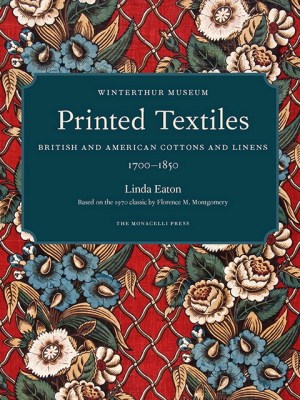 The Winterthur Museum’s richly illustrated history of British and American fabrics made or used from 1700 to 1850 is a visual reference for designers and a definitive contribution to textile studies. From slipcovers that belonged to George Washington, to bedhangings described by Harriet Beecher Stowe, Delaware’s Winterthur Museum holds some of the finest cotton and linen textiles made or used in America and Britain between 1700 and 1850. One of the fastest growing and potentially most lucrative trades in the eighteenth and early nineteenth centuries, on the forefront of developments in science and engineering, chemistry and technology, the textile industry is a fascinating lens into international trade relations and cultural exchange over nearly two centuries.
New Book | Start with a House, Finish with a Collection
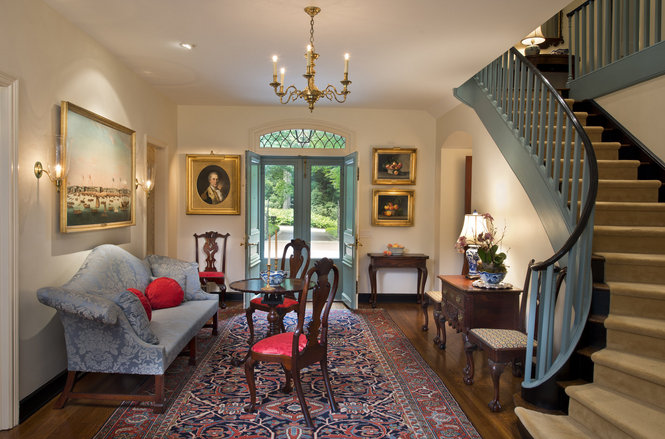 Home of Leslie Ann Miller and her husband, Richard Worley, photo from The Patriot News
◊ ◊ ◊ ◊ ◊
From Scala:
Leslie Anne Miller and Alexandra Kirtley, Start with a House, Finish with a Collection (New York: Scala Arts Publishers, 2014), 272 pages, ISBN: 978-1857599190, $75.
 Start with a House, Finish with a Collection is the story of how a couple’s use of American art and antiques evolved from furnishing a house into a full-blown passion for collecting. Featuring exquisite examples of Hollingsworth and Morris family furniture, Weber boxes, Pennsylvania clocks and Kirk-Stieff silver, as well as American paintings by the Peale family, Edward Hicks, Edward Redfield and Horace Pippin, this museum-caliber collection reveals a pride in the early American sensibility. The combination of text and extraordinary photographs traces this remarkable journey and demonstrates that life can be more than comfortable living among these collections. The compendium catalogues the diversified and important collection, making this a valuable scholarly reference as well as a reading pleasure.
Leslie Anne Miller, a Philadelphia attorney and community leader, has been collecting American art and antiques with her husband Richard Worley for more than 25 years. Alexandra Kirtley is The Montgomery-Garvan Associate Curator of American Decorative Arts at the Philadelphia Museum of Art.
Exhibitions | The Glorious Georges

George I, followed by the future George II and Queen Caroline.
Photo by Miles Willis from a shoot at Hampton Court,
© Miles Willis 2014
◊ ◊ ◊ ◊ ◊
Press release (20 February 2014) from Historic Royal Palaces:
The Glorious Georges
Hampton Court Palace, Kensington Palace, Kew Palace, 17 April — 30 November 2014
Throughout 2014, Historic Royal Palaces will bring the Georgian court and its intriguing cast of royal characters to life, in celebration of the 300th anniversary of the Hanoverian accession to the British throne. These three unlikely monarchs, George I, his son George II, and great-grandson George III, presided over a remarkable era of British history which transformed society and saw the emergence of much that remains ‘quintessentially British’ today. At the very heart of this flourishing nation, within the walls of magnificent royal palaces, sat the Court. Elegant, yet decadent and riven with intrigue and scandal, it captured the imagination of the 18th-century British public and the printing press, making celebrities of the Georgian monarchs and their courtiers.
Visitors to Hampton Court, Kensington and Kew Palaces will be able to step back 300 years, and experience the sights, sounds and even smells of the Georgian age, to celebrate these often overlooked Kings and Queens, and the fascinating era in which they lived. The 18th century court has also inspired an exciting programme of events. Visitors of all ages can explore the music, the fashions and the food and even the fireworks of the Georgian court throughout 2014.
At Hampton Court Palace, meet King George I, who arrived in London in 1714 with a limited grasp on the English language, and a complicated family history. Join his court as tensions brew between the King and his son, the Prince of Wales, forcing courtiers to choose sides. A stunning re-presentation of the Queen’s State Apartments will explore who the Hanoverians were, how they came to rule Britain and how their extraordinary bitter family rows played out in public.
 The story continues at Kensington Palace, where the glittering court of George II and Queen Caroline burst onto the scene in 1727. Their arrival heralded a new era of culture, music and fashion at the British court. The stories of court will brought to life against the backdrop of William Kent’s beautifully restored King’s State Apartments. In 2014, visitors to these fabulous spaces can explore a feast for the senses, featuring Georgian music, court gossip, and lavish fashion, the displays at Kensington will explore the intellectual pursuits of Queen Caroline and her circle. Visitors will be able to meet the Queen in person, in a morning ‘levee’, as she is dressed by her rival, the King’s mistress, Henrietta Howard.
Finally, at Kew Palace, the little known younger years of King George III (later infamous for his bouts of ‘madness’) will be uncovered in a dazzling new display for 2014. A series of fascinating objects will illuminate his education at Kew Palace and highlight many of the interests and influences which shaped a young King who went on to be the first Hanoverian monarch to truly glorify in his Britishness.
Lucy Worsley, Chief Curator, Historic Royal Palaces, said: “These Georgian kings, with all their extraordinary family rivalries, and complex, intriguing courts, have become something of a footnote in British history, often over-shadowed by more glamourous predecessors, and by the tumultuous period of history in which they lived. The Glorious Georges season at Historic Royal Palaces in 2014 is about putting them back on the map. Immersed in the world of the Georgian court, within the walls of their Palaces, visitors will discover that the Hanoverian dynasty presided over a dramatic century in style, preserving the monarchy, and eventually transforming themselves into a very British royal family.”
◊ ◊ ◊ ◊ ◊
Note from the Editor
 In the midst of HRP’s robust marketing, descriptions of the installations and actual objects on display are sometimes overshadowed. Based on my visit earlier this month in connection with the Enlightened Princesses conference, I’m glad to recommend a visit for the summer festivities (I’m also glad to report that the conference was immensely stimulating thanks to terrific talks and, as a bonus, fabulous music from Arcangelo).
Each time I’m at Hampton Court, the palace makes a little more sense even as I’m confused by new things. My basic framework of juxtaposing the grand Tudor country-house-turned-palace with the never-quite-finished building campaign of William and Mary is now complicated by a fuller appreciation of the Georgian layer. It’s particularly interesting to see the future George II and Caroline sharing the Queen’s Apartments during the reign of George I (who, of course, didn’t need the quarters for his own queen whom he divorced and imprisoned back in Hanover). Access to the servants’ and courtiers’ staircase came as a small, deeply satisfying revelation for me. And included in the dining room is an installation of folded linen by Catalonian artist Joan Sallas, who last year produced an installation for Waddesdon Manor, detailed in the video below. For the Hampton Court work, think less heraldry and more animals to be eaten (rabbit, shellfish, fowl, &c.) strewn across the table. Absolutely stunning.
-Craig Hanson
Royal Kitchen Garden Opens at Hampton Court Palace

Historic Royal Palaces press release (11 June 2014). . .
Made legendary by Henry VIII, undisputed king of the joust, Hampton Court Palace’s enormous tiltyard saw some of the most significant moments of his long and often scandalous reign. Horses thundered, colours fluttered in the breeze, and the court gathered in their finery to watch the displays of pride and chivalry. By 1702 however, with the passion for royal tournaments long faded, Queen Anne had ordered the site to be dug up and cropped with “severall varietys of Eatables, the most proper for Her Majesty’s Use.” The kitchen garden, covering six acres, fed the Queen and her court not only at Hampton Court, but at royal residences across the capital.
This summer, Historic Royal Palaces will be turning back the clock at Hampton Court to return the garden to its eighteenth century heyday, recreating the pathways and planting pattern laid down by the palace’s Georgian gardeners. Based on historic evidence and John Roque’s plan of 1736, it will be as true to the period as possible, right down to the now rare heritage varieties of fruit and vegetables which will be grown there.
This new addition to the palace’s world famous gardens will allow visitors to explore the untold history of food production at Hampton Court, with on-site displays helping to showcase some of the traditional techniques employed by royal gardeners to tend crops fit for a king. Herbs and vegetables familiar to the palace’s Georgian cooks will be reinstated, from Italian celery to borrage, skirret and swelling parsnips. Apricots, nectarines and even peaches will return to the garden in their original fan shapes, while the garden’s very own melonry, complete with hot beds of straw and manure, will also be recreated by the palace’s team of expert gardeners.
Importantly, the garden will be open to the public free of charge, and will provide a valuable educational resource for the local community, as well as the hundreds of visitors and school groups who enjoy the palace every day. As the garden matures, Historic Royal Palaces hopes to be able to run vegetable growing classes at the palace—reconnecting the Great Kitchens at Hampton Court with the locally sourced produce which once stocked them.
Vicki Cooke, Hampton Court Palace’s Kitchen Garden Keeper, said: “The reinstated Kitchen Garden at Hampton Court is the realisation of a massive amount of research, planning and labour by the team, and will give visitors a real taste of the work involved in supplying a royal kitchen. Our ambitious planting scheme showcases a whole range of less well known fruit, vegetables and herbs which would have gone into the lavish meals prepared for the monarchs who lived here, and will mean that each passing season brings new crops waiting to be discovered.”
The opening of the Royal Kitchen Garden is part of a wider celebration of the Georgians across Historic Royal Palaces in 2014, to commemorate the 300th anniversary of the Hanoverian Accession to the British throne.
Conference | A Head for Fashion: Hair, Wigs, Cosmetics, Jewelry
From The Colonial Williamsburg Foundation:
A Head for Fashion: Hair, Wigs, Cosmetics, and Jewelry, 1600–1900
Colonial Williamsburg, 14–16 November 2014
 Colonial Williamsburg is celebrating the 75th anniversary of the opening of the Kings Arms Barber and Wig Shop by hosting a conference on wigs, hair, makeup, and accessories of the seventeenth, eighteenth, and nineteenth centuries. The program will examine how ‘fashion from the neck up’ changed over time, reflecting changes in taste, the personal images people wished to present, affluence and class, and sheer practicality. Colonial Williamsburg wigmakers and other tradespeople, historians and interpreters, will be joined by noted guest speakers to present talks on wigs, hairstyles, cosmetics, jewelry, and related topics. These presentations will be interspersed with demonstrations and panel discussions.
As we put this program together, we realized that there is little published information specifically about these topics, and it is difficult to find anything that brings them all together. This conference will help to fill that gap, for scholars, curators, museum interpreters, reenactors, theatre costumers, and anyone who is just plain interested. We are looking forward to a diverse and enthusiastic audience who will bring their perspectives to the conversation. And we plan to have fun!
Conference | 400 Years of Chocolate: Aztec to Artisanal
From The Colonial Williamsburg Foundation:
400 Years of Chocolate: Aztec to Artisanal
Colonial Williamsburg, 2–4 November 2014
 Come join us on a journey with one of the world’s favorite plants: cacao. We will discover the amazing paths through time and space that this plant and its products have traveled. From early uses as a ceremonial beverage and important crop in Mesoamerica, to its transformation to one of the most popular foodstuffs in the world, chocolate has crossed oceans, been carried up mountains, and even flown into outer space. How did the seeds of this humble plant become so popular?
Join Colonial Williamsburg’s Historic Foodways staff, curators, and distinguished guest scholars as they explore how this plant is grown and processed and how the seeds are transformed into a product that conquers the food world. Learn how people of the past used and altered chocolate from a beverage into a candy and beyond.
Guest speakers will include Dr. Howard-Yana Shapiro, one of the world’s top cacao scientists. He is Global Director of Plant Science and External Research, Mars Incorporated, and Adjunct Professor in the College of Agriculture and Environmental Sciences, The University of California at Davis. Dr. Shapiro also helped map the cacao gene and is one of the foremost scholars in the field of cacao propagation. Dr. Michael Coe, Professor Emeritus, Department of Anthropology, Yale University, will present the place of chocolate in early Mesoamerica. Ruby Fougère, Curator of Furnishings, Collections and Conservation Supervisor, Parks Canada, will complement a Foodway’s staff presentation on chocolate in seventeenth- and eighteenth-century Europe and North America, with a look at chocolate in French Canada. Dr. Deanna Pucciarelli, Program Director, Hospitality and Food Management Program, Ball State University, will explore how chocolate production methods evolved during the nineteenth century, and John and Tracy Anderson of Woodhouse Chocolate in St. Helena, California, will delve into modern artisanal chocolate making.
And, of course, no program on chocolate would be complete without a chance to eat some! Chef Rhys Lewis and the Colonial Williamsburg Lodge culinary team will present us with delicious chocolate concoctions of the past, present, and future. So, come learn, smell, taste, and follow chocolate on its journey through history.
Exhibition | A Royal Collecting Passion: Wilhelm I of Württemberg
From the Staatsgalerie Stuttgart:
A Royal Collecting Passion: Wilhelm I of Württemberg
Staatsgalerie Stuttgart, 18 July — 26 October 2014

Gottlieb Schick, Apollo among the Shepherds, 1806–08, (Staatsgalerie Stuttgart)
As a regent, Wilhelm Friedrich Karl von Württemberg (1781–1864) gave the young kingdom of Württemberg a historical identity; his multifarious initiatives as a collector and patron, however, have all but sunk into oblivion. The holdings of the Staatsgalerie, which opened in 1843, were expanded by artworks in royal ownership as well as by personal gifts. Wilhelm I moreover initiated the acquisition of the Barbini-Breganze collection, which today forms the core of the Staatsgalerie Stuttgart’s holdings in the area of Italian Baroque painting. The royal gifts, still present in our museum’s collection in their near entirety, are now to be presented to the public for the first time in many decades. Numerous furnishings from Wilhelm I’s private residences as well as masterpieces from his private painting collection—disbanded after 1918—will be on view. On the basis of the records at the Staatsarchiv Baden-Württemberg, which have been preserved almost in full, light will also be shed on the history of the royal purchases. The exhibition is being realized in cooperation with the Staatliche Schlösser und Gärten Baden-Württemberg.
More information (in German) is available here»
◊ ◊ ◊ ◊ ◊
The catalogue, published by Nicolai Verlag, is available from ArtBooks.com:
Königliche Sammellust: Wilhelm I. von Württemberg als Sammler und Förderer der Künste (Berlin: Nicolai, 2014), 208 pages, ISBN: 978-3894798727, 35€ / $68.










 Enfilade
leave a comment