Exhibition | Rococo to Revolution: 18th-Century French Drawings

Jean-Baptiste Greuze, The Father’s Curse: The Ungrateful Son, ca. 1778
(Los Angeles: The J. Paul Getty Museum)
◊ ◊ ◊ ◊ ◊
From the press release (17 June 2014) for the upcoming exhibition:
Rococo to Revolution: 18th-Century French Drawings from Los Angeles Collections
J. Paul Getty Museum, Getty Center, Los Angeles, 1 July – 21 September 2014
Curated by Edouard Kopp
For nearly three-quarters of a century, from the death of Louis XIV in 1715 to the Revolution of 1789, France’s intellectual and artistic landscape flourished, reaching new levels of splendor and accomplishment. During this period, when inventiveness was greatly valued, drawing exemplified the creative impulse perhaps more than any other artistic medium. Through outstanding examples by of some of the period’s most acclaimed artists, the art of drawing is celebrated in Rococo to Revolution: 18th-century French Drawings from Los Angeles Collections, on view July 1–September 21, 2014 at the J. Paul Getty Museum, Getty Center. The exhibition includes more than 40 drawings from the J. Paul Getty Museum’s collection, complemented by works from distinguished private collections in Los Angeles.
“Drawing contributed to an aesthetic evolution in France, starting with the decorative exuberance of the Rococo, and gradually giving way to the austerity of Neoclassicism,” explains Timothy Potts, director of the J. Paul Getty Museum. “This exhibition tracks that evolution through the work of some of the finest artists of the 18th century, highlighting works in our collection alongside generous loans from local collections. We are fortunate and grateful to be able to exhibit these rarely-seen works.”
Featured in the exhibition is work by artists such as Jean-Antoine Watteau, François Boucher, Gabriel de Saint-Aubin, Henri-Pierre Danloux, Jean-Honoré Fragonard, Jean-Baptiste Greuze, and Jacques-Louis David, among others.

Jean- Antoine Watteau, Woman Seated with a Fan, c. 1717 (Los Angeles: J. P. Getty Museum)
“While drawing was most often used in preparation for paintings, prints, sculpture or architecture, many of the drawings created in that period were works of art in their own right,” explains Edouard Kopp, associate curator of drawings at the J. Paul Getty Museum. “Drawings were avidly collected at the time, as connoisseurs much appreciated the insights into the creative process that such works offered. This pursuit is continued with enthusiasm by the Getty Museum and private collectors in Los Angeles today.”
Indeed, artists during this period elevated drawing to new heights. In The Swing (late 1730s or early 1740s), François Boucher (French, 1703–1770) revives the pastoral genre, portraying figures at play on a log turned seesaw, with their elegant dress belying the country setting in typical Rococo fashion. Boucher shows a virtuosic command of black chalk, creating a wide array of marks from short flicks to zigzags. Among the most dazzling drawings in the exhibition is Two Studies of a Flutist and a Study of the Head of a Boy by Jean-Antoine Watteau (French, 1684–1721). Executed in a spontaneous yet highly sophisticated combination of red, black, and white chalk, the sheet evokes the flow of music and Watteau’s passion for it. A master of suggestion, the draftsman has captured the undulating, rhythmic motion of a flute player in two distinct poses, while a young observer appears to be listening intently, enraptured by the concert.
Some of the works in the exhibition reflect political leanings. Henri-Pierre Danloux (French, 1753–1809) was the most sought-after portraitist by the French aristocracy in the 1780s. In Portrait of a Young Lady in Profile (about 1783–85), Danloux’s skill is apparent in a remarkably lifelike depiction of a woman, her layers of soft curls and striped, ruffled dress rendered with loose black lines. Her parted lips demonstrate immediacy, rather than a static moment. An outspoken rival of the royalist Danloux, Jacques-Louis David (French, 1748–1825) created Portrait of Andre-Antoine Bernard, called Bernard de Saintes (1795) while imprisoned for revolutionary activities. The portrait is a bust-length profile in a medallion format that recalls ancient coins. However, David undermined the classical association with that genre by depicting the sitter crossing his arms defiantly and wearing a distinctive hat and an intense expression that identified him as a revolutionary.
Family drama was also a popular theme in the later 1700s. One of the greatest draftsmen of all time, Jean-Honoré Fragonard (French, 1732–1806) evokes the frenzied joy of family life in Making Beignets (about 1782). Fragonard is able to turn the simple act of making sweets into a celebration, as a roiling mound of forms and faces are imbued with energy using a flurry of rapid-fire graphite lines, a warm brown wash, and the luminous quality of the paper itself. In Jean-Baptiste Greuze’s (French, 1725–1805) The Father’s Curse: The Ungrateful Son (about 1778), a scene of violent family discord is handled with a degree of seriousness and theatricality normally reserved for grand historical subjects: the artist indeed creates dramatic figural poses and strong contrasts of light and shadow.
Conversely, the revolutionary sentiment at the time was slyly referenced in ancient scenes by David such as The Lictors Bringing Brutus the Bodies of His Sons (1787). David illustrates the story of Roman consul Lucius Junius Brutus, who, upon hearing that his sons have conspired to overthrow his government, orders them executed for treason. David chooses the moment when Brutus is presented with their bodies, his own figure placed in the dark foreground. This drawing conveys a sense of struggle between patriotic duty and familial loyalty, which David intended to be morally edifying for the public, not long before France entered years of political turmoil.
Rococo to Revolution: 18th-Century French Drawings from Los Angeles Collections, is on view July 1–September 21, 2014 at the J. Paul Getty Museum, Getty Center. The exhibition is curated by Edouard Kopp, associate curator of drawings at the J. Paul Getty Museum.
For related events see the full press release…Study Day | Josephine and the Empire of Fashion
From H-ArtHist:
Joséphine et l’Empire de la Mode
Archives Nationales Hôtel Soubise, Paris, 24 June 2014
Marie-Joseph-Rose de Tascher de la Pagerie, impératrice des Français sous le nom de Joséphine, est née aux Trois-Ilets en Martinique le 23 juin 1763, et décédée au château de Malmaison le 29 mai 1814. L’année 2014 célèbre Joséphine au titre des commémorations nationales. Deux grandes expositions lui sont consacrées, Joséphine au musée du Luxembourg à Paris, et Joséphine, la passion des fleurs et des oiseaux au musée national du château de Malmaison. L’inventaire fait après le décès de Joséphine comprend celui d’une importante garde-robe, dont le château de Malmaison conserve quelques témoignages. C’est à propos des choix textiles, du goût et du style de Joséphine que s’articule la journée d’étude Joséphine et l’Empire de la mode, initiée par l’association ART & LUXE.
Sur inscription dans la limite des places disponibles par courriel à l’adresse suivante: Art-luxe@live.fr
◊ ◊ ◊ ◊ ◊
P R O G R A M M E
13:30 Accueil
14:00 Corinne Thépaut-Cabasset (historienne de la mode, Paris), L’image de la mode dans la presse : Le ‘costume parisien’, 1800–1815
14:30 Alain Pougetoux (conservateur en chef, domaine national des châteaux de Malmaison et Bois-Préau), La boutique à paris sous le Premier empire
15:00 Céline Meunier (conservateur en chef, Domaine national des châteaux de Malmaison et Bois-Préau), Joséphine : en quête d’une garde-robe
15:30 Fiona Ffoulkes (Université de Southampton, professeur associé Université des arts de Bournemouth et université américaine, Paris) Muse, cliente et amie ? L’importance de la relation de l’impératrice Joséphine avec Leroy, marchand de modes
16:00 Marguerite Coppens (Chef de département, Musées royaux d’art et d’histoire, Bruxelles), Les commandes dentellières de la maison impériale
16:30 Carole Damour (archiviste textile, Société Tassinari & Chatel, Paris), Des palais impériaux au château de la Malmaison : Les choix textiles de Joséphine
17:00 Discussion
Conference | George I 300 Years On
From the conference website:
George I 300 Years On: Reconstructing the Succession
Bath Royal Literary and Scientific Institution, 18–20 June 2014
This interdisciplinary conference takes the theme of the accession of the first Hanoverian king, George I. It will examine not just the end of the Stuart era, but the defining characteristics, outcomes and consequences the Hanoverian succession.
W E D N E S D A Y , 1 8 J U N E 2 0 1 4
2:00 Registration and afternoon tea
Welcome from Elaine Chalus (Bath Spa University), Nichola Hayton (Mannheim Universität), and Stefano Weinberger (Cultural Attaché for the German Embassy in London)
3:45 Opening Plenary, Dominic Aidan Bellenger (Abbot of Downside Abbey), George I and the Catholics
Drinks reception; delegates may wish to visit the Georgian exhibition at the Fashion Museum or take a walking tour of Bath.
7:30 Conference Dinner
T H U R S D A Y , 1 9 J U N E 2 0 1 4
9:00 Tea and coffee
9:30 Panel I, chaired by Elaine Chalus
• Ruth Paley (History of Parliament), Seditious Libel in the Last Years of Anne
• Robin Eagles (History of Parliament), The Duke of Shrewsbury and the Politics of Succession in the Last Days of Anne
• Matthew Kilburn (History of Parliament), The Missing Queen
11:00 Tea and coffee
11:30 Panel II, charied by Kevin Grieves
• Mark Walker (University of Essex), The Bittersweet Death of Queen Anne, 1714
• Noel Cox (Aberystwyth University), The Law of Succession
• Heike Bormuth (Universität Mannheim), From Georg Ludwig to George I: An Absolutistic Elector in the English Parliamentary Monarchy. The Settling in of the Hanoverian Dynasty
• Richard Johns (University of York), ‘A New Breed of Men’: George I and his Progeny at Greenwich
1:30 Lunch
3:00 Panel III Postgraduate Panel, chaired by Georgina Moore
• James Camp (Bath Spa University), By Royal appointment: Bath and the Reception of Royalty, 1660–1714
• Kate James (Bath Spa University), Newton Park and the Country House in Transition
• Kelly Yates (University of Manchester), Jeffrey the Jacobite Poltergeist
F R I D A Y , 2 0 J U N E 2 0 1 4
9:30 Tea and coffee
10.00 Panel IV, chaired by Andrew Thompson
• James Caudle (Yale University), A Revolution in Political Broadcasting: The Political Sermon in the Hanoverian Revolution, 1714–16
• Ralph Stevens (Fitzwilliam College, University of Cambridge), ‘King George’s Religion’: The Religious Politics of the Hanoverian Succession
• James Lees, Schism, Succession: Chaplains of George Augustus and Caroline as Prince and Princess of Wales, 1714–27
11:30 Tea and coffee
12:00 Panel V, chaired by Arnd Reitemeier
• Kevin Grieves (Bath Spa University), The London Press and the Succession
• Stewart Tolley (University of London), A Popular Rail? Press and Public Interest in George I’s Ministers, 1714–27
• Benjamin Bühring (Göttingen University), An Expatriate Community: The London German Court of George I
1:30 Lunch
2:45 Panel VI, chaired by Jackie Collier
• Philip Loft (University of London), Parliament, Petitioning, and the Public, 1714–20
• Pauline Chakmakjian (Independent Scholar), A Sociable King: George I and the Rise of Speculative Freemasonry
• Nigel Aston (University of Leicester), A Mixed Ministry? The Tories in government, 1714–16
4:45 Closing Plenary, Clarissa Campbell Orr (Anglia Ruskin University), Life and Culture at Court in England and Hanover: An Anglo-German Comparison
Call for Articles | Picturing the Eighteenth-Century Novel
Picturing the Eighteenth-Century Novel through Time:
Illustration, Intermediality and Adaptation
Special Issue of Journal for Eighteenth-Century Studies (2016)
Guest-edited by Christina Ionescu and Ann Lewis
Abstracts due by 1 August 2014
‘Have you noticed that no book ever gets well illustrated once it becomes a classic?’, asked in passing Aubrey Beardsley when faced with the challenge of illustrating Les Liaisons dangereuses in the Art Nouveau era. Yet visually intriguing and conceptually intricate illustrations of eighteenth-century classics are abundantly present at key moments in the history of the book (Romanticism, the fin-de-siècle, the interwar period, amongst others). Defoe’s Robinson Crusoe, Swift’s Gulliver’s Travels, Voltaire’s Candide, Rousseau’s La Nouvelle Héloïse, Goethe’s Werther and Bernardin’s Paul et Virginie are just some examples of canonical texts that have inspired artists not only through time but also across national boundaries and different media. Such texts have produced visual corpora that are as vast as they are diverse. The timeless fascination with Paul et Virginie, for example, has resulted not only in illustrative series that steadily accompanied the text in its various incarnations as a book, but also in drawings, prints, sculptures, caricatures, tapestries, ceramics, clocks, etc., which circulated and were displayed independently of the text. Artistic transpositions and intermedial engagements with eighteenth-century bestsellers range from these visually static, yet geographically mobile forms of expression, to dynamic, performative adaptations such as films, operas and plays.
In spite of the increasing availability of digital images, critical approaches still tend to privilege the authorially sanctioned series (such as Gravelot’s engravings for Rousseau’s bestselling novel, commissioned and designed with the writer’s direct involvement), or ‘intervisual paradigms’ (patterns of iconographic representation considered independently of their text of origin). Moreover, theatrical or cinematic adaptations of eighteenth-century novels are seldom considered in relation to other forms of visual crossover, such as book illustration and decorative objects, though they all a priori rely on similar processes of visualising and adapting the text. The comparative analysis of different series of illustrations and of other forms of artistic representation of the same novel through time and space, however, allows us to explore the complexity of adaptation, to understand the visual representation inspired by text as an intermedial product and cultural phenomenon, and perhaps to grasp the fascination that the eighteenth century continues to exert upon us.
We invite submissions of papers that address any of the following questions through interdisciplinary and cross-cultural approaches:
• How does the illustration of an eighteenth-century novel through time respond to new techniques and to changing views of the function of illustration itself?
• How do successive generations of artists shape the reception of an eighteenth-century novel at different moments in time?
• How do illustrated translations of eighteenth-century classics reflect the geographical, linguistic and cultural displacement of the original text?
• How does the gradual shift from the poorly paid artisan to the internationally known artist affect the illustration of an eighteenth-century classic?
• How do publishers operating from lucrative centres of book production (Amsterdam, Brussels, The Hague, London, Paris, etc.) respond to the specific expectations of their subscribers or readerships in regard to illustration?
• How do artists, publishers and/or stage directors facilitate or negotiate verbal/visual crossover? What is their respective involvement in this process?
• How do individual artists re-view an eighteenth-century text when they illustrate it again for a different publisher or edition?
• How does the phenomenon of extra-illustration exemplify a unique rapport of visual closeness between the collector and text? How is the reading process impacted by the insertion within a single volume of parallel illustrations of the same scenes, which were executed at different moments in time?
• How do objects inspired by eighteenth-century novels become cultural artefacts and exist independently of the text? How are they integrated in home décor, private collections or museum space? And what impact do they have as things commissioned, inherited, or collected?
• How is visual representation transposed from one medium to another (for example, from book illustration to film adaptation)? What are the similarities and differences in the ways in which the text is visually adapted for each medium of expression?
Please send an abstract of 500 words to a.lewis@bbk.ac.uk and cionescu@mta.ca by 1 August 2014. The deadline for submission of completed articles will be June 2015 (approximately 8000 words). Articles may be in French or English. As is usual for peer-reviewed journals, all final decisions concerning the acceptance of articles for this special issue will be made by the JECS editorial board. We also intend to host a workshop around the collection at the BSECS annual conference in January 2016.
Call for Papers | CAA 2015 Session, Home Subjects
A late addition to the CAA 2015 sessions:
Home Subjects: Domestic Space and the Arts in Britain, 1753–1900
HBA Session at the 103rd Annual Conference of the College Art Association
New York, 11–14 February 2015
Proposals due by 15 August 2014
Session chairs:
Melinda McCurdy (Associate Curator of British Art, Huntington Art Collections), mmccurdy@huntington.org
Morna O’Neill (Wake Forest University), morna.oneill@gmail.com
Anne Nellis Richter (independent scholar and adjunct instructor, American University), anne.nellis@gmail.com
Home Subjects is a new research working group which aims to illuminate the domestic display of art in Britain. Our goal is to examine the home as a place to view and exhibit works of art within the historical context of the long nineteenth century.
Recent scholarship has emphasized the importance of the house itself and notions of ‘domesticity’ as important touchstones in British culture. At the same time, art historians have tended to focus on a history of British art premised on the display of art in public; according to this important narrative, British art developed in relationship to the public sphere in the eighteenth century. Art institutions and exhibitions asserted the importance of the display of art in forming audiences into publics in cultural and political terms. Such efforts continued in the ‘exhibition age’ of the nineteenth century, when display of artwork in museums, galleries, and special exhibitions solidified the important role given to art in articulating a public sphere. This narrative overlooks the continuation of older paradigms of display, especially those premised on the private and domestic audience for works of art. Within this context, the country house takes it place alongside the townhouse as an important venue for the display of art. We aim to explore this ‘counter-narrative’ of the home as the ideal place to view works of art, a view which permeated all areas of art and design and which persisted throughout the nineteenth century, despite the prevailing narrative of the development of public museums.
Also at stake in this project is a reconsideration of domesticity and its relationship to modernity. Important recent scholarship has illuminated some of the ways in which entrenched narratives of modernity and artistic modernism were defined in opposition to the domestic sphere. In a typical avant-garde gambit, artists distinguished works of art from objects of interior decoration by rejecting the private and the domestic.
This session aims to bring together scholars whose work addresses this topic in order to posit a new trajectory for modernity, one that can be traced through the private, domestic sphere. Topics of interest include but are not limited to:
• the display of easel painting and its relationship to the domestic interior
• decorative arts, their status as works of art and relationship to interior decoration
• domestic architecture and museum/gallery architecture, both public and private
• collecting and taste
• the interrelationship between private and public modes of display and decoration
Proposal abstracts should be no more than 500 words, and should be accompanied by a current 2-page c.v. and must be received by email to homesubjects@gmail.com by August 15, 2014. Please also include a mailing address, telephone number, and email.
New Book | Portraiture and Politics in Revolutionary France
From Penn State UP:
Amy Freund, Portraiture and Politics in Revolutionary France (University Park: The Pennsylvania State University Press, 2014), 312 pages, ISBN: 978-0271061948, $85.
 Portraiture and Politics in Revolutionary France challenges widely held assumptions about both the genre of portraiture and the political and cultural role of images in France at the beginning of the nineteenth century. After 1789, portraiture came to dominate French visual culture because it addressed the central challenge of the Revolution: how to turn subjects into citizens. Revolutionary portraits allowed sitters and artists to appropriate the means of representation, both aesthetic and political, and articulate new forms of selfhood and citizenship, often in astonishingly creative ways. The triumph of revolutionary portraiture also marks a turning point in the history of art, when seriousness of purpose and aesthetic ambition passed from the formulation of historical narratives to the depiction of contemporary individuals. This shift had major consequences for the course of modern art production and its engagement with the political and the contingent.
Summer 2014 Issue of the CODART eZine
The 4th issue of the CODART eZine focuses on the eighteenth-century:
CODART eZine 4 (Summer 2014)

Jan Ekels, A Writer Sharpening His Pen, 1784
(Amsterdam: Rijksmuseum)
• Tom van der Molen, “Editor’s Note: Eighteenth-Century Art”
• Gerdien Verschoor, “Welcome: CODART Director Dies under Avalanche of Books”
• Virginie D’haene, “Bruges Artists Abroad: Neoclassicist Drawings in the Printroom of the Groeningemuseum”
• Stefaan Hautekeete, “A Cabinet of the Most Delightful Drawings: Eighteenth-Century Netherlandish Drawings from the Collection of Jean de Grez, To Be Exhibited at the Koninklijke Musea voor Schone Kunsten van België (Royal Museums of Fine Arts in Belgium) in 2016”
• René Dessing, “Historic Country Houses in the Netherlands”
• Silke Gatenbröcker, “Duke Anton Ulrich of Braunschweig-Wolfenbüttel: One of the First Collectors of Dutch Paintings outside the Netherlands”
• Jacek Tylicki, “Collecting at the Court of Poland-Lithuania and the Activities of King Stanislaus II August”
• Curator’s Interview: Paul Knolle interviewed by Andrea Rousová
• Friends: Brian Capstick interviewed by Gerdien Verschoor
• Rebecca Long, “CODART ZEVENTIEN Congress Review”
About CODART
CODART—the international council for curators of Dutch and Flemish art—aims to further the study, care, accessibility and display of art from the Low Countries in museums around the globe. It serves as a platform for exchange and cooperation between curators from different parts of the world, with different levels of experience, and from different types and sizes of institutions. Our organization stimulates international inter-museum cooperation through a variety of activities, including congresses, focus meetings, publications and our website. By these means CODART strives to solidify the cultural ties between the Netherlands and Flanders, and to make the artistic heritage of these countries accessible to the international art-loving public.
Exhibition | How Glasgow Flourished, 1714–1837
◊ ◊ ◊ ◊ ◊
From the Kelvingrove Art Gallery:
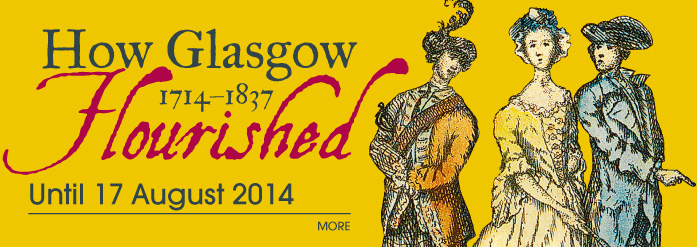
How Glasgow Flourished, 1714–1837
Kelvingrove Art Gallery and Museum, Glasgow, 18 April — 17 August 2014
How Glasgow Flourished takes a fresh look at a hugely significant but often overlooked period in Glasgow’s history. Discover how over 300 years ago, Glasgow’s businessmen made their fortunes from trading in colonial goods and through slave labour, and how they manufactured and exported products made in Glasgow, across the world. This was also when ordinary Glaswegians came together in workers’ associations and co-ops to campaign for better working and living conditions for them and their families and paved the way for the Trade Union movement.
The exhibition shows how weaving changed from a cottage industry to a full-blown manufacturing industry and green fields were covered over by some of the largest and most advanced dyeing and smelting factories in the world. You can see a reconstructed weaver’s loom, factory engines and dresses and outfits, which have never been displayed before. Other exclusive displays include new portraits of members of one of Glasgow’s wealthiest families, the Glassfords and a newly conserved music organ made by James Watt, as well as the great man’s steam engine with its condenser unit. There are also many other pieces from Glasgow Museums’ collection that have never been on display before, including art and objects relating to the lives of Glaswegians.
Teixeira’s Topographia de la Villa de Madrid in The Art Bulletin

◊ ◊ ◊ ◊ ◊
In the latest issue of The Art Bulletin (which I’m just now catching up on). . .
Jesús Escobar, “Map as Tapestry: Science and Art in Pedro Teixeira’s 1656 Representation of Madrid,” The Art Bulletin 96 (March 2014): 50–69.
Abstract: Pedro Teixeira’s Topographia de la Villa de Madrid is arguably the greatest representation of a city in the Spanish Habsburg world. Measuring nearly six feet high and more than nine feet wide, the map is a remarkable scientific achievement as well as a sophisticated art object. An exploration of the map’s text and ornament details the efforts of a scientist working in a court setting to shape a grandiose picture of the Spanish capital. Displayed on a wall, Topographia de la Villa de Madrid rivaled paintings and tapestries in their ability to exalt the image of a powerful ruler.
◊ ◊ ◊ ◊ ◊
Though dating to the the mid-seventeenth century, the map caught my attention for Enfilade because of this statement and footnote toward the end of the article:
As testament to the map’s legacy, a derivative map at a smaller scale than Teixeira’s was engraved in four plates in 1683 by the Dutch-Spanish artist Gregorio Fosman (1635–1713) and printed in the Madrid studio of Santiago Ambrona.107 (66).
107. Molina Campuzano, Planos de Madrid, 283–89, notes that the depiction of the city in Fosman’s map is approximately one-seventh the size of Teixeira’s. Fosman’s image would, in itself, serve as a model for a number of eighteenth-century maps of Madrid engraved by foreign artists in Paris, Amsterdam, and Augsburg. . . (69).
If anyone is looking then for the equivalent for Madrid of Giambattista Nolli’s 1748 map of Rome, Teixeira’s Topographia de la Villa de Madrid would seem to be at least part of the answer. -CH
Conference | The Images and Texts of Alexander Pope
Originals, Translations, and Imitations:
The Images and Texts of Alexander Pope
Waddesdon Manor, Buckinghamshire, 12 July 2014
 A one-day conference organized by Waddesdon Manor (the Rothschild Foundation) in collaboration with The Paul Mellon Centre for Studies in British Art
This conference will explore some central themes running through the exhibition, Fame and Friendship: Pope, Roubiliac, and the Portrait Bust in Eighteenth-Century Britain, organised jointly by the Rothschild Foundation and Waddesdon Manor with the Yale Center for British Art. At the heart of the exhibition are eight portrait busts of the poet Alexander Pope by Roubiliac along with various replications of this model. These images imitate classical portrait busts, translating the conventions of the originals into an eighteenth-century mode. At the same time, the replications translate Roubiliac’s original into other media, such as plaster or ceramic. At Waddesdon these various images will not only shown not only alongside both some of the most celebrated painted portraits of the poet and examples of his printed texts, but also juxtaposed with French works celebrating Pope and other writers. These various processes of imitation and translation could hardly be more appropriate for a subject whose contemporary fame rested partly on his own translations of Homer and whose poetry constantly imitated classical models. In its turn, Pope’s work was itself translated into French. All the papers in this conference will address different aspects of imitation and translation, in the form of both images and texts. The fee for the day is £40. To book a place, please ring the booking line on 01296 653226. Please let us know of any dietary requirements.
◊ ◊ ◊ ◊ ◊
P R O G R A M M E
9:45 Coffee and registration in the Manor Restaurant with the exhibition open for viewing
10.30 Welcome by Sarah Weir (Chief Executive, Waddesdon Manor)
10:45 Text, Image, and Translation (Chair: Alastair Laing)
• Nigel Wood (Loughborough University), Pope as the Translator of Homer and Horace
• James McLaverty (Keele University), Pope in his Pastorals: Manuscript and Print
• Valerie Rumbold (Birmingham University), The Use of Art in Alexander Pope’s “To Mr. Addison, Occasioned by Dialogues on Medals”
12:45 Lunch
1:50 Pope and the Image (Chair: Martin Postle)
• Caroline Pegum (Independent Scholar), Charles Jervas and Pope’s Portraits
• Malcolm Baker (University of California, Riverside), For Friends and Admirers: The Sculptural Replication of Pope’s Image
• Juliet Carey (Waddesdon Manor), Pope and the Ceramic Canon
3.50 Tea
4:20 Pope, Writers, and France (Chair: Malcolm Baker)
• Russell Goulbourne (Kings College, London), Voltaire’s Pope
• Guilhem Scherf (Musée du Louvre), French Sculptors and the Image of the Writer
5:45 Drinks reception (Parterre or Manor Restaurant, depending on weather) during which the exhibition will again be open for viewing.










leave a comment