Exhibition | Architectural Drawings of the Eighteenth Century
From the Museo di Roma:
Architectural Drawings of the Eighteenth Century / Disegni di architettura del Settecento
Museo di Roma, 20 December 2013 — 30 June 2014
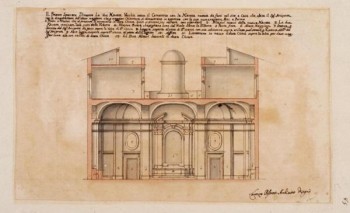
Lorenzo Possenti, Progetti per la nuova chiesa di Sant’Andrea a Gallicano, ca. 1731–33
The drawings exhibited in the “Hall of graphics” were selected from the collection of the Museum of Rome and come mainly from the collection of Antonio Muñoz. They testify the various architectural structures in Rome during the eighteenth century, which have greatly contributed to the creation of the image of the city.
In addition to the projects for monumental works commissioned by the popes, such as the Trevi Fountain, the facade of St. John Lateran, St. Paul Outside the Walls, there are those for minor works, such as small shrines, oratories, fountains and especially houses. A new type of building was conceived in this period: the apartment building, which helps to dramatically change the appearance of the city by marking its “gentrification.”
The designs, both by major architects (Ferdinando Fuga, Nicola Salvi) and other less well-known ones (Andrea Francesco Nicoletti, Girolamo Toma), are always very imaginative and extremely elegant from the point of view of graphics, especially those presenting the project to the potential buyer, the only means available to an artist to promote their work. Sketches, study sheets, design or academic drawings, and publications also allow to follow and better understand some important debates of the period relating to the “modern style” of the Roman Barocchetto opposed to the more austere “old style” or the difference between reproduction and imitation.
New Book | Four Emperors and an Architect
From Oxbow Books:
Alicia Salter, Four Emperors and an Architect: How Robert Adam Rediscovered the Tetrarchy (Lexicon Publishing, 2013), 196 pages, ISBN: 978-0957571907, £20.
 The eighteenth century saw an explosion of interest in the architecture of ancient Rome, spawning the phenomenon of the Grand Tour. The palace of Diocletian at Split, however, remained unappreciated and under the radar until its 1757 rediscovery by the young British architect, Robert Adam. This superbly illustrated volume narrates Adam’s pioneering work and the influence it had on his own architectural practice, interweaving his story with that of Diocletian himself and his colleagues in power, the Tetrarchs. Above all Alicia Salter explores their architecture, showing how it was used to symbolise their rule, and describing in detail not only the palace at Split, but work by the other Tetrarchs in their capitals at Milan, Trier, Nicomedia and Thessalonica, as well as at Rome itself.
Alicia Salter read history at St. Hilda’s College, Oxford. After marriage and three children, she graduated to Art History (The Study Centre at The Victoria and Albert Museum), specialising in the history of architecture—her great love. For seventeen years, together with two friends, she ran her own small business—Art Circle—concentrating on the great wealth of art to be found in a city such as London. Some years later research into the work of Sir Robert Taylor led to an interest in Robert Adam and his archaeological survey of Diocletian’s palace in Split.
More information is available at book’s website.
Conference | The Sculpture of the Écorché
From the Henry Moore Institute:
The Sculpture of the Écorché
Henry Moore Institute, Leeds, 7 June 2014

Thomas Mewburn Crook ‘Stage 9a: Anatomical Studies of the Human Figure from the Flat’ 1893 Pencil, ink and watercolour on paper Leeds Museums & Galleries (Henry Moore Institute Archive)
This one-day conference takes the écorché as its subject, reconsidering the many ways that models of the flayed figure have been understood from the sixteenth century to the present day. Across seven papers, the conference addresses the écorché variously as a teaching object for the education of sculptors, as a scientific model crucial to the understanding of anatomy, as a sculptural process and as a sculptural object in its own right.
The écorché has frequently operated across disciplinary boundaries and registers of respectability. Makers of wax écorchés in the eighteenth century, such as the Florentine Clemente Susini (1754–1814), were highly acclaimed during their lifetimes, with their work sought by prestigious collectors. By the nineteenth century, however, wax had come to be seen as a merely preparatory, or even a disreputable, medium for sculpture with its capacity for forensic detail and mimetic reproduction of bone, muscle and skin operating against the prevailing neoclassical tendency towards ideal form. As a result of this change in taste, the écorché in plaster of Paris became the primary teaching object for anatomical studies in European academies and schools of art into the twentieth century.
The conference will be chaired by Professor Fay Brauer (University of East London/University of New South Wales College of Fine Arts), Dr Nina Kane (University of Huddersfield) and Dr Rebecca Wade (Henry Moore Institute). Advanced booking is required for this event. Book here.
◊ ◊ ◊ ◊ ◊
S A T U R D A Y , 7 J U N E 2 0 1 4
10.30 Registration
11.00 Introduction
11.10 Panel 1: Cigoli and Ceroplastics: Wax Écorché in Seventeenth-Century Italy
• Roberta Ballestriero (Open University), Under the Wax Skin: Representation of the Écorché in the Art of
Ceroplastics
• Lisa Bourla (University of Pennsylvania), Cigoli’s Écorché, Giambologna’s Studio and the ‘Poe Paradox’
12.20 Lunch
1.30 Panel 2: Dissection as Sculptural Practice: Criminality, Pathology, and the Academy
• Meredith Gamer (Yale University), ‘A necessary inhumanity’: William Hunter’s Criminal Écorchés
• Naomi Slipp (Boston University), Thomas Eakins and the Écorché: Understanding the Human Body in Three
Dimensions
• Natasha Ruiz-Gómez (University of Essex), In Sickness and in Health: Doctor Paul Richer’s Écorché at the École
des Beaux-Arts
3.30 Tea
4.00 Panel 3: Écorché, Modernism, and the Sculptural Canon
• Elena Dumitrescu (National University of Arts, Bucharest), The Écorché by Brancusi and Gerota: An Artwork Created at the School of Fine Arts of Bucharest
• Stefan Grohé (University of Cologne), An Anatomy of Sculpture: The ‘Ecorche, dit de Michel-Ange’ and its Transformations in Modern Art
5.20 Closing remarks
Exhibition | In the Library: Deforming and Adorning
Of the 29 volumes on display (dating from 1471 to 1973), 8 are from the eighteenth century, including Reynolds’s copy of Walpole’s Anecdotes of Painting and Christoph Gottlieb von Murr’s copy of Philipp von Stosch’s gem collection, Description des Pierres gravés du feu Baron de Stosch.
From the National Gallery of Art in Washington:
In the Library: Deforming and Adorning with Annotations and Marginalia
National Gallery of Art, Washington, D.C., 3 March — 27 June 2014
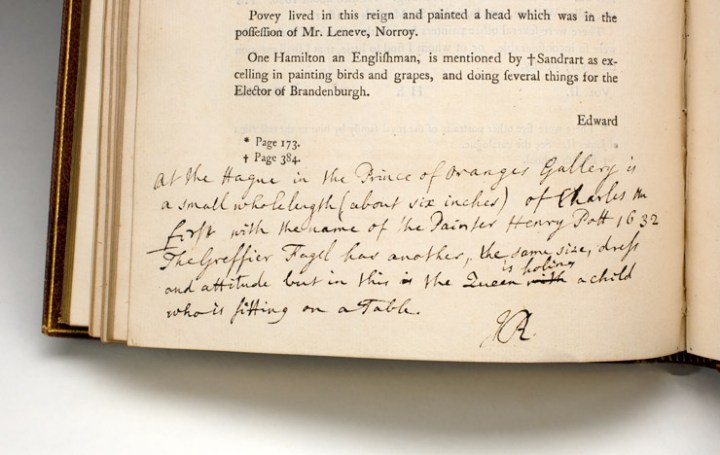
Horace Walpole, Anecdotes of Painting in England (Strawberry Hill, 1762–1771). National Gallery of Art Library, Gift of Joseph E. Widener. The remarks throughout this four-volume set reveal that this copy of an important 18th-century work on British paintings once belonged to Sir Joshua Reynolds (1723–1792). His commentary illuminates his relationship with the author and his role as the head of the Royal Academy of Arts.
◊ ◊ ◊ ◊ ◊
This exhibition highlights a selection of rare books that are unique not because of their content or imprint, but because of the one-of-a-kind markings and additions that readers of the past made to the printed text. From their hand-written marginal commentary and sketches to custom bindings with extra pages and illustrations to editorial notes, each of these books has been transformed from a standard mass-printed volume into a uniquely personal object. They illuminate us with insights into the texts themselves, as well as the readers who read, enjoyed, and annotated them—and the relationships between the two.
The printing press was introduced in the West by Johannes Gutenberg in the 15th century. Prior to this, manuscripts were often copied by hand—a laborious process that was both expensive and prone to errors. In contrast, the printed page permitted the creation and distribution of exact copies of a book to a wide audience. This revolutionary technology changed the spread of knowledge forever.
Yet even a mass-printed volume has the potential to survive as a unique artifact: perhaps all other copies of a particular edition are destroyed; perhaps an individual copy gains notoriety through its provenance, having belonged to a figure of historical importance; or perhaps the book is bound in a peculiar way. In the hand-press period, variance in collation is common for a variety of reasons. Alterations to the text might be made during the print run; moreover, bookbinding was performed separately from the actual publishing process, which allowed for the possibility of pages being lost, added, trimmed, or bound in a different order.
In spite of all these variations, the specific focus of this exhibition is alterations made to the text by readers. The books on view all began as copies identical to hundreds or thousands of others, but each has been transformed by the addition of new information. Many include annotations ranging from navigational aids to detailed critiques of the text.
In the manuscript era, extra-large margins were sometimes provided for scholars to provide commentary, known as glosses. Many early printed books incorporated these earlier glosses along with the main text, and modern readers continued the tradition of adding their own thoughts in the margins. Benjamin Franklin was known to have penned entire debates with authors in the blank spaces of his books; other readers adorned the text with sketches and illustrations. Some readers had their books rebound and included extra material such as prints, notes, and correspondence. In several cases, the author has made editorial notes and revisions for the next edition of his book.
Call for Essays | Art and Social Change, La Salle University Art Museum
Art and Social Change: The Collection of La Salle University Art Museum
Abstracts for an edited volume due by 30 June 2014; completed essays due by 30 January 2015
We are seeking scholarly essays (3,000–6,000 words) for an edited book on the subject of art and social change. The book will focus on Western art from the Renaissance to about 1950 (after which artists-activists and art for social change become important themes—and the focus of numerous other recent books). Scholarly essays should address some aspect of the subject and should ideally engage with one or more artworks in the collection of La Salle University Art Museum. (See the museum’s website for images of artworks on display; detailed lists of artworks in storage are also available on request.)
We welcome proposals from established scholars, recent Ph.D. recipients, upper level graduate students and museum professionals. The deadline for submission of abstracts (300–600 words) is June 30, 2014, with notification by August 30, 2014. The deadline for completed essays is January 30, 2015, with peer reviews taking place in early spring 2015. More information is available here.
Please direct proposals and inquiries to the editors:
Susan Dixon, Ph.D., Chair/Associate Professor Art History, La Salle University Deptartment of Fine Arts, dixons@lasalle.edu
Klare Scarborough, Ph.D., Director/Chief Curator, La Salle University Art Museum, scarborough@lasalle.edu
Call for Papers | The Monkey in the 17th and 18th Centuries
The call for papers includes a bibliography. From Le Blog de L’ApAhAu:
Le singe aux XVIIe et XVIIIe siècles: Figure de l’art, personnage littéraire & curiosité scientifique
CLARE Université Bordeaux Montaigne, 28–29 May 2015
Proposals due by 15 June 2014
 Colloque international, organisé par Florence BOULERIE, CEREC [Centre de Recherches sur l’Europe Classique (XVIIe et XVIIIe siècles)], EA 4593 CLARE, Université Bordeaux Montaigne, Bordeaux (France), et Katalin BARTHA-KOVÁCS, Université de Szeged (Hongrie)
Le singe figure dans les représentations littéraires et artistiques depuis l’Antiquité, en particulier autour du culte des singes dans l’Égypte ancienne ; on le rencontre fréquemment au Moyen âge, notamment dans la statuaire, illustrant la symbolique chrétienne de l’homme déchu, et il reste familier dans l’imaginaire burlesque de la Renaissance (voir à ce sujet la journée d’étude « Singes et singeries à la Renaissance », Chantilly, 15 mars 2014, organisée par l’Atelier XVIe siècle de l’université Paris-Sorbonne).
Au XVIIe siècle, l’intérêt pour cet animal connaît cependant un essor nouveau : les singes prolifèrent dans les fables et les représentations allégoriques, devenant figures du double trompeur et images satiriques de la vanité humaine. La mode des chinoiseries à la fin du XVIIesiècle vient renforcer la vogue des représentations picturales de singes, avant que le XVIIIe siècle ne s’enthousiasme pour les singeries… et les singes, animaux de compagnie fort prisés au milieu du siècle.
Allégorie de l’artiste (peintre, écrivain, acteur), le singe interroge aussi sur l’humain d’un point de vue religieux, moral et philosophique. Les naturalistes l’observent, le dessinent ; l’on découvre de nouvelles espèces au gré des explorations géographiques, de sorte que la limite entre l’homme et le singe est parfois bien près de chanceler.
Notre colloque entend éclairer les multiples aspects du singe dans la culture européenne des XVIIeet XVIIIe siècles : la mode picturale des « singeries », à son apogée vers 1740, doit être replacée dans un contexte artistique (l’héritage des peintres flamands), littéraire (la tradition de la fable concurrencée par les nouveaux visages du singe littéraire) et anthropologique (les interrogations sur l’homme et les espèces). (more…)
Call for Papers | Congress of German Art Historians: The Value of Art
From the Verband Deutscher Kunsthistoriker:
33rd Congress of German Art Historians | The Value of Art
Johannes Gutenberg University of Mainz, 24–28 March 2015
Proposals due by 14 May 2014
The social and political function of art is currently being interrogated, more intensively and thoroughly than we have seen in a long time. The explosive nature of the Cornelius Gurlitt case is thereby a daily topic of discussion, as are forgeries and the relevance of everything that, subsequent to the iconic turn, we might term the upward revaluation of the art work or of images per se. Not least in view of these many debates, the Verband Deutscher Kunsthistoriker e. V. (Association of German Art Historians) and the Institute of Art History at the Johannes Gutenberg University of Mainz, as joint organizers of the 2015 Congress of German Art Historians, have chosen “the value of art” as the central theme of its multi-day conference.
During the meeting, the spotlight will fall in particular on those research activities that reflect the current social and political status of the discipline of art history, and also that of its objects and institutions. The twelve sessions making up the programme each approach the conference’s theme from a different perspective and thereby clearly demonstrate how the enquiry into values and evaluations is reflected in a wealth of aspects and current academic discourses within art history’s various professional groups. The sessions that have been chosen correspondingly include those that take a completely fresh look at traditional art-historical forms and contexts, such as gold, the Church and court art. Other sessions go on to discuss the question of the value of art for our own present. In an epoch in which museums, and the role they play in cultural education and the preservation of the arts, no longer enjoy automatic social acceptance, the question of the value of art is being raised with increasingly urgency. The sessions will therefore ask, from the perspective of today, how the value of art, and more generally the medium of the image, restates itself in museums, churches and cultural landscapes, as well as in other disciplines such as the neurosciences.
Following the call for sessions in autumn 2013, interested colleagues are warmly invited to submit their proposals (1–2 pages) for individual papers to be delivered in the sessions outlined below. Each session can accommodate five 30-minute papers. The final selection will be made by the heads of each session and the members of the board at a joint meeting.
Please send your proposals to:
Verband Deutscher Kunsthistoriker e. V.
Haus der Kultur
Weberstraße 59a
53113 Bonn
◊ ◊ ◊ ◊ ◊
S E S S I O N S (more…)
English Collaborative Doctoral Award: At Home With Books
AHRC-funded English Collaborative Doctoral Award: At Home With Books
The University of Oxford Faculty of English Language & Literature and The Geffrye Museum of the Home are pleased to announce a new English Collaborative Doctoral Award (AHRC-funded): ‘At home with books: the role and history of reading in domestic contexts in the long eighteenth century.’
Applicants are sought for a three year, fully funded studentship to work towards a DPhil (PhD) in the Faculty of English, University of Oxford on the AHRC project ‘At home with books: the role and history of reading in domestic contexts in the long eighteenth century.’ This collaborative doctoral award (CDA) will be supervised jointly by Dr Abigail Williams, of the University of Oxford, Ms Hannah Fleming, Curatorial Department of the Geffrye Museum, and a member of the Learning and Engagement Department of the Geffrye Museum. The Geffrye Museum in East London is a leading centre for the study of home, with a focus on middle class urban homes over 400 years.
The studentship will commence in October 2014 and is open to UK nationals, or EU nationals who have resided in the UK for 3 years or more. The successful applicant will normally have achieved a Master’s degree with distinction (or equivalent) in literary studies or history, or will have done so by October 2014. It would be an advantage to have a solid grounding in the literature or history of the seventeenth and eighteenth century.
Applicants for this position should apply online by Friday 18 April 2014 at http://www.ox.ac.uk/admissions/postgraduate_courses/index.html and quote reference ENGL AHWB Studentship in the ‘Departmental Studentship Applications’ section of page 6 of the application form. Interviews for the studentship will be conducted in late April or May. Further information on the studentship and details on how to apply may be found here. If you would like to discuss this informally, please contact Dr Abigail Williams or Hannah Fleming.
More information (as a PDF file) is available here»
The Burlington Magazine, March 2014
The (long) eighteenth century in The Burlington:
The Burlington Magazine 156 (March 2014)
 A R T I C L E S
• François Marandet, “The Pool of Bethesda by Louis Chéron: A Modello Discovered at the Wellcome Library, London,” pp. 162–63.
An oil-sketch by Louis Chéron in the Wellcome Library, London, is identified as a study for the large painting of the Pool of Bethesda (1683) in S. Pantaleone, Venice.
• Massimo Favilla and Ruggero Rugolo, “A Portrait of a Baby Girl by Lorenzo Tiepolo,” pp. 164–69.
An attribution to Lorenzo Tiepolo of a Portrait of a Baby Girl in a High Chair (c.1770–76).
R E V I E W S
• Jocelyn Anderson, Review of Geoffrey Tyack, ed., John Nash: Architect of the Picturesque (English Heritage, 2013), pp. 175–76.
• Uta Christina Koch, Review of the exhibition Fragonard: Poetry and Passion / Poesie und Leidenschaft, pp. 194–95.
• Francis Russell, Review of the exhibition Pietro Bellotti: Another Canaletto, pp. 198–99.
Smithsonian American Art Museum’s 2014 Fellows Lectures
All three afternoons look interesting; I include only Amy Torbert’s talk here only because most of the sessions address the nineteenth and twentieth centuries. -CH
Smithsonian American Art Museum’s 2014 Fellows Lectures
Smithsonian American Art Museum, Washington, D.C., 7–9 May 2014
The Fellowship Program at the Smithsonian American Art Museum cordially invites you to attend three afternoons of lectures in American art delivered by Smithsonian art history research fellows. The talks will be held in the museum’s McEvoy Auditorium, located at 8th and G Streets NW, Washington, D.C. This event is open to the public and no reservations are required. For further information, please contact Amelia Goerlitz at (202) 633-8353 or email AmericanArtFellowships@si.edu.
Thursday, 8 May, 2:00
Amy Torbert, Predoctoral Fellow (National Portrait Gallery), University of Delaware
“Robert Sayer’s Empire: The Geographies of Prints, 1770–1800”
A full list of speakers is available here»










 Enfilade
leave a comment