Call for Panel Proposals | 2016 Congress in the History of Art, Beijing
As posted at CAA News (14 March 2014), From the International Committee of the History of Art (Comité International de l’Histoire de l’Art, known as CIHA) and from the conveners of the Beijing Committee for the Congress: Professors LaoZhu, Fan Di’an, and Shao Dazhen.
Thirty-Fourth Congress in the History of Art
Beijing, September 2016
Session Proposals are due by 10 April 2014
The organizing committee for the thirty-fourth Congress in the History of Art, which will take place in Beijing, China, in September 2016, warmly invites expressions of interest from the international community of art historians. The concepts for the sessions are outlined below. We ask for expressions of interest from scholars who wish to develop these themes as session chairs.
Each session will have an international chair and a Chinese chair. A Chinese chair may be from Chinese mainland, Taiwan, or abroad. An early career researcher might serve as associate chair, if necessary. The two cochairs (and an early career researcher, if there is one) will act as a committee to define and refine the session’s concept for the preliminary congress in 2015, and to select presenters for the major congress in Beijing in 2016.
Applications for chairs may be made by academics or independent scholars. We want to remind applicants that no member of the CIHA board, and no one having been a chair in the Nuremberg Congress in 2012, can apply for serving as chair of a session at the Beijing Congress.
Applicants should:
1. Be thoroughly acquainted with the most recent developments in the field of art history relevant to the topic of their session
2. Be able to develop the chosen concept by organizing relevant symposia and workshops before 2016, to initiate dialogue and discussion, and to identify important issues for discussion at CIHA 2016 in Beijing
3. Be able to identify global experts in the appropriate fields and to collaborate with them
4. To be present at CIHA 2016 in Beijing
Applicants should send the following to the CIHA scientific secretary with copy to Chinese committee:
1. Number and title of the proposed session
2. 1–2 pages explaining the perspective they intend to give to the session and the main ideas they would like to be developed and discussed
3. A first draft of the call for papers to be developed with the Chinese chair if the session is selected
4. A short CV stressing the activities and publications related to the session
The deadline for applications is April 10, 2014. The list of the chairs will be established during the CIHA board meeting in Marseilles, France (June 25, 2014) and immediately announced on CIHA website and the Beijing Congress website.
Session Themes
The sessions as defined by the National Committee of the People’s Republic of China and the International Committee for the History of Art are as follows:
1. Words and Concepts【语词与概念】
2. The Rank of Art【标准与品评】
3. Imagination and Projection【想象与投射】
4. Appreciation and Utility【欣赏与实用】
5. Self-Awareness or Self-Affirmation【自觉与自律】
6. Politics of Identity: Tradition and Origin【传统与渊源】
7. Translation and Change【流传与嬗变】
8. Art and Taboo【禁忌与教化】
9. Autonomy and Elusion【独立与超脱】
10. Gendered Practices【性别与妇女】
11. Landscape and Spectacle【风景与奇观】
12. Garden and Courtyard【园林与庭院】
13. Transmission and Adoption【传播与接受】
14. Othering and Foreignness【他者与陌生】
15. Creative Misunderstanding【误解与曲用】
16. Commodity and Market【商品与市场】
17. Display and Observation【展示与观看】
18. Media and Visuality【媒体与视觉】
19. History of Beauty vs. History of Art【审美与艺术史】
20. Professional Education and Aesthetic Education【专业与美育】
21. Connecting Art Histories and World Art【多元与世界】
Full session theme descriptions are available at CAA News»
Exhibition | The Coast and the Sea
Press release (4 October 2013) from D. Giles:
Linda S. Ferber, The Coast and the Sea: Marine and Maritime Art in America (London: D. Giles Limited, 2013), 104 pages, ISBN 978-1907804311, $30 / £20.
The Society of the Four Arts, Palm Beach, Florida, 25 January — 9 March 2014
The Baker Museum of Art, Naples, Florida, 19 April — 6 July 2014
Portland Museum of Art, Portland, Maine, January — May 2015
The Mattatuck Museum, Waterbury, Connecticut, 6 June — 13 September 2015
The New York State Museum, Albany, New York, 24 October 2015 — 22 February 2016

A Southeast Prospect of the City of New York, ca. 1756–61. Oil on canvas. 38 x 72 1/2 in. (96.5 x 184.2 cm). Collection of the New-York Historical Society.
◊ ◊ ◊ ◊ ◊
The Coast and the Sea: Marine and Maritime Art in America will be published by D Giles Limited, in association with the New-York Historical Society, in December 2013. It is an appealing and colourful volume which presents over 50 of the best marine paintings and artifacts from the New-York Historical Society’s impressive maritime art collection.
 The works range in date from 1750 to 1940, and are by eminent marine artists like Thomas Birch, John Frederick Kensett, and Charlton T. Chapman. Highlights include large format canvasses of famous sea battles, ships at work, portraits of heroic sea captains, dashing naval officers like James Gordon Bennett Jr. and pioneering merchants, such as the aptly named Preserved Fish of New York, prominent in shipping in the early 19th century. There are also maritime themed objects such as an engraved whale’s tooth from the late 19th century, and a silver presentation urn commemorating acts of bravery from the War of 1812. An essay by curator Linda S. Ferber places the works within their wider historical and cultural narrative.
The works are then arranged thematically rather than by artist or period; there is for example a chapter on the Anglo-Dutch tradition in American marine art: the War of 1812 with its great sea battles and heroes and romantic and idealized visions of the sea. A section on the merchant marine and maritime trade features paintings of major trading posts in and around the Pearl River Delta, including Hong Kong; some of these paintings were by a group of Chinese artists working in the European style specifically for the export market. There are views of the Hudson River and the great Port of New York, as well as Gilded Age nostalgia for the great age of sail, with its clipper ships and majestic wind-jammers.
Linda S. Ferber is Senior Art Historian, the New-York Historical Society.
◊ ◊ ◊ ◊ ◊
Note (added 1 August 2014) — The original version of this posting included only the first two exhibition venues.
Call for Papers | Fraktur, 1683–1850
From the Facebook page of the McNeil Center for Early American Studies:
Fraktur and the Everyday Lives of Germans in Pennsylvania and the Atlantic World, 1683–1850
Philadelphia, 5–7 March 2015
Proposals due by 15 April 2014

Reward of Merit (Belohnung),watercolor on laid paper
10.6 cm x 9.4 cm, ca. 1790s (Free Library)
Paper and panel proposals are invited for a conference on Fraktur and the Everyday Lives of Germans in Pennsylvania and the Atlantic World, 1683–1850 to be jointly sponsored by the McNeil Center for Early American Studies, the Free Library of Philadelphia, and the Philadelphia Museum of Art and to be held in Philadelphia, Pennsylvania, 5–7 March 2015. The conference will coincide with major exhibitions at both the Museum and the Free Library. The Philadelphia Museum will be exhibiting fraktur from the collection of Joan and Victor Johnson, featuring many extraordinary manuscript and printed examples from southeastern Pennsylvania along with other objects, and will also be publishing a comprehensive scholarly catalogue of the Johnson collection [more information on the collection is available from a 2013 article at The Magazine Antiques]. The Free Library will feature historically significant, rare and unique examples of Fraktur, manuscripts, broadsides, and printed books from the Henry Stauffer Borneman Pennsylvania German Collection. Presently many of these items are available to scholars in an online database and are featured on the Free Library’s PA German Collection Blog.
These two exhibitions and their accompanying digital and printed components offer a tremendous opportunity for boundary-crossing discussion and analysis. While German-speaking people in Pennsylvania are often conceptualized as a distinctive and isolated group, the exhibitions and this conference encourages efforts to see them as a common subject of inquiry that provides a point of entry for a much broader understanding of the significance of art and culture and for how we understand human experience in the past and the present.
Among the potential themes that the conference hopes to explore are:
• the place of ethnicity within the Early American Republic
• Philadelphia’s historic and on-going relationship to its rural, small-town, and suburban hinterlands
• Pennsylvania Germans and acculturation
• varieties of German culture in European, Atlantic, and non-Pennsylvania contexts
• digital projects as a transformative force for studying art, material culture, history, genealogy, and our understanding of the past
• the relationship of libraries, museums, and university-based academic programs to the general public
• the strengths and weaknesses of art and material culture for understanding the past
• the role of the collector in preserving the past for the future
Proposals are welcome for papers of 25 to 30 pages in length, which will be pre-circulated to all conference participants. Suggestions for complete panels will also be considered, but the organizers reserve the right to accept, reject, or reassign individual papers. Please submit proposals of approximately 500 words, along with curriculum vitae, to mceas@ccat.sas.upenn.edu no later than 15 April 2014. Accepted panelists will be notified by late May 2014. Papers will be due for pre-circulation no later than 15 January 2015. Some support for participants’ travel and lodging will be available for paper presenters.
Joshua Lane Appointed Curator of Furniture at Winterthur
As reported at ArtFix Daily (24 February 2014). . .
 Dr. David P. Roselle, Director of Winterthur Musem, Garden & Library, announced the appointment of Joshua W. Lane as the Lois F. and Henry S. McNeil Curator of Furniture at Winterthur Museum.
“Josh Lane is one of the leading scholars in the field of early American furniture,” said Roselle, “and we look forward to welcoming him to Winterthur.” He will start his new position on April 14, 2014.
Lane received his B.A. in American Studies from Amherst College and his M.Phil. from Yale. He worked at the Connecticut Historical Society and the Stamford Historical Society before moving to Historic Deerfield, where he has curated the furniture collection since 2000. In addition, Lane served as the Director of the Summer Fellowship Program at Historic Deerfield between 2005 and 2012.
His most recent exhibitions include Into the Woods: Crafting Early American Furniture, an innovative examination of the materials, tools, and evidence of workmanship in furniture: and Furniture Masterworks: Tradition and Innovation in Western Massachusetts, part of Four Centuries of Massachusetts Furniture, a collaborative project involving eleven institutions including Winterthur Museum.
“Josh is highly regarded for his exhibitions, teaching, research, and scholarship,” said Linda S. Eaton, John L. and Marjorie P. McGraw Director of Collections, “and we are all delighted that he is coming to Winterthur.”
New Books | Beastly London / Gorgeous Beasts
Along with these two books (the second of which I should have posted months ago), readers interested in animals may find useful the review essay by Simona Cohen, “Animal Imagery in Renaissance Art,” in Renaissance Quarterly 67 (March 2014): 164–80. -CH
From Reaktion:
Hannah Velten, Beastly London: A History of Animals in the City (London: Reaktion Books, 2013), 288 pags, ISBN: 978-1780231679, £29 / $50.
 Horse-drawn cabs rattling through the streets, terrified cattle being herded along congested thoroughfares to Smithfield market, pigs squealing and grunting in back yards—London was once filled with a cacophony of animal noises (and smells). But over the last thirty years, the city seems to have finally banished animals from its streets, apart from a few well-loved beasts such as the ravens at the Tower of London and the shire horses that pull the Lord Mayor’s golden coach.
Londoners once shared their homes with all kinds of animals—pets, livestock and vermin—and the streets were full of horses, cattle and the animal entertainers that performed to passers-by. Animals from all corners of the globe were imported through London’s docks and exotic beasts became popular attractions at venues such as the Zoological Gardens or lived in the private menageries of kings and naturalists. The city’s residents were entertained by performing fleas, mathematically gifted horses and dancing bears, as well as more bloodthirsty pursuits such as shooting and dog- and cockfights. In the Victorian age the city, not before time, became the birthplace of animal welfare societies and animal rights campaigns. Yet just as conditions gradually improved for the beasts of London, markets, slaughterhouses and dairies began to be moved to the suburbs, and the automobile eventually replaced the horse. The number of resident animals fell, and they are no longer a large part of everyday life in the capital—apart from a stalwart few, such as pets, pigeons and pests. Beastly London explores the complex and changing relationship between Londoners of all backgrounds and their animal neighbours, and reveals how animals helped to shape the city’s economic, social and cultural history.
Hannah Velten is a freelance writer based in Fletching, Sussex, and the author of Cow (Reaktion, 2007) and Milk (Reaktion, 2010).
C O N T E N T S
Introduction: Revealing the Beasts
1. Livestock: Londoners’ Nuisance Neighbours
2. Working Animals: Straining Every Muscle
3. Sporting Animals: Natural Instincts Exploited
4. Animals as Entertainers: Performance, Peculiarity and Pressure
5. Exotic Animals: The Allure of the Foreign and the Wild
6. Pampered Pets and Sad Strays
7. London Wildlife: The Persecuted and the Celebrated
Final Thoughts: An Apology and a Pardon
References
Acknowledgements
Photo Acknowledgements
Index
◊ ◊ ◊ ◊ ◊
From Penn State UP:
Joan B. Landes, Paula Young Lee, and Paul Youngquist, eds., Gorgeous Beasts: Animal Bodies in Historical Perspective (University Park: Pennsylvania State University Press, 2012), 258 pages, ISBN: 978-0271054018, $50.
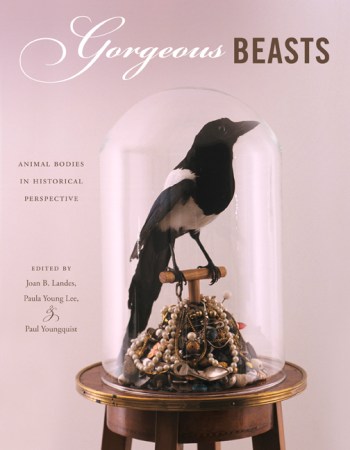 Gorgeous Beasts takes a fresh look at the place of animals in history and art. Refusing the traditional subordination of animals to humans, the essays gathered here examine a rich variety of ways animals contribute to culture: as living things, as scientific specimens, as food, weapons, tropes, and occasions for thought and creativity. History and culture set the terms for this inquiry. As history changes, so do the ways animals participate in culture. Gorgeous Beasts offers a series of discontinuous but probing studies of the forms their participation takes.
This collection presents the work of a wide range of scholars, critics, and thinkers from diverse disciplines: philosophy, literature, history, geography, economics, art history, cultural studies, and the visual arts. By approaching animals from such different perspectives, these essays broaden the scope of animal studies to include specialists and nonspecialists alike, inviting readers from all backgrounds to consider the place of animals in history and art. Combining provocative critical insights with arresting visual imagery, Gorgeous Beasts advances a challenging new appreciation of animals as co-inhabitants and co-creators of culture.
Joan B. Landes is Walter L. and Helen Ferree Professor of Early Modern History and Women’s Studies at The Pennsylvania State University. Paula Young Lee is an independent scholar and the editor of Meat, Modernity, and the Rise of the Slaughterhouse (2008). Paul Youngquist is Professor of English at the University of Colorado.
C O N T E N T S
List of Illustrations
Acknowledgments
Introduction, Joan B. Landes, Paula Young Lee, and Paul Youngquist
1. Animal Subjects: Between Nature and Invention in Buffon’s Natural History Illustrations, Joan B. Landes
2. Renaissance Animal Things, Erica Fudge
3. The Cujo Effect, Paul Youngquist
4. On Vulnerability: Studies from Life That Ought Not to Be Copied, Ron Broglio
5. The Rights of Man and the Rights of Animality at the End of the Eighteenth Century, Pierre Serna, Translated by Vito Caiati and Joan B. Landes
6. Calling the Wild, Harriet Ritvo
7. Trophies and Taxidermy, Nigel Rothfels
8. Fishing for Biomass, Sajay Samuel and Dean Bavington
9. Daniel Spoerri’s Carnival of Animals, Cecilia Novero
A Conversation with the Artist Mark Dion, Joan B. Landes, Paula Young Lee, and Paul Youngquist
Bibliography
About the Contributors
Index
Installation | Molly Hatch’s ‘Physic Garden’ at the High Museum
Warm thanks to Courtney Barnes of Style Court for noting this one. More information and photos are available at her website. -CH
Press release (5 February 2014) from Atlanta’s High Museum of Art:
Two-story tall installation of 450 hand-painted plates were inspired by works in the High Museum’s Frances and Emory Cocke Collection of English Ceramics
◊ ◊ ◊ ◊ ◊
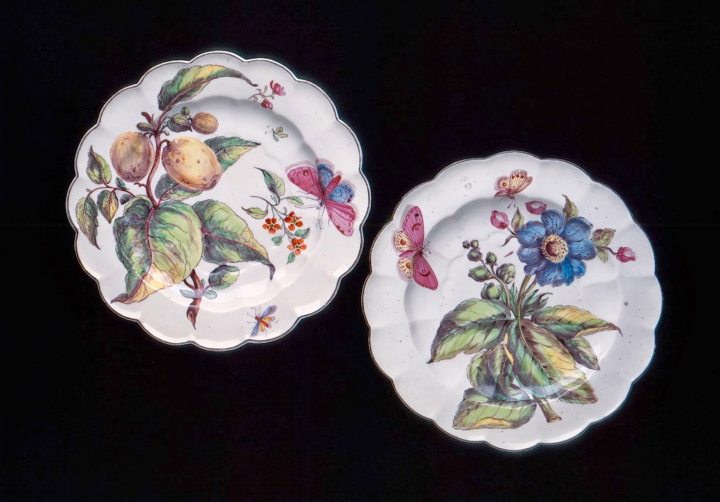
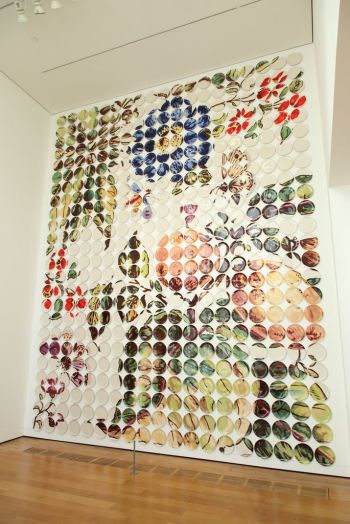
The High Museum of Art has commissioned contemporary ceramicist Molly Hatch to present Physic Garden, a two-story tall, hand-painted ‘plate painting’, which reinterprets works from its renowned decorative arts and design collection. On view starting March 12, the ‘plate painting’ will be installed in the High’s Margaretta Taylor Lobby and will be comprised of 456 plates featuring an original design inspired by two ca. 1755 Chelsea Factory plates from the Museum’s Frances and Emory Cocke Collection of English Ceramics, which totals more than 300 works.
 The historic source plates depict realistic flora and fauna in the Chelsea ‘Hans Sloane’ style of the early 1750s. The influential Chelsea Physic Garden, a botanical garden founded by the Society of Apothecaries in London in 1673, was leased by collector Hans Sloane and likely inspired neighboring factory porcelain decorators.
The High’s installation will be the largest ever produced by Hatch. She has created other works based on source material from the Metropolitan Museum of Art and Museum of Fine Arts, Boston. Hatch also designs her own line of products for national retailers such as Anthropologie.
“I am thrilled to work with such a talented contemporary artist as Molly and to have the outcome be such a dynamic and monumental acquisition for the High. One of the most exciting aspects of ‘Physic Garden’ is seeing the historic decorative arts and design collection through the lens of a creative young artist. We can’t wait for our visitors to experience this new work as well as revisit our important and beloved collection of English ceramics,” says Sarah Schleuning, curator of decorative arts and design at the High.
Hatch often sources historic works to make a contemporary counterpart, however this project marks the first time she is sourcing historic decorative arts from a museum collection to create a site-specific ‘plate painting’. To create the ‘plate painting’, Hatch digitally altered high-resolution images of the surface decoration of the source material to draft a new composition. She altered the original color, scale and composition of the Chelsea designs and then projected the new images onto 456 dinner plates (each 9.5 inches in diameter). She then hand-painted each plate using the projected image as a guide.
The complete installation will measure approximately 20 feet high by 17 feet wide. The Chelsea source plates are also on view in the High’s permanent collection Gallery 200, which patrons may visit to view the historic material. The High is acquiring the piece, which can re-installed by the Museum at future dates in smaller incarnations or in other locations.
“I encourage the viewer to see ceramics as a part of the fine art continuum—viewing plates as one would view a painting,” said Hatch. “For this installation, I’ve re-worked the surface imagery to create a new composition that reflects the historic. The artwork becomes an exploration of the relationship between the historic and the contemporary – crossing over categories of decorative art, design and fine art.”
Molly Hatch
Born in 1978, the daughter of a painter and a dairy farmer, Molly Hatch divided her childhood between physical labor, play, and creating art. She studied drawing, painting, printmaking, and ceramics and receiving her bachelor’s degree of fine arts from the Museum School in Boston in 2000. After several ceramic residencies and apprenticeships in the U.S. and abroad, she received her master’s degree of fine arts degree in ceramics at the University of Colorado in Boulder in 2008. In 2009, she was awarded the Arts/Industry Residency in Pottery at the John Michael Kohler Arts Center in Wisconsin, which laid the foundation for her career as an artist designer. Hatch works from her home studio in Northampton, Mass., on everything from designing and illustration to one-of-a-kind pieces. Her work has been widely collected and commissioned and is exhibited nationally and internationally at art fairs and museums. Hatch’s work has also been widely licensed in partnership with Anthropologie, Galison, Chronicle, and other companies for homeware and stationery products. Her work has been featured in numerous publications from House Beautiful magazine to online publications such as Design*Sponge and Apartment Therapy. For the last two years, Hatch has been teaching a tableware course at Rhode Island School of Design. She also teaches ceramic and illustration workshops across the country as well as online courses through Creativebug. Her first book will be released in 2015.
The Netherlands Yearbook for History of Art (NKJ) Now Online
◊ ◊ ◊ ◊ ◊
The Netherlands Yearbook for History of Art / Nederlands Kunsthistorisch Jaarboek (NKJ) is now available online via subscription with access to all 62 volumes dating back to 1947. The online version gives this unique and high quality publication an extra dimension. NKJ, reflecting the variety and diversity of approaches to the study of Netherlandish art and culture, is now even more accessible and easy to use. Each NKJ volume is dedicated to a particular theme. The latest volume (62) is dedicated to Meaning in Materials 1400–1800. For details see www.brill.com/nkjo or contact marketing@brill.com.
Exhibition | From Watteau to Fragonard: Les Fêtes Galantes
The exhibition opens today at the Jacquemart-André. In addition to the remarkably comprehensive 30-page press kit, the exhibition website, available in both French and English, is outstanding. -CH
From Watteau to Fragonard: Les Fêtes Galantes
Musée Jacquemart-André, Paris, 14 March — 21 July 2014
Curated by Christoph Vogtherr and Mary Tavener Holmes

Antoine Watteau, An Embarrassing Proposal, oil on canvas, ca. 1715–20
(Saint-Petersburg, Hermitage Museum)
◊ ◊ ◊ ◊ ◊
The Musée Jacquemart-André is delighted to be holding the exhibition From Watteau to Fragonard, les fêtes galantes. There will be approximately sixty works on display, mostly paintings lent for the occasion by major collections, predominantly public, from countries including France, Germany, the UK and the USA.
The poetical term fête galante refers to a new genre of paintings and drawings that blossomed in the early 18th century during the Regency period (1715–1723) and whose central figure was Jean-Antoine Watteau (1684–1721). Inspired by images of bucolic merrymaking in the Flemish tradition, Watteau and his followers created a new form, with a certain timelessness, characterised by greater subtlety and nuance. These depict amorous scenes in settings garlanded with luxuriant vegetation, real or imaginary: idealised dancers, women and shepherds are shown engaged in frivolous pursuits or exchanging confidences. The poetical and fantastical atmospheres that are a mark of his work are accompanied by a quest for elegance and sophistication characteristic of the Rococo movement, which flourished during the Age of Enlightenment, evidenced in his flair for curved lines and light colours.

Jean-Honoré Fragonard, A Game of Hot Cockles, oil on canvas, ca. 1775–80 (Washington, D.C., National Gallery of Art)
The exhibition offers a chance to rediscover the pioneering nature of Watteau’s output. These are works of great creativity, depictions of life outdoors in some of his finest paintings and most accomplished drawings. Nicolas Lancret (1690–1743) and Jean-Baptiste Pater (1695–1725) were greatly influenced by the master, their works revisiting and refining the codes of the fêtes galantes. Their imaginary scenes are anchored in reality, featuring locations, works of art and multiple details that would have been easily recognisable to their contemporaries.
The flexibility of the fête galante theme proved to be an invitation to experimentation and innovation, and the genre was to inspire several generations of artists, occupying a central place in French art throughout the 18th century. Works by other highly creative painters, such as François Boucher (1703–1770) and Jean-Honoré Fragonard (1732–1806), illustrate their very personal visions of the joys of the fête galante as first imagined by Watteau.
The Musée Jacquemart-André, with its marvellous collection of 18th-century French paintings, is the perfect setting for an exhibition looking at fêtes galantes. We are particularly pleased that several of the finest drawings from the period, from the collection created by Nélie Jacquemart and Édouard André, will also be on display as part of the exhibition.
The Curators
 Currently director of London’s Wallace Collection, Christoph Vogtherr is a specialist in 18th-century French painting. He is the author of an authoritative work on the subject, the catalogue raisonné of paintings by Jean-Antoine Watteau, Jean-Baptiste Pater, and Nicolas Lancret in Berlin and Potsdam, published in 2010. During 2011, he curated two successful exhibitions of works by Watteau at the Wallace Collection.
Mary Tavener Holmes holds a doctorate from the Institute of Fine Arts at New York University. A specialist in 18th-century French paintings and drawings, she has over thirty years’ experience as a curator, author and professor of European art. She has produced numerous publications, including A Magic Mirror: The Portrait in France, 1700–1900 (1986) and Nicolas Lancret: Dance before a Fountain (2006).
◊ ◊ ◊ ◊ ◊
The catalogue is available from Artbooks.com:
Christoph Vogtherr and Mary Tavener Holmes, De Watteau à Fragonard. Les Fêtes Galantes (Antwerp: Mercator, 2014), 224 pages, ISBN: 978-9462300453, €39.
Call for Papers | Decline—Metamorphosis—Rebirth
From the conference website:
Decline—Metamorphosis—Rebirth: International Conference for PhD Students
Ljubljana, Slovenia, 18–19 September 2014
Proposals due by 12 May 2014
Throughout history mankind has witnessed rises and declines of civilisations, governments and regimes, ideologies and ideas, cultural movements and artistic creativity. The periods of crisis in social as well as artistic fields are generally periods of reflection and pursuit of new ways. However, crises often bring about voices that advocate a return to old values and beliefs. Various connotations may be implied by the word decline, which in turn leads to different understandings of the concept. That is why the term itself rarely refers to something terminal—revivals of ideas, past ages and artistic movements are a common historical occurrence. In connection to these revivals and bearing in mind Heraclitus’s utterance »Ever-newer waters flow on those who step into the same rivers.«, new questions emerge: what is the effect of a new historical context on old, revived ideas, and what is the dialectical relationship between their manifestations in different periods of time?
The international conference Decline—Metamorphosis—Rebirth is intended for PhD students and recent PhD graduates from different fields of humanities and social sciences, who are invited to participate. Proposed topics for interdisciplinary analyses are:
• understanding and interpretation of concepts of decline, transformation/metamorphosis and rebirth in different periods and in different fields of humanities and social sciences
• artistic creation and modes of living in periods of decline, transformation and rebirth (the effect of social changes on artistic creativity, artistic and/or creative reactions on social changes)
• ways of understanding and attitudes towards historical phenomena, periods, and cultural heritage in different periods of time
• decline, transformation and rebirth of social systems, political structures, ideologies
• artistic and social contexts and the role of historicisms, neo- and post- styles in art
• decline, transformation and rebirth as iconographical motifs
• metamorphosis of iconographical motifs, ways in which they are perceived in new contexts
• forgotten, rediscovered or »rehabilitated« artists
• crisis, transformation, and rebirth in an individual artist’s oeuvre
• revival (Nachleben) of concepts and content within art historical periods
Abstract in English of maximum 400 words should be send, with the title of the paper, name and contact information (address, phone number, e-mail) until 12th of May 2014 by e-mail to phdconference2014@gmail.com or by post to Department of Art History, Faculty of Arts, Aškerčeva 2, SI-1000 Ljubljana, Slovenia (with the note ‘Conference for PhD students’).
Exhibition | Hatch, Match, and Dispatch, Part II
My nomination for notable exhibition title of the year comes from the current show at the Fan Museum in Greenwich (complete with the use of the older spelling of that third term and the irresistible ‘part II’). -CH
Hatch, Match & Despatch, Part II
The Fan Museum, Greenwich, 11 January — 1 June 2014
 An intriguing display of fans which commemorate births, marriages and deaths…
Covering a period of over 300 years (beginning in the mid seventeenth century), the exhibition reveals how fans recorded not only joyous occasions of national significance such as royal births and weddings but those of a darker, melancholic nature, too. From lavishly crafted examples given as part of a bride’s wedding trousseau to modest commemorative confections produced in quantity and designed to appeal to all pockets, these fans reveal an often subtle undercurrent of dynastic and political intrigue.
Hatch, Match & Despatch celebrates the theatricality of love, life and death—the foundations upon which all human experience is built.
Pictured on the French fan on the right-hand side of the poster is The Marriage of the Dauphin, ca. 1770.










 Enfilade
leave a comment