Conference | Objects, Families, Homes: British Material Cultures
From The East India Company at Home project:
Objects, Families, Homes: British Material Cultures in Global Contexts
University College London, 11–12 July 2014
Since 2011, The East India Company at Home project has focused on country houses—and the families and objects that inhabited them—to explore how British material culture developed in a global context during the eighteenth and nineteenth century. The project’s goals have been twofold. First, we have sought to illuminate the broad-ranging ways in which the activities of the English East India Company shaped elite material cultures in Britain—and by doing so, shaped British identities in the Georgian and Victorian periods, and beyond. Second, we have sought to develop new ways of connecting diverse communities of historical researchers (archivists, curators, family historians, freelance historians, local historians, stately home volunteers and university-based historians) and in so doing to weave otherwise dispersed studies into a transnational material narrative. At the same time, by disseminating research findings through our website we have made them available on an open-access basis. The conference plans to encourage a range of speakers to present on these themes and discuss their wider significance.
Confirmed keynote speakers include Deborah Cohen, Professor of Modern British and European History at Northwestern University and author of Household Gods: The British and their Possessions (2006) and Family Secrets (2013), in dialogue with Marietta Crichton-Stuart, a descendant of the Marquess of Bute, who has researched how Margaret Bruce designed and furnished Falkland House in Fife in the 1830s and 1840s.
Members of the public are warmly welcomed to attend this event. Registration is accessible (until 30 June 2014) via the UCL online store.
The conference will take place in the Roberts Building on the Bloomsbury Campus of University College London. A map giving directions to the Roberts Building can be found here. The building stands opposite Waterstones, Gower Street. The Roberts Building is a 5- to 10-minute walk from various underground stations including, Goodge Street, Euston, Euston Square, Russell Square and Tottenham Court Road.
◊ ◊ ◊ ◊ ◊
From the conference programme:
F R I D A Y , 1 1 J U L Y 2 0 1 4
9.30 Registration
10.00 Welcome Remarks from Margot Finn, Principal Investigator, The East India Company at Home, 1757–1857
10.30 Session 1
Strand A: China and the ‘Chinese’ Style in British Houses
• Alexandra Loske (University of Sussex), ‘Chinese Landscapes in yellow etched in gold and highly varnished’: The influence of exportware and print culture on colour and ornament in the Royal Pavilion, Brighton
• Emile de Bruijn (National Trust) and Helen Clifford (UCL/University of Warwick), Past, Present and Future: The Chinese Wallpaper Project
• Clare Taylor (The Open University), Trading wallpaper: India paper and prints in the eighteenth-century home
Strand B: Buildings and Networks, Chair: Ellen Filor (UCL)
• Joanna Frew (University of Essex), ‘Inform me how I may become a useful member of the community at large’: Looking beyond the family
• Rosie Dias (University of Warwick), The British Country House in Colonial India
• Sylvia Shorto (American University, Beirut), Robert Smith’s ‘Truly Fair Palaces’ in India and in Europe
12.00 Lunch
13.00 Session 2
Strand A: Wales, Chair: Kate Smith (UCL)
• Diane James (University of Warwick), Welsh gardens
• Lowri Ann Rees (Bangor University), The nabob returned: the infiltration of East India Company men into Welsh landed society, c.1760–1840
• Joanna de Groot (University of York), Movement and materiality: traces of the transnational career of Harford Jones Brydges (1764–1847)
Strand B: Gender and Collecting, Chair: Kate Hill (University of Lincoln)
• Holly Shaffer (Yale), Publishing Indian Art between Suffolk and the Deccan
• Rosemary Raza (Independent scholar), Bringing India home: Early nineteenth-century British women and the understanding of India
• Catherine Eagleton (British Library), Collecting Asia at 32 Soho Square: Sarah Sophia Banks and her coins, tokens and medals
14.30 Coffee and tea
15.00 Session 3
Strand A: London Houses, Chair: Spike Sweeting (University of Warwick)
• David Veevers (University of Kent), The matriarchy of 45 Berkeley Square: gender, identity and imperial expansion in the late eighteenth century
• Harriet Richardson and Peter Guillery (Survey of London, UCL), At home in Cavendish Square and Harley Street: East India Company impact on eighteenth-century Marylebone
• George McGilvary ( Independent scholar), The Sulivans of India House
Strand B: Portraying India, Chair: Natasha Eaton (UCL)
• Viccy Coltman (University of Edinburgh), Portraiture and Empire: George Chinnery’s Gilbert Elliot, 1st Earl of Minto, 1812–13
• Jennifer van Schoor (Birkbeck), The Indian folds at Harewood House
• Bharti Parmar (Independent scholar and artist), Widow’s Weeds: Reflections on Black
16.30 Coffee and tea
17.00 Keynote Lecture
Deborah Cohen, Professor of Modern British and European History at Northwestern University and author of
Household Gods: The British and their Possessions (2006) and Family Secrets (2013) will be speaking in dialogue with Marietta Crichton-Stuart, a descendant of the Marquess of Bute, who has researched how Margaret Bruce designed and furnished Falkland House in Fife in the 1830s and 1840s.
18.30 Drinks reception
S A T U R D A Y , 1 2 J U L Y 2 0 1 4
9.30 Session 1
Strand A: Loss and Looting, Chair: Meike Fellinger (University of Warwick)
• Lindsay Allen (KCL), Curious gifts of ancient substance
• Nigel Erskine (Australian National Maritime Museum), Passages to India: exploring Pacific pathways to Asia during Australia’s colonial period
• Rosie Llewellyn Jones (BACSA), Lost, stolen or strayed?: India artefacts in Britain
• Shaleen Wadhwana (India Photo Archive Foundation), Of Awadh, Oudh and Lucknow
Strand B: And so we go to Daylesford, Chair: Kevin Rogers
• Zirwat Chowdhury (Reed College), ‘Meanwhile’ at Daylesford…
• Elizabeth Lenckos (University of Chicago Graham School), ‘The House is fitted up with a degree of Taste & Magnificence seldom to be met with’: Daylesford, and the ‘nabobina’ Hastings’ ivory furniture collection
• Gillian Forrester (Yale Center for British Art), ‘Such a proof of Love and Duty’: Warren Hastings and the memorialization of India at Daylesford
11.00 Coffee and tea
11.30 Session 2
Strand A: Displaying Identity, Chair: Jane Hamlett (Royal Holloway, University of London)
• Deborah Sugg Ryan (Falmouth University), The elephant on the mantelpiece: the interwar suburban home and the detritus of empire
• Britta Schilling (University of Cambridge), Grand designs: British homes in East Africa, 1850–1960
• Sarah Longair (British Museum), ‘The scene was brilliant and striking’: display and imperial identity in early colonial Zanzibar
Strand B: Daily Lives and Longings, Chair: Lucy Dow (UCL)
• Jean Sutton (Independent scholar), Distance, longing and return in the imperial family
• Laura Humphreys (Queen Mark, University of London), World service: the foreign dimensions of domestic service in late nineteenth-century and early twentieth-century London
• Kate Smith (UCL), Imperial families: Women writing home in Georgian Britain
13.00 Lunch
14.00 Is the East India Company at home?
Presentations from Margot Finn, Helen Clifford, Kate Smith and Ellen Filor; followed by general discussion with panel and audience
16.00 Conference ends
New Book | Androids in the Enlightenment
From The University of Chicago Press:
Adelheid Voskuhl, Androids in the Enlightenment: Mechanics, Artisans, and Cultures of the Self (Chicago: University of Chicago Press, 2013), 296 pages, ISBN: 978-0226034027, $45.
 The eighteenth century saw the creation of a number of remarkable mechanical androids: at least ten prominent automata were built between 1735 and 1810 by clockmakers, court mechanics, and other artisans from France, Switzerland, Austria, and the German lands. Designed to perform sophisticated activities such as writing, drawing, or music making, these ‘Enlightenment automata’ have attracted continuous critical attention from the time they were made to the present, often as harbingers of the modern industrial age, an era during which human bodies and souls supposedly became mechanized.
In Androids in the Enlightenment, Adelheid Voskuhl investigates two such automata—both depicting piano-playing women. These automata not only play music, but also move their heads, eyes, and torsos to mimic a sentimental body technique of the eighteenth century: musicians were expected to generate sentiments in themselves while playing, then communicate them to the audience through bodily motions. Voskuhl argues, contrary to much of the subsequent scholarly conversation, that these automata were unique masterpieces that illustrated the sentimental culture of a civil society rather than expressions of anxiety about the mechanization of humans by industrial technology. She demonstrates that only in a later age of industrial factory production did mechanical androids instill the fear that modern selves and societies had become indistinguishable from machines.
Adelheid Voskuhl is associate professor in the Department of the History of Science at Harvard University.
C O N T E N T S
List of Illustrations
Acknowledgments
1 Introduction: Androids, Enlightenment, and the Human-Machine Boundary
2 The Harpsichord-Playing Android; or, Clock-Making in Switzerland
3 The Dulcimer-Playing Android; or, Furniture-Making in the Rhineland
4 The Design of the Mechanics; or, Sentiments Replicated in Clockwork
5 Poetic Engagement with Piano-Playing Women Automata
6 The ‘Enlightenment Automaton’ in the Modern Industrial Age
Conclusion
Bibliography
Index
Symposium | From Poussin to Monet
Von Poussin bis Monet. Die Farben Frankreichs
Bucerius Kunst Forum, Hamburg, 1 April 2014
Mit Dr. Susanne Blöcker, Remagen; Dr. Eva Hausdorf, Bremen; Prof. Dr. Christian Michel, Lausanne; Prof. Dr. Beate Söntgen, Lüneburg; Dr. Christoph Vogtherr, London; Prof. Dr. Michael F. Zimmermann, Eichstätt-Ingolstadt
Rund 200 Jahre liegen zwischen dem Werk von Poussin und Monet. In dieser Zeit befreite sich die französische Malerei radikal von künstlerischen Regeln und Traditionen. Die gesellschaftlichen Umbrüche des 18. Jahrhunderts leiteten die Moderne ein. Die Veränderungen der französischen Gesellschaft vor und nach dem Epochenjahr 1789 wurden auch zum Motor der Revolutionierung der künstlerischen Mittel. Die Ausstellung Von Poussin bis Monet. Die Farben Frankreichs widmet sich der künstlerischen Befreiung der französischen Malerei von den Vorgaben des Akademismus und der Entwicklung zur Freilichtmalerei des Impressionismus. Die Ausstellung zeigt Werke aus der Sammlung der National Gallery of Ireland in Dublin. Sie werden durch Gemälde aus der Sammlung Rau (UNICEF) in Remagen ergänzt. Tickets € 10,– (inkl. Kaffee und Empfang), ermäßigt für Bucerius Kunst Club Mitglieder € 8,– Freitickets für Studierende in begrenzter Anzahl (nur im Voraus an der Kasse im Bucerius Kunst Forum).
P R O G R A M M
10.00 Begrüßung, Ortrud Westheider, Bucerius Kunst Forum
10.15 “The collection of French painting in the National Gallery of Ireland,” Adrian LeHarivel, National Gallery of Ireland
11.00 “Vom Gelehrten zum Genie. Das Bild des Malers von Poussin bis Monet,” Eva Hausdorf, Kunsthalle Bremen
11.45 “Les combats de l’Académie royale de Peinture et de Sculpture pour un retour à la nature / Der Kampf der Königlichen Akademie für ein retour à la nature,” Christian Michel, Université de Lausanne
12.30 Mittagspause
14.00 “Die Fête galante im 18. Jahrhundert. Ein Raum für Innovation außerhalb der akademischen Gattungsdefinitionen,” Christoph Vogtherr, The Wallace Collection, London
14.45 “Revolution der Gefühle. Bürgerliche Ideale der Aufklärungszeit,” Susanne Blöcker, Arp Museum Bahnhof Rolandseck, Remagen
15.30 Kaffeepause
16.00 “Übertragungen. Emotion und Kommunikation bei Jean Siméon Chardin,” Beate Söntgen, Leuphana Universität Lüneburg
16.45 “Winkel der Schöpfung. Naturalismus, Impressionismus und der intime Blicke in die Weite,” Michael F. Zimmermann, Katholische Universität Eichstätt-Ingolstadt
17.30 Empfang
Exhibition | From Poussin to Monet
This 2015 exhibition will showcase French paintings from the National Gallery of Ireland:
Von Poussin bis Monet. Die Farben Frankreichs
Bucerius Kunst Forum, Hamburg, 10 October 2015 — 17 January 2016
Die gesellschaftlichen und künstlerischen Umbrüche des 18. Jahrhunderts leiteten die Moderne ein. War Frankreichs Gesellschaft und Kunst im 17. Jahrhundert noch durch den königlichen Hof und die königliche Kunstakademie streng zentralistisch reglementiert, so gewann die bürgerliche Öffentlichkeit im Zeitalter der Aufklärung neue Bedeutung und Macht. Die Veränderungen der französischen Gesellschaft vor und nach der Revolution wurden auch zum Motor der Revolutionierung der künstlerischen Mittel. Die Ausstellung Von Poussin bis Monet. Die Farben Frankreichs widmet sich der künstlerischen Befreiung der französischen Malerei von den Zwängen und Regeln des Akademismus hin zur Freilichtmalerei des Impressionismus. Die Ausstellung präsentiert die Sammlung französischer Malerei der National Gallery of Ireland in Dublin. Sie wird durch eine Auswahl von Gemälden aus der Sammlung Rau (UNICEF) in Remagen ergänzt.
Die Ausstellung entsteht in Kooperation mit dem Arp Museum Bahnhof Rolandseck.
New Book | Credit, Fashion, Sex in Old Regime France
From Duke UP:
Clare Haru Crowston, Credit, Fashion, Sex: Economies of Regard in Old Regime France (Duke University Press, 2013), 448 pages, ISBN: 978-0822355137 (hardcover), $100 / ISBN: 978-0822355281 (paperback), $28.
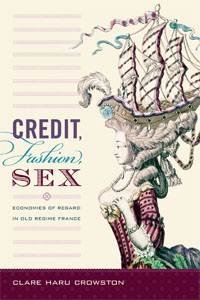 In Old Regime France credit was both a central part of economic exchange and a crucial concept for explaining dynamics of influence and power in all spheres of life. Contemporaries used the term credit to describe reputation and the currency it provided in court politics, literary production, religion, and commerce. Moving beyond Pierre Bourdieu’s theorization of capital, this book establishes credit as a key matrix through which French men and women perceived their world. As Clare Haru Crowston demonstrates, credit unveils the personal character of market transactions, the unequal yet reciprocal ties binding society, and the hidden mechanisms of political power.
Credit economies constituted ‘economies of regard’ in which reputation depended on embodied performances of credibility. Crowston explores the role of fashionable appearances and sexual desire in leveraging credit and reconstructs women’s vigorous participation in its gray markets. The scandalous relationship between Queen Marie Antoinette and fashion merchant Rose Bertin epitomizes the vertical loyalties and deep social divides of the credit regime and its increasingly urgent political stakes.
Clare Haru Crowston is Associate Professor of History at the University of Illinois, Urbana-Champaign. She is the author of Fabricating Women: The Seamstresses of Old Regime France, 1675–1791, also published by Duke University Press.
C O N T E N T S
Illustrations and Tables ix
Money and Measurements xi
Acknowledgments xiii
Introduction 1
1. Credit and Old Regime Economies of Regard 21
2. Critiques and Crises of the Credit System 56
3. Incredible Style: Intertwined Circuits of Credit, Fashion, and Sex 96
4. Credit in the Fashion Trades of Eighteenth-Century Paris 139
5. Fashion Merchants: Managing Credit, Narrating Collapse 195
6. Madame Déficit and Her Minister of Fashion: Self-Fashioning and the Politics of Credit 246
7. Family Affairs: Consumption, Credit, and the Marriage Bond 283
Conclusion. Credit is Dead. Long Live Credit! 316
Notes 329
Bibliography 383
Index 407
Exhibition | Hogarth, Reynolds, Turner: The Dawn of Modernity
From the museum:
Hogarth, Reynolds, Turner: Pittura inglese verso la modernità
The Dawn of Modernity: Painting in Britain in the 18th Century
Fondazione Roma Museo, Palazzo Sciarra, Rome, 15 April — 20 June 2014
Curated by Carolina Brook and Valter Curzi
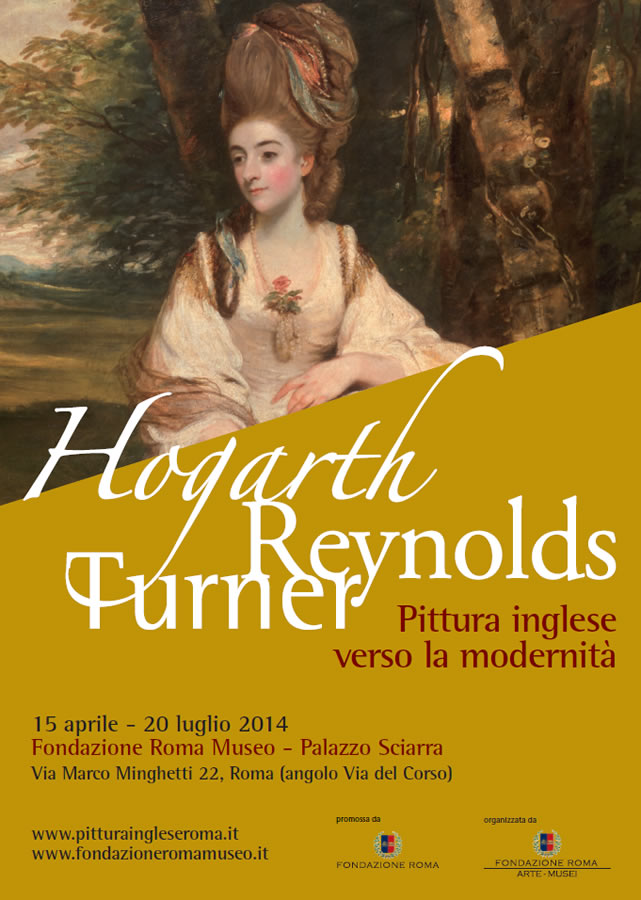 The exhibition offers the public a comprehensive overview of the social and artistic development that took place during the XVIII century in step with the hegemony gained by Great Britain at the historical, political, and economic level. For this purpose a corpus of over one hundred works belonging to prestigious institutions such as the British Museum, the Tate Gallery, the Victoria & Albert Museum, the Royal Academy, the National Portrait Gallery, the Museum of London, and the Uffizi Gallery has been formed and is accompanied by a nucleus of works from the important American collection belonging to the Yale Center for British Art.
During the eighteenth century England became an authentic international power, leader of the Industrial Revolution and of the domination of the sea routes, and thus raised the issue of establishing its own artistic school for the first time. The economic development lead by Great Britain created a new middle-class which included professionals, industrialists, merchants, scientists and philosophers who, having found that visible arts considerably affirmed their new social status, became patrons of those masters who over the century contributed to the definition of a domestic school.
The exhibition is divided into seven sections featuring a selection of works by the most significant English painters, for the purpose of documenting the portrait and landscape genres that found more fortune during this century, creating a figurative language capable of interpreting modernity which, in the nineteenth century, became a reference throughout Europe. Visitors may admire artists such as Hogarth, Reynolds, Gainsborough, Wright of Derby, Stubbs, Füssli, Constable, and Turner. Their works offer a significant cross-section of the peculiarity and originality of English art, an exhibition of which has not been held in Rome since 1966.
Update (added 19 April 2014) — The exhibition press release, which details the seven sections, is available as a PDF file here».
The catalogue is available from Skira:
Carolina Brook and Valter Curzi, Hogarth, Reynolds, Turner: Pittura inglese verso la modernità (Rome: Skira, 2014), 304 pages, ISBN: 8857222707, €40.
New Book | A Deadly Art: European Crossbows, 1250–1850
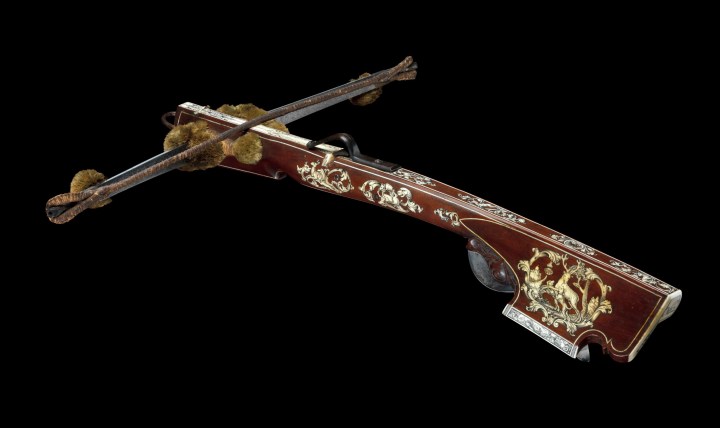
Johann Gottfried Hänisch the Elder (German, Dresden, 1696–1778), Small Crossbow (Bolzenschnepper), probably for a Woman or a Child, 1738 (Metropolitan Museum of Art, 2011.429), catalogue entry #15. Read more here»
◊ ◊ ◊ ◊ ◊
Distributed by Yale UP:
Dirk Breiding, A Deadly Art: European Crossbows, 1250–1850 (New York: The Metropolitan Museum of Art, 2014), 160 pages, ISBN: 978-0300197044, $25.
 The advent of the crossbow more than 2,500 years ago effected dramatic changes for hunters and warriors. For centuries, it was among the most powerful and widely used handheld weapons, and its popularity endures to this day. A Deadly Art presents a lively, accessible survey of the crossbow’s “golden age,” along with detailed descriptions of twenty-four remarkable examples.
Beginning in the middle ages, the European aristocracy’s enthusiasm for the crossbow heralded shooting competitions and pageants that featured elaborately decorated weapons bearing elegant embellishments of rare materials and prized artistry. In addition to being highly functional, these weapons were magnificent works of art.
Dirk Breiding is J. J. Medveckis Curator of Arms and Armor at the Philadelphia Museum of Art.
Exhibition | Grand Collecting: Richard Wilson and the Ford Collection
One more to add to the list of exhibitions of work by Richard Wilson, on this the 300th anniversary of his birth. The exhibition as described at ArtFund:
Grand Collecting: Richard Wilson and Masterworks from the Ford Collection
Gainsborough’s House, Sudbury, Suffolk, 11 January — 31 May 2014

Richard Wilson, Syon House from Richmond Gardens, Evening, 1761 (?)
(Gainsborough’s House)
◊ ◊ ◊ ◊ ◊
The Ford Collection originated in the 18th century thanks to Benjamin Booth, who amassed the largest set of works by Royal Academician Richard Wilson, held at the time. Booth’s grandson Richard Ford, an author, traveller and connoisseur, continued collecting into the 19th century, and in later years Richard’s great grandson Sir Brinsley Ford strengthened the existing areas of work as well as introducing his own interests.
At the centre of the collection are works by Richard Wilson, one of the leading figures in British landscape painting, whose influence was felt across Europe. Along with artists including Thomas Gainsborough he created the country’s ‘landscape tradition’, with John Hoppner proclaiming: ‘We recollect no painter, who, with so much originality of manner, united such truth and grandeur of expression’.
The works in this exhibition, predominantly collected by Booth, show the breadth of his expression from early drawings in Rome to paintings in the 1770s. Other featured artists include renowned English painter, John Frederick Lewis.
2014 marks 300 years since the birth of Richard Wilson and the beginning of the Georgian age. In celebration, Gainsborough’s House is displaying the 1714 Sudbury Map, hand drawn map on vellum using iron gall ink and various shades of watercolour. It was created by Cornelius Brewer, whose signature can be seen with the inscription and it contains the earliest image of Gainsborough’s House.
New Book | Paris au XVIIIe siècle
Published by Parigramme and available from Artbooks.com:
Nicolas Courtin, Paris au XVIIIe siècle : entre fantaisie rocaille et renouveau classique (Paris: Parigramme, 2013), 192 pages, ISBN: 978-2840967934, 45€ / $88.
 La première ambition du XVIIIe siècle aurait-elle été de ne plus «périr en symétrie», comme s’en plaignait Mme de Maintenon en pensant aux courants d’air de Versailles ? En l’occurrence, c’est la sévérité du Grand Siècle qui est en cause, plus que les belles ordonnances, encore promises à de beaux jours. L’architecture privée illustre l’esprit nouveau en composant dans un Paris où l’espace devient rare et les parcelles irrégulières ; à cette contrainte s’ajoute l’aspiration à des espaces intimes et aimables. «Nos petits appartements sont tournés comme des coquilles rondes et polies», note Louis-Sébastien Mercier. Les sinuosités rocaille des intérieurs gagnent parfois les façades avant que les bâtisseurs ne puisent dans l’Antiquité l’inspiration d’une renaissance néoclassique. Celle-ci demeurera un témoin sûr du goût français, partout imité, tandis que les embellissements publics portent la marque pédagogique et moralisatrice des Lumières. Et pour cette ville de chair et de pierre, combien de Paris de papier ? Le siècle n’est avare ni de
projets ni de plans… qu’il reviendra au suivant de mettre
en oeuvre.
Nicolas Courtin est historien de l’art, chargé de mission auprès de la Commission du Vieux Paris et enseignant. Il a notamment publié Paris Grand siècle (Parigramme, 2008) et L’Art d’habiter à Paris au XVIIe siècle (Faton, 2011).
Sample pages are available here»
Exhibition | Wedding Dresses, 1775–2014
Press release for the upcoming exhibition at the V&A (also see the exhibition blog). . .
Wedding Dresses, 1775–2014
Victoria & Albert Museum, London, 3 May 2014 — 15 March 2015
Curated by Edwina Ehrman
◊ ◊ ◊ ◊ ◊
The V&A’s spring 2014 exhibition will trace the development of the fashionable white wedding dress and its interpretation by leading couturiers and designers, offering a panorama of fashion over the last two centuries. Wedding Dresses 1775–2014 will feature over 80 of the most romantic, glamorous and extravagant wedding outfits from the V&A’s collection. It will include important new acquisitions as well as loans such as the embroidered silk coat design by Anna Valentine and worn by The Duchess of Cornwall for the blessing after her marriage to HRH The Prince of Wales (2005), the purple Vivienne Westwood dress chosen by Dita Von Teese (2005), and the Dior outfits worn by Gwen Stefani and Gavin Rossdale on their wedding day (2002).
Displayed chronologically over two floors, the exhibition will focus on bridal wear. Most of the outfits were worn in Britain, by brides of many faiths. Alongside the dresses will be accessories including jewellery, shoes, garters, veils, wreaths, hats and corsetry as well as fashion sketches and personal photographs. Garments worn by bridegrooms and attendants will also be on display. The exhibition will investigate the histories of the garments, revealing fascinating and personal details about the lives of the wearers, giving an intimate insight into their occupations, circumstances and fashion choices.

Silk brocade gown, hat, and shoes, 1780. Olive Matthews Collection, Chertsey Museum. Photo by John Chase.
The opening section of the exhibition will feature some of the earliest examples of wedding fashion including a silk satin court dress (1775) and a ‘polonaise’ style brocade gown with straw bergère hat (1780) lent by the Chertsey Museum. The preference for white in the 19th century will be demonstrated by a white muslin wedding dress decorated with flowers, leaves and berries (1807) recently acquired by the V&A, and a wedding outfit embellished with pearl beads design by Charles Frederick Worth (1880). As the 19th century drew to a close historical costume influenced fashion. A fine example will be a copy of a Paris model designed by Paquin Lalanne et Cie made by Stern Brothers of New York (1890) for an American bride.
Designs from the 1920s and 1930s will illustrate the glamour of bridal wear which was now influenced by evening fashions, dresses were slim-hipped and made from richly beaded textured fabrics and slinky bias-cut satin. During the Second World War when clothing restrictions were introduced, brides needed to make imaginative and practical fashion choices. They used non-rationed fabrics such as upholstery materials, net curtaining and parachute silk, or married in a smart day dress or service uniform. On display will be a buttercup patterned dress made in light-weight upholstery fabric by London dressmaker Ella Dolling (1941).
Wedding Dresses 1775–2014 will also explore the growth of the wedding industry and the effect of increasing media focus on wedding fashions. Improvements in photography in the early 20th century encouraged photojournalism and society weddings were reported in detail in the national press and gossip columns. Two of the most spectacular wedding dresses on show will be the Norman Hartnell dress made for Margaret Whigham (later Duchess of Argyll) for her marriage to Charles Sweeny (1933), and the Charles James ivory silk satin dress worn by Barbara ‘Baba’ Beaton for her marriage to Alec Hambro (1934). These dramatic dresses will be seen alongside archive film and news clippings of the occasions as examples of society ‘celebrity’ weddings.
The mezzanine level will feature wedding garments from 1960 to 2014, taking the exhibition right up to date with Spring/Summer 2014 designs by Jenny Packham and Temperley Bridal. Emphasising the glamour and spectacle of weddings today, key designers will include Vivienne Westwood, John Galliano, Christian Lacroix, Lanvin, Vera Wang, Jasper Conran, Bruce Oldfield, Osman, Hardy Amies, Bellville Sassoon, Mr.Fish, John Bates and Jean Muir, with millinery by Philip Treacy and Stephen Jones. This section will explore the changing social and cultural attitudes to the wedding ceremony and marriage in the late 20th century and will feature examples of innovative and unconventional wedding outfits including dresses designed by Gareth Pugh and Pam Hogg for the weddings of Katie Shillingford (2011) and Mary Charteris (2012).
A version of the exhibition previously toured to Bendigo Art Gallery, Victoria, Australia (2011), Museum of New Zealand Te Papa Tongarewa (2011–12), National Museum of Singapore (2012), and Western Australian Museum, Perth, Australia (2012–13).
◊ ◊ ◊ ◊ ◊
From the V&A:
Edwina Ehrman, The Wedding Dress: 300 Years of Bridal Fashions, 2nd edition (London: V&A Publishing, 2014), 208 pages, ISBN 978-1851778133, £30 / $50.
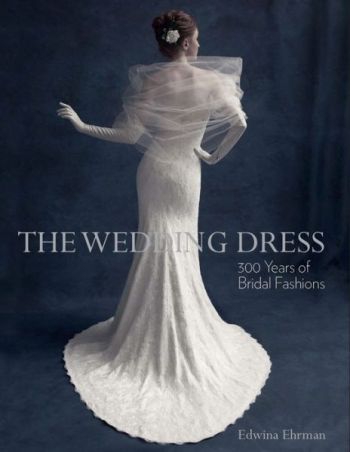 This sumptuous book draws on wedding garments in the V&A’s collection, photographs, letters, memoirs, newspaper accounts and genealogical research to explore the history of the wedding dress and the traditions that have developed around it since 1700. It focuses on the white wedding dress, which became fashionable in the early nineteenth century and is now chosen by women across the world. The book considers the way couturiers and designers have challenged and refreshed the traditional white dress and the influence of the wedding industry, whose antecedents lie in the commercialization of the wedding in Victorian Britain. The Wedding Dress is not only about costume, but also about the cultivation of the image of the bride. This book is a glorious tribute to an exquisite, stylish, glamorous gown, the romance of its evolution and the splendour of its design.
Edwina Ehrman is a curator of Textiles and Fashion at the V&A and of the exhibition The Wedding Dress: 300 Years of Bridal Fashions. She is co-author of The London Look: Fashion from Street to Catwalk and a contributor
to The Englishness of English Dress.










 Enfilade
leave a comment