New Book | Johann Paul Egell, 1691–1752
From Imhof Verlag (and available at Artbooks.com). . .
Stefanie Michaela Leibetseder, Johann Paul Egell (1691–1752), Der kurpfälzische Hofbildhauer und die Hofkunst seiner Zeit: Skulptur – Ornament – Relief (Petersberg: Imhof, 2013), 176 pages, ISBN: 978-3865688514, 39€ / $75.
 Der kurpfälzische Hofbildhauer Paul Egell (1691–1752) zählt zu den bedeutendsten Bildhauern Deutschlands im 18. Jahrhunderts. Wie kein anderer Bildhauer der Zeit markiert sein Werk den Paradigmenwechsel zwischen den italienisch geprägten Traditionen des Barock und der französisch geprägten Formensprache des Rokoko. Das Buch spürt anhand exemplarischer Werke erstmals den Entstehungsbedingungen von Egells Werk nach. Im Mittelpunkt stehen sein Beitrag zum Nymphenbad des Dresdner Zwingers sowie die Skulpturen und Stuckaturen, die er für die kurpfälzische Residenz in Mannheim schuf. Es wird die ikonografische Tradition untersucht, in der sich Egell bewegte, und aufgezeigt, dass dessen Schaffen bereits sehr früh die Kunst der Régence in Frankreich rezipierte. Damit wird zum einen die Grundlage für eine differenziertere Einschätzung von Egells Œuvre gelegt, zum anderen werden Anregungen für die Auseinandersetzung mit anderen Bildhauern des deutschen Rokoko gegeben.
Conference | Maritime Culture in the Age of J. M. W. Turner
Next month at Greenwich:
Maritime Culture and Britain in the Age of J.M.W. Turner
Royal Museums Greenwich, London, 21–22 March 2014
Registration due by 20 March 2014

J.M.W. Turner, The Battle of Trafalgar, 21 October 1805, 1822–24, National Maritime Museum, Greenwich, London
To coincide with a major exhibition of the work of J.M.W. Turner (1775–1851), Royal Museums Greenwich is hosting an interdisciplinary conference exploring the cultural impact of the sea in the late 18th and 19th centuries. Turner and the Sea is the first full-scale examination of the artist’s lifelong preoccupation with the sea, and features many of his most celebrated works, from his transformative Academy paintings of the late 1790s and early 1800s to the unfinished, experimental seascapes he produced towards the end of his life. The exhibition offers the opportunity to discover the myriad ways in which Turner responded to the maritime art—past and contemporary—while challenging his audiences with new ways of representing the sea. The conference aims to locate Turner’s seascapes within a broader maritime context, and explore the cultural and political significance of the sea during his lifetime.
Conference fee: £100 (concessionary rate £90). Including Friday evening reception and private view of the Turner and the Sea exhibition. To book tickets contact Lizelle de Jager on 020 8312 6716, research@rmg.co.uk.
◊ ◊ ◊ ◊ ◊
F R I D A Y , 2 1 M A R C H 2 0 1 4
10.30 Registration and refreshments
11.00 Session 1
• ‘Now for the painter’: Turner and the Sea at Greenwich: Richard Johns (University of York)
• ‘Commercial care and busy toil’: Turner’s Image of Downriver Thames: Geoff Snell (National Maritime Museum and University of Sussex)
• Turner, the Mouth of the Thames and Commerce: Leo Costello (Rice University, Texas)
12.30 Lunch
14.00 Session 2
• Craft and Labour in John Ruskin’s Romantic Tradition: ‘The Harbours of England’: Carmen Casaliggi (Cardiff Metropolitan University)
• Nautical Zombies: Death and the Undead in Romantic Maritime Literature: James Robertson (University of Leeds)
15.00 Coffee and tea
15.30 Session 3
• Sperm, Blood, Blubber, Bone, Oil and Water: the 19th-Century Visual and Literary (Sub)Cultures of Whaling: Jason Edwards (University of York)
• Turner’s Abstraction and the Culture of Steam Power in the Ships of the Peninsular and Oriental Steam Navigation Company: Jonathan Stafford (Kingston University)
16.45 Keynote
• Stephen Deuchar (The Art Fund)
17.45 Reception and private view of Turner and the Sea
S A T U R D A Y , 2 2 M A R C H 2 0 1 4
8.45 Pre-conference discussion in Turner and the Sea exhibition
9.45 Coffee and tea
10.00 Session 4
• ‘Baptism of the Waves’: Vernet, Turner and the Near-Death Experience: Melanie Vandenbrouck (Royal Museums Greenwich)
• Literal or Littoral? Constable’s Representations of the Sea: Annie Lyles (independent scholar)
• Perceptions, Practice, Association: Turner and Stanfield: Pieter van der Merwe (Royal Museums Greenwich)
11.30 Coffee and tea
12.00 Session 5
• Carthage, Venice and Holland: Turner, British Identity and the Sea Powers of the Past: Andrew Lambert (King’s College, London)
• ‘One haunting conception’? Turner’s ‘Trafalgar’ Paintings: Christine Riding (Royal Museums Greenwich)
13.00 Lunch (from 13.45 to 14.30 a curatorial talk will take place in the Nelson, Navy, Nation gallery by James Davey, Royal Museums Greenwich)
14.45 Session 6
• Glorious Firsts! Turner, War and British Marine Painting: Eleanor Hughes (Yale Center for British Art)
• Relegation or Patriotic Promotion: a Reconsideration of George IV’s Donation of Turner’s Battle of Trafalgar to the National Gallery of Naval Art: Cicely Robinson (National Maritime Museum and University of York)
• The Sailor in the Gallery: Representing the Reception of Maritime Art: Catherine Roach (Virginia Commonwealth University)
Call for Papers | Creatures of Comfort, 1650–1950
Rienzi’s 15th Anniversary Symposium | Creatures of Comfort, 1650–1950
Museum of Fine Arts, Houston, 19–21 September 2014
Proposals due by 1 May 2014
Rienzi, the Museum of Fine Arts Houston’s house museum for European decorative arts, celebrates its 15th anniversary as a public collection with the symposium, Creatures of Comfort, 1650–1950. By examining the period from 1650 to 1950, how and why did the concept of comfort evolve and become an important part of European and American cultures? What objects, inventions, aesthetic or cultural changes improved ones’ physical or emotional well-being simply by making life more comfortable?
Rienzi houses a significant European collection of paintings, sculpture, furniture, porcelain, and silver from the mid-17th to mid-19th centuries. Built in 1953 as a residence and now a house museum, Rienzi evokes the fine European country houses of the 18th century with formal, yet comfortable, furnishings, entertaining and private spaces, and rooms specifically designed for the enjoyment of family and friends. Rienzi also retains many modern amenities such as central air conditioning, a dishwasher, an elevator and other luxurious essentials that defined the ultimate comforts in America in the 1950s.
The Creatures of Comfort, 1650–1950 symposium offers academics and emerging scholars an opportunity to explore the ever-changing role of comfort in European and American cultures. The symposium will take place at the Museum of Fine Arts, Houston, from Friday, September 19, 2014, through Sunday, September 21, 2014.
We invite masters, doctorial students and emerging scholars to submit a 400-word abstract outlining a twenty-minute presentation, along with a current CV by May 1, 2014. Please direct all submissions to rienzisymposium@mfah.org. Selected participants will be notified by July 1, 2014. Participants will be offered a $600 travel and lodging stipend. All presentations will be given on Saturday, September 20, and Sunday, September 21, at the Museum of Fine Arts, Houston.
Possible themes of investigation may include, but are not limited to: interiors, design, architecture, dining, privacy, leisure activities, etiquette, gender, costume, travel, technology, and economics.
The keynote address will be given on Friday, September 19, 2014 by Dr. Joan DeJean, Cultural Historian and Trustee Professor of Romance Languages at the University of Pennsylvania. Her research includes the cultural history and the material culture of late 17th- and early 18th-century France. She is the author of ten books on French literature, history, and material culture, including, The Essence of Style, How the French Invented High Fashion, Fine Food, Chic Cafes, Style, and Sophistication, The Age of Comfort: When Paris Discovered Casual and the Modern Home Began, and her most recent publication, How Paris Became Paris: The Invention of the Modern City.
New Book | Queen Caroline
From Yale UP:
Joanna Marschner, Queen Caroline: Cultural Politics at the Early Eighteenth-Century Court (London: The Paul Mellon Centre for Studies in British Art, 2014), 232 pages, ISBN: 978-0300197778, $75.
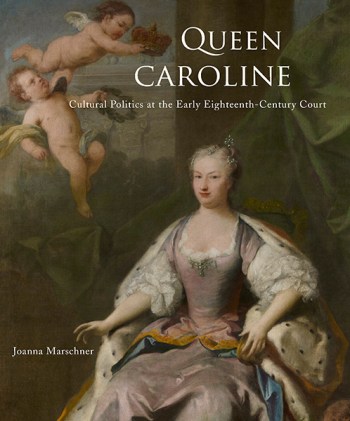 As the wife of King George II, Caroline of Ansbach became queen of England in 1727. Known for her intelligence and strong character, Queen Caroline wielded considerable political power until her death in 1737. She was enthusiastic and energetic in her cultural patronage, engaging in projects that touched on the arts, architecture, gardens, literature, science, and natural philosophy. This meticulously researched volume will survey Caroline’s significant contributions to the arts and culture and the ways in which she used her patronage to strengthen the royal family’s connections between the recently installed House of Hanover and English society. She established an extensive library at St. James’s Palace, and her renowned salons attracted many of the great thinkers of the day; Voltaire wrote of her, “I must say that despite all her titles and crowns, this princess was born to encourage the arts and the well-being of mankind.”
Joanna Marschner is senior curator at Historic Royal
Palaces.
Exhibition | The First Georgians: Art & Monarchy 1714–1760
Press release (29 January 2014) from The Royal Collection:
The First Georgians: Art & Monarchy 1714–1760
The Queen’s Gallery, Buckingham Palace, London, 11 April — 12 October 2014

◊ ◊ ◊ ◊ ◊
In 1714 Georg Ludwig, Elector of Hanover in Germany, acceded to the British throne as George I, the country’s first constitutional monarch. Despite many stronger genealogical claims to the crown than his, the 1701 Act of Settlement had declared that the choice of sovereign was the gift of Parliament alone and that only a Protestant could sit on the British throne. With this unprecedented decision, the Georgian era began, ushering in an unbroken line of succession to Her Majesty Queen Elizabeth II.
Marking the 300th anniversary of the Hanoverian succession, The First Georgians: Art & Monarchy 1714–1760 explores the reigns of George 1 (r.1714–27) and his son George II (r.1727–60), shedding light on the role of this new dynasty in the transformation of political, intellectual and cultural life. Through over 300 works from the Royal Collection, it tells the story of Britain’s emergence as the world’s most liberal, commercial and cosmopolitan society, embracing freedom of expression and the unfettered exchange of ideas.
The Hanoverians’ right to rule was fiercely disputed by the Jacobites, supporters of the Stuart claim to the throne. The ‘Old Pretender’, Prince James Francis Edward Stuart, set up a rival court in Paris and Rome, and his son, Prince Charles Edward—Bonnie Prince Charlie—led an uprising in 1745–46 on behalf of his father’s cause. The continuous threat to Hanoverian rule, both at home and overseas, is reflected in the exhibition’s military maps and battle plans. They include a draft order of battle at Culloden, thought to have been produced by George II’s son, the Duke of Cumberland, who led the King’s troops to victory in 1746.
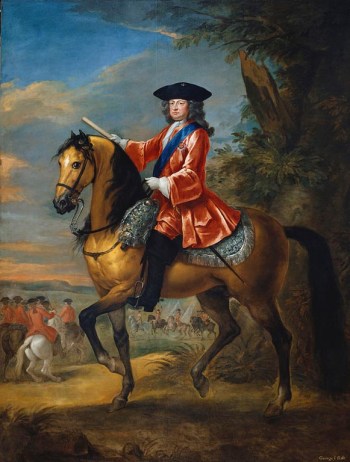
Vanderbank, Equestrian Portrait of George I, 1726
(Royal Collection 404412)
Although St James’s Palace remained the principal royal residence, the newly installed George I focused his artistic attention on Kensington Palace–its location outside London provided some shelter from the scrutiny of his more sceptical subjects. Here he appointed William Kent to decorate a new suite of State Rooms. The King filled Kensington with the best British furniture of the day, including pieces by James Moore and Old Master paintings, such as Don Roderigo Calderón on Horseback, 1612–15, and The Holy Family with St Francis, 1620–30, by Peter Paul Rubens.
The reigns of both Georges were fraught with familial strife. In 1717 George I expelled the Prince of Wales, the future George II, from St James’s Palace. Far from enduring a humiliating exile, the Prince established an alternative court, hosting ‘drawing rooms’, evening parties and balls, and regularly dining in public. Some 20 years later, George II’s son, Frederick, Prince of Wales (whose son George William Frederick became George III) was similarly banished and set up rival headquarters. Furnishing his private residences, the Prince could indulge his enthusiasm for the Old Masters. Among his acquisitions were Guido Reni’s Cleopatra with the Asp, c.1628, Anthony van Dyck’s Thomas Killigrew with an unidentified Man, c.1630, and ‘The Jealous Husband’, c.1660, by David Teniers.
Frederick presented himself as a fashionable man about town, entertaining freelyand informally—a typical supper party offered a menu of larks, pigeons, partridges, truffles, veal, turkey, lamb, turbot, salmon, teal, blackbird, asparagus, broccoli, sweetbreads, coffee cream and jelly. To dress his table, he commissioned dining plate in the new Rococo style, including the spectacular marine service by Paul Crespin and Nicholas Sprimont. Frederick’s mother, Queen Caroline, despised her son’s relaxed manner: “popularity always makes me sick,” she is reported to have said, “but Fretz’s popularity makes me vomit.”
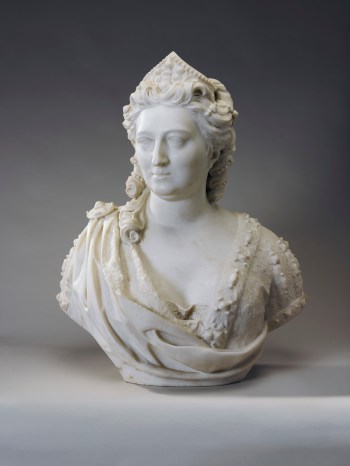
After John Michael Rysbrack and Joseph Highmore, Posthumous Portrait of Queen Caroline, Consort of George II, 1739
(Royal Collection, 31317)
Queen Caroline, consort of George II, was the most intellectual member of the Hanoverian dynasty. Her interests combined art, genealogy and a passion for gardening. She undertook major landscape projects at Kensington Palace and at her private retreat in Richmond, where she commissioned Charles Bridgeman to lay out the new gardens, complemented by follies created by William Kent. The most remarkable of these was the Hermitage, a picturesque temple devoted to British scientists and theologians, encapsulating Caroline’s belief in the interdependence of science and religion.
During the course of the 18th century, the focus of British cultural life began to shift away from court. Artists achieved success and fame through their own efforts, without the traditional support of a royal patron. William Hogarth’s portrait of David Garrick and his Viennese dancer wife, Eva-Marie Veigel, captures one of the most high-profile couples of the age. When the portrait was painted, in c.1757–64, Garrick had already combined great financial success as an actor-manager with international celebrity. Hogarth himself was not only a prominent artist, but
also a writer on art and a noted philanthropist.
The favourite genre of the early Georgian period was satire, both pictorial and literary. In 1724, its greatest practitioner, William Hogarth, published The Bad Taste of the Town, ridiculing British taste for foreign forms of art, such as Italian opera. London’s leading exponent of Italian opera was the German composer George Frideric Handel, who was employed in many royal roles. He was music teacher to George II’s daughter, Princess Anne, who is seen playing the cello with her two sisters and brother, Frederick, Prince of Wales, in Philippe Mercier’s The Music Party, 1733.

Meissen, Tea and coffee service with chinoiserie figures, 1720s
(Royal Collection, 5000106)
The desire for fashionable luxury goods drove Britain’s commercial enterprise and turned London into the most important trading city in the world. The Chelsea porcelain works, one of several new ventures set up to compete with the newly established Meissen factory in Germany, typified the entrepreneurialism of the time. With the emergence of a new leisure class came an explosion of coffee houses, gaming haunts, assembly rooms, theatrical entertainments and pleasure gardens. In the painting St James’s Park and the Mall, c.1745, all elements of cosmopolitan Georgian society mix together, with Frederick, Prince of Wales at the centre, rubbing shoulders with his future subjects.
◊ ◊ ◊ ◊ ◊
The catalogue is published by the Royal Collection and distributed by the University of Chicago Press:
Desmond Shawe-Taylor, ed., The First Georgians: Art & Monarchy 1714–1760 (London: Royal Collection Trust, 2014), 496 pages, ISBN 978-1905686797, £45 / $90.
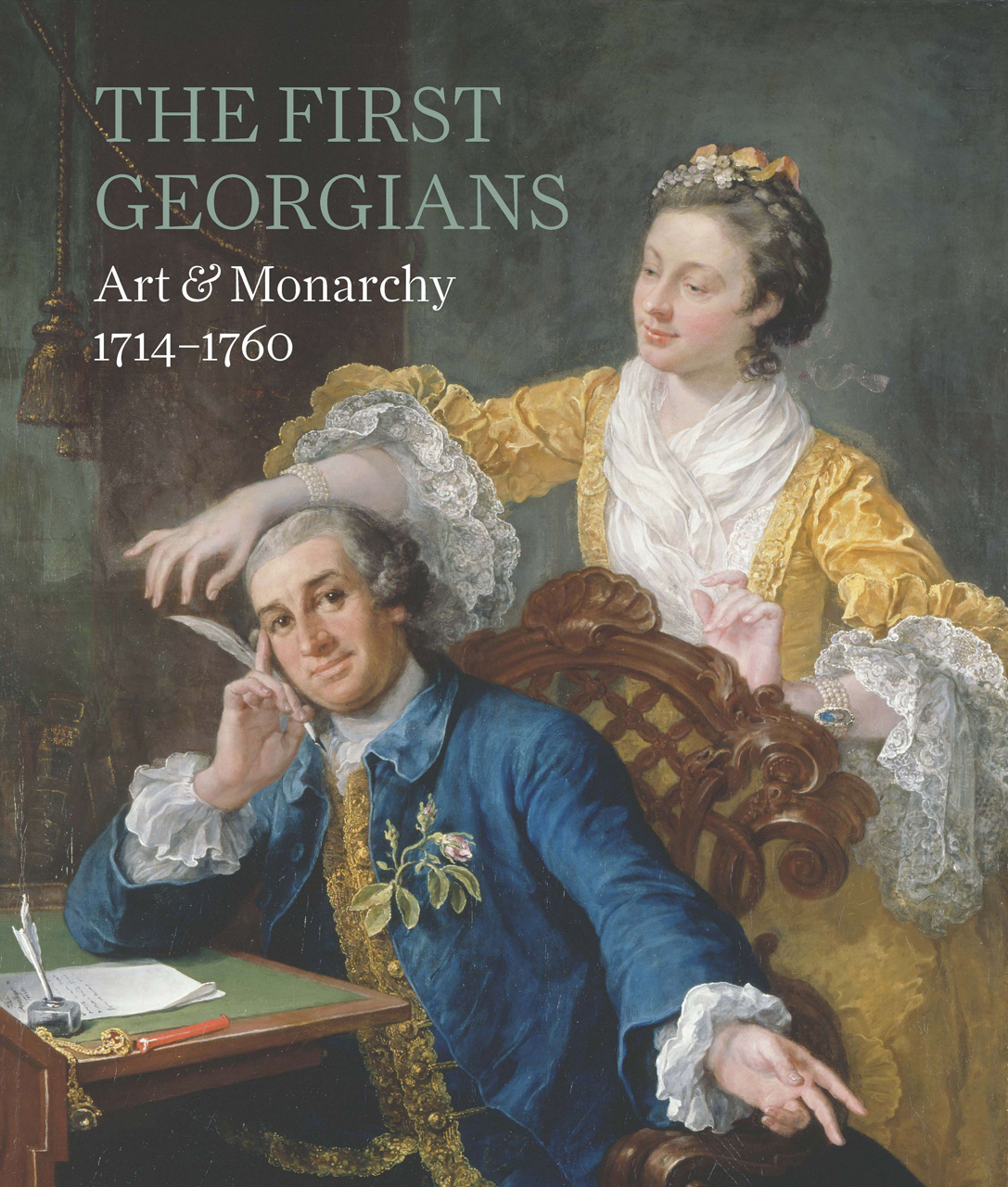 2014 marks the three-hundredth anniversary of the succession of the House of Hanover to the British throne. In celebration of this historic milestone, The First Georgians explores the rich artistic culture of the early Hanoverian period.
This publication showcases more than three hundred of the finest works of this period, many of which have never been on public display before. Created in Germany, France, and Britain during one of the most dramatic periods of change across all aspects of political, intellectual, and cultural life, they reflect changing views of science, politics, and art throughout the early to mid-eighteenth century—the period when modern Britain was coming into being.
New Book | The Great Mirror of Folly
Published in November 2013 by Yale University Press:
William N. Goetzmann, Catherine Labio, K. Geert Rouwenhorst, and Timothy G. Young, eds., The Great Mirror of Folly: Finance, Culture, and the Crash of 1720, with a foreword by Robert J. Shiller. Yale Series in Economic and Financial History (New Haven: Yale University Press, 2013). 360 pages, ISBN: 978-0300162462, $75.
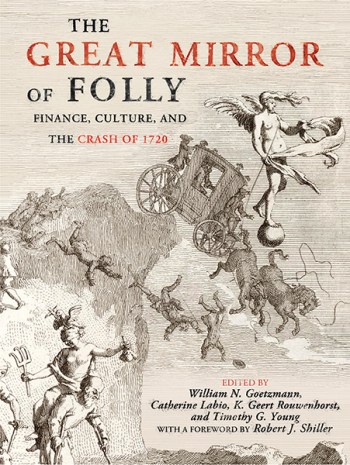 The world’s first global stock market bubble suddenly burst in 1720, destroying the dreams and fortunes of speculators in Paris, London, and Amsterdam. Their folly and misfortune inspired the quasi-simultaneous publication of an extraordinary Dutch collection of texts and images, including financial prospectuses, satirical prints, plays, poems, and suites of playing cards: Het groote Tafereel de Dwaasheid (The Great Mirror of Folly), the most aesthetically pleasing and historically valuable record of a financial crisis and its cultural dimensions.
No one discipline has been able to give a definitive account of the causes and effects of the bouts of “irrational exuberance” that have taken stock market participants and observers by surprise since 1720, when the collapses of the Mississippi, South Sea, and a host of smaller companies stunned Europe’s burgeoning financial markets. In this new and richly illustrated volume scholars from fields as diverse as economics, history, the history of art, literature, and cultural studies bring a wide variety of perspectives to bear on the Tafereel in order to provide a definitive account of the events of 1720 and of the mix of economic and cultural factors behind the financial crashes that have caused widespread economic and cultural shock for almost 300 years. The book also reproduces many of the engravings included in the Tafereel to give readers an approximation of the original volume and of the dramatic rise, progress, and fall of the first international stock market crash.
William N. Goetzmann is the Edwin J. Beinecke Professor of Finance and Management at the Yale School of Management. Catherine Labio is associate professor of English at the University of Colorado Boulder. K. Geert Rouwenhorst is Robert B. & Candice J. Haas Professor of Corporate Finance at the Yale School of Management. Timothy G. Young is curator of modern books and manuscripts at Beinecke Rare Book and Manuscript Library at Yale University.
IFA’s Rendez-Vous Seminars, March and April 2014
Rendez-vous: An International Seminar on French Art, 18th–20th Centuries
Rendez-vous is a seminar on French art (18th–20th centuries) held monthly throughout the 2013–14 academic year at the Institute of Fine Arts, NYU. International scholars are invited to present their research in an informal and creative setting for approximately 30 minutes, followed by an open discussion with students and colleagues. Rendez-vous focuses on French art in the broadest sense: ‘French’ is interpreted in an extensive way, including global exchanges, political dimension and colonial history, and ‘Art’ includes painting, architecture and sculpture, but also material and visual culture. Rendez-vous offers an occasion to learn about current innovative research by international and engaging scholars. The seminar aims to open up an exchange of methodologies, thoughts and ideas in a participatory atmosphere.
Rendez-vous is organized by Noémie Etienne, IFA/Mellon Postdoctoral Fellow (2013–15). These lectures begin at 12:30pm in the Loeb room at the Institute of Fine Arts. They are open to the public, but RSVPs are required.
◊ ◊ ◊ ◊ ◊
Frédérique Baumgartner | Women Artists in Hubert Robert’s Views of the Louvre’s Grande Galerie
Institute of Fine Art, New York University, Friday, 14 March 2014
Hubert Robert (1733–1808), one of the most versatile artists of his generation, managed to combine the careers of a painter and museum curator during the French Revolution. Using his painter’s talent to express his curatorial vision, Robert painted numerous views of the Louvre’s Grande Galerie, which opened to the public for the first time in 1793. This paper examines the place that Robert attributed to women artists in these views, in light of the rules and regulations that he and other Louvre curators were in the process of developing for this new public space. In doing so, it aims to assess how the Revolution’s gendered discourse pervaded the construction of the museum space and the degree to which Robert’s representation of women artists in the Grande Galerie challenged this discourse.
Frédérique Baumgartner is a lecturer and the director of MA in Art History in the Department of Art History and Archaeology at Columbia University. She received her PhD from Harvard University in 2011 and was a Postdoctoral Mellon Fellow at Columbia in 2011–13. Her research focuses on eighteenth- and nineteenth-century European art, with a particular emphasis on the convergence of art and politics. Her current book project, stemming from her dissertation, examines the politicization of the art of Hubert Robert during the French Revolution in relation to notions of cultural experience.
Open to the public, RSVP required. For reservations click here
◊ ◊ ◊ ◊ ◊
Jessica Fripp | Caricature and Rebellion in Rome in the Eighteenth Century
Institute of Fine Arts, New York University, Tuesday, 8 April 2014
Winning the Prix de Rome was the capstone in an aspiring artist’s career in eighteenth-century France. But alongside the professional training a stay in the Eternal City offered, studying abroad also provided artists an opportunity to escape the hierarchy and competition of the Royal Academy and forge friendships with other young artists from all over Europe. This paper examines the effect of these new networks on artistic practice in Rome. It focuses on a group of caricatures produced by the French painter François-André Vincent, the French sculptor Jean-Baptiste Stouf, and the Swedish sculptor Johan-Tobias Sergel. These caricatures were copied, etched, and exchanged between the artists represented in them, and served to define these artists as a group of friends. Fripp argues that caricature was a form of representation well-suited to memorializing the homosocial bonds formed in Rome, and an act of rebellion for these young artists as they transitioned from students to full-fledge artists.
Jessica Fripp is a Post Doctoral Fellow in Material and Visual Culture at Parsons the New School for Design. She received her MA from Williams College and a PhD from the University of Michigan with a dissertation entitled “Portraits of Artists and the Social Commerce of Friendship in Eighteenth-Century France.” Her work examines the intersection between visual culture and sociability in the eighteenth century, focusing on the role art played in creating, defining, and sustaining personal relationships.
Open to the public, RSVP required. For reservations click here
Design History 27 (March 2014)
A selection of offerings from the latest issue of Design History:
Design History 27 (March 2014).
Julie Bellemare, “Design Books in the Chinese Taste: Marketing the Orient in England and France, 1688–1735,” pp. 1–16.
 This article examines design books replicating Asian and Asian-inspired imagery in seventeenth- and eighteenth-century England and France. Often created to provide craftsmen with new sets of decorative patterns, the designs compiled in these books served to imitate a range of new manufactured products imported from Asia, for which local demand was growing at a steady pace. Design books provide a particularly fruitful entry point into the European conception of the ‘orient’ by synthesising exotic images from a variety of pictorial sources into convenient formats. The present discussion focuses on two specific books: A Treatise of Japaning and Varnishing, by John Stalker and George Parker, published in London and Oxford in 1688, and Livre de desseins chinois, tirés d’après des originaux de Perse, des Indes, de la Chine et du Japon by Jean-Antoine Fraisse, which appeared in Paris in 1735. Using these case studies, I argue that not all patterns found in design books were intended to be replicated on real objects; some also circulated independently as images available to a broader consumer base than previously thought. I examine the books’ contents, publishing history and the marketing strategies employed for reaching wide audiences and generating a desire for the ‘orient’.
R E V I E W S
• Deborah Sugg Ryan, Review of Tatiana C. String and Marcus Bull, eds., Tudorism: Historical Imagination and the Appropriation of the Sixteenth Century (2011); and Andrew Ballantyne and Andrew Law, Tudoresque: In Pursuit of the Ideal Home (2011), pp. 97–101.
• Susan House Wade, Review of Liza Antrim, Family Dolls’ Houses of the 18th and 19th Centuries (2011), pp. 103–04.
• Galen Cranz, Review of Anne Massey Chair (2011), pp. 104–06.
• Dominique Grisard, Review of Chris Horrocks, ed., Cultures of Colour: Visual, Material, Textual (2012), pp. 106–08.
C F P : S P E C I A L I S S U E S
Beyond Dutch Design: Material Culture in the Netherlands in an Age of Globalization, Migration and Multiculturalism, p. 114.
Articles due by 1 December 2014 (more…)
New Book | The Duchess’s Shells
Due out in April from Yale UP:
Beth Fowkes Tobin, The Duchess’s Shells: Natural History Collecting in the Age of Cook’s Voyages (London: The Paul Mellon Centre for Studies in British Art, 2013), 328 pages, ISBN: 978-0300192230, $55.
 Margaret Cavendish Bentinck, the 2nd Duchess of Portland (1715–1785), was one of the wealthiest women in eighteenth-century Britain. She collected fine and decorative arts (the Portland Vase was her most famous acquisition), but her great love was natural history, and shells in particular. Over the course of twenty years, she amassed the largest shell collection of her time, which was sold after her death in a spectacular auction.
Beth Fowkes Tobin illuminates the interlocking issues surrounding the global circulation of natural resources, the commodification of nature, and the construction of scientific value through the lens of one woman’s marvelous collection. This unique study tells the story of the collection’s formation and dispersal—about the sailors and naturalists who ferried rare specimens across oceans and the dealers’ shops and connoisseurs’ cabinets on the other side of the world. Exquisitely illustrated, this book brings to life Enlightenment natural history and its cultures of collecting, scientific expeditions, and vibrant visual culture.
Beth Fowkes Tobin is a professor of English and
women’s studies at the University of Georgia.
Exhibition | Shells: Magic and Science
From the MIA:
Shells: Magic and Science
Minneapolis Institute of Arts, 23 November 2013 — 8 June 2014
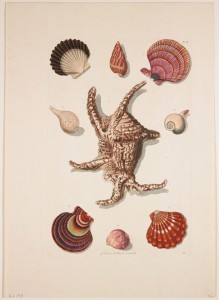
George Wolfgang Knorr, Plate B. II., from Deliciae Naturae Selectae, 1750–72, etching, hand-colored.
Shells are common yet precious, abundant yet desirable—among the first things a child instinctively collects. From prehistoric shacks to the courts of Baroque Europe, their translucent texture and fantastical forms have been integrated into everyday objects, decoration, and an incredible variety of art. They are also as central to modern studies of the natural world as the discovery of new lands, their perfection embodying—and ultimately resolving—the dilemma of creation and evolution. This importance is reflecting in the mania for shell collecting, particularly during the late 16th and early 17th centuries when nautilus and conches were mounted in precious metals, adorned with gems, and displayed in magnificent Wunderkammern—the “wonder rooms” or “cabinets of curiosities.”
This exhibition encompasses our passion for shells throughout the ages, gathering treasures from such Twin Cities institutions as the Wangensteen Historical Library, the James Ford Bell Library, the Bell Museum of Natural History, and the MIA itself. Together, they comprise an intriguing patrimony
of prints and precious antique books on natural history, while testifying to
the still-burning fever of shell-collecting.










 Enfilade
leave a comment