Call for Papers | French Seventeenth-Century Studies
For those of you working in the long seventeenth century. From SE17:
33rd Annual Conference | Society for Interdisciplinary French Seventeenth-Century Studies
University of Western Ontario, London, Canada, 16–18 October 2014
Proposals due by 30 March 2014
Conference Organizer / Organisateur du colloque
Jean Leclerc, University of Western Ontario, jlecler@uwo.ca
Scholars from all disciplines are invited to submit abstracts in French or English (300 words maximum) for presentations relating to the session themes listed below. Please send abstracts by email directly to session chairs by March 30, 2014. Presentations will be of 20 minutes’ duration.
Les chercheurs de toutes disciplines sont invités à soumettre des propositions de communication (en français ou en anglais) relatives aux thèmes annoncés ci-dessous. Les propositions ne doivent pas dépasser 300 mots et sont à envoyer par courriel directement aux présidents de séance avant le 30 mars 2014. Les interventions devront se limiter à 20 minutes.
1. Economy and spending / Économie et dépenses
Chair / Présidente de session : Nathalie Freidel, Université Wilfrid Laurier, nfreidel@wlu.ca
2. Center and margins / Centre et marges
Chair / Président de session : Jean-Vincent Blanchard, Swarthmore College, jblanch1@swarthmore.edu
3. Old and New France / Ancienne et Nouvelle France
Chair / Présidente de session : Marie-Christine Pioffet, York University, mpioffet@yorku.ca
4. Spaces and perspectives / Espaces et perspectives
Chair / Président de session : Francis Assaf, University of Georgia, fassaf@uga.edu
5. Disappearances and endings / Disparitions et fins
Chair / Présidente de session : Charlotte Trinquet, University of Central Florida, ctrinquet@gmail.com
6. Dazzling, stunning, sublime / Éblouissement, sidération, sublime
Chair / Président de session : Gilles Declercq, Université Sorbonne Nouvelle, gilles.declercq@univ-paris3.fr
7. Pedagogy / Pédagogie
Chair / Présidente de session : Sylvaine Guyot, Harvard University, guyot@fas.harvard.edu
Further information concerning the conference will be available starting in March on the Society’s website / Des informations complémentaires seront disponibles dès le mois de mars sur le site Web de la Société.
View: A Festival of Art History
London’s View: A Festival of Art History (7–9 February 2014) is the latest example of events that slip by me. For anyone interested, the good news is that events were filmed and could be available online in the near future. Plans are also underway for 2015. Here’s the coverage from Apollo Magazine’s blog, The Muse Room. -CH
◊ ◊ ◊ ◊ ◊
Digby Warde-Aldam, “Great View: The UK’s First Art History Festival,” The Muse Room from Apollo Magazine (19 February 2014).
 The venue is a large room in London’s Institut français, its windows looking out over the crazed Victorian skyline of South Kensington. French academic Frédéric Ogée looks slightly taken aback by the crowd, a mix of all ages that has just filled up every available seat—indeed, staff are starting to turn away latecomers to the lecture he is about to give, a fascinating half-hour examination of ‘Englishness’ in English art. At the end of the talk, Ogée is forced to cut short the barrage of questions from the audience in order to clear the room for the next speaker on the bill of the Institut’s View Festival.
The public interest in the talk shouldn’t really be surprising. The View, which had its first edition this month, is Britain’s first art history festival—which, taking into account the fact that the UK has festivals dedicated to everything from Heavy Metal to knitting comes as something of a surprise. Given London’s position as a global art capital, it seems bizarre that nothing like this has ever taken place in the city before. . .
The full review is available here»
Call for Papers | Trade in Animals in the Indian Ocean World
It’s not an art history conference, but thinking about possible correlations between representations of animals and the actual trade in animals would seem fruitful. And maybe some of you are already doing that. -CH
From McGill’s Indian Ocean World Centre:
Trade in Animals and Animal Products in the Indian Ocean World
Indian Ocean World Centre, McGill University, Montreal, 23–24 October 2014
Organized by Omri Bassewitch Frenkel
Proposals due by 1 May 2014
Recently, much public attention has focussed on the lucrative yet often illegal trade in the Indian Ocean world (IOW) of animal parts, including elephant tusks, rhinoceros horns, and tiger skins. However, the trade in exotic animals and animal parts in the IOW, from Africa to China, is not a modern phenomenon. Its roots can be traced back centuries and is reflected in the traditions, folklore, medicinal practices and religious beliefs of many different societies across the IOW. It has also impacted on the environment. By exploring the long-distance trade in animals and animal products as economic, cultural, and ecological phenomenon, this conference will seek to interrogate the concept of the Indian Ocean as a ‘world’. The conference will consider the trade in all land and sea animals as well as birds.
A wide range of relevant issues will be given consideration, but prospective participants are asked to give special consideration to the following themes:
• Trade in exotic animals
• Trade in animal parts
• Trade in animal products
• Impact of the trade on the environment of the source regions
• Finance and structure of the trade
• Prices and profits
• Demand and consumption patterns
• Legal and religious prescriptions governing the hunting/collection and consumption of animals and animal parts
Papers should be in English or French. Deadline for submission of abstracts (title and 1–2 paragraphs) is 1 May 2014. The review process will be completed by 1 June 2014. Papers should be a maximum of 9,000 words (including footnotes). We anticipate that selected papers will be published in a volume to appear in Palgrave Macmillan’s Indian Ocean World Studies series. A registration fee of $200 USD ($60 USD for students) is payable by 1 September 2014. The late registration fee (after 1 September 2014) is $250 USD and $100 USD for students. Registration is payable by cash, personal cheque or money order. Credit card payments are not accepted. All those interested in participating should complete the conference registration form and return it by email to the IOWC (iowc@mcgill.ca). All queries should be sent to the conference organizer, Omri Bassewitch, omri.bassewitchfrenkel@mail.mcgill.ca.
Call for Articles | The Eighteenth-Century Bird in Literature
Edited Volume | The Eighteenth-Century Bird in Literature, 1660–1830
Proposals due by 1 July 2014
A great deal of scholarly effort has been made over the years to gather together, analyze, and anthologize eighteenth-century bird poetry, paintings, and other material cultures that describe and represent birds in this period. Very few publications, however, have attempted to bring together the wide range of different approaches that scholars have adopted. This new project, The Eighteenth-Century Bird in Literature, 1660–1830, accordingly aims to further extend the discussion of the eighteenth-century bird and bring incisive, new critical approaches to the topic of birds and the representations of birds in eighteenth-century literature and cultural life. The editors are particularly interested in ways in which a deeper understanding of the bird in eighteenth-century cultural life shapes our twenty-first century notions of birds, our behaviors towards birds, and towards the environments that birds inhabit.
Chapters may include (but are not limited to) engagement with additional perspectives on eighteenth-century birds. These are just a few suggested topics:
• The eighteenth-century bird in the visual arts of the period
• Natural histories and the eighteenth-century bird
• Print cultures and the eighteenth-century bird
• Animal welfare and animal rights discourses around eighteenth-century birds
• Figurative birds
• The languages of eighteenth-century birds
• The exotic, the local, and the eighteenth-century bird
• The eighteenth-century bird as pet
• Ecocriticism and the eighteenth-century bird
• Science, culture, and the eighteenth-century bird
• Animal studies and the eighteenth-century bird
• Co-evolutions: the eighteenth-century bird and other animals (human and non-human)
• Eighteenth-century bird habitats, land-use transformations, and cultures
• Migrations, diasporas, and the eighteenth-century bird
We ask that anyone interested in contributing to this volume submit a one page CV (including previous publications) and an abstract of no more than 500 words by July 1, 2014 in docx or pdf format. Please send abstracts and direct any questions to the volume editors: Anne Milne (anne.milne@utoronto.ca), Brycchan Carey (brycchan@brycchancarey.com) and Sayre Greenfield (sng6@pitt.edu).
Online Course | Conservation of Globes
From the Hornemann Institute in Hildesheim:
Online Course | Patricia Engel and Michael Højlund Rasmussen, Conservation of Globes
Through the Hornemann Institute, 31 March — 1 June 2014
Historic globes exist all over Europe, in public collections and libraries, but also as private property. While older celestial globes were made of metals, since Behaim’s Erdapfel from 1492, globes have been made of paper, papier-mâché, wood, and parchment. In contrast to this omnipresence of globes, there is a sort of vacuum in conservation expertise concerning globe conservation. Today there are only a few conservators working in different European countries, who, due to their individual careers, are able to deal with the conservation of globes. Isolated articles in various journals have so far been the only competent publications in the field of globe conservation.
Course Structure
The first chapter of the course gives a description of the cultural and historical background of the topic and describes the history of the globes from 3000 BC to the 20th century. This is followed by helpful suggestions for the documentation of a globes material and an overview of damages. The latter provides pictures of typical damages on the globes along with case-by-case explanations. It will enable conservators to identify damages – even rare ones – and help the laymen to deal with their problems. The main chapters deal with specific suggestions for conservators concerning concrete practical conservation requests including the preparation of some materials and the techniques of surface cleaning on globes. The last chapter explains the practical storage problems, the climatic conditions and the correct packing and transportation of globes. Fee: 198€ (20% reduction for students).
Instructors: Based on her broad experiences in globe conservation Dr. Patricia Engel (European Research Centres for Book and Paper Conservation-Restoration in Horn, Austria) developed an e-learning course with the most up-to-date technical possibilities. Michael Højlund Rasmussen (Conservation Centre Vejle, Dänemark) cooperated in this project. For further information ask: hentschel@hornemann-institut.de
If you also want to deepen practically your new knowledge, please contact directly the author Dr. Patricia Engel, who offers regularly workshops for the conservation of globes in the European Research Centre for Book and Paper Conservation-Restoration in Horn, Austria. Further information can be found here.
New Book | Art, Theatre, and Opera in Paris, 1750–1850
Due out from Ashgate in April:
Sarah Hibberd and Richard Wrigley, eds., Art, Theatre, and Opera in Paris, 1750–1850: Exchanges and Tensions (Aldershot: Ashgate, 2014), 288 pages, ISBN: 978-1409439479, £65.
 Art, Theatre, and Opera in Paris, 1750–1850: Exchanges and Tensions maps some of the many complex and vivid connections between art, theatre, and opera in a period of dramatic and challenging historical change, thereby deepening an understanding of familiar (and less familiar) artworks, practices, and critical strategies in the eighteenth and nineteenth centuries. Throughout this period, new types of subject matter were shared, fostering both creative connections and reflection on matters of decorum, legibility, pictorial, and dramatic structure. Correspondances were at work on several levels: conception, design, and critical judgement. In a time of vigorous social, political, and cultural contestation, the status and role of the arts and their interrelation came to be a matter of passionate public scrutiny.
Scholars from art history, French theatre studies, and musicology trace some of those connections and clashes, making visible the intimately interwoven and entangled world of the arts. Protagonists include Diderot, Sedaine, Jacques-Louis David, Ignace-Eugène-Marie Degotti, Marie Malibran, Paul Delaroche, Casimir Delavigne, Marie Dorval, the ‘Bleeding Nun’ from Lewis’s The Monk, the Comédie-Française and Etienne-Jean Delécluze.
Sarah Hibberd is Associate Professor in the Department of Music at the University of Nottingham, UK. Richard Wrigley is Professor of Art History at the University of Nottingham, UK.
C O N T E N T S
Sarah Hibberd and Richard Wrigley, Introduction
David Charlton, Hearing through the eye in eighteenth-century French opera
Mark Darlow, Nihil per saltum: Chiaroscuro in eighteenth-century lyric theatre
Mark Ledbury, Musical mutualism: David, Degotti, and operatic painting
Thomas Grey, Music, theatre, and the Gothic imaginary: Visualising the ‘Bleeding Nun’
Sarah Hibberd, Belshazzar’s Feast and the operatic imagination
Olivia Voisin, Romantic painters as costumiers: The stage as pictorial battlefield
Stephen Bann, Delaroche off stage
Patricia Smyth, Performers and spectators: Viewing Delaroche
Beth S. Wright, Delaroche and the drama of history: Gesture and impassivity from The Children of Edward IV to Marie-Antoinette at the Tribunal
Céline Frigau Manning, Playing with excess: Maria Malibran as Clari at the Théâtre Italien
Richard Wrigley, All mixed up: Etienne-Jean Delécluze and the théâtral in art and criticism
Bibliography
Index
Catalogue | Art and Music in Venice
This catalogue accompanies the exhibition Venice: The Golden Age of Art and Music, which opened last weekend at the Portland Museum of Art. From Yale UP:
Hilliard T. Goldfarb, ed., Art and Music in Venice: From the Renaissance to Baroque (New Haven: Yale University Press, 2013), 240 pages, ISBN: 978-0300197921, $65.
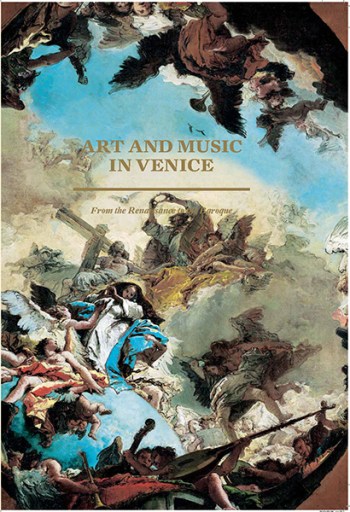 Artistic and musical creativity thrived in the Venetian Republic between the early 16th century and the close of the 18th century. The city-state was known for its superb operas and splendid balls, and the acoustics of the architecture led to complex polyphony in musical composition. Accordingly, notable composers, including Antonio Vivaldi and Adrian Willaert, developed styles that were distinct from those of other Italian cultures. The Venetian music scene, in turn, influenced visual artists, inspiring paintings by artists such as Jacopo Bassano, Canaletto, Francesco Guardi, Pietro Longhi, Bernardo Strozzi, Giambattista and Domenico Tiepolo, Tintoretto, and Titian. Together, art and music served larger aims, whether social, ceremonial, or even political. Lavishly illustrated, Art and Music in Venice brings Venice’s golden age to life through stunning images of paintings, drawings, prints, manuscripts, textbooks, illuminated choir books, musical scores and instruments, and period costumes. New scholarship into these objects by a team of distinguished experts gives a fresh perspective on the cultural life and creative output of the era.
Hilliard T. Goldfarb is associate chief curator and curator of Old Masters at the Montreal Museum of Fine Arts.
Eighteenth-Century Studies 47 (Winter 2014)
Eighteenth-Century Studies 47 (Winter 2014) | Special Issue: Eighteenth-Century Easts and Wests
A R T I C L E S
Chi-ming Yang, “Eighteenth-Century Easts and Wests: Introduction,” pp. 95–101.
 The essays in this “Eighteenth-Century Easts and Wests” issue of Eighteenth-Century Studies inaugurate the journal’s institutional relocation from California to New Haven, by way of India, China, Russia, and the Levant. Far from peripheral, the histories and perspectives that emerge from these sites are central to their interdisciplinary remapping of traditional eighteenth-century encounters of enlightenment and of imperialism. The virtues of a collection that is organized at this moment in time by an East-West rubric are several: it signals a regional, relational, and critical orientation that at once refuses the catchall, and too often Eurocentric, categories of the “exotic” or the “global,” and yet invites questions of comparison across and between cultures. Although seemingly axiomatic, it also calls into question its own bipartite structure of analysis by foregrounding the heterogeneity of the Easts and Wests under consideration here. The vector of a Pondichéry, Morocco, Andalusia, or Kiakhta shifts in relation to the particular local or intra-regional network of exchange in which it is situated. At the same time, the attention to place, and the importance of place to textual and archival analysis, keeps us attuned throughout to the larger structures of European and Asian states, companies, and institutions, as well as the continuing role of Western institutions in structuring the distinctions between Orient and Occident that open up fields of inquiry even as they push Asia to the margins of the modern academic mainstream. . . .
Matthew W. Mosca, “The Qing State and Its Awareness of Eurasian Interconnections, 1789–1806,” pp. 103–16.
This article examines the response of the Qing state to two instances in its foreign relations that required long-distance coordination between overland and maritime frontiers: the implementation of a rhubarb embargo in 1789 and the emergence between 1792 and 1806 of clear links between affairs at Kiakhta and Canton. It argues that Qing emperors and minsters had the intelligence capabilities to perceive that their empire was encircled within global networks of economic exchange and political rivalry. Unlike their Russian and British competitors, however, they pursued their interests primarily by seeking to break rather than forge these connections, designing their frontier as a series of discrete sectors rather than one integrated entity.
Kristina Kleutghen, “Chinese Occidenterie: The Diversity of ‘Western’ Objects in Eighteenth-Century China,” pp. 117–35.
The eighteenth-century Chinese taste for European things was met less by importing foreign goods than by domestically producing occidentalizing works of art, a diverse category of objects that can be termed “occidenterie.” This essay redirects the previous consideration of occidenterie from the Jesuit mission and imperial court painting toward a diversity of examples that span geography, material, format, and social class. The various ways in which Chinese occidenterie produced in different places and for different audiences employed elements connoting the West, thereby acquiring their foreign or exoticizing auras, more accurately reflects the empire-wide complexity of this phenomenon.
Danna Agmon, “The Currency of Kinship: Trading Families and Trading on Family in Colonial French India,” pp. 137–55.
In the French colony of Pondichéry, French and local actors alike drew on the shared idiom of kinship to strategically advance their political and commercial agendas. Recent scholarship has shown that the structures of family underlay early modern European state building and imperial expansion. This essay deploys this insight in the colonial context, to examine how indigenous families in the Tamil region entered into the European colonial project. For native commercial brokers, involvement with European newcomers could actually strengthen local family ties. Simultaneously, French employees of the Compagnie des Indes were eager to insert themselves into Tamil networks and did so by deploying public and inscribed performances of kinship.
Suzanne Marchand, “Where Does History Begin?: J. G. Herder and the Problem of Near Eastern Chronology in the Age of Enlightenment,” pp. 157–75.
This essay treats the very long set of debates concerning biblical and oriental chronology in early modern Europe down to the time of J. G. Herder and William Jones in the later eighteenth century. It shows that sacred chronology remained a burning issue for Herder; controversy about dating “oriental” texts did not wane, even as a series of newly-readable, original texts made their way westward. What did happen in Herder’s lifetime, however, was that a more specialized classical philology began to set the standards for what counted as wissenschaftlich, making it more difficult for scholarly “orientalists” to make the case that the cultures that they studied really had been at the forefront of cultural developments.
Nabil Matar, “Christians in the Eighteenth-Century Ottoman Mashriq,” pp. 177–94.
The article examines a selection of writings and icons by and about the Christian Arabs of the Middle East. Living under Ottoman rule, from Syria to Egypt, they became aware of an Arabic linguistic identity that helped them write and translate numerous chronicles, disputations, theological commentaries, sermons, and histories, in verse and prose. At the same time, they engaged the larger Muslim population in dialogue. While their legal status was that of second class dhimmis, they enjoyed their own religious space, by far more secure than was allowed minorities in the European World of expanding empires.
Srinivas Aravamudan, “East-West Fiction as World Literature: The Hayy Problem Reconfigured,” pp. 195–231.
This article focuses on the reception history of translations of Ibn Tufayl’s Hayy ibn Yaqzan and how natural theodicy, empiricist experimentalism, and philosophical fiction influenced eighteenth-century England. Discussing the status of Ibn Tufayl’s ideas in relation to Edward Pococke, John Locke, Robert Boyle, and Daniel Defoe allows scholars to go beyond the East-West dichotomy and instead create an opening from eighteenth-century studies onto recent debates around world literature. Using Hayy as a prism, we can understand the opportunities as well as the drawbacks of a world literature paradigm, as theorized by Wolfgang von Goethe, Erich Auerbach, and more recent scholars.
R E V I E W A R T I C L E S
Ruth P. Dawson, “Actress Images, Written and Painted, Famed and Defamed, British and German,” pp. 233–35.
Review of Mary Helen Dupree, The Mask and the Quill: Actress-Writers in Germany from Enlightenment to Romanticism (2011); Laura Engel, Fashioning Celebrity: Eighteenth-Century British Actresses and Strategies for Image Making (2011); and Gill Perry with Joseph Roach and Shearer West, The First Actresses: Nell Gwyn to Sarah Siddons (2011).
Suzanne Desan, “Gender, Intimacy, and Politics in the French Revolutionary Era,” pp. 236–40.
Review of Andrew Cayton, Love in the Time of Revolution: Transatlantic Literary Radicalism and Historical Change, 1793–1818 (2013); Lindsay Parker, Writing the Revolution: A French Woman’s History in Letters (2013); and Annie Smart, Citoyennes: Women and the Ideal of Citizenship in Eighteenth-Century France (2011).
Call for Participation | British Print Culture in a Transnational Context
Call for Participation from The Paul Mellon Centre for Studies in British Art:
Graduate Summer Seminar | British Print Culture in a Transnational Context, 1700–2014
The Paul Mellon Centre for British Art, London, 21–25 July 2014
Applications due by 10 March 2014
In July 2014, the Paul Mellon Centre for Studies in British Art will offer a week-long graduate student seminar focusing on British print culture. This is open to doctoral candidates who are working on related topics, or whose research would benefit from a deeper knowledge of the subject. There is a substantial body of literature on British prints that takes the form of survey publications, monographic studies of individual printmakers, and studies of individual techniques, and a number of scholars and doctoral students are currently undertaking research related to these topics. However, the broad field of British print culture still remains relatively underexplored, and its importance for those working in other areas of British visual culture tends to be underestimated. Two related areas, in particular, have been neglected and offer rich possibilities for further study: the reproductive print and the transnational aspect of the British print. The now canonical division between reproductive and ‘original’ prints has tended to elevate the latter category at the expense of the former, and the long-held perception of the status of professional engravers working in Britain as inferior to the artists whose work they translated has obscured appreciation of the collaborative relationships between artist and engraver, and so inhibited our understanding of the complexities of British artistic production. Secondly, Stephen Bann’s research on Anglo-French exchange in nineteenth-century reproductive printmaking has provided an important model for investigating the transnational nature of the British print trade, the various different manifestations of which include: British engravers working elsewhere in the world; foreign engravers working in Britain; the circulation of British prints around the world; the appropriation of imagery from non-British prints in Britain and vice-versa; and indeed the emergence of global modes of representation transmitted by way of prints throughout the former British empire.
The seminar will engage with the development of British print culture, in a transnational context, from 1770 to the present day. It will offer an opportunity for consideration of the state of the field, through a series of sessions taught at the Paul Mellon Centre and at various print rooms in central London, including the British Museum, the Courtauld Institute of Art, University College London, and the V & A Museum. Students will have the chance to see and discuss a wide range of primary materials. The seminar will also offer an introduction to the different techniques of printmaking in relation to their historical development, and includes a visit to a print studio. (more…)
Exhibition | The Material World of the Early South
From the press release (10 February 2014). . .
A Rich and Varied Culture: The Material World of the Early South
DeWitt Wallace Decorative Arts Museum, Colonial Williamsburg, opens 14 February 2014
Curated by Ronald Hurst and Margaret Beck Pritchard

Powder Horn, attributed to Jonathan Sarrazin, Charleston, South Carolina, cow horn, 1762–64 (Winston-Salem, NC: The Museum of Early Southern Decorative Arts)
◊ ◊ ◊ ◊ ◊
A groundbreaking exhibition examining the material culture of the early South from the 17th century through 1840—the first of its kind to include a wide variety of media—will open at the DeWitt Wallace Decorative Arts Museum, one of the Art Museums of Colonial Williamsburg, on February 14. A Rich and Varied Culture: The Material World of the Early South will feature a dozen categories of media and represent three geographic regions of the South.
Some 350 objects will be drawn from the Colonial Williamsburg collections, those of 10 other institutions and 14 private collections. Many of the items in the exhibition will be on public view for the first time in a museum setting. Like the culture they represent, the objects are diverse, chronologically telling the story of the region’s population as it expanded westward and southward toward the frontier.
“The early American South has long been depicted as a society that produced almost none of the objects used by its substantial populace,” said Ronald L. Hurst, Colonial Williamsburg vice president for collections, conservation, and museums and its Carlisle H. Humelsine Chief Curator. “However, the opposite is true. Southern artists and artisans generated a vast body of material in virtually every medium. The abundance and diverse cultural resonance of these goods will be powerfully conveyed by the objects assembled for this exhibition.”
Featured in A Rich and Varied Culture will be furniture, paintings, prints, metals (silver and pewter), ceramics, mechanical arts and arms, architectural elements, archaeological objects, rare books, maps, costumes and accessories and musical instruments. These objects are each receiving detailed, exhaustive research that sometimes challenges previous research. In one example, a remarkable painting of Frances Parke Custis, on loan from Washington and Lee University, has recently been identified as the work of the Broadnax Limner, a little-known artist who worked in Virginia during the 1720s. Similarly, an elaborately decorated 1770s ‘dresser’ or hutch was long thought to be a Pennsylvania product, but has proven instead to be the work of a Quaker cabinetmaker working in Alamance County, N.C.
While the majority of the objects and paintings in the exhibition come from the various collections of the Colonial Williamsburg Foundation, several sister institutions are also lending to this important undertaking in an example of unprecedented partnership. Chief among them is The Museum of Early Southern Decorative Arts (MESDA) at Old Salem Museums and Gardens in Winston-Salem, N.C., with which the Art Museums recently announced a five-year partnership. It is the largest lender with 39 objects. Other lenders include Drayton Hall, a Historic Site of the National Trust for Historic Preservation in Charleston, S.C..; The Charleston Museum; Washington and Lee University in Lexington; The Winterthur Museum, Garden, and Library in Winterthur, Del.; Historic Charleston Foundation; Tennessee State Museum; the University of Tennessee’s Department of Anthropology and McClung Museum of Natural History and Culture; Marble Springs State Historic Site in Knoxville, Tenn.; and The President’s House Collection at The College of Williams & Mary in Williamsburg. Fourteen private collectors are also generously lending to the exhibition. (more…)










 Enfilade
leave a comment