Lecture | Richard Taws on the Dauphin and his Doubles
This evening’s installment in the Birkbeck Forum for Nineteenth-Century Studies:
Richard Taws | Proofs of Life: The Dauphin and his Doubles in Nineteenth-Century France
Birkbeck Forum for Nineteenth-Century Studies, Keynes Library, London, 29 January 2014
The next event of the spring term for the Birkbeck Forum for Nineteenth-Century Studies will feature Richard Taws (UCL) presenting on ‘Proofs of Life: The Dauphin and his Doubles in Nineteenth-Century France’ on Wednesday 29 January 2014 from 6.00 to 8.00pm in the Keynes Library, 43 Gordon Square, London, WC1H 0PD.
This paper will consider the authenticating agency attributed to images of the dauphin Louis-Charles, the son and heir of Louis XVI and Marie-Antoinette, as they circulated globally in the late eighteenth and nineteenth centuries. Louis-Charles died at the age of ten in the Temple prison in 1795, yet rumours soon spread that he had been freed in a secret royalist escape plot and continued to live somewhere, most probably in the French colonies or North America. During the course of the nineteenth century the numerous images of Louis-Charles produced before, during and after the French Revolution were invoked regularly as the primary standard of proof against which to judge the many imposters who subsequently came forward from around the world, accompanied by lurid tales of adventure, to announce themselves the ‘lost’ dauphin. The appropriation of eighteenth-century images of Louis-Charles by these pretenders, as well as the paintings, prints and photographs they had made of themselves, were, in a rapidly transforming media ecology, closely connected to competing claims about the utility of different media in the production of the French past.
Exhibition | Visions and Nightmares
From the exhibition press release:
Visions and Nightmares: Four Centuries of Spanish Drawings
The Morgan Library & Museum, New York, 17 January — 11 May 2014
Curated by Edward Payne

◊ ◊ ◊ ◊ ◊
It was traditionally assumed that Spanish artists rarely drew, but recent research has demonstrated that drawing was, in fact, central to artistic practice in Spain. Visions and Nightmares: Four Centuries of Spanish Drawings explores the shifting roles and attitudes toward the art of drawing in Spain, as well as the impact of the Catholic Church and the nightmare of the Inquisition on Spanish artists and their work. It is the first exhibition of Spanish drawings ever to be held at the Morgan Library & Museum, whose holdings in this area are relatively small but strong.
On view in the Clare Eddy Thaw Gallery through May 11, the exhibition features more than twenty drawings spanning the sixteenth through the nineteenth centuries. Works by well-known artists such as José de Ribera, Bartolomé Esteban Murillo, and Francisco Goya are presented alongside sheets by equally talented but less familiar artists, including Vicente Carducho, Alonso Cano, and Eugenio Lucas. Complementing the drawings is a display of contemporary Spanish letters and volumes, notably a lavish 1780 edition of Cervantes’ Don Quixote.
“With one of the world’s most important collections of master drawings, the Morgan is committed to developing exhibitions that explore important subjects that may be less familiar or have been overlooked,” said William M. Griswold, Director. “The practice of drawing in Spain is relatively unexplored, by comparison to that in Italy or France, but the extraordinary works in this show demonstrate an artistry and themes unique to their country of origin.”
Among the drawings in the exhibition is one of many sheets preparatory for a series of fifty-six paintings that Vicente Carducho designed for the Charterhouse of El Paular. In the foreground, Father Andrés is tortured using a device called la garrucha; the background reveals his subsequent murder by a mob. Squared for transfer to the oil sketch that preceded the final painting, the drawing bears an inscription by the patron indicating that the suspended figure should be larger and more centrally placed. Carducho incorporated this correction into the finished canvas.
José de Ribera was drawn to violent subjects—notably, the flaying of St. Bartholomew and his pagan counterpart, Marsyas, a satyr who challenged Apollo to a musical contest. As punishment for losing the competition and for his sin of pride, Marsyas was tied to a tree and skinned alive. This drawing depicts the bound satyr screaming, his skin still intact. In a variation on the theme, Ribera portrays Marsyas with human (rather than goat) legs, thus connecting this mythological subject to the artist’s numerous other drawings of bound figures.
On view are three drawings by Alonso Cano, including his masterpiece on paper: a monumental design for the altarpiece of the Chapel of San Diego de Alcalá. Composed of seventeen joined sheets, the work is highly finished, indicating that it was a presentation drawing, offering the patron different options to consider. King Philip IV became patron of the chapel in 1657; his coats of arms appear at the lower left and right of the drawing.
Renowned for his paintings of religious themes, Bartolomé Esteban Murillo made this preparatory drawing for one of his many versions of the Immaculate Conception. The loose, sketchy handling of this sheet is typical of the artist’s later style. The doctrine of the Immaculate Conception—the belief that the Virgin was born free of original sin—was especially popular in seventeenth-century Spain. Here the abstract ideal is embodied by the figure of the Virgin standing on a crescent moon.
Visions and Nightmares includes four drawings by Francisco Goya. Toward the end of his life, the artist drew increasingly for his own pleasure, executing eight albums now lettered A through H and variously named. Pesadilla (Nightmare)—one of two drawings on view from the so-called Black Border Album—depicts a disheveled woman astride a flying bull, her eyes bulging as she screams in terror. Although the image of a woman and bull traditionally personified the European continent, Goya’s drawing seems to symbolize the turmoil in Spain following the Peninsular War.
Eugenio Lucas’s ominous drawing depicts Death reading from an oversized book supported by the back of a kneeling man who serves as a human lectern. Moody and macabre, this sheet recalls the threat of the Inquisition. Also on view is another sheet by Lucas, which depicts a figure shrouded in white, its arms extending toward the top of the page. The latter drawing may be seen as the pendant to Death Reading from a Human Lectern—the two works representing death and resurrection, respectively.
Visions and Nightmares also includes items from the Morgan’s collections of printed books, letters, and music manuscripts. One highlight is a deluxe edition of Don Quixote, commissioned by the Royal Spanish Academy and printed in Madrid in 1780. In addition to lavish engravings, the volume includes editorial revisions to the text, a biography of Cervantes, and the first map to chart Quixote’s itinerary. Also on view is a letter written by Goya to his lifelong friend Martín Zapater, in which he relates the exciting news that he was appointed painter to the Spanish king Charles III, the most prestigious position for an artist in Spain.

◊ ◊ ◊ ◊ ◊
P U B L I C P R O G R A M S
Visions and Nightmares: Four Centuries of Spanish Drawings
Friday, February 7, 6:30 pm
An informal tour with exhibition curator Edward Payne, Moore Curatorial Fellow, Drawings and Prints. Free with museum admission.
Blancanieves (2012, 104 minutes) Director: Pablo Berger
Friday, February 28, 7 pm
“Snow White” is retold in 1920s Seville, with imagery inspired by Francisco Goya. Spain’s Academy Awards submission for Best Foreign Film in 2013, starring Maribel Verdú and Daniel Giménez Carlos. In Spanish with English subtitles. Free with museum admission.
From Inquisition to Enlightenment: Drawing in Spain
Wednesday, March 5, 6:30 pm
Edward Payne, the Morgan’s Moore Curatorial Fellow, will lead this discussion on Spanish drawings with Jonathan Brown, the Carroll and Milton Petrie Professor of Fine Arts, Institute of Fine Arts, NYU, and scholar Lisa Banner. They will explore how new research has altered the perception of the role of drawing in Spain from the sixteenth through the nineteenth centuries, a period that witnessed the horror of the Inquisition, the rise of the Catholic Church, and the intellectual curiosity of the Enlightenment. The exhibition Visions and Nightmares will be open at 5:30 pm for program attendees. Tickets: $15; $10 for members; and free for students with valid ID; 212-685-0008 x560; themorgan.org/programs.
Call for Articles | ABO Public: Forum for Women in the Arts, 1640–1830
ABO Public: An Interactive Forum for Women in the Arts, 1640–1830
Proposals due by 15 March 2014; final contributions due by 15 April 2014
ABO: Interactive Journal for Women in the Arts, 1640–1830 is pleased to announce ABO Public: An Interactive Forum for Women in the Arts, 1640–1830.
Launching in April 2014, ABOPublic is a new public scholarship forum that integrates public and academic interests through intersecting feminist perspectives on gender, sexuality, race, class, privilege, geography, politics, culture, and the arts. Each issue may explore different themes related to eighteenth-century studies. ABOPublic invites submissions that consider any of the topics below or other topics relating to eighteenth century studies. For our first issue, we are particularly interested in (although not limited to) submissions that explore the nature of public scholarship in the eighteenth century, or public scholarship about the eighteenth century. Consider it our “meta issue.”
Bawdy Houses
Brewing/Alcohol Production
Children’s Literature and Public Scholar Programs
Coffee Houses and Coffee House Culture
Cookery
Faith-Based Furniture
Fashion/Fashion Culture/Material Culture
Female Pirates
Girl’s Education
Gossip/Secret Histories
Midwifery and Medicine
Natural History and Science
Postcolonial Approaches to the Eighteenth Century
Publishing and Print Culture
Queer Approaches to the Eighteenth Century
Religion and Missionary Work
Slavery/Colonialism
The Theater and Performance
Transatlanticism
Women’s Roles in Whaling
Women of Color and the Eighteenth Century
Women and Travel
Submissions should fit into one of the following categories. See the categories below for a more detailed description:
Bluestocking Salon
The Eighteenth Century in Popular Culture
Public Pedagogy/New Media Pedagogy
News and Discoveries
Proposals must be submitted through our online submission form before March 15, 2014. Final contributions must be received by April 15, 2014 for publication in the March issue. Before submitting a proposal, please review our submission guidelines. General inquiries may be sent to abopublic@aphrabehn.org.
Exhibition | Love & Play: A Pair of Paintings by Fragonard
From the museum’s press release:
Love & Play: A Pair of Paintings by Fragonard
Toledo Museum of Art, 24 January — 4 May 2014

◊ ◊ ◊ ◊ ◊
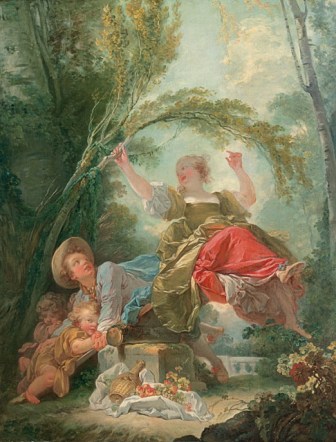
The original wardrobe malfunction might have originated more than 250 years ago, at the hands of a 20-something Frenchman named Jean-Honoré Fragonard. Fragonard was only beginning to discover his niche as a portrayer of thinly veiled eroticism when he painted an errant body part peeking out from his subject’s frilly 18th-century dress. The resulting work of art, Blind Man’s Buff, and its companion, The See-Saw, comprised a pair of paintings that must have delighted his patron with symbolic depictions of seduction.
The two works will be reunited for the first time in 25 years in a special focus exhibition at the Toledo Museum of Art titled Love and Play: A Pair of Paintings by Fragonard, on view January 24 until May 4, 2014 in Gallery 28. It’s the first in the Museum’s Encounters series, concentrated shows and installations that pair exceptional works of art in new or interesting ways.
Blind Man’s Buff, part of the Museum’s collection, and The See-Saw, on loan from the Thyssen-Bornemisza Museum, Madrid, will be displayed alongside two engraved copies of the paintings, a terracotta sculpture by Clodion and a small selection of French decorative arts of the period.
“They’re risqué, they’re provocative—and the artist intended these canvases to be seen together,” said Lawrence W. Nichols, William Hutton senior curator of European and American painting and sculpture before 1900. “So to reunite these two very important paintings by one of the most significant French artists of the 18th century is quite an exciting opportunity.”
Painted in Paris in the first years of the 1750s, they were likely commissioned by Baron Baillet de Saint-Julien and subsequently passed through the hands of private 18th-century collectors, a Parisian comte and a Rothschild. When they came onto the open market in 1954, they were finally separated. (more…)
Exhibition | Late Barbarians
Now on at London’s Gasworks:
Late Barbarians
Gasworks, London, 24 January — 9 March 2014

Matts Leiderstam, After Image (Portrait of a Gentleman), 2010
Gasworks presents the group exhibition Late Barbarians, which includes video, photography, and sculpture by Juan Downey, Lili Dujourie, Sidsel Meineche Hansen, Matts Leiderstam, and Chris Marker.
Focusing on the notion of corporeal memory, the exhibition explores how shifting social codes and cultural values have been embodied in historical Western European art and architecture. The exhibition takes its title from an expression by German sociologist Norbert Elias, which suggests that our future descendants may eventually consider us to have lived during an extended medieval period, implying that we share far greater affinities with our Barbarian ancestors than we might like to think. Similarly, the works on show question linear interpretations of history, invoking a present that is haunted by the gestures of our ancestors.
Paying particular attention to art historical representations of the body, works range from photographs that propose a queer re-reading of the gestures depicted in Renaissance paintings (Matts Leiderstam) to abstract, single-take “dances to camera” that attempt to divorce particular habits of the body from their entrenched social connotations (Lili Dujourie) and a virtual exhibition tour that takes place in the online world of Second Life (Chris Marker). In addition, Juan Downey’s video essay The Looking Glass (1981) decodes the iconography of the mirror in well-known artworks by Velázquez, Holbein and Picasso, and a new commission by Sidsel Meineche Hansen entitled His Head (2013–) comprises a clay sculpture and symposium that together examine the human head, separate from the body, as a symbol of patriarchy and power.
Late Barbarians is the second exhibition of The Civilising Process, a yearlong programme of exhibitions and events at Gasworks inspired by Elias’ eponymous 1939 book, which looks at the development of the tastes, manners and sensibilities of Western Europeans since the Middle Ages. Between October 2013 and November 2014 Gasworks is working with invited artists, designers, curators and researchers to tackle a wide range of issues raised by this book in an attempt to understand their relevance for contemporary debates and practices.
The Civilising Process comprises five exhibitions, a programme of interdisciplinary events, contributions to Gasworks’ online platform Pipeline, and a printed publication.
Gasworks
155 Vauxhall Street
London SE11 5RH United Kingdom
Conference | The Production of Ornament
From the conference website:
The Production of Ornament: Reassessing the Decorative in History and Practice
University of Leeds, 21-22 March 2014
Registration due by 28 February 2014
The descriptive terms ‘decorative’ and ‘ornamental’ are in many ways synonymous with superfluity and excess; they refer to things or modalities that are ‘supplementary’ or ‘marginal’ by their very nature. In the West, such qualitative associations in made objects intersect with long-standing and inter-related philosophical oppositions between ‘form’ and ‘matter’, ‘body’ and ‘surface’, the ‘proper’ and the ‘cosmetic’. Accordingly, this has weighed both on determinations of value in artistic media, and on the inflexions of related histories – particularly histories of ‘non-Western’ art, design and culture, where a wide range of decorative traditions are deemed unworthy of critical attention.
Yet such frameworks are no more historically stable than they are culturally universal. To take one very clear and ‘central’ counter-example, decoration in some strands of Renaissance architectural theory (Filarete, Alberti) emerged as a rigorous codification of meaning, as an essentially functional (political) language. In many ways the history of ornament may itself be seen as a process of marginalisation of such ways of thinking, and the separation of ornament from any form of social practice.
This two-day conference seeks to explore the various ways in which ornament might be regarded as itself productive of its objects and sites. How might the technologies, techniques, and materials of ornament be related to the conception and transformation of modes of object-making? How might ornament be understood to inform its objects, disrupting the spatial categories of ‘surface’ and ‘structure’, and the temporal models in which ornament ‘follows’ making? What are the relations between ornament and representation, and what is at stake in the conventional oppositions between these categories? What are the roles of ornament in larger dynamics of copying, hybridisation and appropriation between things? In what ways have practices and thinking on ornament staged cultural encounters, and engendered larger epistemological and social models?
Tickets cost £15/£8, and include lunches and refreshments. To book a place email Dr Richard Checketts and Dr Lara Eggleton at production.of.ornament@gmail.com by Friday the 28th of February.
F R I D A Y , 2 1 M A R C H 2 0 1 4
10:00 Coffee/tea and registration
10:45 Richard Checketts and Lara Eggleton (University of Leeds), Welcome and Introduction
11:00 Emma Sidgwick (University of Leuven), ‘Late Antique Strigillation: The Abstract Iconography and Embodied Mediation of a Holy Productive Power’
11:40 Catherine E. Karkov (University of Leeds), ‘Entanglement, Enchantment, Stone: The Materiality of Ornament in Tenth-Century Leeds’
12:20 Carol Bier (Graduate Theological Union, Berkeley / The Textile Museum, Washington D.C.), ‘Is Ornament Ornamental? Geometry Made Manifest in Islamic Architecture’
13:00 Lunch
14:30 Soersha Dyon (Independent Scholar), ‘Unravelling the Arabesque’
15:10 Jason Nguyen (Harvard University/ Institut national d’histoire de l’art, Paris), ‘Communauté ornament: Law and Labour in Late Seventeenth-Century Paris’
15:50 Coffee and tea
16:30 Keynote 1, Alina Payne (Harvard University)
S A T U R D A Y , 2 2 M A R C H 2 0 1 4
10:00 Keynote 2, Susanne Kuechler (UCL), ‘The Quest for Affinity: The Ornament in Perspective’
11:15 Coffee and tea
11:30 Todd P. Olson (University of California, Berkeley), ‘Sticky Figures: Reconciling Pattern and Mimesis in Early Modern Prints’
12:10 Elizabeth Athens (Yale University), ‘Monstrosity, Ornament, Ecology: William Hogarth’s Natural Knowledge’
12:50 Frances S. Connelly (University of Missouri-Kansas City), ‘Rogue Ornament or Poetic Monster: Giambattista Vico and the Ornamental Grotesque’
1:30 Lunch
2:30 Sabrina Rahman (Northumbria University), ‘The Politics of Ornament: Historiographical and Ethnological Practices of the Austrian Werkbund’
3:10 Mark Crinson (University of Manchester), ‘The Ornamented Ceiling in New Brutalism’
3:50 Closing remarks and discussion
5:00 Drinks reception
Exhibition | A Dialogue with Nature: Romantic Landscapes
Press release from Sue Bond:
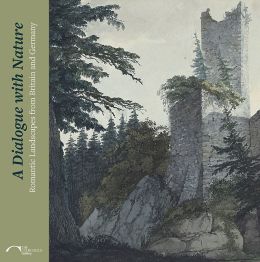
A Dialogue with Nature: Romantic Landscapes from Britain and Germany
The Courtauld Gallery, London, 30 January — 27 April 2014
The Morgan Library & Museum, New York, 30 May — 7 September 2014
Curated by Rachel Sloan

John Robert Cozens, A Ruined Fort near Salerno, ca. 1782
watercolour on paper (The Courtauld Gallery)
◊ ◊ ◊ ◊ ◊
Organised as a collaboration between The Courtauld Gallery and The Morgan Library & Museum in New York, this exhibition explores aspects of Romantic landscape drawing in Britain and Germany from its origins in the 1760s to its final flowering in the 1840s. Bringing together twenty-six major drawings, watercolours and oil sketches from both collections by artists such as J.M.W. Turner, Samuel Palmer, Caspar David Friedrich, Carl Philipp Fohr, and Karl Friedrich Lessing, it draws upon the complementary strengths of both collections: the Morgan’s exceptional group of German drawings and The Courtauld Gallery’s wide-ranging holdings of British works. A Dialogue with Nature offers the opportunity to consider points of commonality as well as divergence between two distinctive schools. Together, these drawings exemplify Friedrich’s understanding of Romantic landscape draughtsmanship as ‘a dialogue with Nature’.
 Friedrich claimed that ‘the artist should not only paint what he sees before him, but also what he sees in himself’. His words encapsulate two central elements of the Romantic conception of landscape: close observation of the natural world and the importance of the imagination. The display opens with a selection of drawings made in the late 18th century. The legacy of Claude Lorrain’s ideal vision is visible in both Jakob Philipp Hackert’s magisterial view of ruins at Tivoli, near Rome, and in Thomas Gainsborough’s more informal rendering of a rustic cottage among rolling hills, while cloud and tree studies by John Constable and Johann Georg von Dillis demonstrate the importance of drawing from life and the observation of natural phenomena. This newfound emphasis on drawing out of doors extended to amateur artists as well, exemplified by two remarkable sketchbooks by dilettante draughtsmen, the composer Felix Mendelssohn and the British naval officer Robert Streatfeild.
The important visionary strand of Romanticism is brought to the fore in a group of works centred on Friedrich’s Moonlit Landscape and The Jakobikirche as a Ruin and Samuel Palmer’s Oak Tree and Beech, Lullingstone Park. These are exemplary of their creators’ intensely spiritual vision of nature as well as their strikingly different techniques, Friedrich’s painstakingly fine detail contrasting with the dynamic freedom of Palmer’s penwork.
The final grouping shows Romantic landscapes at their most expansive and painterly, featuring Turner’s St Goarshausen and Katz Castle, one of fifty watercolours inspired by his first visit to Germany in 1817 and his highly atmospheric late rendering of a full moon over Lake Lucerne, as well as Friedrich’s subtle wash drawing of a coastal meadow on the remote Baltic island of Rügen. The exhibition closes with three small-scale drawings revealing a more introspective and intimate facet of the Romantic approach to landscape: Theodor Rehbenitz’s fantastical medievalising scene, Palmer’s meditative Haunted Stream and, lastly, Turner’s Cologne made as an illustration for The Works of Lord Byron (1833), which underscores important links between literature and the visual arts in the ongoing exchange of ideas between Britain and Germany.
A Dialogue with Nature is the first exhibition to be organised jointly by The Courtauld’s IMAF Centre for Drawings and The Morgan Library & Museum’s Drawings Institute. The accompanying publication will feature an essay by Matthew Hargraves (Yale Center for British Art and Morgan-Courtauld Fellow) and individual catalogue entries for each work by Rachel Sloan (The Courtauld Gallery).
From Athena Books/Paul Holberton:
Matthew Hargraves and Rachel Sloan, A Dialogue with Nature: Romantic Landscapes from Britain and Germany (London: Paul Holberton Publishing, 2014), 84 pages, ISBN: 978-1907372667, $25.
Alexander Sturgis Appointed Director of the Ashmolean
From the press release (January 2014) . . .
 The University of Oxford is pleased to announce the appointment of Dr Alexander Sturgis as the new Director of the Ashmolean Museum of Art and Archaeology. He will take up the appoint- ment on 1 October 2014, succeeding Professor Christopher Brown CBE, who has been the Museum’s Director since 1998.
Dr Sturgis has had a distinguished career as the Director of the Holburne Museum, Bath, since 2005 and previously held various posts over 15 years at the National Gallery, London, including Exhibitions and Programmes Curator from 1999 to 2005.
Welcoming the appointment of Dr Sturgis, the University’s Vice-Chancellor, Professor Andrew Hamilton, said: “We are delighted that Dr Sturgis has agreed to come to Oxford to lead the Ashmolean. The Museum has undergone a substantial transformation in recent years under the outstanding leadership of Christopher Brown. I am fully confident that Dr Sturgis will take forward with equal distinction the next stage of the Ashmolean’s development.”
Professor Ian Walmsley, Pro-Vice-Chancellor (Academic Services and University Collections), said: “I am looking forward very much to working with Dr Sturgis as he develops a strategy for the Ashmolean that continues its exceptional trajectory and maximises the contribution of its outstanding collections, both to the teaching and research of the University and to the Museum’s exciting range of activities involving the general public.”
Mr Bernard Taylor, Chairman of the Board of Visitors of the Ashmolean Museum, said: “I am so pleased that Xa Sturgis has decided to come to the Ashmolean. His great success at the Holburne Museum and his previous time at the National Gallery, working closely with Neil McGregor, prepares him well for leadership of this great museum. His past work in the use of collections in education, in arranging successful exhibitions, and in raising visitor numbers six-fold at the Holburne gives him the experience base to build upon the considerable success the Ashmolean has enjoyed in recent times.”
Responding to his appointment, Dr Sturgis said: “I am thrilled to be appointed the next Director of the Ashmolean. It is a huge honour to be given the chance to lead one of the country’s great museums, however hard it will be to leave the Holburne after eight exceptionally happy and eventful years. I look forward to working with the Ashmolean team and Oxford University to build on all that has been achieved at the Museum in recent years.”
◊ ◊ ◊ ◊ ◊
Sturgis’s bio from the Holburne Museum:
Alexander Sturgis studied Modern History at Oxford (1982–85) before completing a PhD in Art History at the Courtauld Institute, London (1985–90).
He joined the National Gallery, London in 1991 where he spent 14 years first as Education Officer (1991–99) and then as Exhibitions and Programmes Curator (1999–2005). During this time he also served as the Director’s Curatorial Assistant helping to set up the Regional Museums Task Force. His exhibition credits at the National Gallery include Seeing Salvation (2000), Telling Time (2000), Bill Viola: The Passions (2003), and Rebels and Martyrs: The Artist in the Nineteenth Century (2006). His list of publications includes Faces (1999) Telling Time (2000) Understanding Paintings: Themes in Art Explored and Explained (2000), and Rebels and Martyrs: The Artist in the Nineteenth Century (2006). He was appointed Director of the Holburne Museum in 2005.
Book and Display | Baroque and Later Ivories in the V&A
From the V&A:
Baroque and Later Ivories in the V&A
Victoria & Albert Museum, London, 25 January — 28 September 2014
This is a display of a number of sculptures from the outstanding collection of baroque and later ivories in the V&A, including German, Austrian, Netherlandish, French, British and Hispanic works. A range of objects will be seen: portrait busts, tankards, statuettes, and devotional reliefs. Carved and turned ivories were highly treasured items throughout the seventeenth, eighteenth and nineteenth centuries. They might render dramatic mythological scenes, present exquisitely carved portrait likenesses on a small scale, or depict religious narratives. This small exhibition celebrates the recent publication of a catalogue of these ivories at the V&A.
From the V&A Shop:
Marjorie Trusted, Baroque and Later Ivories in the V&A (London: V&A Publishing, 2013), 544 pages, ISBN: 978-1851777679, £85.
 Over 500 baroque and later ivories from the V&A’s outstanding collection are illustrated and discussed in this scholarly catalogue. This publication includes every ivory sculpture made after 1550 from a collection comprising German, Austrian, Netherlandish, British, French, Italian, Scandinavian, Russian and Spanish pieces, as well as examples from the Philippines, Goa, Sri Lanka and South America. The range of objects is extensive: statuettes, reliefs, tankards, boxes, cabinets, snuff rasps and cutlery handles are all represented. These small-scale sculptures might render dramatic scenes from mythology, present exquisitely carved portrait likenesses on a small scale, or depict religious narratives. The high quality of the V&A’s holdings is readily apparent; leading ivory sculptors to be found here include Francis van Bossuit, Benjamin Cheverton, Balthasar Griessmann, Joachim Henne, Johann Christoph Ludwig Lücke, David Le Marchand, and Balthasar Permoser. In addition to detailed entries on each piece, the Introduction summarises the history and techniques of baroque and later ivory carving, while indexes of subjects and artists, in addition to a comprehensive bibliography, provide a full scholarly apparatus.
Marjorie Trusted is Senior Curator of Sculpture at the V&A. She has published and lectured widely, specializing in European art from the seventeenth century onwards, in particular British and Spanish sculpture. Her books include Spanish Sculpture (V&A 1996), British Sculpture 1470–2000 (co-author, V&A 2002), The Making of Sculpture (V&A 2007), and The Arts of Spain (V&A 2007).
Exhibition | The Image of the European City
From the Correr:
The Image of the European City from the Renaissance to the Enlightenment
Museo Correr, Venice, 8 February — 18 May 2014
Curated by Cesare De Seta
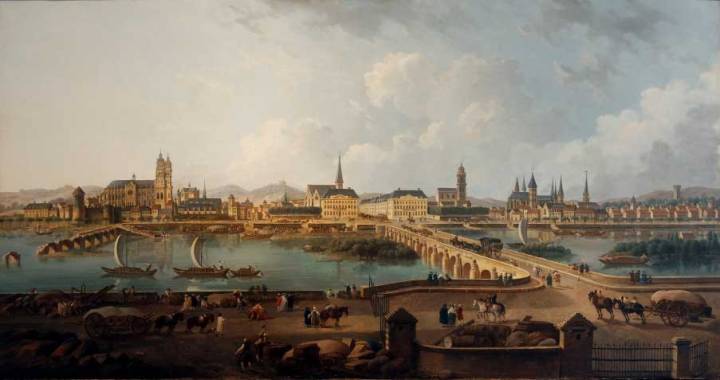
Pierre-Antoine Demachy, Panoramic View of Tours,
1787 (Musée des Beaux-Arts, Tours)
◊ ◊ ◊ ◊ ◊
The fascinating context of the European city from the Renaissance to the Enlightenment is evoked in this exhibition through an extraordinary iconographic repertory comprising over a hundred paintings, prints and drawings from prestigious public and private, Italian and foreign collections.
Ever since the Middle Ages, towns have been a favoured subject in European painting and a means for a state to promoate itself and show off its virtues. The exhibition brings together those global images of an especially high quality that for centuries were the only or most persuasive means for showing off the beauty and wealth of Europe’s leading cities. The exhibition starts with Italy, the first to introduce the imago urbis thanks to the invention of perspective in the early years of the 15th century, providing a fascinating manifesto of the ambitions of popes, princes and sovereigns. Following a chronological and geographic itinerary, the visitor can then travel virtually through cities transformed by time, which for the most part no longer exist in the same way.
For more information, see the press release, available here»










 Enfilade
leave a comment