Exhibition | Winter Antiques Show in New York to Highlight the PEM
Press release (13 August 2013) from the Winter Antiques Show:
Fresh Take, Making Connections at the Peabody Essex Museum
60th Winter Antiques Show, Park Avenue Armory, New York, 24 January — 2 February 2014

Pair of carp tureens, 1760–80, Porcelain, Jingdezhen, China, with gilded bronze mounts, possibly from Spain (Peabody Essex Museum)
The Winter Antiques Show’s 2014 loan exhibition will celebrate the Peabody Essex Museum (PEM) in Salem, Massachusetts. Fresh Take, Making Connections at the Peabody Essex Museum is comprised of more than 50 paintings, sculptures, textiles, and decorative objects. One of America’s oldest and fastest growing museums, PEM was founded in 1799 and its collection showcases an unrivaled spectrum of American art as well as outstanding Asian, Asian export, Native American, African, Oceanic, maritime, and photography collections. The exhibition will be on view during the run of the Winter Antiques Show, from January 24 to February 2, 2014.
PEM celebrates its 215th year in 2014, and has recently embarked on a $650 million capital campaign and expansion that will place the museum among the top 10 art museums in the country in terms of gallery space and total endowment. The museum’s campus boasts 22 historic buildings celebrating Salem’s rich architectural and garden heritage and Yin Yu Tang, a 200-year old Chinese house that is the only example of its kind in the United States. PEM offers a vibrant schedule of changing exhibitions, a lively contemporary art program, performances, and an interactive education center.

Painted Side Chair, ca. 1795, Salem, MA, wood, paint, reproduction
upholstery (Peabody Essex Museum)
Fresh Take, Making Connections at the Peabody Essex Museum is a microcosm of the PEM experience. Works of art from diverse cultures and time periods are grouped together, uniting and contrasting objects of creative expression in unexpected ways. Highlights of the exhibition range from a spectacular inlaid ivory chair from India (18th century) to a mahogany dressing chest by Thomas Seymour (c. 1810); from an English brass mariner’s astrolabe used to determine time and latitude by the stars (late 1500s) to a stick chart used by Micronesian sailors navigating the Pacific Ocean (early 20th century); from a view of Salem Common by George Ropes (1808) to a Joseph Cornell collage inspired by Magritte’s surrealist landscape (c.1964); from a bronze Japanese reliquary from the Koki-ji Temple, Kawachi-gun, Osaka Prefecture (1679) to a Chinese bridal headdress made of Kingfisher feathers, silk, pearls, and semi-precious stones (c. 1800s).
One of the many highlights is a striking portrait of Nathaniel Hawthorne by Charles Osgood (1809– 1890). The 1840 portrait was painted when Hawthorne worked in the Boston Custom House, ten years before The Scarlet Letter was published. It is the best-known likeness of the young author.
The founding organization of today’s Peabody Essex Museum was the East India Marine Society. A centerpiece of the exhibit is the 1803 sign painted by Michele Felice Cornè (1752–1845) for the original Society’s exhibition hall. The sign depicts Salem Harbor and a ship, probably the Mount Vernon, on which the artist emigrated from Naples to America in 1800. Banner and letters were added in 1825 by sign painter Samuel Bartol for the new East India Marine Hall, where it was placed over the door.
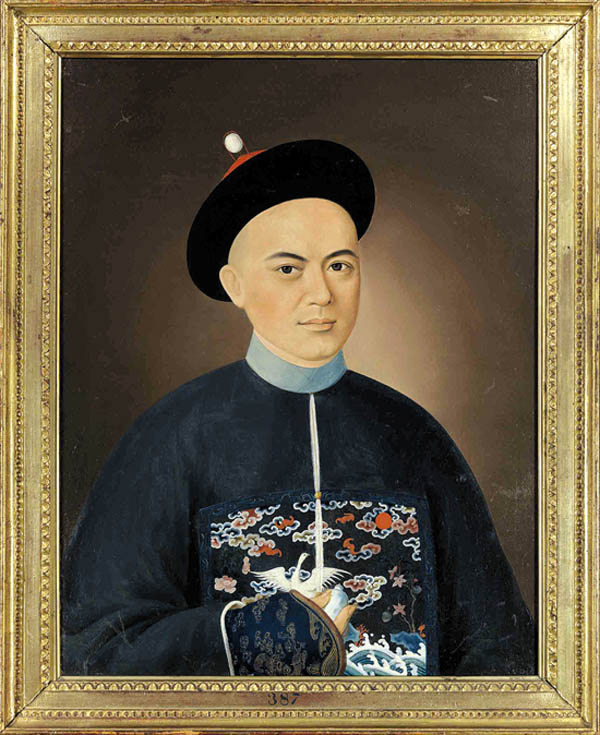
Spoilum, Portrait of Eshing, ca. 1805, Guangzhou (Canton).
Oil on canvas (Peabody Essex Museum)
A Spoilum portrait of a prominent Cantonese silk merchant is also included in the exhibition (1805). Spoilum (active 1785–1810) was one of the first Chinese artists to work in a Western style, and though he never traveled outside of China, his paintings often resemble early American portraiture. The artist is best known for his portraits of English and American merchants, so this portrait of Eshing (a Chinese merchant) is particularly rare. Eshing frequently did business with Salem merchants, and this portrait was acquired as a gift from one of these merchants to the East India Marine Society in 1809.
Demonstrating the wide travels of Salem’s wealthy merchants is a Brazilian headdress collected by Michael W. Shepherd on a trip up the Amazon River in 1847. The mid 19th-century headdress is made primarily of red and blue macaw feathers, an important expression of wealth for many indigenous people of South America. This type of headdress would have been worn by caciques (Native chiefs).
Jeff Daly, formerly senior design advisor to the director at the Metropolitan Museum of Art, will design the Winter Antiques Show’s loan exhibition and plans to create a modern kuntskammer to hold the many treasures from PEM, much like they were displayed in the original East India Marine Society exhibition hall.
The exhibition is sponsored by Chubb Personal Insurance for the 18th consecutive year.
About the Winter Antiques Show
The Winter Antiques Show celebrates its 60th year Diamond Jubilee as America’s most prestigious antiques show, featuring 73 renowned experts in American, English, European, and Asian fine and decorative arts in a fully vetted show. The show was established in 1955 by East Side House Settlement, a social services institution located in the South Bronx. All net proceeds from the show benefit East Side House Settlement. The Winter Antiques Show will run from January 24 to February 2, 2014, at the Park Avenue Armory, 67th Street and Park Avenue, New York City. The Winter Antiques Show hours are 12–8pm daily except Sundays and Thursday, 12–6 pm. Daily admission to the show is $25, which includes the show’s award-winning catalogue. To purchase tickets for the Opening Night Party on January 23, 2014, or Young Collectors Night on January 30, 2014, call (718) 292-7392 or visit the show’s website.
About East Side House Settlement
East Side House Settlement was founded in 1891 to help immigrants and lower income families on the East Side of Manhattan. In 1962, it moved to the South Bronx where it serves 8,000 residents annually within one of America’s poorest congressional districts, the Mott Haven section of the South Bronx. Among the initiatives that focus on educational attainment as the gateway out of poverty is the innovative and highly acclaimed Mott Haven Village Preparatory School.
Aronson Antiquairs Presents Puzzle Jugs at the Winter Antiques Show
Regular readers may recall my irrationally exuberant affection for puzzle jugs. -CH
As noted at Art Daily (4 January 2014)
Delft Puzzle Jugs from Aronson Antiquairs of Amsterdam
60th Winter Antiques Show, Park Avenue Armory, New York, 24 January — 2 February 2014

◊ ◊ ◊ ◊ ◊
At the 60th Annual Winter Antiques Show in New York, January 23 – February 2, 2014, Aronson Antiquairs of Amsterdam will showcase an amusing collection of Suijgkannen or Delft Puzzle Jugs. “Delft Puzzle Jugs from the 17th and 18th centuries are among the most prized examples of the amusing novelty, but Delft examples were seen as early as 1650. The style gained popularity throughout Europe. Puzzle Jugs were designed with hollow rims and handles and diverting spouts and tubes. They challenged and entertained guests at both homes and taverns. You never knew if a dinner party would be a success and whether your guests would like the food and wine and have a good time. But with a variety of Puzzle Jugs on hand you could get a good laugh out of those trying their dexterity and luck by making a game of it,” says Robert Aronson, fifth generation Dutch Delft dealer of Aronson Antiquairs of Amsterdam.
 Puzzle Jugs got their name from their ingenious design which could include a perforated neck, and hollow handle and rim. Sometimes as many as five or six concealed tubes or pipes were incorporated into the jug, making it even more difficult to imbibe the liquid, most often ale or wine. The trick was to drink the liquid without spilling the jug’s contents all over your shirt. It was common for tavern-keepers to offer these jugs in various drinking games, with guests wagering on who would master the puzzle. It helped to be highly dexterous and clever—itself a challenge during a night of merriment.
The oldest known, the Exeter Puzzle Jug, was produced in western France around 1300 and discovered in England in 1899. It was given to the Royal Albert Memorial Museum in Exeter, Devon. Many Puzzle Jugs had inscriptions on the body of the jug that ranged from simple to poetic, typically something along the lines of “Here gentlemen, come try your skill. I’ll hold a wager, if you will, that you don’t drink this liquid all without your spill or let some fall.”. . .
Highlights at the Aronson Antiquairs stand will include nine outstanding Delft Puzzle Jugs from a private collection including a Blue and White Delft Puzzle Jug from the Ten Tooren-Smith Collection, The Netherlands, which dates to 1760 and portrays an elegant couple on the body. The gallant gentleman is doffing his hat and approaching his sweetheart who holds a fan. The 22.8cm puzzle jug features a baluster-form body and panels of trellis diaperwork beneath the floral and foliate-pierced neck. The puzzle is in the tubular rim affixed with three nozzles which interrupts a flowering vine border continuing onto a hollow loop handle.
A second Blue and White Ring-Form Delft Jug dates to 1725–35 and features a circular body painted with a Chinese pheasant perched on a c-scroll forming the stem of a flowering leafy peony branch. It is pierced with three roundels, each centering a six petal flowerhead below three teardrop-shaped nozzles issuing from the tubular neck (24.4cm).
A third Delft Blue and White Puzzle Jug (23.4cm high) is from an earlier period, 1688–92, and was in Dr Gunther Grethe’s Hamburg Collection. Aronson says, “This jug has a GV mark in blue, probably is from Gijsbrecht Claesz, Verhaast. The spherical body is painted with a large insect and birds in flight above a chrysanthemum border. The cylindrical neck is pierced with three four-petal blossoms and eight dots against a foliate-patterned blue ground between floral borders, and affixed beneath the rim with a tubular device molded with seven blossoms, one of them pierced, and continuing into the flower and scroll-patterned hollow loop handle.”
Aronson says that the whimsical characteristics of Delft Puzzle Jugs appeal to collectors now because, “These are novelty pieces with amusing stories to tell that reveal how people lived centuries ago. Those who enjoy having a peek at what brought a smile to the face of our ancestors collect Delft Puzzle Jugs now. We are lucky to have acquired this collection of nine examples.” Prices range from $16,000 to $25,000.
New Book | Shapely Bodies: The Image of Porcelain
From the University of Delaware Press:
Christine A. Jones, Shapely Bodies: The Image of Porcelain in Eighteenth-Century France (Newark: University of Delaware Press, 2013), 216 pages, 978-1611494082, $85.
 Shapely Bodies: The Image of Porcelain in Eighteenth-Century France constructs the first cultural history of porcelain making in France. It takes its title from two types of ‘bodies’ treated in this study: the craft of porcelain making shaped clods of earth into a clay body to produce high-end commodities and the French elite shaped human bodies into social subjects with the help of makeup, stylish patterns, and accessories. These practices crossed paths in the work of artisans, whose luxury objects reflected and also influenced the curves of fashion in the eighteenth century.
French artisans began trials to reproduce fine Chinese porcelain in the 1660s. The challenge proved impossible until they found an essential ingredient, kaolin, in French soil in the 1760s. Shapely Bodies differs from other studies of French porcelain in that it does not begin in the 1760s at the Sèvres manufactory when it became technically possible to produce fine porcelain in France, but instead ends there. Without the secret of Chinese porcelain, artisans in France turned to radical forms of experimentation. Over the first half of the eighteenth century, they invented artificial alternatives to Chinese porcelain, decorated them with French style, and, with equal determination, shaped an identity for their new trade that distanced it from traditional guild-crafts and aligned it with scientific invention. The back story of porcelain making before kaolin provides a fascinating glimpse into the world of artisanal innovation and cultural mythmaking. To write artificial porcelain into a history of ‘real’ porcelain dominated by China, Japan, and Meissen in Saxony, French porcelainiers learned to describe their new commodity in language that tapped into national pride and the mythic power of French savoir faire. Artificial porcelain cut such a fashionable image that by the mid-eighteenth century, Louis XV appropriated it for the glory of the crown. When the monarchy ended, revolutionaries reclaimed French porcelain, the fruit of a century of artisanal labor, for the Republic. Tracking how the porcelain arts were depicted in documents and visual arts during one hundred years of experimentation, Shapely Bodies reveals the politics behind the making of French porcelain’s image.
Christine A. Jones is associate professor of French and Comparative Literary and Cultural Studies in the Department of Languages and Literature at the University of Utah.
Call for Papers | New Eyes on the Eighteenth Century Dinner Symposium
For graduate students and new PhDs in and around the Boston/New England region:
Fifth Annual New Eyes on the Eighteenth Century Dinner Symposium
Harvard University, Cambridge, MA, 10 February 2014
Proposals due by 17 January 2014
We are pleased to announce the fifth annual symposium featuring new work from emerging scholars (graduate students and new PhDs) living or studying in the region. This year we are again adopting a hybrid model, and we therefore invite abstracts for either of two formats:
• a 5-minute presentation of a specific problem, challenge, or conundrum in your research, followed by a dedicated time for problem-solving, discussion, and advice
• a 10-minute paper drawn from a larger piece of work: a seminar paper, your dissertation, or another current project, followed by a brief time for questions.
We aim to represent in a lively forum a broad spectrum of disciplines, national cultures, and intellectual approaches to eighteenth-century studies. Graduate students and new PhDs who wish to participate are asked to submit a one-page abstract electronically to Ruth Perry (rperry@mit.edu) and Sue Lanser (lanser@brandeis.edu) by Friday, January 17. Those selected will be notified within a week so that you will have time to prepare your brief presentation.
We ask all our colleagues to circulate this notice widely, to encourage graduate students to participate, and to make plans to join us on Monday, February 10. And please remember that ours is a long eighteenth century.
Monday, February 10, 2014, 6:00–8:30, Barker Center, Room 133
Sponsored by the Harvard Humanities Seminar on Eighteenth-Century Studies
New Book | Eighteenth-Century Thing Theory in a Global Context
Due out this month from Ashgate:
Ileana Baird and Christina Ionescu, eds., Eighteenth-Century Thing Theory in a Global Context: From Consumerism to Celebrity Culture (Aldershot: Ashgate, 2014), 386 pages, ISBN: 978-1472413307, $130.
 Exploring Enlightenment attitudes toward things and their relation to human subjects, this collection offers a geographically wide-ranging perspective on what the eighteenth century looked like beyond British or British-colonial borders. To highlight trends, fashions, and cultural imports of truly global significance, the contributors draw their case studies from Western Europe, Russia, Africa, Latin America, and Oceania. This survey underscores the multifarious ways in which new theoretical approaches, such as thing theory or material and visual culture studies, revise our understanding of the people and objects that inhabit the phenomenological spaces of the eighteenth century. Rather than focusing on a particular geographical area, or on the global as a juxtaposition of regions with a distinctive cultural footprint, this collection draws attention to the unforeseen relational maps drawn by things in their global peregrinations, celebrating the logic of serendipity that transforms the object into some-thing else when it is placed in a new locale.
Ileana Baird is a Postdoctoral Preceptorship Fellow at the University of Virginia, and Christina Ionescu is an Associate Professor of French Studies at Mount Allison
University in Canada.
C O N T E N T S
Introduction
• Peregrine things: rethinking the global in 18th-century studies, Ileana Baird
• Through the prism of thing theory: new approaches to the 18th-century world of objects, Christina Ionescu
I. Western European Fads: Porcelain, Fetishes, Museum Objects, Antiques
• Caution, contents may be hot: a cultural anatomy of the tasse trembleuse, Christine A. Jones
• Cultural currency: Chrysal, or The Adventures of a Guinea and the material shape of 18th-century celebrity, Kevin Bourque
• Feather cloaks and English collectors: Cook’s voyages and the objects of the museum, Sophie Thomas
• Imagining Ancient Egypt as the idealized self in 18th-century Europe, Kevin M. McGeough
II. Under Eastern Eyes: Garments, Portraits, Books
• Frills and perils of fashion: politics and culture of the 18th-century Russian court through the eyes of La Mode, Victoria Ivleva
• From Russia with love: souvenirs and political alliance in Martha Wilmot’s The Russian Journals, Pamela Buck
• ‘The battle of the books’ in Catherine the Great’s Russia: from a jousting tournament to a tavern brawl, Rimma Garn
III. Latin American Encounters: Coins, Food, Accessories, Maps
• From Peruvian gold to British Guinea: tropicopolitanism and myths of origin in Charles Johnstone’s Chrysal, Mauricio E. Martinez
• Eating turtle, eating the world: comestible things in the 18th century, Krystal McMillen
• The fur parasol: masculine dress, prosthetic skins, and the making of the English umbrella in Robinson Crusoe, Irene Fizer
• Terra Incognita on maps of 18th-century Spanish America: commodification, consumption and the transition from inaccessible to public space, Lauren Beck
IV. Imagining Other Spaces: Trinkets, Collectibles, Ethnographic Artifacts, Scientific Objects
• (Re-)appropriating trinkets: how to civilize Polynesia with a jack-in-the-box, Laure Marcellesi
• Images of exotic objects in the Abbé Prévost’s Histoire Générale des Voyages, Antoine Eche
• Souvenirs of the South Seas: objects of imperial critique in Jonathan Swift’s Gulliver’s Travels, Jessica Durgan
Select Bibliography and Index
New Book | Early Modern Things: Objects and their Histories
Collected here are papers that originated from the Early Modern Things Workshop (Stanford, 29–30 January 2010). From Routledge:
Paula Findlen, ed., Early Modern Things: Objects and their Histories, 1500–1800 (New York: Routledge, 2013), 392 pages, ISBN: 978-0415520508 (hardcover), $160 / ISBN: 978-0415520515 (paperback), $45.
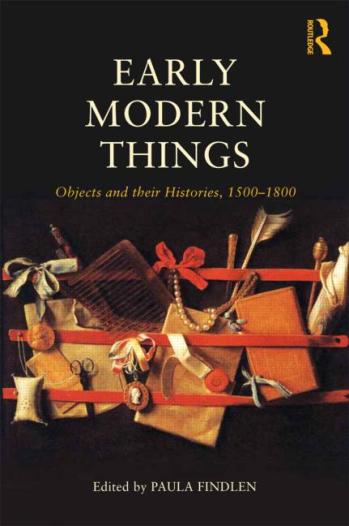 What can we learn about the past by studying things? How does the meaning of things, and our relationship to them, change over time? This fascinating collection taps a rich vein of recent scholarship to explore a variety of approaches to the material culture of the early modern world (c.1500–1800).
Divided into six parts, this book explores the ambiguity of things, representing things, making things, empires of things, consuming things, and lastly the power of things. Spanning across the early modern world, from Ming dynasty China to Georgian England, and from Ottoman Egypt to Spanish America, the authors provide a generous set of examples in how to study the circulation, use, consumption and, most fundamentally, the nature of things themselves.
Drawing on a broad range of disciplinary perspectives and lavishly illustrated, Early Modern Things supplies fresh and provocative insights into how objects—ordinary and extraordinary, secular and sacred, natural and man-made—came to define some of the key developments of the early modern world.
C O N T E N T S
Paula Findlen, Introduction: Early Modern Things: Setting Objects in Motion, 1500–1800
Part One: The Ambiguity of Things
1. Carla Nappi, Surface Tension: Objectifying Ginseng in Chinese Early Modernity
2. Marcy Norton, Going to the Birds: Animals as Things and Beings in Early Modernity
3. Jessica Riskin, The Restless Clock
Part Two: Representing Things
4. Julie Hochstrasser, ‘Stil-staende dingen’: Picturing Objects in the Dutch Golden Age
5. Giorgio Riello, ‘Things Seen and Unseen’: The Material Culture of Early Modern Inventories and Their Representation of Domestic Interiors
6. Chandra Mukerji, Costume and Character in the Ottoman Empire: Dress as Social Agent in Nicolay’s Navigations
Part Three: Making Things
7. Pamela H. Smith, Making Things: Techniques and Books in Early Modern Europe
8. Corey Tazzara, Capricious Demands: Artisanal Goods, Business Strategies, and Consumer Behavior in Seventeenth-Century Florence
Part Four: Empires of Things
9. Erika Monahan, Locating Rhubarb: Early Modern Russia’s Relevant Obscurity
10. Mark A. Peterson, The World in a Shilling: Silver Coins and the Challenge of Political Economy in the Early Modern Atlantic World
11. Alan Mikhail, Anatolian Timber and Egyptian Grain: Things That Made the Ottoman Empire
Part Five: Consuming Things
12. Morgan Pitelka, The Tokugawa Storehouse: Ieyasu’s Encounters with Things
13. Anne E.C. McCants, Porcelain for the Poor: The Material Culture of Tea and Coffee Consumption in Eighteenth-Century Amsterdam
14. Amanda Vickery, Fashioning Difference in Georgian England: Furniture for Him and for Her
Epilogue: The Power of Things
15. Renata Ago, Denaturalizing Things: A Comment
16. Timothy Brook, Something New: A Comment
17. Erin K. Lichtenstein, Identities through Things: A Comment
Historic Heston / Jas. Townsend & Son
This discussion with Heston Blumenthal, Ivan Day, and Bee Wilson is one of the events I would have most liked to have attended in 2013 (I’m a huge Bee Wilson fan). Alas, Blumenthal’s tome is available for purchase. Paula Forbes provides a thorough review at Eater (16 October 2013), with this brilliant summary: “if Willy Wonka ran Hogwarts, Historic Heston would be the history textbook.” -CH
As noted by Barley Blyton at the British Library’s Social Science Blog, “Historic Heston at the British Library” (29 November 2013) . . .
[On November 8] as part of the Georgians Revealed exhibition, the British Library hosted a discussion between Heston Blumenthal—one of Britain’s most acclaimed chefs and exponent of the egg and bacon ice-cream—and Ivan Day—food historian, broadcaster, writer and confectioner. Centring on Heston’s new book and using the Georgian period as the frame for their discussion, Blumenthal and Day wound their way through history and their own pasts, expertly guided by food writer and historian Bee Wilson as Chair. . .
◊ ◊ ◊ ◊ ◊
Heston Blumenthal, Historic Heston (London: Bloomsbury, 2013), 432 pages, ISBN: 978-1620402344, £125 / $200 (currently discounted to $125 on Amazon).
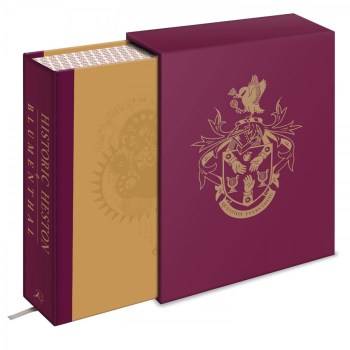 British gastronomy has a grand old tradition that has been lost over time. Now England’s most inventive chef is out to reclaim it. Heston Blumenthal, whose name is synonymous with cutting-edge cuisine, nonetheless finds his greatest source of inspiration in the unique and delicious food that the sceptered isle once produced. This has been the secret to his success at world-famous restaurants The Fat Duck and Dinner, where a contrast between old and new, modern and historic, is key.
Historic Heston charts a quest for identity through the best of British cooking that stretches from medieval to late-Victorian recipes. Start with thirty historic dishes, take them apart, put them together again, and what have you got? A sublime twenty-first-century take on delicacies including meat fruit (1500), quaking pudding (1660), and mock-turtle soup (1892). Heston examines the history behind each one’s invention and the science that makes it work. He puts these dishes in their social context and follows obscure culinary trails, ferreting out such curious sources as The Queen-like Closet from 1672 (which offers an excellent method for drying goose). What it adds up to is an idiosyncratic culinary history of Britain.
This glorious tome also gives a unique insight into the way that Heston works, with signature dishes from both The Fat Duck and Dinner. Illustrated by Dave McKean and with some of the most superb food photography you’ll ever see, Historic Heston is a book to treasure. You think you know about British cooking? Think again.
◊ ◊ ◊ ◊ ◊
If any of this gets you in the mood for exploring eighteenth-century food, you might also be interested in the blog Savoring the Past along with the accompanying video series 18th-Century Cooking with Jas. Townsend & Son. Both are connected to the Indiana-based, online retailer Jas. Townsend & Son. With food goods comprising only a portion of the company’s business, the store, has “helped historical reenactors, movie makers, theatrical companies, pirates, and regular people find items including clothing, tents, books, knives, tomahawks, oak barrels, and lots of other goods appropriate for 1750 to 1840,” for over 35 years. Perhaps just the thing as you get ready for ASECS in Williamsburg . . .
Here Jonathan Townsend makes mushroom ketchup:
Exhibition | Fragonard: Poetry and Passion
From the Staatliche Kunsthalle Karlsruhe:
Fragonard: Poetry and Passion / Poesie und Leidenschaft
Staatliche Kunsthalle Karlsruhe, 30 November 2013 — 23 February 2014
You could say that the drawings are the diary of his imagination.
–Edmond and Jules de Goncourt, 1865
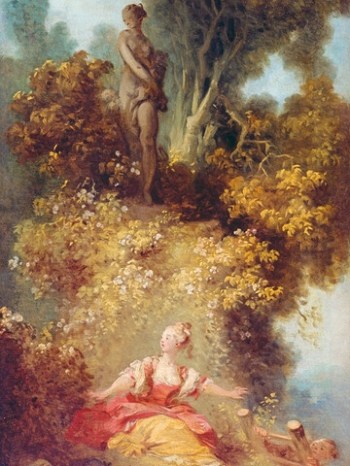
Jean-Honoré Fragonard, La Surprise, ca. 1771
(Musée des Beaux-Arts, Angers)
The work of Jean-Honoré Fragonard (1732–1806) is the embodiment of elegance and expressiveness. The French artist was one of the outstanding masters of the 18th century; and yet his name is relatively unfamiliar to many in Germany today. Born in Grasse, Fragonard spent most of his life in Paris, where he was a pupil of François Boucher. Despite initial successes in the Paris Salon exhibition, he embarked on a path outside the Academy and found his main audience among wealthy private collectors.
First monographic exhibition in Germany of Fragonard’s work
The Karlsruhe exhibition principally features a selection of Fragonard’s drawings, enriched by several oil studies and paintings. With some 80 works in all, the display gives an insight into the dazzling versatility of an oeuvre that includes scenes of cheerful social gatherings, landscapes, narrative scenes, and intimate depictions of great sensuality. The exhibition captures and reflects the artist’s delight in experimentation, his vitality of imagination, and boldness in formal composition. In the same breath, Fragonard demonstrates both how firmly rooted he was in the artistic tradition of the 17th century and his skill in being able to vary and reinterpret the repertoire of forms and subjects of that tradition. Through his handling of chalk and brush, he created compositions of sparkling imagination and great passion.
The exhibition has been made possible thanks to the generous support of international lenders, including the Louvre in Paris, the Albertina in Vienna, the British Museum in London, and the Fundação Calouste Gulbenkian in Lisbon, as well as several private collectors.
◊ ◊ ◊ ◊ ◊
From Artbooks.com:
Juliane Betz, ed., Fragonard: Poesie und Leidenschaft (Munich, Deutscher Kunstverlag, 2013), 272 pages, ISBN: 978-3422072145, $68.50.
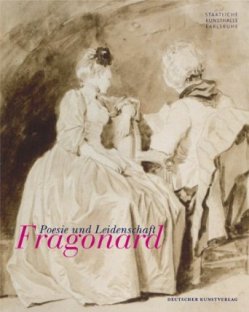 The current exhibition at Staatliche Kunsthalle Karlsruhe focuses on drawings by Jean-Honoré Fragonard, one of the finest French artists of the 18th century. They are juxtaposed against selected paintings that reveal links between his graphic and painterly works. Fragonard developed a unique pictorial idiom, which made use of both painterly and graphic elements and elevated unworked sections of bare paper into a core compositional element.
Year-End Book Ideas
Having taken off a week, I return just barely in time to offer a few year-end suggestions, books that may not focus on the eighteenth century—but books many of you will find interesting and perhaps just the thing for any bookstore gift cards you may have received over the holidays.
Thanks for your continued support and happy new year. All the best for 2014! -CH
P.S. Now is the perfect time to join HECAA or renew your membership; rates go up next week.
◊ ◊ ◊ ◊ ◊
From the University of Chicago Press:
James W. P. Campbell with photographs by Will Pryce, The Library: A World History (Chicago: University of Chicago Press, 2013), 320 pages, ISBN: 978-0226092812, $75.
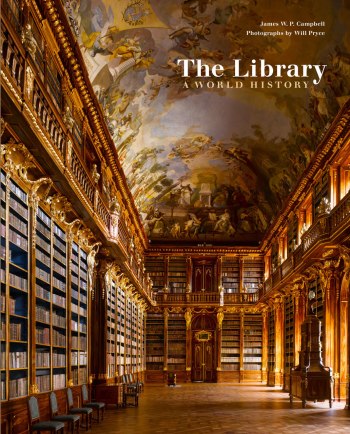 A library is not just a collection of books, but also the buildings that house them. As varied and inventive as the volumes they hold, such buildings can be much more than the dusty, dark wooden shelves found in mystery stories or the catacombs of stacks in the basements of academia. From the great dome of the Library of Congress, to the white façade of the Seinäjoki Library in Finland, to the ancient ruins of the library of Pergamum in modern Turkey, the architecture of a library is a symbol of its time as well as of its builders’ wealth, culture, and learning.
Architectural historian James Campbell and photographer Will Pryce traveled the globe together, visiting and documenting over eighty libraries that exemplify the many different approaches to thinking about and designing libraries. The result of their travels, The Library: A World History is one of the first books to tell the story of library architecture around the world and through time in a single volume, from ancient Mesopotamia to modern China and from the beginnings of writing to the present day. As these beautiful and striking photos reveal, each age and culture has reinvented the library, molding it to reflect their priorities and preoccupations—and in turn mirroring the history of civilization itself. Campbell’s authoritative yet readable text recounts the history of these libraries, while Pryce’s stunning photographs vividly capture each building’s structure and atmosphere. Together, Campbell and Pryce have produced a landmark book—the definitive photographic history of the library and one that will be essential for the home libraries of book lovers and architecture devotees alike.
James W. P. Campbell is Fellow in Architecture and History of Art, Queens’ College, Cambridge.
His most recent books include Building St Paul’s and Brick: A World History, also with Will Pryce.
Will Pryce is an award-winning photographer of international acclaim. His previous titles include Architecture in Wood: A World History, Brick: A World History and World Architecture: The Masterworks.
◊ ◊ ◊ ◊ ◊
From the Vendome Press:
Oscar Tusquets Blanca, Martine Diot, Adelaïde de Savray, Jérôme Coignard, and Jean Dethier, Staircases: The Architecture of Ascent (New York: Vendome Press, 2013), 240 pages, ISBN: 978-0865653092, $75.
 The essential purpose of a staircase is utilitarian: to facilitate ascent and descent. Yet the design of even the simplest stair is complex, requiring great knowledge, skill, and ingenuity. This volume showcases the astonishing diversity of staircases over the centuries, from the stepped pyramids of the Maya to the exquisitely proportioned stairs of the Renaissance, to the elaborate balustraded confections of the Baroque period, to the virtuosic, computer-aided designs of today. Among the scores of featured staircases are Michelangelo’s double stair at the Palazzo dei Senatori on the Capitoline Hill in Rome; the double-spiral stair at Château de Chambord in France’s Loire Valley; the entrance stair in the Winter Palace (now the Hermitage) in St. Petersburg; the radical spiral ramp of Frank Lloyd Wright’s Guggenheim Museum; and the exterior stair at the Pompidou Center in Paris. Architectural tours de force all, often charged with religious, mystical, and hierarchical meaning, these staircases are inherently dynamic, as is every page of this fascinating and beautifully illustrated book.
◊ ◊ ◊ ◊ ◊
From English Heritage:
Philip Davies with photographs by Derek Kendall, London: Hidden Interiors (London: Atlantic, 2012), 448 pages, ISBN: 978-0956864246, £40.
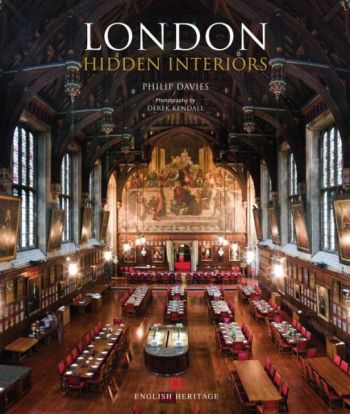 Following his successes with revealing London’s vanished architectural heritage in Lost London and Panoramas of Lost London, Philip Davies now turns his attention to 180 of London’s best conserved and least known interiors, revealed in over 1200 spectacular photographs—most taken specially for this book and not previously published. . . . The most exciting new book about London in generations. . . presents an expert introductory essay followed by the most extraordinary collection of contemporary photographs of London’s historic interiors ever published.
The increasing popularity of Open City has stimulated the curiosity of local Londoners and visitors from afar, awakening renewed interest and comprehension of London’s success in preserving amazing interiors, from private salons to traditional public houses, from ornate churches to industrial plants. London: Hidden Interiors has one hundred and eighty examples which have been selected from a complete range of building types to convey the richness and diversity of London’s architectural heritage and the secrets that lie within. It concentrates generally on the buildings and interiors that are lesser known and to which the public are not normally allowed the hidden and the unusual, the quirky and the eccentric, although there is space too for some of the better known. The careful composition, superb lighting and exposure of the images featured in this book are themselves a lesson in conservation, capturing the sense of these unique spaces whilst at the same time revealing the important architectural detail; Derek Kendall’s photographs, perfectly reproduced, make this book a visual delight and a major contribution to the architectural history of London.
To learn more, please visit the London Hidden Interiors website.
◊ ◊ ◊ ◊ ◊
From Thames & Hudson:
James Peill with photographs by James Fennell and a foreword by Julian Fellowes, The English Country House (London: Thames & Hudson, 2013), 224 pages, ISBN 978-0500517079, £28 / $55.
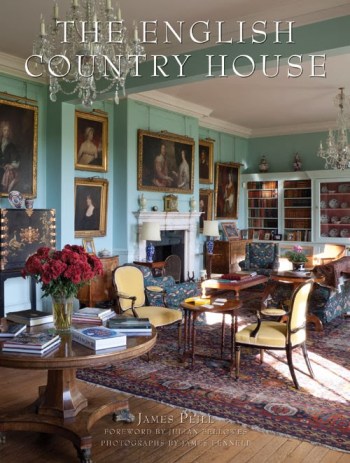 The houses range from Kentchurch Court, a fortified medieval manor house that has been the seat of the Scudamore family for nearly 1,000 years, to a delightful Strawberry Hill-style Gothic house in rural Cornwall, the ducal palace of Badminton in Gloucestershire, and Goodwood House, England’s greatest sporting estate. Many of the houses remain closed to the public—and some have never been featured in a book before.
James Peill recounts the ups and downs of such deeprooted dynasties as the Cracrofts, whose late 18th-century Hackthorn Hall is a perfect example of the kind of house Jane Austen describes in her novels (indeed, she appears on their family tree), as well as the Biddulphs, who constructed the Arts and Crafts masterpiece Rodmarton in the first decades of the last century. James Fennell provides superb photographs of a wealth of gardens, charming interiors, bygone sporting trophies, fine art collections and evocative family memorabilia. A stirring source of inspiration for all those concerned with living traditions and classic interiors, here
is a proud celebration of England’s country house heritage.
James Peill is the curator of Goodwood House in West Sussex. Formerly a director of Christie’s, where he was a specialist in the Furniture Department, he is the co-author (with the late Desmond FitzGerald, Knight of Glin) of The Irish Country House and Irish Furniture.
James Fennell specializes in interior, architectural, portrait, fashion and travel photography. His work has been published in Condé Nast Traveller, World of Interiors, Elle Décor and Architectural Digest. His books include The Irish Country House, The Scottish Country House and The Irish Pub, all of which are published by Thames & Hudson.
Julian Fellowes is the creator of the hugely successful period drama Downton Abbey.
Exhibition | Houghton Hall: Portrait of an English Country House
As Courtney Barnes noted back in November at Style Court, America’s fascination with England’s country houses will continue into the new year (and 2015). While Houghton Revisited, which brought dozens of paintings back to the house from Russia for display this summer and fall, was awarded Apollo Magazine’s 2013 Exhibition of the Year, pictures and objects still in the Houghton Hall collection will travel to Houston, San Francisco, and Nashville. From the MFAH press release (22 November 2013). . .
Houghton Hall: Portrait of an English Country House
Museum of Fine Arts, Houston, 22 June — 22 September 2013
Legion of Honor, San Francisco, 18 October 2014 — 18 January 2015
Frist Center for the Visual Arts, Nashville, 13 February — 10 May 2015
Curated by Gary Tinterow and Christine Gervais with David Cholmondeley

William Hogarth, The Cholmondeley Family, 1732
(Marquess of Cholmondeley, Houghton Hall)
◊ ◊ ◊ ◊ ◊
Family portraits by Hogarth and Sargent, exquisite examples of Sèvres porcelain, and unique pieces of William Kent furniture from this aristocratic English family chronicle three centuries of art, history, and politics.
Museum of Fine Arts, Houston, Director Gary Tinterow today announced an unprecedented exhibition: Houghton Hall: Portrait of an English Country House, which will be on view at the Museum from June 22 to September 22, 2014. The exhibition marks the first time the renowned collection of the Marquesses of Cholmondeley, housed at Houghton Hall, the family estate in Norfolk, will travel outside of England.

Houghton Hall (Photo: Nick McCann)
The house and much of its collection were built in the early 1700s by Sir Robert Walpole—England’s first prime minister and the ancestor of the current marquess. Renowned as one of the finest Palladian houses and one of the most extensive art collections in Britain, Houghton became notorious when Sir Robert’s collection of Old Master paintings was sold by his grandson to Catherine the Great, in 1779. But the house and all of its furnishings, considered to comprise William Kent’s Georgian masterpiece, remained intact; Walpole’s descendants added considerably to the collection of paintings. From great family portraits by William Hogarth, Joshua Reynolds, and John Singer Sargent, to exquisite examples of Sèvres porcelain, rare pieces of R. J. & S. Garrard silver, and unique furniture by William Kent, the exhibition vividly evokes the fascinating story of art, history, and politics through the collections of this aristocratic English family over three centuries.
Organized by Tinterow; Christine Gervais, associate curator; and Lord Cholmondeley, the exhibition will tour nationally after the Houston presentation, beginning with the Legion of Honor of the Fine Arts Museums of San Francisco (October 18, 2014–January 18, 2015) and the Frist Center for the Visual Arts in Nashville (February 13–May 10, 2015).
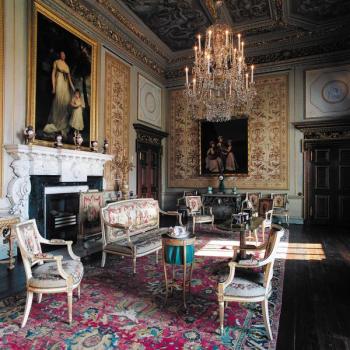
The White Drawing Room at Houghton Hall, with paintings by John Hoppner and George James (Photo: Nick McCann)
“Houghton Hall and its superb collections epitomize the historic legacy of art, architecture, and patronage among the great families and country houses of England,” commented Tinterow. “I am delighted to partner with David Cholmondeley to bring this extraordinary heritage to American audiences. Given our fascination with Downton Abbey and its similar story of a great English house and its family, I know this exhibition will be highly anticipated.”
“I was enormously gratified by the response to Houghton Revisited, the exhibition in which we reunited the paintings sold to Catherine the Great with their home at Houghton Hall,” commented David Cholmondeley on the success of that recent project. “I look forward to working with Gary Tinterow and his colleagues at the Museum of Fine Arts, Houston, to share Houghton Hall and our family’s history with visitors in Houston, San Francisco, and Nashville.”
About Portrait of an English Country House
Houghton Hall: Portrait of an English Country House will assemble more than 100 objects in settings that combine paintings, porcelain, sculpture, costume, metalwork, and furniture to evoke the stunning rooms at Houghton Hall. Bought or commissioned by eight generations of descendants of Sir Robert Walpole, together these objects comprise a fascinating chronicle. (more…)










 Enfilade
leave a comment