Conference | Georgian Pleasures
From the conference website:
Georgian Pleasures
Bath Royal Literary and Scientific Institute and The Holburne Museum, Bath, 12–13 September 2013
 Georgian Pleasures is an interdisciplinary two-day conference which takes the diversity of the experience of pleasure as its theme. Georgian pleasures were myriad. Some were exclusive — specific to certain classes, ages or genders — others were inclusive and/or overlapping. High life or low life, licit or illicit, private or public, domestic or commercial — there were pleasures to suit all tastes and circumstances. This conference will explore what it was that people of the period enjoyed and what we, as academics, re-enactors and period performers, can learn about society and culture from a better appreciation of pleasure, Georgian-style.
The conference will take place in Bath on 12–13 September 2013. On the 12th the conference will be held in the impressive Queen’s Square home of the Bath Royal Literary and Scientific Institute and on the 13th in the recently refurbished Holburne Museum, itself the centre-piece of Sydney Gardens, the last of Bath’s famous Georgian Pleasure Gardens. On Thursday evening, there will be a launch for Bath History Journal, volume 13, and the conference will end on Friday evening with a gala musical concert in the grounds of the Holburne Museum. We welcome academics of all disciplines and interested non-specialists. All are welcome!
Keynote speakers:
John Strachan, Bath Spa University
Cynthia Hammond, Concordia, Montreal
Adrian Teal, author of The Gin Lane Gazette
◊ ◊ ◊ ◊ ◊
T H U R S D A Y , 1 2 S E P T E M B E R 2 0 1 3
9:15 Registration and coffee
9:30 Plenary 1
• John Strachan (Bath Spa University), ‘The Pleasures of the Chase’: The Literature of Late Georgian Fox-Hunting
10:30 Pleasure and Moral Order
• Paul Holden (NT Lanhydrock), ‘The weakest woman sometimes may, the wisest man deceive’: Mary Toft and the Pleasures of Humiliation
• Steve Poole (University of the West of England), Pleasure … and Shame: Reputation and Respectability in Sydney Gardens, Bath, 1820–30
11:50 Theatricality
• Anna Meadmore (Royal Ballet School), John Weaver: The ‘Father of English Pantomine’
• Bill Tuck, From Carnival to Pleasure Garden: The Venetian Connection
12:50 Lunch
14:00 Music
• Nicola Pink (University of Southampton), The Experience of Domestic Vocal Music for Young Gentry Women, 1790–1830
• Andrew Clarke (Bristol University), Loder and Sons, Bath: A Band of Musicians
• Madeline Goold, A Portrait of Mrs Luther, ‘…a Lady of taste and of great discernment.’ Harpsichords, Pianoforte, and Subscription Concert Society in Georgian London
15:20 Tea
15:45 Satire and Conviviality
• Jessica Monaghan (Exeter University), Simulation and Satire: Feigned illness and the Georgian Health Resort in the Works of Christopher Anstey and His Imitators
• Heather Carroll (University of Edinburgh), Pleasure in Excess: Corporeality and Hedonism in the Satirical Prints of Albinia, Countess of Buckinghamshire
• Jeremy Barlow, The Sublime Society of Beefsteaks: Contexts, Traditions, and Early Membership
17:05 Spectacle
• Matthew Spring (Bath Spa University), Bath’s Grand Gala Concerts: A Combination of Pleasure ‘after the Manner of Vauxhall’
• Mike Rendell (London Historians), Roll up, roll up, the Greatest Show on Earth
• Vicky Vanruysseveldt (Vrije Universiteit), Travelling Entertainers and the Use of Public Space in Brabantine Cities
19:00 Wine and nibbles sponsored by Bath History / Launch of Bath History, volume 13
F R I D A Y , 1 3 S E P T E M B E R 2 0 1 3
9:15 Plenary 2
• Cynthia Hammond (Concordia University), ‘The Gardens will be Illuminated’: Gendered and Georgian Pleasures in the Sydney Gardens, Bath
10:15 Fashionable Consumption
• Elenor Ling (Fitzwilliam Museum), The Allure of Luxury Shops: The Blathwayt Family in London
• Mike Baldwin (London Metropolitan University), Consuming the Harp in Late Georgian England: Products, Services and Customers of the Erat Manufactory, 1821–24
11:15 Coffee — Charles Wiffen will be playing the Schantz fortpiano (1795)
11:30 Healthy Living
• Sarah Spooner (University of East Anglia), ‘Fields of Corn make a Pleasant Prospect’: Gardening and Agriculture in Georgian England
• Linda Watts (Cleveland Pools Trust), The Cleveland ‘Pleasure Baths’: Secluded Pleasures in a Spa City
• Robin Jarvis (University of the West of England), Hydromania: The Natural and Unnatural Pleasures of Swimming in Late Georgian England
13:00 Lunch
14:00 Dance
• Barbara Segal, Dance: A Most Popular Georgian Entertainment
14:30 Music in the Air
• Peter Holman, Politics in the Pit: Directing from the Keyboard [or Not] in the Georgian Theatre
• Andy Lamb (Oxford University), Stealing from the French: The Rise of Wind Harmony Music
• William Summers, Music, Naturalism, and Royal Power Struggles Surrounding Hampton Court Palace, 1716–21
15:30 Tea
15:50 Popular Culture
• Kevin Grieves (Bath Spa University), The Female Bruisers: Women Prizefighters of the Eighteenth Century
• Nick Nourse (Bristol University), Controlling Georgian Pleasures: Music and Entertainment, Legislation and the Law
• Nick Rogers (York University, Toronto), ‘Pleasures for the Poor?’ The Dilemma of Gin Drinking
17:30 Adrian Teal, The Gin Lane Gazette
During the conference Steven Parsons, Diana Russell and Kate James, PGR students at Bath Spa University, will be presenting a poster session.
19:00 Georgian Pleasures — An evening’s entertainment in the manner of a Georgian Garden Gala concert with a pleasure gardens band (The Vauxhall Players) in a specially constructed and lit ‘orchestra’, plus singers, a troupe of entertainers performing a comic intermezzo piece – The Death of Pulcinella, and strolling wind band performing in the gardens between items. The concert will take place outdoors in the Sydney Gardens (Holburne) or at Burdall’s Yard (7a Anglo Terrace, Bath, BA15NH), if the weather is inclement.
Conference | Interdisciplinary Seventeenth-Century French Studies
Thanks to by Kimberly Chrisman-Campbell for drawing my attention to this one. And yes, by definition, this takes us to the seventeenth century, but the gala reception just seems to require us to take note. -CH

◊ ◊ ◊ ◊ ◊
Society for Interdisciplinary Seventeenth-Century French Studies Conference
Los Angeles, 8–10 November 2013
Entertainment, show, and the arts are the lifeblood of Los Angeles — just as they were central to the court of Louis XIV of France. International scholars studying French literature, the arts, and history during this incredible monarchy form the membership of the Society for Interdisciplinary Seventeenth-Century French Studies (SE-17) that will hold its annual conference at two Los Angeles academic Institutions: UCLA’s William Andrews Clark Library and California State University, Long Beach, November 8–10, 2013.
Period literature, art, and music will be central to the academic program. 17th-century French theater as spectacle along with spectacular fashion will also be at the heart of the 2013 meeting’s events. This year, SE-17 plans to embrace the area’s artistic community and include a gala reception around the theme of “What Would Louis Do (in 2013)?”
Proceeds from the reception and meeting will be donated equally to support: (1) graduate students’ travel scholarships to attend upcoming SE-17 events; and (2) travel scholarships for students of the French for Hispanophones program at CSULB, a unique program specially conceived to accelerate the learning of French for Spanish speakers.
Recent TLS Reviews
The eighteenth century in The Times Literary Supplement (16 & 23 August 2013). . .
Paula Findlen, “Man of the Museum: Review of Michael Hunter, Alison Walker, and Arthur MacGregor, eds., From Books to Bezoars: Sir Hans Sloane and His Collections (British Library, 2012),” p. 27.
 The story of the founding of the British Museum has been told many times. Less often discussed is the man behind the museum. Who was Hans Sloane, and how did he become Britain’s greatest collector? The twenty essays in Alison Walker, Arthur MacGregor and Michael Hunter’s From Books to Bezoars, written by leading scholars and curators and accompanied by a modern transcription of Thomas Birch’s Memoirs relating to the life of Sir Hans Sloane, offer us a preliminary answer. They are the result of recent efforts to reconstruct Sloane’s collections from surviving materials in the main repositories established (or partly established) by his bequest: the British Museum, the British Library, and the Museum of Natural History. . .
The contributors to From Books to Bezoars repeatedly invite us to return to Sloane’s lists and catalogues as a guide through the original collection. They urge us to pull out the drawers of his cabinets, contemplating his collections of shoes, weapons, musical instruments, tobacco pipes and pouches, and many other things such as a Caribbean dugout canoe. . .
In the past two decades, museums and libraries have become ever more conscious of the importance of reconstructing their pasts. This volume cannot answer all our questions about why and how Hans Sloane built his collection, or how an eighteenth-century public embraced and satirized it, but it paints a vivid picture of the man. It also lays the groundwork for a new history of the origins of the British Museum, and prompts us to consider how that history might inform the presentation of its artefacts.
The full review is available here (subscription required)
◊ ◊ ◊ ◊ ◊
Jennifer Potter, “Before Arcadia: Review of Gordon Campbell, The Hermit in the Garden: From Imperial Rome to Ornamental Gnome (Oxford University Press, 2013),” p. 31.
 Ornamental hermits, like garden gnomes, are great dividers of taste. Dorothy and William Wordsworth sneered at the “distressingly puerile” theatrics of an Ossian-inspired hermitage in the rugged landscapes of Perthshire. Horace Walpole, despite his architectural predilection for Strawberry Hill Gothic, poked fun at the notion of setting aside a quarter of one’s garden in which to be melancholy. Even Gordon Campbell, in The Hermit in the Garden, describes his subject as “Pythonesque.” Yet the story of how Georgian Britain peopled its gardens with real, imaginary and occasionally stuffed hermits of a secular rather than religious nature is one he rightly wills us to take seriously.
As defined by Campbell, the British craze for keeping a pet hermit in your garden began at Richmond with William Kent’s ornamental hermitages for Queen Caroline, consort to George II (first a ruined hermitage, begun in 1730, and then a druidic Merlin’s cave). It ended a century later with the death of George IV, although a venal, fortune-telling hermit lingered on in London’s pleasure gardens at Vauxhall. Casting his eye beyond Britain’s shores, Campbell looks first for origins and antecedents, principally religious garden hermits in Renaissance Italy, northern France, Spain and Bohemia; and garden retreats of Europe’s rulers, starting with Emperor Hadrian’s island pavilion at his magnificent villa complex near Rome, the Villa Adriana, where so much of garden history began. While the Reformation swept away England’s religious hermits for three centuries or more, secular hermits emerged with the transitional figure of Thomas Bushell, a mining engineer and one-time secretary to Francis Bacon. . .
The full review is available here (subscription required)
Conference | Collections in Flux: Dynamic Spaces and Temporalities
From the University of California’s research group for The Material Cultures of Knowledge, 1500–1830:
Collections in Flux: The Dynamic Spaces and Temporalities of Collecting
UCLA Clark Library, Los Angeles, 9–10 May 2014
Organized by Adriana Craciun and Mary Terrall
This interdisciplinary conference explores how collections shift their meanings and uses with motion through time and space, as well as how layers of meanings can inhabit a single collection in a specific time and place. We hope to bring new light to bear on how spaces of display and representation mapped onto geographical and political spaces, and how concerns about permanence and stability shaded rapidly into dissolution and reorganization and, sometimes, re-use. As Collections in Flux will demonstrate, the activity of collecting becomes more than the expression of curiosity, the desire for order, or the policing of boundaries. Collections in flux, considered dynamically and globally, through the agency of Europeans and indigenous people, can become a forum for rethinking the relation of centers to peripheries, of alien and native, of exotic and mundane.
Keynote Speakers
Miles Ogborn, Professor and Head of School of Geography, Queen Mary, University of London
Nicholas Thomas, Professor of Anthropology and Director, Cambridge Museum of Archaeology and Anthropology, Cambridge University
Conference Participants
Malcolm Baker, UC Riverside
Adriana Craciun, UC Riverside
Lucia Dacome, University of Toronto
Alessa Johns, UC Davis
Stacy Kamehiro, UC Santa Cruz
Mi Gyung Kim, North Carolina State University
Stacey Sloboda, Southern Illinois University
Mary Terrall, UCLA
Conference details and registration information will be available on the webpages of the UCLA Center for 17th and 18th Century Studies and the Clark Library. This conference is organized in collaboration with the University of California Multi-campus Research Group on “The Material Cultures of Knowledge, 1500–1830.”
Exhibition | Leipzig 1813, The Battle of the Nations
Leipzig marks the 200th anniversary of the Battle of the Nations (19 October 1813) with a 1:1 scale panorama by Yadegar Asisi, depicting the city in the aftermath of the battle — Europe’s largest prior to World War I, with 90,000 dead and injured. From a press release:
Leipzig 1813, The Battle of the Nations: A Panorama by Yadegar Asisi
Leipzig Panometer, 3 August — December 2013

◊ ◊ ◊ ◊ ◊
Having opened on August 3, Yadegar Asisi’s monumental 360° panorama Leipzig 1813: Amidst the Confusion of the Battle of the Nations is now on display at the Panometer Leipzig. The world’s largest panorama, 3500 m² in size and on a scale of 1:1, shows us the city of Leipzig immediately following the Battle of the Nations, which took place on October 19, 1813. The visitor views the scene from the vantage point of the roof of the church of St. Thomas at the western border of the city, with an excellent view both of the city centre and of the surrounding areas, where the most violent battles took place.
It came as something of a surprise to Yadegar Asisi that he was to spend so much time – since 2009 – working so intensively on this theme. “Having grown up in Leipzig, the Battle of the Nations was present in the form of the monument but not in as far as the actual events were concerned“, says the artist. “For a long time it didn’t really mean anything to me, until I asked myself the question of what Leipzig was like in 1813 and what the battle meant to the city. I came to the conclusion that I would present this European event from the perspective of Leipzig and its citizens. Under no circumstances did I wish to create a battle panorama. In fact, it has turned out to be more of an anti-war panorama.”
Asisi presents Leipzig as it would have looked in 1813, complete with its architecture still relatively intact. The city is struggling to come to terms with the repercussions of the battle: 90,000 dead and injured, countless numbers of refugees from the burned-out villages in the surrounding areas. The crowds in the alleyways and squares are in turmoil as the victorious troops move in and the French take flight, leaving behind them hundreds of thousands of people in a state of despair.
The successful ten-year collaboration between Asisi and the composer Erik Babak, well known for his work in international film and television productions, again bears fruit in Leipzig 1813; the accompanying music features a chorus of 40 voices and passages from the poem “Abroad” by Heinrich Heine. The panoramic experience is rounded off with sound effects reflecting the era and the confusion of the scene.
The complex figuration in the architectural design was the greatest challenge facing Asisi during his work on Leipzig 1813. Troops numbering around 600,000 soldiers, with over 90,000 dead and injured, all had to find their places in and around Leipzig, which had only 35,000 inhabitants at the time. For this purpose alone, it was necessary to stage four lavish photo shootings with several hundred extras in costume, saddle horses, teams of horses and traps. Scenes featuring soldiers, citizens of Leipzig, marketeers, refugees, the wounded and the dead, were re-enacted and coordinated as though a film were being made. To this end, Asisi’s expert advisor Helmut Börner smoothed the way for a cooperation with the “Verband Jahrfeier Völkerschlacht b. Leipzig 1813 e.V.”.
An encounter with the novelist Sabine Ebert led to a piece of special media interaction. Details from the panorama Leipzig 1813 can be discovered in Sabine Ebert’s most recent work 1813 – Kriegsfeuer (1813 – Warfire), just as scenes from the book can be found in Yadegar Asisi’s panorama. For example, the author is depicted in the panorama wearing the same clothes as one of her protagonists on the cover of the book.
The accompanying exhibition introduces the free city of Leipzig on the evening before the battle on an emotional and intuitive level. It leads visitors around the outside circumference of the panorama, presenting Leipzig as a town famous for its trade, learning, publishing and music, before the greatest battle there had ever been breaks out outside its gates. A “making-of” film will be shown in the auditorium, explaining how the complex circular picture was created and documenting the milestones of its production, which covered a period of almost five years.
An extensive mediation programme, including various guided tours, lectures and special events, is scheduled in connection with the panorama. This programme is designed to bring visitors into closer contact with life as it was at the time of the battle, 200 years ago.
Additional information is available here»
◊ ◊ ◊ ◊ ◊
For those of you interested in panoramas generally, see the website of the International Panorama Council. The organization’s conference takes place in November:
2013 International Panorama Conference
Switzerland, 22–24 November 2013
The conference days will include visits to Bourbaki Panorama Lucerne, Alpineum Museum with its Alpine Dioramas and to Glacier Garden Museum with its optical spectacles. On November 25 a post-conference program rounds up the panoramic experience in the beautiful city of Lucerne and includes a trip to Einsiedeln to visit the Crucifixion of Christ Panorama.
Thank the Getty for Open Content!
Press release (12 August 2013) from the Getty:

◊ ◊ ◊ ◊ ◊
The Getty announced that it is lifting restrictions on the use of images to which the Getty holds all the rights or are in the public domain. Getty President and CEO Jim Cuno made the announcement in a post on The Iris, the Getty’s blog.
“As of today, the Getty makes available, without charge, all available digital images to which the Getty holds all the rights or that are in the public domain to be used for any purpose,” wrote Cuno, citing the new program.
As a result, there are roughly 4,600 images from the J. Paul Getty Museum available in high resolution on the Getty’s website for use without restriction—representing 4,689 objects (some images show more than one object), including paintings, drawings, manuscripts, photographs, antiquities and sculpture and decorative arts. The Getty plans to add other images, until eventually all applicable Getty-owned or public domain images are available, without restrictions, online.
The Getty Research Institute is currently determining which images from its special collections can be made available under this program, and the Getty Conservation Institute is working to make available images from its projects worldwide.
“The Museum is delighted to make these images available as the first step in a Getty-wide move toward open content,” said J. Paul Getty Museum Director Timothy Potts. “The Getty’s collections are greatly in demand for publications, research and a variety of personal uses, and I am pleased that with this initiative they will be readily available on a global basis to anyone with Internet access.”
Previously, the Getty Museum made images available upon request, for a fee, and granted specific use permissions with terms and conditions. Now, while the Getty requests information about the intended use, it will not restrict use of available images, and no fees apply for any use of images made available for direct download on the website.
“The Getty was founded to promote ‘the diffusion of artistic and general knowledge’ of the visual arts, and this new program arises directly from that mission,” said Cuno. “In a world where, increasingly, the trend is toward freer access to more and more information and resources, it only makes sense to reduce barriers to the public to fully experience our collections. This is part of an ongoing effort to make the work of the Getty freely and universally available.”
HBA Publication Grant
Historians of British Art Publication Grant
Proposals due by 15 January 2014
The Historians of British Art (HBA) invites applications for its Publication Grant. The organization grants a sum of $600 to offset publication costs for a book manuscript in the field of British art or visual culture that has been accepted by a publisher. Applicants must be current members of HBA. To apply, send a 500-word project description, publication information (name of press and projected publication date), budget, and CV to Renate Dohmen, Prize Committee Chair, HBA, brd4231@louisiana.edu. The deadline is January 15, 2014.
HBA Travel Award for Graduate Students
Historians of British Travel Award
Proposals due by 15 September 2013
The award is designated for a graduate student who will be presenting a paper on British art or visual culture at an academic conference in 2014. The award of $750 is intended to offset travel costs. Applicants must be current members of HBA. To apply, send a letter of request, a copy of the letter of acceptance from the organizer of the conference session, an abstract of the paper to be presented, a budget of estimated expenses (noting what items may be covered by other resources), and a CV to Renate Dohmen, Prize Committee Chair, HBA, brd4231@louisiana.edu. The deadline is September 15, 2013.
Stockholm’s Nationalmuseum Acquires Plate Warmer by Rudolf Wittkopf
From the Nationalmuseum’s press release (as noted at the French Silver Blog , 14 August 2013) . . .
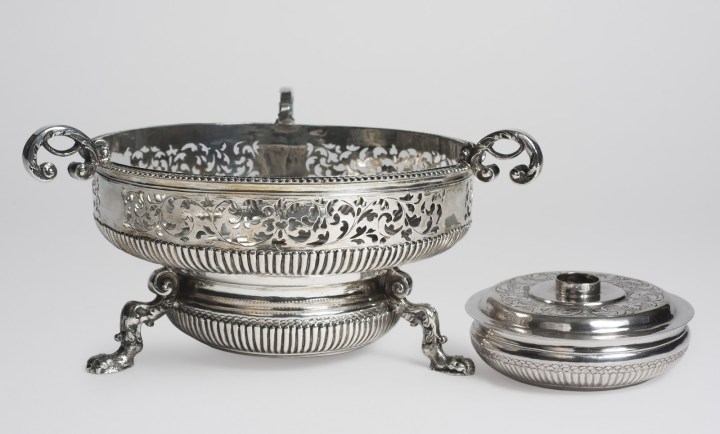
Plate Warmer by Rudolf Wittkopf, 1709. Diameter 20 cm, height 12 cm, weight 830 g. (Stockholm: Nationalmuseum, inventory number: NMK 102/2013) Photograph: Bodil Karlsson / Nationalmuseum)
◊ ◊ ◊ ◊ ◊
A plate warmer manufactured by Rudolf Wittkopf in Stockholm in 1709, believed to be a unique artifact, has been added to Nationalmuseum’s collection of early 18th-century Swedish silver. The piece, the only known surviving example in Sweden of a silver plate warmer, consists of a stand with three cast-metal feet and a removable burner with oil reservoir. The upper section is perforated to improve the airflow to the flame providing the heat, and at the top are three volute-shaped handles that hold the plate of food to be warmed.
The new, refined dining customs that appeared in Swedish upper-class circles in the early 18th century were modelled on French practices. Nationalmuseum’s extensive collection of hand drawings includes depictions from this period of two French réchaudes, or plate warmers, which were intended to serve as models for the modern silverware to be ordered by the Swedish court and aristocracy. The royal household accounts of Queen Hedvig Eleonora show that, in 1705, the fashion-conscious monarch purchased “a silver dish ring that can also be used as a heating dish” from Petter Henning, a Stockholm silversmith. However, little of the royal silverware from this period has survived, and there are no known examples in Sweden apart from the plate warmer now acquired by Nationalmuseum. This suggests that objects of this kind were a rarity even in their day and were probably manufactured only in very limited quantities.
The new acquisition is an important addition to Nationalmuseum’s collection of late baroque silver, illustrating how closely the Swedish court and aristocracy followed contemporary fashion, especially that of France.
Nationalmuseum’s acquisition of the Rudolf Wittkopf plate warmer has been made possible by a donation from the Barbro Osher Fund. Nationalmuseum has no budget of its own for new acquisitions, but relies on gifting and financial support from private funds and foundations to enhance its collections of fine art and craft.
Conference | Politeness and Prurience: Situating Transgressive Sexualities
From the conference website:
Politeness and Prurience: Situating Transgressive Sexualities in the Long Eighteenth Century
Edinburgh College of Art, University of Edinburgh, 2–3 September 2013
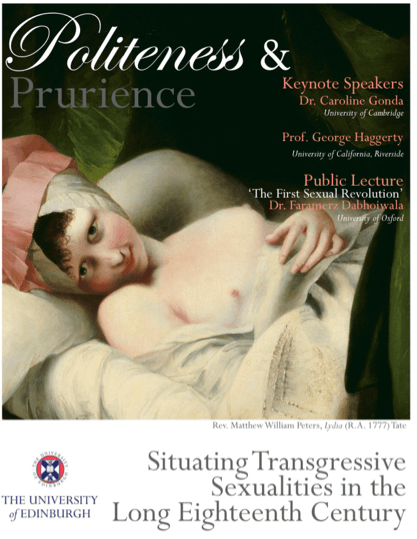 A major, two-day, international, and multidisciplinary conference hosted by the History of Art department (Edinburgh College of Art, University of Edinburgh) which focuses on the cultural history of sexuality, particularly as embedded in polite culture in Britain in the long eighteenth century.
Featuring major scholars in the history of sexuality, eighteenth-century culture, and gender studies, this conference will present illicit sexuality as having a crucial, yet understated, presence in polite culture. Drawing across visual, material and literary cultures, we hope to provide a multi-faceted and challenging platform for thinking about the role of sexualities in aspects of history in which they have often seemed absent.
The conference will include keynote addresses from Professor George Haggerty (University of California Riverside) and Dr. Caroline Gonda (University of Cambridge), as well as an associated public lecture from Dr. Faramerz Dabhoiwala. Conference fees: £40 standard price, £20 students and wnwaged. Booking for the public lecture is free but essential.
◊ ◊ ◊ ◊ ◊
2 S E P T E M B E R 2 0 1 3
9:00 Registration
9:30 Keynote address by George Haggerty (University of California, Riverside), Penile Politeness: The Society of Dilettanti, Richard Payne Knight and Horace Walpole
10:30 Refreshments
11:00 Panel 1: Staging Sexualities: Mounting the ‘Fop’
• Matthew Kinservik (University of Delaware), Men Writing about Men in the Theatre: Male Eroticism on (and off) the Eighteenth-Century Stage
• Robert Jones (University of Leeds), Performing the Fop: Effeminacy and Performance on the Georgian Stage
12:30 Lunch
13:30 Panel 2: Interfaces: Politeness and Prurience
• Lawrence Klein (University of Cambridge), Polite Sex
• Sarah Betzer (University of Virginia), Polite, Queer, Taste
• Barrett Kalter (University of Wisconsin-Milwaukee), Antiquarianism and Queer Time
15:30 Refreshments
16:00 Panel 3: [A]dressing the Subject: Dress, Undress, Cross-Dress
• Peter McNeil (University of Technology, Sydney), ‘Things of a peculiar species’: Macaronism and Fashion in Eighteenth-Century Theatre
• Dawn Hoskin (Victoria & Albert Museum), ‘Nature turned topsy-turvy’: Cross-dressing, Effeminacy and Sodomitical Inclinations at London Masquerades
• Liza Foley (National College of Art and Design, Ireland), ‘Soft, stretched and soiled’: Eroticizing the Glove in Eighteenth-Century England
19:00 Public lecture by Faramerz Dabhoiwala (Exeter College, Oxford; author of The Origins of Sex), The First Sexual Revolution
3 S E P T E M B E R 2 0 1 3
9:30 Keynote address by Caroline Gonda (University of Cambridge), The Epitome of Sapphism and the First Modern Lesbian: Anne Damer and Anne Lister
10:30 Refreshments
11:00 Panel 1: Scandal, Gossip and Sexual Reportage
• Katrina O’Loughlin (ARC Centre of Excellence for the History of the Emotions, University of Western Australia), ‘Strolling Roxanas’: Sexual In/continence, Travel and Scandal
• Rachel Cleves (University of Victoria), ‘Malicious Tongues’: Sex and Slander in the Early American Republic
12:30 Lunch
13:30 Panel 2: Subversive Unions – Alternative Marriages
• Helen Berry (University of Newcastle), A Queer Marriage in Eighteenth-Century England: The Castrato, His Wife, Her Child and Her Lover
• Ana Clara Santo-Santana (University of York), The Criminal Marriage Plot in Henry Fielding’s The Female Husband
• Freya Gowrley (University of Edinburgh), ‘Damned Sapphists’? Que(e)rying the Gothic at Plas Newydd, Llangollen
15:30 Refreshments
16:00 Panel 3: Peering, Leering, Ogling: Varieties of Viewing
• Jordan Mearns (University of Edinburgh), The Wandering Gaze: Perception, Prurience and the Practice of Connoisseurship in Late Eighteenth-Century Britain
• Lydia Syson (Independent Scholar), Dr. Graham’s Ocular Turn: A Look at the Origins of the Celestial Bed
17:30 Drinks Reception










 Enfilade
leave a comment