At Auction | One of Fragonard’s ‘Fantasy’ Portraits
Up for auction on December 5 in London (#21413), Fragonard’s Portrait of François-Henri d’Harcourt will be on public view in Geneva at the newly opened Bonhams office (10 rue Etienne-Dumont,) September 24–26. From Bonhams:
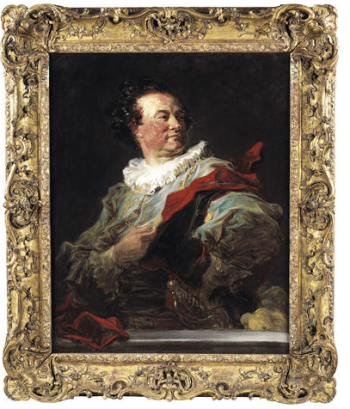 A major work by the eighteenth-century French artist Jean-Honoré Fragonard, Portrait of François-Henri d’Harcourt, will lead Bonhams sale of works from the renowned collection of the German philanthropist, the late Dr Gustav Rau. The proceeds will be used to benefit the Foundation of the German Committee for UNICEF – for the children of the world. The sale will take place at Bonhams New Bond Street on 5 December [auction #21413].
It will be one of the most important sales in the inaugural season of auctions to be held in Bonhams new saleroom which is being built at a cost of £30m and is due to open in October.
One of Fragonard’s famous 15 fantasy portraits, the Portrait of François-Henri d’Harcourt is the most significant of the artist’s works to appear on the market for many years. Only two other fantasy portraits remain in private hands making this painting rarer than portraits by Frans Hals, Joshua Reynolds or even Rembrandt. With a multimillion-pound estimate, it has only changed hands once in its 250 year history when Dr Rau acquired the picture from the Harcourt family in 1971. (more…)
August 23: International Slavery Remembrance Day
Next Friday at the National Maritime Museum in Greenwich:

Yinka Shonibare, Nelson’s Ship in a Bottle, 2010.
The work was displayed on the Fourth Plinth in
Trafalgar Square from 24 May 2010 to February 2012.
Photo from Wikimedia Commons, 2010
◊ ◊ ◊ ◊ ◊
The National Maritime Museum will host a day of remembrance on the anniversary of the first successful slave uprising in the western hemisphere – on 23 August in Haiti in 1791.
This year’s events will explore the Museum’s vast collections relating to the trade of enslaved people, as well as focusing on the many local connections to be found in the Greenwich World Heritage Site. Actor and broadcaster Burt Caesar will act as Master of Ceremonies for the day, which will also see art historian Dr Temi Odumosu discussing the controversial Cruickshank caricature The New Union Club; composer Dominique LeGendre giving a talk on black composers from the period of enslavement; and historian S. I. Martin revealing the hidden impact of the transatlantic slave trade during a walk around Greenwich. Unless otherwise stated, events are suitable for all ages.
Dr Temi Odumosu: The New Union Club | 12.30 | Age: 16+ | Art historian and creative educator Dr Temi Odumosu will explore the themes and attitudes of George Cruickshank’s The New Union Club, which is considered one of the most racist and complex prints of the 19th century.
Dominique LeGendre: Black Composers in the period of Enslavement | 14.00 | Critically acclaimed composer Dominique LeGendre discusses the impact and work of influential black composers during the period of enslavement, including the celebrated Ignatius Sancho.
Life of Ignatius Sancho interactive tour | Age: 10+. Maximum of 30 places on each tour | 12.00, 15.00 | Storyteller Rich Sylvester will lead interactive family learning tours around Greenwich Park, exploring Ignatius Sancho’s early life. Starting at Yinka Shonibare MBE’s eminent Nelson’s Ship in a Bottle, the tour concludes at The Ranger’s House, and with a ceremony investigating the importance of names. Young people are invited to leave their names in remembrance.
Walk to St. Alfege Church | 14.00 | Historian S. I. Martin will lead a walking tour to St. Alfege Church, Greenwich, looking into the impact that the slave trade had on Greenwich families. The walk begins at the Group Entrance of the Museum.
Youth Advisory Group textile workshop | 11.30, 14.00 | Join the Museum’s Youth Advisory Group in creating prints using adinkra symbols. Originally from the Republics of Ghana and Côte d’Ivoire, the symbols are used as both decoration and to represent objects, capturing evocative messages that carry traditional wisdom, aspects of life or the environment.
Songs of Freedom: workshop | Age: All ages and abilities welcome | 13.00, 15.30 | Singing group Ethnovox will lead a workshop exploring how songs were used as a powerful medium of resistance, and for messages of solidarity, hope and freedom.
Alternative Gallery Tour: mobile learning session | 12.30 | Take a tour of The Atlantic: Slavery, Trade, Empire gallery, using a tablet to learn about the movement of people, goods and ideas across and around the Atlantic Ocean, from the 17th century to the 19th century.
What’s in a Name? workshop | 11.00, 13.30 | Uncover the journeys that have brought people’s names to Britain, and discuss what your name means to you.
Tracing History: archive session | Age: 10+ | 11.30 | Join historian S. I. Martin in the Museum’s Compass Lounge to investigate transatlantic slavery through rare and revealing manuscripts; and unlock hidden histories of enslaved people and their struggle for freedom.
Closing ceremony | Age: 14+ | 16.15 | Broadcaster and actor Burt Caesar will lead the closing ceremony, which will take place by the River Thames at the Water Gates at the Old Royal Naval College. Participants are invited to scatter rose petals into the river as an act of silent commemoration.
Maritime Museum’s Appeal to Acquire Two Paintings by Stubbs
Press release (9 August 2013) from the National Maritime Museum in Greenwich . . .
Paintings completed after Cook’s first voyage to Australia are the earliest depictions of a kangaroo and a dingo in Western art.

George Stubbs, Portrait of the Kongouro (Kangaroo)
from New Holland, 1772 (private collection)
◊ ◊ ◊ ◊ ◊
The National Maritime Museum, London has announced a £1.5M appeal to acquire two oil paintings, Portrait of the Kongouro from New Holland and Portrait of a Large Dog, by the celebrated British artist George Stubbs (1724–1806).
The Museum has already secured £3.2M from the Heritage Lottery Fund (HLF) and £200,000 from the Art Fund which will go towards the acquisition of the works as well as much-needed conservation work and a public programme which will bring these remarkable works to the widest audience possible. Due to their significant place within British history and artistic culture, the paintings have been put under an export bar while the appeal is mounted to save them for the nation. Should the appeal be successful they will initially go on display in the Queen’s House, Greenwich in 2014.
The paintings (both of which are oil on panel measuring 24¼ by 28½ inches) were commissioned by the gentleman-scientist Sir Joseph Banks following his participation on Captain James Cook’s first Pacific voyage of ‘discovery’ (1768–71) aboard HMS Endeavour. Stubbs was the pre-eminent animal painter of his day and is now widely appreciated as an 18th-century European master. His paintings of the kangaroo and dingo are the most significant artistic productions directly related to Cook’s seminal voyage and the earliest painted representations of these iconic animals in Western art. They were first exhibited together in London in 1773 and have remained in the UK ever since.
Exploration is a particularly rich area of collection for the National Maritime Museum, which already holds many objects relating to Cook’s voyages, including works by William Hodges (1744–97), who was appointed by the Admiralty to record the places discovered on Cook’s second Pacific voyage (1772–75); and the highly-regarded portrait of Cook by Nathaniel Dance (1775-76), which was also commissioned by Banks and was displayed along with the paintings of the kangaroo and dingo in his house in Soho Square, London.

George Stubbs, Portrait of a Large Dog (Dingo)
from New Holland, 1772 (private collection)
◊ ◊ ◊ ◊ ◊
Lord Sterling, Chairman of Royal Museums Greenwich, said ‘We are delighted that the Heritage Lottery Fund and the Art Fund have formally backed our bid to purchase the works with very generous grants totalling two-thirds of the required funds. This is a fabulous kick-start to our campaign. Royal Museums Greenwich has a once in a lifetime opportunity to complete the acquisition of these two remarkable paintings which will enhance immeasurably the Museum’s role in engaging audiences worldwide with the story of exploration.’
Carole Souter, Chief Executive of HLF, said: “No one captures the movement and magic of animals better than George Stubbs. These two paintings form an extraordinarily important part of the James Cook voyage of ‘discovery’ story. The Heritage Lottery Fund believes they are an integral part of our seafaring nation’s multi-layered heritage, and we hope that our grant of just over £3 million, along with contributions from other funding partners, will enable them to be acquired by the National Maritime Museum. I’m particularly pleased that plans are already taking shape for the less fragile of the pair – Kongouro – to go on tour to a number of other venues with connections to Captain Cook, so it can be seen and enjoyed by as many people as possible.”
Stephen Deuchar, Director of the Art Fund, said “I cannot think of a better home for these two outstandingly important works by Stubbs than the National Maritime Museum, whose collection covers the important interrelationship between art, science and exploration. We are delighted to be supporting both the acquisition and education plans for these paintings, helping audiences to engage with a key episode in the history of exploration. I urge everyone to support the museum in the final leg of their appeal.”
The Museum’s bid to acquire the paintings is supported by the Royal Society and by Sir David Attenborough, who said “I had the privilege of working with the National Maritime Museum when it staged the exhibition of the paintings made on Cook’s Second Voyage and I greatly admired the way it cared for paintings and other artefacts. Its Cook collections, are, of course, of world importance and I have no doubt that these two Stubbs paintings should be placed among them.”
Culture Minister Ed Vaizey said: “Temporary export bars have been instrumental in ensuring many of our national treasures, like these two striking paintings by Stubbs, stay here in the UK where they can be enjoyed by all. I’m delighted that the Maritime Museum, the Heritage Lottery Fund and the Art Fund have joined forces in a campaign to save them for the nation and hope that the necessary funds can be raised to secure them for the Museum.”
 The public can donate to the appeal via mobile phone by texting STUB35 to 70070, online via JustGiving or in person at the Museum. Visitors to the Museum can also see the paintings, which are on public display in the Sammy Ofer Wing throughout the fundraising campaign.
◊ ◊ ◊ ◊ ◊
N.B. — These terrific images are taken from a Flickr set of art works subject to export bars; the set is presented by the UK’s Department for Culture, Media and Sport. Even higher resolution images are, in fact, available for download. The page offers the quickest means I’m aware of for seeing what pieces are currently subject to possible export bans. -CH
◊ ◊ ◊ ◊ ◊
Update (added 20 August 2013) — As reported at Art Daily: “The National Gallery of Australia today strongly reaffirmed its commitment to acquiring two iconic paintings by George Stubbs for Australia’s national art collection.…”
Call for Papers | ‘Art History Supplement’ to Address Advertising Images
From Hypotheses.org, the blog of the Art Histories Society and Art History Supplement:
Art History Supplement 3.6 (November 2013) — Advertising Images / Art as Advertisement
Papers due by 15 October 2013
Images with advertising attitude frequently draw forms and figures from artworks. This appropriation is commonly discussed in each case as a reference to the particular work of art being discussed in the image of the advertisement, when it comes to an art history curriculum. The reception of that artwork would be the primary concern of that study. For instance, see John Berger (1972) Ways of Seeing, London: BBC and Penguin Books, chapter seven. The role of advertisement is primarily to communicate a certain message in order to support, in one way or another, the promotion, the sale or the awareness of a particular product. This product may be a commodity; including a person or an idea, for instance. Such a perspective inevitably brings art historians in front of a certain quandary.
When are these advertising images becoming part of a history of art (art history) curriculum on their own status? Could advertising images bridge the gap, if such a gap exists indeed, between history of art and history of images?
On the other hand, according to OED (2nd edition), for instance, an advertisement could be defined as: a) the turning of the mind to anything, b) the action of calling the attention of others; admonition, warning, precept, instruction, c) the action of informing or notifying; information, notification, notice, d) a (written) statement calling attention to anything; a notification, a ‘notice’, e) a public notice or announcement: formerly by the town-crier; now, usually, in writing or print, by placards, or in a journal; spec. a paid announcement in a newspaper or other print.
Yet, Hoepli describes the current meanings of pubblicità as a) L’essere fatto in pubblico, b) azione del far conoscere al pubblico, c) complesso delle varie forme di propaganda aventi lo scopo di far conoscere e di incrementare il consumo e l’uso di un prodotto commerciale, di un servizio, d) mezzo con cui si fa conoscere al pubblico, a scopo commerciale, un determinato prodotto, e) piccola pubblicità, nei giornali, la rubrica degli annunci economici.
While, John Florio (1611) in his Italian – English dictionary annotated the meaning of publicatione as a publication, a proclamation, a manifestation, a making knowen (p.408).
Wouldn’t all these above qualities be able to describe images regarded, for example, as renaissance and/ or early modern art? A) Religious or humanistic art communicating a political or cultural message, B) “preaching” through images, C) the narration or the narrative element of early modern painting, D) the dictum that images can be the Book of the illiterates, E) public devotional or secular commemorative art or the diffusion of engravings. The drawing of such intriguing parallels could be alleged to the role and the use of those art images in those times, based on the theoretical and their rhetorical structures, as patronage and reception studies, built upon the Panofskian model of “cultural” signs.
Papers and short notes are sought to support, or not, the advertising images as a traceable chapter in a history of art survey course; concerning the use of these images, along with any stylistic dimensions these images have. Moreover, submissions are being welcomed to investigate earlier examples of advertisements through renaissance and early modern religious, or not, paintings, portraits, engravings and ephemera. (more…)
Exhibition | Souvenir Nation: Relics, Keepsakes, and Curios
From the Smithsonian’s National Museum of American History:
Souvenir Nation: Relics, Keepsakes, and Curios
Smithsonian Castle, Washington, D.C., 9 August 2013 — 17 August 2014
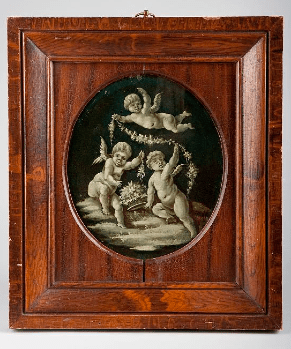
Panel from George Washington’s Coach, 17 x 15 inches. President Washington’s state coach featured four side panels representing the seasons; this panel, encased in an oak frame, depicts ‘Spring’ (Smithsonian)
Souvenir Nation: Relics, Keepsakes and Curios features a selection of diminutive and personal objects that Americans have taken, made and saved as historical mementos from the Early Republic up to the present day. Many of the postcards, structural fragments such as a brick from George Washington’s childhood home, consumer goods, locks of hair and other keepsakes on display are part of the earliest Smithsonian collections now in the museum’s Division of Political History. Highlights include a fragment of Plymouth Rock, presidential hair, wood from George Washington’s coffin and pieces from Joan of Arc’s dungeon, the Bastille, and the Berlin Wall.
◊ ◊ ◊ ◊ ◊
From Princeton Architectural Press:
William Bird, Souvenir Nation: Relics, Keepsakes, and Curios from the Smithsonian’s National Museum of American History (Princeton: Princeton Architectural Press, 2013), 176 pages, ISBN: 978-1616891350, $25.
 Buried within the collection of the Smithsonian Institution’s National Museum of American History exists an astonishing group of historical relics from the pre-Revolutionary War era to the present day, many of which have never been on display. Donated to the museum by generations of souvenir collectors, these ordinary objects of extraordinary circumstance all have amazing tales to tell about their roles in American history. Souvenir Nation presents fifty of the museum’s most eccentric items. Objects include a chunk broken off Plymouth Rock; a lock of Andrew Jackson’s hair; a dish towel used as the flag of truce to end the Civil War; the microphones used by FDR for his Fireside Chats; and the chairs that seated Nixon and Kennedy in their 1960 television debate. This fascinating collection of Americana includes an introductory essay on this nation’s passion for souvenir collecting, as well as a brief history and a glimpse behind the scenes of the Smithsonian.
Exhibition | Bernard Picart: Cérémonies et coutumes religieuses
From the National Gallery in Prague:
Bernard Picart: Slavnosti a náboženské zvyky národů celého světa
Schwarzenberg Palace, Prague, 1 July — 7 October 2013
Curated by Dalibor Lešovský
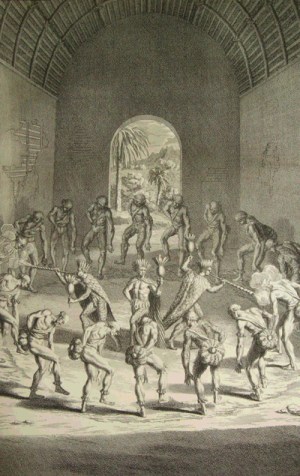 Bernard Picart (1673–1733) byl francouzský rytec, který většinu svého života strávil v Holandsku. Přestože byl autorem řady knižních ilustrací, zcela nezastupitelné místo v jeho tvorbě zaujímá soubor grafik pro knihu Cérémonies et coutumes religieuses de tous les peuples du monde (Slavnosti a náboženské zvyky národů celého světa) [1723–43]. V knize, která se nevěnovala pouze zvykům a tradicím spojeným s duchovním životem monoteistických kultur, s nimiž se grafik mohl seznámit v evropském prostředí, byl věnován velký prostor i náboženským zvyklostem amerických Indiánů, Afričanů, Indů, Číňanů, ale také některým evropským herezím. Přestože Picart nikdy neopustil Evropu, přispěl svými formálně i obsahově nesmírně poutavými ilustracemi ke vzniku díla, které se stalo prvním univerzálním přehledem světových náboženství.
◊ ◊ ◊ ◊ ◊
Translation via Google . . .
Bernard Picart (1673–1733) was a French engraver, who spent most of his life in Holland. Although he was the author of numerous book illustrations, completely irreplaceable in his work occupies a set of prints for the book Ceremonies coutumes Religieuses et de tous les Peuples du monde (Festivals and Religious Customs of Nations around the World) [1723–43]. In the book, which is not only on customs and traditions associated with the spiritual life of monotheistic cultures with which the graphics can get to know the European environment has ample space and religious practices of Native Americans, Africans, Indians, Chinese, but also some European heresies. Although Picart never left Europe, contributed their form and content extremely eye-catching illustrations of the works, which became the first universal overview of world religions.
Exhibition | Emma Hamilton Dancing
From The Lewis Walpole Library:
Emma Hamilton Dancing
The Lewis Walpole Library, Farmington, CT, October 2013 — April 2014
Curated by John Cooper
◊ ◊ ◊ ◊ ◊
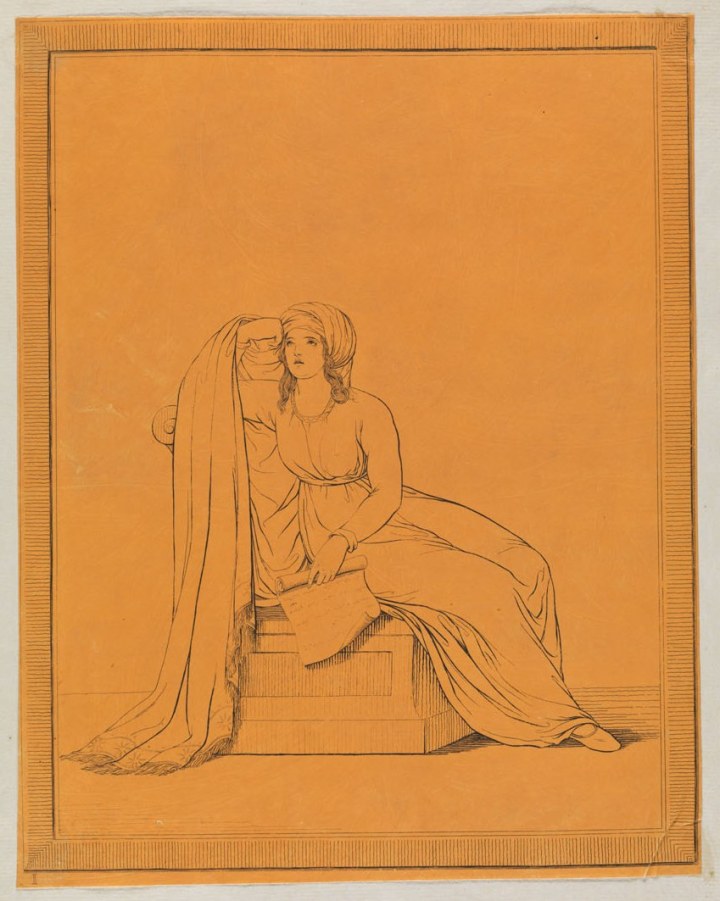
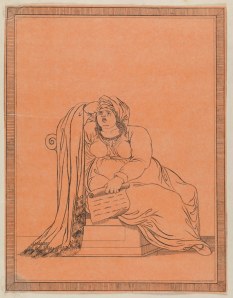
Emma Hamilton (1761?–1815) first performed the Attitudes in Naples in the 1790s. The twelve neoclassical engravings of the Attitudes by Frederick Rehberg published in 1794 and 1797 and the twelve parodies of the same attributed to James Gillray and published by Hannah Humphrey in 1807 will be the centerpieces of the exhibition. Hamilton’s embodied performances will be presented alongside prints and illustrated books representing a range of social and theatrical dancing in Europe that will include contemporary images of the Neapolitan dance the Taranatella, Greek dance from William Hamilton’s volumes on antique vases, social dances including the Minuet, Cotillion, Quadrille, Allemande and Waltz, as well images of the classical ballet. The exhibition will present a new context for the Attitudes and will open up a new space in which to imagine the connections between art history and performance in Europe before the twentieth century.
The exhibition is curated by John Cooper, a Clare-Mellon Fellow in the History of Art and Graduate Research Assistant at the Yale Center for British Art.
Exhibition | Treasures of the Fan Museum
Thanks to Pierre-Henri Biger for noting this upcoming fan exhibition in Paris. From the press release:
Les Trésors du Musée de l’Éventail
L’Atelier Hoguet Musée de l’Éventail, Paris, 15 October 2013 — 15 February 2014
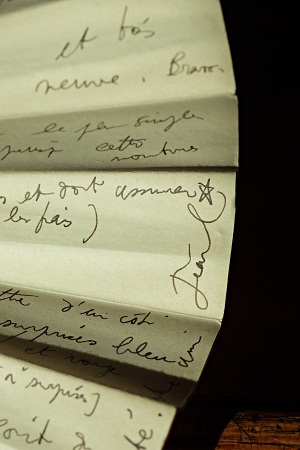 Le Musée de l’Eventail – Hervé Hoguet, seul musée français consacré à cet accessoire, fêtera en octobre 2013 ses 20 ans d’existence. Cette date anniversaire sera d’autant plus symbolique qu’elle célèbrera également les 120 ans de la création du décor du musée et la réinstallation, à l’angle des boulevards Saint-Denis et de Strasbourg, de l’enseigne du XIXème siècle qui doit être remise en état à cette occasion–salon d’exposition et enseigne classés aux monuments historiques en 2004.
Un catalogue sera édité. Il présentera certaines pièces de la collection d’éventails selon l’histoire, les différents styles et les thématiques abordées à travers le temps ainsi que des illustrations et reproductions de documents.
Le musée de l’éventail porte le nom d’Hervé Hoguet, successeur de la Maison Ernest Kees fondée en 1805. Il est le seul musée français exclusivement consacré à l’éventail. Cette initiative est née de la volonté de préserver ce lieu d’histoire, véritable témoin du patrimoine artisanal comme de l’excellence de la capitale française dans l’éventaillerie.
Le musée de l’Eventail est le seul musée en France à conserver dans ses collections des éventails datant du XVIe aux XXe siècles. Plus de deux milles pièces les constituent aujourd’hui. Parmi elles, vingt-deux, datant du XVIIIème au XXème siècle, sont classées à l’inventaire des monuments historiques. Issu en premier lieu des ateliers des maisons d’éventaillistes qui se sont succédées à cette adresse, le fonds constitué par Hervé Hoguet a été considérablement enrichi par le soin de l’association AHME, de la collection d’Anne Hoguet, maître d’art et actuelle directrice du musée. Ce sont aussi des années de dons qui ont permis de les faire croître. Les collections sont régulièrement présentées au public à l’occasion d’expositions temporaires thématiques au sein du musée mais aussi grâce aux prêts effectués lors de manifestations culturelles en France et ailleurs.
Call for Papers | ISECS 2015 in Rotterdam
From the conference website:
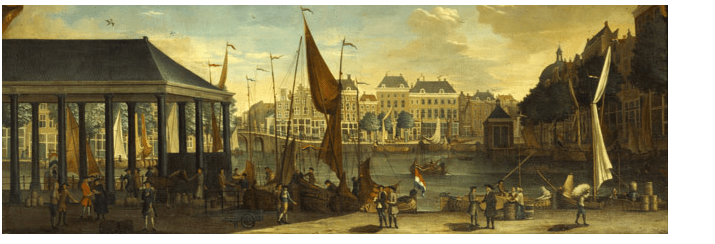
ISECS Congress 2015 | Opening Markets: Trade and Commerce in the Age of Enlightenment
Rotterdam, 26–31 July 2015
◊ ◊ ◊ ◊ ◊
The International Congress on the Enlightenment is the largest event in the field, and takes place every four years. Recent meetings have been held in Dublin (1999), Los Angeles (2003), Montpellier (2007) and Graz (2011). The 14th Congress will take place from 26 to 31 July 2015 in Rotterdam, the Netherlands. Congress facilities will be provided by Erasmus University Rotterdam, with tours and displays on local heritage coordinated by members of the Dutch-Belgian Society for Eighteenth-Century Studies.
The Congress is organized by the Organizing Committee of Dutch-Belgian Society of Eighteenth-Century Studies and is hosted by the Erasmus University Rotterdam. The Congress is preceded by an ordinary meeting of the ISECS General Assembly. Opening Markets includes theme-related sessions as well as plenary sessions featuring invited speakers. The Congress is organized into parallel sessions and round tables with keynotes elaborating on the subtopics. The Congress facilitates poster presentations. Preceding the Congress the organizers host an ISECS International Seminar for junior Eighteenth-Century scholars.
The scientific program is coordinated by an International Steering Committee made up of members of the Organizing Committee and eminent scholars from scientific institutes and universities in the world. A professional Congress Organizing Office is in charge of the practical aspects concerning the preparation, registration, communication and organization of the Congress, the accomodations for participants and the excursions and (partner)tours during and after the Congress.
The Scientific Steering Committee invites the submission of abstracts for oral and poster presentations at the Congress from January 2014. Abstracts must be submitted online by 31 December 2014. An individual may submit more than one abstract. Abstracts must not exceed 250 words. Presenters must be registered participants at the Congress. Accepted abstracts will be presented at the Congress and published in the Congress proceedings.
Additional information is available at the conference website. Also consult the first announcement of the preliminary programme, available for download as a PDF file here»
Exhibition | Artists & Amateurs: Etching in Eighteenth-Century France
Press release (3 June 2013) from The Met:
Artists and Amateurs: Etching in Eighteenth-Century France
The Metropolitan Museum of Art, New York, 1 October 2013 — 5 January 2014
Curated by Perrin Stein
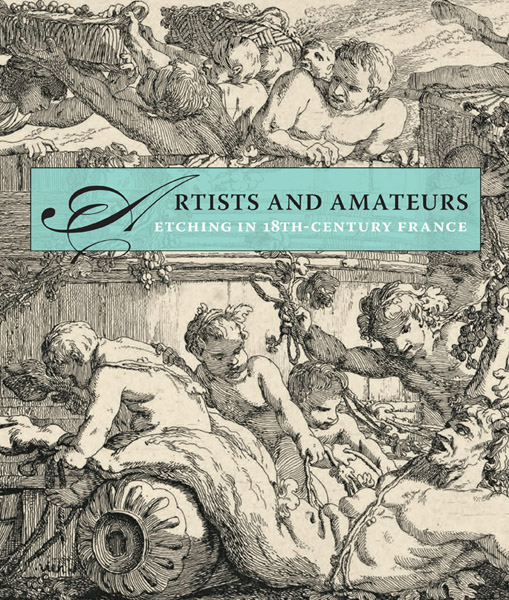 During the eighteenth century in France, a great number of artists—painters, sculptors, draftsmen, and amateurs—experimented with etching, a highly accessible printmaking technique akin to drawing. Featuring 130 works by such artists as Watteau, Boucher, Fragonard, Hubert Robert, and many others, Artists and Amateurs: Etching in Eighteenth-Century France will be the first exhibition to focus on the original etchings created by painters and amateurs in eighteenth-century France. It will present a fresh exploration of how etching flourished in ancien régime France, shedding new light on artistic practice and patronage at that time. In a period when artists strained to navigate the highly regulated Académie Royale and the increasingly discordant public spheres of the marketplace and the Salon, etching afforded them stylistic freedom and allowed them to produce exquisite works of art in a spirit of collaboration and experimentation. The exhibition will present etchings, plus a few drawings and preparatory sketches, from the Metropolitan Museum’s rich holdings, as well as loans from North American museums and private collections. The selection of prints includes a number of rare or unique examples.
While printmaking was dominated by professionals for much of its early history, the technique of soft-ground etching—where a plate was coated in varnish and could then be drawn on with a metal stylus—transformed the practice from a specialized technique practiced by an exclusive group with extensive training, to a highly accessible art form. Some artists, like Antoine Watteau and François Boucher, encountered the process within the thriving commerce of the Paris print trade, where a painter would sometimes be asked to make a preliminary sketch on a prepared copper plate to guide the professional printmaker who would later reinforce the design with engraving. Others, like Jean-Honoré Fragonard and Hubert Robert, first experimented with the technique during their student years in Rome, where Piranesi’s studio was in close proximity to the French Academy. For some, like Jean-Baptiste-Marie Pierre, etching formed a bridge with amateurs, wealthy members of the court or aristocracy who wanted to learn etching as a cultured, leisure pursuit. Because of these relationships, the making of the prints became intermingled with the collecting and studying of prints, creating an environment of cross-fertilization which led to a flourishing of the art form.
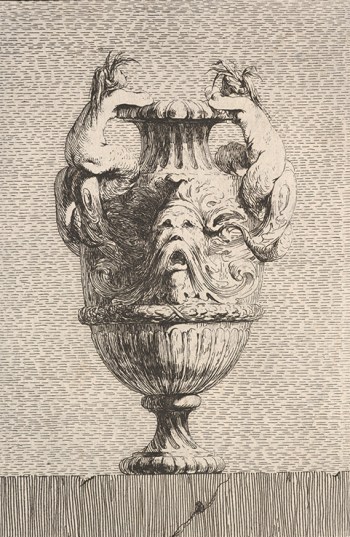
Jacques François Joseph Saly, Design for a Vase with Two Mermaids, from the “Vases” series, 1746 (NY: The Metropolitan Museum of Art)
Artists and Amateurs will highlight the freedom, spontaneity, and creativity of the medium of etching in the hands of artists and collectors. Over the course of the century, etching came to be viewed not solely as a reproduction medium, but also, as one capable of original artistic expression. As the free and improvisational aesthetic of the etching process increasingly was embraced, French artists looked to seventeenth-century masters—such as Rembrandt in the North and Salvator Rosa and Giovanni Benedetto Castiglione to the South—for inspiration. The expressive potential of the technique was also explored in a more experimental manner by artists like Gabriel de Saint-Aubin and Louis Jean Desprez, who harnessed the inky tonalities of the medium to their personal and idiosyncratic vision. The painters who felt the urge to pick up the etching needle were drawn to the freedom and accessibility of the technique, and not necessarily focused on exploiting commercial potential. Their prints tend to be rare and are valued for their qualities of expressiveness and experimentation—in many ways the opposite of the mass production and technical expertise of professional printmakers like Demarteau and Bonnet.
The exhibition will also focus on the French Academy in Rome as a setting that provided the means and freedom to explore this medium; the etchings made by amateurs, both in Rome and in Paris; and, finally, the increasing stylistic engagement with past masters. Overall there will be a balance between works of the most successful painters of the period and lesser known, but equally accomplished figures, including the work of amateurs and the working relationships between them where the influence went both ways.
The exhibition will be organized thematically and will explore how, where, and why artists first learned to etch, their occasional experimentation with marketing their prints for sale, and their technical innovations as they found new ways to manipulate the medium for individual expression. Highlights include Watteau’s Recruits Going to Join the Regiment (ca. 1715-16), Fragonard’s The Satyr’s Family (1763) and The Armoire (1778), Liotard’s Self-Portrait, Boucher’s Andromeda (1734), Gabriel de Saint-Aubin’s View of the Salon of 1753, de Boissieu’s Study of Thirteen Heads (ca.1770), and amateur Ange-Laurent de la Live de Jully’s etching after a drawing by Jacques-François-Joseph Saly of Nicolas Bremont, Cook at the French Academy in Rome (ca. 1754).
From Yale UP:
Perrin Stein, ed., Artists and Amateurs: Etching in Eighteenth-Century France (New York: The Metropolitan Museum of Art, 2013), 240 pages, ISBN: 978-0300197006, $60. With essay by Charlotte Guichard, Rena M. Hoisington, Elizabeth Rudy, and Perrin Stein.










 Enfilade
leave a comment