Exhibition | The Age of Pleasure and Enlightenment
From the museum’s website:
The Age of Pleasure and Enlightenment
Wadsworth Atheneum Museum of Art, Hartford, Connecticut, 10 August 2013 — 27 April 2014

Pompeo Batoni, Portrait of Sir Humphry Morice, 1762 (Hartford, CT: Wadsworth Atheneum Museum of Art)
European art of the 18th century increasingly emphasized civility, elegance, comfort, and informality. During the first half of the century, the Rococo style of art and decoration, characterized by lightness, grace, playfulness, and intimacy, spread throughout Europe. Painters turned to lighthearted subjects, including inventive pastoral landscapes, scenic vistas of popular tourist sites, and genre subjects—scenes of everyday life. Mythology became a vehicle for the expression of pleasure rather than a means of revealing hidden truths. Porcelain and silver makers designed exuberant fantasies for use or as pure decoration to complement newly remodeled interiors conducive to entertainment and pleasure.
As the century progressed, artists increasingly adopted more serious subject matter, often taken from classical history, and a simpler, less decorative style. This was the Age of Enlightenment, when writers and philosophers came to believe that moral, intellectual, and social reform was possible through the acquisition of knowledge and the power of reason. The Grand Tour, a means of personal enlightenment and an essential element of an upper-class education, was symbolic of this age of reason.
The installation highlights the museum’s rich collection of 18th-century paintings and decorative arts. It is organized around four themes: Myth and Religion, Patrons and Collectors, Everyday Life, and The Natural World. These themes are common to art from different cultures and eras, and reveal connections among the many ways artists have visually expressed their cultural, spiritual, political, material, and social values.
23 Things for Research: Teaching with Digital Tools
For anyone thinking about introducing digital tools into the classroom in connection with structured assignments, you might find this model from Oxford’s Bodleian Library useful. -CH
◊ ◊ ◊ ◊ ◊
23 Things for Research
An online learning programme for researchers, students and staff at the University of Oxford
 23 Things is a self-directed course, run as part of the Engage programme, that aims to expose you to a range of digital tools that could help you in your personal and professional development as a researcher, academic, student or in another role. The aim is for you to spend a little time each week over Michaelmas Term, building up and expanding your skills. Each week, we’ll talk about one or more of the tools/tasks from our 23 Things programme and encourage you to try it out and reflect on it. We hope that the programme presents a realistic challenge and will allow you to fit it into your schedule. 23 Things for Research is inspired by the first 23 Things Oxford and based on the original 23 Things program, which ran at the
Public Library of Charlotte & Mecklenburg County in the USA in 2006.
Continue reading here»
At Auction | Passover Haggadah from 1726
The story of this recently discovered manuscript was featured at The Antiques Trade Gazette back in September and then at the BBC in October; but it has received lots of attention over the past few days after being featured in The Daily Mail and The Independent. It’s estimated to fetch between between £100,000 and £150,000.
Update (added 24 November): As reported by the Manchester Evening News, the Haggadah fetched £210,000.
Silver, Judaica, Jewellery, and Watches Sale
Adam Patridge Auctioneers, Macclesfield, 22 November 2014
 In July 2013 this important Haggadah was found in a routine house contents valuation. It will be offered for auction on the 22nd November at The Cheshire Saleroom as part of a specialist one day auction of Judaica, Silver, Jewellery & Watches.
A rare and important 18th-century Passover Seder Haggadah, written and illuminated on vellum by Aaron Wolff Shreiber Herlingen of Gewitsch, Pressberg, 5486 [1726 CE]. The pictorial title border depicts Aaron and Moses and is inscribed in Hebrew “Written by Aaron son of Benjamin Wolff 1726 for Mendel Oppenheimer. This Aaron was a friend of Moses Mendelsohn.” Aaron Wolff Herlingen was active 1721–1755 and held the position of official scribe at the Imperial Library in Vienna.
Original Viennese red-dyed vellum binding over pasteboard, 20-leaf, each 242mm x 162mm, containing 45 coloured vignettes of 27mm x 45mm and 11 coloured vignettes of 77mm x 120mm. Slight food and wine staining throughout.
It is thought that the manuscript was commissioned to mark the birth of Emanuel Mendel Oppenheimer (1726–80), the first child of Samuel Emanuel Oppenheimer of Vienna and a close descendant of the great banker and imperial court diplomat Samuel Oppenheimer (1630–1703).
Provenance: This was inherited by the current vendor in 2007. It has been in the family for over 100 years.
Call for Papers | The Enlightened Image: History and Uses of Projection
From ArtHist:
The Enlightened Image: History and Uses of Projection
Université du Québec à Montréal, 22–24 May 2014
Proposals due by 6 January 2014
The purpose of this conference is to reflect on the issues concerning the projection of still images as this way of presenting images, used by museums and universities, plays an increasingly important role in the visual landscape. A projection can be part of an exhibition by artists or curators, its vocation can be recreational or educational, in any situation, the projection still monumentalises the image, which is placed in the heart of a collective experience. Thus, from the early development of magic lanterns in the middle of the seventeenth century, the intermedial transposition has made the projection dedicated to the collective use of the image and gives it a status of mediator to the public.
The sharing of images provided by the projection is transformative: the projection dematerializes images, distances them, changes their scales and proportions, makes them ephemeral, etc. The projection also affects the way images are perceived in particular by focusing its iconicity at the expense of its texture. All these mutations influence how the projected image is received and creates perceptual habitus. The new visual literacies, which inaugurated the conception of numeric screens and their uses, seem to have been initiated by the luminosity of the projected image. Microsoft PowerPoint, for instance, borrows the word ‘slides’ from projection lexicon.
The aim of this conference is to investigate the issues concerning the intermedial transposition operated by projection in order to understand what projection does to the image, how it is used, perceived and its received. These questions will be investigated through a long historical period (from the eighteenth century to today), to build a cultural history of the projection including the paradigm, rather than considering the projection as a pre-cinematographic phenomenon. By tracing the genealogy of techniques dedicated to the exhibition of images, the conference will outline the anchoring of the transition between a print culture and a screen culture.
The expected contributions will explore various aspects of the projection and its history through specific cases (exhibitions, art history lectures, etc.), narratives or representation of projections (advertising posters, scenes in novels, etc.), specific relationships between projection and print, photography or soundscape, technical
developments (Kodachrome, e-readers, etc.) or metaphorical uses of the word ‘projection’ (psychoanalysis, etc.).
Organised by Joanne Lalonde, Vincent Lavoie and Érika Wicky (Department of Art History, UQAM), this conference is held under the auspices of RADICAL (Repères pour une articulation des dimensions culturelles, artistiques et littéraires de l’imaginaire contemporain), a component of FIGURA, centre de recherche sur le texte et l’imaginaire. A 300-word proposal in English or in French, with a brief CV, should be submitted by the 6th January 2014 to wicky.erika@uqam.ca.
Exhibition | Historias Naturales: A Project by Miguel Ángel Blanco
Press release from The Prado:
Historias Naturales: Un Proyecto de Miguel Ángel Blanco
Museo Nacional del Prado, Madrid, 19 November 2013 — 27 April 2014
Curated by Miguel Ángel Blanco; coordinated by Javier Portús

Miguel Ángel Blanco, A Leviathan Swallows a Goddess (Room 74)
Roman workshop, Venus with a Dolphin, MN; Dolphin skeleton, MNCN- CSIC.
Photo: Pedro Albornoz / Museo Nacional del Prado
◊ ◊ ◊ ◊ ◊
The Museo del Prado is presenting the exhibition Historias Naturales: A Project by Miguel Ángel Blanco, organised with the collaboration of the Higher Council for Scientific Research (CSIC) and the support of the Region of Madrid. 150 objects from the natural world make up the twenty-two interventions installed in the Museum’s galleries by this Madrid-born artist. Most of the objects — animals, plants and minerals — have been loaned by the Museo Nacional de Ciencias Naturales of the CSIC, displayed alongside 25 works from the Museum’s own collection. The result is a close dialogue with these 25 works of art and also with the building itself and the urban setting of the Paseo del Prado.
Through this exhibition the Prado is paying tribute to its own history and to the origins of its building, originally designed as a Natural History museum. On 19 November 1819 the Prado opened its doors to the public for the first time as the Museo Nacional de Pinturas y Esculturas (National Museum of Paintings and Sculptures). However, the Neo-classical building designed by Juan de Villanueva that now houses the Prado was originally designed as the Royal Natural History Cabinet on the orders of Charles III in 1785.

Miguel Ángel Blanco, The Anteater’s Cruel Winter (Room 90)
Antón Mengs worskshop (?), His Majesty’s Anteater, MNP; Anteater skeleton, MNCN-CSIC (Photo: Pedro Albornoz / Prado).
To celebrate the anniversary of the Museum’s first opening to the public on 19 November 1819, the Prado will be introducing visitors to a lesser known aspect of its history, namely that of its origins as a natural history museum prior to its inauguration as the Museo de Pintura y Escultura. The building that now houses the Museum was designed by the architect Juan de Villanueva in 1785 as the Natural History Cabinet on the orders of Charles III. Now, for a period of almost six months the galleries of the Permanent Collection will display objects including some of those that the monarch acquired from the collector and naturalist Pedro Franco Dávila for his new natural history museum, which was previously located in the Palacio de Goyaneche (now the headquarters of the Academia de Bellas Artes de San Fernando).
The Exhibition
Natural Histories: A Project by Miguel Ángel Blanco consists of twenty-two interventions in the Prado’s galleries, made up of 150 objects from the natural world (minerals, stuffed or preserved animals, skeletons and insects), the majority from the Museo Nacional de Ciencias Naturales, shown alongside twenty-five works from the Museum’s collection. The result is to establish a close relationship between them and also with the building itself and the surrounding urban context of the Paseo del Prado. Visitors will thus be able to see the realisation of Charles III’s desire to house a Natural History museum in the Villanueva Building. Due to the circumstances of history, the arts and sciences coexisted under the same roof on two occasions: in 1827 and during the Civil War when objects from the collections of the Real Jardín Botánico and the Museo de Ciencias were moved to the Prado for greater safety.
In order to bring about this reencounter with the Museum’s history and origins, the artist Miguel Ángel Blanco has not set out to reconstruct the Natural History Cabinet three hundred years later. Rather, as he explains, “What I have done in the Museo del Prado is to evoke that collection, the ghost of which inhabits the Villanueva Building. The twenty-two artistic interventions create a collection for the future, incorporating a creative viewpoint, interacting with the Permanent Collection and encouraging a new way of looking at the works which helps to increase the significance of the images.”
The first intervention is to be seen in the Ariadne Rotunda in the Museum, in which the preeminent work is the large-scale, recently restored sculpture of the Sleeping Ariadne (anonymous sculptor, 150–175AD). Next to it is the sculpture of Venus with a Dolphin (anonymous sculptor, 140–150AD), who now becomes the principal focus of this space. From the room’s ceiling Blanco has suspended a dolphin’s skeleton from the Museo Nacional de Ciencias Naturales, explaining that “the marble-like bones of the skeleton resemble the ivory-like marble of the sculptures.” The skeleton projects its shadow over Venus, “leaping like a Leviathan to swallow up the goddess ….”
Another of the works that sums up Blanco’s work in the Museum is his intervention based on Joachim Patinir’s celebrated painting Charon Crossing the Styx. Patinir’s work, which is among those that has most fascinated Blanco, ceases to be a painting and becomes an extension of the lake. It is transformed into pigment by the placement immediately in front of it of a giant piece of azurite (Museo Nacional de Ciencias Naturales), the source of the copper carbonate that Patinir used as a pigment in his painting, “which we can imagine as the result of the lake drying up, assisted by the similarity between the shape of its outline and that of the stone.”
Room 55B in the Prado is another space transformed into a natural history collection by Blanco through his introduction of the skeleton of a snake wound round itself, located next to Dürer’s two panels of Adam and Eve. The skeleton is one of the most beautiful objects in the Museo de Ciencias Naturales’ reptile collection. Through this juxtaposition, Dürer’s two nude studies remind us even more forcefully of the subject of human proportions, which Blanco considers “a scientific endeavour.” Here he reveals an aesthetic intent in his placement of the skeleton, while “the snake’s flexibility resulting from its numerous vertebrae echoes the sinuosity of Dürer’s figures.”
Blanco’s twenty-two installations are completed with one of his own works, Book-box no. 1072, which is part of the work for which he is best known, the Forest Library. It consists of 1131 book-boxes housing natural elements, each one forming a micro-landscape. The book-box that he has chosen for this intervention acquires meaning in front of Lucas van Valckenborch’s Landscape with an Iron Works of 1595. According to Blanco, this is one of his boxes most oriented towards landscape and can be visually related to the landscape paintings in the Room 57 of the Museum: “Among these Flemish painters I feel close to Lucas van Valckenborch, who depicted himself in some of his works with a sketchbook on his lap, reflecting the practice of observing the landscape at first hand … Of all natural environments, the forest is my place and the tree my equal.” (www.bibliotecadelbosque.net)
Miguel Ángel Blanco (born Madrid, 1958)
Miguel Ángel Blanco is among the best known of Spanish artists associated directly with nature. For some years he lived in the Sierra de Guadarrama, which has been his preferred artistic terrain and was the subject of an exhibition he held at La Casa Encendida in Madrid in 2006 entitled Visions of Guadarrama: Miguel Ángel Blanco and the pioneering artists of the Sierra. In that event his book-boxes established a dialogue with works by the leading Spanish landscape painters who visited this mountainous area in the 19th century with the aim of depicting it in their works.
Miguel Ángel Blanco has exhibited different selections from the Forest Library, his most important project, at the Biblioteca Nacional de España, the Museo Nacional de la Estampa in Mexico City, the Fundación César Manrique in Lanzarote, the Calcografía Nacional, Madrid, and the Abbey of Santo Domingo de Silos (Museo Nacional Centro de Arte Reina Sofía), among other venues. In 2008 the Ministry of Culture commissioned a project from him in memory of the dead beech tree in the garden of the Fundación Lázaro Galdiano, which presented the temporary exhibition Fallen Tree, focusing on the relationship between the tree and time.
The Catalogue
The catalogue that accompanies the exhibition includes a text by Miguel Ángel Blanco, the creator of this project, entitled “The Call of the Bird of Paradise” and another, entitled “From Wunderkammern to Enlightenment Collections,” by Javier Ignacio Sánchez Almazán, curator of the collection of invertebrates at the Museo Nacional de Ciencias Naturales. The catalogue also includes a portfolio with photographs and texts by the artist of each of the exhibition’s twenty-two interventions with technical details on all the works on display, in addition to the artist’s biography
At Auction | Centuries of Style at Christie’s
Press release (5 November 2013) from Christie’s:
Centuries of Style: Silver, European Ceramics, Portrait Miniatures and Gold Boxes (#1162)
Christie’s, London, 26–27 November 2013
 Christie’s announced the forthcoming bi-annual sale of Centuries of Style: Silver, European Ceramics, Portrait Miniatures and Gold Boxes (Sale 1162) that will be held over two consecutive days in London on Tuesday, 26 and Wednesday, 27 November 2013. This sale offers collectors a superb opportunity to add to their collections with a wide-range of important, rare and unique treasures.
Silver
The silver section of the sale presents exemplary pieces of extraordinary quality from the 16th century to the 21st century, it is expected to realise in the region of £1.5 million. The auction is led by two very important private collections of Georg Jensen silver, which contain many outstanding pieces by the maker and the largest collection to be offered in London in recent years. Among the stars is a rare and important Danish fish dish, cover and mazarine, designed by Harald Nielsen (1892–1977). This beautifully crafted silver displays the greatest originality of design and is amongst the largest items made by the Jensen workshop, measuring 65 centimetres wide. This work is expected to realise between £80,000 and £120,000. Further examples of the highest quality of European silver include a pair of Danish five-light candelabra (estimate: £40,000–60,000), which is one the most spectacular piece of Jensen silver to be offered. A further highlight is a magnificent Danish jug designed by Henning Koppel (1918–1981) (estimate: £25,000–35,000). Known as the ‘African Girl’, due to its elegant handle stacked with ‘necklaces’, this pitcher was the first in the series that was designed in 1948 and has become an icon of Scandinavian modern design.
Gold Boxes and Objects of Vertu
 This sale presents a varied and interesting array of gold boxes and objects of vertu, displaying examples of the many techniques employed by European goldsmiths during the 18th and 19th centuries. This section of the sale is led by a highly important and incredibly rare Louis XV enamelled gold snuff-box, by Louis Charonnat (Lot 298, estimate: £150,000–200,000). This striking piece displays outstanding enamelling extract, which has been attributed to Charles-Jacques de Mailly, who worked in Paris during the 1760s and 1770s and later in St Petersburg. De Mailly is known for his grisaille allegorical scenes which are surrounded by brightly coloured flower garlands.
A French jewelled enamelled gold presentation snuff-box, circa 1860, by Louis Tronquoy, a highly-sought after name in the world of gold boxes, is another important example (estimate: £40,000–60,000). The striking box is set with diamonds that form the initials of Isma’il Pasha (1830–1895) Khedive of Egypt and Sudan. A presentation box, it was given by Isma’il to a Dutch contractor who was working for him in Egypt during the late 19th century. Further highlights include an important private Greek collection belonging to the Late Mrs. Melas (1908–1983), comprising twenty-five boxes with estimates ranging from £2,000 up to £60,000. This outstanding collection started in 1954 when Mrs. Melas purchased a boîte-à-miniatures set with miniatures by the 18th-century engraver Jacques-Joseph de Gault, from the auction of the King Farouk Collection, The Palace Collections of Egypt, in Cairo. A leading example is an exquisite Louis XVI goldlined boîte-à-miniatures, by Adrien Vachette (estimate: £20,000–30,000).
Portrait Miniatures
 Charming British portrait miniatures are a notable part of the sale, they are offered alongside an array of rare and important Continental sitters and artists. A remarkable group of royal sitters is led by two exceptional examples by Nicholas Hilliard (1547–1619), King James I of England and VI of Scotland (1566–1625) (estimate: £15,000–20,000) and King Charles I (1600–1649) when Duke of York (estimate: £15,000–25,000). Further highlights from this group include an exquisitely detailed miniature of King James II of England and VII of Scotland (1633–1701) by Samuel Cooper, the second son of Charles I, who ascended to the throne upon the death of his brother, Charles II (estimate: £40,000–60,000).
Members of the German royal families of Bavaria, Hesse-Cassel and Prussia are well represented by a portrait of Queen Louise of Prussia (1776–1810) (estimate: £6,000–8,000) and two remarkable miniatures by Anton König (1722–1787) and Daniel Chodowiecki (1726–1801) depicting the German Emperor Frederick the Great, King of Prussia during the 1740s through to the 1780s. Both König’s Frederick the Great (estimate: £6,000–8,000) and Chodowiecki’s Frederick the Great on Horseback (estimate: £20,000–30,000) depict the King planning his military movements in battle. Frederick the Great remains one of the most renowned German rulers of all time for his military successes and his domestic reforms that made Prussia one of the leading European nations. Further highlights include exemplary works by Heinrich Füger (1751–1818), led by an impressive miniature of Leopold II, Holy Roman Emperor (1747–1792) (estimate: £30,000–50,000).
European Ceramics
One of the many spectacular and unusual offerings in the European ceramics section is a striking pair of hispano-moresque copper lustre and blue drug-jars from the mid-15th century (estimate: £35,000–40,000). These boldly decorated pieces have not been on the market for over fifty years; they are very rare examples, remarkably large in size and in exceptionally good condition. A further rare piece is a Staffordshire salt glaze Stoneware ‘scratch-blue’ Jacobite loving-cup (estimate: £7,000–10,000). The cup depicts Charles Edward Stuart (1720–1788), known as the ‘Bonnie Prince Charlie’. He instigated the unsuccessful Jacobite uprising of 1745 in which he attempted to restore the Stuarts to the throne of the Kingdom of Great Britain. The Meissen section of the sale is led by an important private collection of good early pieces decorated with Chinoiserie and European subjects, comprising sixteen lots with estimates ranging from £2,000 up to £12,000.
Call for Articles | Tribute to Francis Haskell
From the Call for Papers:
Special Issue of Studi di Memofonte in Tribute to Francis Haskell
Proposals due by 24 November 2013
Fondazione Memofonte is planning a tribute to the memory of Francis Haskell in the form of a special issue of its journal Studi di Memofonte, no. 12, due to appear by July 2014. Titles of proposed papers, together with an abstract of not more than 2000 characters (including spaces) and a CV not exceeding 1000 characters (including spaces), should be e-mailed to the journal’s editors (info@memofonte.it) by 24 November 2013.
Where an abstract is accepted, the editorial board will consider the complete paper by 28 February 2014. This should not exceed 40,000 characters, including spaces, and may be accompanied by up to 10 images at a resolution of 300 dpi. If protected by copyright, permission to reproduce images should already have been obtained.
The special issue will be divided into sections corresponding to the following subject areas:
1. Concerning Patrons and Painters: Patronage, collecting and the history of exhibitions.
2. Concerning Rediscoveries in Art: The visual, historiographical and literary reception of artworks and aspects of the history of taste.
3. Concerning Taste and the Antique: The rediscovery and reception of the antique and antiquarian studies.
4. Concerning History and its Images: The uses of images in historiographical research.
The editorial board, which will include specially invited experts, will give preference to those papers most closely reflecting the methodology adopted in Francis Haskell’s own writings, with their exemplary elucidation of the multidisciplinary links between the history of social institutions and that of the appreciation and interpretation of artworks.
Restoration of the Queen’s House at Versailles

Maison de la Reine au hameau, Versailles
Photo: Wikimedia Commons, 2011
◊ ◊ ◊ ◊ ◊
From The Art Newspaper:
Claudia Barbieri Childs, “Dior to Fund Versailles Makeover,” The Art Newspaper (14 November 2013).
Fashion house to help restore Marie Antoinette’s rustic hideaway, where the French queen enjoyed the simple things in life
The fashion house Dior is to sponsor the restoration of the Queen’s House in Versailles. The deal was announced last month by Catherine Pégard, the director of the Palace of Versailles. The house was Marie Antoinette’s rustic hideaway, where Louis XVI’s queen played out a fantasy life as a simple milkmaid until the revolution of 1789 imposed a sterner reality. The house was abandoned after the revolution. . .
The full article is available here»
Exhibition | Bernardo Bellotto Paints Europe
With his younger brother Pietro the focal point of an exhibition in Venice, Bernardo Belotto, the pupil and nephew of the more famous ‘Canaletto’ will be the subject of a major show in Munich next fall:
Canaletto, Bernardo Bellotto Paints Europe / Bernardo Bellotto Malt Europa
Alte Pinakothek, Munich, 17 October 2014 — 19 January 2015

Bernardo Bellotto, View of Munich from the East, 1761
© Bayerische Staatsgemäldesammlungen, Munich
◊ ◊ ◊ ◊ ◊
With around 80 loans from public and private collections in Europe and the USA, this exhibition will be the first comprehensive show of Bellotto’s work in Germany for almost 50 years and will provide a unique opportunity to accompany the Venetian vedute painter on his journey through 18th-century Europe.
Bernardo Bellotto, known as Canaletto, worked for several months in Munich in 1761 and painted a broad panorama of the city and two views of Nymphenburg Palace for Maximilian III, Elector of Bavaria. Thanks to a comprehensive restoration programme, the three large-format paintings will regain their original lustre over the next few months. These are among the artist’s major works and are also unique historical documents.
The exhibition shows Bellotto’s pictures of Munich for the first time within the context of exemplary paintings and drawings from all his creative phases. Views of royal cities, palaces and villas will form the focus of attention and bring to life the places where Bellotto worked — from Venice and Rome to Dresden, Vienna and Warsaw. In addition, groups of works, such as landscapes and the artist’s fanciful capricci that have so far been paid less attention, will also form thematic highlights in the projected exhibition.
Exhibition | Pietro Bellotti: Another Canaletto
From Ca’ Rezzonico:
Archives of Landscape Painting | Pietro Bellotti: Another Canaletto
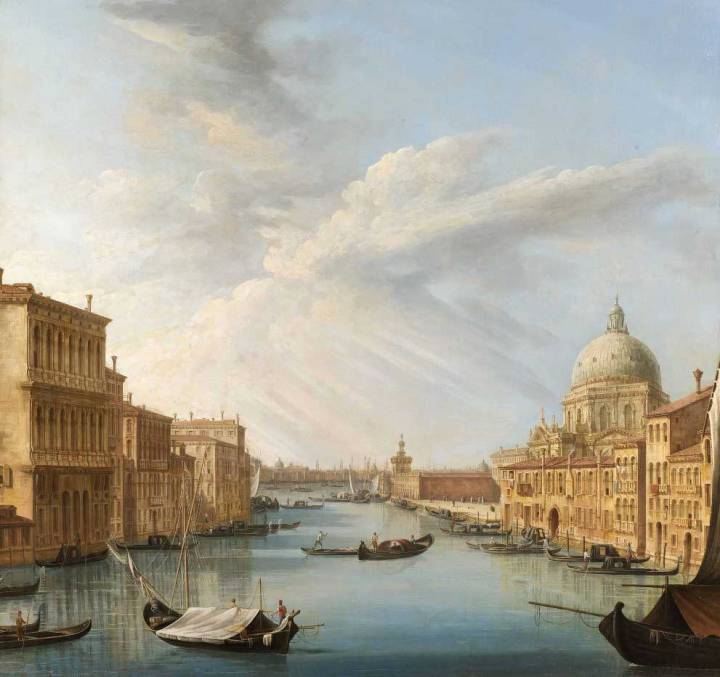
Ca’ Rezzonico, Museum of 18th-Century Venice, 7 December 2013 — 28 April 2014
Curated by Charles Beddington, Alberto Craievich, and Domenico Crivellari
◊ ◊ ◊ ◊ ◊
This year sees the start of a new and fascinating investigation at Ca’ Rezzonico, the symbol of 18th-century Venice, into landscape painting. This important genre developed during the 18th century in Venice, which provided an extraordinary source of inspiration for its exponents.
Among the leading figures of the genre, which is at the centre of a necessary re-evaluation, was Pietro Bellotti, Canaletto’s nephew and the younger brother of Bernardo Bellotti. Born in Venice in 1725, he developed a manner that was very different to that of the Canaletto ‘clan’ of which he was a part and despite exploiting the fame of his uncle (especially in France, where he lived for 50 years, calling himself ‘le Sieur Canalety’ or ‘Pietro Bellotti di Caneletty’). After moving to Toulouse with his family, he stayed for a brief apprenticeship in his brother’s workshop and then was active in Besançon, Nantes, Lille and Paris and, at least for a brief period, in England. Adopting an autonomous, personal style, he developed Canaletto’s inventions, producing numerous views of Europe’s most important cities, together with some architectural capriccios, some of which realised with the collaboration of other landscape painters.
The exhibition will offer a survey of the painter’s long working life, bringing together the few of his works conserved in public collections, such as at the Yale Center for British Art and the Mauritshuis in The Hague, and about 40 other pictures, including signed works in private European collections.










leave a comment