Exhibition | Mengs & Azara: Portrait of a Friendship
Press release (3 July 2013) from The Prado:
Mengs & Azara: Portrait of a Friendship / El Retrato de una Amistad
Museo Nacional del Prado, Madrid, 3 July — 13 October 2013
Curated by Stephen Schröder and Gudrun Maurer
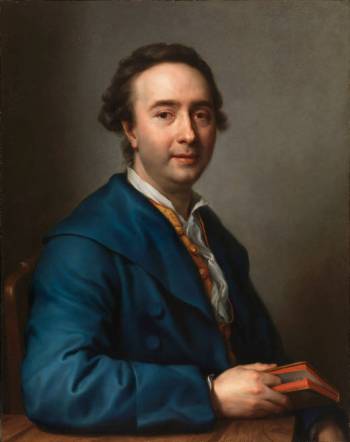
Rafael Mengs, José Nicolás de Azara, oil on panel, 77 x 61.5 cm, 1774 (Madrid, Museo Nacional del Prado)
To mark the Museum’s recent acquisition of one of Mengs’s finest portraits, his Portrait of José Nicolás de Azara, the Prado has recreated the friendship and close collaboration between the Neo-classical painter and his sitter, a leading exponent of the Spanish Enlightenment. This small exhibition, on display in Room 38 of the Villanueva Building until 13 October, consists of 24 works – paintings, sculptures, prints, medals and books – from the Museum’s own holdings or loaned from private collections. The addition of this work to the Prado’s collections will enrich the Museum’s holdings of 18th-century paintings and add to its group of portraits by Mengs.
The recent acquisition by the State and its entry into the Prado of the remarkable Portrait of José Nicolás de Azara, painted in 1774 by Anton Raphael Mengs, has led to the organisation of this small exhibition, which evokes the friendship and close collaboration that existed between the two men: Mengs, the
Neoclassical painter from Bohemia, and Azara, one of
the leading names of the Spanish Enlightenment.
Portrait of José Nicolás de Azara by Mengs
This intimate and strikingly simple image, painted in Florence in early 1774, is an outstanding example of Mengs’s particular classicism and is considered one of his finest portraits. It is also important due to the identity of the sitter, who was one of the most prominent representatives of the Spanish Enlightenment.
Mengs’s portrait conforms to the taste of the time in its use of a pure Neo-classical mode, of which the artist was one of the principal exponents. Azara is depicted with a sublime dignity and naturalness that suggest his intellectual integrity. He has none of the accessories normally used to evoke power and authority but is portrayed with a psychological depth that reveals his character. Particularly striking is his lyrical expression, with its slight smile conveyed through the “gentle movement of the mouth and eyes” that Azara considered the Ancient Greeks to have used to represent the movements of the soul. His expression transmits his friendship with Mengs, his sensibility and his passion for literature. The latter is also indicated by the book that he holds, which he momentarily sets aside in order to focus on the artist with a spontaneity of the kind newly fashionable in 18th-century portraits.
The Exhibition
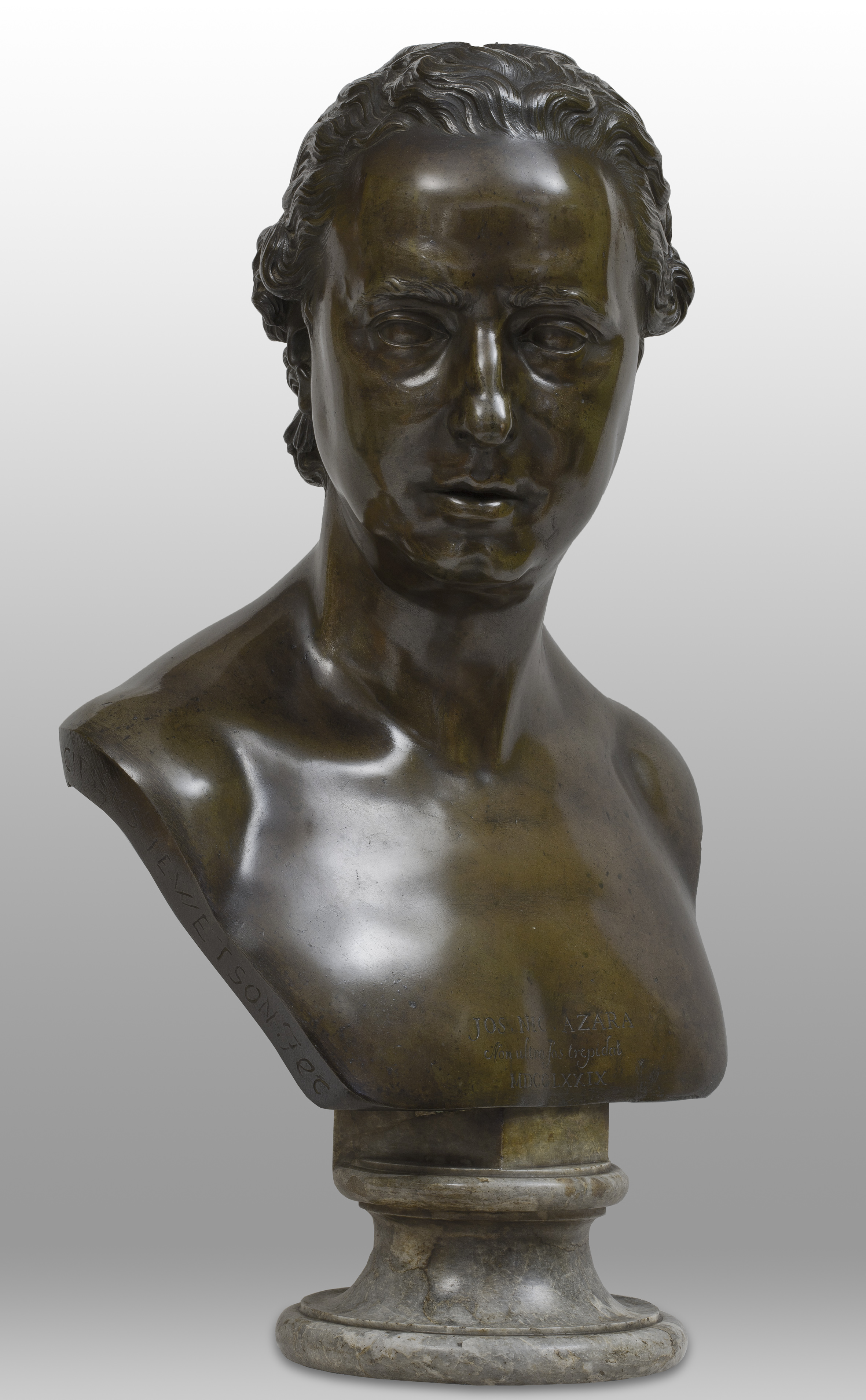
Christopher Hewetson, José Nicolás de Azara, bronze, 52 x 39 x 29 cm, 1779 (Private collection)
The exhibition focuses on the friendship between Mengs and Azara, the affinities between their aesthetic ideas and their close artistic collaboration. It also looks at the way they were depicted in portraits, Azara’s collecting activities, and his role in the promotion and dissemination of Mengs’s works.
In addition to the recently acquired painting, other eloquent proofs of the friendship between the artist and his patron are the two bronze busts of Azara and Mengs of 1779 by the Irish sculptor Christopher Hewetson. The exhibition also includes a Self-portrait by Mengs (ca.1761–1765) dating from the time he first met Azara and their collaboration on the production of a medal to commemorate the marriage of the Prince and Princess of Asturias, which is also on display. Another later Self-portrait of around 1774–1776 was the primary model for the dissemination of the artist’s image in Spain. It is present here through a copy in pastel by Mengs’s daughter, Ana María, and a print after it by Ana María’s husband, Manuel Salvador Carmona.
As examples of the affinity between the two men’s aesthetic ideas, the exhibition includes a drawing by Mengs of the classical sculpture of Antinous as Osiris (original in the Vatican Museums), and a print after a drawing by Mengs of one of the mural paintings in the
Villa Negroni.

Christopher Hewetson, Anton Raphael Mengs, bronze, 51 x 38 x 26 cm, 1779 (Madrid, Museo Nacional de Artes Decorativas)
In 1779 Azara initiated an excavation project in Tivoli near Rome. Following the discovery of fifteen portraits of Greek philosophers and poets and other small sculptures in the so-called Villa dei Pisoni, Azara began to collect classical portraits and sculptures, possessing around 70 examples by the end of his life. His collection, which is now divided between the Real Casa del Labrador in Aranjuez and the Museo del Prado, is represented here by sculpted portraits of the poets Homer and Menander, the Epicurian philosopher Hermarcus and the Attic general Miltiades, in addition to a statue of a Dacian from Trajan’s Forum in Rome and one of Fortuna.
Also on display is a copy of the Life of Cicero by Conyers Middleton, edited and translated by Azara and illustrated with prints of sculptures from his own collection. Azara’s role in protecting and disseminating Mengs’s artistic legacy is conveyed in the exhibition through a print of his portrait by Mengs, engraved by Domenico Cunego; a commemorative medal of the “philosopher painter” by Caspar Joseph Schwendimann, in which Azara included his own image; Las Obras de D. Antonio Rafael Mengs, edited and with commentaries by Azara, published in Parma and Madrid in 1780; and the first biography of the artist written in 1780 by Ludovico Bianconi and illustrated with a print relating to Azara’s homage to Mengs after his death when he installed a bust of him by Hewetson in the Pantheon in Rome.
Finally, Azara’s friendship with Napoleon arising from his diplomatic mission of 1796 is documented through two works: a commemorative gold medal issued that year by the Senate in Rome in honour of Azara and his negotiation of the Armistice of Bologna; and a medal with a portrait of Napoleon that commemorates the Peace of Amiens, which Azara signed in 1802 as the representative of the Spanish monarch.
Stephen Schröder and Gudrun Maurer, Mengs & Azara: El Retrato de una Amistad (Madrid: Museo Nacional del Prado, 2013), 48 pages, ISBN: 978-8484802648, 10€.
The exhibition is accompanied by an essay-catalogue written by the curators, Stephen Schröder, Head of the Department of Classical and Renaissance Sculpture, and Gudrun Maurer, Curator in the Department of 18th-century Spanish Painting and Goya, both at the Museo del Prado.
Azara and Mengs
The relationship between the two men yielded its first artistic results in 1765 when Azara requested the collaboration of Mengs in the design of a medal to commemorate the marriage of the Prince and Princess of Asturias.
José Nicolás de Azara (Barbuñales, 1730 – Paris, 1804) became widely known in Spain from the time of his first appointment as a civil servant in the Government Office in 1760. He subsequently achieved international renown through his diplomatic post in Rome, where he remained for more than thirty years, followed by Paris from 1798 to 1803 as Spanish ambassador at a delicate period in the last decade of the 18th century and early years of the following century. Among Azara’s numerous friendships with leading cultural and political figures were those with Winckelmann, the theoretician of classical art, the famous typographer Bodoni, Pope Pius VI and politicians such as Godoy in Spain and Napoleon and Talleyrand in France.
Anton Raphael Mengs (Aussig, 1728 – Rome, 1779) initially trained with his father Ismael Mengs in Dresden then went to Italy to study the works of the Italian masters including Raphael, Michelangelo, Carlo Maratti, Correggio, the Carracci, and Titian. In 1751 he was appointed painter to the privy chamber by the Elector of Saxony, Frederick August II. During his time in Rome from 1752 to 1761, where he met the German archaeologist Johann Joachim Winckelmann, Mengs evolved the theories that formed the basis of his writings on ideal beauty and the recovery of the perfection of art through the study of the great models of the ideale classico. After painting the fresco of the Parnassus in the Villa Albani, which can be considered the embodiment of Neo-classical art, Mengs was summoned to Madrid by Charles III, the Elector of Saxony’s son-in-law, to supervise the decoration of the Royal Palace.
Appointed painter to the privy chamber in 1766, he introduced the new artistic trends into Spain and supported Spanish painters such as Maella, the Bayeu brothers and Goya. Due to poor health, Mengs returned to Rome in 1769. As a commission from Charles III, in 1770 in Florence he painted the portraits of the families of the Grand Dukes of Tuscany (Museo Nacional del Prado), at which point he made plaster casts of the most important classical and Renaissance sculptures in their collection, which he used for teaching purposes. In Rome the artist was appointed director of the Academy of Saint Luke and received important commissions for paintings for the Museo Clementino and the basilica of Saint Peter’s. Having returned to Madrid in 1774 he went to Rome again in 1776, where he died of tuberculosis in 1779. Mengs’s output encompasses history paintings, religious works, frescoes on religious, mythological and allegorical subjects, and an important group of portraits.
A checklist of the 24 works on display is available at the end of the press release.
The Slave Owner, the Cook, His Sister, and Her Lover
Published last September, Craughwell’s book underscores Jefferson’s complicated attitudes and debts to slavery. On, this, the day of the United State’s birth and Jefferson’s death, that strikes me as useful. It’s certainly fascinating to see the American introduction of macaroni and cheese as part of a trans-Atlantic story involving both Europe and Africa. Happy Independence Day. –CH
◊ ◊ ◊ ◊ ◊
From Quirk Books:
Thomas J. Craughwell, Thomas Jefferson’s Crème Brûlée: How a Founding Father and His Slave James Hemings Introduced French Cuisine to America (Philadelphia: Quirk Books, 2012), 256 pages, ISBN: 978-1594745782, $20.
 This culinary biography recounts the 1784 deal that Thomas Jefferson struck with his slaves, James Hemings [brother of Sally Hemings]. The founding father was traveling to Paris and wanted to bring James along “for a particular purpose”— to master the art of French cooking. In exchange for James’s cooperation, Jefferson would grant his freedom.
Thus began one of the strangest partnerships in United States history. As Hemings apprenticed under master French chefs, Jefferson studied the cultivation of French crops (especially grapes for winemaking) so the might be replicated in American agriculture. The two men returned home with such marvels as pasta, French fries, Champagne, macaroni and cheese, crème brûlée, and a host of other treats. This narrative history tells the story of their remarkable adventure—and even includes a few of their favorite recipes.
Abram Barkshian reviewed the book for The Wall Street Journal (14 September 2012).
Exhibition | From Colony to Nation: 200 Years of American Painting
Press release (6 June 2013) from the New-York Historical Society:
From Colony to Nation: 200 Years of American Painting
New-York Historical Society, New York, 7 June — 8 September 2013
Curated by Linda S. Ferber

Charles Peale, The Peale Family, 1773–1809, 57 x 90 inches
(New York-Historical Society)
Capturing the spirit of the United States through two centuries of artistic expression, From Colony to Nation: 200 Years of American Painting features more than eighty works dating from 1720 to 1918, drawn from the New-York Historical Society’s large holdings of American paintings. On view June 7 through September 8, 2013, the exhibition interweaves art history and American history into a richly textured visual panorama, with subjects ranging from early Colonial portraits to urban Impressionism. The exhibition also highlights the story of the artists, patrons, and collectors whose contributions informed the history of New-York Historical.
Many works in From Colony to Nation will be exhibited for the first time in decades, following conservation of both the paintings and their period frames. Among the exhibition highlights is John Singer Sargent’s portrait Mrs. Jacob Wendell (1888), a recent gift to the New-York Historical Society from The Roger and Susan Hertog Charitable Fund and Jan and Warren Adelson. The first painting by Sargent in New-York Historical’s collection, the work was created during the young expatriate artist’s first professional foray on American soil.
The exhibition is organized into six overarching themes that interweave art history and American history into a richly textured national narrative beginning in the early 18th century and ending in the early 20th. Colonial Painting: Faces, Places & a Bible Story features a number of New-York Historical’s early portraits of the men, women and children who comprised the thriving populations of colonial New York and Philadelphia. Among the treasures on display are seven Beekman family portraits, dating from the 1760s and still in their original frames—a rare instance of an entire suite of portraits of a prominent family represented in a single collection. Also on view is Charles Willson Peale’s monumental The Peale Family (1773–1809), which brings together several generations in the artist’s studio for one of the most ambitious group portraits of the 18th century. The Peale family saga is played out over several decades and generations, coming to a close when the elderly Peale added a memorial portrait of his beloved dog Argus. Another exhibition highlight is the recent acquisition The Finding of Moses (ca. 1720), a rare scripture painting attributed to Gerardus Duyckinck. The Dutch community valued such Biblical narrative paintings for their religious content and as a reflection of their political experience, identifying with the exiled Israelites in their own struggles against the domination of Spain in the Netherlands and the English in New York.
Artists featured in the exhibition are also well-represented in New-York Historical’s portrait collection—The World of the American Artist features a selection of these likenesses, along with depictions of noted art collectors and patrons. Expatriate artist Benjamin West’s London studio was the destination for a first generation of aspiring Colonial painters, including Gilbert Stuart, Charles Willson Peale, and Abraham Delanoy, who painted West in 1766 at the height of the artist’s early fame as a history painter. Portraits of Asher B. Durand and Thomas Cole represent a later generation of American masters who focused upon the American landscape. Important collectors and patrons depicted in the exhibition include Luman Reed and Thomas Jefferson Bryan, whose collections formed the early core of New-York Historical’s collection.
The Early Republic: Patriots, Citizens & Democratic Vistas features founding fathers, New York merchants and Pennsylvania farmers, with several joined by their wives to create charming pairs. Iconic portraits of Washington, Jefferson, Hamilton, and Lafayette portray the heroes of the Revolutionary generation. Gilbert Stuart portrays the dashing Schulyers as a newly married couple (1807), and Jacob Eichholtz’s captures the genteel charm of Pennsylvania country gentry in his portraits of Mr. and Mrs. Frederick Eichelberger (ca. 1819). Scenic wonders of the new nation include John Trumbull’s 1808 epic panoramas of Niagara Falls, contrasted with the 1818 record of a lively transportation hub at the New York waterfront captured by visiting Swiss painter J.H. Jenny. (more…)
Imagining the Shantytown Dwellings at Fort Mifflin
I’m sorry I learned of this Philadelphia project only a few days ago (after the close of the festival, which looks to have been positively exhilarating). Still, it seems worth noting, a useful counterweight perhaps to all the magnificence within the period’s historiography. One of the artists, Ben Neiditz, is, incidentally, on staff at the Penn Museum. -CH
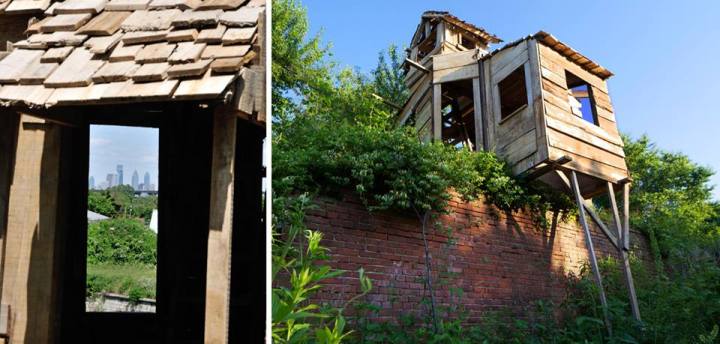
Ben Neiditz and Zach Webber, Ruins at High Battery,
Fort Mifflin, Philadelphia, 2013. Photo by Peter Woodall
◊ ◊ ◊ ◊ ◊
In connection with Philadelphia’s Hidden City Festival (23 May — 30 June 2013), Ben Neiditz and Zach Webber have constructed improvised dwellings that recall Revolutionary War-era shantytowns along the Delaware River at Fort Mifflin, a stunning remnant of the Revolutionary War. Playing with notions of permanence and impermanence, the artists’ settlement recalls the shantytowns that have dotted the Delaware River wetlands since the 18th century–while also imagining the DIY settlements of the future. . .
Read more at the festival website; additional photos can be found at Street Department, Conrad Benner’s blog dedicated to art on the streets of Philadelphia.
◊ ◊ ◊ ◊ ◊
From the Fort Mifflin website:
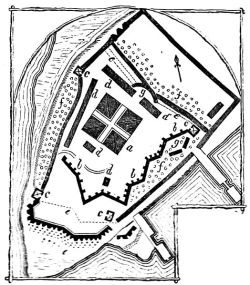
Fort Mifflin, 1777, from Benson John Lossing’s Field Book of the Revolution, 2 volumes (New York: Harper Brothers, 1853), vol. 2, p. 90. Image from Wikimedia Commons
[At Fort Mifflin, in the fall of 1777,] on the frozen, marshy ground within the walls of a stone and wood fort, the American Revolution produced a shining moment. Cold, ill and starving, the young garrison of (now) 400 men at Fort Mifflin refused to give up. The valiant efforts of the men at Fort Mifflin held the mighty British Navy at bay providing Washington and his troops time to arrive safely at Valley Forge where they shaped a strong and confident army. This battle escalated into the greatest bombardment of the American Revolution and one that many say changed the course of American history. . .
Call for Papers | American Art History and Digital Scholarship
From the symposium and workshop website:
American Art History and Digital Scholarship: New Avenues of Exploration
Archives of American Art, Smithsonian Institution, Washington, D.C., 15–16 November 2013
Proposals due by 15 August 2013; registration due by 30 September 2013
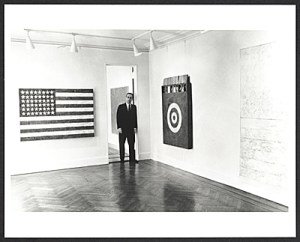
Leo Castelli in a room of the Jasper Johns exhibit at the Castelli Gallery, 1958 (Archives of American Art)
The Archives of American Art announces an upcoming symposium, American Art History and Digital Scholarship: New Avenues of Exploration, to be held at the Donald W. Reynolds Center for American Art and Portraiture, in Washington, DC, on Friday, November 15, followed by a one-day workshop at the Archives of American Art on Saturday, November 16. We seek proposals for Friday’s presentations and applications for participation in Saturday’s moderated workshop.
The symposium will convene scholars, archivists, librarians, graduate students, technical experts, and the public to consider American art history in a digital world, examining ways to integrate digital tools and resources into the study of
American art and to encourage collaboration. (more…)
Exhibition | Surveying George Washington
From Crystal Bridges:
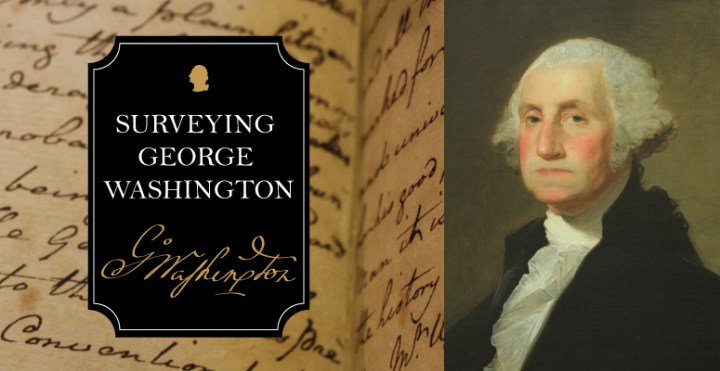
Surveying George Washington
Crystal Bridges Museum of American Art, Bentonville, Arkansas, 29 June — 30 September 2013
◊ ◊ ◊ ◊ ◊
This summer, Crystal Bridges will mount the second of an ongoing series of exhibitions featuring historical documents pertaining to the Museum’s mission and collection. This year’s exhibition focuses on George Washington, and features an assortment of documents written by Washington himself, or by contemporaries who knew him, on loan from the Harlan Crow Library in Dallas, TX. The aim is to provide a look at Washington that provides insight into his life as a real person, not just a historical figure.
The exhibition will feature documents spanning the breadth of Washington’s life, including, among others, a land survey prepared by Washington at age 19; a copy of the broadside recruiting poster mustering troops for what would become a regiment under Washington’s command during the French & Indian War; a hand-written letter to General John Cadwalader of the Pennsylvania militia, appealing to him for troops to continue the push against British outposts in New Jersey during the War for Independence; and a hand-written letter by Washington’s private secretary Tobias Lear, announcing Washington’s death in 1799. Also included is a first edition of George Washington’s Last Will and Testament, printed from the record of the County Court of Fairfax, 1800.
Call for Papers | The Art of Science in New England, 1700–1920
The Art of Science in New England, 1700–1920
Wellesley College, Wellesley, Massachusetts, 15 March 2014
Proposals due by 30 September 2013
A one-day symposium sponsored by the Grace Slack McNeil Program for Studies in American Art at Wellesley College and the Office of Academic Programs at Historic Deerfield
This symposium will explore visual representations of scientific inquiry produced, collected, distributed or otherwise circulating in New England from the start of the 18th century to the first decades of the 20th century. Beginning with the scientific discoveries of the Enlightenment and extending through the 19th and into the 20th centuries, New Englanders sought to understand and explain scientific paradigms through two and three-dimensional representations. Botanical drawings, geological maps and charts, anatomical models, waxworks, and dioramas are just a few of the methods through which professionals and amateurs employed artistic methods and techniques in pursuit of scientific research and pedagogy. How did these representations shape scientific understanding? How did scientific ideas produce particular types of objects? What was the nature of collaboration between scientist and artist? How was the art of science put to pedagogical use in a variety of educational institutions from classrooms to lecture halls and museums?
Papers should be theoretical or analytical in nature rather than descriptive and should be approximately 20 minutes long. Please submit 250-word proposals and a two-page c.v. via electronic mail to Martha McNamara, mmcnamar@wellesley.edu and Barbara Matthews, bmathews@historic-deerfield.org. Proposals should include the title of the paper and the presenter’s name. The deadline for submissions is September 30th, 2013.
New Book | Men from the Ministry: How Britain Saved Its Heritage
Available in August from Yale UP:
Simon Thurley, Men from the Ministry: How Britain Saved Its Heritage (New Haven: Yale University Press, 2013), 224 pages, ISBN: 978-0300195729, $45.
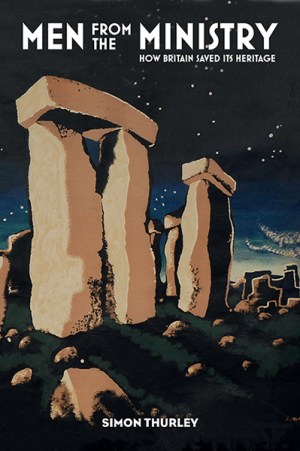 Between 1900 and 1950 the British state amassed a huge collection of over 800 historic buildings, monuments, and sites and opened them to the public. This engaging book explains why the extraordinary collecting frenzy took place, locating it in the fragile and nostalgic atmosphere of the interwar years, dominated by neo-romanticism and cultural protectionism. The government’s activities were mirrored by the establishment of dozens of voluntary bodies, including the Council for the Protection of Rural England, the Society for the Protection of Ancient Buildings, and the National Trust. Men from the Ministry sets all this activity, for the first time, in its political, economic and cultural contexts, painting a picture of a country traumatized by war, fearful of losing what was left of its history, and a government that actively set out to protect them. It dissects a government program that established a modern state on deep historical and rural roots.
Simon Thurley is the Chief Executive of English Heritage. He was formerly the Director of the Museum of London, and the Curator of Historic Royal Palaces.
English Heritage to Become a Charitable Trust

From English Heritage (26 June 2013) . . .
The Government has announced that it will work with English Heritage to consult on establishing a charity to care for the historic properties in the National Heritage Collection on a self-financing basis, supported by Government investment of £80 million. English Heritage will be awarded this one-off lump sum to invest in the National Heritage Collection of 420 historic sites, monuments and collections in its care. This will support its plan to transfer management of the Collection to a charity, licensed by English Heritage’s governing body, The Commission. This investment in historic properties across the entire country will create jobs and boost local economies.
The National Heritage Collection, which includes Stonehenge, Kenwood, Audley End, Dover Castle and Charles Darwin’s home Down House in Kent, will remain in public ownership. However, the new charity will have more freedom to generate greater commercial and philanthropic income to safeguard and present to the public what is arguably England’s most vulnerable and important collection of cultural treasures.
Under current plans, the new charity will be set up by March 2015. It will retain the name English Heritage and in due course, will be completely self-financing and no longer need tax-payer support. (more…)
Campaigning to Save the Chapel at Bretton Hall Park
Press release (20 May 2013) . . .
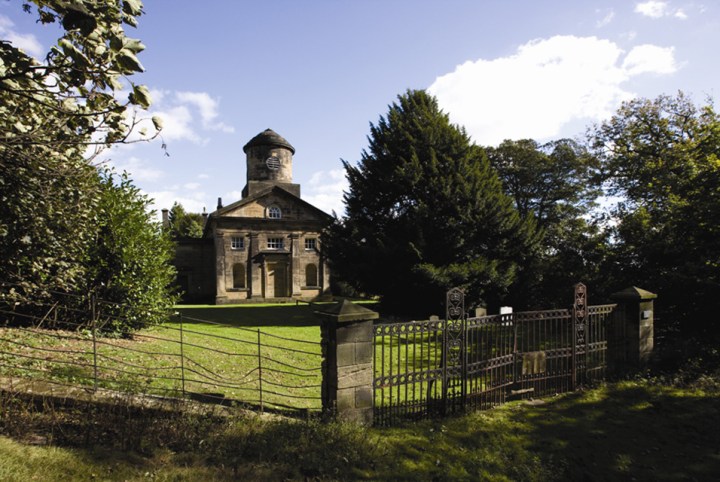
Sir William Wentworth, Chapel of Bretton Hall Park, 1744
Yorkshire Sculpture Park, Wakefield, West Yorkshire
◊ ◊ ◊ ◊ ◊
Yorkshire Sculpture Park (YSP) is campaigning to save one of the oldest surviving buildings on the Bretton Estate and transform it into a gallery space. The 270-year-old YSP Chapel is in an urgent state of repair and must be restored soon, in order to keep it open to the public. The Park’s fundraisers have secured financial support from English Heritage, Country Houses Foundation, The Wolfson Foundation and The Pilgrim Trust but are £100,000 short of the £500,000 needed to complete the full restoration plan. They are now asking visitors and supporters to give whatever they can to help reach the total.
Andy Carver, Director of Development at YSP said: “At a time when public funding is becoming increasingly scarce, we depend on the people and organisations that love YSP to give us their financial support. Restoring the chapel is an important and exciting project for us; it will mean that we can keep this historic building open for future generations to enjoy and allow us to programme new exhibitions of sculpture in the beautiful, tranquil space. At the moment, the conditions in the chapel aren’t suitable for some types of art works and structurally it is deteriorating quite badly. The restoration will bring the building back to its former glory and give us a unique and versatile space for exhibitions and events.”
Built in 1744 by Sir William Wentworth, the Georgian sandstone chapel is a historically important part of the Bretton Estate. Nestled within the YSP Country Park, the Grade II* listed building was at the heart of life on the estate during the 18th and 19th centuries. Renovation plans include replacing the roof, making extensive structural repairs and installing heating. An improved path from YSP Centre and disabled access to the building is also in the pipeline. (more…)










 Enfilade
leave a comment