New Book | Daniells’ India: Views from the Eighteenth Century

◊ ◊ ◊ ◊ ◊
From ACC Distribution:
Thomas and William Daniell, Daniells’ India: Views from the Eighteenth Century, introduction and foreword by B. N. Goswamy (New Delhi: Niyogi Books, 2013), 184 pages, ISBN: 978-9381523636, $200.
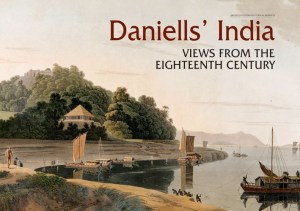 Thomas Daniell was thirty-six years old when he and his nephew William, barely sixteen, sailed out from Gravesend in April 1785, headed for the East. They arrived in Calcutta via China the next year. The Daniells traveled across India, painting oriental scenery wherever they went. Their views were widely appreciated and are representative of that fascinating period. The Daniells returned to England in September 1794. This special book presents a selection of their work in India, bringing alive the scenery and architecture of that age.
Additional images are available here»
B. N. Goswamy, distinguished art historian and author of several books on Indian Art, is Professor Emeritus of Art History at the Punjab University, Chandigarh. His work covers a wide range and is regarded, especially in the area of Indian painting, as having influenced much thinking. The recipient of many honors, Professor Goswamy has taught as Visiting Professor at several universities across the world.
Exhibition | Sacred Stitches: Ecclesiastical Textiles at Waddesdon Manor
Paul Holberton published the catalogue for this exhibition now on view at Waddesdon Manor:
Sacred Stitches: Ecclesiastical Textiles in the Rothschild Collection at Waddesdon Manor
Waddesdon Manor, Buckinghamshire, 27 March – 27 October 2013
Curated by Rachel Boak
 Sacred Stitches accompanies an exhibition that assembles together for the first time fragments of opulent and unique ecclesiastical textiles drawn from the stored collections at Waddesdon Manor, the astonishing Renaissance-style château that is one of the rare survivors of the splendour of the ‘goût Rothschild’. Dating from c. 1400 to the late 1700s, the textiles were acquired by several members of the Rothschild family, the greatest collectors of the 19th century, who sought the highest quality of workmanship with a keen sense of historical importance.
Although it might seem strange for a Jewish family to collect objects associated with the Christian Church, the textiles were prized for their technical and artistic brilliance. Parts of altar frontals, vestments and other church furnishings, they survive as fragments, cushions, banners, hangings and furniture upholstery, as their original purposes were altered to suit tastes and interior styles of the late 1800s. Baron Ferdinand de Rothschild used them in the Bachelors’ Wing at Waddesdon, the first part of the house to be completed in 1880. His sister, Alice, also had an eye for the finest ecclesiastical embroideries, displayed as decorative hangings in her own house nearby. A passionate collector of costume and textiles, Ferdinand and Alice’s niece, Baroness Edmond de Rothschild, shared their interest and added to the collection.

Dress fabric, now a chalice veil, ca. 1745-50, (Rothschild Collection at Waddesdon Manor, acc. #523). Photo by Mike Fear.
Rachel Boak, Curator at Waddesdon Manor, first considers the changing manufacture and style of vestments and furnishings for the Church in the Medieval and early Renaissance period, as well as the impact of the Reformation and the French Revolution, when many vestments and textile furnishings became redundant, were destroyed and their precious metal threads melted down. Her main focus, however, is the collecting habits of Ferdinand, Alice and Baroness Edmond in the context of 19th-century Britain, where George IV’s historicizing coronation of 1821, at which guests wore Tudor-style dress, had brought about a renewed interest in Medieval and Renaissance collecting, design and costume, and the Oxford Movement in 1833 meant a revival of vestments associated with the celebration of the Eucharist.
Each Waddesdon object – its iconography, manufacture and history – is considered individually, illustrated with beautiful new photography that captures all the detail, texture and intricate stitching.
Rachel Boak, Sacred Stitches: Ecclesiastical Textiles in the Rothschild Collection at Waddesdon Manor (London: Paul Holberton, 2013), 80 pages, ISBN: 978-0954731038, £15.
Display at Waddesdon | A Selection of Lace
Now on view at Waddesdon:
Costume at Waddesdon: A Selection of Lace
Waddesdon Manor, 27 March – 27 October 2013
Curated by Rachel Boak
 A selection of lace acquired by Baroness Edmond de Rothschild (1853–1935) is displayed outside the Family Room and shows eighteenth-century lappets, part of a fashionable woman’s headdress. Baroness Edmond collected the exquisite French, Brussels and Venetian lace now at Waddesdon, along with the popular buttons, on long-term display.
A sample from the collection is available here»
Display and New Catalogue | Printed Books and Bookbindings
Now on view at Waddesdon Manor:
 A Celebration of Books and Bindings
Waddesdon Manor, Buckinghamshire, 10 July — 27 October 2013
To mark the publication this year of Giles Barber’s magisterial catalogue of the French 18th-century books and bindings at Waddesdon, a number of highlights of the collection will be on display in the Morning Room at the Manor. The books were collected by Baron Ferdinand de Rothschild towards the end of his life, partly to complement the collections of 18th-century paintings and decorative arts, but also as works of art in their own right thanks to their intricately decorated gold-stamped bindings. The Waddesdon collection is one of the finest in the world, and the publication of the catalogue marks the first time which many of these treasures have been revealed in public.
◊ ◊ ◊ ◊ ◊
Press release from Waddesdon Manor:
Giles Barber, Catalogue of Printed Books and Bookbindings: The James A. de Rothschild Bequest at Waddesdon Manor (London: The Rothschild Foundation, 2013), 1162 pages, ISBN: 978-0954731083, £300.
A new catalogue of Printed Books and Bookbindings marks the completion of the important Waddesdon Catalogue Series, and the final publication of eminent author and book specialist, Giles Barber. The James A. de Rothschild Bequest: Printed Books and Bookbindings, published by the Rothschild Foundation, 2013, presents a scholarly analysis of Waddesdon’s outstanding collection of largely 18th-century French books. These were collected by Baron Ferdinand de Rothschild towards the end of his life, partly to complement the collections of 18th-century paintings and decorative arts, but also as works of art in their own right thanks to their intricately decorated gold-stamped bindings. The Waddesdon collection is one of the finest of its kind in the world, and the publication of the catalogue allows many of these treasures to be revealed to public for the first time. A monumental work in two volumes, the first offers a series of essays, which chart the history of bookbinding, from the materials and techniques used, the histories of the binders themselves, the role of the patron and collector and the fluctuations of the market. One unique feature is the photographic index of every tool used on each book in the catalogue. All the books have been scanned and the individual tools isolated reprographically and reproduced at actual size. As many as 50 separate tools could be used in the creation of a prestigious binding, and being able to identify each one precisely allows comparisons with books in other collections and attributions to particular workshops to be made more accurately than ever before.
The Books and Bookbindings catalogue is also the final publication in the thirteen-volume Waddesdon Catalogue series, which covers the James A. de Rothschild Collection at the Manor as bequeathed to the National Trust. Waddesdon holds one of the most significant collections of 18th-century works of art in the world, comparable with similar holdings in the V&A, the Louvre, the Metropolitan Museum and the Wallace Collection. The impetus to create the catalogue series arose when, on the death of James de Rothschild, the house was bequeathed to the National Trust and the need to make the collections accessible to the public and scholars became pressing. James’s widow, Dorothy, who took over the management of the house and ran Waddesdon until her death in 1988, set up a Catalogue Committee, headed initially by Anthony Blunt, then Director of the Courtauld Institute of Art. He was succeeded as General Editor of the series by Geoffrey de Bellaigue, later Director of the Royal Collection. The first volume, Paintings, by Ellis Waterhouse, appeared in 1967, and over the ensuing half century all the major subject areas of the Collections have been covered, each catalogue written by an eminent specialist in the field. The result is an exemplar in art publishing, with many of the titles, in which world-class objects benefit from exhaustive expert research, setting the standard in their fields.
This tradition of inviting eminent specialists to write the catalogues was especially true of Giles Barber, an internationally acknowledged expert with an unique encyclopaedic knowledge of the French bookbinders’ art. Barber’s career encompassed the Bodleian and the Taylor Institution at Oxford alongside independent writing and research, and included this last extensive catalogue for Waddesdon. Very sadly, Giles died unexpectantly in 2012, leaving the overseeing of the final editorial stages to the former Keeper of the Collections at Waddesdon, Rosamund Griffin, a role she has carried out on almost all the previous catalogues.
Call for Papers | Artistic Practices in Southern Asian Art
Artistic Practices in Southern Asian Art in the Long Eighteenth Century
College Art Association, Chicago, 12-15 February 2014
Proposals due by 15 July 2013
Session sponsored by the American Council of Southern Asian Art (ACSAA)
Panel Chair: Yuthika Sharma, Postdoctoral Fellow, Max Planck Institute of Human Development, Berlin
The eighteenth century in South Asia was an era of transition that saw the gradual decentralization of the Mughal State, the rise of autonomous regional polities as economic hubs and consolidation of the English East India Company as an administrative power. The artistic culture of this period underwent a fundamental change with increasing diversification of the patronage base, the rise of the domestic art market and the consolidation of regional identities. With the Mughal court no longer a dominant venue of artistic production, artists cut across of divides of genres and styles and acquired greater mobility. The rise of collecting, in turn, also indexed a demand for historical paintings and manuscripts contributing to a burgeoning market for copies. Taking a longue durée span between the closing years of the 17th century to the opening decades of the 19th century, we invite papers to consider a range of complexities that signal important shifts within artistic practice in this period. How can we think about in this period differently, reaching beyond conventional art historical categories or regional paradigms of analysis? How did the mobility of artists, ideas, and the rise of new media and print culture create new modes of visual expression? How did artists invent new visual vocabularies to address their cross-cultural contexts? What were the private and public channels through which artworks circulated? What was the role of copies in this period? This panel asks how the art of this transition era can bear upon the present methodologies of art historical analysis and how they can further inform questions about the nature of modernity in this period. While the term modern is taken here as a research problematic, this panel is concerned with explicit and implicit expressions of newness in artistic practices that can enrich new perspectives within South Asian art history.
Please send an abstract (300 words) and a brief one page CV by July 15, 2013 with the subject heading CAA-ACSAA Long 18th Century to: yuthika.sharma@gmail.com.
Exhibition | An Indiscreet Look at the Mechanics of Fashion
Sarah Moroz provides a summary of the exhibition for The Daily Beast (5 July 2013). From the Musée des Arts Décoratifs:
La Mécanique des Dessous: Une Histoire Indiscrète de la Silhouette
Behind the Seams: An Indiscreet Look at the Mechanics of Fashion
Musée des Arts Décoratifs, Paris, 5 July — 24 November 2013
Bard Graduate Center, New York, 3 April — 26 July 2015
Curated by Denis Bruna

Panier à coudes articulé, vers 1770, et corps à baleines, vers
1740-60, Paris, Les Arts Décoratifs, Collection Mode et
Textile et dépôt du musée de Cluny, © Patricia Canino
◊ ◊ ◊ ◊ ◊
This exhibition explores the ‘underworld’ of female and male undergarments such as the fly, the pannier, the corset, the crinoline, the bustle, the pouf, the stomach belt, the bra and other vestimentary devices fashioning the body by means of whalebones, hoops and cushions according to the changing dictates of fashion. Modelling the body sometimes to extremes, these ‘mechanical garments’ enabled the wearer to artificially attain the ideal of beauty of the time. This exploration is full of surprising discoveries since, contrary to common belief, these artifices were by no means a 19th-century speciality. Recourse to these concealed architectures has been constant since at least since the 14th century until the present day. Illustrating the diversity of artifices and their mechanics with museum pieces rarely shown to the public, this exhibition – the first of its kind – takes us ‘backstage’, into another, behind-the-scenes history of clothing and fashion.
La Mécanique des dessous. Une histoire indiscrète de la silhouette (Paris, Musée des Arts Décoratifs, 2013), 272 pages, ISBN : 978-2916914428, 55€.
◊ ◊ ◊ ◊ ◊
Exhibition Press release:

Robe de cour, vers 1760, Lyon, musée des Tissus, achat, 1913
© Lyon, musée des Tissus, photo Pierre Verrier.
L’exposition La mécanique des dessous, une histoire indiscrète de la silhouette présentée aux Arts Décoratifs du 5 juillet au 24 novembre 2013 se propose d’explorer les artifices utilisés par les femmes et les hommes, du XIVe siècle à nos jours, pour dessiner leur silhouette. Ce projet original peut être appréhendé comme une longue histoire des métamorphoses du corps soumis aux diktats des modes successives. Quels sont les mécanismes qui ont contraint les corps des femmes afin d’obtenir des tailles resserrées jusqu’à l’évanouissement, des gorges pigeonnantes contrebalançant un fessier rehaussé à l’extrême, des hanches elargies, ou bien applati des seins et des ventres ?
Comment les hommes eux-mêmes ont-ils poussé leur virilité en bombant artificiellement les torses, en rajoutant des formes aux mollets, ou aux braguettes ? Toutes ces structures faites de fanons de baleine, de cerceaux de rembourrage, mais plus encore de laçages, de charnières, de tirettes, de ressorts ou de tissus élastiques dissimulés sous l’habit sont exposés dans une scénographie de Constance Guisset. Près de deux cents silhouettes rassemblant paniers, crinolines, ceintures d’estomac, faux-cul, gaines, « push up » issus des collections publiques et privées françaises et étrangères permettent, pour la première fois, d’aborder une lecture insolite de la mode liée au corps.
Tout d’abord, l’univers masculin et sa quête de la virilité sont évoqués avec les pourpoints étonnamment rembourrés du XIVe au XVIe siècle ainsi qu’avec les braguettes proéminentes de la Renaissance. Le XVIIIe siècle est caractérisé par les vestes matelassées provoquant des torses arqués. Les amplificateurs de mollets, les ceintures d’estomac et les slips-gaines sont révélateurs de la période XIXe-XXIe siècles. Les femmes, quant à elles, ont de tout temps rivalisé d’imagination et d’artifices avec les premiers corsages baleinés, les vertugadins (premières jupes renforcées de cerceaux de rotin ou de métal), les paniers, les crinolines, les tournures, les corsets, les gaines et les push-up d’aujourd’hui. Cet insolite défilé de mode n’oublie pas non plus les enfants qui ont porté des corsets au moins depuis le XVIIe siècle. Renforcées d’armatures et d’autres mécanismes, toutes ces pièces de vêtement permettaient la rectitude, la verticalité tant attendue par une aristocratie, puis par une puissante bourgeoisie, toutes deux soucieuses d’un idéal de supériorité.
Le parcours tant insolite que didactique donnera la part belle au XIXe siècle. En effet, sous le Second Empire et la Troisième République principalement, le corset règne en tyran pour répondre à l’exigence de la « taille de guêpe » accentuée par l’évasement excessif des crinolines. Après 1870, ce jupon à baleines disparaît et se voit remplacé par la tournure – dite aussi le « fauxcul », la « queue d’écrevisse » ou encore le strapontin – qui donne aux femmes un étrange et sinueux profil d’oie. Au XIXe siècle, les sous-vêtements n’ont jamais été aussi abondants et cachés à la fois. Si, au fil de l’histoire de la mode, les formes évoluent et les techniques s’affinent, le dessein du vêtement mécanique est récurrent : effacer le ventre, comprimer la taille jusqu’à la creuser, maintenir la poitrine, rehausser les seins – parfois les aplatir –, arrondir les hanches. Bref, le confort a souvent cédé le pas à l’apparence jusqu’à ce que, vers 1900, Nicole Groult, Paul Poiret et Madeleine Vionnet instaurent, pour un temps, le goût de la ligne «naturelle».
L’exposition se poursuit avec le soutiengorge, la gaine (et ses exemples masculins). Si le souci du soutiengorge n’est plus de comprimer ou de rehausser les seins mais de les emboîter et les séparer, a-t-il perdu pour autant le rôle essentiel des vêtements baleinés d’autrefois : modeler la silhouette ? De nos jours, les soutiens-gorge « ampliformes » et pigeonnants en vue de créer un effet plongeant même sur les silhouettes les plus menues, répondent encore aux diktats des canons de beauté à une époque où l’on façonne moins son corps par des vêtements que par des régimes, le body building et la chirurgie.
Toutefois, l’histoire du corset, de la crinoline ou de la tournure n’est pas révolue pour autant puisque des créateurs comme Thierry Mugler, Jean Paul Gaultier, Rei Kawakubo pour Comme des Garçons, Christian Lacroix ou Vivienne Westwood, etc. ont livré d’étonnants exemples permettant de clamer que les XXe et XXIe siècles ont fait du dessous d’autrefois un dessus expérimental.
Parallèlement aux deux-cents dessous présentés – et habits complets formés grâce à ces structures dissimulées –, l’exposition montre des mannequins couverts de reconstitutions de paniers, de crinolines ou de tournures, etc., toutes animées afin de saisir l’ingéniosité des mécanismes. De plus, un espace du parcours est spécialement dédié à l’essayage de corsets, de paniers du XVIIIe ou de crinolines, tous spécialement faits à l’identique, afin que le visiteur puisse porter et comprendre ces structures qui ont joué un rôle essentiel dans l’histoire de la mode et des usages vestimentaires.
◊ ◊ ◊ ◊ ◊
Note (added 14 January 2015) — The Bard Graduate Center venue was not part of the original posting; more information is available here»
New Book | Livio Pestilli’s ‘Paolo de Matteis’
From Ashgate:
Livio Pestilli, Paolo de Matteis: Neapolitan Painting and Cultural History in Baroque Europe (Aldershote: Asghate, 2013), 502 pages, ISBN: 978-1409446200, $125.
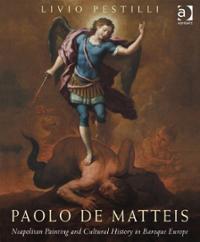 This volume represents a long overdue reassessment of the Neapolitan painter Paolo de Matteis (1662-1728), an artist largely overlooked in English language scholarly publications, but one who merits our attention for the quality of his work and the originality of its iconography, as well as for his remarkable ability to respond creatively to his patrons’ aesthetic ideals and agendas.
Following a meticulous examination of the ways in which posterity’s impression of de Matteis has been conditioned by a biased biographical and literary tradition, Livio Pestilli devotes rich, detailed analyses to the artist’s most significant paintings and drawings. More than just a novel approach to de Matteis and the Neapolitan Baroque, however, the book makes a significant contribution to the study and understanding of early eighteenth-century European art and cultural
history in general, not only in Naples but in other major European centers,
including Paris, Vienna, Genoa, and Rome.
Livio Pestilli is Director and Professor of Art History at Trinity College–Rome Campus.
C O N T E N T S
Introduction
Part I
Framing the Artist: A fabricated life
Enter the critic
Part II Paintings
‘Napoli nobilissima’
Circa 1700
Naples again
A Herculean feat
The celebratory self
Supporting authorship
The skill of a ‘Valentuomo’
Portraying Carthusian values
Campanian connections
The remains of the day
Part III Drawings
‘And truly Paolo was a great draftsman…’
Epilogue; Appendices; Index.
Tim Knox as New Director of the Fitzwilliam Museum
Tim Knox stepped into his new role at the Fitzwilliam Museum earlier this spring. Press release (7 December 2012) from the Soane’s Museum:
 After nearly eight highly successful years as Director of Sir John Soane’s Museum, Tim Knox has been appointed to succeed Timothy Potts as Director and Marlay Curator of the Fitzwilliam Museum in Cambridge.
During his time at the Soane Museum Tim Knox masterminded the restoration of the two houses, Nos. 12 and 14 Lincoln’s Inn Fields, which flank Soane’s original Museum at No. 13. The ambitious OUTS (Opening up the Soane) project, which has involved raising over £7 million, is now fully planned and financed, and ready to move into its second phase, the first having provided a new exhibition gallery, new conservation studios and a new museum shop. At the same time many of Sir John Soane’s original arrangements have been meticulously restored, notably his Picture Room The reinstatement of Soane’s lost private apartments, including his Model Room, is planned and fully funded for 2013.
There has also been notable progress in cataloguing the Museum’s collections and making them available on the Soane’s website; in education; in outreach and access, including disabled access; and in building up support for the Museum among its many generous friends, old and new, here and in the United States.
The Trustees of Sir John Soane’s Museum are, naturally, saddened at the prospect of Tim’s departure, but will set about the task of finding a worthy replacement, confident that the Museum is in very good heart, with plans for the future fully in place and all its systems in excellent order. Simon Swynfen Jervis, Chairman of the Trustees, commented: “Working with Tim has been an exciting and rewarding experience, and we shall greatly miss him, while wishing him the very best in his new role at the Fitzwilliam Museum.”
Knox studied History of Art at the Courtauld Institute of Art. He was appointed Assistant Curator at the Royal Institute of British Architects Drawings Collection in 1989. In 1995 he moved to the National Trust as its Architectural Historian, becoming Head Curator in 2002. He was much involved with the restoration of the gardens at Stowe in Buckinghamshire, and championed the acquisition of the Workhouse in Southwell, Nottinghamshire, Tyntesfield in Somerset, and the restoration of the Darnley Mausoleum in Cobham Park, Kent.
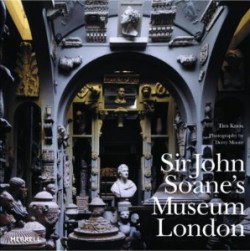 He was appointed Director of Sir John Soane’s Museum in London in 2005, and has since striven to restore Sir John Soane’s glittering architectural treasury to its appearance in 1837, just as its founder wished. In 2009 the next door house, No 14 Lincoln’s Inn Fields, was restored to provide Education facilities, a Research Library and offices for the Museum. In July 2012, the first phase of the £7 million Opening up the Soane project was unveiled, with a new Gallery for temporary exhibitions, a Shop, Conservation Studios and a lift. The next phase of the project, the restoration of Soane’s private apartments, began in April 2013, and the Opening up the Soane project will be fully complete in 2015.
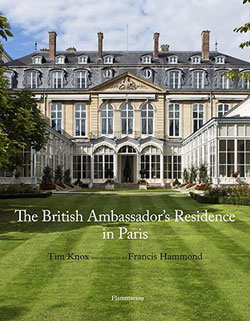 Knox is Historic Buildings Adviser to the Foreign and Commonwealth Office – advising on the presentation of historic ambassadorial residences abroad – and is Chairman of the Government’s Acceptance in Lieu Committee, He sits on the Royal Mint Advisory Committee on the Design of Coins, Medals, Seals and Decorations. He is a Trustee of the Pilgrim Trust and is Patron of the Mausolea and Monuments Trust, which he helped found and Chaired 2000-2005. He is a Fellow of the Society of Antiquaries of London and a Member of the Society of Dilettanti. His Publications include Sir John Soane’s Museum London (Merrell, 2009) and The British Ambassador’s Residence in Paris (Flammarion, 2011).
The Fitzwilliam press release is available here»
Exhibition | Fashioning Switzerland
From The Fitzwilliam:
Fashioning Switzerland: Portraits and Landscapes by Markus Dinkel and His Contemporaries
The Fitzwilliam Museum, Cambridge, 4 June — 15 September 2013
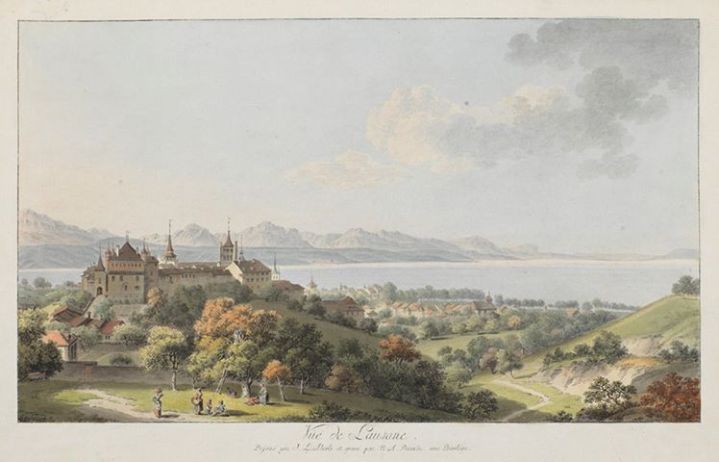
Vue du Lausane (Cambridge: The Fitzwilliam Museum)
◊ ◊ ◊ ◊ ◊
An exhibition of Swiss watercolours and prints featuring a rare selection of finely drawn and coloured portraits of Swiss women in regional costume, by the Bernese artist Markus Dinkel (1762–1832). These are accompanied by other artists’ picturesque views of the Swiss landscape, largely etched and each one delicately hand finished in watercolours.
The prints and drawings on show were made in the century before the establishment of the Swiss federal state in 1848, at a time when foreign tourists were discovering the delights of the various cantons (districts). The images show an affectionate attachment to Swiss landscapes and culture, felt not only by those native to the country, but by the many foreign visitors who collected them as permanent reminders of their travels.
◊ ◊ ◊ ◊ ◊
From Averil King’s review of the exhibition for Apollo Magazine ( 28 June 2013) . . .
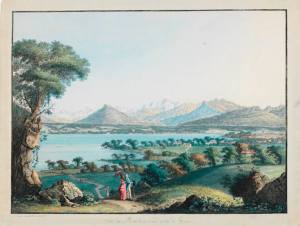
Carl Ludwig Hackert, Vue du Montblanc et Une Partie de Genéve, 1781 (Cambridge: The Fitzwilliam Museum)
Fashioning Switzerland is built around two bequests to the Fitzwilliam Museum: one, in 1910, by the Master and Fellows of Trinity College, Cambridge, of works by the Swiss watercolourist Markus Dinkel (1762–1832); and a later donation, by the Reverend Alfred Valentine-Richards of the Cambridge University Alpine Club, of a number of early views of Swiss mountain scenery. While we may be aware of Swiss artists such as Arnold Böcklin, Jean-Étienne Liotard, Félix Vallotton and Giovanni Giacometti, Dinkel’s name is not a familiar one, and this exhibition, showing his engaging watercolours of Swiss women in regional costume alongside landscapes by his contemporaries, comes as an agreeable surprise. . .
By the late 18th century the formidable mountain chain comprising the Mönch, Eiger and Jungfrau, in the Bernese Alps, was already becoming a tourist destination. So too was the nearby Chamonix (Mont Blanc) range, situated in south-eastern France but clearly visible from the Swiss city of Geneva (as shown in Carl Ludwig Hackert’s View of Mont Blanc and Part of Geneva, 1781). For sightseers, often English Grand Tourists wanting to extend their journeys, the Bernese ‘Three Sisters’ would in time become truly iconic, being portrayed by artists as diverse as Ferdinand Hodler and Emil Nolde. . .
Call for Papers | Society for Emblem Studies Conference
Call for Papers from the Kunsthistorisches Institut at Kiel:
10th International Conference of the Society for Emblem Studies
Some light up, when we read them / Manche leuchten, wenn man sie liest
Christian-Albrechts-Universität zu Kiel, Kunsthistorisches Institut, 28 July — 1 August 2014
Proposals due by 1 September 2013
The conference will devote itself to the entire spectrum of emblem studies, and papers on all aspects of emblematics are welcome. Please submit proposals by 1 September 2013. In additional to a traditional focus on emblem books, the conference will focus on four thematic clusters:
The Domains of the Emblem: Changes in Medium

University Library Kiel. Text was designed by Elsbeth Arlt (Flensburg) in 2002, from André Gide, Les nourritures terrestres et Les nouvelles nourritures (1897), translated into German by Hans Prinzhorn (1930). Photo: Katrin Ulrich, Kunsthistorisches Institut, Kiel.
While emblems are closely associated with the development of printing, emblems can be found in all aspects of life and culture, and they were adapted to these new spaces and uses beyond the page. The choice, application, space, adaption and invention, the compilation of emblematic programs in sacred and secular architectural spaces, and their application to furniture and objects constitute one thematic cluster of the conference. This includes, of course, ephemeral emblems in festivals and theater, and in baptismal and funeral rituals. Emblems in devotional books, novels and other literary genres, on title pages and in paintings and graphics are further topics for consideration. This rubric also includes transitional forms of emblematic expressions, such as emblematized fables and imprese and devices as manifestations of individual or dynastic maxims.
History of Emblem Research
The Tenth Conference of the Society for Emblem Studies provides the opportunity to continue the impetus from the Glasgow conference in 2011 by looking both forward and backward. The beginnings and development of the study of emblems and its most important representatives, beginning with Henry Green, the discoverer of Alciato, and the scholar of mannerism, Mario Praz, will provide the focus here. It will be particularly interesting to compare the various national research traditions and various directions in emblem research with one another, as well as to discover other relationships and contexts. The critical look back is intended to give impetus to new directions in research.
Digitization and Documentation
This area has increasingly become an important focus of research. In addition to completed individual emblem projects with a national or thematic focus, Emblematica Online and its OpenEmblem Portal are now established, providing cross-repository searching across international boundaries. While work continues to expand the scope of the Portal, there now exists a substantial online corpus for emblem studies that facilitates and supports comparative research. There is now greater access to emblem books than ever before. This also supports the study of non-literary emblems.
Text and Image Combinations in Modern Art
The juxtaposition of textual and pictorial elements can be observed in many forms of modern art: photography and painting with integrated or accompanying texts, films, and videos, interactive and internet-based art, and performative art strategies and interventions in public spaces create tension between image and language/text elements. Previously unknown and entirely new forms of expression have been created by assuming textual structures into pictorial forms and by fixing and encoding syntactic models in pictorial contexts. This thematic cluster of the conference is dedicated to questions concerning how modern art employs emblematic strategies that are, however, distinctly different from emblematic ways of constituting meaning. An exhibition in Kiel’s Kunsthalle will complement this part of the conference.
Papers and entire panels on all aspects of your research into emblematics, in addition to these topics, are welcome. Papers can be given in German, English, French, or Spanish. Please let us know if you would like to suggest a panel or moderate a section. Please send us your abstract for a twenty-minute presentation by 1 September 2013.
ihoepel@kunstgeschichte.uni-kiel.de
kunstgeschichte@email.uni-kiel.de










 Enfilade
leave a comment