Conference | Architecture and the Street
From the conference website:
Cambridge Conference Talks VII: Architecture and the Street
Harvard University, Cambridge, 29 March 2013
Organized by Morgan Ng and Jason Nguyen
 The PhD program at the Harvard University Graduate School of Design is pleased to invite you to the seventh annual Cambridge Talks conference, entitled Architecture and the Street, which will take place on Friday, March 29, 2013, 9:00-4:30, in Piper Auditorium, Gund Hall.
No building is an island – and in the context of the city, architecture takes shape in relation to the street. Arcades and façade treatments, lighting fixtures and shop windows, setback and building height restrictions: each of these mediate how buildings interact with streets as spaces of visual display and public sociability. More recently, the construction of flyovers and underground transport systems has transformed streets into ever-more complex, multi-layered spatial armatures for architectural intervention. Streets serve as the liminal zones by which architectural form and symbolism meet with the contingencies of urban life.
Cambridge Talks VII seeks to bring fresh historical themes and tools to bear on the problem of Architecture and the Street. New research promises to enrich and challenge perspectives pioneered by Spiro Kostof, Jane Jacobs, and William H. Whyte. How does the infrastructural function of streets as circulation (of people, goods, water, and waste) press against the static character of architecture? How do streets serve as the spatial framework for social control, ceremony, procession, and protest? How might we theorize and historicize modern streets as sites of cultural memory and nostalgia? And above all, what are the effects of such social, political, and technological forces on architectural form?
Cambridge Talks is generously supported by the Harvard University Graduate School of Design, the Weatherhead Center for International Affairs & the GSAS Graduate Student Council. The event is free and open to the public.
P R O G R A M
9:00 Breakfast
9:30 Introduction
9:45 Session I: The Street between Infrastructure and Architectural Form
• Katherine Rinne (California College of the Arts), Walking on Water in Rome: Streets and Water in the Baroque City
• Richard Wittman (UC Santa Barbara), Architecture, Authority and the Street in Eighteenth-Century Paris
• Eric Mumford (WashU), CIAM, Sert and the Street
Discussion, moderated by Sonja Duempelmann (Harvard)
11:15 Break
11:30 Session II: The Street as Territorial Network
• Gabrielle Esperdy (NJIT), The Street, the Strip, and the Freeway: On the Legibility of Place in the Territories of the Car
• Ateya Khorakiwala (Harvard), Street Paint: A Story of India’s National Development
• Keller Easterling (Yale), No Road
Discussion, moderated by Brian Goldstein (Harvard)
1:00 Lunch Break
2:30 Session III: The Street as Space of Social Protest and Control
• Cesare Birignani (Harvard), The Trouble with the Street
• Christopher Heuer (Princeton) and Matthew Jesse Jackson (UChicago), 7 March 1965: Selma and the Architecture of the Event
• Mariana Mogilevich (NYU), Street Psychology and the Politics of Pedestrianization
Discussion, moderated by Neil Brenner (Harvard)
4:30 Closing Remarks
Conference | On the Way to the Museum, Ancient Art in Germany
From Art-Hist:
Interdisziplinäre Tagung: Auf dem Weg zum Museum
Sammlung und Präsentation antiker Kunst an deutschen Fürstenhöfen des 18. Jahrhunderts
Kassel, 19-20 April 2013
Die Erforschung der Geschichte von Museen, ihrer Sammlungen und ihrer Ausstellungspraxis hat in den letzten beiden Jahrzehnten signifikant zugenommen und ist inzwischen zu einem eigenständigen fachübergreifenden Forschungsbereich der historischen Kulturwissenschaften geworden. Die interdisziplinär ausgerichtete Tagung „Auf dem Weg ins Museum“ lenkt den Fokus erstmalig gezielt auf den Umgang mit antiker Skulptur und Kleinkunst in fürstlichen Sammlungen des deutschen Sprachraumes im „langen“ 18. Jahrhundert (1700 – 1815). Welche Ordnungsprinzipien und Vermittlungsabsichten kennzeichneten diese Zusammenstellungen von antiken Artefakten vor der Herausbildung einer Systematik der Kunstmuseen im fortgeschritteneren 19. Jahrhundert? Auf welche internationalen Vorbilder reagierten die Verantwortlichen? Welche Modelle stellten die Ergebnisse ihrer Bemühungen für andere europäische Fürstenhöfe und die späteren öffentlichen Museen bereit? Das
Erkenntnisinteresse der Tagung richtet sich somit nicht nur auf die historische Rekonstruktion einer vergangenen Sammlungspraxis, sondern auch auf die grundlegenden Entstehungsbedingungen der Institution Museum, wie sie in wesentlichen Zügen bis in die Gegenwart fortbesteht.
◊ ◊ ◊ ◊ ◊
F R E I T A G , 1 9 . 0 4 . 2 0 1 3
I. Höfische Antikensammlungen im deutschen Sprachraum im 18. und frühen 19. Jahrhundert
Moderation: Rüdiger Splitter
9.15 Begrüßung/Einführung
9.30 Gisela Bungarten, Museumslandschaft Hessen Kassel: Die Antikensammlung am Braunschweiger Hof im 18. Jahrhundert
10.15 Kordelia Knoll, Staatliche Kunstsammlungen Dresden: „mit königlicher Pracht aufgestellt“ – Die Dresdener Antikensammlung im 18. Jahrhundert
11:00 Reinhard Stupperich, Institut für klass. Archäologie, Universität Heidelberg: Das Antiquarium der Mannheimer Akademie
11.45 Pause
12.15 Hildegard Wiegel, Archäologisches Institut, Universität Göttingen: Die Vasensammlung Anna Amalias in Weimar – Aufstellung und Kontext
13:00 Caterina Maderna, Institut für klass. Archäologie, Universität Heidelberg: Die Antikensammlung Franz I. von Erbach zu Erbach
13.45 Mittagspause
II. Das Beispiel der Kasseler Sammlungen
Moderation: Charlotte Schreiter
15:00 Antje Scherner, Museumslandschaft Hessen Kassel: Kunstkammer, Kunsthaus, Kabinett. Zur Wechselwirkung von Kunstwerk und Sammlungsort im frühen 18. Jahrhundert
15:45 Justus Lange, Museumslandschaft Hessen Kassel: Das Kasseler Galeriegebäude Landgraf Wilhelm VIII.
16:30 Maximiliane Mohl, Universität Heidelberg: Die Architektur des Museum Fridericianum in Kassel
17:15 Andrea Linnebach, Geschichte der Frühen Neuzeit, Universität Kassel: Das Publikum der Antike. Kunsthaus und Museum Fridericianum als ein Ziel von Bildungs- und Forschungsreisen der europäischen Aufklärung
18:00 Pause
19:00 Abendvortrag: Gerrit Walther, Neuere Geschichte, Universität Wuppertal: Antikensammlungen als Element eines adligen Kulturhabitus in der Frühen Neuzeit
S A M S T A G , 2 0 . 0 4 . 2 0 1 3
III. Antikensammlungen in der literarischen Wahrnehmung um 1800
Moderation: Alexis Joachimides
9:30 Adelheid Müller, Berlin: Strategie und Leidenschaft. Weibliche Wege zur Antikensammlung
10:15 Katharina Krügel, Klassikstiftung Weimar: Sammlungen antiker Abgüsse in Weimar. Orte und Präsentationskonzepte
11:00 Pause
11:30 Christoph Frank, Istituto di Storia e teoria dell’arte e dell´architettura, USI, Mendrisio: Im Schatten Winckelmanns: Friedrich Wilhelm von Erdmannsdorff und Friedrich Rehberg und die Dessau-Wörlitzer Antiken
12:15 Martin Dönike, SFB Transformationen der Antike, HU Berlin: Komplementäre Antiken. Zur kunstgeschichtlichen und-theoretischen Rahmung von Antikensammlungen im goethezeitlichen Weimar
13:00 Mittagspause
IV. Residenz und Museum – Von der höfischen zur musealen Repräsentation
Moderation: Gisela Bungarten
14.15 Bénédicte Savoy, Institut für Kunstgeschichte, TU Berlin: Was kostet die Antike? Preisschätzungen im Inventaire des Musée Napoléon (Louvre) um 1800
15:00 Charlotte Schreiter, LVR-Archäologischer Park Xanten/LVR-RömerMuseum: Repräsentation und Kontext – Antike Plastik und Gipsabgüsse in Sammlungen des 18. Jahrhunderts
15:45 Rüdiger Splitter, Museumslandschaft Hessen Kassel: Neue Forschungen zur Kasseler „Société des Antiquités“
16:30 Pause
17:00 Helen Dorey, Deputy Director, Soane’s Museum, London: Sir John Soane’s Collections of Antiquities
17:45 Stephan Schröder, Museo del Prado, Madrid: Sammlung und Ausstellung von Antiken in Spanien bis zur Einrichtung des Prado
◊ ◊ ◊ ◊ ◊
Veranstalter: Universität Kassel in Kooperation mit der Museumslandschaft Hessen Kassel
Ort: Hörsaal der Kunsthochschule Kassel, Menzelstraße 13, 34121 Kassel
Organisation:
Prof. Dr. Alexis Joachimides (Universität Kassel)
Prof. Dr. Rüdiger Splitter (Museumslandschaft Hessen Kassel)
PD Dr. Charlotte Schreiter (LVR-Archäologischer Park Xanten/LVR-RömerMuseum)
Exhibition | Mozart and Goethe: The Quest of Tone Colours
Press release for the exhibition Im Labyrinth der Farben und Töne at the Mozarthuis (additional information is available at The Art Newspaper). . .
In the Labyrinth of Colours and Sounds: Reflections on Mozart
and Goethe with a Picture Cycle by Bernd Fasching
Mozarthaus Vienna, 24 January 2013 — 12 January 2014
Curated by Gernot Friedel

Johann Wolfgang von Goethe, Colour wheel, 1809
The most extensive special exhibition to date at Mozarthaus Vienna, a member of the Wien Holding group, deals with the investigations of science by Mozart and Goethe. Both were interested in the variety of nature, astronomy and the technical accomplishments of the time and they were fascinated by the connection between light, colours and sounds. The presentation looks at this connection on the basis of documents, letters, portrayals of nature and books from their estates, some of which have never been seen in Vienna before. It is accompanied by new, modern pictures and a sculpture by the Viennese painter and sculptor Bernd Fasching, who will attempt in this way to find a new approach to the image of Mozart.
Goethe’s Thoughts on Music and His Admiration of Mozart
Goethe was one of Mozart’s greatest admirers. As director of the Hoftheater in Weimar he organised 282 opera evenings with works by Mozart including 49 performances of Die Entführung aus dem Serail, 20 of The Marriage of Figaro, 68 of Don Giovanni and 82 of The Magic Flute. In the fragment of his theory of sound he developed a view of music that is still valid today, claiming that it should first be enjoyed with the senses and then judged from intellectual, aesthetic, social and scientific standpoints. Sounds were at the centre of Goethe’s thinking, and Mozart’s music seems to have fitted his theories to a large extent. No other poet has had so many works put to music as Goethe. For him music was the oldest art form from which all others were derived and “to which they should all return” as a sign of its merit. One demonstration of the power of music according to Goethe was the fact that good “old music” in fact never gets old. He was also convinced of the therapeutic effect of music, and his understanding of music was centred on its life-giving and balancing effect.
Goethe’s Theory of Colour
 Goethe’s attempt to devise a theory of sound arose in parallel to his work on colour theory, in which he conducted experiments for years to understand and describe the nature of colour in its entirety. Isaac Newton’s light and colour experiments and his finding that the primary colours exist in sunlight was vehemently contested by Goethe. He believed that sunlight contained only white light and that colours was formed in the human brain. In keeping with the philosophy of the time he based his ideas on his own perception, hence the famous formula: “Colours are the deeds of light that first arise in the human mind and then express themselves only there in deeds and suffering.” In other words they were produced purely by the brain – unlike light, which was just colourless brightness.
From Goethe’s ‘Tone Colours’ to Twelve-Tone Music
In the early 20th century the “physiological complementarity of Goethe’s tone colours” became a structural aspect of chromatic music, leading to twelve-tone music. Emancipating itself increasingly from the major-minor tonality, the music was free and atonal, with compositions based on twelve successive related tones. Ideas like this were developed in Vienna at the turn of the century by Arnold Schönberg, Anton Webern and Josef Hauer.
Even as an old man Goethe recalled a concert by the young Mozart in Frankfurt and spoke of his astonishingly “polychromatic” piano playing. Although Mozart’s music felt as if it had just been invented, he believed that it had been created spontaneously and fully formed in his head. Goethe compared Mozart with master painters like Raphael, Leonardo da Vinci or Michelangelo and looked for links between sound and coloured painting. He said that Mozart had the same abiding importance as a genius as these Italian painters. The sentence “Mozart can be compared with Shakespeare” also comes from him.
A Colour Experience by Mozart and Goethe on One and the Same Day
On 10 December 1777 Mozart wrote to his father from Mannheim that the prince elector did not want to hire him after all and that he would travel to Paris. He later wrote to his friend and patron Michael Puchberg about this devastating “grey experience,” that he had almost fallen into a dark black hole and only his music had protected him from it. At the same time, Goethe was walking on the Brocken, the highest mountain in north Germany, and happily observing the colours of the sky, which ended in the “grey light of evening.” He drew a grey sketch of the landscape, the Brocken by moonlight – two completely different experiences, but both to do with the colour grey and both on the same day!
Mozart, Goethe and the Natural Sciences
Mozart and Goethe were both interested in the latest scientific discoveries. They carried out astoundingly similar observations of animals and nature, as telescopes and measuring instruments continued to be refined. Inspired by the work of J. Ebert, Mozart had gradually acquired a picture gallery of birds and other animals, to which he soon added detailed drawings of plants. The following anecdote is illustrative.
Mozart’s father Leopold died on 28 May 1787 in Salzburg, on the same day as Mozart’s bird, a starling, which he had bought on 27 May 1784 and which had shared his study for three years. It could whistle the first five bars of the Rondo from the Piano Concerto in G major for Barbara Ployer note perfect. Mozart invited friends to an almost macabre double burial procession in memory of his father and the dead bird. Everybody had to follow him and the laid out bird to a small grave that had been dug in the garden. He then wrote a poem dedicated to the starling. He bought another bird, a canary, which kept him company on the many lonely nights while his wife was taking a cure in Baden. Mozart set it free a few hours before he died from this deathbed in a small house at Rauhensteingasse, Stadt 970, Vienna.
The exhibition features original objects such as the only living mask of Goethe made by K. G. Weisser around 1807, Goethe’s fragment “Die Zauberflöte Zweyter Theil” from 1798, and many books from the estates of Mozart and Goethe never before seen in Vienna.
◊ ◊ ◊ ◊ ◊
Gernot Friedel, the curator of this special exhibition, grew up in Innsbruck and studied theatre at the Mozarteum in Salzburg, the Max Reinhard Seminar and the University of Vienna. As assistant director at the Burgtheater and the Salzburger Festspiele he worked with the likes of Herbert von Karajan, Heinz Hilpert, Leopold Lindberg, Fritz Kortner and Otomar Krejca. As a permanent assistant to theatre manager and director Ernst Haeussermann he was responsible for the theatre programme of the Salzburger Festspiele and the Theater in der Josefstadt in Vienna. His first venture as a director was Martin Walser’s Zimmerschlacht at Theater in der Josefstadt with Susi Nicoletti and Curd Jürgens. His work in the theatre includes three new productions of Jedermann by Hugo von Hofmannsthal at the Salzburger Festspiele, with Klaus Maria Brandauer, Helmut Lohner, Gerd Voss and Ulrich Tukur in the main roles. He has received an award from the Province of Salzburg for his work. Friedel has worked as a director for films and television with productions like the documentary Mozart und Da Ponte, Die Zauberflöte, Mozart fragen, a film based on his own play, and Salieri sulle tracce die Mozart, with performers like Wilma Degischer, Heinz Marecek, Klaus Maria Brandauer, Helmut Lohner and Mario Adorf. His work includes plays such as Othello darf nicht platzen with Otto Schenk, scripts, literature programmes, exhibitions and novels.
The painter and sculptor Bernd Fasching, born 1955 in Vienna, created a furore in the year 2000 with his project Westwerk at St Stephan’s Cathedral in Vienna, which was specially opened up for his contemporary exhibition. In a project entitled 12 Days, 12 Nights, the artist created twelve pictures in each of seven cities between 1987 and 2006 inspired by the 12 Labours of Hercules and conversations with the people watching him while he worked. With his walk-in sculpture The Hammer of Thor (1990) in the entrance area of the Museum of Applied Arts (MAK) in Vienna, the project Terra Nova (1996–97) in the Dominican Republic and his latest work A More Complex Reality in Istria the sculptor sends visitors on a personal journey of discovery and brings art to life. The works entitled Mozart Vibrations shown in this exhibition are the result of an intensive study of Mozart.
Conference | Berlin in 1800
As noted at Early Modern Architecture:
Die Klassizität des Urbanen. Resümee, Kritik und Fortgang des
Akademienvorhabens “Berliner Klassik”. Eine Großstadtkultur um 1800
Zentrum Preußen-Berlin der Berlin-Brandenburgischen Akademie der Wissenschaften, 14-16 März 2013
Veranstalter: Cord Friedrich Berghahn, Conrad Wiedemann
Mit freundlicher Unterstützung der Stiftung Preußische Seehandlung
Das Akademienvorhaben “Berliner Klassik. Eine Großstadtkultur um 1800” befasste sich zwölf Jahre lang mit der Rekonstruktion einer urbanen Kulturblüte, die von der Forschung beharrlich ausgeblendet wurde, obwohl sie nach Bedeutung und aktueller Wirkung eigentlich nur mit dem Ereignis Weimar-Jena vergleichbar ist. Hauptgegenstand der Forschungsarbeit waren dabei nicht die bekannten großen Einzelfiguren und Einzelleistungen, sondern die soziokulturellen Rahmenbedingungen (Institutionen, Milieus, Kontroversen), aus denen heraus sich deren Besonderheit versteht. Mit der Tagung wollen wir die Vielfalt der geleisteten Quellen- und Konzeptarbeit festhalten und der öffentlichen Diskussion zuführen. Der Eintritt ist frei. Eine Anmeldung ist erwünscht, bitte schreiben Sie an Christopher Drum (bk-stud@bbaw.de).
◊ ◊ ◊ ◊ ◊
D O N N E R S T A G , 1 4 M ä r z 2 0 1 3
14.00 Günter Stock, Präsident der BBAW, Begrüßung
14.10 Cord Berghahn (Braunschweig), Einleitung
14.25 Conrad Wiedemann (Berlin), “Berliner Klassik” als kulturgeographisches Problem. Zu Absicht und Gang eines abgebrochenen Forschungsprojekts
15.30 Pause
15.45 Klaus Gerlach (Berlin), Das Berliner Nationaltheater – Bühne des klassischen Berlin
16.30 Uta Motschmann (Berlin), Die Berliner Vereine als Laboratorien einer großstädtischen Gesellschaft
17.15 Claudia Sedlarz (Berlin), Berliner Klassizismus und die Berliner Akademie der Künste Ende ca. 18.00 Uhr
20.00 Abendvortrag: Werner Busch (Berlin), Die klassizistische Karikatur. Zu Gottfried Schadows Zeichnungen
F R E I T A G , 1 5 M ä r z 2 0 1 3
09.00 Walther Gose (Trier), “… dass die gesunde Vernunft immer mehr und mehr auf den Thron aller menschlichen Angelegenheiten erhoben werde”. Die ‘Gesellschaft von Freunden der Aufklärung’ (Geheime Berliner Mittwochsgesellschaft) 1783-1798
09.45 Iwan Michelangelo D’Aprile (Potsdam), “Wissenschaft von heute” Gegenwartsreflexion und Zeitgeschichtsschreibung in Berlin um 1800
10.30 Pause
10.45 Günter Oesterle (Gießen), Popularität – Urbanität – Freiheit: Kunst der Prosa in Berlin um 1800
11.30 Anne Baillot (Berlin), “Der Hauptzweck einer Akademie der Wissenschaften muss dieser sein, Unternehmungen zu machen und Arbeiten zu liefern, welche kein Einzelner leisten kann” – August Boeckh als Projekt
12.15 Mittagspause
14.00 Cord Berghahn (Berlin), Karl Philipp Moritz’ zirkumpolare Wirkung in Berlin
14.45 Hans-Georg von Arburg (Lausanne), Zur Architekturästhetik von Karl Philipp Moritz und ihren Folgen für
einen klassisch gewordenen Epochenbegriff
15.30 Pause
15.45 Christoph Wingertszahn (Düsseldorf), Die Stadt als Schwall. Karl Philipp Moritz als Zeitungsschreiber
16:30 Matthias Hahn (Berlin), Ein Neuerer der Innendekoration: Louis Catel, Architekt, Berlin, Weimar
17.15 Harald Tausch (Gießen), Gießen oder Berlin. Ortsnamen aus der Sicht eines Berliner Spätromantikers
S A M S T A G , 1 6 M ä r z 2 0 1 3
09.00 Ute Tintemann (Berlin), Isaac Azulay alias Joseph Leonini (1769 – 1840): Ein italienischer Sprachmeister in Berlin
09.45 Jürgen Trabant (Berlin), Der fremde Mund. Über Individualität und Alterität bei Wilhelm von Humboldt
10.30 Pause
10.45 Felix Saure (Hamburg), Wilhelm von Humboldt und Friedrich Ludwig Jahn
11.30 Laurenz Lütteken (Zürich), Konstruktionen der Klassik. Schwierigkeiten im Umgang mit einem musikhistorischen Problem
12.15 Abschlusspanel, Moderation Günter Oesterle
Works in Progress from The Met’s Fellow Program
A series of colloquia take place from 26 February to 30 April 2013. On Tuesday, 9 April, Donato Esposito is scheduled to speak on Reynolds’s collection in the nineteenth-century. The full schedule is available (as a PDF) here»
◊ ◊ ◊ ◊ ◊
The Metropolitan Museum’s Fellowship Colloquium
The Metropolitan Museum of Art, New York, 9 April 2013
The Fellowship Program at The Metropolitan Museum of Art cordially invites you to attend colloquia on works in progress by art history, conservation, and scientific research fellows. The following talks will be held in Bonnie J. Sacerdote Lecture Hall, Ruth and Harold D. Uris Center for Education. These colloquia are made possible in part by Mrs. Henry S. Blackwood.
Moderator: Xavier F. Salomon, Curator, European Paintings
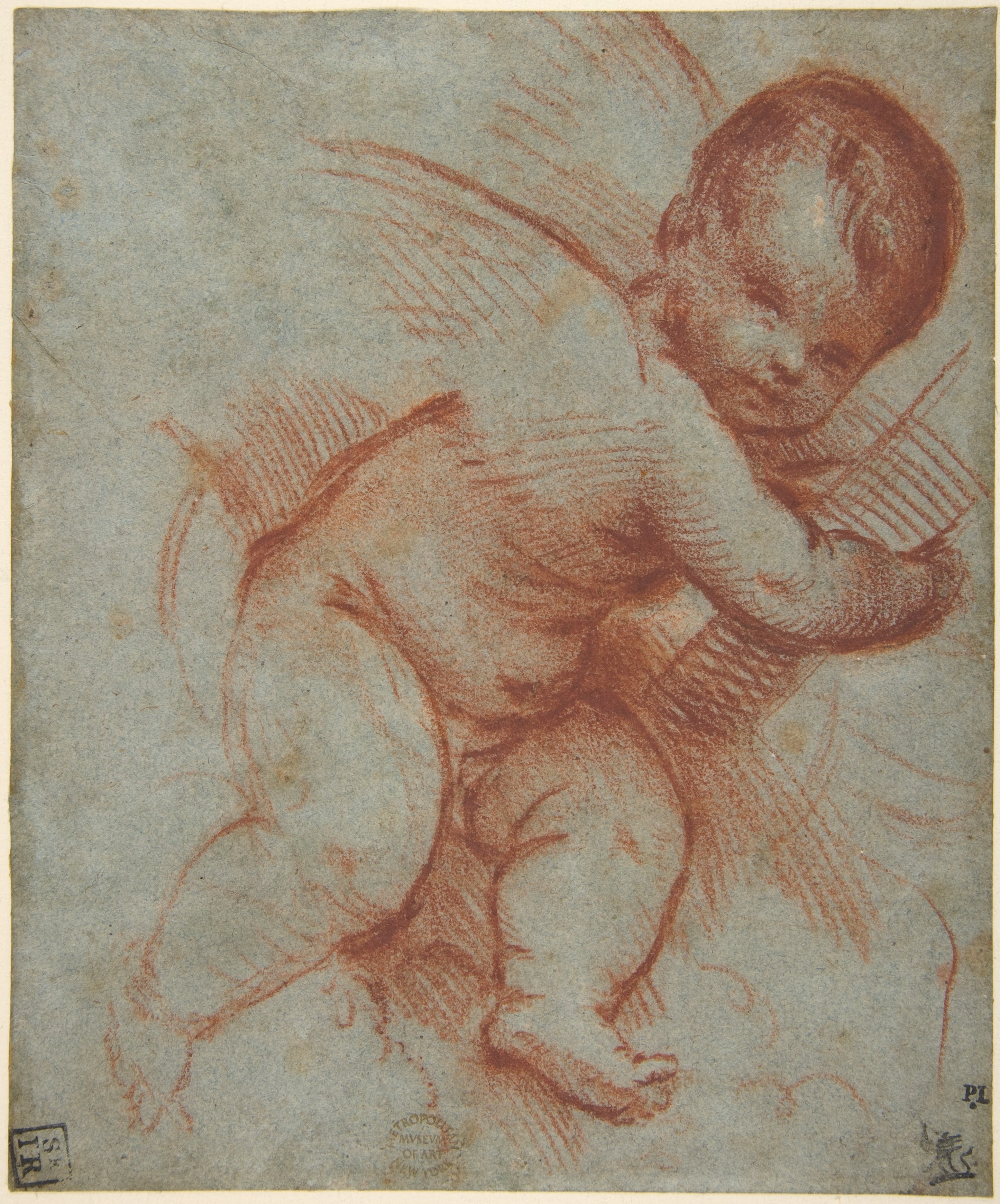
Circle of Titian, Putto Holding the Base of a Cross (New York: Metropolitan Museum of Art, Rogers Fund, 1911). Part of the collection of Joshua Reynolds in the eighteenth century.
10:00 Ronda Kasl (Chester Dale Fellow, European Paintings), “Miquel Alcanyís and Gherardo Starnina: Two Altarpieces from the Valencian Church of San Juan del Hospital”
10:30 Linda Borean (Andrew W. Mellon Fellow, European Paintings), “Self-Portraits and Portraits of Artists in Seicento Venice”
11:00 Valeria De Lucca (Jane and Morgan Whitney Fellow, Musical Instruments), “Roman Heroes / Roman Patrons: Constructing Aristocratic Identity in Seventeenth-Century Rome”
Intermission
11:45 Furio Rinaldi (Andrew W. Mellon Fellow, Drawings and Prints), “Timoteo Viti (1469/70–1523): An Artist and Collector in the Footsteps of Raphael”
12:15 Donato Esposito (Andrew W. Mellon Fellow, Drawings and Prints), “‘Many Curious and Valuable Things’: Sir Joshua Reynolds’s Collection in Nineteenth-Century New York”
12:45 Allen Doyle (Jane and Morgan Whitney Fellow, Robert Lehman Collection), “Michelangelo as Bad Object: Horace
Vernet’s Renaissance”
Forthcoming Book | Stretch: America’s First Family of Clockmakers
From ACC Distribution:
Donald L. Fennimore & Frank L. Hohmann with Onie Rollins, Stretch: America’s First Family of Clockmakers (Winterthur Museum, 2013), 376 pages, ISBN: 978-0912724706, $75.
 This volume presents the definitive history of the UK-born Stretch family of clockmakers who emigrated to Philadelphia in 1703 and played an influential role in the city’s early clockmaking, civic, and Quaker communities. Initial essays discuss the family and the importance of their Quaker beliefs; time-telling and the clockmaking community in pre-1750 Philadelphia; innovative mechanical advances made by the Stretches; and their notable civic and cultural contributions to the city.
The catalog section of the book features 84 of the 133 Peter, Thomas, and William Stretch clocks discovered during the course of the project, illustrating and fully describing both the cases and the works. The majority of the clocks, passed down through the generations and still in private collections, are being published for the first time.
C O N T E N T S
Foreword, Acknowledgments, Introduction
Chapter 1 – Time and Telling Time in Early Philadelphia
Chapter 2 – Peter Stretch and Family
Chapter 3 – Stretch Clocks and the Philadelphia Clockmaking Community before 1750
Catalogue: Peter Stretch Clocks, Nos. 1 – 62; Thomas Stretch Clocks, Nos. 63 – 78; William Stretch Clocks, Nos. 79 – 84
Appendix 1 – Peter Stretch Will and Inventory
Appendix 2 – Thomas Stretch Will and Inventory
Appendix 3 – Samuel Stretch Will and Inventory
Appendix 4 – Clock Owners in Philadelphia, 1684 – 1750
Appendix 5 – Stretch Signature Plates: A Comparison
Appendix 6 – Stretch Clocks: A Comparison
Appendix 7 – Identified Stretch Clocks
Appendix 8 – Genealogy
Endnotes, Bibliography, Index
Donald L. Fennimore, Curator Emeritus, served as metalwork specialist at Winterthur Museum, Delaware, for 34 years. The list of his numerous publications includes Metalwork in Early America (Winterthur, 1996); Iron at Winterthur (Winterthur, 2004); and Silversmiths to the Nation: Thomas Fletcher and Sidney Gardiner (ACC, 2007).
Frank L. Hohmann III, a retired Wall Street executive, is a collector of 18th-century furniture, with a concentration on brass dial clocks. He co-authored and published the volume Timeless: Masterpiece American Brass Dial Clocks (2009). He is a Trustee of Winterthur Museum, Delaware and a Liveryman in the Worshipful Company of Clockmakers.
Exhibition | Indiennes Sublimes
Thanks to Hélène Bremer for noting this exhibition of eighteenth- and nineteenth-century printed textiles at the Musée de la Toile de Jouy (an English description is available here) . . .
Indiennes Sublimes
Villa Rosemaine, Toulon, 13 September 2011 — 31 January 2012
Musée de la Toile de Jouy, Jouy-en-Josas, 21 February — 23 June 2013
 L’exposition Indiennes sublimes est proposée au musée de la Toile de Jouy par la Villa Rosemaine, centre d’étude et de diffusion du patrimoine textile situé à Toulon. Elle présente les indiennes, toiles de coton peintes et imprimées des Indes, de Perse, de Provence mais aussi de Jouy. Moins connues que les fameuses « toiles de Jouy », si on donne à ce terme le sens de « toiles monochromes à personnages », leur production était pourtant bien plus importante.
Nous remontons le temps grâce à cette exposition, aux origines et à l’apparition du coton imprimé en occident à la fin du XVIIe siècle et à la naissance des compagnies d’importation occidentale. Les compagnies des Indes portugaises, anglaises, hollandaises puis françaises vont « déballer » en Europe et à Marseille des produits jusqu’alors inconnus : le café, les épices, les pierres précieuses et… les indiennes, initialement réservées à la noblesse ou à la riche bourgeoisie. Les 1ères impressions françaises et anglaises étaient de simples imitations, pour devenir grâce aux efforts technologiques et esthétiques, de véritables “labels” avec le développement d’importants centres
d’indiennage.

Motif aux écailles imbriquées, circa 1790, Manufacture Oberkampf, Jouy-en-Josas. © Serge Liagre / Villa Rosemaine. Click on the photo for additional images
Indiennes sublimes sera présentée grâce à la passion de collectionneurs provençaux qui ont réuni une sélection de leurs plus belles pièces parmi lesquelles de nombreux costumes. Elle sera enrichie par des œuvres des collections du musée de la Toile de Jouy (costumes, kalemkhar, boutis etc.). Cette exposition a fait l’objet d’un très beau catalogue lors de sa présentation à la Villa Rosemaine (Toulon) qui sera mis en vente à la boutique du musée.
Paper-Cut Project
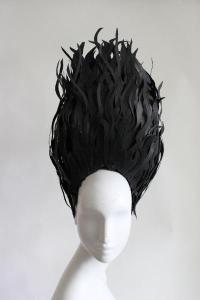
Amy Flurry and Nikki Nye, Marie Antoinette (2006), paper, 2012
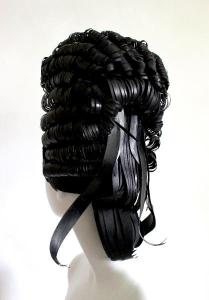
Amy Flurry and Nikki Nye, Marie Antoinette (1938), paper, 2012
As profiled by Rinne Allen and Lucy Allen Gillis in the recent issue of Selvedge Magazine 50 (Jan/Feb 2013), Amy Flurry and Nikki Nye, co-founders of the Atlanta-based company Paper-Cut Project, contributed sixteen paper wigs for the V&A’s recent exhibition Hollywood Costume. Given that notice of Isabelle de Borchgrave’s paper dresses exhibited in San Francisco in 2011 remains one of the most popular postings here at Enfilade, I would expect readers to be similarly interested in these paper hair pieces.
–CH
New Book | Le Ciseau et la Tiare: Les Sculpteurs dans la Rome des Papes
From Publications de l’École Française de Rome:
Anne-Lise Desmas, Le ciseau et la tiare : les sculpteurs dans la Rome de Benoît XIII, Clément XII et Benoît XIV, 1724-1758 (Rome: École Française de Rome, 2012), 471 pages, ISBN: 978-2728309405, 50€ / $95. [available from Artbooks.com]
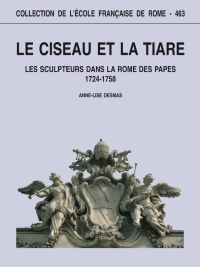 L’image monumentale de la Ville éternelle, des statues de la fontaine de Trevi ou de la façade du Latran à celles des fondateurs d’ordres dans la nef de Saint-Pierre, a été largement façonnée par les sculpteurs des pontificats de Benoît XIII, Clément XII et Benoît XIV. Pourtant, ces artistes, tels Maini, Bracci et Della Valle, restent méconnus.
C’est ce grand atelier et ses acteurs que cet ouvrage fait revivre, entrelaçant recherches monographiques et études sociales, reconstitutions de carrières, enquêtes sur les institutions artistiques et examen stylistique des œuvres.
Cette approche globale prend en compte tous les rouages de ce vaste chantier sculptural, du transport du marbre à la composition des décors éphémères, de la restauration d’antiques aux concours, des commandes privées de monuments funéraires à l’organisation des grands chantiers, souvent dominés par la figure de l’architecte. Elle examine aussi différents milieux, dont celui de l’Académie de France où brillent Adam et Bouchardon, et retrace le parcours romain de sculpteurs italiens, tels le Napolitain Benaglia, le Florentin Cornacchini ou le Vénitien Corradini.
Ces années, entre Rusconi et Canova, restent dominées par le poids de la tradition héritée du siècle de Bernin. Or c’est l’un des paradoxes que cherche à élucider cette étude : pourquoi la Rome des Lumières n’a-t-elle pas laissé émerger l’un de ces artistes qui, incontestablement talentueux, lui assurèrent une abondante et remarquable production sculpturale ?
The table of contents is available as a PDF here»
Exhibition | Dalou, Regards sur le XVIIIe Siècle
Press release from the Cognac-Jay:
Dalou, Regards sur le XVIIIe Siècle
Musée Cognac-Jay, Paris, 18 April — 13 July 2013
Curated by Cécilie Champy-Vinas and Benjamin Couilleaux
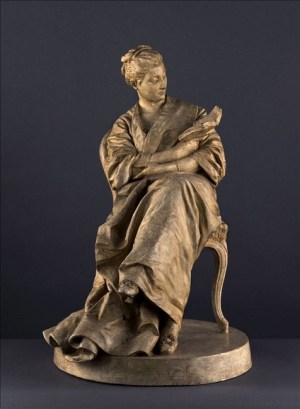
Aimé-Jules Dalou, La Liseuse (Paris: Petit Palais, Musée des Beaux-Arts de la Ville de Paris) © Petit Palais/ Roger-Viollet
À l’occasion de la publication du catalogue raisonné du fonds Dalou conservé au Petit Palais, le Musée Cognacq-Jay accueille une sélection d’œuvres de ce grand sculpteur du XIXe siècle, en les confrontant à ses propres collections du XVIIIe siècle.Trente-cinq terres cuites, plâtres et bronzes, issus des collections du Petit Palais et du musée Carnavalet, sont présentés parmi les collections permanentes. Cette manifestation montre comment un grand artiste républicain du XIXe siècle pouvait puiser son inspiration dans le siècle des Lumières, balançant entre l’exaltation des hauts faits de la Révolution et la nostalgie des grâces de l’art rocaille.
D’une famille parisienne modeste, « communard » en 1871, ce qui lui valut de s’exiler à Londres jusqu’en 1879, le sculpteur Aimé-Jules Dalou (1838-1902) commence sa carrière en France dans les années 1880. Artiste engagé, il eut à cœur de célébrer la République depuis ses origines, c’est-à-dire depuis la Révolution. Sa carrière est jalonnée de monuments ambitieux à la gloire des grands hommes de ce temps, de Mirabeau répondant à Dreux-Brézé le 23 juin 1789, un des épisodes fondateurs de la Révolution, en 1883, au Monument à
Hoche, dernière commande publique passée à l’artiste en 1900.
Pendant son exil à Londres et après son retour à Paris, Dalou a également réalisé de nombreuses œuvres intimistes. Pour celles-ci, il se tourne souvent vers un autre XVIIIe siècle, celui des grâces enfantines, des bacchanales et des intrigues d’alcôves. Ses portraits d’enfants, ses baigneuses et ses groupes mythologiques font écho aux créations de Boucher, Clodion ou Lemoyne.
En parallèle, le Petit Palais, musée des Beaux-arts de la Ville de Paris, présente du 18 avril au 13 juillet Dalou. Le sculpteur de la République, première exposition monographique consacrée à l’artiste. Près de trois cents œuvres seront présentées, en grande partie inédites, provenant de collections publiques et privées en France et à l’étranger.










 Enfilade
leave a comment