Submissions for the Oscar Kenshur Book Prize
Oscar Kenshur Book Prize
Applications due by 31 January 2013
The Center for Eighteenth-Century Studies at Indiana University is pleased to announce its annual book prize, to be awarded for an outstanding monograph of interest to eighteenth-century scholars working in a range of disciplines. The prize honors the work of Oscar Kenshur, professor emeritus of comparative literature at Indiana University, a dix-huitièmiste par excellence, and one of the founding members of the Center.
Submissions in English from any discipline are welcome; authors can submit their work irrespective of citizenship. Multi-authored collections of essays and translations, as well as books by members of the Indiana-University-Bloomington faculty, are not eligible. The Kenshur prize of $1000 will be awarded together with an invitation to the Center for Eighteenth-Century Studies for a workshop dedicated to the winning book, in which several colleagues will discuss the book from different disciplinary perspectives. The Center will cover the author’s expenses to attend this event.
To be eligible for this year’s competition, a book must carry a 2012 copyright date. Submissions can be made by the publisher or the author: three copies must be received at the ASECS office by the 31st of January 2013. Please send the books (clearly marked for Kenshur Prize) to ASECS, 2598 Reynolda Rd., Suite C, Winston-Salem, NC 27106. For further inquiries please contact Professor Mary Favret, Director of the Center for Eighteenth-Century Studies at Indiana University (email favretm@indiana.edu).
Conference | European Portrait Miniatures
European Portrait Miniatures: Artists, Functions and Collections
Celle Castle, Celle, Germany, 25-27 January 2013
 The conference is being held on the occasion of the opening of the fifth exhibition of the Tansey Collection and the publication of the accompanying catalogue Miniatures from the Time of Marie-Antoinette in the Tansey Collection on 25 January 2013.
Admission is free. Celle Castle as well as the Bomann-Museum nearby are within walking distance (20 minutes) from Celle railway station. Trains from Hannover take approximately 25 to 45 minutes (Deutsche Bahn, Metronom or S-Bahn). For more information and for registration, please contact bernd.pappe@miniaturen-tansey.de.
◊ ◊ ◊ ◊ ◊
F R I D A Y , 2 5 J A N U A R Y 2 0 1 3
16:30 Opening of the exhibition Miniatures from the Time of Marie-Antoinette in the Tansey Collection
18:00 Visit of the exhibition and reception at the Bomann-Museum Celle
19:30 Dinner
S A T U R D A Y , 2 6 J A N U A R Y 2 0 1 3
Objects, Agencies, and Social Practices
9:00 Marcia POINTON (Manchester), Intimacy, Exclusion and Revelation: The Portrait Miniature as Image and Object, ca. 1640-1800
9:30 Bert WATTEEUW (Antwerp), Miniature Dramas: The Portrait Miniature as a Literary Motif in Early Modern European Drama
10:00 Discussion
10:15 Coffee
Politics and Representation
10:45 Vanessa REMINGTON (London), ‘Philistines or Connoisseurs?’: The Collecting of Miniatures by the Early Hanoverians at the English Court, 1714-1760
11:15 Karin SCHRADER (Bad Nauheim), Between Representation and Intimacy: The Portrait Miniatures of the Georgian Queens
11:45 Friederike DRINKUTH (Schwerin), Intimacy and Ancestry: A Dynastic Souvenir for Queen Charlotte
12:15 Discussion
12:30 Lunch
13:45 Laurent HUGUES (Nîmes), The Commissions of Miniatures of the Royal Family from France According to the Archival Sources, 1725-1792
14:15 Sarah GRANT (London), Miniatures of the Princesse de Lamballe (1749-1792): The Portraiture, Patronage and Politics of a Royal Favourite
14:45 Sigrid RUBY (Gießen/Saarbrücken), Love Affairs with the Founding Father: Portrait Miniatures of George Washington – Modes of Creation and Display
15:15 Discussion
15:30 Coffee
European Miniature Collections (part I)
16:00 Stephen LLOYD (Edinburgh), A Group of Miniatures by Jacob van Doordt (fl. 1606 – d. 1629) in the Buccleuch Collection
16:30 Thierry JAEGY (Paris), Masterpieces of Miniature Painting in French Private Collections
17:00 Markus MILLER (Eichenzell), The Collection of Portrait Miniatures of the Landgraves and Grand Dukes of Hesse-Darmstadt
Andreas DOBLER (Eichenzell), The Miniature Collection of Empress Friedrich in Castle Fasanerie
17:45 Discussion
19:30 Dinner
S U N D A Y , 2 7 J A N U A R Y 2 0 1 3
European Miniature Collections (part II)
9:00 Elizaveta ABRAMOVA (Saint Petersburg), The Collection of Miniatures from the State Hermitage, Saint Petersburg
9:30 Izabela WIERCZINSKA (Warsaw), The Enchantment of History: Selected Masterpieces from the Miniatures Collection of the Great Dukes of Hesse and by Rhine
10:00 Discussion
10:15 Coffee
10:45 Astrid SCHERP (Munich), The Collection of Portrait Miniatures of Elector Palatine Johann Wilhelm von der Pfalz (1658-1716)
11:15 Lucyna LENCZNAROWICZ and Danuta GODYN (Cracow), The Highlights of the Miniatures Collection at the National Museum in Cracow
11:45 Discussion
12:00 Lunch
Techniques and Materials
13:15 Emma RUTHERFORD (London), The Plumbago Portrait in Britain
13:45 Julia SEDDA (Berlin), Silhouettes: The Fashionable Paper Portrait Miniature around 1800
14:15 Discussion
Miniature Painters
14:30 Nathalie LEMOINE-BOUCHARD (Paris), Charles-Paul-Jérôme de Bréa (1739-1820) and his Work in Miniature
15:00 Coffee
15:30 Catherine DE LEUSSE (Paris), Mme. Herbelin, a Miniaturist of the July Monarchy and of the Second Empire
16:00 Roger and Carmela ARTURI PHILLIPS (Ferndown, Dorset), Miniature Painting in the 20th Century
16:30 Discussion
16:45 Closing Remarks
◊ ◊ ◊ ◊ ◊
From Artbooks.com:
Catalogue: Juliane Schmieglitz-Otten and Bernd Pappe, Miniaturen der Zeit Marie Antoinettes aus der Sammlung Tansey / Miniatures from the Time of Marie Antoinette in the Tansey Collection (Munich: Hirmer, 2013), 500 pages, ISBN: 978-3777490212, $105.
The Tansey miniatures, now housed in the Bomann Museum in Celle, form one of the most significant collections of European miniature paintings. Miniatures from the Time of Marie Antoinette in the Tansey Collection is the fifth book in a series exploring this collection by key periods; 168 works, mostly by French artists, are examined in actual size using the outstanding photographs of Birgitt Schmedding. The final 50 years of the 18th century constituted one of the most magnificent periods in the art of miniature painting, with regard to both style and technique. The artists, who produced these portraits for private gifts, not only excelled in applying watercolours to ivory, but also expressed great ingenuity in their representations of affection and love. The authors Bernd Pappe and Juliane Schmieglitz-Otten, both renowned connoisseurs in this field, detail and analyse each work. Introductory essays by leading specialists provide further insights into this fascinating time for miniature painting. The Tansey Collection, started about thirty years ago by the German-American couple Lieselotte and Ernest Tansey, was donated in part to the Bomann Museum in Celle 1997.
New Book | Common Land in English Painting, 1700-1850
From Boydell & Brewer:
Ian Waites, Common Land in English Painting, 1700-1850 (Woodbridge: Boydell Press, 2012), 216 pages, ISBN: 978-1843837619, $90.
 During the eighteenth and nineteenth centuries, much of England’s common land was eradicated by the processes of parliamentary enclosure. However, despite the fact that the landscape was frequently viewed as unproductive, outmoded and unsightly, many British landscape painters of the time – including Constable, Gainsborough and Turner – resolutely continued to depict it.
This book is the first full study of how they did so, using evidence drawn not only from art-historical picture analysis, but from contemporary poems and novels, and the contemporary pamphlets, essays and reports that advanced the rhetoric of both agricultural improvement and new theories on landscape aesthetics. It highlights a deep-rooted social and cultural attachment to the common field landscape, and demonstrates that common land played a significant but – until now – underestimated role in both the history of English art and of the formation of an English national identity, reflecting what are still highly sensitive issues of
progress, nostalgia and loss within the English countryside. Recasting common land as a recurrent facet of English culture in the modern period, the numerous paintings, drawings and prints featured in this book give the reader a comprehensive and evocative sense of what this now almost wholly lost landscape looked like in its hey-day.
Ian Waites is Senior Lecturer in History of Art and Design at the University of Lincoln.
Horowitz Foundation Funds Institute for American Arts at BGC
Recently announced by the BGC:
The Bard Graduate Center is pleased to announce that it has been awarded a grant of $1 million by the Mr. and Mrs. Raymond J. Horowitz Foundation for the Arts to establish the Center’s first named institute.
“The study of American material culture and art has always been a cornerstone of the BGC academic mission,” said Dean Peter N. Miller. “This magnificent commitment from the Horowitz Foundation will not only enhance the BGC’s existing program and provide essential financial support to our students, but also enable us to think big.”
Over the past several years, the Horowitz Foundation has generously supported the BGC through grants for exhibitions on topics of American material culture presented by the BGC Gallery. This latest award will provide a firm foundation to sustain and grow a key aspect of the Center’s academic program. Among the Horowitz Institute’s teaching, research, and scholarship components will be:
• A fellowship awarded to a PhD student with an approved dissertation topic focusing on an aspect of American material culture
• The Materials of American Art program to provide MA students with first-hand exposure to materials and techniques used to create objects and opportunities to engage with artists and artisans working in a variety of media
• A prize for the best Qualifying Paper on a topic in American art
• The establishment of the Mr. and Mrs. Raymond J. Horowitz Foundation Seminars for advanced discussion of a wide range of topics and issues in architecture, decorative arts, design, and collecting involving American material culture
• The creation of a book prize for the best manuscript in the field of American art and culture to be awarded in the name of Mr. and Mrs. Raymond J. Horowitz
“I founded the BGC in 1993 with the conviction that the aspirations and habits of civilization are revealed through art and objects, which are fundamental to our lives,” said Dr. Susan Weber, BGC Founder and Director. “The Horowitz Institute will benefit future professors, curators, and authors who will one day be making valuable contributions to the scholarship in the field. We extend our deepest gratitude to the directors of the Horowitz Foundation for this significant commitment that will serve both student need and the wider academic community.”
The Raymond and Margaret Horowitz Foundation was established by an extraordinary couple. New Yorkers to the core, they collected American Impressionist art avidly, beginning in the early 1960s, when there were few others interested in this genre. Mr. and Mrs. Horowitz scoured galleries in New York and Boston, and bought singular examples in oil, watercolor, pastel, charcoal, and print media. In 1999, forty-nine Impressionist and Realist paintings and works on paper from the collection were exhibited at the National Gallery of Art, Washington, DC, and the response was resounding.
“The Horowitz Foundation was formed to better the education, exhibition, and scholarship in the field of American art. Thus far grants have been made to many institutions, museum and university alike. We are proud to assist the Bard Graduate Center in their work, which has been consistently thoughtful in approach and brilliant in execution,” commented Warren Adelson, Director of the Horowitz Foundation.
American Material Culture at the BGC
From its inception in 1993, the BGC has seen the study of American decorative arts and material culture as a cornerstone of the graduate program. Several members of the faculty specialize or teach in areas pertaining to American art, design, and cultural history. Among them are Ken Ames, one of this country’s leading authorities on American silver; Catherine Whalen, a specialist in American craft; and David Jaffee, a specialist in the material culture of early America. An anthropologist, Aaron Glass focuses his research on the material culture of Native American cultures, particularly those found in the Northwest Coast. Ivan Gaskell, Pat Kirkham, Michele Majer, and Amy Ogata teach and publish in aspects of American material culture ranging from costumes and textiles to architecture, design, film, and history.
Organized by the academic programs department and open to the general public, BGC’s Seminar Series is a venue for advanced intellectual discussion in New York City and an expression of the range of methods and approaches for studying the cultural history of the material world. In 2007, the BGC inaugurated a special series focused on New York and American Material Culture. Since then leading scholars of American history from such venerable institutions as Yale, Brown, Winterthur, the University of Virginia, and the Getty Institute have come to the BGC to examine a wide range of topics related to architecture, decorative arts, design, and collecting.
Lectures | Michael Fried, ‘David – Manet, une affinité ignorée’
As noted at Le Blog de l’ApAhAu:
Michael Fried, David – Manet, une affinité ignorée
Collège de France, Paris, 21 and 28 March 2013
Les professeurs du Collège de France, sur la proposition du professeur Marc Fumaroli, ont invité :
Michael Fried (J.R. Herbert Boone Professor of Humanities and the History of Art, John Hopkins University, Baltimore)
à donner une conférence sur le sujet suivant:
David – Manet, une affinité ignorée
Ces leçons auront lieu les jeudis 21 et 28 mars 2013, à 11 heures dans l’Amphithéâtre Maurice Halbwachs, 11, place Marcelin-Berthelot, 75005, Paris.
Exhibition | Precision and Splendor: Clocks and Watches at The Frick
With time on our minds, it seems like an appropriate posting to begin the new year. It’s easy enough still to connect ‘precision’ to our twenty-first conceptions of time (even if my own clocks are anything but precise). Yet, I imagine ‘splendor’ is a more difficult association for us to make. And yet what a lovely thought! A very happy 2013 to all of you! -CH
◊ ◊ ◊ ◊ ◊
Press release (7 December 2012, as PDF) from The Frick:
Precision and Splendor: Clocks and Watches at The Frick Collection
The Frick Collection, New York, 23 January 2013 — 2 February 2014

Garniture of One Clock and Two Vases, ca. 1770, clock movement by Jean Martin, Chinese hard-paste porcelain garniture, Qing dynasty, Qianlong period, with French gilt-bronze mounts, clock 21 x 8 inches, vases 14 x 9 inches, Horace Wood Brock Collection
Today the question “What time is it?” is quickly answered by looking at any number of devices around us, from watches to phones to computers. For millennia, however, determining the correct time was not so simple. In fact, it was not until the late thirteenth century that the first mechanical clocks were made, slowly replacing sundials and water clocks. It would take several hundred years before mechanical timekeepers became reliable and accurate. This exhibition explores the discoveries and innovations made in the field of horology from the early sixteenth to the nineteenth century. The exhibition, to be shown in the new Portico Gallery, features eleven clocks and fourteen watches from the Winthrop Kellogg Edey bequest, along with five clocks lent by the collector Horace Wood Brock that have never before been seen in New York City. Together, these objects chronicle the evolution over the centuries of more accurate and complex timekeepers and illustrate the aesthetic developments that reflected Europe’s latest styles. Precision and Splendor: Clocks and Watches at The Frick Collection was organized by Charlotte Vignon, Associate Curator of Decorative Arts, The Frick Collection. Support for the exhibition is generously provided by The Selz Foundation, Peter and Gail Goltra, and the David Berg Foundation.
Timekeeping during the Renaissance

Isaac Thuret or Jacques Thuret, case attributed to André-Charles Boulle, Marquetry-Veneered Barometer Clock, ca. 1690–1700, case veneered with marquetry of ebony, tortoiseshell, and brass, mounted with gilt bronzes, H.: 45 1/4 inches (New York: The Frick Collection, Bequest of Winthrop Kellogg Edey) Photo: Michael Bodycomb
It is not known when, where, or by whom the first mechanical clock was invented, but by the mid-fifteenth century several European towns had a monumental timekeeper, powered by falling weights, incorporated into the architecture of a church or public hall. Smaller versions of weight-driven clocks could also be found in the homes of a few wealthy individuals. The existence of mechanical clocks was made possible by an invention known as an escapement. Falling weights (and later springs) provided the energy to power the clock’s mechanism, while the escapement regulated the rate at which that energy was delivered to the oscillator (at first a simple balance and later a pendulum). The introduction of the escapement gradually caused the shift away from time-finding devices (sundials) and time-measuring devices (water clocks) to timekeepers (clocks and later watches) as advances in science and technology were made.
In the fifteenth century progress in metallurgy made possible the production of springs, which ultimately led to the development of portable clocks powered by a coiled spring rather than a weight. The origins of the spring-driven clock are almost as obscure as the invention of the weight-driven clock. Evidence suggests that the idea came from Italy. In the early 1400s Filippo Brunelleschi and others made drawings of spring-driven devices that made the invention of the portable timekeeper possible. One of these devices was the fusee, a cone-shaped spindle that equalizes the diminishing force of a coiled spring as it unwinds. Ornate and prohibitively expensive, clocks at this time were regarded as objects of curiosity; their principal function was to display the wealth and erudition of their owners and to entertain guests at banquets.
The earliest example in the exhibition that incorporates an escapement, a coiled spring, and a fusee is a gilt-brass table clock made in Aix-en-Provence about 1530 by Pierre de Fobis. One of the most famous French clockmakers of his time, Fobis is still recognized today for his durable and highly refined movements. The Frick’s clock is among Fobis’s rare surviving works and is one of the earliest extant spring-driven timekeepers. Its complex movement is set into a typical sixteenth-century French clock case, inspired by classical architecture and ornament rediscovered during the Renaissance. Except for the small dial in blue enamel, the hexagonal gilt-brass case is covered entirely with acanthus scrolls, urns, winged heads, and tiny figures whose limbs morph into elegant, intertwining foliage. The initials “IM” found on each face may refer to the original owner, perhaps Jean Martin, who was instrumental in bringing Renaissance architecture to France.
Germany was a leading producer of clocks during the Renaissance, and, by the late sixteenth century, Augsburg was an important center of their manufacture. The gilt-brass and silver table clock made by David Weber around 1653, most likely for his admission to the Augsburg clockmakers’ guild, exemplifies his expertise. Although Weber chose a popular form for the clock’s case, he demonstrated his imagination and hand skills in its finely worked surfaces. The tower, composed of two tiers, rises to the formidable height of nearly two feet. Balancing precariously atop a winged sphere, a female figure represents the Roman goddess Fortuna and serves as a reminder of the capriciousness of life.Because of this association, Fortuna was often used to adorn timekeepers, even as their orderly mechanisms worked to undermine her. Floral motifs decorating the clock elaborate on its symbolic message: carnations, like Fortuna, allude to capriciousness; tulips symbolize luck and plentitude; and narcissi remind us of fleeting youth and rebirth. The base depicts the four elements—air, water, fire, and earth—symbolizing cosmic order and harmony. The complex mechanism includes seven dials that provide astronomical, calendrical, and horary information. The prominent central dial is an astrolabe with twenty-one star pointers and two concentric hands, which relate to the sun and moon. The smaller dial beneath it is an alarm.
Development of the Watch
Watches were introduced in the middle of the sixteenth century following the refinement of spring-driven clocks. Like the early clocks, the first watches were inaccurate, valued primarily as luxury items and fashion accessories by men and women of distinction. Just as clocks were unreliable until the pendulum clock was invented in 1653, watches became more accurate only after 1675 when the balance spring was introduced. During the seventeenth and eighteenth centuries, the most sought-after watches were decorated with enamels to resemble miniature paintings on paper, parchment, or ivory. A stunning example is an early balance-spring watch made in Switzerland about 1685. The movement by Henry Arlaud is set into a lavish enamel case by Pierre Huaud II. Both men were the sons of French Protestants who had fled France and established themselves in Geneva in the early seventeenth century. The Huaud family popularized the practice of decorating watchcases with miniature paintings created with opaque colored enamels over a ground of pure white enamel. A painting or a print usually inspired the scenes. In this case, Huaud based his composition after The Toilet of Venus, a large canvas of around 1640 by the French artist Simon Vouet. It is unlikely that Huaud ever saw the painting (now at the Carnegie Museum of Art, Pittsburgh), copying instead the engraving of 1651 made by Vouet’s son-in-law, Michel Dorigny. Indeed, the scene on the watch is oriented like the engraving, which is a reverse image of the original painting. Huaud chose to execute the composition using the rich and vivid colors that were his family’s trademark.
Eighteenth-Century Splendor: Remarkable Loans

Clock with Study and Philosophy, movement by Renacle-Nicolas Sotiau, figures after Simon-Louis Boizot, ca. 1785−90, patinated and gilt bronze, marble, enameled metal, and glass, H.: 22 inches, Horace Wood Brock Collection
The precision and splendor of the art of clockmaking in France during the eighteenth century is extremely well represented by several clocks from the collection of Horace Wood Brock. Although by this point their mechanisms had become both reliable and accurate, clocks continued to be valued as objects of distinction used to display their owners’ wealth and refinement. A perfect example is the lavish clock with its two matching vases. Made of a rare type of Chinese porcelain known as celadon bleu fleuri, the already costly vases were embellished with a movement by Jean Martin and gilt-bronze mounts shortly after their importation to France, in an attempt to satisfy French collectors’ perpetual quest for increasingly more elaborate and novel luxury items. The mounts reflect the latest style, the goût grec (Greek taste), which developed in the 1760s and 1770s as a reaction to the rococo style favored by Louis XV and his court. Here the beautifully chased mounts include crowns of laurel, acanthus leaves, pilasters, lion’s masks, and other motifs inspired by classical Greek and Roman architecture. A gilded snake indicates the time.
Cases for clocks reached new heights of elaborateness in France during the late eighteenth century, often incorporating sculptures in bronze made by or after renowned artists. One such example is the stunning mantel clock of about 1785 to 1790 representing Study and Philosophy after a sculpture by Simon-Louis Boizot. A classical symmetry is achieved by placing within an imaginary equilateral triangle the figure of Study on the left, Philosophy on the right, and a column topped by a globe in the center. This composition is completed by the harmonious contrast between the dark patinated figures, the clock’s white marble column and dial, and its gilt-bronze ornamentation.
Breguet: Innovative Horologists

The Dance of Time, Three Nymphs Supporting a Clock, movement by Jean-Baptiste Lepaute, sculpture by Claude Michel Clodion, 1788, terracotta, gilt brass, and glass, H.: 40 3/4 inches (New York: The Frick Collection, bequest of Winthrop Kellogg Edey) Photo: Michael Bodycomb
The exhibition concludes with important watches and clocks by the innovative horologist Abraham-Louis Breguet and his son, Antoine-Louis Breguet, who, at the end of the eighteenth and beginning of the nineteenth century, created highly accurate movements set in sober and elegant cases. Writing in 1982 Winthrop Edey—who bequeathed his collection of clocks to the Frick in 1999—described the elder Breguet as “a phenomenon without parallel. He was the genius of his age, perhaps the most outstanding horologist of all time.” Indeed, Breguet’s combination of technical skill, refined design, and exquisite craftsmanship gave him an unrivaled reputation. His patrons included Louis XVI, Napoleon, and most of the civil and political leaders of his day.
A modern looking watch by the Breguets is one of the very few watches or clocks to include both traditional and decimal dials. The decimal system, introduced during the French Revolution, affected not only weights and measures, but also time. (Decimal time divided the day into ten hours and the year into ten months.) This new division of time, however, proved impossible to enforce: the Republican calendar, introduced on the autumnal equinox in 1792, remained in use for only thirteen years; the decimalization of the day, issued by a 1793 decree, was abandoned in less than eighteen months. The Breguet watch was probably made shortly before or after Abraham-Louis returned to Paris from Switzerland in April 1795. The traditional twelve-hour dial was made after 1807, when his son joined the business. The provenance of the watch is notable as well: it belonged to the influential politician and art collector Antoine-César Praslin, duc de Choiseul.
◊ ◊ ◊ ◊ ◊
Course with Joseph Godla and Charlotte Vignon — The Art and Science of Horology
The Frick Collection, New York, 7 February 2013, 5:30pm
Curious about clocks and watches? It’s about time you joined us for this after-hours session for undergraduates and recent graduates. Participants will learn about stylistic and technical advances in European timepieces made between 1500 and 1830 and study examples from the Frick’s special exhibition up close.
The Frick is pleased to offer courses for college students and recent graduates under the age of 35. Space is limited to twenty participants, and advance registration is required; please visit our Web site or e-mail students@frick.org. A $25 annual fee is payable upon acceptance and includes student membership to The Frick.
◊ ◊ ◊ ◊ ◊
Seminar with Joseph Godla and Charlotte Vignon — What Time Is It?
The Frick Collection, New York, 14 March 2013, 6:00pm
For centuries, “What time is it?” was a difficult, almost impossible, question to answer. This seminar examines several clocks and watches from the sixteenth to the early nineteenth century that attempted—sometimes successfully, sometimes not—to measure time.
Seminars provide unparalleled access to works of art and encourage thought-provoking discussion with experts in their fields. Sessions, held when the galleries are closed to the public, are limited to twenty participants. Advance registration is required; register online or by calling 212.547.0704. $100 ($90 for Members).
◊ ◊ ◊ ◊ ◊
William J. H. Andrewes (museum consultant and sundial maker) — The Tapestry of Time
The Frick Collection, New York, 17 April 2013, 6:00pm
Time is woven throughout the fabric of our civilization. Although its impact on our society today is greater than ever before, most people know very little about its history or the origins of the intervals that control our lives. Through images of major works of the art and science of horology, this talk will describe the evolution of time measurement from around 1600 to the present.
This lecture is free. No reservations are necessary, and seating is on a first-come, first-served basis. This program will be webcast live and thereafter can be viewed on our Web site or The Frick Collection’s channel on FORA.tv.
Scholars in Residence this Spring at the YCBA
From The Yale Center for British Art:
Visiting Scholars
The Yale Center for British Art offers short-term residential awards to scholars undertaking research related to British art. The awards are intended to enable scholars working in any discipline, including history, the history of art, literature, and other fields related to British visual and material culture, to study the Center’s collections of paintings, sculptures, drawings, prints, rare books, and manuscripts, as well as primary and secondary reference materials. The Visiting Scholars for Spring 2013 are as follows:
January 7 – February 1
William L. Coleman, PhD candidate, History of Art Department, University of California, Berkeley. To conduct research for a dissertation entitled “Constable, Cole, and the Country House: The Domesticated Landscape in Anglo-American Art, 1800-1850.” Coleman’s dissertation project studies the way in which the art of house portraiture participated actively in dialogues about aesthetics, wilderness, leisure, and class in Britain and the United States in the early nineteenth century. The Center’s rich collection of country house portraits, including one of Constable’s earliest house portraits, Trentham Park (ca. 1801), will be examined.
January 7 – March 1
Matthew C. Hunter, Assistant Professor, Department of Art History and Communication Studies, McGill University. To conduct research for a project entitled “Joshua Reynolds’s ‘Nice Chymistry.’” Drawing upon collections and archival materials uniquely available at the Center, Coleman’s project uses Reynolds’s complex engagement with painting’s “nice chymistry” to reconsider this crucial figure in British art and the longer legacies of his practice.
January 14 – March 8
Chi-ming Yang, Assistant Professor of English, University of Pennsylvania. To pursue research for a book project entitled Global Chinoiserie and the Lives of Objects, 1660-1800. This project examines how Asian decorative art shaped English discourses of racial difference in eighteenth-century literary and visual culture.
February 3 – March 1
Ada Sharpe, PhD candidate, Department of English and Film Studies, Wilfrid Laurier University. To conduct research for a dissertation entitled “Rapture at Work: Romanticism and the Discourses of Female Accomplishment.” Materials to be consulted from the Center’s Rare Books and Manuscripts collection include a number of handbooks (some explicitly aimed at female readers) that provide instruction on the decorative arts, as well as commonplace books compiled by women living in Britain during the late eighteenth and early nineteenth centuries.
February 3 – May 24
Joerg Trempler, Privatdozent, Member of the Collegium for the Advanced Study of Picture Act and Embodiment, Humboldt University, Berlin. To conduct research for a project entitled “On Representations of Elemental Violence or the Invention of the Image of Catastrophe.” A range of materials from the Center’s collections which focus on the subject of catastrophes will be explored, including images and accounts of the Great Fire of London of 1666.
March 3 – March 29
Sean Willcock, PhD candidate, Department of History of Art, University of York. To conduct research for his PhD thesis, “Consolidating the Colonies: Art and Unrest in the British Empire, c.1850-1900.” Taking the form of a series of case studies predominately relating to colonial India, Willcock’s project considers moments of turbulence or crisis in which the British invoked graphic and photographic practices with a degree of ideological urgency and with an eye to their military or diplomatic utility. Among the materials to be consulted at the Center are William Simpson’s sketchbooks (of which over 200 are in the YCBA) and Sir Charles D’Oyly’s watercolors.
April 3 – April 27
Stephen Bann, Emeritus Professor of History of Art, University of Bristol, will be at the Center as a Senior Visiting Scholar. Professor Bann will be bringing to completion a major edition of the letters of Ian Hamilton Finlay, which extends over the years 1964-74. This correspondence covers the vital period in which Finlay built upon his decisive move from metrical to concrete poetry, producing innovatory poster poems and poems sand-blasted on glass, and finally establishing his celebrated garden of Stonypath/Little Sparta, in the Pentland Hills, near Edinburgh. Professor Bann will also be initiating a project on “British Prints and Printmakers in the Long Nineteenth Century.” Senior Visiting Scholars are invited to spend one month at the Center annually for a term of three years, pursuing their research and participating in the intellectual life of the Center and Yale University. This is Professor Bann’s second year at the Center.
◊ ◊ ◊ ◊ ◊
Andrew W. Mellon Foundation Curatorial Scholars
This spring the Center welcomes four curators from different British museums as part of a new program generously funded by the Andrew W. Mellon Foundation. This program provides four-week residential fellowships to curators based in museums in regions in the UK, beyond London, whose curatorial remit or activities encompass British art. These awards are intended to enable curators to make use of the resources and collections of the Center, and other Yale holdings where relevant, in order to advance research on their own collections or curatorial projects. While in residence, visiting curators will be encouraged to engage with the scholarly community of the Center and at Yale, discuss their research projects, and share information about the collections they oversee. Our first curatorial scholars in this program, all visiting in Spring 2013, are:
March
Charlotte Keenan, Tomlinson Curator of Works on Paper, across the three art galleries managed by National Museums Liverpool; the Walker Art Gallery, Lady Lever Art Gallery and Sudley House. She will conduct research into the British artist Walter Sickert for a catalogue and major exhibition of works by the artist from their collection, planned for 2014 and tentatively titled Walter Richard Sickert: The Hand behind the Brush.
April
Sara Cooper, Collection Curator at the Towner, a contemporary art museum in Eastbourne, East Sussex, will investigate works in the Center’s collection by the British artist Robert Bevan, who was local to Eastbourne but is not yet represented in the Towner collection. She will examine Bevan’s connections with his contemporaries, including Sickert, Wadsworth and Nash, who are well-represented in the Center’s collections as well as in those at the Towner.
May
Anna Rhodes is Assistant Collections Officer, Buxton Museum and Art Gallery, and coordinator for Enlightenment! Derbyshire, part of the Heritage Lottery Funded Enlightenment Project, a partnership focused on the enhancemnt and interpretation of collections relating to Derbyshire. She will investigate the Center’s holdings relating to 18th- and 19th-century Derbyshire, particularly topographical art by professional and amateur artists.
Lucy Salt, Keeper of Art for Derby Museums and Art Gallery, will conduct preliminary research for a major retrospective of Joseph Wright of Derby, which aims to revisit his artistic and Enlightenment legacy and explore the artist’s place in the shaping of the modern world, utilizing the YCBA’s own important collection of works by Wright and his contemporaries.
Call for Papers | Medieval Manuscripts in the Eighteenth Century
Collections, remaniements, expositions: Les vies du manuscrit médiéval
aux périodes moderne et contemporaine
Institut national d’histoire de l’art, Paris, 18 November 2013
Proposals due by 19 May 2013
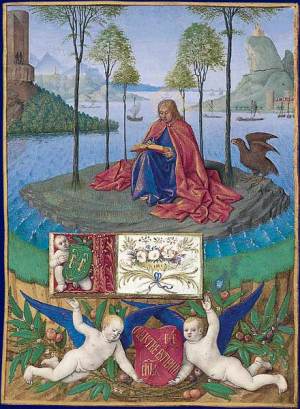
Saint Jean à Pathmos. Heures d’Étienne Chevalier, enluminées par Jean Fouquet (Chantilly: Musée Condé) Photo from Wikimedia Commons
Dismantled codices, where pages have been extracted from their original contexts, have provided museums with important examples of medieval and Renaissance illumination. Although artists of the late medieval period began to create single-leaf illuminations, many of the pages donated and purchased by museums resulted from the cutting and reshaping of complete manuscripts during the eighteenth century, a phenomenon which was spurred by changing collecting practices that favoured the presentation of single objects as a works of art.
Despite their importance to the history of the book, these objects are rarely displayed, little studied, and generally unknown. In the fall of 2013, a series of three exhibitions will be presented in collaboration with the INHA (the French National Institute for Art History): the first at the Musée des Beaux-Arts in Angers, followed by the Palais des Beaux-Arts in Lille, and then the Musée des Augustins in Toulouse. These exhibitions, which will help to inform audiences about this fragile heritage, will bring together objects from the collections of museums and learned societies in regions such as the Centre and Pays de la Loire, Nord-Pas-de-Calais, Picardy and
Champagne-Ardenne, Midi-Pyrénées and Languedoc-Roussillon.
To mark this occasion, the INHA will organize a one day conference on the 18th of November, 2013. This Journée d’études will consider the history of modern and contemporary manuscript collections, paying special attention to the practice of cutting, pasting, and revising medieval works during the eighteenth century. Issues relating to the conservation, restoration, and exhibition of these objects in museums will also be taken into account.
The famous manuscripts known as the Hours of Etienne Chevalier by Jean Fouquet is an example of this phenomenon. Dismembered during the eighteenth century, its miniatures were pasted on panels to create independent images satisfying the desires of collectors. For both economic and aesthetic reasons, the history of medieval books is full of similar examples of assembly from several manuscripts, collections of initials, and detached single leaves. Such practices reveal the tastes and the aspirations of collectors, some of whom were famous for their approach to illuminated manuscripts (J. Granger and J. Bagford during the eighteenth century, or Luigi Celotti during the nineteenth century). Collectors and learned societies played an important role in the constitution of certain collections, facilitating the preservation of many illuminated works. Papers may thus address the following questions:
• Practices of collectors concerning illuminated manuscripts from the beginning of the modern era to the contemporary period (cutting, reshaping, destruction, creation of false/fakes/false leaves, etc.)
• The development of manuscripts collections in museums
• The conservation, restoration and presentation of manuscripts in museums or private collections and learned societies from the nineteenth century to the present day
Communications in English, French or Italian. Please send an abstract of 250 words with a CV (maximum two pages) to Tania Lévy (tlevy@info-histoire.com) and Judith Soria (judith.soria@yahoo.fr) before the May 19th, 2013. The program will be announced in July 2013.
For the call for papers in French, click here»
Exhibition | The Patina of Time
From the Musée Cognacq-Jay:
La Patine du Temps: Conservation et restauration des oeuvres d’art
Musée Cognacq-Jay, Paris, 11 September — 30 December 2012
 Le musée Cognacq-Jay conserve essentiellement des œuvres du XVIIIe siècle et certaines sont plus anciennes encore : elles ont donc plusieurs siècles d’âge et toutes n’ont pas traversé le temps sans dommage. Sous le titre La Patine du temps, un parcours est proposé au visiteur, dans les salles-mêmes du musée, pour lui permettre de comprendre la fragilité des œuvres d’art, la manière dont elles vieillissent, ce que l’on peut faire pour freiner ce vieillissement ou ce que l’on doit attendre d’une restauration. Quatorze panneaux pédagogiques scandent la visite : À quoi ressemble un tableau en bon état ? Que faire d’une sculpture cassée ? figurent ainsi parmi les questions qui sont abordées.
Des restaurations récemment effectuées sur L’Ânesse de Balaam de Rembrandt et Le Retour de chasse de Diane de François Boucher, deux peintures majeures du musée Cognacq-Jay, font l’objet d’une étude plus minutieuse. Mais la conservation et la restauration des pastels, des sculptures ou du mobilier sont aussi évoquées en prenant des exemples éclairants parmi les œuvres du musée. De fait, ce sont aussi aux techniques de fabrication des
œuvres que le visiteur est initié.
Ce parcours fait suite à l’ouvrage publié sous le même titre en 2011, La Patine du temps, rédigé par Georges Brunel, directeur honoraire, et José de Los Llanos, actuel directeur du musée Cognacq-Jay.
◊ ◊ ◊ ◊ ◊
Catalogue: Georges Brunel and José de Los Llanos, La Patine du Temps (Paris: Paris-Musées, 2011), 71 pages, ISBN: 978-2759601547, 12€.
Techniques « Tous les êtres ont leur histoire : toi et moi en avons une, les oeuvres d’art aussi. L’histoire, c’est toute l’épaisseur du temps écoulé depuis que l’on est venu au monde. Il s’est pour ainsi dire condensé dans des craquelures, des accidents de surface, un changement des teintes… » Avec ce douzième titre de la collection « Petites Capitales », le lecteur est confronté aux questions délicates soulevées par la restauration des oeuvres d’art. Le temps ne se remonte pas… Comment présenter son passage sous le jour le plus favorable ? Beau sujet de débat entre Fiordiligi et Dorabella, deux jeunes Italiennes en visite au musée Cognacq-Jay. La vivacité de leur dialogue nous entraîne dans une méditation sur l’oeuvre et le temps, sur l’évolution du goût, à partir des restaurations exemplaires du Retour de chasse de Diane de Boucher et de L’Ânesse du prophète Balaam de Rembrandt, deux chefs d’oeuvre du musée Cognacq Jay. Rendre compte de la richesse du patrimoine parisien, de ses deux mille ans d’histoire et de la diversité des collections de la Ville de Paris, voilà l’ambition de la collection « Petites Capitales ». Le principe de chaque ouvrage est de rassembler une trentaine d’oeuvres emblématiques – peintures, dessins, sculptures, photographies, archives – autour d’un thème, en privilégiant le détail révélateur ; en regard de chaque illustration, des textes et de brefs commentaires créent un jeu de correspondances toujours éclairantes, sur le mode d’une érudition sensible et accessible à tous.
◊ ◊ ◊ ◊ ◊
Bénédicte Bonnet Saint-Georges reviewed the exhibition for The Art Tribune (available in English and French) . . .
The Musée Cognac-Jay is inviting visitors to rediscover their collections by taking a close look at the patina of time. Painting on canvas or wood, marquetry or upholstered furniture, terracotta sculpture…each object presents specific conservation, renovation and restoration problems. Though restorations must be reversible, legible and not alter the nature of the work since the signing of the Venice Charter in 1964, this has not always been the case.
Fourteen explanatory panels dealing with these various problems are scattered throughout the museum using examples of objects on view in the respective rooms. The didactic theme addresses the general public as does the publication behind this hang : written by Georges Brunel and José de Los Llanos, it is in the form of a dialogue between two women visiting the Musée Cognac-Jay. . . .
The full review is available here»
Fellowships | History of the Material Text at UCLA
Visiting Fellows in History of the Material Text
University of California Los Angeles
Applications due by 1 February 2013
The UCLA Center for 17th- and 18th-Century Studies announces two two-year visiting positions in History of the Material Text, to be housed in the Departments of History and English, respectively. These positions are designed to enable participation in the life of the Center and the appropriate Department, as well as fuller use of the riches of the William Andrews Clark Memorial Library and the Special Collections of the UCLA Libraries. We seek scholars of early modern studies (16th-18th centuries), broadly defined, whose expertise includes but is not limited to book history, history of the material text, and print cultures, in Europe and beyond. Applicants should have received their doctorates in the last six years (no earlier than July 1, 2007 and no later than September 30, 2013).
Visiting fellows will teach two courses per year in their respective Department, one of which would be at the Clark Library. Fellows are also expected to make a substantive contribution to the Center’s working groups and other research initiatives. Fellows will receive a stipend of $50,000 per year, plus benefits for the fellow and dependents and a $3000 research fund.
Candidates should submit a letter of application, curriculum vitae, 20-page writing sample, and three letters of recommendation to:
Barbara Fuchs, Director
Center for 17th- and 18th-Century Studies
310 Royce Hall Box 951404
UCLA
Los Angeles CA 90095-1404
Letters of recommendation may be also be submitted electronically to: c1718cs@humnet.ucla.edu. Application dossiers are due by February 1, 2013.










 Enfilade
leave a comment