Imperial Apartments at the Correr Museum Restored
This article by Gildas le Roux from the AFP appeared on Sunday, 16 December 2012 at ArtDaily:

Piazza San Marco with View of Museo Correr
(Photo March 2007 by Andrew Balet, Wikimedia Commons)
◊ ◊ ◊ ◊ ◊
After a century of neglect, a magnificent palace built by Napoleon in Venice has re-opened its doors to the public on the island city’s famous St Mark’s Square thanks to a French restoration effort. The reasons for the long abandonment are easily explained — Venice is not Napoleon’s biggest fan. Nor do canal residents have fond memories of the Royal Palace’s most famous resident — 19th-century Austrian empress Elisabeth or ‘Sisi’ — a symbol of the city’s imperial domination. “In popular consciousness, Napoleon is primarily the man who ended the glorious republic of Venice (697-1797),” said Andrea Bellieni, director of the Correr Museum which oversees the Royal Palace.
A group called French Committee for Safeguarding Venice [Comité Français de Sauvegarde de Venise in partnership with the Napoleon Foundation] has financed the restoration of this sumptuous palace, which was in a pitiful state. With a budget of 2.5 million euros ($3.2 million) from private donors, the committee has restored the main halls and the empress’s apartment to its old-time splendour when a 19-year-old ‘Sisi’ and her husband, Emperor Franz Joseph I, stayed there. The furniture decorating the restored chambers is in the same neo-Baroque style popular at the imperial court in Vienna at the time. The empress’s boudoir is a highlight with its images of feminine allegories and flowery garlands.
Napoleon proclaimed himself King of Italy in 1805 and ordered the palace built in 1807 in front of the iconic St Mark’s Basilica after visiting Venice, but never actually lived in it. Built in six years and decorated by French-inspired painter Giuseppe Borsato, the structure is now the only neo-Classical royal palace in Italy. . .
The full article is available here»
Eighteenth-Century Art and the Marketing of Classical CDs
B Y M I C H A E L Y O N A N
The visuals that adorn classical recordings are not usually of terribly high quality. CD packaging often seems an afterthought, and when designers try to be creative, bad things sometimes happen (as demonstrated by this Pinterest collection of Worst Classical Album Covers Ever). The age of early stereo LPs probably marked the peak of production values. The famous Dario Soria series of recordings on RCA, issued in the 1960s, featured deluxe packaging with lavish booklets printed on embossed cardstock and brimming with reproductions of art works, recording session photos, and scholarly essays. They remain prized collectors’ items.
The 1970s saw packaging standards decline, and the advent of CDs in the 1980s just made things worse. The smaller format of compact discs reduces the impact of visuals, and the paper inserts are typically flimsy and poorly printed. You might be buying good music, but you typically get an ugly object.
 Why does it matter, one might ask? Isn’t the music the point? It is, but the visual aspects still work to entice buyers and, in the case of obscure classical music, to suggest what they’re buying. For many, the real item on offer is a mood. Music creates mood, and savvy music marketers know that the right packaging helps. You might even say that since handling the packaging precedes listening to the music, it inflects how one comprehends what one hears.
Recent moves to improve the physical character of classical CDs have enlisted eighteenth-century art to work its magic. Exceptionally successful in this regard is an independent publisher from Belgium, Out There Music. One of its labels, Alpha, notably pairs excellently performed music and strikingly beautiful packaging. In fact, Alpha claims to make “records that are as beautiful to look at as to listen to…”, striving to “shape each production into a unique object reflecting the centuries-old links between various forms of artistic expression.”
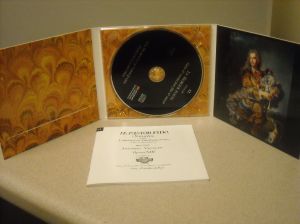 Take, for example, the CD, “Le Berger poète” (Alpha 148), which features eighteenth-century French music for flute and musette de cour. On the cover is a detail of Hyacinthe Rigaud’s Portrait of Gaspard de Gueidan Playing the Musette de cour, 1738. This image on a simple level helps the buyer visualize a musette, an instrument most of us have never seen. It’s a small bagpipe that enjoyed great popularity among French nobles with rustic proclivities. Its sound is reminiscent of an oboe’s or, less charitably, a kazoo’s. Inside there is a full reproduction of Rigaud’s painting and an additional detail from Gueidan’s garments, both framed by richly colored marbling. Included is a 45-page booklet introduced by a reproduction of an eighteenth-century musical title page. If the recording aims to evoke the world out of which this music comes, then the pictures help, and as someone who loves recorded music, I can say that the combination of visual and aural together powerfully suggest a long lost ambience.
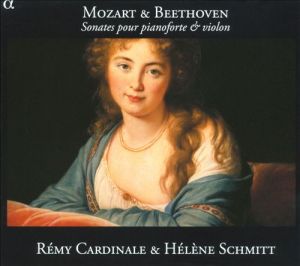 “Le Berger poète” isn’t unique. Other Alpha CDs feature high-resolution details of images by Vigée-Lebrun, Goya, Nattier, Liotard, and Tiepolo in equally creative and often gorgeous packaging. Ramée, another label from Out There, uses a similar design principle but shifts the focus from images to objects. Ramée’s covers feature pictures of early modern textiles, metalwork, silver, furniture, architectural elements, and machines. Both labels make frequent use of cropping and details, design choices that counteract the CD’s physical limitations. I’d like to think that such choices are especially apposite for the eighteenth century, an era so fascinated by fragments, ruins, and oblique views. Ramée’s mission statement is even bolder than Alpha’s in that they seek to “create CDs as complete objets d’art,
because we believe the ear’s pleasure is intimately tied together
with that of the eye and the hand.” I agree.
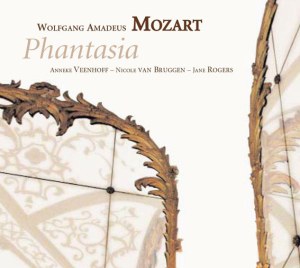 I find it interesting that as we increasingly download our music, a process that would indicate the obsolescence of the CD altogether, not only is the CD not (yet?) going away, but in fact it is becoming more and more beautiful (Out There offers recordings both as digital downloads and as CDs). Even with downloaded music, art can remain a component of the musical experience. The new iTunes redesign continues to let you pair every song with a picture, be it the album cover or an image of one’s choice. It’s another way of doing what Soria did earlier and Alpha and Ramée do now, namely setting the tone for the ear’s experience.
Holiday Gift Ideas | Four Novels and One Biography
This may be a list less of possible gift ideas than one of small self-indulgences, especially for those of you who struggle to fit in fiction. I make no claims for literary accomplishment (I haven’t read any of these — yet!), but it is interesting to see the eighteenth century put to fictional purposes or, in the case of the biography of Samuel Foote, to see how fiction could serve life within the eighteenth century. -CH
◊ ◊ ◊ ◊ ◊
Donna Leon, The Jewels of Paradise (New York: Atlantic Monthly Press, 2012), 256 pages, ISBN: 978-0802120649, $25.
 Donna Leon has won heaps of critical praise and legions of fans for her best-selling mystery series featuring Commissario Guido Brunetti. With The Jewels of Paradise, Leon takes readers beyond the world of the Venetian Questura in her first standalone novel.
Caterina Pellegrini is a native Venetian, and like so many of them, she’s had to leave home to pursue her career. With a doctorate in baroque opera from Vienna, she lands in Manchester, England. Manchester, however, is no Venice. When Caterina gets word of a position back home, she jumps at the opportunity.
The job is an unusual one. After nearly three centuries, two locked trunks, believed to contain the papers of a baroque composer have been discovered [the real-life Agostino Steffani (1654-1728), whose arias have recently been recorded by Cecilia Bartoli]. Deeply-connected in religious and political circles, the composer died childless; now two Venetians, descendants of his cousins, each claim inheritance. Caterina’s job is to examine any enclosed papers to discover the “testamentary disposition” of the composer. But when her research takes her in unexpected directions she begins to wonder just what secrets these trunks may hold. From a masterful writer, The Jewels of Paradise is a superb novel, a gripping tale of intrigue, music, history and greed.
In the judgment of Jane Jakeman, writing for The Independent (10 October 2012) . . .
Leon shows us the balancing-act required to mediate between the world and the spiritual life as a feature of the present as well as of the 18th century. From Steffano’s patchy biography, Leon has forged a fascinating historical mystery. Full of authentic detail and wittily recounted (Caterina’s sojourn at a British university with its badly dressed scholars is a joy), Leon’s 22nd novel has a freshness which indicates her delight in her subject, and perhaps celebrates a release from the treadmill of the Brunetti stories.
◊ ◊ ◊ ◊ ◊
Robin Blake, A Dark Anatomy (London: Pan Macmillan, 2011), 368 pages, 978-1250006721, $25.
 Bloodshed and mystery in 1740s England
The first Cragg and Fidelis mystery begins with Coroner Titus Cragg being called to the corpse of a lady, the wife of the local squire, when it is found in woods near Preston. Her throat has been cut. It is his job to call an inquest that will reach a right verdict, and the investigation that follows has a number of twists and turns as Cragg tries to discover the evidence the jury will need to consider . His friend Dr Luke Fidelis provides medical and scientific knowledge and his wife Elizabeth gives him staunch moral support, in face of determined opposition to his methods from the town’s corporation.
Christopher Fowler writes in The Financial Times (4 April 2011):
Beer and beef for breakfast, and the Devil come down to earth: we are in 1740s Preston, Lancashire. Titus Cragge, the local coroner, has been summoned to investigate the death of a “rough riding hoyden”, the squire’s wife Dolores Brockletower, who has plunged through a tree to lie gashed, bashed and part-buried in the soil at its roots.
George II might hold the throne in the capital, but out in the wilds superstition and hearsay rule. Cragge teams up with energetic young doctor Luke Fidelis and the pair take faltering steps into the as-yet-unknown science of forensic pathology. Soon they’re crossing swords with the victim’s husband, and discovering that the corpse has taken a walk.
Despite hinging on an improbable act of physics, coupled with an 11th-hour surprise that makes Preston seem rather exotic, this is rollicking stuff. . .
More information on the book and Blake are available at his website»
◊ ◊ ◊ ◊ ◊
Ian Kelly, Mr. Foote’s Other Leg (London: Picador, 2012), 462 pages, 978-0330517836, £17.
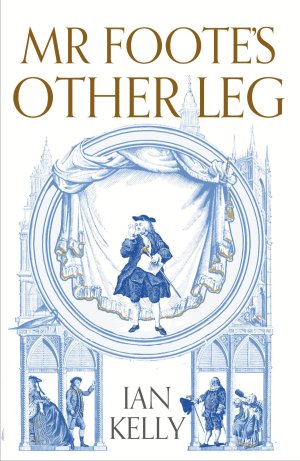 In 1776 Foote’s was the most talked-of name in the English-speaking world. By 1777 it was almost unmentionable. Samuel Foote, friend of David Garrick and Dr Johnson, is the greatest lost figure of the eighteenth century; his story defies belief and has only been forgotten for reasons both laughable and shocking.
Foote’s rise to fame was based on three unrelated accidents: his extraordinary gifts as an impressionist, a murder within his family which he turned into a true-crime bestseller, and the loss of his leg after a disastrous practical joke. Out of this was born the most singular career in stage history. He flouted convention in transvestite roles, evaded the censors by selling his scurrilous satires as ‘Tea Parties’, wrote a series of plays for one-legged actors – accordingly not much revived – and established London’s Theatre Royal, Haymarket. Then came two scandalous trials that rocked Georgian high society. Trials of such magnitude they kept America’s Declaration of Independence from the front pages of the London papers.
In a unique conflation of biography and social and medical history, award-winning historian Ian Kelly uncovers the hidden world of ‘the Hogarth of the stage’. From Sheridan to Dickens to Dudley Moore, Foote’s influence continues, but Mr Foote’s Other Leg is not just a tragicomic tale of this Oscar Wilde of the eighteenth century, it is also the story of the first media storm, the first true-crime bestseller, the first victim of celebrity culture, and a joyous hop around the mad theatre of London life – high and low.
Anne Sebba writes in The Telegraph (24 October 2012):
This is a stunningly good and long overdue biography of a man largely forgotten today. Why he has been out of the limelight for so long remains a puzzle. His plays may be conceived as dated, yet Kelly makes the case that they are important for the way they ridiculed vanity and class pretension. But his real claims on posterity come from his courageous refusal to bow to convention or artistic safety, which, in the end, destroyed him. It is this trait that commands our attention, Kelly insists. It is hard to think of anyone who could have written his life story with greater sympathy, understanding of his talent and the difficulties he faced.
◊ ◊ ◊ ◊ ◊
P.D. James, Death Comes to Pemberley (New York: Knopf, 2011), 304 pages, 978-0307959850, $26.
 A rare meeting of literary genius: P. D. James, long among the most admired mystery writers of our time, draws the characters of Jane Austen’s beloved novel Pride and Prejudice into a tale of murder and emotional mayhem.
It is 1803, six years since Elizabeth and Darcy embarked on their life together at Pemberley, Darcy’s magnificent estate. Their peaceful, orderly world seems almost unassailable. Elizabeth has found her footing as the chatelaine of the great house. They have two fine sons, Fitzwilliam and Charles. Elizabeth’s sister Jane and her husband, Bingley, live nearby; her father visits often; there is optimistic talk about the prospects of marriage for Darcy’s sister Georgiana. And preparations are under way for their much-anticipated annual autumn ball.
Then, on the eve of the ball, the patrician idyll is shattered. A coach careens up the drive carrying Lydia, Elizabeth’s disgraced sister, who with her husband, the very dubious Wickham, has been banned from Pemberley. She stumbles out of the carriage, hysterical, shrieking that Wickham has been murdered. With
shocking suddenness, Pemberley is plunged into a frightening mystery.
Inspired by a lifelong passion for Austen, P. D. James masterfully re-creates the world of Pride and Prejudice, electrifying it with the excitement and suspense of a brilliantly crafted crime story, as only she can write it.
◊ ◊ ◊ ◊ ◊
Lloyd Shepherd, The English Monster: or, The Melancholy Transactions of William Ablass (London: Simon & Schuster, 2012)2012), 432 pages, 978-1451647570, $16.
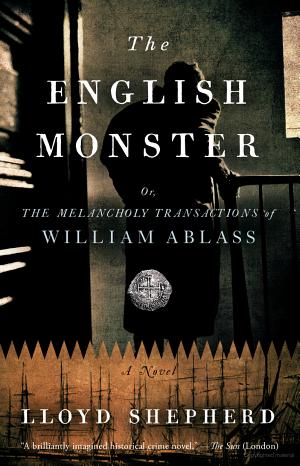 Two moments in England’s rise to empire, separated by centuries, yet connected by a crime that cannot be forgiven . . .
London, 1811. Along the twisting streets of Wapping, bounded by the ancient Ratcliffe Highway and the modern wonder of the London Dock, many a sin is hidden by the noise and glory of Trade. But now two families have fallen victim to foul murder, and Charles Horton, a senior officer of the newly formed Thames River Police Office, must deliver revenge to a terrified populace.
Plymouth, 1564. Young Billy Ablass arrives in the busy seaport with the burning desire of all young men: the getting and keeping of money. Setting sail on a ship owned by Queen Elizabeth herself seems the likely means to a better life. But the kidnapping of hundreds of human souls in Africa is not the only cursed event to occur on England’s first official slaving voyage. On a sun-blasted Florida islet, Billy too is to be enslaved.
Based on the true story of the gruesome Ratcliffe Highway murders, The English Monster is a breathtaking voyage across centuries, from the Age of Discovery to the Age of Empire, illuminating what happens to Britain as she gains global power
but risks losing her soul.
The Popol Vuh: An Eighteenth-Century Manuscript Copy
With the December 21st solstice marking the end of a 5,125-year cycle of the Mayan ‘Long Count’ calendar, a posting on the oldest copy of the Mayan sacred text, the Popol Vuh, seems appropriate. The manuscript was produced in 1701-03 and is now part of the collection of the Newberry Library in Chicago.
◊ ◊ ◊ ◊ ◊
From The Newberry:
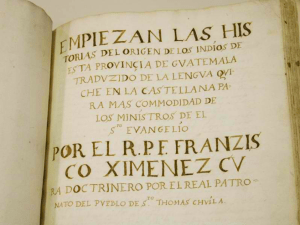
Title page, Popol Vuh. 1701-03 (Chicago: The Newberry Library, Vault Ayer MS 1515)
The Popol Vuh, which has been translated as Book of the Council, Book of the Community, Book of the People, and The Sacred Book, is the creation account of the Quiché Mayan people. It contains stories of the cosmologies, origins, traditions, and spiritual history of the Mayan people. It is considered by many Mayans as their equivalent to the Christian Bible and is held in deep reverence by them. In an effort to make it more widely available and reduce non-essential handling of the text, an important digitization project is underway and almost complete. It includes the complete conservation of the manuscript.
The Newberry’s manuscript of the Popol Vuh is one of the most widely known and possibly the earliest surviving copy. Quiché nobility probably wrote the original manuscript of the Popol Vuh in the mid-sixteenth century, in the Quiché language, using Latin orthography. The Newberry’s Popol Vuh was most likely copied from this original manuscript (now lost) in 1701-03, in the Guatemalan town of Chichicastenango, by Dominican Father Francisco Ximenez. His copy includes the Quiché text and a Spanish translation in side-by-side columns. In addition to the Popol Vuh, the manuscript also contains a Cakchikel-Quiché-Tzutuhil grammar, Christian devotional instructions, and answers to doctrinal questions and other material by Ximenez.
Conservation preparation and treatment are major components of the Popol Vuh digital project. With increased handling of the delicate manuscript during the filming and scanning process, it is absolutely critical to stabilize the paper and inks. A multi-disciplinary group of curators, librarians, conservators, and other experts reviewed the Popol Vuh’s condition and created the following procedure to provide appropriate conservation of the document.
The group decided that the binding, which was not original, should be removed and the ink checked under a microscope and stabilized. Removal of the binding included: separation of the covers from the text, cleaning the glue and paper linings from the spine, cutting the sewing threads, and separating the pages. By removing the old binding, the pages laid flat for filming. After the text was digitized, the manuscript was mended, page-by-page. Mending rejoins tears and strengthens any weak areas of the page, such as loss from insects, moisture damage, or wear from use. After additional consultation, a new binding style was chosen that was sympathetic to the Popol Vuh’s history, and a custom fitted enclosure created to house the Popol Vuh.
The new electronic versions of the Popol Vuh make the manuscript more accessible to a larger number of readers. In order to preserve the item for future generations of researchers, access to the actual sacred text of the Popol Vuh is available by appointment only. To make an appointment, please contact John Brady, Director of Reader Services, at bradyj@newberry.org.
Visitors to the Newberry may access the new electronic versions of the Popol Vuh in the Reference Center on the third floor. Ohio State University has recently released a digital version of the Popol Vuh. In addition, Brigham Young University’s Neal A. Maxwell Institute for Religious Texts (formerly the Institute for the Study and Preservation of Ancient Religious Texts) produced a DVD-ROM of the Popol-Vuh. This DVD is available for use in the 3rd floor reference area and is also for sale in the Newberry Bookstore. A facsimile of the work is also available in the Reference Center.
More information is available here»
Conference | Entangled Landscapes: China and Europe
Recently on a number of list-servers, the following conference was categorized under ‘call for papers’. In fact, the organizers are not soliciting proposals. It does, however, look really interesting. For more information, see the conference website.
◊ ◊ ◊ ◊ ◊
Entangled Landscapes: Re-thinking the Landscape Exchange between China and Europe
Institute of Art History, University of Zurich, Switzerland, 10-12 May 2013
The exchange of landscape culture between China and Europe in the 16th-18th centuries has received considerable attention in terms of its cultural qualities and significance. The expression of this cultural exchange includes art (e.g. drawings, prints, architecture, landscape architecture, and sculptures), literature (e.g. letters, travelogues, and novels) and material culture (e.g. porcelain and furniture). Traditional scholarship examines these objects as static and fixed in their narrow disciplinary specialty rather than considering them within a multidisciplinary contextual matrix. Some emerging conceptions and understandings of culture and landscape shed new light on the exchange of landscape culture. ‘Entangled histories’, for example, does not consider cultures as separated entities with fixed boundaries, but rather cultures as being constituted by intertwined processes of interaction, translation and hybridization within interconnected societies. Meanwhile, landscape is increasingly being understood as not a mere pictorial representation, but ‘an instrument of cultural power,’ a cultural practice ‘by which social and subjective identities are formed.’ In both Chinese and European traditions, landscape has complex relations with notions such as nature and land – territory, nation, and state. Both landscape traditions have been investigated within multidisciplinary (social, cultural, economic and political) perspectives.
Against this background, the symposium proposes to re-think the landscape exchange between China and Europe during the 16th-18th centuries within an ‘entangled landscapes’ approach. By using this term, we do not understand the cross-cultural Chinese-European landscape representations as a mere artistic exchange between two isolated ‘islands’. Rather, we consider these landscape representations being used to manifest and perform interactions among different cultures, religions, and powers within their cultural, social and political contexts. The ‘entanglement’ of these cross-cultural landscapes is traceable in aspects such as the appropriation of representational methods, the hybridization of landscape styles, and the negotiation of aesthetic concepts. The main goal of the symposium is to achieve a deeper understanding of Chinese-European landscape exchange through examination of these three often complex aspects.
Landscape exchange has taken place between China and Europe on occasions provided by trade, Christian missions and diplomacy (ceremonials), which are inseparable from their backgrounds such as economic expansion, the circulation of knowledge, the transfer of technologies (e.g. scientific technologies and technologies of governance), and the negotiation of ideologies and power structures. We are interested in analyzing these landscape entanglements (appropriation of representational methods, transplantation of styles, and negotiation of concepts) in relation to the above backgrounds, as well as face-toface interaction and dynamics between the discourse of arts and social, economic and political practices. As examples, ‘linear perspective’ as a landscape representational method was adopted by early Qing court artists to promote the Manchu emperor’s statecraft (in terms of morality, science and epistemology); ‘the Chinese style of gardening’ was advocated by the English/British elite in the late seventeenth and eighteenth century to promote the physiocrats’ economy and enlightened polity; and concepts like ‘the grotesque’ were indicative of the nature, as well as the results, of crises, conflicts and cultural clashes.
By addressing such topics, our objectives are to understand: 1. how different perceptions of landscape, nature, and land by the people of China and Europe constructed the representations of cross-cultural landscapes; and conversely, how the representation of cross-cultural landscapes influenced Chinese and European perceptions of landscape, nature and land. 2. how different national, social and individual identities were formed through the appropriation, transplantation and negotiation of landscape representations; and conversely, how transcultural landscapes were influenced by these different identities.
Through this symposium, we hope to explore and discuss different theoretical, empirical and methodological perspectives of landscape representation between Europe and China across disciplines and national boundaries. In summary, we seek not only a more thorough understanding of the exchange of landscape culture, but also a deeper understanding of the formation of cultural identities in China and Europe, and the relation between China and Europe during the 16th-18th centuries.
At Auction | Joseph Wright’s ‘A Blacksmith Shop’
Warm thanks to John Chu for pointing out the results of this Christie’s auction, notable for its inclusion of a long-untraced painting by Joseph Wright. -CH
◊ ◊ ◊ ◊ ◊
From Christie’s:
Christie’s Old Master & British Paintings Evening Sale (Sale 5964)
London, King Street, 4 December 2012

Joseph Wright of Derby, A Blacksmith’s Shop, 1771-73 [estimate £400,000 – £600,000; sold for £914,850]
Wright’s dramatic portrayal of a lowly Blacksmith’s Shop is a highly significant re-discovery, having been untraced since it was exhibited at the Graves Galleries in 1910. Known only through an engraving executed by William Pether in 1771 (fig. 1), Benedict Nicolson, in his complete catalogue of Wright’s works published in 1968, lamented: ‘We have lost a fine invention’ (op. cit., p. 50). One of a group of five Blacksmith’s Shops and Iron Forges executed between 1771 and 1773, and the only one to remain in private hands, this painting is both an expression of Wright’s close engagement in the spirit of the Industrial Revolution and a sophisticated example of his mastery of chiaroscuro effects.
Wright was not the first British painter to depict contemporary industrial scenes. Thomas Smith had executed two detailed topographical views of a Shropshire industrial site as early as 1758, Edward Penny exhibited The Gossiping Blacksmith at the Royal Academy’s inaugural exhibition in 1769, and Sandby and Ibbetson made numerous sketches of mines, coal-pits and factories in the North of England. He was, however, the first artist of his generation to explore its full potential as a subject for serious, academic art. . .
The Old Master & British Paintings Evening Sale realised £11,562,250/$18,603,660/€11,426,147, selling 54% by lot and 70% by value.
The full catalogue entry is available here»
Call for Papers | Materializing the Spirit: Cultures of Women Religious
From the H-WRBI:
Materializing the Spirit: Spaces, Objects, and Art in the Cultures of Women Religious
Institute of Historical Research, Senate House, London, 5-7 September 2013
Proposals due by 1 February 2013
The History of Women Religious of Britain and Ireland Annual Conference will be hosted by the Institute of Historical Research, University of London, on 5-7 September 2013.
Paper proposals are now invited. Presentations should be 20 minutes in duration, and should address some element of the conference theme, with reference to British and/or Irish contexts. The devotional and vocational activities of women religious sculpted the physical space of religious houses in unique ways. Patterns of use were etched into the fabric of buildings, guiding structural design and interior decoration. But buildings also shaped practice: whether the formal monastic sites of early or revived enclosed orders or the reused secular buildings of active congregations, women both adapted and adapted to their material surroundings.
A growing body of literature has addressed itself to convent art, exploring nuns as patrons, consumers and manufacturers of material and visual culture. These practices span the history of women’s religious life – from the early Middle Ages to the present day – and suggest a hidden but dynamic tradition of artistic enterprise. This conference explores the creative output of women religious including but not limited to textiles and the decorative arts, illuminated manuscripts and printed books, women’s patronage of painting and architecture, the commercial production of ecclesiastical textiles in the nineteenth-century, production of liturgical and devotional art in recent periods, and the development of unique convent and institutional spaces by and for women religious.
Key aims of the conference will be to highlight the scholarly value of these under-researched and little known spaces and collections and also to raise awareness and discuss the threats that they face as communities decline, buildings close, artefacts and archives are dispersed.
This conference will take a broad and diverse view on what constitutes ‘material culture’, emphasizing the conception, production, and meanings of the many material outputs of convents and monasteries. Papers are welcomed from a diverse range of disciplines: scholars from social and religious history, art and architecture, theology, anthropology, psychology and beyond are invited to offer fresh and innovative perspectives in order to illuminate ways in which women religious in Britain and Ireland created and were formed by material histories for over a thousand years.
Please send 200-word proposals for 20-minute papers to conference conveners Kate Jordan (kate.jordan.09@ucl.ac.uk) and Ayla Lepine (ayla.lepine@gmail.com) by no later than 1 February 2013.
Call for Papers | Encounters, Affinities, Legacies
Encounters, Affinities, Legacies: The Eighteenth Century in the Present Day
University of York, 28-29 June 2013
Proposals due by 19 April 2013 (extended from previous due date of 1 March 2013)
As the field of eighteenth-century studies continues to boom within the academy, the eighteenth century – invoked around names like Rousseau, Voltaire, and Adam Smith – is becoming an increasingly frequent interlocutor in contemporary debates in the international media about society, democracy, human rights, and the economy. Whilst social and political commentators are reading our present in dialogue with our eighteenth-century past, cultural appetites for the eighteenth century on page, stage, and screen continue to grow: powerful suggestions that intertwined discourses like (E)nlightenment and modernity, central to so much eighteenth- and twentieth-century thought, remain vital to the social, political and cultural construction of our contemporary moment. This interdisciplinary conference seeks to explore the complex webs of interconnection between the long eighteenth century and the ‘long’ twentieth century, from 1900 to the present.
Keynote speakers: Donna Landry (University of Kent) and Markman Ellis (Queen Mary, University of London)
The conference will take place at the heart of a festival of public engagement events including public lectures, fashion, music, performance, and photography. Any proposals for involvement in the festival would also be received with interest, and should be emailed to Adam Perchard at agkp500@york.ac.uk by the end of January 2013.
The conference organisers welcome submissions for presentations in the following formats:
• Pre-formed panels, approximately one hour in length. Panels can contain two, three or exceptionally four speakers, and should identify an appropriate panel chair. We particularly encourage interdisciplinary panels.
• Individual papers, approximately 20 minutes in length.
We welcome presentations in original and innovative formats, such as interactive demonstrations, Q&A/debating sessions, or exhibitions. These should be no longer than 30 minutes per contributor. Topics may include, but are not limited to, the following:
• intertexts/intersects: engagements between eighteenth- and twentieth-century texts, images, and performances
• the eighteenth century on the twentieth-century stage, page and screen
• nostalgia and rejection: twentieth-century historiographies of the eighteenth century
• global centuries: (post-)empire, race, and cosmopolitanisms
• legacies and disconnects: constructing and reforming society
• print culture and satire: resistance, radicalism, and freedom of speech
• ‘the rise of the novel’: literary grand narratives
• place and space: architecture between centuries
• Romantic Modernisms/Modern Romanticisms
Panel submissions: Please send a 250-300 word abstract for each paper in the panel, along with a panel overview of 300 words, explaining how the individual papers relate to one another. Include the name and contact details for your chair, as well as each of the contributors.
Individual paper submissions: Please send a 250-300 word abstract outlining your paper. Include your name and contact details.
Alternative format submissions: Please send a 300-350 word outline of your presentation, outlining the content and format. Where presentations are made by more than one contributor, longer proposals will be considered. Include the names and contact details of all contributors.
Please send abstracts to encounters.2013@gmail.com no later than 1 March 2013.
Half-Day Workshops | Ornament, Models, and Objects
Conference program (PDF) from the Centre Chastel:
Ornements et décor : du modèle à l’objet
Institut national d’histoire de l’art, Paris, 15 January — 30 April 2013
 Demi-journées d’études organisées par Jérémie Cerman (Université Paris-Sorbonne, Centre Chastel) et Julie Ramos (INHA), avec la collaboration de Dominique Morelon et Lucie Fléjou (Bibliothèque de l’INHA), Michael Decrossas, Elli Doulkaridou et Céline Ventura-Teixeira (INHA).
Contacts : julie.ramos@inha.fr ou jeremie.cerman@paris-sorbonne.fr
Le catalogage et la numérisation du fonds de recueils d’ornements de la bibliothèque de l’INHA-collections Jacques Doucet, riche d’environ 650 volumes pour une période allant du XVIe siècle au début du XIXe siècle, constitue l’axe central du programme Histoire de l’ornement. Dans ce cadre, l’Institut national d’histoire de l’art a choisi de faire porter sa réflexion sur les relations entre les modèles et les objets. De janvier à avril 2013, quatre demi-journées d’études thématiques, organisées en partenariat avec le Centre Chastel, proposeront ainsi des échanges que l’intérêt actuellement suscité par l’ornement et les arts décoratifs rend propice. Dans une perspective chronologique et disciplinaire étendue, elles s’attacheront à considérer les modèles d’ornements sur le plan de leur circulation et de leurs usages pratiques ; elles envisageront les recueils en tant qu’objets de collection mais aussi comme sources d’inspiration pour les artistes, les artisans et les industriels. Sans se limiter au domaine des arts décoratifs, l’ornement sera également envisagé dans ses relations aux autres champs de la création, de l’architecture à la sculpture en passant par la photographie. Enfin, sa propension à stimuler l’imaginaire, tant chez le créateur que chez le spectateur ou l’usager, sera interrogée.
◊ ◊ ◊ ◊ ◊
15 janvier 2013, 14h-18h | Modèles d’ornements et collectionnisme
Modérateur : Rossella Froissart (Université de Provence)
• Lucie Fléjou (Bibliothèque de l’INHA) : Edmond Foulc (1828 -1916), collectionneur d’estampes d’ornements
• Jean-François Bédard (Syracuse University, New York) : Entre collection et décoration : ornement et construction de soi à l’âge des Lumières
• Sylvain Cordier (Université Paris-Sorbonne) : Percier, Jacob, Bellangé: autour de quelques recueils de dessins d’ornements et d’ameublement de l’époque Empire conservés aux États-Unis
• Wilfried Zeisler (Université Paris-Sorbonne) : Des collections de recueils et de modèles dans les ateliers de création et de leur usage
◊ ◊ ◊ ◊ ◊
12 février 2013, 14h-18h | De l’ornement à l’objet : imitation, inspiration, réinterprétation
Modérateur : Agnès Callu (Musée des arts décoratifs, Paris)
• Céline Ventura-Teixeira (Université Paris-Sorbonne / INHA) : De la parure au motif : la pointe de diamant. Entre diffusion et adaptation d’un modèle ornemental au XVIIe siècle
• Anne Perrin-Khelissa (Université catholique de l’Ouest, Angers) : «D’excellens modèles » pour des objets d’arts « dans tous les genres ». Les Collections de culs de lampes et fleurons de Jean-Jacques Bachelier, extraites des Fables de La Fontaine illustrées par Jean-Baptise Oudry
• Odile Nouvel (Musée des arts décoratifs, Paris) : De l’élaboration à la réutilisation des modèles : quelques réflexions autour des fonds Odiot et Biennais du Musée des Arts décoratifs
• Audrey Millet (Universités Paris 8 et Neuchâtel) : La fabrique de l’ornement. De l’imitation à l’invention, l’art de dessiner des indiennes dans les grands centres européens (XVIIIe-XIXe siècles)
• Valérie Nègre (École nationale supérieure d’architecture Paris-La Villette) : Du dessin à l’objet. Quelques remarques sur les usages des recueils d’ornements commerciaux au XIXe siècle
◊ ◊ ◊ ◊ ◊
26 mars 2013, 14h-18h | L’ornement et les arts
Modérateur : Jean-Paul Midant (École nationale supérieure d’architecture Paris-Belleville)
• Michaël Decrossas (INHA) : Jean Lemoine de Paris (1638 – 1709), peintre et ornemaniste
• Sébastien Quéquet (INHA) : L’artiste peintre et la manufacture : la régénération de la céramique par les beaux-arts
• Sébastien Bontemps (Université de Provence) : Polarité du programme architectural et de son serviteur, l’ornement : les travaux des sanctuaires parisiens de Saint-Germain-l’Auxerrois et de Saint-Merry au milieu du XVIIIe siècle
• Hélène Bocard (INHA) : « Des modèles pour les artisans » : la collection d’arts décoratifs du baron Alexander von Minutoli (1806-1887) et sa diffusion par la photographie
• Frédéric Dassas (Musée du Louvre) : L’histoire du meuble à l’épreuve des arts graphiques : le cas d’André-Charles Boulle (1642-1732)
◊ ◊ ◊ ◊ ◊
30 avril 2013, 14h-18h | L’objet imaginaire
Modérateur : Rémi Labrusse (Université Paris Ouest Nanterre La Défense)
• Elli Doulkaridou (Université Paris 1 Panthéon-Sorbonne / INHA) : Les jeux de l’ornement : réflexions autour de quelques manuscrits enluminés romains du XVIe siècle
• Nicolas Cordon (Université Paris 1 Panthéon-Sorbonne) : L’ornement de stuc comme lieu du simulacre
• Jean-Louis Gaillemin (Université Paris-Sorbonne) : Ornement et surréalisme
Exhibition | Between Orient and Occident: Kremlin Treasures
Press release from the Staatliche Kunstsammlungen Dresden:
Between Orient and Occident: Treasures of the Kremlin from Ivan the Terrible to Peter the Great
Royal Palace, Dresden, 1 December 2012 — 4 March 2013
Curated by Ulrike Weinhold

Lidded dish Kremlin workshops, 1694
© Moscow Kremlin Museums
The Residenzschloss (Royal Palace) in Dresden is home to two world-class museums, the Grünes Gewölbe (Green Vault) and the Kupferstich-Kabinett (Collection of Prints, Drawings and Photographs), while the Rüstkammer (Armoury), one of the most important collections of its kind, also has a significant presence here, with its Türckische Cammer (Turkish Chamber). Before the Rüstkammer opens the outstanding new presentation of another part of its collection here in the Riesensaal (Giants Hall) on 18 February 2013, the Residenzschloss hosts a museum organisation of international stature, the Moscow Kremlin Museums. From 1 December 2012 to 4 March 2013, the exhibition Between Orient and Occident: Treasures of the Kremlin from Ivan the Terrible to Peter the Great is being shown in the State Apartments, in surroundings where reconstruction work is as yet unfinished. There could hardly be a more appropriate place to hold an exhibition with this theme: like the Kremlin, the Residenzschloss, the very heart of the Staatliche Kunstsammlungen Dresden, is a place of encounter between Orient and Occident. In this unique special exhibition, the first ever to highlight the significance of the Kremlin as a crossroads of eastern and western cultures, around 140 outstanding exhibits are displayed in an area of some 700 sq. m. in all. Masterpieces by European goldsmiths, superb ceremonial weapons crafted by Persian and Turkish armourers, precious objects, splendid vessels and opulent garments are displayed alongside exquisite pieces produced in the Kremlin workshops, but clearly showing influences from beyond Russia.
The exhibition focuses on a clearly defined period, from 1547, when Ivan the Terrible (1530–1584) was crowned as tsar, to 1712, when Peter the Great (1672–1725) designated St Petersburg as the new capital of the Russian Empire. Magnificent objects acquired by the tsars, and sumptuous gifts presented by foreign emissaries from both west and east impressively demonstrate to today’s visitors the great power and wealth of Russia, and the significant role it played in the political and economic structures of that time. Inspired by works of art from abroad, the Kremlin workshops created treasures which are a synthesis of European and oriental taste and ancient Russian traditions.
The current exhibition is to some extent a reciprocal visit: in 2006, before the Grünes Gewölbe moved back to its original home on the ground floor of the Residenzschloss, it presented an exhibition in Moscow, entitled The Jewel Cabinet of August the Strong, hosted by the Kremlin Museums. The SKD already have close scholarly and scientific working relationships of long standing with these Russian museums, as well as with the State Hermitage in St Petersburg and the Pushkin Museum in Moscow. This special exhibition, Between Orient and Occident: Treasures of the Kremlin from Ivan the Terrible to Peter the Great, is a major contribution to the continuing exchange between the respective museums. Finally, but not least, it is also a contribution to the Year of Russia in Germany and Germany in Russia 2012/13.










 Enfilade
leave a comment