Exhibition | Johann Georg Pinsel: An 18th-Century Sculptor in Ukraine
From the Louvre:
Johann Georg Pinsel: Un Sculpteur Baroque en Ukraine au XVIIIe Siècle
Musée du Louvre, Paris, 22 November 2012 — 25 February 2013
Curated by Guilhem Scherf
 En étroite collaboration avec les institutions ukrainiennes, le musée du Louvre organise une exposition consacrée à Johann Georg Pinsel, un important sculpteur de l’époque baroque actif au milieu du XVIIIe siècle en Galicie, la partie occidentale du pays alors territoire polonais.
L’exposition s’appuie principalement sur les collections du musée Pinsel de Lviv, avec des emprunts venant d’autres musées de Galicie et aussi de Pologne (Wroclaw) et de Munich. Une trentaine de sculptures parmi les plus spectaculaires de l’artiste, majoritairement en bois (certaines avec polychromie ou dorure), seront présentées.
Le style de Pinsel, très brillant, proche de celui des grands sculpteurs de l’âge d’or du baroque germanique, témoigne d’une esthétique rarement montrée en France. L’artiste se distingue de ses contemporains par une personnalité propre : une gestuelle extravertie démonstrative, une expressivité prononcée, une caractérisation très personnelle des draperies.
◊ ◊ ◊ ◊ ◊
Jan K. Ostrowski and Guilhem Scherf, eds., Johann Georg Pinsel: Un sculpteur baroque en Ukraine au XVIIIe siècle (Paris: Coédition Louvre éditions/Snoeck éditions, 2012), 173 pages, ISBN: 978-9461610485, 32€.
Le catalogue, comprenant textes et notices d’oeuvres, est écrit par les spécialistes du sculpteur Jan Ostrowski, Boris Voznitsky, Oxana Kozyr-Fedotov avec également des essais de Claude Michaud et Guilhem Scherf. C’est le premier ouvrage sur Pinsel disponible en français.
◊ ◊ ◊ ◊ ◊
Didier Rykner reviewed the exhibition for La Tribune de l’Art (2 January 2013).
C’est à une vraie découverte que nous convie le département des sculptures du Musée du Louvre. Car qui, en France, pouvait se targuer d’avoir jamais entendu parler de Johann Georg Pinsel ? Ce sculpteur fut actif en Galicie, c’est-à-dire dans une région d’Europe de l’Est aux confins de la Pologne et de l’Ukraine, deux pays entre lesquels elle se partage aujourd’hui. Plus précisément, Pinsel exerça son art autour de Lviv (autrefois plutôt connue sous le nom de Lvov), un territoire faisant aujourd’hui partie de l’Ukraine, et aux populations mêlées, ainsi qu’aux religions diverses (catholiques romains, uniates – c’est-à-dire catholiques grecs, et orthodoxes). . . .
◊ ◊ ◊ ◊ ◊
Call for Papers | Visualizing Portuguese Power
Visualizing Portuguese Power: The Political Use of Images
in Portugal and Its Overseas Empire, 16th to 18th Century
Munich, Center for Advanced Studies, 26-27 September 2013
Proposals due by 28 February 2013
Images have always played a vital role in political communication and in the visualization of power structures and hierarchies. They gain even more importance in situations where non-verbal communication prevails: In the negotiation processes between two (or more) different cultures, the language of the visual is often thought of as the more effective way to acquaint (and overpower) the others with one’s own principles, beliefs, value systems. Scores of these asymmetrical exchange situations have taken place in the Portuguese overseas Empire since its gradual expansion in the 16th century.
In art history, the role of images in the contact zones of the early modern empires has recently met with an increasing interest. It is above all the study of objects belonging to the so-called Jesuit mission art and the art produced in the context of the other religious orders that has shed new light on the potentiality of images in
transcultural exchange processes. Numerous of these religious art works were, however, also used to visualize political claims and transmit notions of colonial power. The Munich workshop aims to develop thoughts on the broad phenomenon of Portuguese-Christian Art in the African, Asian and American colonies further by adding the dimension of the political appropriation of these (and other) objects. How were these ‘hybrid’ artefacts staged and handled to generate new layers of meaning and visualize political ideas and concepts? (more…)
CAA 2013, New York

NYC from the Millennium UN Plaza Hotel, 2 September 2007
(Photo by AngMoKio, Wikimedia Commons)
◊ ◊ ◊ ◊ ◊
The 2013 College Art Association conference takes place in New York, February 13-16. HECAA will be represented by two panels on Friday, chaired by Hector Reyes and Amelia Rauser. Other sessions that may be of interest for dixhuitièmistes are also listed. A full schedule of panels is available here»
H E C A A S E S S I O N S
Art in the Age of Philosophy?
Friday, February 15, 9:30-12:00, Nassau Suite
Chair: Hector Reyes (University of California, Los Angeles)
- Anne Betty Weinshenker (Montclair State University), The Allegorical Tomb of Locke, Boyle, and Sydenham: A Celebration of Empiricism
- Stephanie O’Rourke (Columbia University), Faithful Impressions: Fuseli, Lavater, and the Physiognomic Pursuit of Knowledge
- Ryan Whyte (Ontario College of Art and Design University), Happy Fathers and Other New Ideas in French Art: Genre, Masculinity, and Philosophy in the Final Decades of the Old Regime
- Lauren Cannady (Institute of Fine Arts, New York University), Aesthetic Discourse in Science: The Rococo and the Natural World
- Johanna Fassl (Franklin College Switzerland), Radical Thought: Connecting Guardi, Newton, Vico, and Damasio
◊ ◊ ◊ ◊ ◊
New Scholars Session: International Artists Working in Eighteenth-Century Great Britain
Friday, February 15, 12:30-2:00, Rendezvous Trianon
Chair: Amelia Rauser (Franklin and Marshall College)
- Francesca Whitlum-Cooper (Courtauld Institute of Art), Quacks, Peddlers, and Pastellists: Jean-Etienne Liotard (1702–89) and Jean-Baptiste Perronneau (1715–83) in London
- Katherine McHale (Hunter College, City University of New York), The Bel Composto: The Role of Inset Paintings in Robert Adam’s Interiors
- Abram Fox (University of Maryland), Family, Students, and Legacy: Benjamin West’s Workshop and the Shaping of an American School of Art
◊ ◊ ◊ ◊ ◊
O T H E R S E S S I O N S R E L A T E D T O T H E 1 8 T H C E N T U R Y (more…)
New Book | The Fusion of Neo-Classical Principles
From Wordwell Books:
Lynda Mulvin, ed., The Fusion of Neo-Classical Principles (Dublin: Wordwell, 2012), 200 pages, ISBN: 978-1905569557, €35.
 Our understanding of Neo-Classicism is currently in an interesting phase of development, a progression to which this volume will make a significant contribution. As Kathleen James-Chakraborty’s keynote paper argues, scholarly attention is shifting from a focus on the production of works of art and buildings to a focus on consumption. The only chapter in the book that deals with painting, Brendan Cassidy’s on the reputation of Gavin Hamilton, neatly exemplifies the polarities of production and consumption. Hamilton painted his pictures in Rome where they were admired by travelling British patrons but, upon their arrival in England, they were consumed by the public with far less enthusiasm. Cassidy advances a very particular reason for this: that Grand Tourists tended to be very young men who took pleasure in identifying Hamilton’s historical subjects whilst on the sacred territory of Rome by reference to their schoolboy steeping in classical texts but, on their return to more distant northern Europe, were happy to conform with the predominant taste for landscape painting and portraiture.
Conor Lucey’s chapter, on the architectural pattern books that can be identified as having been in the hands of Dublin artisans, is a good contribution to the theme of diffusion of design ideas from one place to another, as is John Wilton-Ely’s on the design revolution of Robert Adam. As Wilton-Ely argues, the targeting and marketing of a ‘style’ is a sign of economic modernity. Another aspect of economic modernity in the eighteenth century is the quasi-professional organisation of the means of production, and Barbara Arciswewska’s essay on the reform of the English Office of Works instigated by the new Hanoverian dynasty is a very important contribution to scholarship in this respect.
In this volume the chapters of Michael McCarthy and Toby Barnard deal explicitly with the problem of when Neo-Classicism begins and ends. McCarthy argues that the fierceness of the nineteenth-century ‘battle of the styles’ has caused us to lose sight of the more gentlemanly basis on which the debate took place in the eighteenth century, but Barnard explores the religious disputes in Ireland that saw the Gothic commandeered by the Protestant community and the Catholics turning to classicism – and perhaps not unwillingly, given that their sense of civic duty was modelled on their classical educations like the young English aristocrats who, as we have seen, form the basis of Cassidy’s chapter.
The issue of the thoroughgoing Greek Revival, which would have hardly any place if this volume were circumscribed in chronological terms by the dates 1750-1800, is vigorously dealt with in this volume by three essays. Susan Pearce looks back to that first truly great phase of archaeological discovery in Greece that followed the Napoleonic Wars and in particular at the extraordinary understandings of Greek architecture and architectural sculpture of C.R. Cockerell. Lynda Mulvin’s own chapter on Cockerell’s work in Ireland pursues these ideas into built form are, while Patricia McCarthy deals with the much more extensive Irish projects of Richard and William Morrison. Also in this connection, Joe McDonnell through the works of the Irish sculptor Christopher Hewetson and Paul Caffrey with a collection of miniatures examine the emergence of Neo-Classicism in other media in Ireland.
A final strand to this rich volume can be found in the transference of design ideas between different artistic media. This is explored in the essays of Tracy Watts and Eddie McParland.
These essays will make a wide-ranging and stimulating contribution to current scholarly debates about the nature of Neo-Classicism, that critical cultural development that signals the arrival both of recognisable modernity and of internationalism in the western tradition. Moreover the essays have been written by some of the leading experts on the subject.
Setting Les Misérables
As some of you may have noticed, it’s eighteenth-century Greenwich that stands in for nineteenth-century Paris in Tom Hooper’s Les Misérables. And the elephant also returns us to the XVIIIe siècle; see the 24 May 2011 posting from the ‘Lost Paris’ series of the blog, Culture & Stuff). Thanks to Jennifer Germann for the suggestion. -CH
◊ ◊ ◊ ◊ ◊
From Architectural Digest:
Cathy Whitlock, “The Sets of Les Misérables,” Architectural Digest
Through dramatic set design and a pitch-perfect cast, the legendary story of a nation in turmoil comes to vivid new life in Hollywood’s adaptation
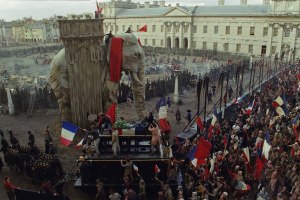 . . . Academy Award–winning director Tom Hooper and production designer Eve Stewart collaborate for the fourth time, having also worked together on the visually stunning and award-winning The King’s Speech, among other productions. In Les Mis, the duo translate the environs of the book, which include majestic French mountain ridges and the bleak Parisian streets of 1832, in all their glory via London’s Pinewood Studios in a shoot that lasted just 12 weeks . . .
The stately grounds of the National Maritime Museum in Greenwich, England, were transformed into the Place de la Bastille, the square where the Bastille prison stood. Originally conceived by Napoléon as a symbol of victory, the 40-foot-tall elephant is front and center at French commander Jean Maximilien Lamarque’s funeral procession and and the subsequent student uprising. Producer Cameron Mackintosh was so fond of the pachyderm that after production he had it moved it to his home in England. . . .
Sample of Louis XVI’s Blood Authenticated
As reported by the Agence France-Presse (AFP)

Embellished gourd, 1792-93, inscription reads: “Maximilien Bourdaloue le 21 janvier de cette année imbiba son mouchoir dans le sang de Louis XVI après sa décollation” (Photo: Davide Pettener)
Two centuries after the French people beheaded Louis XVI and dipped their handkerchiefs in his blood, scientists believe they have authenticated the remains of one such rag kept as a revolutionary souvenir. Researchers have been trying for years to verify a claim imprinted on an ornately decorated calabash that it contains a sample of the blood of the French king guillotined in Paris on January 21, 1793. The dried, hollowed squash is adorned with portraits of revolutionary heroes and the text: “On January 21, Maximilien Bourdaloue dipped his handkerchief in the blood of Louis XVI after his decapitation.” He is then believed to have placed the fabric in the gourd, and had it embellished. The sinister souvenir has been in the private hands of an Italian family for more than a century, said the team of experts from Spain and France which published its findings in the journal Forensic Science International. . . .
The full AFP article is available at ArtDaily here»
Coverage in Le Figaro»
Additional images (from a 2010 story) are available at Wired.com»
◊ ◊ ◊ ◊ ◊
From Forensic Science International:
“Genetic Comparison of the Head of Henri IV and the Presumptive Blood from Louis XVI (Both Kings of France),” Forensic Science International (2 January 2013)
Authors: Philippe Charlier, Iñigo Olalde, Neus Solé, Oscar Ramírez, Jean-Pierre Babelon, Bruno Galland, Francesc Calafell, Carles Lalueza-Fox
Abstract: A mummified head was identified in 2010 as belonging to Henri IV, King of France. A putative blood sample from the King Louis XVI preserved into a pyrographically decorated gourd was analyzed in 2011. Both kings are in a direct male-line descent, separated by seven generations. We have retrieved the hypervariable region 1 of the mitochondrial DNA as well as a partial Y-chromosome profile from Henri IV. Five STR loci match the alleles found in Louis XVI, while another locus shows an allele that is just one mutation step apart. Taking into consideration that the partial Y-chromosome profile is extremely rare in modern human databases, we concluded that both males could be paternally related. The likelihood ratio of the two samples belonging to males separated by seven generations (as opposed to unrelated males) was estimated as 246.3, with a 95% confidence interval between 44.2 and 9729. Historically speaking, this forensic DNA data would confirm the identity of the previous Louis XVI sample, and give another positive argument for the authenticity of the head of Henri IV.
◊ ◊ ◊ ◊ ◊
Update (added 5 April 2013) — In the case of another artifact (as reported by the AFP at Art Daily) . . .
A bloodstained cloth allegedly belonging to Louis XVI, the French king who was beheaded after the 1789 revolution, on Wednesday [3 April 2013] fetched a staggering 19,000 euros ($24,400) at a Paris auction. Kept in a miniature coffin, the cloth was estimated to go under the hammer for between 4,000 and 6,000 euros. . . .
Update (added 10 October 2013) — The saga continues (as reported by the AFP at Art Daily) . . .
Scientists revealed genetic data Wednesday they said disproved the authenticity of macabre relics attributed to two French kings: a rag dipped in Louis XVI’s blood and Henri IV’s mummified head. A DNA analysis of three living relatives of the Bourbon kings found no link with genetic traces from the grisly souvenirs, according to a study in the European Journal of Human Genetics.
“It is not the blood of Louis XVI,” co-author Jean-Jacques Cassiman, a Belgian geneticist, told AFP of the handkerchief allegedly dipped in the blood of the king guillotined by revolutionaries in Paris on January 21, 1793, and kept in an ornately-decorated calabash since then. . .
TEFAF Museum Restoration Fund Announces 2013 Grants
Good news for a few eighteenth-century holdings at the Worcester Art Museum and the Ashmolean, announced by the TEFAF Museum Restoration Fund ahead of this year’s art fair at Maastricht (15-24 March 2013) . . .
◊ ◊ ◊ ◊ ◊
The Worcester Art Museum in the United States and the Ashmolean Museum in the United Kingdom are to receive grants from the TEFAF Museum Restoration Fund to help them carry out important conservation projects. The Fund was set up by TEFAF Maastricht, as one of its 2012 Silver Jubilee initiatives and provides up to €50,000 each year to help institutions around the world conserve works of art in their collections. A panel of independent, international experts considered many applications from museums before selecting the two winning projects, which will each receive €25,000.

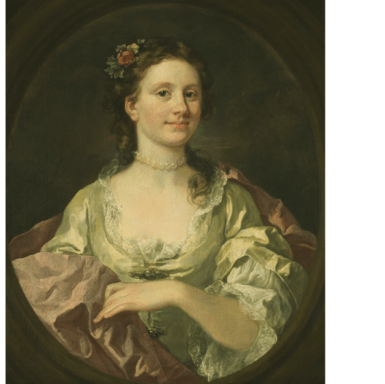
William Hogarth, Portraits of William and Elizabeth James,
1744 (Worcester Art Museum)
◊ ◊ ◊ ◊ ◊
The Worcester Art Museum in Worcester, Massachusetts is to restore a pair of portraits by the eighteenth-century British artist William Hogarth. The pendant portraits of William and Elizabeth James, painted by Hogarth in 1744, were acquired by the museum more than a century ago but have never been comprehensively treated or technically evaluated and will benefit greatly from a conservation project. The work will enable the Worcester Art Museum to feature them prominently in Hogarth and the English Character, an exhibition planned for 2016, and ultimately to return these cornerstone works to its permanent galleries. The restoration will allow those viewing them to experience the full impact of the paintings as exquisite works of art without any concerns about their condition. The newly conserved pictures will reveal more authentic palettes and broader tonal ranges that, when reunited with their newly conserved frames, will enable viewers to have the pleasing experience intended by Hogarth.
William Hogarth (1697-1764) was one of the masters of British painting. Although best known for his biting satires of society that were popularised in engravings, he was also a skilled portraitist. In these paintings he captured the confidence of William James, a country squire from the English county of Kent, and his wife Elizabeth, both proud of their fashionable London clothes.
◊ ◊ ◊ ◊ ◊
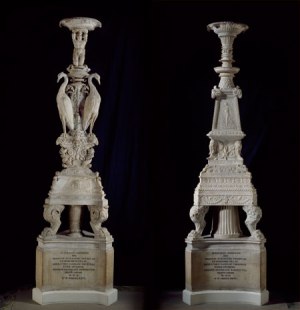 The Ashmolean Museum in Oxford is to carry out a conservation project on two candelabra by the Italian artist Giovanni Battista Piranesi (1720-78). The intricately carved candelabra are some of the finest examples of neo-classical sculpture in the United Kingdom. They form a key element of the collections displayed in the Ashmolean’s impressive Randolph Sculpture Gallery and are of international significance. They were purchased from Piranesi by Sir Roger Newdigate, who made two Grand Tours in 1739-40 and 1774-75. The candelabra were shipped in component form from Italy to Oxford with instructions for their re-assembly provided by Piranesi. The candelabra have become structurally unsound because the plaster bonding in the joints between each vertical section has failed during the 100 years since they were last restored. Until they were re-plinthed on pallets in 1991, these vulnerable objects were traditionally moved by masons dragging them across the floor, using winches, rather than lifting them. Although they are now mounted on pallets, disguised as plinths, moving them still puts them at risk as they comprise many loose components. For that reason the museum has developed this project to dismantle, conserve and structurally stabilize these remarkable objects.
A Collaborative Reading of ‘Slavery and the Culture of Taste’
An invitation from Dave Mazella of The Long Eighteenth:
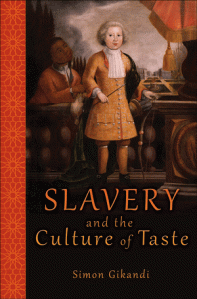 Simon Gikandi’s book Slavery and the Culture of Taste has just received a James Russell Lowell prize at MLA, and I thought that C18L, Long 18th, and other 18th-century scholars/readers might be interested in doing a collaborative reading of this book in the spring. Right now I’m trying to gauge the level of interest in the book, and seeing when might be a good time to do it.
We would probably do it over about a week or so, with one respondent per chapter posting a 500-800 word response every day or so, depending on the level of traffic. Then hopefully we can get Gikandi to respond to our posters at the end. For those interested in the process, we’ve done this with books by Joe Roach, Michael McKeon and Richard Sher in the past. Here’s the link to our announcement. If you’d like to participate, or better yet, help organize, please contact me at dmazella@uh.edu. It would also be helpful if you could give me an idea of the best week or weeks this spring for me to schedule.
Thanks,
Dave Mazella
The Long Eighteenth
◊ ◊ ◊ ◊ ◊
Recent postings at The Long Eighteenth offer numerous items of potential interest Enfilade readers including: 1) Soren Hammerschmidt‘s new course blog, Eighteenth-Century Media; 2) ‘Jeffersongate’ and the controversy surrounding Henry Wiencek’s treatment of Thomas Jefferson in Master of the Mountain; and 3) thoughts on synthesis. -CH
New Book | Hadrian’s Wall: A Life
From Oxford University Press:
Richard Hingley, Hadrian’s Wall: A Life (Oxford: Oxford University Press, 2012), 416 pages, ISBN: 978-0199641413, $150.
 In Hadrian’s Wall: A Life, Richard Hingley addresses the post-Roman history of this world-famous ancient monument. Constructed on the orders of the emperor Hadrian during the 120s AD, the Wall was maintained for almost three centuries before ceasing to operate as a Roman frontier during the fifth century. The scale and complexity of Hadrian’s Wall makes it one of the most important ancient monuments in the British Isles. It is the most well-preserved of the frontier works that once defined the Roman Empire.
While the Wall is famous as a Roman construct, its monumental physical structure did not suddenly cease to exist in the fifth century. This volume explores the after-life of Hadrian’s Wall and considers the ways it has been imagined, represented, and researched from the sixth century to the internet. The sixteen chapters, illustrated with over 100 images, show the changing manner in which the Wall has been conceived and the significant role it has played in imagining the identity of the English, including its appropriation as symbolic boundary between England and
Scotland. Hingley discusses the transforming political, cultural, and religious significance of the Wall during this entire period and addresses the ways in which scholars and artists have been inspired by the monument over the years.
◊ ◊ ◊ ◊ ◊
From Christopher Catling’s review, “Vandals and Hanoverians,” for TLS (14 December 2012): 27.
. . . in Gildas [writing around 540], the Wall is explicitly about “them and us” – civilization versus beastly paganism. The Wall is a genetic and cultural boundary, an idea that Hingley shows to be surprisingly long-lived: it recurs in nineteenth-century historical paintings of the Wall’s construction destined for the walls of the Houses of Parliament, in the illustrations to Kipling’s Puck of Pook’s Hill (1906), and even in a cartoon published in The Times in 1997 referring to the devolution debate. Civilization versus beastly paganism The idea that there is something different (for which read hostile and culturally inferior) about the people who live north of Hadrian’s Wall recurs every time political relations between the English and the Scottish come to the fore. . . .
Scotland really did turn hostile with the Jacobite uprisings of 1715. There was much talk about building a new Hadrian’s Wall, as roads, bridges and garrisons were constructed between 1725 and 1737 to militarize the Borders and the Highlands and Islands of Scotland. One result was the first accurate mapping of the Wall and its associated landscapes, undertaken by military surveyors; another was the use of the Wall as a quarry for road stone and the construction of a military road right on top of the eastern section of the Wall, from Newcastle to Sewingshields.
The antiquary William Stukeley was horrified by this act of desecration. Lobbying the Princess of Wales, he asked her to be his patron and champion in the work of protecting “this most noble, most magnificent work from further ruin, not from enemies, but from more than Gothic workmen, quite thoughtless and regardless of this greatest wonder, not of Brittain only, but of Europe.” Now, for the first time in the history of the Wall, it was the English who were cast in the role of the barbarians; Hanoverian military engineers were no better than the Goths and Vandals who had sacked Rome. . .
◊ ◊ ◊ ◊ ◊
For the Wall’s ongoing influence, we can also add The Game of Thrones, as George R. R. Martin acknowledged in 2000 (as quoted in The Guardian). Hadrian’s Wall as civilization’s boundary will presumably be with us for a long time.
The Art World in Britain 1660 to 1735
I should have noted this incredibly useful resource much, much earlier. As a compendium of primary materials, The Art World in Britain 1660 to 1735 is an ongoing project, with a completion date estimated at 2020. There’s a large team of people who deserve credit, but Dr. Richard Stephens stands out for his impressive work as editor. General information is provided below, and news of the latest additions are available here (details for having your name added to the update list are available at the website). -CH
◊ ◊ ◊ ◊ ◊
The Art World in Britain 1660 to 1735

The art world in Britain 1660 to 1735 will create a searchable corpus of the principal primary materials relating to the arts in early modern Britain. It will present new research in the form of a biographical dictionary, a database of art sales, a topographical dictionary and a group of subject-based texts. It will provide tools for further research with a database of financial records and a large checklist of works of art. The art world in Britain 1660 to 1735 is a major initiative of Court, Country, City: British Art 1660-1735. It is a long-term project, based at the University of York, which collaborates with other scholars and institutions and welcomes the involvement of its users. The website will be published as a developing work in progress: substantial additions of data will be uploaded every three months, and functional enhancements will keep pace with the growing body of material. The project aims to reach completion in October 2020.










 Enfilade
1 comment