Exhibition | Lyon in the Eighteenth Century
Now on at the Musées Gadagne de Lyon, as noted by Hélène Bremer:
Lyon au 18e, Un Siècle Surprenant
Musées Gadagne de Lyon, 22 November 2012 — 5 May 2013
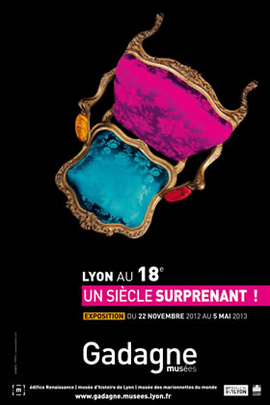 Au 18e siècle, Lyon pense, Lyon imagine, Lyon construit, Lyon s’enrichit…
Au 18e siècle, Lyon est une ville innovante et avant-gardiste au cœur des réseaux commerciaux, financiers et intellectuels. Sensible aux idées des Lumières, riche et commerçante, Lyon connaît une croissance économique exceptionnelle avec le développement de la faïence, des armes et de la soierie, annonçant, notamment, les révolutions industrielles du siècle suivant. La ville est au centre des débats littéraires et philosophiques qui animent la seconde moitié du siècle et un lieu de développement de la franc-maçonnerie. C’est une cité qui imagine la ville de demain avec les ingénieurs et architectes fabuleux que sont Morand, Perrache ou Soufflot. Ces grands projets urbanistiques ont une résonance surprenante avec les grands chantiers de 2012, tels les aménagements du nouveau quartier de Confluence ou la réhabilitation de l’Hôtel-Dieu.
◊ ◊ ◊ ◊ ◊
From Somogy éditions:
Catalogue: Maria-Anne Privat-Savigny, ed., Lyon au 18e: Un Siècle Surprenant (Paris: Somogy éditions d’art, 2012), 312 pages, ISBN: 978-2757205808, 35€.
Ouvrage collectif sous la direction de Maria-Anne Privat-Savigny, le catalogue suit le parcours de l’exposition tout en lui apportant l’analyse de 40 auteurs, chacun spécialiste de son domaine. De l’architecture à l’urbanisme, de la vie religieuse à la vie politique, des enjeux économiques, commerciaux, financiers et bancaires aux préoccupations et débats intellectuels, Lyon apparaît, au 18ème siècle, comme une ville innovante, enthousiaste, pétillante de nouveautés, cultivée, riche, essentielle à l’économie du royaume et au commerce européen, définitivement ouverte sur le monde. Perrache et Morand ont inventé l’urbanisme du siècle suivant, les jésuites ont mis en place le ballet moderne, tandis que la Saône a vu naviguer le premier bateau à vapeur et que des discussions vives et d’une remarquable modernité animent le monde de l’éducation. Lyon est, au siècle des Lumières, définitivement moderne et tournée vers l’avenir.
 ◊ ◊ ◊ ◊ ◊
The programming is extensive, including talks on the following themes:
• Autour de l’exposition
• Rencontres métiers d’art
• La science au siècle des Lumières
• Rousseau à Lyon
At Auction | Important Judaica at Sotheby’s
Press release from Sotheby’s:
Sotheby’s: Important Judaica, N08922
New York, 19 December 2012
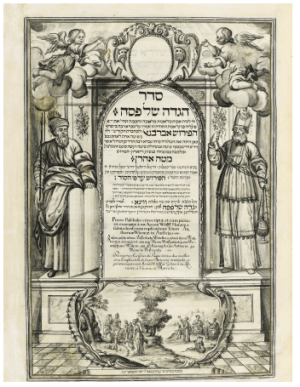
Lot 122 — Aaron Wolff Herlingen, The Herlingen Haggadah, 1730 (Vienna) — est. $800,000/1.2 million
Sotheby’s New York sale of Important Judaica on 19 December 2012 will offer examples of Hebrew ceremonial metalwork, illuminated manuscripts, early printed books, original decorative bindings, and fine art. The auction, which presents works from across the globe, is led by a magnificent Passover Haggadah, written and illustrated by Aaron Wolf Herlingen, from Vienna, 1730 (est. $800,000/1.2 million*).
The sale also includes important paintings by Isidor Kaufmann, a silver section highlighted by a German Hanukah Lamp, and the Kagan-Maremba Coin and Medal Collection that will be sold on behalf of The Jewish Museum (est. $300/500,000). The sale will be exhibited in its entirety in our York Avenue galleries beginning 14 December, alongside the sale of Israeli & International Art.
Undoubtedly the highlight of the Books and Manuscripts section of the sale, The Herlingen Haggadah from 1730 is a magnificent example of the 18th-century revival of Hebrew manuscript illumination that began in Vienna (est. $800,000/1.2 million).
 The scribe and artist of the manuscript is Aaron Wolff Herlingen, one of the finest Jewish calligraphers of the 18th-century renaissance of Hebrew manuscripts, and who became the scribe of the Imperial Library in Vienna in 1736. Herlingen signed his name on the title page of the present work in four languages – Hebrew, Latin, German and French – a conspicuous demonstration of his facility in the multiple languages of the Austrian Empire. The present haggadah is one of Herlingen’s finest efforts and his consummate skill as a scribe is evidenced in the superbly written letters of the text and commentaries. His artistic mastery is demonstrated in the numerous illustrative and decorative elements within the manuscript. The work features three ornamented initial word panels and 60 text illustrations, as well as a detailed manuscript map appended by Herlingen specifically for this volume.
Another highlighted manuscript is an extremely rare and important early Mahzor, France, 13th century. Estimated at $180/240,000, the work contains the liturgy from Yom Kippur, Sukkot and Hanukkah, according to the French rite. Research shows that the present manuscript and a Mahzor for Rosh ha-Shanah currently in the collection of the British Library, were penned by the same scribe and originally constituted a single, larger work. This volume also may well be the most important extant source of the liturgical rite of medieval French Jewry, and includes several customs and traditions that are unknown from any other source.

Lot 119 — Derekh Etz Heim (Path of the Tree of Life), ca. 1700-20, est: $60,000 – 80,000
Additional works on offer feature the first Haggadah printed in America, which contains service for the first two nights of the Passover in Hebrew and English (est. $80/100,000), and an important decorated Esther Scroll in a matching contemporary silver case, circa 1800 (est. $70/90,000). Also included in the sale is Derekh Etz Heim (Path of the Tree of Life), an 18th-century manuscript by Haim Vital of a kabbalistic masterwork (est. $60/80,000). This manuscript is the first part of Haim Vital’s authoritative summary of the kabbalistic teachings of his master, the preeminent kabbalist of 16th-century Safed, Isaac Luria.
The highlight of the silver and metalwork on offer in the December auction is an important German silver-gilt Hanukah Lamp made by Johann Valentin Schüler in Frankfurt, Germany, circa 1690 (est. $300/500,000). The magnificent lamp belongs to a group of seven related examples from late-17th- and early 18th-century Frankfurt, most of which are preserved in museum collections – the example in the Steiglitz Collection at the Israel Museum is closest to the piece on offer. These lamps show the wealth of Frankfurt’s Jewish community, at a time when the city’s ghetto was one of the most densely populated in Europe. The sale also features two fine singleowner groupings, one of which includes a very early German silvergilt Havdalah Compendium, made in Augsburg, circa 1630 (est. $30/50,000). (more…)
Holiday Gift Guide | From The Metropolitan Museum’s Gift Shop
The Metropolitan Museum of Art’s gift shop includes an assortment of items inspired by the museum’s eighteenth-century holdings. I can vouch for only the crocus pot, but it’s fabulous. And through December 2, you can save 25% sitewide with code L182. -CH
◊ ◊ ◊ ◊ ◊
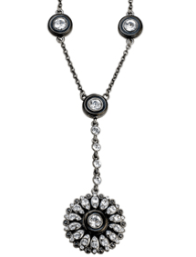 French Neoclassical Button Necklace ($75)
In the collection of The Costume Institute at the Museum is a group of six French buttons made about 1785. These striking buttons are made of silver-mounted, star- shaped strass (a flint glass used to imitate gemstones) interspersed with rich cobalt blue enamel. Their geometric design is in keeping with the Neoclassical style in vogue during the reign of Louis XVI, while their eye-catching sparkle speaks of opulence. Our necklace adapts these stunning buttons in hematite overlay with black hand enameling and Swarovski™ crystals. Hematite overlay, with Swarovski™ crystals. Hand enameled. Lobster claw closure. Adjusts from 17”L to 19”L with extender chain.
Earrings are also available
◊ ◊ ◊ ◊ ◊
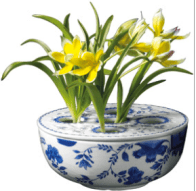 Crocus Pot ($65 / on sale for $32.50)
Made in 1740 in England, the original delftware crocus pot was conceived to cultivate bulbs indoors to brighten gloomy winter days. Although the shape of the bowl is European, the inspiration for the decoration is Chinese—a true depiction of immaculate chinoiserie. Left in the white or decorated in shades of blue or polychrome enamels, delftware was both a useful and a decorative luxury ware for wealthy households. By the middle of the eighteenth century, crocus pots were being used to cultivate flowering bulbs indoors during the winter months. Our reproduction holds bulbs or cut flowers. Porcelain. 8” diameter.
◊ ◊ ◊ ◊ ◊
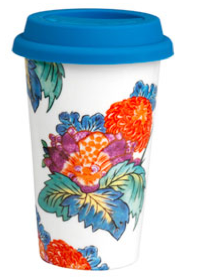 18th-Century German Floral Ceramic Travel Cup ($20 / on sale for $10)
In the collection of the Metropolitan Museum is a large, white, baluster-shaped vase decorated with Kakiemon-style flowers and birds in polychrome and gilt, and an iron-red meander pattern on the neck. This splendid covered vase (Germany, ca. 1725–30), almost two feet high, was made at a German factory, which was the first European manufactory of hard-paste porcelain. Kakiemon is the name given to a distinctive class of Japanese porcelains, which were widely imitated by eighteenth-century European manufacturers. The colorful design on our sturdy ceramic travel cup is adapted from the vibrant floral decorations on the original vase. Ceramic cup. Silicone lid. Microwave and dishwasher safe. 8 oz. 6”H x 3 3/4” diameter.
◊ ◊ ◊ ◊ ◊
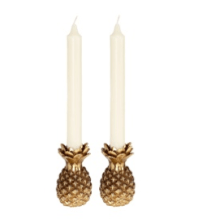 Pineapple Candleholders, Large ($75 / on sale for $37.50)
A charming addition to your holiday table and all year round, these candleholders are adapted from a pair of late eighteenth-century French ormolu finials in the Museum’s collection. Set of 2. 14K gold overlay. Candles not included. 4”H x 2”W.
A smaller set, of four, is also available.
Call for Papers | Sugar and Beyond
From the conference website:
Sugar and Beyond
The John Carter Brown Library, Providence, RI, 25-26 October 2013
Proposals due by 15 December 2012
◊ ◊ ◊ ◊ ◊
Organizers: Christopher P. Iannini (Rutgers), Julie Chun Kim (Fordham), and K. Dian Kriz (Brown)
The John Carter Brown Library seeks proposals for a conference entitled Sugar and Beyond, to be held on October 25-26, 2013, and in conjunction with the Library’s Fall 2013 exhibition on sugar in the early modern period, especially its bibliographical and visual legacies. The centrality of sugar to the development of the Atlantic world is now well known. Sugar was the ‘green gold’ that planters across the Americas staked their fortunes on, and it was the commodity that became linked in bittersweet fashion to the rise of the Atlantic slave trade. Producing unprecedented quantities of sugar through their enforced labor, Africans on plantations helped transform life not only in the colonies but also in Europe, where consumers incorporated the luxury commodity into their everyday rituals and routines.
Sugar and Beyond seeks to evaluate the current state of scholarship on sugar, as well as to move beyond it by considering related or alternative consumer cultures and economies. Given its importance, sugar as a topic still pervades scholarship on the Americas and has been treated in many recent works about the Caribbean, Brazil, and other regions. This conference thus aims to serve as an occasion where new directions in the study of sugar can be assessed. At the same time, the connection of sugar to such broader topics as the plantation system, slavery and abolition, consumption and production, food, commodity exchange, natural history, and ecology has pointed the way to related but distinct areas of inquiry.
Although sugar was one of the most profitable crops of the tropical Americas, it was not the only plant being cultivated. Furthermore, although the plantation system dominated the lives of African and other enslaved peoples, they focused much of their efforts at resistance around the search for ways to mitigate or escape the regime of sugar planting. We thus welcome scholars from all disciplines and national traditions interested in exploring both the power and limits of sugar in the early Atlantic world. Topics that papers might consider include but are not limited to the following:
• The development of sugar in comparative context
• The rise of sugar and new conceptions of aesthetics, taste, and cultural refinement
• Atlantic cultures of consumption
• Coffee, cacao, and other non-sugar crops and commodities
• Natural history and related genres of colonial description and promotion
• Imperial botany and scientific programs of agricultural expansion and experimentation
• Alternative ecologies to the sugar plantation
• Plant transfer and cultivation by indigenous and African agents
• Provision grounds and informal marketing
• Economies of subsistence, survival, and resistance
• Reimagining the Caribbean archive beyond sugar: new texts and methodological approaches
In order to be considered for the program, please send a paper proposal of 500 words and CV to jcbsugarandbeyond@gmail.com. The deadline for submitting proposals is December 15, 2012.
Presenters will likely have some travel and accommodation subvention available to them. For more information, consult the conference website or email Margot Nishimura, Deputy Director and Librarian (margot_nishimura@brown.edu).
YCBA’s Complete Collection Now Accessible Online
The YCBA’s complete art collection, including nearly 50,000 works on paper, is now accessible online
 The Yale Center for British Art is pleased to announce that its entire art collection is now available online. Visitors to the website can search the Center’s collection of more than two thousand paintings, two hundred sculptures, and nearly fifty thousand prints and drawings from the Elizabethan period to the present. This is the first time the Center’s complete holdings of works on paper, the most important and comprehensive collection of its kind outside the United Kingdom, have been are searchable online. The Center has also made available more than thirteen hundred records of its historic frame collection, among the first museums in the world to do so. These frames join other collections at the Center that have been made available online, including a sizable portion of the rare books and manuscripts collection, and the entire Reference Library.
More than one-third of the new prints and drawings records include high-resolution images, and the Center offers free downloads of works that are in the public domain as high-resolution TIFs. This update to the online collection also includes the release of expanded data, such as bibliographic citations, for the records of specific works of art. More than six thousand citations, including books, journals, newspaper articles, auction catalogues, and online resources, have been added to four hundred objects to date, with more being added daily.
 Aside from making its collections accessible online, the Center has partnered with Google Art Project and is working with other platforms to allow broader audiences to discover British art. It has also created a data provider that allows third parties to harvest the Center’s collections for use in their own content platforms. Those interested in harvesting the collections as either extensible mark-up language (XML) or linked open data can now find simple instructions for how to do so at britishart.yale.edu/collections/usingcollections/ technology. The Center is particularly focused on the potential of linked open data to disseminate its collections, to expand the possibilities of integration between related collections, and to support
opportunities for developing new technologies for research in the realm of
cultural heritage.
Yale Center for British Art Refurbishment Project, 2013
Good news for anyone planning to make use of the YCBA in 2014, but for the summer and fall of 2013, a bit of extra planning is in order. -CH
◊ ◊ ◊ ◊ ◊

Summer and Fall 2013
The first phase of a refurbishment project at the Yale Center for British Art has been scheduled for summer and fall 2013, and there will be limited availability of some services and partial closures on the second and third floors, as noted below. The permanent collection on the fourth floor will remain on view throughout this period. It is expected that the project will be completed by early January 2014.
The Departments of Prints & Drawings and Rare Books & Manuscripts will be temporarily relocating their offices within the building, and the Study Room will be closed from June through December 2013. The collections will be transferred to other parts of the building over the summer of 2013.
As soon as these transfers are completed, staff will make every effort to accommodate the needs of faculty, students, and scholars. However, access to the collections will be limited during the fall term and by appointment only. Requests for materials will require at least two weeks advance notice (ycba.prints@yale.edu). The Center will continue to accommodate classes using works from the Prints & Drawings and Rare Books & Manuscripts collections by special arrangement with the staff; to discuss your requirements, please contact Gillian Forrester, Curator of Prints & Drawings, and Elisabeth Fairman, Senior Curator of Rare Books & Manuscripts.
The Center will be unable to host Visiting Scholars during the refurbishment project. Please note that during this period, the second- and third-floor galleries will be closed, as will the Library Court. The second-floor classroom will remain accessible for teaching; please contact Jane Nowosadko, Senior Manager of Programs, to check availablity. The Reference Library will keep normal hours, although there may be some disruptions over the summer. Details will be circulated as they become known. Tours of the collection will be offered as normal, although requests need to be made two weeks in advance (ycba.education@yale.edu).
There will be a regular roster of programs in the Center’s Lecture Hall throughout the refurbishment project. It is expected that normal services in the Study Room will resume by early January 2014.
Contact Details
• Requests for materials from Prints and Drawings and Rare Books and Manuscripts should be made at least two weeks in advance by e-mailing ycba.prints@yale.edu.
• To discuss requirements for classes contact the curators: Gillian Forrester, Curator of Prints & Drawings, gillian.forrester@yale.edu, Elisabeth Fairman, Senior Curator of Rare Books & Manuscripts, elisabeth.fairman@yale.edu
• Inquiries about the availability of the second-floor classroom and the Docent Room should be e-mailed to Jane Nowosadko, Senior Manager of Programs, jane.nowosadko@yale.edu
• Inquiries about the Reference Library can be addressed to Kraig Binkowski, Chief Librarian, kraig.binkowski@yale.edu
• For information about the Visiting Scholar program for 2013–14, please visit britishart.yale.edu/research/visiting-scholars, or contact Lisa Ford, Associate Head of Research, lisa.ford@yale.edu.
Exhibition | Bouke De Vries: War & Pieces
My apologies for posting this one so late. I’m afraid this is the last weekend. -CH
From The Holburne Museum:
Bouke De Vries: War & Pieces
The Holburne Museum, Bath, 1 September — 2 December 2012
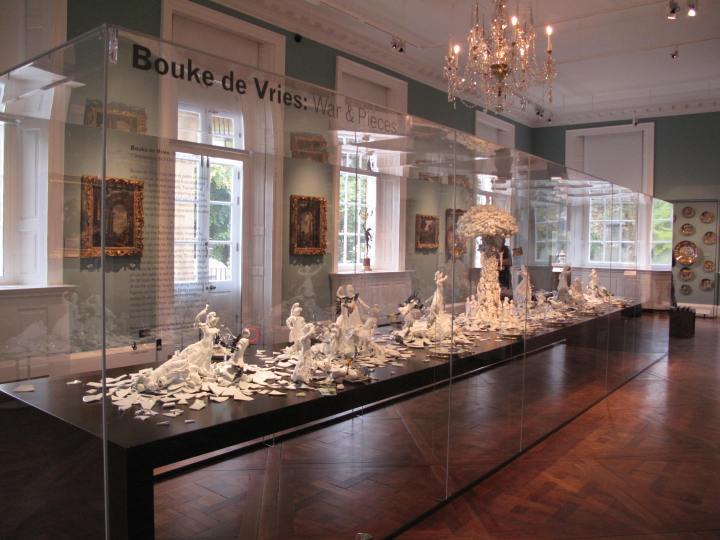
Bouke de Vries, War & Pieces, installation at
The Holburne Museum, Bath, 2012
◊ ◊ ◊ ◊ ◊
 Ceramic artist Bouke de Vries has created a unique contemporary installation on the Holburne’s Ballroom table. His work is inspired by the eighteenth-century fashion for decorating banqueting tables with extravagant porcelain and sugar sculptures, War & Pieces draws on the tradition of grand banquets and balls held on the eve of battle.
The centre-piece is a dramatic atomic-bomb mushroom cloud made using shards of white ceramics, old and new, around which the table is set with an intervention incorporating Sir William Holburne’s Chinese tobacco-leaf pattern dinner service. A battle will be fought out along the table with figures derived from 1770s Derby porcelain, some of which have mutated into cyborgs using elements from plastic toys – a new and contemporary material fighting to defeat the forces of sugar and ceramic.
Conference | Interiors and Interiority
Expanding on a previous conference and workshop on the theme of interiority at the Radcliffe Institute for Advaced Study in 2009 and 2011, Beate Söntgen and Ewa Lajer-Burcharth have organized a three-day conference in Berlin on the subject.
◊ ◊ ◊ ◊ ◊
As posted at the H-ArtHist List:
Interiors and Interiority
Denkerei, Oranienplatz 2, Berlin, 6-8 December 2012
Organized by Beate Söntgen and Ewa Lajer-Burcharth
T H U R S D A Y , D E C E M B E R 6
Introduction
14.00 Beate Söntgen (Leuphana Universität Lüneburg) / Ewa Lajer-Burcharth (Harvard University)
Conceptualizing Interiority
14.30 Brigid Doherty (Princeton University), “‘Armlos wie Inneres’: Interior, Surface, and Metaphor in Rilke’s Rodin Lecture”
15.15 Bettine Menke (Universität Erfurt), “Interiors: The Exteriority of Inwardness”
Visualizing Interiority
16.30 Catherine Girard (Harvard University), “Violence and Interiority: Stags at Louis XV’s Versailles”
17.15 Anne Hemkendreis (Leuphana Universität Lüneburg), “The Alienation of Inwardness: Female Figures at a Threshold in the Paintings of Vilhelm Hammershøi”
18.15 Susan Sidlauskas (Rutgers), “House Inside Out—Cézanne’s Perforated Wall”
F R I D A Y , D E C E M B E R 7
Interiority and Consumer Culture
10.00 Holger Kuhn (Leuphana Universität Lüneburg), “From the Household of the Soul to the Economy of Money (around 1500)”
10.45 Charlotte Klonk (Humboldt-Universität zu Berlin), “Africa Interiorised: Displaying Non-European Artefacts in the Late 1920s and Early 1930s”
12.00 Katrin Grögel (Leuphana Universität Lüneburg), “Andrea Zittel’s ‘Small Liberties’: Situating Interiors in Contemporary Media Culture”
Building Interiors / Interiority Furnished
14.30 Katie Scott (The Courtauld Institute of Art), “Rococo Interiors: An Inside Story”
15.15 Mimi Hellman (Skidmore College), “Staging Retreat: Designs for Bathing in the Eighteenth Century”
16.30 Etienne Jollet (Université Paris 1 Panthéon-Sorbonne), “Interiors in the Exterior: Eighteenth-Century Grottoes and the Intimacy of Nature”
17.15 Johannes Grave (Universität Bielefeld), “Living with Pictures: Goethe’s Interiors”
Panel Discussion
18.15 Wilfried Kuehn (Architekturbüro Kuehn Malvezzi, Berlin/Mailand) / Andreas Beyer (Deutsches Forum für Kunstgeschichte, Paris), “Contemplation or Communication? The Museum’s Interior”
S A T U R D A Y , D E C E M B E R 8
Interiority on the Move
9.30 Annette Urban (Ruhr-Universität Bochum), “Wild Walls, Revolving Sets, Built Cuts: Staged Interiors in Contemporary Photography and Film Installation”
10.15 Peter Schneemann (Universität Bern), “Anagrammatic Spaces: Moving Interiors in Contemporary Art”
11.30 Stefanie Diekmann (Universität Hildesheim), “Scenes from the Backstage: Theatrical Interiors and Interiority”
12.15 Gertrud Koch (Freie Universität Berlin), “Inside/Outside: The Two Sides of the Wall and the Filmic View”
Contact: Eva Frey, Fon 04131.677-1990, frey@leuphana.de
Attingham Offerings for 2013
In 2013 the Attingham Trust for the Study of Historic Houses and Collections will offer three courses: the three-week Summer School (5-22 July), the nine-day Royal Collection Studies (1-10 September), and the nine-day Study Programme (12-20 September). Whereas the first two courses follow similar itineraries each year, the Study Week is set in a different location each year, and its timing varies as well. 2013 will offer an in-depth study of the Norfolk Country House, corresponding with the upcoming William Kent exhibition (at the Bard Graduate Center in the fall of 2013 before appearing at the V&A in 2014) and taking advantage of the summer exhibition Houghton Revisited: The Walpole Masterpieces from Catherine the Great’s Hermitage, which will reassemble the collection of Sir Robert Walpole in its eighteenth-century home of Houghton Hall (it’s a safe bet that the course will include special, private viewing opportunities for a show that’s sure to be crowded much of the summer). The Study Week will be directed by Andrew Moore, the former Keeper of Art at Norwich Castle Museum and Art Gallery, and the co-editor of A Capital Collection: Houghton Hall and the Hermitage (Yale UP, 2002). -CH
◊ ◊ ◊ ◊ ◊
From the Attingham Trust:
Attingham Trust Course Offerings for 2013
Application due dates vary according to the programme, starting 31 January 2013

◊ ◊ ◊ ◊ ◊
Attingham Study Programme — The Norfolk Country House: Collections and Networks
THE ATTINGHAM STUDY PROGRAMME is a strenuous and stimulating nine-day course studying historic houses and their collections. Based in specific regions of Britain and often abroad, a wide range of houses, many of them private, are visited in the company of tutors. The architecture, gardens and interiors, including collections of paintings, furniture and other decorative arts, are studied within a context of social and cultural history. It is intended for museum curators, lecturers, architects, conservationists and others with a keen interest in the fine and decorative arts. Accommodation is in modest hotels where lectures are also given. Some full and partial scholarships are available.
The eastern wetlands and broad skies of Norfolk boast a landscape which was the inspiration behind the first regional School of painting in Britain, together with an array of classic country houses that few other English regions can equal. The county’s close proximity to London placed it in the pole position of England’s second city from the medieval period, until the coming of the railways reduced the centrality of its agrarian economy. The 15th-century origins of the moated manor house of OXBURGH HALL and the privately owned Tudor pile of EAST BARSHAM survive today as testimony of the earlier period.
The focus of the 2013 programme will be two great Palladian houses still in private hands, both with magnificent interiors and furnishings by William Kent. The quintessential Grand Tour house, HOLKHAM HALL will feature seminars on the library, archive, silver, textiles and sculpture. We also visit HOUGHTON HALL, the country palace that Sir Robert Walpole controversially built to house his great collection of European master paintings and classical sculpture while based at 10 Downing Street as first minister successively to both George I and George II. This visit will also include seminars on paintings and textiles, visits to the private Picture Gallery and the contemporary sculpture within the park, together with the newly established gardens in memory of Sybil Cholmondeley.
The programme, based in the heart of the medieval market town and seaport of KING’S LYNN in West Norfolk, will also visit the city of NORWICH, and will include tours of the historic built environment of both centres, with their merchant houses and guildhalls. Seminars in NORWICH CASTLE will focus on Norwich Silver and the redisplayed Colman galleries featuring the paintings of Norwich School of Artists. The course plans to feature significant private houses, including RAYNHAM HALL, seat of the Townshend family, which also features the work of William Kent, and NARFORD HALL, home to successive generations of the Fountaine family.
Additional information about all three courses is available here»
Exhibition | Houghton Revisited: The Walpole Masterpieces
More than sixty paintings from the Hermitage will spend the summer of 2013 back at Houghton Hall. The exhibition curator Thierry Morel will be in New York providing a preview at The Metropolitan Museum of Art on Friday, 7 December 2012, at 6pm.
◊ ◊ ◊ ◊ ◊
From the exhibition website:
Houghton Revisited: The Walpole Masterpieces from Catherine the Great’s Hermitage
Houghton Hall, Norfolk, 17 May — 29 September 2013 [extended to 24 November]
Curated by Thierry Morel

Colen Campbell, James Gibbs, and William Kent, Houghton Hall,
Norfolk, 1722-35 (Photo: 2008, Wikimedia Commons)
◊ ◊ ◊ ◊ ◊
The magnificent art collection of Great Britain’s first Prime Minister, Sir Robert Walpole, sold to Catherine the Great to adorn the Hermitage in St. Petersburg, is reassembled in its spectacular original setting, Houghton Hall, Norfolk, for the first time in over 200 years.
◊ ◊ ◊ ◊ ◊
From the Mail Online (6 October 2012) . . .
Lord Cholmondeley is about to announce plans to stage a very special exhibition next year that will see the triumphant, if temporary, return to the house of about 60 old master paintings from Sir Robert Walpole’s once celebrated collection, the bulk of which was sold to Catherine the Great of Russia in 1779 and which to this day remains one of the greatest treasures of the Hermitage Museum in St Petersburg. To provide an authentic and breathtaking backdrop for the pictures, the principal rooms of the house will be restored to their exact appearance of the early 1740s, a time when Walpole was at the height of his powers. . .
The full article is available here»










 Enfilade
leave a comment