Call for Papers | Re-Imagining Allegory in Alchemical Tradition
From ArtHist.net:
Visita Interiora: Re-Imagining Allegory in the Alchemical Tradition, 1400–1800
Palazzo Giustinian Lolin, University of Warwick Venice Centre, Venice, 16–17 June 2025
Keynote Speaker: Jennifer M. Rampling
Organized by Sergei Zotov
Proposals due by 15 April 2025
Alchemy is often associated with the imagery of flasks, furnaces, and laboratories. However, the universe of alchemical iconography extends far beyond these familiar motifs, encompassing a rich tapestry of symbols and allegories tied to both chemical processes and cultural phenomena. Thanks to extensive archival efforts and digitisation projects, we now have access to thousands of alchemical image series preserved in manuscripts and printed books. How might our understanding of this visual tradition deepen if we approach alchemical allegorical iconography using the same methodologies applied to other forms of imagery—such as iconographic analysis and the study of text-image relationships?
This conference invites case studies on the allegorical iconography of alchemy (1400–1800), aiming to foster new perspectives on the role of visual culture in the history of science. We particularly emphasise manuscripts and material culture and encourage submissions that engage with previously unstudied or undigitised sources. The key topics include, but are not limited to:
• Iconographic Trends: What trends emerge in alchemical iconography? Why did certain allegories gain widespread popularity while others remained obscure?
• Sources of Influence: What visual or textual traditions—including non-European and non-alchemical ones such as sacred art, emblem books, or scientific imagery—influenced specific images or image series in European alchemy?
• Methods of Analysis: How can we assess the role and function of allegorical images in alchemy? For instance, what do variations in the same image series across different manuscripts reveal about cultural, religious, or laboratory contexts?
• Material Evidence: What insights can be gained from the imagery on objects such as alchemical medals, coins, book covers, or laboratory apparatus like furnaces?
• Reception: How was allegorical alchemical imagery received in later alchemical or non-alchemical traditions?
We warmly invite you to the historic Palazzo Giustinian Lolin in Venice this June, where the Baroque setting will provide a fitting backdrop for scholarly discussions on alchemical allegories and their visual traditions. Please complete the registration form here. Alternatively, send your submissions to sergei.zotov@sas.ac.uk, including a short biographical note (50 words) and a presentation abstract (250 words) by 15 April 2025.
Prado Launches Online Collection of Printed References to Goya
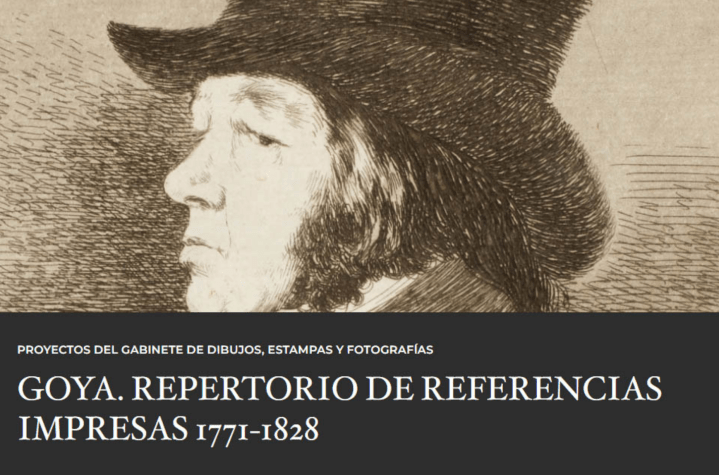
As noted at Art History News, the Prado has just launched its latest online digital project, Goya: Repertorio de referencias impresas: 1771–1828, which collects some 30,000 published references to Goya made during his lifetime in books, advertisements, newspaper articles, and prints. From the press release (6 February 2025) . . .
Goya: Repertorio de Referencias Impresas, 1771–1828
Online, The Prado Museum, Madrid
El Museo del Prado amplía los proyectos digitales del Gabinete de Dibujos, Estampas y Fotografías reuniendo por primera vez todas las referencias impresas sobre Goya publicadas durante su vida. Este Repertorio de referencias impresas. 1771–1828, disponible en la web, facilita el acceso a un corpus documental de gran valor para investigadores y amantes del arte, y público en general.
Para acercar al público su extensa colección de dibujos, estampas y fotografías—formada por aproximadamente 30.000 obras que por motivos de su conservación no se exponen permanentemente en las salas—el Museo Nacional del Prado ha desarrollado un espacio web con contenidos monográficos especialmente concebidos para dar a conocer su singularidad y riqueza. En este contexto, el Museo presenta el Repertorio de referencias impresas. 1771–1828 sobre Francisco de Goya, una herramienta única que pone a disposición del público el primer repertorio en el mundo que reproduce la totalidad de referencias publicadas sobre un artista durante su vida.
Este nuevo repertorio amplía el campo de divulgación de la obra de Goya mediante la recopilación de referencias impresas, conservadas en bibliotecas y museos de todo el mundo, algunas de difícil acceso. Desde la primera mención de Goya en 1771 hasta su fallecimiento en 1828, su nombre fue citado en libros, anuncios, artículos periodísticos y estampas, reflejando su notoriedad y reconocimiento en vida. El Repertorio de referencias impresas. 1771–1828 está organizado mediante fichas cronológicas que incluyen datos bibliográficos, transcripciones, traducciones, imágenes de documentos originales y enlaces a versiones digitalizadas completas. Asimismo, se ha desarrollado un sistema de búsqueda por términos y etiquetas, permitiendo filtrar la información por tipología documental y década.
Este recurso digital ha sido posible gracias al trabajo del especialista en obra gráfica de Goya, Juan Carrete Parrondo, quien inició este proyecto antes de su fallecimiento en 2023. Tras dos años de labor, el Museo del Prado culmina su esfuerzo y lo pone a disposición del público. Siguiendo el espíritu colaborativo de su creador, el proyecto sigue abierto a nuevas aportaciones, invitando a los usuarios a contribuir con referencias adicionales mediante el correo gabinete.dibujos@museodelprado.es.
El Repertorio de referencias impresas. 1771–1828 ha sido financiado con fondos del Plan de Recuperación, Transformación y Resiliencia de España (PRTR) y vinculado a las actuaciones dentro del programa C.24 I3 Digitalización e impulso de los grandes servicios culturales, incluido en el eje incluido en el eje Prado Formación y dentro de la actuación “Prado Formación e Investigación” y de la actividad Canal de formación e investigación.
Research Seminar | Martin Myrone on the Foggo Brothers’ Parga

.
James and George Foggo, Parga during the Awful Ceremony that Preceded the Banishment of its Brave Christian Inhabitants and the Entrance of Ali Pacha, ca. 1819, lithograph, 42 × 64 cm (London: the British Museum, 1842,0319.14).
◊ ◊ ◊ ◊ ◊
Next month at the Mellon Centre:
Martin Myrone | A Radical Alternative within British Romanticism: The Foggo Brothers’ Parga
Online and in-person, Paul Mellon Centre, London, 19 March 2025, 5pm
This talk focuses on one of the most remarkable—but forgotten—works of British art of any era: The Christian Inhabitants of Parga Preparing to Emigrate (1822) by the brothers George and James Foggo. This huge painting, twenty-six feet long by sixteen high, was exhibited several times in the nineteenth century before disappearing. Recorded in a mezzotint, the picture features a multitude of figures in a scene of horror with the people of Parga in Greece disinterring their ancestors so that their remains were not left on ground falling under Ottoman rule. The incident of 1819 on which the picture was based was an international scandal, identified as an appalling indictment of British foreign policy. Ironically, the very size, political purpose and pictorial ambition of the Foggo brothers’ picture has made it easy to be ignored by art history. This talk will explore how the discipline has by contrast—and this is almost regardless of political orientation—been preoccupied with the subjective and commodified aesthetics assumed to be the enduring legacy of the ‘Romanticism’ of the era.
The event starts with a presentation and talk by Martin Myrone, lasting around 40 minutes, followed by Q&A and a free drinks reception. The event is hosted in our Lecture Room, which is up two flights of stairs (there is no lift). The talk will also be streamed online and recording published on our website.
More information and registration is available here»
Martin Myrone is Head of Research Support and Pathways at the Paul Mellon Centre. Before joining the Centre in 2020, Martin spent over twenty years in curatorial roles at Tate, London. His many exhibitions at Tate Britain have included Gothic Nightmares (2006), John Martin (2011), William Blake (2019), and Hogarth and Europe (2021). His research and publications have focused on eighteenth- and nineteenth-century British art, with a special interest in artistic identity and artists’ labour, class, cultural opportunity and gender. His many published works include Bodybuilding: Reforming Masculinities in British Art 1750–1810 (2005) and Making the Modern Artist: Culture, Class and Art-Educational Opportunity in Romantic Britain (2020), both published by the Paul Mellon Centre.
Exhibition | Illusion: Dream–Identity–Reality
Now on view at the Hamburger Kunsthalle:
Illusion: Dream – Identity – Reality
Hamburger Kunsthalle, Hamburg, 6 December 2024 — 6 April 2025
Curated by Sandra Pisot and Johanna Hornauer

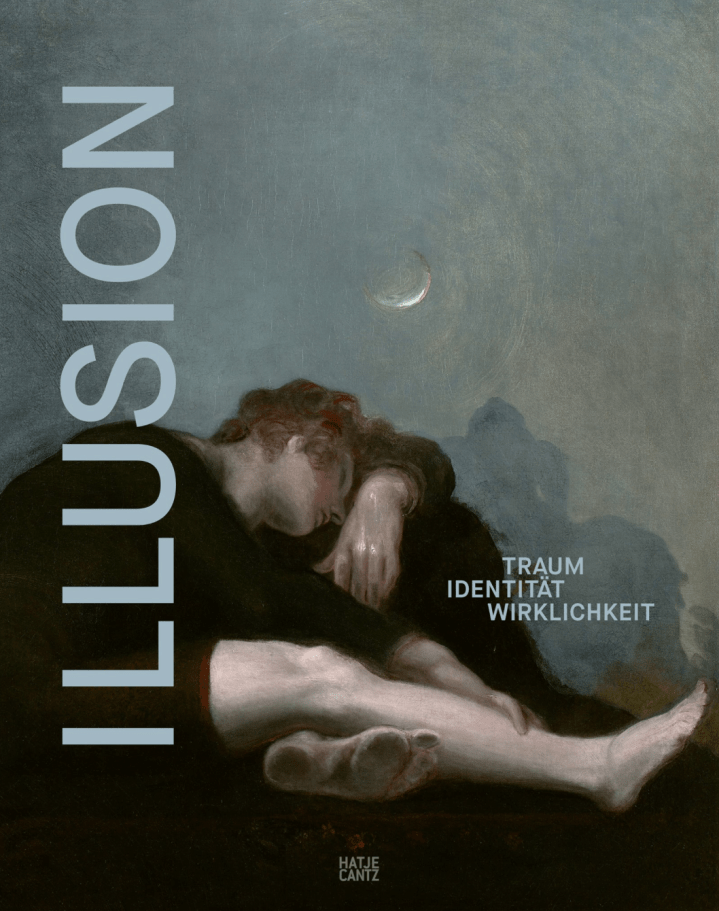
Henry Fuseli, Die Vision des Dichters (The Poet’s Vision), 1806–07, oil on canvas, 61 × 41.5 cm (Winterthur: Stiftung für Kunst, Kultur und Geschichte). The composition served as the frontispiece for William Cowper’s book, Poems (London: J. Johnson , 1808), volume 1.
With a large-scale exhibition spanning several epochs, the Hamburger Kunsthalle looks at the diverse facets of the theme of illusion in art from the Old Masters to the present day. Trompe-l’œil has been widely used in art since antiquity, flourishing in particular in the Renaissance and Baroque periods. And this technique continues to fascinate artists today, when the spread of fake news is almost normal, when people are confronted daily with manipulated images on the internet and virtual reality seems to be expanding our cosmos into infinity. We now live in the certainty that we can no longer trust our eyes, that images are deceptive and are used to depict what is desired rather than what is. But the exhibition shows how illusion means far more than merely deceiving the eye. It is manifested in the (illusionistic) self-love of Narcissus as well as in spatial illusions in architecture, in the play of concealing and revealing via the pictorial motifs of the curtain and the mask, in the meaning of the open or closed window onto the world, and in images of visions and dreams. Based on some 150 paintings, drawings, prints, photographs, sculptures, installations and video works, the show traces the many different forms taken by hyperrealism, reality, fiction, dream, transformation and deception. Among the exhibits are major works from the Hamburger Kunsthalle as well as loans from national and international collections.
Marcel Duchamp remarked succinctly in 1964: “Art is a deception.” And in 1976 Sigmar Polke wondered about the limits of human perception: “Can you always believe your eyes?” Against the backdrop of fake news and artificial intelligence, the exhibition also takes a look at illusion in twenty-first-century society, urging us to sharpen our senses and reflect on what is innately human: our viewing habits, expectations, conventions and vulnerability to visual seduction.
 Artists featured in the exhibition
Helene Appel, Hans Arp, Thomas Baldischwyler, Max Beckmann, Paris Bordone, Carl Gustav Carus, Marc Chagall, Jean-Baptiste Siméon Chardin, Adriaen Coorte, Lovis Corinth, Edgar Degas, Robert Delaunay, Johann Friedrich Dieterich, Gerrit Dou, Wilhelm Schubert von Ehrenberg, Lars Eidinger, Elmgreen & Dragset, James Ensor, Max Ernst, M. C. Escher, Juan Fernández, Charles de la Fosse, Caspar David Friedrich, Johann Heinrich Füssli, Xaver Fuhr, Jean-Léon Gérôme, Cornelis Gijsbrechts, Nan Goldin, Francisco de Goya, Andreas Greiner, Joachim Grommek, Duane Hanson, Vilhelm Hammershøi, Johann Georg Hinz, David Hockney, Samuel van Hoogstraten, Roni Horn, Gerard Houckgeest, Horst Janssen, Alexander Kanoldt, Howard Kanovitz, Anish Kapoor, Oskar Kokoschka, Jens Lausen, François Lemoyne, Lorenzo Lippi, Simon Luttichuys, Alfred Madsen, René Magritte, Tony Matelli, Stefan Marx, Adolph Menzel, Frans van Mieris d. Ä., Piet Mondrian, Ron Mueck, NEAL, Giovanni Battista Piranesi, Sigmar Polke, Gerhard Richter, Joachim Ringelnatz, Jan van Rossum, Pieter Jansz. Saenredam, Godfried Schalcken, Markus Schinwald, Oskar Schlemmer, Georg Schrimpf, Cindy Sherman, Kiki Smith, Antonie van Steenwinckel, Theodoor van Thulden, Nikos Valsamakis, Victor Vasarely, Wolf Vostell, Friedrich Wasmann, John William Waterhouse, Jacob de Wit, Francisco de Zurbarán.
From Hatje Cantz:
Sandra Pisot and Johanna Hornauer, eds., Illusion: Traum – Identität – Wirklichkeit (Berlin: Hatje Cantz Verlag, 2024), 320 pages, ISBN: 978-3775758451, €54. With contributions by Juliane Au, Markus Bertsch, Clara Blomeyer, Laura Förster, Johanna Hornauer, David Klemm, Brigitte Kölle, Kerstin Küster, Sandra Pisot, Jan Steinke, Andreas Stolzenburg, Ifee Tack.
New Book | Creator of Nightmares: Henry Fuseli’s Art and Life
From Reaktion Books with distribution by The University of Chicago Press:
Christopher Baker, Creator of Nightmares: Henry Fuseli’s Art and Life (London: Reaktion Books, 2024), 192 pages, ISBN: 978-1789149302, £30 / $45.
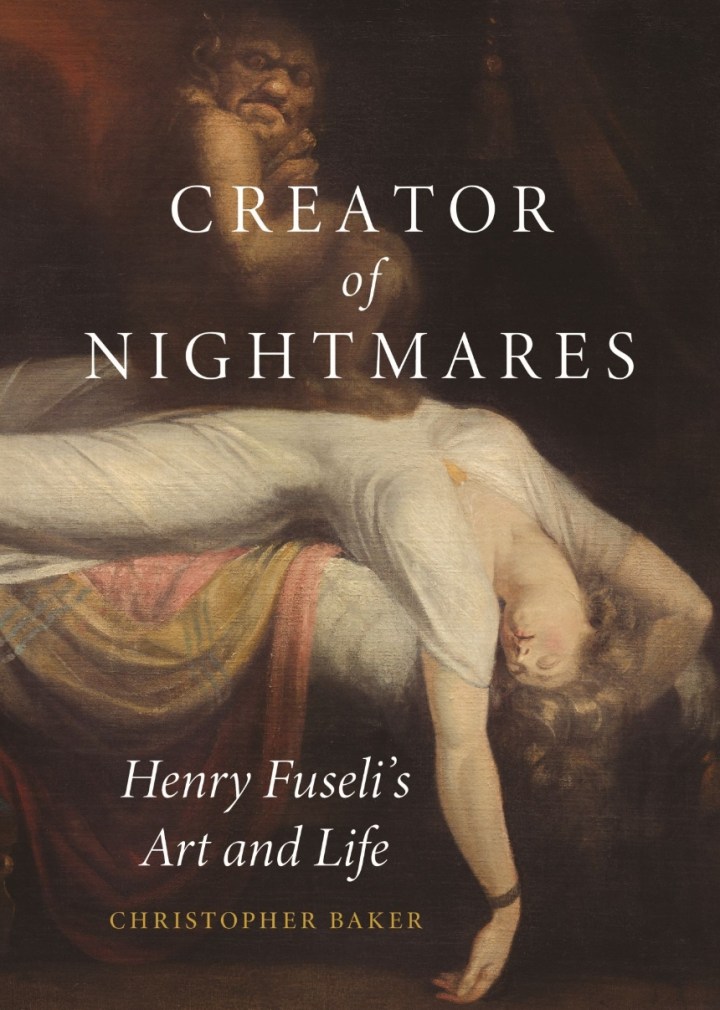 A critical biography of the eighteenth-century painter.
Henry Fuseli (1741–1825) was one of the eighteenth century’s most provocative and inventive artists. He is best known for his painting The Nightmare, which created a new form of terrifying gothic imagery for the Romantic age. This engaging study of the artist’s career unveils Fuseli’s complexities, navigating contradictions between literary and painted works, sacred and secular themes, and traditional patronage versus the new era of competitive exhibitions and intense criticism. Plotting Fuseli’s trajectory from Zurich to Paris, Rome and ultimately London, where he secured long-lasting fame, the artist is revealed as an astute publicity seeker and self-proclaimed genius who transformed himself from a priest to an Enlightenment writer, a ‘mad’ mercurial force in the art world, and finally a revered teacher.
Christopher Baker is Editor of The Burlington Magazine and an Honorary Professor at the University of Edinburgh. He was previously a Director at the National Galleries of Scotland and has published widely on eighteenth- and nineteenth-century British and European art.
c o n t e n t s
Introduction
1 Origins in Zurich
2 A European Man of Letters
3 The Impact of Rome
4 The Nightmare
5 The Vagaries of Fame
6 Creative Friendships
7 Legacies
References
Select Bibliography
Acknowledgements
Photo Acknowledgements
Index
Call for Submissions | Horowitz Book Prize
From the Bard Graduate Center:
The Mr. and Mrs. Raymond J. Horowitz Book Prize
For titles on the decorative arts or material culture of the Americas published in 2024
Submissions must be postmarked by 4 April 2025
Bard Graduate Center welcomes submissions for the Mr. and Mrs. Raymond J. Horowitz Book Prize, awarded annually to the best book on the decorative arts, design history, or material culture of the Americas. The prize rewards scholarly excellence and commitment to cross-disciplinary conversation. The winning author(s) or editor(s) will be chosen by a committee of Bard Graduate Center faculty and will be honored with a research event exploring critical applications of the awarded book’s argument. Eligible titles include monographs, exhibition catalogues, and collections of essays in any language, published in print or in digital format. Submissions must have a 2024 publication date.
Three copies of each print title and an entry submission form should be sent to the below address. For digital publications, please email a copy of the submission form, a PDF of the publication, and a link to the publication to horowitz.prize@bgc.bard.edu. Submissions must be postmarked by 4 April 2025. There is no limit to the number of submissions, but please note that we are unable to return items submitted for review. Incomplete submissions will not be considered. Shipping is the responsibility of the applicant and we are not able to confirm receipt of submissions. The winning title will be announced in September 2025. For questions, contact Mary Adeogun, manager of public research and education, at horowitz.prize@bgc.bard.edu.
Horowitz Book Prize Committee
Bard Graduate Center
38 West 86th Street
New York, NY 10024
New Book | A Perfect Frenzy
From Grove Atlantic (with a review by Alexis Coe for The New York Times available here).
Andrew Lawler, A Perfect Frenzy: A Royal Governor, His Black Allies, and the Crisis That Spurred the American Revolution (New York: Atlantic Monthly Press, 2025), 544 pages, ISBN: 978-0802164131, $30.
 From the nationally bestselling author of The Secret Token, the largely untold story of rebellion in Virginia that will forever change our understanding of the American Revolution
As the American Revolution broke out in New England in the spring of 1775, dramatic events unfolded in Virginia that proved every bit as decisive as the battles of Lexington and Concord and Bunker Hill in uniting the colonies against Britain. Virginia, the largest, wealthiest, and most populous province in British North America, was led by Lord Dunmore, who counted George Washington as his close friend. But the Scottish earl lacked troops, so when patriots imperiled the capital of Williamsburg, he threatened to free and arm enslaved Africans—two of every five Virginians—to fight for the Crown.
Virginia’s tobacco elite was reluctant to go to war with Britain but outraged at this threat to their human property. Dunmore fled the capital to build a stronghold in the colony’s largest city, the port of Norfolk. As enslaved people flocked to his camp, skirmishes broke out. “Lord Dunmore has commenced hostilities in Virginia,” wrote Thomas Jefferson. “It has raised our countrymen into a perfect frenzy.” With a patriot army marching on Norfolk, the royal governor freed those enslaved and sent them into battle against their former owners. In retribution, and with Jefferson’s encouragement, furious rebels burned Norfolk to the ground on January 1, 1776, blaming the crime on Dunmore. The port’s destruction and Dunmore’s emancipation prompted Virginia’s patriot leaders to urge the Continental Congress to split from Britain, breaking the deadlock among the colonies and leading to adoption of the Declaration of Independence. Days later, Dunmore and his Black allies withdrew from Virginia, but the legacy of their fight would lead, ultimately, to Abraham Lincoln’s 1863 Emancipation Proclamation.
Chronicling these stunning and widely overlooked events in full for the first time, A Perfect Frenzy offers a striking new perspective on the American Revolution that reorients our understanding of its causes, highlights the radically different motivations between patriots in the North and South, and reveals the seeds of the nation’s racial divide.
Andrew Lawler is the author of the national bestseller The Secret Token, about the lost colony of Roanoke, and the award-winning Under Jerusalem. As a journalist he has written more than a thousand newspaper and magazine articles for, among many others, The New York Times, The Washington Post, National Geographic, and Smithsonian. He is a contributing writer for Science and contributing editor for Archaeology. He lives in Asheville, North Carolina.
The Decorative Arts Trust Invites Proposals for Its Publishing Grants
From The Decorative Arts Trust:
Publishing Grants from The Decorative Arts Trust
Proposals due by 31 March 2025
The Decorative Arts Trust established a new publishing grant program in December 2023, the latest expansion of the organization’s efforts to invigorate scholarship and broaden appreciation of material culture. The endeavor is structured to support publications tackling the broad context of the Americas and to encourage projects that advance diversity in the study of American decorative arts and material culture. The program will also respond to the changing needs of the field and will consider publishing efforts in both the print and digital sectors. This new venture establishes a commitment to sharing important art historical research as broadly as possible. An advisory committee consisting of museum professionals and academics with broad experience in publishing stewards the program and oversees the selection of grant recipients.
The Trust will fund two separate grant lines:
Publishing Grants for First-Time Authors of Book-Length Publications
This program is focused specifically to support an author’s first book-length publication (based on a completed dissertation, thesis, or other scholarly research) that increases the awareness and appreciation of important areas of material culture.
Publishing Grants for Collections, Exhibitions, and Conferences
The program awards grants to support book-length publications tied to collections, exhibitions, and conferences that increase the awareness and appreciation of important areas of research in the decorative arts including catalogues, and compilations of conference papers.
Online Conversation | Teaching the 18th Century Now
From the event flyer (which includes a QR code for registering). . .
Online Conversation | Teaching the Eighteenth Century Now: Pedagogy as Ethical Engagement
Online, Wednesday, 26 February 2025, 3pm (Eastern Time)
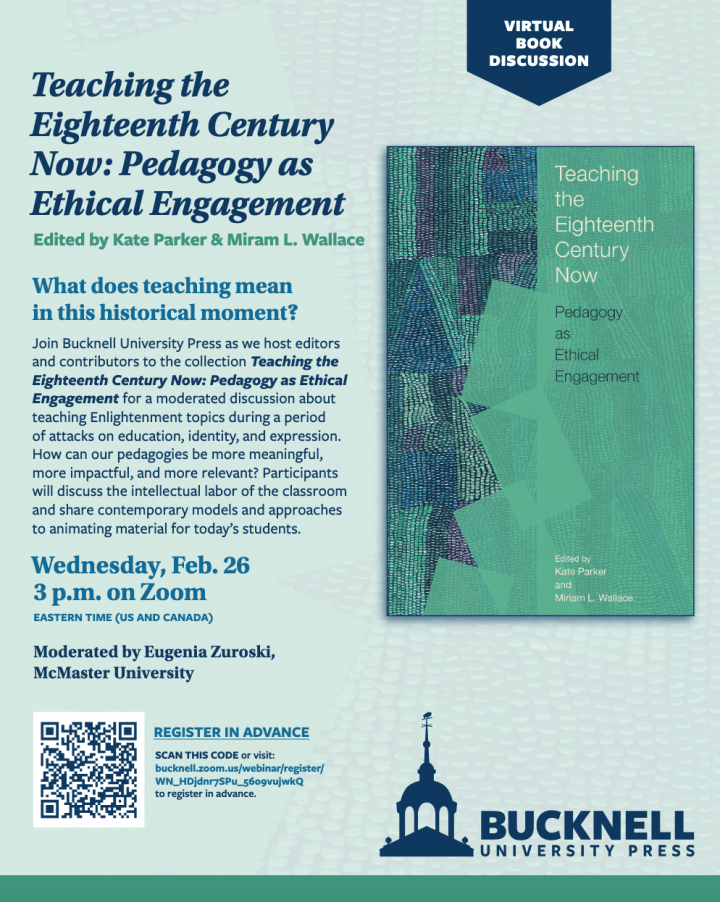 What does teaching mean in this historical moment? Join Bucknell University Press as we host editors and contributors to the collection Teaching the Eighteenth Century Now: Pedagogy as Ethical Engagement for a moderated discussion about teaching Enlightenment topics during a period of attacks on education, identity, and expression. How can our pedagogies be more meaningful, more impactful, and more relevant? Participants will discuss the intellectual labor of the classroom and share contemporary models and approaches to animating material for today’s students. The conversation will be moderated by Eugenia Zuroski.
Kate Parker and Miriam Wallace, eds., Teaching the Eighteenth Century Now: Pedagogy as Ethical Engagement (Lewisburg, PA: Bucknell University Press, 2024), 196 pages, ISBN: 978-1684485048 (hardcover) / ISBN: 978-1684485031 (paperback), $38.
Exhibition | J. M. W. Turner: Romance and Reality
 .
.
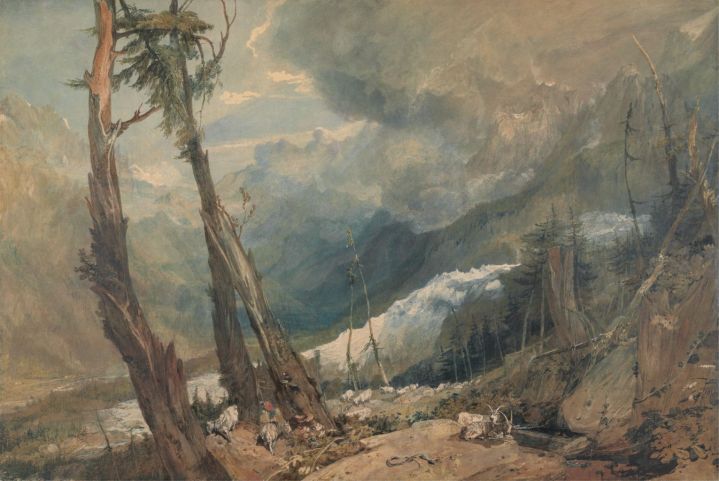
J.M.W. Turner, Mer de Glace, in the Valley of Chamonix, 1803, watercolor, graphite, gum, scraping out and stopping out on moderately thick, slightly textured, cream wove paper mounted on thick, smooth wove paper (New Haven: Yale Center for British Art, B1977.14.4650)
◊ ◊ ◊ ◊ ◊
Opening next month at the YCBA, which itself reopens after a two-year conservation project:
J. M. W. Turner: Romance and Reality
Yale Center for British Art, New Haven, 29 March — 27 July 2025
Dordrechts Museum, Spring 2026
The year 2025 marks the 250th anniversary of the birth of Joseph Mallord William Turner (1775–1851), possibly the most widely admired and influential British artist of all time.
Though Turner was trained within the English topographical tradition, his practice was deeply rooted in a wider European heritage of landscape painting. Turner pushed this inheritance to its limits in pursuit of his own expressive ends, astounding contemporaries with his bold and highly original compositions. His unique approach paved the way for a new form of landscape art, one that combined virtuoso brushwork with brilliant color, dazzling light effects, and an almost abstract sensibility. As a result, Turner came to be recognized as the most radical and innovative painter of his time and has continued to be so ever since.
This exhibition, the first show focused on Turner to be held at the Yale Center for British Art in more than thirty years, will showcase the museum’s rich holdings of the artist’s work. Unequaled in North America, this collection includes some of Turner’s most acclaimed oil paintings, notably his masterpiece Dort or Dordrecht: The Dort Packet-Boat from Rotterdam Becalmed (1818) and his celebrated later painting Staffa, Fingal’s Cave (1831–32). Alongside these major works, the exhibition will also feature outstanding watercolors and prints from the YCBA’s collection, including the artist’s only complete sketchbook outside of the British Isles.
Turner’s works are akin to painted poems, filled with incident, anecdote, and symbolism. Conveying both the beauty and cruelty of nature and human life, they shed fascinating light on the artist’s world and reveal an aesthetic—and moral—complexity that is at once discomforting and strangely modern.
The exhibition is generously supported by the Dr. Lee MacCormick Edwards Charitable Foundation.
From Yale UP:
Ian Warrell, with contributions by Gillian Forrester, Turner (New Haven: Yale University Press, 2025), 144 pages, ISBN: 978-0300279719, $40.
 This book, the inaugural installment in the Yale Center for British Art’s Collection Series, explores the museum’s astonishing Turner holdings—the largest outside the United Kingdom—in a manner that will engage the general reader and expert alike. Six sections of plates provide a comprehensive overview of the artist’s career, place the works within their historical and cultural context, and include new discoveries regarding the identification of locations, landscapes, and dates. Gillian Forrester’s supplementary essay offers a novel account of Turner’s innovative printmaking practice, illuminating his fraught collaborations with other printmakers. Complementing an exhibition at the YCBA and a satellite exhibition at the Dordrechts Museum (The Netherlands), both planned for the 250th year of Turner’s birth, this publication celebrates the artist’s unparalleled vision as exemplified in the YCBA’s world-class collection of his work.
Ian Warrell is an independent curator specializing in British art of the nineteenth century. Gillian Forrester is an independent curator specializing in British art from the eighteenth century to the present and former senior curator of prints and drawings at the Yale Center for British Art.










 Enfilade
leave a comment