Colloquium | Mark Catesby’s Third Centennial in America
From the Catesby Commemorative Trust:
Mark Catesby’s Third Centennial in America: Celebrating His Impact
Richmond, Washington, D.C., and Charleston, 4-9 November 2012
 Attendees may purchase tickets for the Virginia, Washington, D.C. and Charleston days individually or as a package (ticket prices include tax-deductible contributions to the Catesby Commemorative Trust and hopefully other non-profits involved in the program). The following covers the program as it now stands and may be modified as appropriate. With the few exceptions noted, all locations and speakers are confirmed.
◊ ◊ ◊ ◊ ◊
Sunday, 4 November 2012 — Richmond
Accommodations at the four-star Omni Hotel
5:30 pm Wilton House Museum
- Welcome by Laura Towers, President of NSCDA – VA
- Moderator: Robert Strohm, Executive Director, Wilton House Museum
- Introduction by Cynthia Neal, Producer/Director and showing of The Curious Mister Catesby (2008)
- The museum will display a concurrent exhibition of Catesby’s etchings (25 October 2012 — 3 February 2013)
- Cocktail reception
◊ ◊ ◊ ◊ ◊
Monday, 5 November 2012 — Richmond / Washington, D.C.
Wilton House Museum
9:00 am Catesby’s Influences and Sources
- “Mark Catesby and His Botanical Forerunners,” Dr. Karen Reeds, Independent Scholar (scheduled)
- “William Dampier,” Diana and Michael Preston, authors of A Pirate of Exquisite Mind: Explorer, Naturalist and Buccaneer: The Life of William Dampier
- “Maria Sibylla Merian: Pioneering Naturalist, Artist, and Inspiration for Catesby,” Florence F. J. M. Pieters, Faculty of Biology, University of Amsterdam, and Dr. Kay Etheridge, Professor of Biology, Gettysburg College
10:30 Break
10:45 Catesby’s World
- “England,” Dr. Janet Browne, Chair, Aramont Professor of the History of Science, Harvard University
- “Virginia,” Dr. Sarah Meacham, Associate Professor of History, Virginia Commonwealth University
- “Carolina,” Dr. Suzanne Linder Hurley, Independent Scholar, Davidson, NC
- “Bahamas,” Dr. Robert Robertson, Curator of Malacology, Philadelphia Academy of Natural Sciences
1:00 Lunch at the Commonwealth Club
2:30 Tour of the Kent-Valentine House, which has a large collection of Catesby’s etchings
Richmond locations will include floral arrangements of plants illustrated by Catesby
3:00 Chartered coach transfer to four-star Hotel Monaco in Washington, D.C.
◊ ◊ ◊ ◊ ◊
Tuesday, 6 November 2012 — Washington, D.C.
9:30 am Smithsonian Institution Libraries, Baird Auditorium, Museum of Natural History. Baird sessions open for free to the public
Welcome: Senior Smithsonian and GCA officials
Moderator: Dr. Nancy Gwinn, Director, Smithsonian Institution Libraries
Catesby’s Art
- “Catesby’s Drawings,” Henrietta McBurney Ryan, Keeper of Fine and Decorative Arts, Eton College, formerly Deputy Keeper, Royal Library, Windsor Castle, and author of a forthcoming book on Catesby’s original paintings
- “The Natural History: Its Printing and Publication,” Leslie Overstreet, Curator, Natural History Rare Books, Smithsonian Institution Libraries
- “Catesby’s Etchings: His Compositional Interests and the Birth of Environmental Science,” Dr. Amy Meyers, Director, Yale Center for British Art
12:00 Ticket holders’ viewing of the Smithsonian’s first edition of The Natural History and other rare natural history books; lunch at the Metropolitan Club
1:30 Catesby’s Science
- “Ornithology (including bird migration),” Shepard Krech III, Professor Emeritus, Brown University
- “Botany,” Dr. Steven A. Harris, Druce Curator of the Oxford University Herbaria (scheduled – possibly given by his delegate)
- “Zoology (other than ornithology),” Dr. Aaron Bauer, Professor & Gerald M. Lemole Chair in Integrative Biology, Villanova University
- “Catesby’s Economic and Ethnobotany,” Dr. W. Hardy Eshbaugh, Professor of Botany Emeritus, Miami University, Oxford, OH
6:00 United States Botanic Garden, Washington, D.C.
◊ ◊ ◊ ◊ ◊
Wednesday, 7 November 2012 – Washington, D.C. / Charleston
Personal transportation to Charleston, SC to be arranged by attendees
Accommodation at the five-star Sanctuary Hotel, on Kiawah Island
Customized Kiawah Island Nature Tours
Banquet dinner at Kiawah Island with keynote speaker, Sir Ghillean Prance, FRS, Director (retired) of the Royal (Kew) Botanic Gardens, previously Research Director and Vice-President of the New York Botanical Garden as well as President of the UK Linnean Society, and currently Scientific Director of the Eden Project
◊ ◊ ◊ ◊ ◊
Thursday, 8 November 2012 — Charleston
Coach transfers from Kiawah to Charleston, within town, and return to Kiawah
9:30 am Addlestone Library Rare Book Collection, College of Charleston
- Welcome to Charleston: The Honorable Joseph P. Riley, Jr., Mayor of Charleston
- Introduction of speakers: John Cay III, Chairman of Friends of the Addlestone Library
- “Catesby The Explorer,” Dr. James L. Reveal, Professor Emeritus, University of Maryland and Adjunct Professor of Plant Biology, Cornell University
10:30 Break
Catesby’s Impact on Natural History
- “Linnaeus and the Relevance of His Use of Catesby’s Botanical Work,” Dr. Charlie Jarvis, Botany Department, Natural History Museum, London
- “Linnaeus and His Use of Catesby’s Zoological Work,” Dr. Kraig Adler, Professor & Department Chair, Department of Neurology & Behavior, Cornell University
- “The Naturalists Who Came after Catesby,” Judith Magee, Special Collections Curator, Library & Archives, Natural History Museum, London and author of Art and Nature: Three Centuries of Natural History Art from around the World
Opportunity to view a second edition Natural History, Alexander Wilson and Audubon double elephant folio (Leslie Overstreet will be available for all viewings of copies of the Natural History to point out their salient features; no two are exactly the same)
1:00 Gibbes Museum of Art
This section of the program honors the memory of Chris Hammond, long-term Director of the Trust to whom it owes much; truly a gentleman and a good friend.
Lunch in the museum garden; viewing the museum collections
3:00 The Charleston Library Society (founded in 1748)
- “The Bartram-Catesby Connection,” Joel T. Fry, Curator, Bartram’s Garden, Philadelphia
- “Catesby and Eighteenth-Century Gardening,” Mark Laird, Senior Lecturer, Department of Landscape Architecture, Harvard University
- Viewing of second and third editions of The Natural History
Visit to the Preservation Society of Charleston
6:00 Cocktail receptions at the historic Miles Brewton House and William Gibbes House
◊ ◊ ◊ ◊ ◊
Friday, 9 November 2012 – Charleston
Optional (currently being developed)
- Catesby-Country Immersion Tour at Middleton Place, including fresh-water swamp, salt marsh, rice fields, ruins of Catesby-era house, free flying demonstration by Charleston Center for Birds of Prey of raptors painted by Catesby plus viewing another first edition of Mark Catesby’s Natural History
- Boat tour of the ACE Basin (arrangements by KIGR)
- Tour of Colonial-Era Charleston Gardens (Preservation Society of Charleston) with an opportunity to see the Charleston Museum’s first edition Catesby’s and related materials
- Golf on Kiawah Island’s Ocean Course (site of the 2012 PGA)
- Kiawah Island Nature Tours
In the May 2012 Issue of ‘Apollo Magazine’
From the current issue of Apollo Magazine:
◊ ◊ ◊ ◊ ◊
Elizabeth Angelicoussis, “An Olympiad’s Portrait,” Apollo Magazine (May 2012)
During excavations at Hadrian’s Villa at Tivoli the archaeologist Gavin Hamilton unearthed a classical statue of Hermes. Hamilton’s conservation of the sculpture transformed its identity to create an 18th-century image of an Olympic victor inspired by the ideals of ancient Greece
 In the late 18th century, the 1st Marquess of Lansdowne, William Petty-Fitzmaurice (1737–1805), assembled the most impressive collection of classical marbles in the British Isles, which he displayed in Lansdowne House, in London’s Berkeley Square.1 Many prime specimens were sold at a Christie’s auction in London in 1930, but at a Sotheby’s sale in New York in 1972, a very perceptive buyer purchased one choice piece that deserves examination.2
The sculpture represents a life-size youth with a smooth complexion and flawless features (Figs. 1–4).3 The nose is straight and large; from its bridge the razor-sharp ridges of the eyebrows flare out horizontally. The thin-lidded eyes are unmarked and only the rightwards torsion and the slightly parted lips animate the face. The coif is unfinished: at the crown, thick hair clusters, coarsely carved into spiral curls, lack drill holes to define their centres, while the hair at the back is roughly modelled into two large masses divided by a deep furrow. A lump of marble protrudes from the hair at the right, while a branch chiselled into the tresses above the left ear divides into two sprigs bearing a lanceolate leaf and tiny berries – the genus of the foliage remains undetermined. A wide groove encircles the head. The nude bust is ancient, and the uneven fracture around the neck argues for an original connection between the two parts.4 . . .
Elizabeth Angelicoussis specialises in ancient sculptures in private British museums.
__________________________
1/ This article is an offshoot from my project of the reconstruction of the Lansdowne collection of classical marbles. For surveys of the Lansdowne collection and the construction of Lansdowne House, with further bibliography, see Adolph Michaelis, Ancient Marbles in Great Britain, Cambridge, 1882, pp. 103–06, 453–71; Jonathan Scott, The Pleasures of Antiquity: British Collectors of Greece and Rome, New Haven and London, 2003, pp. 160–68; Ilaria Bignamini and Clare Hornsby, Digging and Dealing in Eighteenth-Century Rome, New Haven and London, 2010, vol. I, pp. 321–26. For more on the Marquess, see Oxford Dictionary of National Biography, online edn. May 2010, http://www.oxforddnb.com/view/article/22070 (J. Cannon).
2/ Catalogue of the Celebrated Collection of Ancient Marbles, the Property of the Most Honourable the Marquess of Lansdowne, 5 March 1930, p.77, lot 60; Sotheby’s Sales Catalogue of Egyptian, Western Asiatic, Greek, Etruscan and Roman Antiquities, 4 December 1972, p. 30, lot 122.
3/ See Michaelis op cit., Ancient Marbles in Great Britain, Cambridge, 1882, p. 452, no. 62. The restorations include the tip of nose, a section of the left brow and a piece of the right side of the neck at the front.
4/ There is a diagonal break running from the back across the chest. The repairs of the bust include the base and index plate, the patchwork of the spine, and the left breast. The inside and the rim of the support have been smoothed over. . . .
◊ ◊ ◊ ◊ ◊
The full article is available here»
Quince, Then and Now
Michael Tortorello, “In Praise of the Misunderstood Quince,” The New York Times (2 May 2012) . . .
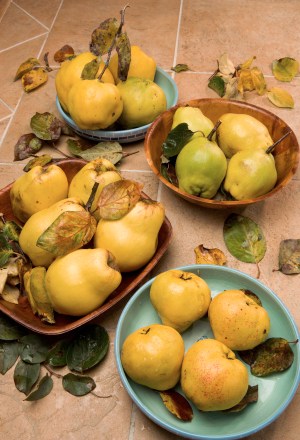
Assorted quince varieties from the germplasm collection at the USDA-ARS National Clonal Germplasm Repository in Corvallis, Oregon. From top down, Van Deman, Cooke’s Jumbo, Ekmek, and Quince A, a rootstock variety used for grafting pears (Wikimedia Commons)
. . . What most Americans know about quince (Cydonia oblonga) — if they know about quince at all — is that it was once a fixture in Grandma’s garden. O.K., Great-Great-Grandma’s garden. As long ago as 1922, the great New York pomologist U. P. Hedrick rued that “the quince, the ‘golden apple’ of the ancients, once dedicated to deities, and looked upon as the emblem of love and happiness, for centuries the favorite pome, is now neglected and the least esteemed of commonly cultivated tree-fruits.” Almost every Colonial kitchen garden had a quince tree. But there was seldom need for two, said Joseph Postman, the United States Department of Agriculture scientist who curates the quince collection in Corvallis, Ore. Settlers valued quince, above all, as a mother lode of pectin for making preserves. And for that task, a little fruit went a long way.
“If you put the seeds in a cup of water, it becomes almost like Jell-O,” Mr. Postman said. This goo doubled as a pomade. (If you try this at home, please post photos.) Like so many American workers, the quince lost its job to a disruptive technology: powdered gelatin, introduced by Charles Knox in the 1890s. Unemployment has been tough. Today the nation’s entire quince crop covers a paltry 250 acres — about the size of the lawns in Central Park. By contrast, farmers this year will
raise some 350,000 acres of apples and 96 million acres of
corn. . .
The full article is available here»
Colloquium | Médiatisation du Littéraire
Notwithstanding the focus on literature, there are art historical offerings, including a talk by Pierre-Henri Biger on hand fans, “L’éventail, moyen de propagation des oeuvres littéraires ou théâtrales.” -CH
Colloquium: La Médiatisation du Littéraire
Bordeaux 3 University, 24-25 May 2012
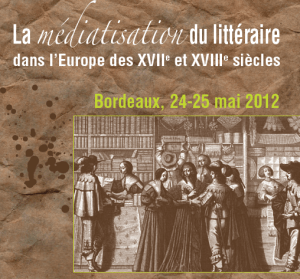 “Médiatisation” is a term of recent onset, which refers to a reality very contemporary to societies where mass dissemination of information is based on various and often sophisticated technical supports. Literature today, with his “rentrée littéraire,” its prizes schedule, its hypersensitive writers or its institutional celebrations, has become one of the media phenomena. This seems obvious in a world so marked by immediacy of information, constant renewal of astonishment and escalation of surprises, albeit artificial. Applying this term to the seventeenth and eighteenth centuries is therefore primarily a voluntary anachronism, intended to destabilize our vision of our literary past and to provoke a reassessment of the emphasis on literature in the public and social life of classical Europe.
This colloquium is organized by the centre Europe classique (CLARE-Cultures Littératures Arts Représentations Esthétiques)
The programme is available here»
Exhibition | William Kent, 1686-1748: Designing Georgian Britain
We’ll hear more in the coming months about this exhibition, but I note it here just to whet your appetite. Based on recent exhibitions at The Bard, I’m especially looking forward to the programming and publication. -CH.
◊ ◊ ◊ ◊ ◊
William Kent 1686-1748: Designing Georgian Britain
The Bard Graduate Center for Studies in the Decorative Arts, New York, Fall 2013
V&A, London, Spring 2014
Organized in collaboration with the Victoria & Albert Museum (V&A).
Curated by Susan Weber Director and Founder, BGC and Julius Bryant, Keeper of Word and Image Department, V&A
New NEH Website: More Accessible, More Informative, More Lively
When there’s so much pressure on federal budgets, it’s exciting to see the NEH make the case for its importance, not only for scholars but also for the public more generally. Among academics, NEH Fellowships are the best known forms of support, but they’re also the most competitive. Have a look at the new site and see if your research projects might fit other funding opportunities. -CH
◊ ◊ ◊ ◊ ◊
The National Endowment for the Humanities launched a comprehensive new website Monday, April 9, giving the Endowment a more user-friendly, engaging, and transparent platform for people seeking grants and for the public interested in humanities research, scholarship, and public programs. After a complete overhaul of the site, grant guidelines and grant management information is clearer and more accessible. A new EXPLORE section allows users to access information about more than 200 documentaries, radio programs, and apps produced by broadcasters and others with NEH grants. A prominent new rotator will showcase news of NEH and books, seminars, and other projects growing out of Endowment funding. As the Endowment launched the site, the rotator featured:
- A lesson from the EDSITEment educational website for teachers, students, and parents about Sor Juana, a seventeenth century nun, feminist and poet, considered the first great poet of the Americas;
- A story about a Maryland State Humanities lecturer on the Oyster Wars, when Maryland had an “Oyster Navy” in the 1890s to drive out interloping oystermen;
- A compendium of Civil War programs funded by the NEH, including reading and discussion programs being put on in 213 community and other libraries using a new anthology of important Civil War stories and documents.
- A biographical sketch of Philip Lampi, the nation’s greatest expert on the election returns from the American political campaigns of 1789-1825 and recipient of the first Chairman’s Commendation for service to the humanities;
- A story about a new NEH-funded translation of the Topography of Algiers, written by Antonio da Sosa in 1612 after he had been imprisoned for five years by the Barbary Pirates ( at the same time as Miguel da Cervantes, author of Don Quixote.)
The new NEH site showcases the award-winning HUMANITIES Magazine, now in a richly illustrated magazine format.
Each NEH division and program will have its own series of pages to feature projects, news about grants and opportunities to meet program officers in the field. The stories include:
- How a small grant from the Mississippi Humanities Council led to a traveling exhibition on the murder of 14 year old Emmett Till, the creation of the Mississippi Civil Rights Trail, and NEH-funded summer sessions on the Mississippi Delta.
- How Helen Clay Frick’s vision of documenting every work of art in the western world echos in the New York Art Resources Consortium online catalog, Arcade.
- How Digital Humanities scholars who received “Start Up” grants to break new ground in the humanities describe their research in “Lightning Round” on the site.
- How knowledge, gleaned through NEH research grants, is freely available and shared through white papers on the site.
NEH.gov will highlight information about projects funded through collaboration with state humanities councils. Links to all 56 state and territorial humanities councils and their calendars of activities will be offered at a single location.
EDSITEment, the Endowment’s prize winning K-12 educational site funded by a partnership between NEH and the Verizon Foundation, will offer high quality internet resources in the subject areas of literature and language arts, foreign languages, art and culture, and history and social studies.
Users can link directly to Chronicling America, the joint project of the NEH and the Library of Congress to digitize historic American newspapers. They can also access information directly on NEH’s funded projects sorted by topics of interest, state by state and at particular universities.
The NEH.gov redesign is part of an administration effort to modernize and streamline web operations, to consolidate websites for ease of maintenance, clarity and cost savings over time, and to make the work of government more accessible to all Americans.
The new neh.gov was built in-house using Drupal, an open source content management system. It is hosted on cloud infrastructure. It replaces an 11 year old interim site that had become outmoded. The new back-end architecture makes it possible to alter and enlarge the website’s capabilities without costly new redesigns.
New Title | ‘Japanned Papier Mâché and Tinware c.1740-1940’
From the Antique Collector’ Club:
Yvonne Jones, Japanned Papier Mâché and Tinware c.1740-1940 (Woodbridge: Antique Collectors’ Club, 2012), 336 pages, ISBN: 9781851496860, £45.
 As one of the few decorative arts about which little has been written, japanning is today fraught with misunderstandings. And yet, in its heyday, the japanning industry attracted important commissions from prestigious designers such as Robert Adam, and orders from fashionable society across Europe and beyond.
This book is a long overdue history of the industry which centred on three towns in the English midlands: Birmingham, Wolverhampton and Bilston. It is as much about the workers, their skills, and the factories and workshops in which they laboured, as it is about the goods they made. It tells of matters of taste and criticism, and of how an industry which continued to rely so heavily upon hand labour in the machine age reached its natural end in the 1880s with a few factories lingering into the late 1930s. Richly illustrated, it includes photographs of mostly marked, or well-documented, examples of japanned tin and papier mâché against which readers may compare – and perhaps identify – unmarked specimens.
Japanned Papier Mâché and Tinware draws predominantly upon contemporary sources: printed, manuscript and typescript documents, and, for the period leading up to the closure of the last factories in the 1930s, the author was able to draw on verbal accounts of eyewitnesses. With a chapter on japanners in London, other European centres, and in the United States, together with a directory of japan artists and decorators, this closely researched and comprehensive book is the reference work for collectors, dealers and enthusiasts alike.
Contents
From Imitation to Innovation; Enter the Dragon!; The Lion of the District; Japanning & Decorating; Not a Bed of Roses!; Clever Accidents?; Decline of the Midlands Japanning Industry; The Birmingham Japanners; The Wolverhampton Japanners; The Bilston Japanners; Japanners in London and Oxford; Products; Other Western Japanning Centres; Appendices.
◊ ◊ ◊ ◊ ◊
With a degree in Fine Art, Yvonne Jones taught art in schools and colleges before joining Wolverhampton Art Galleries and Museums in 1971, serving first as Keeper of Applied Art, and then as Head of Arts & Museums. Researching, documenting and extending the town’s collection of japanned papier mâché and tinware, she became aware of the breadth and importance of this field in the decorative arts. She left her post in 1994 to concentrate on a programme of original research, and is now an international authority on the subject and continues to lecture widely in both Britain and the United States.
At Sotheby’s | de La Tour d’Auvergne Lauraguais Collection
Press release from Sotheby’s:
Collection of Prince and Princess Henry de La Tour d’Auvergne Lauraguais, L12308
Sotheby’s, London, 3 May 2012
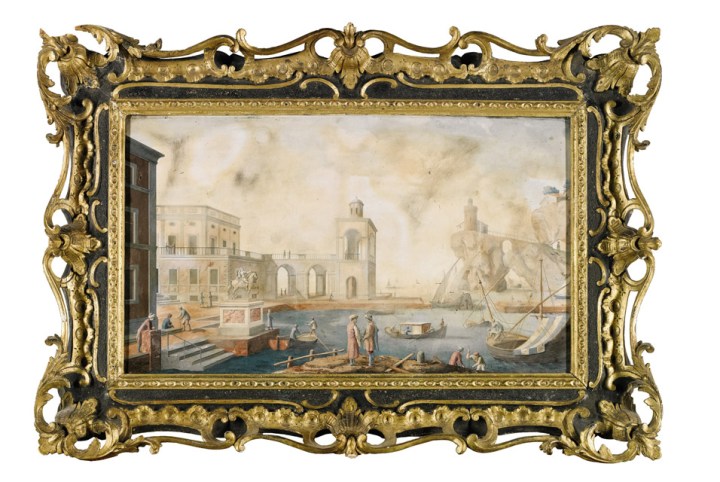
Enrico Hugford, one of a pair of Italian scagliola panels
within carved giltwood and ebonised frames, mid 18th century
◊ ◊ ◊ ◊ ◊
Sotheby’s London will offer for sale The Collection of Prince and Princess Henry de La Tour d’Auvergne Lauraguais on 3rd May 2012 [L12308]. The auction comprises property from the family’s London homes. It will include very fine Neo-classical and Empire furniture, the finest collection of 18th-century scagliola to appear at auction, Old Master paintings, silver, objets de vertu, and drawings and books from the library of celebrated designer and architect Emilio Terry from Château de Rochecotte. Estimates in the sale range from £400 to £300,000. In total, the auction is estimated to realise £2-4 million. The history of the de La Tour d’Auvergne Lauraguais family is a long and distinguished one. Related by marriage to the noblest dynasties in France, it is one of only six families (alongside the houses of Savoie, Lorraine, Grimaldi, Rohan and La Tremoille) to be granted the rights and privileges accorded to foreign princes.
Mario Tavella, Deputy Chairman, Sotheby’s Europe commented: “It is an honour for Sotheby’s to be entrusted with this wonderful collection from one of France’s greatest and most glamorous families. Collectors will be delighted with the quality and breadth of items on offer, which together exude a very chic look. Emilio Terry was at the heart of avant-garde circles in 1920s Paris and many of the books in his library reflect his intimate relationship with key figures such as Henri Matisse and Salvador Dali. More than that, his passionate interest in architecture is manifest in the host of important architectural books that he owned, as well as in his own fabulous and often fantastical drawings.”
The sale includes museum quality Neo-classical and Empire furniture by some of the greatest French ébenistes, including Jacob and Joseph. The group is headlined by a magnificent gilt-bronze mounted amaranth and tulip wood secrétaire by Joseph, circa 1770, which, with its very strong neo-classical outline, represents the pinnacle of Le Goût Grec style. Estimated at £150,000-300,000*, an identical secrétaire is held in the Getty Museum in Malibu.
The sale will present the greatest collection of 18th-century scagliola ever to come to the market. Developed in 17th-century Tuscany as an alternative to the costly marble inlays of pietra dura, scagliola is an extraordinarily complex technique, often used to produce decorative effects resembling inlays in marble and semi-precious stones. The technique is a particular passion of Princess Anne de La Tour d’Auvergne Lauraguais, who is an expert in the field. The sale will offer eight rare scagliola panels by virtuoso craftsmen Enrico Hugford and Lamberto Christiano Gori, which depict seascapes and marine scenes inspired by the Tuscan coast. Princess Anne de La Tour d’Auvergne Lauraguais commented: “It was my father, Prince Henry who inspired me to study the art of scagliola, and in turn it was my father’s uncle Emilio Terry who also truly appreciated this form of art and who had influenced him. In my father’s opinion, scagliola had a refinement of colour, texture and sensuality softened as if dimmed by a veil of fog, not like pietre dure which could be bright and almost screaming with colour. Scagliola is a man-made stone, not meant to be used outside, but to live with…. I followed his advice and am indebted to him for giving me a life-long love for the art of scagliola.” (more…)
Exhibition | Gold, Jasper, and Carnelian: Johann Christian Neuber
From The Frick:
Gold, Jasper, and Carnelian: Johann Christian Neuber at the Saxon Court
Grünes Gewölbe, Dresden, 3 March — 2 May 2012
The Frick Collection, New York, 30 May — 19 August 2012
Galerie J. Kugel, Paris, 12 September — 10 November 2012
Coordinated by Dirk Syndram, Jutta Kappel, Ian Wardropper, and Charlotte Vignon

Johann Christian Neuber, Breteuil Table, Dresden, 1779–80, wood, gilded bronze, semiprecious stones, faux-pearls, and Meissen porcelain plaques, H: 32 inches, collection of the Marquis de Breteuil, Chäteau de Breteuil (Choisel/Chevreuse); photo: © Georges Fessy
Johann Christian Neuber was one of Dresden’s most famous goldsmiths. Sometime before 1775 he was named court jeweler to Friedrich Augustus III, elector of Saxony, and in 1785 he was appointed Curator of the Grünes Gewölbe (Green Vault), the magnificent royal collection of Augustus the Strong, the founder of the Meissen Porcelain Manufactory. For more than thirty years, Neuber created small gold boxes, chatelaines, and watchcases decorated with local semiprecious stones such as agate, jasper, and carnelian. He fashioned enchanting landscapes, complex floral designs, and geometric patterns with tiny cut stones, often incorporating Meissen porcelain plaques, cameos, and miniatures. These one-of-a-kind objects, which reflect the Saxon court’s interest in both luxury items and the natural sciences, remain prized treasures today, but have never before been shown together in a monographic exhibition.
In 2012, the public will have their first comprehensive introduction to this master craftsman’s oeuvre through a traveling exhibition that is accompanied by a lavishly illustrated publication (Paul Holberton publishing, London, and Editions d’Art Monelle Hayot, under the direction of Alexis Kugel). The exhibition began in Dresden at the Grünes Gewölbe on March 3, remaining there through May 2, 2012, when it travels to the United Sates for an exclusive engagement at The Frick Collection (May 30 through August 19, 2012). It concludes at Galerie J. Kugel in Paris in the fall (September 12 through November 10, 2012).
Gold, Jasper, and Carnelian: Johann Christian Neuber at the Saxon Court includes some thirty-five boxes and other decorative objects from the Grünes Gewölbe and the Porcelain Collection of the Staatliche Kunstsammlungen Dresden, The Metropolitan Museum of Art, and private collections in Europe and the United States. The exhibition also features Neuber’s masterpiece, the Breteuil Table. This small table is regarded as one of the most extraordinary pieces of eighteenth-century furniture ever made, distinguished not only by the materials used in its construction and for the remarkable skill of its creator, but also for its prestigious history. It was presented in 1781 by Friedrich Augustus III to Baron de Breteuil, a French diplomat, as recognition for the role Breteuil played in the negotiation of the Treaty of Teschen, which officially ended the war of Bavarian Succession fought between the Habsburg monarchy and a Saxon-Prussian alliance to prevent the Habsburg acquisition of the Duchy of Bavaria. The table features a mosaic top of 128 semiprecious stones and Meissen porcelain plaques. Still owned by the family who received it nearly 250 years ago, this stunning object has almost never been exhibited outside the Château de Breteuil (some twenty-five miles west of Paris) and has never before crossed the Atlantic. The Frick exhibition also reunites for the first time two bases designed and crafted by Neuber for the display of Meissen porcelain groups. One is now in the collection of the Walters Art Museum, Baltimore, while the other is from a private collection in Paris. These bases were part of a much larger diplomatic gift from Friedrich Augustus III to Nicolai Wasilijewitsch Repnin, the Russian emissary who helped to negotiate the Treaty of Teschen. The gift originally included a Meissen porcelain service and an enormous centerpiece composed of seven stands of varying heights, each supporting an allegorical group made of Meissen porcelain. Of this extravagant gift, only these two bases have been definitively identified.
The exhibition is co-organized by the Grünes Gewölbe, Staatliche Kunstsammlungen Dresden, The Frick Collection, and Galerie J. Kugel, Paris. The exhibition in Dresden will be shown in a slightly different form as Johann Christian “Neuber à Dresde”: Schatzkunst des Klassizismus für den Adel Europas. It is coordinated by Dirk Syndram, Director of the Grünes Gewölbe and the Armoury, and Jutta Kappel, Senior Curator of the Grünes Gewölbe. The presentation of the exhibition at The Frick Collection is coordinated by Director Ian Wardropper and Charlotte Vignon, Associate Curator of Decorative Arts.
◊ ◊ ◊ ◊ ◊
From Paul Holberton Publishing:
Alexis Kugel, ed., Gold, Jasper and Carnelian: Johann Christian Neuber at the Saxon Court (London: Paul Holberton, 2012), 400 pages, ISBN: 9781907372360, £100.
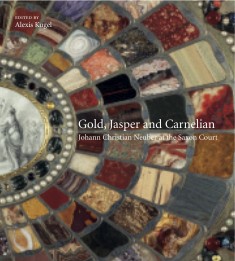 Johann Christian Neuber (1736–1808) was a goldsmith and mineralogist at the Saxon Court. In 1769 he became director of the Grünes Gewölbe, the magnificent State Treasury, and was appointed court jeweler in 1775. He specialized in creating small gold boxes, chatelaines and watchcases decorated with semiprecious stones, such as agate, jasper and carnelian. Neuber fashioned enchanting landscapes, complex floral designs and geometric patterns out of tiny cut stones, often incorporating Meissen porcelain plaques, cameos and miniatures. These one-of-a-kind objects are treasured in public and private collections all over the world today, but have never been brought together.
This book is the first comprehensive introduction to this master craftsman’s oeuvre, presenting boxes and other decorative objects from the Grünes Gewölbe, the Metropolitan Museum of Art as well as public and private collections in Germany, France and New York. One of its highlights is the ‘Breteuil Table’, still owned by the family for which it was made as a diplomatic gift nearly 250 years ago.
Beautiful photographs of all Neuber’s creations adorn this extraordinary book – well over 500 in number. The context and history of the growing interest in mineralogy and its celebration in these works of art are fully investigated. Its distinguished authors include Dr Jutta Kappel, Head of Conservation at Grünes Gewölbe, Dresden; art historians and specialists Sophie Mouquin and Philippe Poindront; marquis de Breteuil, Henri-François Le Tonnelier; and the editor of the book, Alexis Kugel, of the famous Parisian gallery.
There is also a French edition of this book: Le luxe, le goût, la science: Neuber, orfèvre minéarologiste à la cour de Saxe (ISBN 9782903824808).
Call for Papers | CAA 2013: Open Session for New Scholars
In addition to the session chaired by Hector Reyes on ‘Art in the Age of Philosophy’, HECAA is sponsoring an ‘Open Session for New Scholars’ at the annual meeting of the College Art Association in New York, 13-16 February 2013. The deadline is slightly later for this 1.5 hour slot, though I’m sure the chair, Amelia Rauser would appreciate receiving them as early as possible. -CH
◊ ◊ ◊ ◊ ◊
CAA 2013 | HECAA Affiliate Session: Open Session for New Scholars
New York, 13-16 February 2013
Proposals due by 1 June 2012
Open session for new scholars, sponsored by the Historians of Eighteenth-Century Art and Architecture, at the 2013 meeting of the College Art Association in New York. Proposals welcomed on any aspect of eighteenth-century art. Please email CV and abstract by 1 June 2012 to Professor Amelia Rauser at: amelia.rauser@fandm.edu.










 Enfilade
leave a comment