Winterthur Fellowships
Winterthur Museum & Country Estate Research Fellowship Program
Applications due by 15 January 2010
Winterthur Museum & Country Estate, a public museum, library, and garden that supports the advanced study of American art, culture, and history, is pleased to announce its Research Fellowship Program for 2010–11. Winterthur offers an extensive program of short- and long-term fellowships open to academic, independent, and museum scholars—including advanced graduate students—to support research in material culture, architecture, decorative arts, design, consumer culture, garden and landscape studies, Shaker studies, travel and tourism, the Atlantic World, childhood, literary culture, and many other areas of social and cultural history. Fellowships include 4–9 month NEH fellowships, 1–2 semester dissertation fellowships, and 1–2 month short-term fellowships.
Fellows have full access to the library collections, including more than 87,000 volumes and one-half million manuscripts and images, searchable online. Resources for the seventeenth to the early twentieth centuries include period trade catalogues, auction and exhibition catalogues, and an extensive reference photograph collection of decorative arts, printed books, and ephemera. Fellows may conduct object-based research in the museum collection, which includes 85,000 artifacts and works of art made or used in America to 1860, with a strong emphasis on domestic life. Winterthur also supports a program of scholarly publications, including Winterthur Portfolio: A Journal of American Material Culture.
Fellows reside in a furnished stone farmhouse on the Winterthur grounds and participate in the lively scholarly community at Winterthur, the nearby Hagley Museum and Library, the University of Delaware, and other area museums. Fellowship applications are due January 15, 2010. For more details and to apply, visit the Winterthur website or e-mail Rosemary T. Krill at rkrill@winterthur.org.
Mary Vidal Fund — Applications Due November 15
HECAA members who are graduate students or who have completed the Ph.D. within the past three years are eligible to apply for modest subventions (between $100-$200, depending on the number of applicants and available funds). Named in memory of Professor Mary Vidal, the funds are intended to defray costs associated with research travel, conferences in which the recipients are presenting, or publication permission fees.
Applicants should send a CV and a brief description of the project, including an explanation of how the funds will be used, to Julie Plax by May 15th or November 15th (there are two deadlines).
Collecting in Eighteenth-Century Vienna
From Andrew Ayers’s summary of exhibitions in Paris this fall, as reported in Art Info:
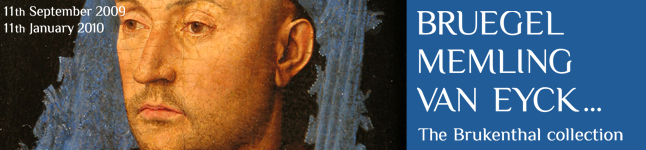
Bruegel, Memling, Van Eyck … The Brukenthal Collection
Musée Jacquemart-André, Paris, 11 September 2009 – 11 January 2010
A favorite of the Austrian Empress Maria Theresa, Samuel von Brukenthal (1721–1803) was an insatiable collector, amassing over 16,000 books, hundreds of objets d’art, and more than 1,200 paintings. In 1777, he became governor of his native Transylvania, where, in present-day Sibiu, Romania, he built a palace to house his collections that became a museum after his death. For the first time in France, about 50 major works from the Muzeul National Brukenthal are being shown. The curators’ selection highlights the Flemish paintings, dating from the 15th to the 17th centuries, which were much sought after in mid-18th-century Vienna. Besides the quartet mentioned in the exhibition title (for there were two Pieter Bruegels, father and son), artists such as Jacob Jordaens, David Teniers II, and Titian also feature in the show. Key works include Bruegel the Younger’s copy of his father’s Massacre of the Innocents in Bethlehem (Elder’s: circa 1567; Younger’s: circa 1586–90), Van Eyck’s Man in a Blue Turban (circa 1430), and Titian’s Ecce Homo (1560).
◊ ◊ ◊ ◊ ◊
From the Brukenthal Museum’s website:

Brukenthal Palace in Sibiu, Romania, 1778-1788
Baron Samuel von Brukenthal (1721-1803) was the only representative of the Transylvanian Saxon community who acceded to high public office in the Austrian Empire under the Empress Maria Theresa (1717 – 1780), the first such office being that of Chancellor of Transylvania. The years spent in Vienna, in this capacity, were the years when the Baron started acquiring his collection of paintings, mentioned in Almanach de Vienne (1773) as being one of the most valuable private collections and generally admired by the cultivated Vienna public of the time. Baron’s initial collections (comprising the collection of paintings, a collection of prints, a library and a coin collection) were mostly put together in the period between 1759 and 1774. We have scant information as to how they came into being, the earliest records in the Brukenthal family being the archive concerning acquisition of paintings dating from 1770 (by which time the core of the collection of paintings must have been acquired). Appointed Governor of the Principality of Transylvania, a position that he occupied between 1777 and 1787, Samuel von Brukenthal built a Late Baroque palace in Sibiu, modelled on the palaces in the imperial capital.










 Enfilade
leave a comment