Current Issue of ‘The Art Bulletin’
Eighteenth-century coverage in the current issue of The Art Bulletin 92 (September 2010):
Richard Taws, “Material Futures: Reproducing Revolution in P.-L. Debucourt’s Almanach National,” pp. 169-87.
Abstract: Philibert-Louis Debucourt’s 1790 Almanach national, intended to serve as a frame for a pasted calendar for the subsequent year, is a unique combination of allegory and everyday scene. Dominated by a bas-relief representing the National Assembly, the image presents responses to the French Revolution organized in terms of race, age, and social class and features a singular representation of a female newspaper vendor at work. Debucourt’s image effectively mobilizes print to conceptualize the reproduction of Revolution across temporal and national boundaries, providing a means of thinking about the relation between Revolutionary time and the materiality of the image.
Darius A. Spieth, “Giandomenico Tiepolo’s Il Mondo Nuovo: Peep Shows and the ‘Politics of Nostalgia’,” pp. 188-210.
Abstract: What was the historiography of Il mondo nuovo, a fresco painted in 1791 by Giandomenico Tiepolo? How did its title emerge? Giandomenico likely found the inspiration for his subject in popular entertainment on Venice’s Piazzetta. The houselike structure in the fresco’s middle ground—a peep show—had been labeled il mondo nuovo by the eighteenth-century playwright Carlo Goldoni. Yet the fresco was not named until after 1906. Art historian Pompeo Molmenti introduced the Goldoni-inspired title, his efforts seconded by Corrado Ricci, a powerful art administrator. Both were steeped in the “politics of nostalgia,” associated with the Italian Aesthetic movement.
Satish Padiyar, Review of Erika Naginski’s Sculpture and Enlightenment, pp. 256-58.
“. . . This ambitious book is the result of a productive interaction between the new cultural history, which has sought to rethink a history of cultural objects and practices beyond disciplinary confines, art histories of French sculpture and architecture, the history of philosophy, and the study of iconoclasm, or demonumentalizing acts of destruction. Over the last twenty years, the sculptural work of Augustin Pajou, Jean-Antoine Houdon, Clodion, Pierre Julien, and Jean Guillaume Moitte has received monographic and curatorial attention: it is thus no longer true to say that eighteenth-century French sculpture is a neglected field. But a careful reframing of key sculptural projects (either realized or planned) within the shift from a theological to a secular idea of immortality, leading to the radical minimalism of sculpture produced during the French Revolution, is long overdue — and very welcome. It begins to do for the eighteenth-century French public funerary monument what has already been achieved so impressively for the British . . .”
Conference: ‘Fictions of Art History’ at The Clark
As noted at The Art History Newsletter, The Clark turns its attention to the relationship between art history and fiction this fall. Conference participants include not only art historians but photographers, critics, novelists, and poets. Included among the seventeen speakers are Thomas Crow and Mark Ledbury. From The Clark’s website:
Fictions of Art History
Sterling and Francine Clark Art Institute, Williamstown, MA, 29-30 October 2010
Clark Conferences question the definition of art history and explore the discipline’s relationships with other modes of understanding and cultural phenomena. The aim of the 2010 conference is to address the complex relationship between art history and fiction, a relationship that will be investigated in art historians’ need to tell stories, their viewing practices, their rhetoric, their writing, and in the interest of art historical work beyond the academy.
Call for Papers: ‘SECC’, Volume 41
Studies in Eighteenth-Century Culture, Volume 41
Submissions due by 1 October 2010
Studies in Eighteenth-Century Culture (SECC) is an interdisciplinary annual volume that publishes significantly revised versions of papers read at national and regional conferences of the American Society for Eighteenth-Century Studies and its affiliates during the 2009-10 academic year. SECC strives to feature the finest work in eighteenth-century studies and to represent ASECS’s wide range of disciplinary interests. The Editors encourage theoretically informed, academically rigorous essays that reflect new directions of research in the field. Essays from previously under-represented disciplines are particularly desired. Published for ASECS by Johns Hopkins University Press and now digitized as part of Project Muse, SECC is included in the membership fees of Sponsors and Patrons of the Society and is offered to all members at a substantial discount.
Guidelines for Submission: Papers from all disciplines presented at regional and national meetings of ASECS and its affiliates between July 1, 2009 and June 30, 2010 are eligible for consideration. Contributions will be judged according to the highest standards of scholarship. The editors of SECC will not consider papers already submitted to other journals. Papers must be substantially revised from their presentation version and scholarly apparatus must be added. All submissions should be written in English or other commonly-used modern European languages. Submissions typically average 20 to 25 double-spaced pages in length. Current editorial practice follows the Chicago Manual of Style. In accordance with SECC’s policy of blind submissions, author’s names should not appear on the manuscript; any references to the author’s previous work should be in the third person. Please note that electronic submissions are preferred. The deadline has been extended to October 1, 2010. Final decisions will be made by December 1, 2010. Please submit appropriately revised essays to:
Lisa Cody
Associate Dean of the Faculty
Claremont McKenna College
Baurer Center, 500 East Ninth Street
Claremont, CA 91711-6400
If you have questions, please contact Lisa Cody (lisa.cody@cmc.edu).
CAA Travel Grants for the 2011 Conference in New York
Although funds are modest, CAA will offer a limited number of Annual Conference Travel Grants to graduate students in art history and studio art and to international artists and scholars. Travel grants are funded solely by donations from CAA members—please contribute today. Charitable contributions are 100 percent tax deductible.
Graduate Student Conference Travel Grant
This $150 grant is awarded to a limited number of advanced PhD and MFA graduate students as partial reimbursement of expenses for travel to the 2011 Centennial Conference in New York. To qualify for the grant, students must be current CAA members. Candidates should include a completed application form, a brief statement by the student stipulating that he or she has no external support for travel to the conference, and a letter of support from the student’s adviser or head of department. For an application and more information, please contact Lauren Stark, CAA manager of programs, at 212-691-1051, ext. 248. Send application materials to: Lauren Stark, Graduate Student Conference Travel Grant, CAA, 275 Seventh Ave., 18th Floor, New York, NY 10001. Deadline: September 24, 2010.
International Member Conference Travel Grant
CAA presents a $300 grant to a limited number of artists or scholars from outside the United States as partial reimbursement of expenses for travel to the Centennial Conference in New York. To qualify for the grant, applicants must be current CAA members. Candidates should include a completed application form, a brief statement by the applicant stipulating that he or she has no external support for travel to the conference, and two letters of support. For an application form and additional information, please contact Lauren Stark, CAA manager of programs, at 212-691-1051, ext. 248. Send materials to: Lauren Stark, International Member Conference Travel Grant, CAA, 275 Seventh Ave., 18th Floor, New York, NY 10001. Deadline: September 24, 2010.
Will the Wedgwood Museum Survive?
As reported by Martin Bailey in The Art Newspaper (18 August 2010) . . .
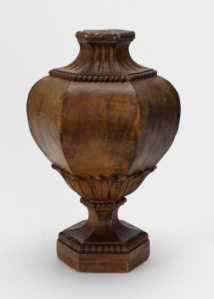
An 18th-century wooden block mould, © Wedgwood Museum
A fundraising campaign may be launched to save the Wedgwood Museum outside Stoke on Trent, if courts rule that its collection can be sold to pay the pensions liability of the Waterford Wedgwood company, which went into administration in January 2009.
Through a legal quirk, the Wedgwood Pension Fund trustees, who face a deficit of £134m for employees, may be able to claim against the museum. The museum had only six staff in the scheme, whose pension interest represented £60,000, but it could be liable for all of the fund’s 7,000 claimants.
Because of the pensions issue, the Wedgwood Museum Trust was itself put under administration in January, and it is temporarily run by insolvency practitioner Begbies Traynor. The next stage is for the courts to decide whether the museum’s assets could be seized. This is a complex legal matter and is likely to require a detailed hearing to resolve this autumn. In the meantime, the museum remains open to visitors, as normal.. . . .
The full story can be found here»
◊ ◊ ◊ ◊ ◊
Back in July, Lucy Ingliss provided a thoughtful response to the uncertain future of the Wedgwood Museum at Georgian London. Ironically, the Wedgwood Museum was awarded the Art Fund Prize in 2009, just after the completion of an extensive construction project. As noted on the museum’s website:
It’s official! The Wedgwood Museum is Britain’s best museum. The news that the independent Stoke on Trent museum has won the £100,000 Art Fund Prize 2009 – the UK’s largest single arts prize – was announced last night (18 June) at the Royal Institute of British Architects in London. The Art Fund Prize honours the most imaginative and original museum or gallery of the year and is a huge accolade for the museum, which only opened last October after the charitable Wedgwood Museum Trust spent nearly a decade raising funds to build it. . .
A Fine Time to Be in Belgium, Too
Open Monumentendag Vlaanderen / Heritage Days
Belgium, 12 September 2010
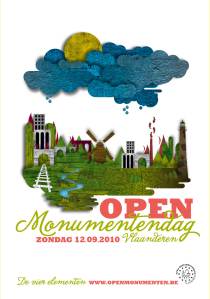 Open Monumentendag Vlaanderen (Heritage Day Flanders) is the holiday for the entire heritagein Dutch-speaking Belgium. It is held every second Sunday of September. On that day all the famous and not-so-famous patrimony of Flanders opens its doors for the general public. But it is not just monuments that are in the spotlights, also archaeological sites and landscapes occupy centre stage. Not only can you admire some of Flanders’ most exciting heritage, but there are also loads of activities, for young and old, presented to you as well (this includes exhibitions, walks, bicycle tours and much more). Every year we highlight one specific topic. This changes the wide variety of activities we offer you every year and it also makes sure that Open Monumentendag will never cease to amaze you. And what is more: all the visits and activities during Open Monumentendag are free of charge!
This year Open Monumentendag takes place on Sunday September 12. The theme of this year’s edition will be The Four Elements. So it will be earth, wind, water and fire that determine the programme. You can find the detailed schedule of the day here.
A Fine Time to Be in the Netherlands
This annual event (second weekend in September) includes sites all over the Netherlands; this year’s theme in Amsterdam is On the Map while the overall theme focuses on The Nineteenth Century. The following description comes from the Amsterdam pages:
Open Monumentendag / Heritage Days
The Netherlands, 11-12 September 2010
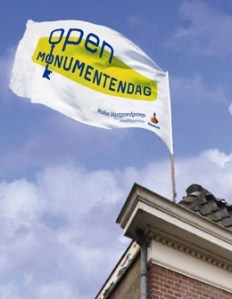 Open Monumentendag (Heritage Days) annually explores and celebrates architecture, both in Amsterdam and the country at large. It is aimed at bringing people into contact with their heritage, and to stir interest in and an understanding of preserving historical monuments. From 11 to 12 September, thousands of historical buildings and sites (about 4,000) are open to the public free of charge. This year’s theme is On the Map.
With a city like Amsterdam that’s partially built on sand, the event gives history lovers a golden opportunity to dip their toes into its architectural sandbox. From Gothic revival and Berlage to modern industrial, what’s not to stop and admire. The focal point this year is On the Map, referring to a variety of maps, topography and architectural plans of buildings that are particularly striking, and which form the subject of the city’s views, postcards and inspiration for drawings, paintings and poems.
 Buildings open to the public include listed (graded) churches and castles, monuments due for restoration and icons long gone from Amsterdam’s skyline. On the Map also highlights structure: the relationship between the monument and its surroundings; and the site of the building in relation to the growth of the city.
Besides opening their doors, many locations also organise on-site activities like exhibitions, music and guided tours. Each year around 80 to 85 percent of Dutch municipalities participate in the Open Monumentendag, organised by local committees. In recent years around 900,000 visitors have participated annually, making the Open Monumentendag one of the Netherlands’ premier cultural events.
A Fine Time to Be in London
From LondonTown.com:
London Open House Weekend
London, 18-19 September 2010
 So many of London’s architectural landmarks are closely guarded secrets, off-limits to Joe Public. It’s tantalising to imagine what goes on behind those closed doors. Well, thanks to the hugely popular London Open House Weekend , we need wonder no more. Almost 700 of the city’s buildings – including the Bank of England – take part in this fantastic, free yearly event, now in its 17th year, by opening their doors to everyone. London Open House Weekend offers a wealth of historical landmarks to choose from including some of the most beautiful architectural achievements in the city. You can also get inside some of the grandest private homes in your own neighbourhood – it’s a voyeur’s dream come true. For the more serious students of contemporary design, this is a chance to visit spaces by famous modern architects. An inspired idea and a real treat whether
you’re a lover of architecture or just plain nosy. . .
◊ ◊ ◊ ◊ ◊
Well-known Georgian buildings — Chiswick House, Handel House Museum, Dr. Johnson’s House, Osterley Park House, &c. — are open for free, but the real opportunities lie in visiting sites that are usually closed (or open only for group tours). A search by period turns up 98 matches. Here’s just a sampling, with descriptions from the Open House site:
Bower House — Grade I listed Mansion House commanding the most extensive southerly views over Essex towards Kent. Leading landscape designer Charles Bridgman and Sir James Thornhill (best known for his wall paintings at Blenheim Palace) were involved with the design.
Dover House, Office of the Secretary of State for Scotland — Elegant Whitehall facade and domed entrance commissioned by the Duke of York. Interesting original interiors.
The House of St Barnabas — Soho’s grandest Grade I listed Georgian townhouse. Fine Roccoco plasterwork commissioned 1754. Victorian Oxford Movement Chapel built 1862 by Joseph Clarke. Owned by the House of St Barnabas, a charity assisting vulnerable people back to independent living.
The Lansdowne Club — Robert Adam house, partly demolished in 1931 and reconstructed as a club house in the Art Deco style, retaining 5 original rooms. Restoration work ongoing.
The Naval Club — Grade II listed Georgian town house c1748-1750 reputed to have been 18C residence of William Pitt the Younger. First floor suite decorated in ornate white and gold ‘Louis XVI’ style. Dark stock brick building with Ionic porch and moulded architraves to sash windows.
Nonsuch Mansion — Tudor Gothic mansion, designed for wealthy merchant Samuel Farmer, in the style later used at Windsor Castle (ca. 1740 and 1806). The service wing has been restored and includes dairy, kitchen, scullery, larders and laundry.
Watermen’s Hall — Only remaining Georgian Hall in the City of London, and perfect example of domestic architecture of the period.
Details and full listings are available here»










 Enfilade
leave a comment