Exhibition | Canaletto and Guardi
From the Musée Jacquemart-André:
Canaletto – Guardi: The Two Masters of Venice
Musée Jacquemart-André, Paris, 14 September 2012 — 14 January 2013
Curated by Bożena Anna Kowalczyk

Canaletto, San Geremia and the Entrance to Cannaregio, ca. 1726-27
London, The Royal Collection, © HM Queen Elizabeth II 2012
◊ ◊ ◊ ◊ ◊
In the 18th century, Venice and its timeless charm became the subject of choice for painters known as the Vedutisti. Their views of Venice quickly spread across Europe, making the Veduta the most collected and one of the most loved genres among the public to this day. Thanks to some generous loans, the Jacquemart-André Museum is now devoting an exhibition to the Veduta for the first time in France, a genre of painting epitomised by Canaletto and Guardi. It is a very under-represented artistic genre in French public and private collections, which makes this exhibition at the Jacquemart-André Museum, Canaletto – Guardi: The Two Masters of Venice, a must-see event, from 14 September 2012 to 14 January 2013. Curated by Bożena Anna Kowalczyk, the focus is on spreading an artistic movement born at the dawn of the 18th century, which was mainly collected by wealthy Italian, British and German collectors.
The exhibition gives pride of place to Canaletto, the cornerstone of the genre, showcasing more than twenty-five of the master’s essential works from the most prestigious museums and collections, while identifying the artist’s place at the heart of the great Veduta artistic movement. His works resonate with those of Gaspar van Wittel, Luca Carlevarijs, Michele Marieschi, Bernardo Bellotto and Francesco Guardi, who was the last master to succeed in immortalising the charm and elegance of the Venetian 18th century. That is why the Jacquemart-André Museum will display about twenty of his works. The exhibition also lays the stress on capricci: striking scenes of an imaginary Venice, painted by Canaletto, Guardi and Bellotto. Some of these canvases have never been displayed in a temporary exhibition before.
Caneletto
The undisputed master of the Veduta, Giovanni Antonio Canal, known as Canaletto (Venice 1697-1768) made his mark on his century by immortalising the various faces of the Venice of his time in his canvases, including streets and piazzas, canals and views over the lagoon, daily life and festival days. Canaletto was a theatre painter in his youth, and succeeded in bringing together an expert sense of composition, a perfectly mastered technique of perspective, and attractive lighting effects.
Guardi
The exhibition takes place on the three-hundredth birthday of Francesco Guardi (1712-1793), and unites more than twenty of his works, rarely exhibited in France. It highlights his links with his older master Canaletto, both considered the most accomplished Vedutisti. For the first time, the Canaletto drawings that the young Guardi admired in Venice are now displayed opposite the Guardi canvases that they inspired. Their works exude a different awareness of perspective and atmospheric effects. While Canaletto’s approach is more rational, Guardi’s paintings also highlight his imagination and awareness, as well as the unique character that he carefully crafted for each scene. Guardi’s works are typified by warm colours and vibrant light, exalting the beauty of Serenissima and unveiling the charm of a fragile and declining Venice.
The Vedutisti
Whether they preceded or followed Canaletto, each of the great Vedutisti displayed at the exhibition brings an individual richness in vision and technique. Gaspar van Wittel (1652/3 – 1736) set the trend for views of Venice by carefully depicting spectacular settings on each canvas, where the buildings contrast with the transparency, movement and reflections of the water. In his wake, Luca Carlevarijs (1663-1730) portrayed a festive Venice, to the rhythm of foreign ambassadors’ grandiose welcomes as they arrived at the Doge’s Palace. Michele Marieschi (1710-1743), from almost the same generation as Canaletto, was his skilled rival. His preference for unexpected viewing angles sets him apart. Following Canaletto’s considerable success, his nephew, Bernardo Bellotto (1722-1780), trained at the master’s school, casting Venetian landscapes in a colder and silvery light, and often utilising innovative compositions. Belletto led to the spread of the Venitian veduta in Europe and became a major protagonist of this genre during the second half of the 18th century.
The Capricci
Although the Vedutisti sought to depict 18th-century Venice in every detail, it is little-known that they also devoted a considerable portion of their works to inventing an imaginary, fantasy Venice, through the capriccio genre. Concern with reality is abandoned in favour of dreaming up reimagined, rustic or unsettling scenes. These spectacular views, created by Canaletto, Guardi or Bellotto, will be examined in detail in the exhibition.
Exceptional Loans
In order to reunite more than fifty key works, more than twenty of which have never been displayed outside their museums of origin, the Jacquemart-André Museum has received support from the largest European and American museums, who helped to make the exhibition a reality through their exceptional loans. These include the London National Gallery, the British Royal Collection, the Thyssen-Bornemisza Museum in Madrid, the Louvre Museum in Paris, the New York Frick Collection, the Parma National Gallery, the Budapest Museum of Fine Arts, and more.
The Royal Collection
The British Crown possesses the largest collection of Canaletto paintings and drawings. Almost all of them were commissioned to Canaletto by Joseph Smith, the British consul at Venice from 1744, who then sold his collection to George III, King of England. Dr. Bozena Anna Kowalczyk, general curator of the exhibition at the Jacquemart-André Museum, studied this prestigious Canaletto collection in great detail and was granted a loan of eight of Canaletto’s exceptional works, which will be displayed for the first time in Paris. Some of these have never been shown in public outside Windsor Castle or the Queen’s Gallery in Buckingham Palace.
Exhibition Curators
Dr. Bożena Anna Kowalczyk is a renowned authority in paintings of views, and she has been at the centre of studies conducted over the last few years. She decided to focus on Canaletto and Bellotto at the University Ca’ Foscari of Venice, while writing her doctoral thesis on “Il Bellotto italiano” (1993-1996). Her work has fundamentally altered critical analysis of the two artists’ works, and she was the source of many discoveries regarding Canaletto’s works, making her an acclaimed specialist among researchers of the period. She knows also very well Michele Marieschi’s and Francesco Guardi’s work and is the main Bernardo Bellotto specialist (1722-1780), whose general catalogue she is preparing.
Exhibitions previously curated or co-curated by Dr. Bożena Anna Kowalczyk:
– Bernardo Bellotto 1722-1780, Venice, Museo Correr, 2001
– Canaletto prima maniera, Venice, Fondazione Giorgio Cini, 2001
– Canaletto: il trionfo della veduta, Rome, Palazzo Giustiniani, 2005
– Canaletto e Bellotto: l’arte della veduta, Turin, Palazzo Bricherasio, 2008
Associate curator of the exhibition: Mr. Nicolas Sainte Fare Garnot, Jacquemart-André Museum curator
◊ ◊ ◊ ◊ ◊
Note (added 29 August 2012) — See Robert O’Byrne’s piece (24 August 2012) on the exhibition for Apollo Magazine.
YCBA — Postdoctoral Research Associateships
Applications due 6 August 2012
The Yale Center for British Art is offering two Postdoctoral Research Associateships of three-year duration, one in the Department of Paintings and Sculpture and the other in the Department of Exhibitions and Publications. These Postdoctoral Research Associateships are for recent recipients of a PhD (degree granted within the last three years) in a field related to British art. The PhD must be in hand by the time the position begins. The closing date for applications is Monday, August 6, 2012. A preference for either position may be stated in the application but is not required. Applicants should apply online and upload a cover letter, CV, and writing sample. Three letters of reference should be e-mailed directly to ycba.research@yale.edu. For further information, visit http://britishart.yale.edu/about-us/opportunities.
Call for Papers | Diderot: Le Génie des Lumières
As noted at L’ApAhAu (my apologies for the short notice) . . .
Diderot – Le Génie des Lumières: Nature, Normes, Transgressions
Halle, 27-29 June 2013
Proposal due by 15 July 2012
Colloque international à l’occasion du 300e anniversaire de Denis Diderot
Comité d’organisation: Konstanze Baron, Robert Fajen, Heinz Thoma
A l’élaboration de la notion de génie moderne, Diderot a sans doute apporté une contribution décisive: d’un côté, il semble reconnaître la pluralité et la valeur relative des « génies » dont il cherche à déterminer l’origine physiologique et l’application pratique; d’un autre côté – et la plupart du temps – le génie, chez lui, fait figure d’exception: c’est un « ressort de la nature » qui permet aux individus d’exception de créer des oeuvres hors norme. En soulignant soit la sensibilité, soit le sang-froid de l’esprit observateur, Diderot insiste sur le don de la nature qui met le génie en état de transcender les conventions humaines en créant ses propres lois. En liant le génie à l’enthousiasme et aux « grandes passions », il en fait une force tout à fait ambiguë, non exempte de qualités diaboliques: l’homme (ou bien la femme) de génie est capable d’exceller dans le bien aussi bien que dans le mal.
Ainsi, la réflexion de Diderot sur le génie ne se limite pas au seul domaine esthétique. Elle fait, tout au contraire, partie intégrante de l’oeuvre philosophique et littéraire de Diderot dans la mesure où celle-ci se préoccupe du rapport entre l’art et la nature, l’individu et la norme, la règle et sa transgression. En tant que telle, la notion de génie participe aux ambivalences et aux tournures dialectiques qui donnent à la pensée de Diderot son caractère distinct. Ce qui intéresse, par exemple, Diderot moraliste, c’est le rapport du génie aux règles et aux conventions de la société. Dans Le Neveu de Rameau, Diderot entame une réflexion sur le génie où l’art et la morale, la dimension éthique et artistique de la vie des « grands hommes » entrent en opposition fondamentale. L’ambiguïté morale du génie ne cesse d’ailleurs de hanter Diderot qui se dit fasciné par la « méchanceté sublime ». Dans la philosophie de la nature, par contre, il met l’accent sur les conditions subjectives de l’investigation scientifique et expérimentale. Dans les Pensées sur l’Interprétation de la Nature, la nature (soi-disant objective) trouve son complément théorique dans l’expérience subjective du philosophe. En même temps, Diderot admet l’importance des dispositions objectives (talent, intuition, esprit de divination etc.) du philosophe. Dans Jacques le Fataliste et son maître, cette même dialectique entre la nature et son interprétation est portée à son comble lorsque l’ingéniosité du narrateur (voire des narrateurs) se trouve en compétition directe avec celle – non moins romanesque – de la nature-même.
En mettant en relief la notion de « génie », la conférence se propose d’explorer une notion-clé de l’oeuvre de Diderot qui permettra en même temps de cerner des tendances générales, voire typiques de la pensée de Diderot ainsi que des Lumières. Il s’agira donc de caractériser la pensée de Diderot : quel est le rapport entre la disposition naturelle, l’héritage physiologique et même génétique d’un côté et la liberté créatrice de l’autre? Comment Diderot conçoit-il le rapport entre l’art et la nature, les facultés innées et la possibilité du changement, voire de l’innovation? Le génie confirme-t-il ou met-il en question le déterminisme matérialiste ? Quel est le rapport entre l’originalité et la norme dans la pensée de Diderot ? de situer cette pensée dans son contexte tant bien historique que contemporain: Quelle est l’influence de la pensée antique et classique dans la pensée de Diderot ? Quel rôle a joué pour Diderot la conception anglaise (Shaftesbury) ou espagnole (Gracián) du génie / de l’ingenium ? Quelle est la réception de la pensée de Diderot en Allemagne, p.ex. auprès des auteurs du Sturm und Drang ? Dans le contexte français et européen, la pensée de Diderot incarne-t-elle la norme ou plutôt l’exception ? Qu’en est-il, en d’autres termes, de la représentativité de Diderot ? Tout ceci s’effectuera en vue d’un troisième objectif, à savoir de tenter une réflexion nouvelle sur la notion des Lumières : la philosophie des Lumières est-elle dominée par la norme, ou admet-elle l’exception ? Quel est le rôle de l’originalité dans la pensée des Lumières? En quoi les théories (esthétiques) du dix-huitième siècle sont-elles vraiment créatrices, en quoi ne font-elles que prolonger des débats plus anciens?Sujets d’investigation possibles:
• Caractère(s) de Diderot : le grand homme, l’homme sans caractère, etc.
• La théorie esthétique des Lumières: entre « imitation » et « inspiration »
• Enthousiasme, énergie, intuition: au-delà du déterminisme mécaniste
• L’exception et la norme : le statut de l’individu / du bizarre / de l’original
• L’art et la nature de l’invention (technique)
• Figures mythiques, interprétations modernes de l’ingenium / du démon
• Morale et esthétique : l’ingénieux n’est pas l’ingénu…
Veuillez envoyer votre proposition de communication (min. 300 mots) jusqu’au 15 juillet 2012 à l’adresse suivante : konstanze.baron@izea.uni-halle.de
Exhibition | Jean-Jacques Rousseau et les Arts
Thanks to Pierre-Henri Biger for noting this exhibition now on at the Panthéon:
Jean-Jacques Rousseau et les Arts
Panthéon, Paris, 29 June — 30 September 2012
 À l’occasion du tricentenaire de la naissance de Jean-Jacques Rousseau (1712-1778), plus de 150 oeuvres et objets consacrés au philosophe et à son image sont réunis au Panthéon, monument où il repose parmi les Grands Hommes. À découvrir une exposition en deux parties, présentant Rousseau et son oeuvre, (l’Antique, le livre, la musique, la nature) et Rousseau et son image (portraits, allégories, monuments, panthéonisation), et concluant avec une évocation du couple Rousseau-Voltaire.
Cette manifestation bénéficie de prêts prestigieux consentis par la Bibliothèque nationale de France, la Bibliothèque publique universitaire de Neuchâtel, la British Library de Londres, les musées du Louvre et Carnavalet, de nombreuses autres institutions publiques en France et à l’étranger et de collections privées.
Commissaire : Guilhem Scherf, conservateur en chef au département des Sculptures du Musée du Louvre
Scénographe : Jérôme Habersetzer
Catalogue for a New Museum | Simone Handbag Museum
This new book from Yale UP is published in conjunction with the new Simone Handbag Museum in Seoul, opening 16 July 2012 (the catalogue is scheduled to appear in September). Yuri Chong writes about the museum for The New York Times Magazine (12 June 2012).
◊ ◊ ◊ ◊ ◊
Judith Clark, ed., Handbags: The Making of a Museum (New Haven: Yale University Press, 2012), 272 pages, ISBN: 9780300186185, $50.
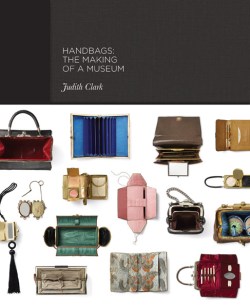 The history of the handbag—its design, how it has been made, used, and worn—reveals something essential about women’s lives over the past 500 years. Perhaps the most universal item of fashionable adornment, it can also be elusive, an object of desire, secrecy, and even fear. Handbags explores these rich histories and multiple meanings.
This book features specially commissioned photographs of an extraordinary, newly formed collection of fashionable handbags that date from the 16th century to the present day. It has been acquired for exhibition in the first museum devoted to the handbag, in Seoul, South Korea. The project is a commission undertaken by experimental exhibition-maker Judith Clark, whose innovative practices are revealed in Handbags.
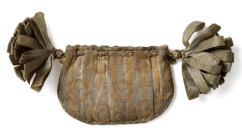
Sweetmeat purse, French, ca. 1670–80. Silk and metal brocade, braid and ribbon.
Essays by leading fashion historians and an acclaimed psychoanalyst investigate the history of gesture, the psychoanalysis of bags, and the museum’s state-of-the-art mannequins and archive cabinets. In order to preserve the words that describe the unique qualities of each bag, a terminology of handbags has been compiled.
Judith Clark is professor of fashion and museology at London College of Fashion. Caroline Evans is professor of fashion history and theory at Central St. Martin’s College of Art & Design. Amy de la Haye is professor of dress history and curatorship, Rootstein Hopkins Chair, at London College of Fashion. Adam Phillips is a psychoanalyst and writer. Claire Wilcox is senior fashion curator at the Victoria and Albert Museum.
Exhibition | Catherine the Great: An Enlightened Empress
Following a £46 million redevelopment, completed last summer, the National Museum of Scotland presents over 600 objects from the Court of Catherine the Great.
◊ ◊ ◊ ◊ ◊
From the museum:
Catherine the Great: An Enlightened Empress
National Museum of Scotland, Edinburgh, 13 July — 21 October 2012

Vigilius Eriksen, Portrait of Catherine II on Her Horse Brilliant, after 1762
Learn the story of the woman behind the legends and discover the greatest collection of treasures from Russia ever seen in the UK
Sharp, funny, generous, iron-willed and passionate, Catherine the Great was one of Russia’s most successful rulers and one of the greatest art collectors of all time. Presented in partnership with the State Hermitage Museum in St Petersburg, this unique exhibition is showing only in Edinburgh. Explore Catherine’s reign through her collections, which vividly reflect her own interests and provide a fascinating glimpse of the wealth and magnificence of the Imperial Russian court. Learn of a woman who won wars and built palaces, wrote plays and books, built a rollercoaster for her own entertainment and who put Russia firmly on the cultural map of Europe.
The exhibition features more than 600 priceless works collected by the Empress. See spectacular paintings, outstanding costumes and uniforms, dazzling cameos, snuffboxes and jewellery, hunting weapons and exquisite works of art seldom seen outside Russia.
◊ ◊ ◊ ◊ ◊
Writing for the The Sunday Times Magazine (1 July 2012), pp. 52-56, Amy Turner reports that the exhibition will place “special emphasis on the Russian-Scottish connection.” Along with many of the empress’s Scottish soldiers and sailor officers, there was the architect, Charles Cameron, and other Scottish characters including art dealers and physicians. As for the equestrian portrait by Eriksen, Turner writes,
The painting was recently discovered in the bowels of the Hermitage, wrapped and filthy, where it was hurriedly stashed for safekeeping at the outbreak of the Russian Revolution in 1917. It has been specially cleaned and restored in preparation for its trip to Scotland. Several copies of the painting exist around the world (one was on display at the Royal Academy’s Citizens and Kings exhibition in London in 2007), but this is the only version attributed solely to Eriksen (55).
◊ ◊ ◊ ◊ ◊
Note (added 12 July 2012) — The catalogue, edited by Godfrey Evans, is available through ACC Distribution.
Exhibition | Renaissance to Goya: Prints and Drawings in Spain
From The British Museum:
Renaissance to Goya: Prints and Drawings Made in Spain
The British Museum, London, 20 September 2012 — 5 January 2013
The Art Gallery of New South Wales, Sydney, 31 August — 24 November 2013
New Mexico Museum of Art, Santa Fe, 14 December — 9 March 2014
Curated by Mark McDonald
Spanish prints and drawings is a subject that is little known outside Spain. It is generally assumed these were marginal arts practiced only by a few well-known artists, including José de Ribera, Bartolomé Murillo and Francisco de Goya. The aim of this project is to explore the largely unchartered territory of the origins, form and function of prints and drawings in Spain. It will present for the first time a coherent study, largely based on the collections of the British Museum, that looks at their history from around 1400 through to and including Goya (died 1828). It will also present new research on the subject of the graphic arts in Spain. The material will be published in a monograph to accompany an exhibition at the British Museum in late 2012.
It is the first time prints and drawings made in Spain have been studied together. A critical aspect of the project will be to consider the presence of foreign artists working in Spain and how they contributed to the artistic landscape. Particular attention will be given to the different types of prints and drawings and their many functions to convey the role they played in artistic practice and visual culture in Spain (architectural prints and drawings, reproductive prints, landscape, religious subjects, prints made for commemorative purposes, fans, playing cards and more).
◊ ◊ ◊ ◊ ◊
Due out in October from Ashgate:
Catalogue: Mark McDonald, Renaissance to Goya: Prints and Drawings Made in Spain (Aldershot: Lund Humphries, 2012), 320 pages, ISBN: 9781848221185.
 The rich tradition of printmaking and drawing in Spain has rarely been examined, in part because of the misapprehension that Spanish artists did not draw and few turned their hand to printmaking. This spectacular study of prints and drawings will for the first time examine the history of graphic practice in Spain, providing an overview of more than 400 years of artistic production.
The story begins in the late 15th century with convergence of foreign artists in Spain who introduced new techniques and ideas. The most significant changes were brought about through the building of Philip II’s monastery of the Escorial near Madrid. Large numbers of foreign artists arrived to decorate the monastery. They included the Italians Pellegrino Tibaldi and Federico Zuccaro and the Flemish printmaker Pedro Perret, whose engravings of the Escorial are among the most remarkable architectural prints of the period. At the Escorial the international influences formed the basis of artistic practice and contributed to the distinctive appearance of art produced in Spain.
The ‘Golden Age’ — a dramatic flourishing of artistic and literary endeavour in Spain during the 17th century — is celebrated through discussion of key works by the most important visual artists of the period: Alonso Berruguete; the Carducho brothers; Murillo; Ribera; Zurbarán and the extraordinary drawings of Velázquez, about which very little is known. Each region of Spain is explored separately as independent centres of artistic activity during this time with prints and drawings examined together to demonstrate how their production was closely linked.
The book concludes with the Enlightenment and the 18th century, with a study of remarkable prints and drawings by Francisco de Goya. Goya’s important Spanish contemporaries are examined alongside the works of foreign artists who continued to come to Spain, such as the Tiepolo family who worked in Madrid.
Contents
Introduction
1. Prints and Drawings in Spain: Attitudes and Evidence
2. Drawings and Prints before 1500 and Early Collecting in Spain
3. Importing Graphic Practices: Castile 1550–1600
4. Madrid as Artistic Capital 1600–1700
5. Andalusia 1500–1700
6. Valencia 1500–1700 and Ribera in Naples
7. The Eighteenth-Century Reinvention of the Graphic Arts
8. Francisco de Goya
Appendix by Clara de la Peña McTigue, Spanish Paper and Papermaking
Bibliography
Mark McDonald is curator of Old Master prints and Spanish drawings at the British Museum. He has published widely on the subject of Old Master prints from the 15th to the 18th centuries, with special interest in the Renaissance period. He is the author of The Print Collection of Ferdinand Columbus (1488–1539): A Renaissance Collector in Seville (winner of the Mitchell Prize 2005).
◊ ◊ ◊ ◊ ◊
Note (added 1 September 2013) — The original posting did not include the Sydney venue; more information is available here»
Note (added 21 December 2013) — Earlier versions did not include Santa Fe venue; more information is available here».
The Art Market and the Pursuit of Superlatives
At Enfilade we’ve noted a number of the events described in this article from the WSJ — including Masterpiece London, Treasures, Prince Taste at Sotheby’s, and the Exceptional Sale at Christie’s. Emma Cricthton-Miller here addresses the trend toward singularity and the strength of the high end of the market for art and luxury goods.
◊ ◊ ◊ ◊ ◊
From The Wall Street Journal:
Emma Crichton-Miller, “Redefining ‘Masterpiece’: How a Shift in Collectors’ Focus Is Changing the Art World,” The Wall Street Journal (28 June 2012).
Once, London’s Grosvenor House Art and Antiques Fair was as integral a part of the English summer season as Henley or Ascot. This year, its successor, Masterpiece, whose third edition runs through July 4, reaffirms its claim to Wimbledon fortnight. In between the big auctions at Sotheby’s, Christie’s and Bonhams, and running in tandem with Master Paintings Week (until July 6), the fair looks to attract a young international audience usually more inclined to spend its money on great wine, fine jewelry or fast cars, to the alternative pleasures of Old Master paintings, contemporary ceramics, antique sculptures or Georgian furniture.
The key to the event is its name. It is under the “masterpiece” rubric . . . This approach has come to dominate fairs and sale rooms around the globe, as collectors focus on outstanding individual examples across categories rather than box-ticking must-haves within a single category. For critics, it aligns art directly with luxury, suggesting that what ultimately unites these objects is their availability only to the very wealthy. But more broadly, it reflects a shift within the market that is changing how we look at objects, understand collections and live with art.
As newspaper headlines indicate, the top end of the market has emerged largely unscathed from the world financial crisis. Records continue to be broken, most recently with the $119.9 million May sale of Munch’s pastel The Scream (1895), now the most expensive work of art ever sold at auction. The middle of the market, however, has become more difficult, as auction houses struggle to sell pieces from less well-known artists and periods. . .
The full article is available here»
Dissertations
From caa.reviews:
Dissertation Listings
PhD dissertation authors and titles in art history and visual studies from US and Canadian institutions are published each year in caa.reviews. Titles can be browsed by subject category or year.
Titles are submitted once a year by each institution granting the PhD in art history and/or visual studies. Submissions are not accepted from individuals, who should contact their department chair or secretary for more information. Department chairs: please consult our dissertation submission guidelines for instructions. The annual deadline is January 15 for titles from the preceding year.
In 2003, CAA revised the subject area categories of art history and visual studies used for all our listings, including dissertations. These categories are listed in the Dissertation Submission Guidelines
◊ ◊ ◊ ◊ ◊
The index for 2011 lists eight eighteenth-century dissertations completed, including:
• Frederique Baumgartner, “Transformation of the Cultural Experience: The Art of Hubert Robert during the French Revolution” (Harvard, E. Lajer-Burcharth)
• Christina Ferando, “Staging Canova: Sculpture, Connoisseurship, and Display, 1780–1822” (Columbia, J. Crary, A. Higonnet)
• Katie Hanson, “A Neoclassical Conundrum: Painting Greek Mythology in France, 1780–1825” (CUNY, P. Mainardi)
• Amanda Lahikainen, “Unchecked Ideas: Humor and the French Revolution in Late Eighteen-Century British Political Graphic Satire” (Brown, K. D. Kriz)
and forty-one dissertations in progress, including:
• Katherine Arpen, “Pleasure and the Body: Representations of Bathing in Eighteenth-Century French Art” (UNC Chapel Hill, M. Sheriff)
• Julie Boivin, “Horrid Beauty: Rococo Ornament and Contemporary Visual Culture” (Toronto, M. Cheetham)
• Elizabeth Berler Brand, “Representing Natural History in Philadelphia, 1770–1820” (UT Austin, S. Rather, M. Cohen)
• Lauren Cannady, “Owing to Nature and Art: The Garden Landscape and Decorative Painting in Eighteenth-Century French Pavillons de Plaisance” (IFA/NYU, T. Crow)
• Zirwat Chowdhury, “‘Imperceptible Transitions’: The Anglo-Indianization of British Architecture, 1768–1820” (Northwestern, S. H. Clayson)
• Katelyn D. Crawford, “Itinerant Portraitists in the Late Eighteenth-Century British Atlantic World” (Virginia, M. McInnis)
• Lindsay Dunn, “A Revolutionary Empress: Figuring Dynastic Power and National Identity in Representations of Marie-Louise, House of Habsburg-Lorraine (1791–1847)” (UNC Chapel Hill, M. Sheriff)
• Emily Everhart, “The Power of Friendship: Madame de Pompadour, Catherine the Great, and Representations of Friendship in Eighteenth-Century Art” (Georgia, A. Luxenberg, A. Kirin)
• Jessica Fripp, “Portraiture as Social Practice: The Creation, Collection, and Exchange of Portraits of Artists in Eighteenth-Century France” (Michigan, S. Siegfried)
• Daniel Fulco, “Palace Frescoes as an Expression of Princely Power in Early Modern Germany: Five Representative Examples” (Illinois at Urbana–Champaign, D. O’Brien)
• Meredith Gamer, “Criminal and Martyr: Art and Religion in Britain’s Early Modern Eighteenth Century” (Yale, T. Barringer)
• Victoria Sears Goldman, “‘The most beautiful Punchinelli in the world’: A Comprehensive Study of the Punchinello Drawings of Giovanni Battista Tiepolo” (Princeton, T. DaCosta Kaufmann)
• Jennifer Jones, “A Discourse on Drawings: P. J. Mariette and the Graphic Arts in Early Eighteenth-Century Paris” (Columbia, D. Rosand)
• Jason LaFountain, “The Puritan Art World” (Harvard, J. Roberts)
• David Pullins, “Cut and Paste: The Mobile Image from Watteau to Pillement” (Harvard, E. Lajer-Burcharth)
• Brian Repetto, “Impressing the Patriot: Visual Culture and Revolution in the Eighteenth-Century Netherlands” (Brown, J. Muller)
• Ünver Rüstem, “Architecture for a New Age: Imperial Ottoman Mosques in Eighteenth-Century Istanbul” (Harvard, G. Necipoğlu)
• Susan Wager, “Boucher’s Bijoux: Luxury Reproductions in the Age of Enlightenment” (Columbia, A. Higonnet)
• Diane Woodin, “Embodied Constellations: Representations of Science, Gender, and Social Allegiance in the Eighteenth Century” (UNC Chapel Hill, M. Sheriff)
Display | The King’s Artists: George III’s Academy
Now on view at the Royal Academy, as noted at British Art Research:
The King’s Artists: George III’s Academy
The Royal Academy of Arts, London, 25 May — 21 October 2012

Joshua Reynolds, Portrait of King George III, 1779. Oil on canvas, 2774 x 1855 mm. Photo: John Hammond. © Royal Academy of Arts, London
Part of a series of displays to celebrate The Queen’s Diamond Jubilee, The King’s Artists explores the influence that George III had on the early shaping and history of the Royal Academy of Arts and how his support contributed to its success.
Dominating the exhibition are the imposing portraits of George III and Queen Charlotte, painted by Sir Joshua Reynolds to hang in the Academy’s council chamber. These served as physical reminders of the Academy’s great patrons, presiding over the institution in its resplendent, purpose-built, new apartments in Somerset House.
A newly attributed chalk study by Reynolds for his grand portrait of the monarch, on loan from a private collection, will be shown for the first time alongside the finished oil painting. Hurriedly taken in the brief sittings that the King allowed, this drawing is a poignant reminder of how George and Joshua were obliged to put aside mutual antipathy for the sake of their Academy as it was about to move to Somerset House. Sculpture, drawings, prints and archival materials exploring the Academy’s royal connections are also on view.










 Enfilade
leave a comment