New HGCEA Emerging Scholar Publication Prize
HGCEA Emerging Scholar Publication Prize
Nominations due by 14 December 2012
The Historians of German and Central European Art (HGCEA), an affiliated society of CAA, announces a new Emerging Scholar Publication Prize. The Prize will be awarded annually to a distinguished essay published the previous year by an emerging scholar. Submissions may be on any topic in the history of German or Central European art, architecture, design or visual culture. This year, essays published in 2011 and 2012 will be considered; submissions will be accepted from current PhD students and from those who earned a PhD in or after 2007. The recipient of the Prize, which will be announced at CAA and comes with an award of $500, must be a current member of HGCEA. Nominations and self-nominations are welcome; the deadline for submissions (the publication and a CV) by electronic attachment to the HGCEA president, Marsha Morton at mortonmarsha10@gmail.com, is December 14, 2012.
Exhibition | Nude Men in Vienna
With the advertising for this exhibition having been covered sensationally by the international press, the focus on contemporary work has obscured the late eighteenth-century offerings. Press release from the Leopold Museum:
◊ ◊ ◊ ◊ ◊
Nude Men from 1800 to the Present / Nackte Männer
Leopold Museum, Vienna, 19 October 2012 — 28 January 2013
Curated by Elisabeth Leopold and Tobias Natter
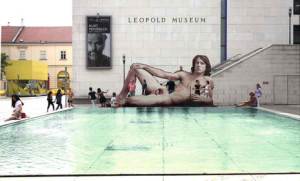
Ilse Haider, Mr. Big, installed at the Leopold Museum
The endless flood of images intrinsic to today’s lifestyle has given unprecedented public prominence to the depiction of male nudes. At the same time seemingly firmly established categories such as masculinity, body, and nakedness are apparently being redefined on a broad social basis, resulting in a new interpretation of male gender roles. These developments have prompted the Leopold Museum to embark on a topical as well as historical journey through the visual arts in search of the male nude, a quest leading predominantly from the longing for antiquity prevalent in art around 1800 to contemporary art. The exhibition Naked Men: Power & Powerlessness through the Ages also represents the fulfillment of the museum’s long-cherished ambition to present a counterpart to the highly successful 2006 exhibition Body – Face – Soul curated by Elisabeth Leopold, which explored the female image in art from the 16th century to the present. Thus, the current presentation constitutes a continuation of this theme, except that its focus is now on the opposite sex.
The exhibition Naked Men: Power & Powerlessness through the Ages is based on works by Egon Schiele, Richard Gerstl and Anton Kolig – three artists who are more comprehensively represented in the Leopold Museum than in any other institution and in whose oeuvre the depiction of the male nude features prominently. Schiele’s male nudes can be seen as unconditional explorations of the self, as expressions of inner emotions and as body images situated between vulnerability and provocation. Gerstl followed the tradition of Christian iconography with the first of his two life-sized self-portraits, while he elevated the fragmentation of form to a principal in the second with his wild brushstrokes. Kolig was captivated by the depiction of naked young men all his life and dedicated his drawings almost exclusively to this motif.
Based on eminent examples from its own collection and complemented by loaned works from all over Europe, the Leopold Museum’s exhibition will set out in two main directions, examining the depiction of the male nude in contemporary art, while also exploring the Old Masters’ approach to the subject from the Renaissance all the way back to antiquity. The exhibition unites examples of many different genres, including painting, sculpture, graphic arts, photography and new media, with special emphases on the following themes:
The Measure of All Things: The Male Body and Art Academies
Ever since the Renaissance, the naked male body was considered to be an important object of study and an indispensable part of the academies’ curriculum, which was one of the reasons that women were denied access to art academies for so long. The presentation affords insights into the life drawing rooms of European art academies from the Baroque period onwards and illustrates to what an extent all eyes were focused on the naked man, though he himself was the only one to remain naked.
Longing for Antiquity and the Male Ideal
For centuries, the depiction of the male nude was only legitimized by ancient art. These restrictions prompted the emergence of various artistic strategies that reinterpreted ancient ideals under the guise of antiquity. This is illustrated in the exhibition with examples from the period around 1800 up until the present.
The Naked Self
While Klimt still believed that nakedness and truth coincided in the Nuda Veritas, Schiele began to make his own body the object of his paintings. Expressionism brought with it a radical examination of the self, which saw the artists exposing themselves both physically and existentially and exploring the use of their own nudity as a sphere of political influence.
In the Sights of Women
The battle of female desire and male denial is not often addressed in the visual arts, but it has its historical sources both in the biblical story of Joseph and the Wife of Potiphar and in the ancient mythological traditions of Narcissus and Adonis. The emancipation of women as artists has brought with it a new basis for the depiction of such conflicts. Nowadays, female artists also have access to male nude models and are free to interpret and depict this motif at their will, currently often with a view to deconstructing gender and gender asymmetries.
Bathers — On the Beach
In the second half of the 19th century depictions of naked people in nature abounded. These renderings had their origin in a reassessment of man’s position in nature. Based on early depictions such as Dürer’s The Men’s Bath, the exhibition features many eminent examples of such encounters and get-togethers of naked men, from Cézanne to Mapplethorpe.
◊ ◊ ◊ ◊ ◊
In the United States, the English edition of the catalogue will be distributed by The University of Chicago Press:
Catalogue: Elisabeth Leopold and Tobias Natter, eds., Nude Men from 1800 to the Present (Vienna: Hirmer, 2013) ISBN: 9783777458519, $50.
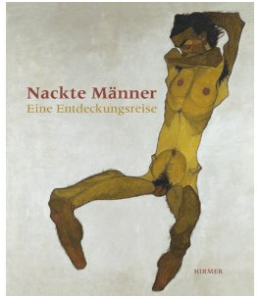 Rodin’s Thinker. Da Vinci’s Vitruvian Man. Pigalle’s controversial portrayal of the philosopher Voltaire. From its earliest days, art history is rife with representations of nude men. But while there is no shortage of studies of art celebrating the female form, the male nude has suffered from relative neglect. This book seeks to correct this imbalance with a collection of paintings, sculptures, and photographs that challenge conceptions of the body and masculinity, many of which continue to have considerable cultural resonance today.
Beginning with a look at art completed in life-drawing classes popular across European academies, the book moves on to representations of masculinity throughout the French Revolution, including works by Johann Heinrich Füssli and Antonio Canova; provocative Sturm und Drang paintings by Edvard Munch and contemporaries; and late impressionist works. The unsettling self-portraits of Austrian artists Egon Schiele and Richard Gerstl exemplify an extreme candor that characterized the early twentieth century. Other twentieth-century artists whose work is included in this book are Jean Cocteau, David Hockney, Andy Warhol, Nan Goldin, and Louise Bourgeois.
With nearly four hundred full-color illustrations, the book also includes insightful essays examining topics like male identity, depictions of desire in modern art, and the use of nude men in advertising.
◊ ◊ ◊ ◊ ◊
Note (added 2 February 2013) — The sensational coverage is likely to continue. As reported by the AFP, viewers are invited to step out of their own clothes for a special viewing on February 18, “Our museum will be a clothes-free zone for one evening. . . Nudists, naturists are welcome!”
Call for Papers | Material Culture Studies in Three Dimensions
From The Center for Material Culture Studies at the University of Delaware:
Embodied Objects: Material Culture Studies in Three Dimensions
Winterthur Museum, Garden & Library, 20 April 2013
Proposals due by 30 November 2012
 The Center for Material Culture Studies at the University of Delaware invites submissions for papers to be given at the Eleventh Annual Material Culture Symposium for Emerging Scholars.
The objects we create, manipulate, and consume mediate our experience with the world. We seek a broad range of papers that highlight the intersection between objects and humans, things and people. We’re interested in how three-dimensional objects act as extensions of ourselves, provide repositories for memory, help stabilize identity, interrupt our sense of scale and space, give permanence to relationships, and mirror human forms. Papers may also address how objects mediate human sensory experience and create aesthetic meaning. We encourage papers that reflect upon and promote an interdisciplinary discussion on the state of material culture studies today.
Disciplines represented at past symposia include American studies, anthropology, archaeology, consumer studies, English, gender studies, history, museum studies, and the histories of art, architecture, design, and technology. We welcome proposals from graduate students, postdoctoral scholars, and those just beginning their teaching or professional careers.
Format
The symposium will consist of nine presentations divided into three panels. Each presentation is strictly limited to eighteen minutes, and each panel is followed by comments from established scholars in the field. There will be two morning sessions and one afternoon session, with breaks for discussion following each session and during lunch. Participants will also have the opportunity to tour Winterthur’s unparalleled collection of early American decorative arts and to engage in a roundtable discussion on Friday, April 19. Travel grants of up to $300 will be available for presenters.
Submissions
The proposal should be no more than 300 words and should clearly indicate the focus of your object-based research, the critical approach you take toward that research, and the significance of your research beyond the academy. While the audience for the symposium consists mainly of university and college faculty and graduate students, we encourage broader participation. In evaluating proposals, we will give preference to those papers that keep a more diverse audience in mind.
Send your proposal, with a current c.v. of no more than two pages, to emerging.scholars@gmail.com. Proposals must be received by 5 p.m. on November 30, 2012. Speakers will be notified of the vetting committee’s decision in January 2013. Confirmed speakers will be asked to provide symposium organizers with digital images for use in publicity and are required to submit a final draft of their papers by March 11, 2013.
Conference Co-Chairs: Liz Jones and Amy Torbert
Postdoctoral Fellowship | Interacting with Print Research Group
From The Interacting with Print Research Group:
Postdoctoral Fellowship: Interacting with Print Research Group
McGill University and the University of Montreal, 2013-14
Applications due by 19 November 2012
The Interacting with Print Research Group at McGill University and the University of Montreal is seeking a postdoctoral fellow with interests in developing digital humanities methodologies for studying the print culture of eighteenth- and nineteenth-century Europe. Candidates may specialize in history, art history, literature or a related discipline, and should have their doctorate in hand by the start date. The ideal candidate has experience in both information design and computer programming; expertise in data visualization, text mining, and designing digital tools is especially desirable. A working knowledge of French is an asset.
Interacting with Print researches how print media interact with other media within a larger communicative ecology. One of our primary concerns is how digital interfaces will reorient an extant print-cultural heritage. The postdoctoral fellow will be an integral member of the team, developing his or her own research and working with team members to develop their projects.
Review of applications will begin on 19 November 2012 and continue until the position is filled. For further information, contact interactingwithprint@mcgill.ca. To apply, send cover letter, CV, and names of three referees to Prof Tom Mole at interactingwithprint@mcgill.ca
Rijks Studio Offers 125,000 Images Free of Copyright
After years of hearing that museums couldn’t provide high resolution reproductions of works in their collections because people might make t-shirts with them, we now learn that the Rijkmuseum is inviting us to do precisely that . . . and more. -CH

◊ ◊ ◊ ◊ ◊
As a prelude to its reopening 13 April 2013, one of the world’s leading museums, the Rijksmuseum in Amsterdam, will launch Rijks Studio, a ground-breaking new online presentation of 125,000 works in its collection. Rijks Studio invites members of the public to create their own masterpieces by downloading images of artworks or details of artworks in the collection and using them in a creative way. The ultra high-resolution images of works, both famous and less well-known, can be freely downloaded, zoomed in on, shared, added to personal ‘studios’, or manipulated copyright-free. Users can have prints made of entire works of art or details from them. Other suggestions for the use of images include creating material to upholster furniture or wallpaper, or to decorate a car or an iPad cover for example.
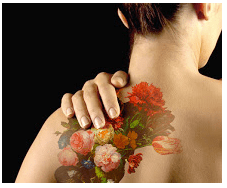 To celebrate this digital milestone, the Rijksmuseum is asking leading international artists, designers and architects to become pioneers of Rijks Studio by selecting one work from the collection and using it creatively to create a new artwork. These will be released in the run up to the reopening of the museum. The first work to be unveiled, by Droog Design, is a tattoo inspired by a flower painting in the collection called Still-Life with Flowers by Jan Davidszn. de Heem and Rachel Ruysch from the 17th century.
Taco Dibbits, Director of Collections, said: “The Rijksmuseum is a museum for and of everyone, and with the launch of Rijks Studio we are excited to share the extensive collection with art lovers around the world using the latest digital technology. We created Rijks Studio based on the belief that the collection of the Rijksmuseum belongs to us all. The collection inspires, we want to unleash the artist in everyone.”
Conference | Art and Its Afterlives
Conference program from The Courtauld:
Fourth Early Modern Symposium: Art and Its Afterlives
The Courtauld Institute of Art, London, 17 November 2012
Organised by Laura Sanders and Francesca Whitlum-Cooper
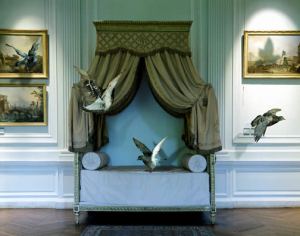
Karen Knorr, The Green Bedroom of Louis XVI. © Eric Franck Fine Art
Art and Its Afterlives aims to address the ways in which the work of art continues to resonate after its creation. While much art history takes as its focus the initial facture of the work of art, this one-day symposium explores what happens to early modern art after the moment of its making. How did early modern works continue to be created in their display, preservation, and reception from the moment of their creation on? Papers will examine how art is shaped by its afterlives – whether these collect, curate, cut up, cut out, copy or correct it – and the ways in which art both persists and changes through time as a material object, a field of generative meaning, and a subject of debate and interpretation.
The question of afterlife is an pertinent topic for art history in general, where the work of art is uniquely tied to a particular assemblage of materials which inevitably change with time, rendering fraught questions of preservation, the presence or possibility of copies, the idea of original state, and how a work of art is staged for a viewer. Less material but no less concrete, the interactions between the work and the viewer, and between the work and the its assumed referent are not stable but open to change. The question of afterlife is particularly relevant for the early modern period, when emergent art markets and cultures of collection allowed not only the circulation of artworks, but also their appropriation and adaptation. Taking as its point of departure Bourdieu’s encouragement to investigate ‘not only the material production of the work but also the production of the value of the work’, this symposium privileges the afterlives of art and the alternative histories they present. Art and Its Afterlives is the fourth symposium of The Courtauld’s Early Modern Department.
Book online or send a cheque made payable to ‘Courtauld Institute of Art’ to: Research Forum Events Co-ordinator, Research Forum, The Courtauld Institute of Art, Somerset House, Strand, London WC2R 0RN, stating the event title: Art and Its Afterlives. For further information, email ResearchForumEvents@courtauld.ac.uk
◊ ◊ ◊ ◊ ◊
P R O G R A M M E
9.00 Registration
9.30 Introduction – Laura Sanders and Francesca Whitlum-Cooper (The Courtauld Institute of Art)
9.40 Session 1: Finding the Original
• Stephanie Knöll (Heinrich-Heine-Universität Düsseldorf): Holbein’s Images of Death and the Construction of Authorship and Authenticity in Nineteenth Century Art Historical Discussions
• Antonia Putzger (Technische Universität, Berlin): What (or Who) Makes an Original? Maximilian I of Bavaria as Collector and Creator of German Renaissance Art
• Gabriella Szalay (Columbia University, New York): Wipe It With a Damp Cloth! Restoring Early Netherlandish Paintings
11.00 Coffee/Tea
11.30 Session 2: Contexts of Reception
• Christina Ferando (Columbia University, New York): From Altarpiece to Masterpiece: Titian’s ‘Long Unnoticed’ Assumption of the Virgin
• Giulia Weston (The Courtauld Institute of Art): Salvator Rosa’s British Afterlives
• Edward Houle (McGill University, Montreal): The Petits Appartements at Versailles and the Vicissitudes of Heritage
• Owen Hopkins (Royal Academy of Arts): Hawksmoor in the Twentieth Century
13.10 Lunch
14.10 Session 3: Appropriation and Re-making
• Jason Nguyen (Harvard University, Boston): Translation, Illustration, and Transmutation: Authorship and Authority in Claude Perrault’s Les dix livres d’architecture de Vitruve (1673)
• Amy Concannon (Tate Britain, London): Cut, Paste, and Copy: Hubert Robert, François Boucher and the Culture of Appropriation Amongst French Artists in the Eighteenth Century
• Heike Zech (Victoria and Albert Museum, London): From Sacred to Profane? The Afterlife of a Seventeenth Century Augsburg Masterpiece
• Sian Bowen (Northumbria University, Newcastle): Capturing the Ephemeral: Materiality and Transience Through Drawing Practice
15.50 Coffee/Tea
16.20 Session 4: Display and Preservation
• Anna Bortolozzi (National Museum, Stockholm): Notes from the Underground: The Afterlife of Old St. Peter’s in the Vatican Grottos and Other Stories
• Noémie Etienne (Barnard College, New York): From the Wall to the Museum: Material and Symbolic Transformations of Paintings in Paris in the Eighteenth Century
• Ronit Milano (Ben-Gurion University, Israel): On Trojan Dogs and Long-Lasting Artistic Quarrels: The Case of Jeff Koons in Versailles
17.45 Reception










 Enfilade
leave a comment