Conference | Face to Face: The Transcendence of the Arts in China
Face to Face: The Transcendence of the Arts in China and Beyond
University of Lisbon, Portugal 3-5 April 2013
The Artistic Studies Research Centre of the Faculty of Fine Arts, University of Lisbon is proud to announce the organization of the international conference Face to Face: The Transcendence of the Arts in China and Beyond. The conference takes place 3-5 April 2013 at the auditorium of the Faculty of Fine Arts.
This academic event is an opportunity to promote the discussion between scholars affiliated to Research Units, Universities or Museums from Portugal, Spain, France, England, Scotland, Germany, Czech Republic, Slovenia, EUA, China, Macau, Hong Kong and Taiwan. In this conference scholars will present recent research that have been developed in the field of Chinese art and its cultural and artistic exchange with other civilizations across historical perspectives and contemporary approaches in artistic creativity.
The conference programme, paper abstracts and speakers academic background, as well as other useful informations are available at the conference website.
Invited Speaker: Shih-hua Chiu (National Palace Museum, Taipei)
Keynote Speaker: Cheng-hua Cheng (Institute of Modern History, Academia Sinica)
Working language: English (no translation will be provided)
Lecture | Emma Barker on Chardin and the Domestic Woman
Lecture by Emma Barker — Painting the Bourgeoisie: Chardin and the Domestic Woman
Keynes Library, Birkbeck College, London, 5 December 2012
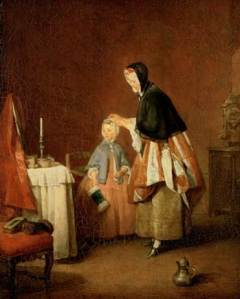 The Birkbeck Eighteenth-Century Research Group is delighted to announce a forthcoming lecture by Emma Barker, Senior Lecturer in Art History at the Open University. Emma Barker’s research focuses on eighteenth and early nineteenth-century French art. Her monograph, Greuze and the Painting of Sentiment, was published by Cambridge University Press in 2005. She has also edited and co-authored several course books for the Open University, including Art and Visual Culture 1600-1850: Academy to Avant-Garde (Tate Publishing, 2012).
7.30pm, Wednesday 5th December 2012, Room 114 (Keynes Library), 43 Gordon Square
All very welcome! For further information, please contact Ann Lewis: a.lewis@bbk.ac.uk
Exhibition | Constable, Gainsborough, Turner
Press release from the Royal Academy:
Constable, Gainsborough, Turner and the Making of Landscape
Royal Academy of Arts, London, 8 December 2012 — 17 February 2013
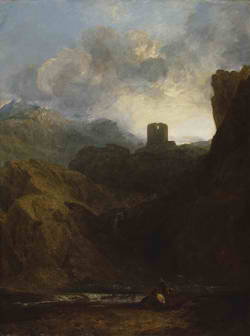
J.M.W. Turner, Dolbadern Castle, 1800, 1194 x 902 mm. Photo: Prudence Cuming Associates Limited. © Royal Academy of Arts, London
This December an exhibition of works by the three towering figures of English landscape painting, John Constable RA, Thomas Gainsborough RA and J.M.W. Turner RA and their contemporaries, will open in the John Madejski Fine Rooms and the Weston Rooms. Constable, Gainsborough, Turner and the Making of Landscape will explore the development of the British School of Landscape Painting through the display of 120 works of art, comprising paintings, prints, books and archival material.
Since the foundation of the Royal Academy of Arts in 1768, its Members included artists who were committed to landscape painting. The exhibition draws on the Royal Academy’s Collection to underpin the shift in landscape painting during the 18th and 19th centuries. From Founder Member Thomas Gainsborough and his contemporaries Richard Wilson and Paul Sandby, to J.M.W. Turner and John Constable, these landscape painters addressed the changing meaning of ‘truth to nature’ and the discourses surrounding the Beautiful, the Sublime and the Picturesque.
The changing style is represented by the generalised view of Gainsborough’s works and the emotionally charged and sublime landscapes by J.M.W. Turner to Constable’s romantic scenes infused with sentiment. Highlights include Gainsborough’s Romantic Landscape (c.1783), and a recently acquired drawing that was last seen in public in 1950. Constable’s two great landscapes of the 1820s, The Leaping Horse (1825) and Boat Passing a Lock (1826) will be hung alongside Turner’s brooding diploma work, Dolbadern Castle (1800).
To contextualise the landscape paintings of Constable, Gainsborough and Turner, a number of paintings by their 18th-century contemporaries Richard Wilson, Michael Angelo Rooker and Paul Sandby will be exhibited with prints made after the 17th-century masters whose work served as models: Claude, Poussin, Gaspard Dughet and Salvator Rosa. Letters by Gainsborough, Turner’s watercolour box and Constable’s palette will also be on display, bringing their artistic practice to life.
Constable, Gainsborough, Turner and the Making of Landscape has been organised by the Royal Academy of Arts. The exhibition is curated by MaryAnne Stevens, Director of Academic Affairs, Nick Savage, Head of Collections & Library, Helen Valentine, Curator of Paintings & Sculpture and Andrew Wilton, with Annette Wickham and Helena Bonett.
The exhibition will be accompanied by an illustrated booklet that will include an essay by Andrew Wilton and introductions to each of the sections of the exhibition.
Call for Papers | Travel, Topography, and the Book Trade
Print Networks Conference: Travel, Topography, and the Book Trade
University of Chichester, 23-25 July 2013
Proposals due by 31 January 2013
Guest Speakers: Bill Bell (Cardiff University) and Anthony Payne (Anthony Payne Rare Books & Manuscripts)
The thirty-first Print Networks Conference on the History of the British book trade will take place at the University of Chichester on 23rd-25th July 2013. Due to the proximity of the conference venue to the south coast, ‘Travel, Topography and the Book Trade’ has been chosen as the theme for the conference. The theme is broadly defined, and any papers relating to the production, distribution and reception of texts and images about travel, imagined and real, from the Middle Ages to the modern era will be considered. Papers on travelling and migrating practitioners of the book trade, the physical movement of texts and travelling printing technology are also welcome. The geographical scope for the conference is Britain and the Anglophone world. Papers should be of 30 minutes’ duration. An abstract of the offered paper should be submitted (preferably via email) by 31st January 2013 to: Catherine Armstrong: C.M.Armstrong@mmu.ac.uk
The Print Networks Conference also offers an annual fellowship to a postgraduate scholar whose research falls within the parameters of the conference brief, and who wishes to present a paper at the conference. The fellowship covers the cost of attending the conference and some assistance towards costs of travel. A summary of the research being undertaken accompanied by a letter of recommendation from a tutor or supervisor should be sent to the above address by 31st January 2013.
The papers presented will be considered for publication; details to follow at the conference. It is understood that papers offered to the conference will be original work and not delivered to any similar body before presentation at this conference.
En-suite accommodation will be provided on the Bishop Otter campus of the University of Chichester. In addition to a full programme of papers, there will be a conference dinner and a visit to the special collections of the University of Chichester library.
Exhibition | Lyon in the Eighteenth Century
Now on at the Musées Gadagne de Lyon, as noted by Hélène Bremer:
Lyon au 18e, Un Siècle Surprenant
Musées Gadagne de Lyon, 22 November 2012 — 5 May 2013
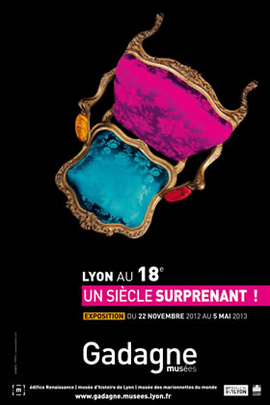 Au 18e siècle, Lyon pense, Lyon imagine, Lyon construit, Lyon s’enrichit…
Au 18e siècle, Lyon est une ville innovante et avant-gardiste au cœur des réseaux commerciaux, financiers et intellectuels. Sensible aux idées des Lumières, riche et commerçante, Lyon connaît une croissance économique exceptionnelle avec le développement de la faïence, des armes et de la soierie, annonçant, notamment, les révolutions industrielles du siècle suivant. La ville est au centre des débats littéraires et philosophiques qui animent la seconde moitié du siècle et un lieu de développement de la franc-maçonnerie. C’est une cité qui imagine la ville de demain avec les ingénieurs et architectes fabuleux que sont Morand, Perrache ou Soufflot. Ces grands projets urbanistiques ont une résonance surprenante avec les grands chantiers de 2012, tels les aménagements du nouveau quartier de Confluence ou la réhabilitation de l’Hôtel-Dieu.
◊ ◊ ◊ ◊ ◊
From Somogy éditions:
Catalogue: Maria-Anne Privat-Savigny, ed., Lyon au 18e: Un Siècle Surprenant (Paris: Somogy éditions d’art, 2012), 312 pages, ISBN: 978-2757205808, 35€.
Ouvrage collectif sous la direction de Maria-Anne Privat-Savigny, le catalogue suit le parcours de l’exposition tout en lui apportant l’analyse de 40 auteurs, chacun spécialiste de son domaine. De l’architecture à l’urbanisme, de la vie religieuse à la vie politique, des enjeux économiques, commerciaux, financiers et bancaires aux préoccupations et débats intellectuels, Lyon apparaît, au 18ème siècle, comme une ville innovante, enthousiaste, pétillante de nouveautés, cultivée, riche, essentielle à l’économie du royaume et au commerce européen, définitivement ouverte sur le monde. Perrache et Morand ont inventé l’urbanisme du siècle suivant, les jésuites ont mis en place le ballet moderne, tandis que la Saône a vu naviguer le premier bateau à vapeur et que des discussions vives et d’une remarquable modernité animent le monde de l’éducation. Lyon est, au siècle des Lumières, définitivement moderne et tournée vers l’avenir.
 ◊ ◊ ◊ ◊ ◊
The programming is extensive, including talks on the following themes:
• Autour de l’exposition
• Rencontres métiers d’art
• La science au siècle des Lumières
• Rousseau à Lyon
At Auction | Important Judaica at Sotheby’s
Press release from Sotheby’s:
Sotheby’s: Important Judaica, N08922
New York, 19 December 2012
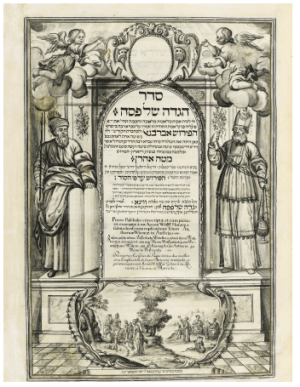
Lot 122 — Aaron Wolff Herlingen, The Herlingen Haggadah, 1730 (Vienna) — est. $800,000/1.2 million
Sotheby’s New York sale of Important Judaica on 19 December 2012 will offer examples of Hebrew ceremonial metalwork, illuminated manuscripts, early printed books, original decorative bindings, and fine art. The auction, which presents works from across the globe, is led by a magnificent Passover Haggadah, written and illustrated by Aaron Wolf Herlingen, from Vienna, 1730 (est. $800,000/1.2 million*).
The sale also includes important paintings by Isidor Kaufmann, a silver section highlighted by a German Hanukah Lamp, and the Kagan-Maremba Coin and Medal Collection that will be sold on behalf of The Jewish Museum (est. $300/500,000). The sale will be exhibited in its entirety in our York Avenue galleries beginning 14 December, alongside the sale of Israeli & International Art.
Undoubtedly the highlight of the Books and Manuscripts section of the sale, The Herlingen Haggadah from 1730 is a magnificent example of the 18th-century revival of Hebrew manuscript illumination that began in Vienna (est. $800,000/1.2 million).
 The scribe and artist of the manuscript is Aaron Wolff Herlingen, one of the finest Jewish calligraphers of the 18th-century renaissance of Hebrew manuscripts, and who became the scribe of the Imperial Library in Vienna in 1736. Herlingen signed his name on the title page of the present work in four languages – Hebrew, Latin, German and French – a conspicuous demonstration of his facility in the multiple languages of the Austrian Empire. The present haggadah is one of Herlingen’s finest efforts and his consummate skill as a scribe is evidenced in the superbly written letters of the text and commentaries. His artistic mastery is demonstrated in the numerous illustrative and decorative elements within the manuscript. The work features three ornamented initial word panels and 60 text illustrations, as well as a detailed manuscript map appended by Herlingen specifically for this volume.
Another highlighted manuscript is an extremely rare and important early Mahzor, France, 13th century. Estimated at $180/240,000, the work contains the liturgy from Yom Kippur, Sukkot and Hanukkah, according to the French rite. Research shows that the present manuscript and a Mahzor for Rosh ha-Shanah currently in the collection of the British Library, were penned by the same scribe and originally constituted a single, larger work. This volume also may well be the most important extant source of the liturgical rite of medieval French Jewry, and includes several customs and traditions that are unknown from any other source.

Lot 119 — Derekh Etz Heim (Path of the Tree of Life), ca. 1700-20, est: $60,000 – 80,000
Additional works on offer feature the first Haggadah printed in America, which contains service for the first two nights of the Passover in Hebrew and English (est. $80/100,000), and an important decorated Esther Scroll in a matching contemporary silver case, circa 1800 (est. $70/90,000). Also included in the sale is Derekh Etz Heim (Path of the Tree of Life), an 18th-century manuscript by Haim Vital of a kabbalistic masterwork (est. $60/80,000). This manuscript is the first part of Haim Vital’s authoritative summary of the kabbalistic teachings of his master, the preeminent kabbalist of 16th-century Safed, Isaac Luria.
The highlight of the silver and metalwork on offer in the December auction is an important German silver-gilt Hanukah Lamp made by Johann Valentin Schüler in Frankfurt, Germany, circa 1690 (est. $300/500,000). The magnificent lamp belongs to a group of seven related examples from late-17th- and early 18th-century Frankfurt, most of which are preserved in museum collections – the example in the Steiglitz Collection at the Israel Museum is closest to the piece on offer. These lamps show the wealth of Frankfurt’s Jewish community, at a time when the city’s ghetto was one of the most densely populated in Europe. The sale also features two fine singleowner groupings, one of which includes a very early German silvergilt Havdalah Compendium, made in Augsburg, circa 1630 (est. $30/50,000). (more…)
Holiday Gift Guide | From The Metropolitan Museum’s Gift Shop
The Metropolitan Museum of Art’s gift shop includes an assortment of items inspired by the museum’s eighteenth-century holdings. I can vouch for only the crocus pot, but it’s fabulous. And through December 2, you can save 25% sitewide with code L182. -CH
◊ ◊ ◊ ◊ ◊
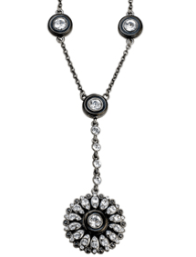 French Neoclassical Button Necklace ($75)
In the collection of The Costume Institute at the Museum is a group of six French buttons made about 1785. These striking buttons are made of silver-mounted, star- shaped strass (a flint glass used to imitate gemstones) interspersed with rich cobalt blue enamel. Their geometric design is in keeping with the Neoclassical style in vogue during the reign of Louis XVI, while their eye-catching sparkle speaks of opulence. Our necklace adapts these stunning buttons in hematite overlay with black hand enameling and Swarovski™ crystals. Hematite overlay, with Swarovski™ crystals. Hand enameled. Lobster claw closure. Adjusts from 17”L to 19”L with extender chain.
Earrings are also available
◊ ◊ ◊ ◊ ◊
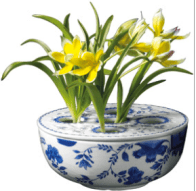 Crocus Pot ($65 / on sale for $32.50)
Made in 1740 in England, the original delftware crocus pot was conceived to cultivate bulbs indoors to brighten gloomy winter days. Although the shape of the bowl is European, the inspiration for the decoration is Chinese—a true depiction of immaculate chinoiserie. Left in the white or decorated in shades of blue or polychrome enamels, delftware was both a useful and a decorative luxury ware for wealthy households. By the middle of the eighteenth century, crocus pots were being used to cultivate flowering bulbs indoors during the winter months. Our reproduction holds bulbs or cut flowers. Porcelain. 8” diameter.
◊ ◊ ◊ ◊ ◊
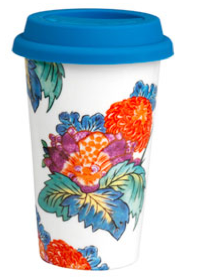 18th-Century German Floral Ceramic Travel Cup ($20 / on sale for $10)
In the collection of the Metropolitan Museum is a large, white, baluster-shaped vase decorated with Kakiemon-style flowers and birds in polychrome and gilt, and an iron-red meander pattern on the neck. This splendid covered vase (Germany, ca. 1725–30), almost two feet high, was made at a German factory, which was the first European manufactory of hard-paste porcelain. Kakiemon is the name given to a distinctive class of Japanese porcelains, which were widely imitated by eighteenth-century European manufacturers. The colorful design on our sturdy ceramic travel cup is adapted from the vibrant floral decorations on the original vase. Ceramic cup. Silicone lid. Microwave and dishwasher safe. 8 oz. 6”H x 3 3/4” diameter.
◊ ◊ ◊ ◊ ◊
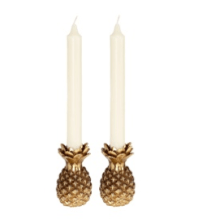 Pineapple Candleholders, Large ($75 / on sale for $37.50)
A charming addition to your holiday table and all year round, these candleholders are adapted from a pair of late eighteenth-century French ormolu finials in the Museum’s collection. Set of 2. 14K gold overlay. Candles not included. 4”H x 2”W.
A smaller set, of four, is also available.
Call for Papers | Sugar and Beyond
From the conference website:
Sugar and Beyond
The John Carter Brown Library, Providence, RI, 25-26 October 2013
Proposals due by 15 December 2012
◊ ◊ ◊ ◊ ◊
Organizers: Christopher P. Iannini (Rutgers), Julie Chun Kim (Fordham), and K. Dian Kriz (Brown)
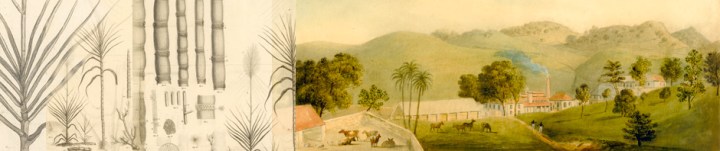
The John Carter Brown Library seeks proposals for a conference entitled Sugar and Beyond, to be held on October 25-26, 2013, and in conjunction with the Library’s Fall 2013 exhibition on sugar in the early modern period, especially its bibliographical and visual legacies. The centrality of sugar to the development of the Atlantic world is now well known. Sugar was the ‘green gold’ that planters across the Americas staked their fortunes on, and it was the commodity that became linked in bittersweet fashion to the rise of the Atlantic slave trade. Producing unprecedented quantities of sugar through their enforced labor, Africans on plantations helped transform life not only in the colonies but also in Europe, where consumers incorporated the luxury commodity into their everyday rituals and routines.
Sugar and Beyond seeks to evaluate the current state of scholarship on sugar, as well as to move beyond it by considering related or alternative consumer cultures and economies. Given its importance, sugar as a topic still pervades scholarship on the Americas and has been treated in many recent works about the Caribbean, Brazil, and other regions. This conference thus aims to serve as an occasion where new directions in the study of sugar can be assessed. At the same time, the connection of sugar to such broader topics as the plantation system, slavery and abolition, consumption and production, food, commodity exchange, natural history, and ecology has pointed the way to related but distinct areas of inquiry.
Although sugar was one of the most profitable crops of the tropical Americas, it was not the only plant being cultivated. Furthermore, although the plantation system dominated the lives of African and other enslaved peoples, they focused much of their efforts at resistance around the search for ways to mitigate or escape the regime of sugar planting. We thus welcome scholars from all disciplines and national traditions interested in exploring both the power and limits of sugar in the early Atlantic world. Topics that papers might consider include but are not limited to the following:
• The development of sugar in comparative context
• The rise of sugar and new conceptions of aesthetics, taste, and cultural refinement
• Atlantic cultures of consumption
• Coffee, cacao, and other non-sugar crops and commodities
• Natural history and related genres of colonial description and promotion
• Imperial botany and scientific programs of agricultural expansion and experimentation
• Alternative ecologies to the sugar plantation
• Plant transfer and cultivation by indigenous and African agents
• Provision grounds and informal marketing
• Economies of subsistence, survival, and resistance
• Reimagining the Caribbean archive beyond sugar: new texts and methodological approaches
In order to be considered for the program, please send a paper proposal of 500 words and CV to jcbsugarandbeyond@gmail.com. The deadline for submitting proposals is December 15, 2012.
Presenters will likely have some travel and accommodation subvention available to them. For more information, consult the conference website or email Margot Nishimura, Deputy Director and Librarian (margot_nishimura@brown.edu).










 Enfilade
leave a comment