Forthcoming | European Painted Cloths, 1400-2000
While most of the papers from this June 2012 Courtauld conference addressed earlier material, there were some eighteenth-century offerings. The collection of essays is due out in June.
◊ ◊ ◊ ◊ ◊
From ACC Distribution:
Christina Young and Nicola Costaras, European Painted Cloths, 1400-2000: Pagentry, Ceremony, Theatre and Domestic (Archetype Publications, 2013), 196 pages, ISBN: 9781904982906, $140.
 The conference papers in this volume explore the use of painted cloths in religious ceremony, pageantry, domestic interiors and scenic art, focussing on their change of context and significance from the fourteenth to the twenty-first centuries and examining their different function, materials, and method of creation. The potential for large sizes, portability, and versatility for religious objects including banners, hangings, altarpieces, and palls was the impetus for the emergence of fabrics as a painting support in Western art in the Middle Ages. The functionality of the works explains the survival of relatively few examples. One of the most common forms of interior decoration for centuries, painted cloths have received less attention from art historians and historians than they deserve in part due to their poor survival. Scenic backcloths were once commissioned for court functions, part of an elaborate display of royal power and magnificence. The same methods and materials continued to be used for theatrical cloths.
New Book | The Cast Gallery of the Ashmolean Museum
Though the Ashmolean’s collection of plaster casts was assembled in the late nineteenth century, some pieces date to the eighteenth century. Anyone interested in the subject should also consult Donna Kurtz, The Reception of Classical Art in Britain: An Oxford Story of Plaster Casts from the Antique (British Archaeological Reports, 2000).
◊ ◊ ◊ ◊ ◊
From ACC Distribution:
R.R.R. Smith and Rune Frederiksen, The Cast Gallery of the Ashmolean Museum: Catalogue of Plaster Casts of Greek and Roman Sculpture (Oxford: Ashmolean Museum, 2013), 360 pages, ISBN: 9781854442666, $30.
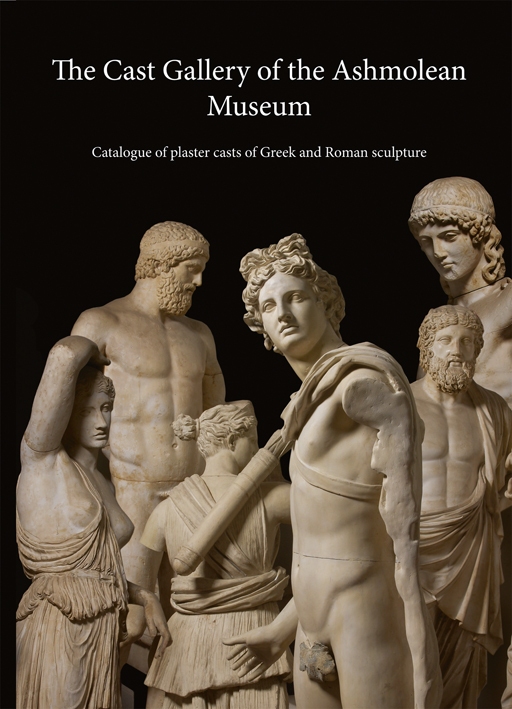 The Cast Gallery of the Ashmolean Museum contains the premier collection of plaster casts of Greek and Roman sculpture in the UK, formed over more than a century, from 1884 to the present. The collection has recently been re-displayed and integrated with the Museum, and this book is its first complete and illustrated catalogue. It presents 1,000 casts of monuments from all over the ancient world, from 600 BC to AD 500, from small bronzes to iconic monuments such as the Laokoon and the Augustus of Prima Porta.
Exhibition | Italian Soup Tureens
Notice of this exhibition at the Hotel Villa Zuccari slipped by me last year, but I see that the catalogue is available from artbooks.com. Eighteenth-century pieces are the minority, but February has me thinking about soup! -CH
◊ ◊ ◊ ◊ ◊
From Good Morning Umbria:
Le Zuppiere dal XVIII al XX Secolo: Collezione Paolo Zuccari
Villa Zuccari, San Luca di Montefalco (Perugia), 22 June — 30 September 2012
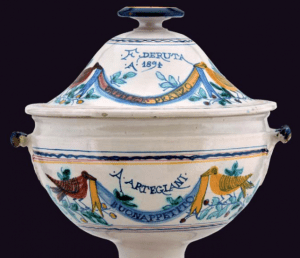 Negli ultimi anni il collezionismo privato ha avuto un notevole sviluppo e gioca un ruolo importante nella nostra cultura e società, in quanto consente di salvaguardare beni di valore artistico, storico e culturale. E’ proprio questo il caso della Collezione di zuppiere di Paolo Zuccari che annovera oltre 500 esemplari alcuni dei quali sono pezzi della fine del ‘700 ed altri –il nucleo principale- dell’800 e del ‘900 di provenienza tutta italiana, dalla Lombardia, all’Emilia Romagna, dalla Toscana all’Umbria alle Marche , agli Abruzzi, dalla Campania al Molise ed alla Puglia. Collezione questa molto originale se si pensa che il collezionista , dopo aver trasformato la sua residenza in un relais a quattro stelle, si è dedicato alla catalogazione di questa sua passione. “Tutti mi chiedono perché, come e quando ho iniziato a collezionare zuppiere.” afferma Paolo Zuccari. “La risposta è semplice, dopo aver vissuto per trenta anni in questa casa, ora Hotel Villa Zuccari, dopo aver sposato Daniela ed avere avuto la prima figlia Federica, ho deciso di andare a vivere a Spoleto dove è nata Lorenza. In occasione di tale trasferimento, per la verità un po’ sofferto, ho portato con me solo poche cose e pochi ricordi della mia casa natale, ma fra queste poche cose c’erano alcune zuppiere. Da queste prime zuppiere, forse per nostalgia, è iniziato il desiderio o la mania di comperarne altre e via via ho iniziato a collezionarle” . Ce ne sono di bellissime e di particolarissime, per esempio la zuppiera realizzata nel 1894 da Angelo Artegiani di Deruta, in cui si legge un cartiglio con l’iscrizione “Buon Appetito” , sicuramente eseguita per qualche ricorrenza speciale. (more…)
Nationalmuseum acquires Miniature Portrait by Adélaïde Labille-Guiard
Press release (February 2013) from the Nationalmuseum in Stockholm:

Adélaïde Labille-Guiard, Madame Lefranc Painting a Portrait of Her Husband Charles Lefranc, watercolour and gouache on ivory, 1779 (Stockholm: Nationalmuseum, NMB 2625) Photo: Bodil Karlsson
The Nationalmuseum has acquired a spectacular miniature by Adélaïde Labille-Guiard. One of the most important women artists in late 18th-century France, she was not previously represented in the museum’s collections. The work is interesting on account of the motif alone, depicting a woman, albeit an amateur, in the role of artist.
Miniature portraits by Adélaïde Labille-Guiard (1749–1803) are extraordinarily rare. Her depiction of Madame Lefranc Painting a Portrait of Her Husband Charles Lefranc was painted five years after she made her debut (1779). Like many other female artists, she realized early on that miniature portraits offered a steady source of income. She was a pupil of the Swiss enamellist François-Élie Vincent, a neighbour of her father’s fashion shop in Paris. Gradually Labille-Guiard also took up working with pastels. She frequently reproduced these works in a smaller format as miniatures. After her election to the French Royal Academy of Art in 1783, she switched over completely to large-scale oil portraits. By then, Labille-Guiard had acquired pupils such as Marie-Gabrielle Capet and Marie-Thérèse de Noireterre. It became their job to translate her portraits into miniature format to satisfy the ever-changing demands of customers.
The acquisition of this spectacular work by Adélaïde Labille-Guiard, made possible by a generous donation from the Hjalmar and Anna Wicander Foundation, has filled a major gap in Nationalmuseum’s world-renowned miniatures collection. Madame Lefranc Painting a Portrait of Her Husband Charles Lefranc also documents a time when women began to emerge as serious artists.
Exhibition | Antoine Watteau: The Music Lesson
From the exhibition press materials:
Antoine Watteau (1684–1721): The Music Lesson
BOZAR (Palais des Beaux-Arts), Brussels, 8 February — 12 May 2013
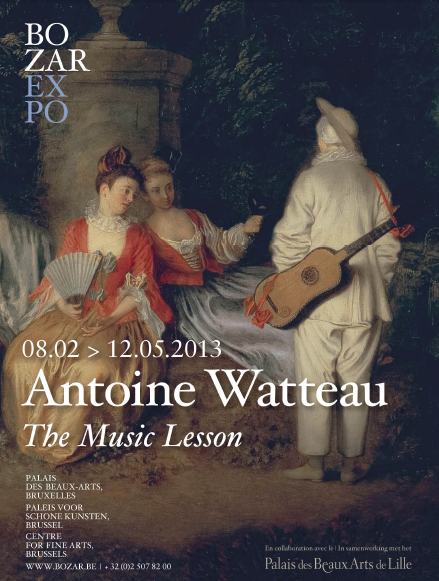 BOZAR EXPO presents, in cooperation with the Palais des Beaux-Arts de Lille, a major interdisciplinary project consisting of an ambitious exhibition, various concerts and debates, devoted to a great French master of the early 18th century, Antoine Watteau, with a particular focus on the musical scenes frequently depicted in the painter’s work. The exhibition’s general curator, the renowned orchestral conductor William Christie, is also at the heart of a cycle of eight concerts that will evoke the sensual atmosphere of Watteau’s canvases.
In the spring of 2013 BOZAR is presenting the first exhibition in Belgium to be devoted to Antoine Watteau (1684–1721). This not only offers an opportunity to see a number of his works; moreover, it sets his pictures to music; it also highlights the correspondence between the arts that was at the heart of his work as an artist. Almost a third of Watteau’s works feature musicians. Born to a humble family, he was a short-lived star of French 18th-century painting, dying at the early age of 37. Despite his short life and limited oeuvre, Watteau’s elegance and
genius left their mark on European art.
Antoine Watteau, father of the fêtes galantes
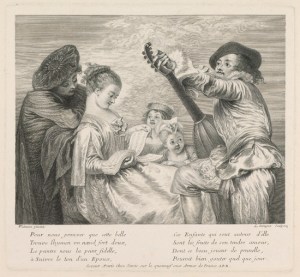
Louis Surugue after Antoine Watteau, The Music Lesson, etching. © Bibliothèque nationale de France
Little is known about his years of training in his native Valenciennes, a town that was open to both Flemish and French influences, as it only became attached to France in 1678. We can, however, be sure of the importance of his master, Claude Gillot (1673–1722). It was through him that Watteau, the “fils du Nord,” discovered Italian painting and the Commedia dell’Arte, which meant so much to him, even though he would never make the journey to Italy.
Watteau passed the bulk of his career in Paris, towards the end of the reign of the Sun King and during the Regency, a period in which the French capital experienced an aesthetic ferment and a renewed commercial enthusiasm for art. It was in that context that, in the 1720s, Watteau became a protégé of Pierre Crozat (1661–1740), one of his great patrons. Crozat helped to bring into being a musical circle in which both Italian and French music were acclaimed. His collection also helped Watteau to find himself as an artist, as he enthusiastically copied drawings it contained by Flemish and Venetian masters (Rubens, Van Dyck, Titian, and Campagnola). Their attention to colour, movement, and sensuality fascinated the young artist, who drew on those qualities to create a new style, less grandiloquent and less formal, imbued with a feigned lightness and an unprecedented elegance.
So there is nothing fortuitous about the presence of other disciplines – theatre, dance, and music, in particular – in Watteau’s paintings. They are very much present in the figures depicted in the fêtes galantes, whose language he invented: scenes of intimacy, conversation, and music set in an enclosed natural setting in which the human condition plays with appearances. Are we looking at aristocrats who have put on the costumes of actors or at theatrical scenes reconstructed in a bucolic setting? Watteau explores, as no one had done before him, a free combination of theatrical characters, whom he places away from the stage, somewhere between life and playing a role. Music is never far away in these fêtes galantes. The titles of works such as La Leçon de musique, Le Concert amoureux, and L’Accord parfait are highly evocative in this context.

Antoine Watteau, L’Enchanteur Huile sur cuivre (Troyes: Musée
des Beaux-Arts) © RMN-Grand Palais – © Jean Schormans
Antoine Watteau (1684–1721): The Music Lesson
The exhibition, which has a particular focus on the musical aspect of Watteau’s painting, brings together a unique selection of fifteen of the artist’s canvases and thirty of his drawings, some of which have not been seen by the European public for more than 50 years. It also presents fifty engravings by his contemporaries, including François Boucher, Benoît Audran II, and Charles-Nicolas Cochin, who produced the finest engravings of the 18th century and spread Watteau’s art throughout Europe. Thanks to them, we have reproductions of paintings of his that have since been lost and it is possible to offer an almost complete overview of his work. This unprecedented combination of original paintings, drawings, and engravings, as well as archival material, scores, and musical instruments of the same period, is a first. The exhibition itinerary is organised chronologically and thematically. The visitor first discovers the silent dimension of Watteau’s art and is thus better placed to appreciate its various musical tones later in the exhibition. The aesthetic experience is heightened as the visitor is immersed in the music of the time thanks to the audioguides and several listening points throughout the exhibition circuit. A special room is set aside for free concerts given by students of various Belgian and French conservatories on Thursday evenings. The intervention by Dirk Braeckman, leading Belgian photographer with an international reputation, establishes connections between Watteau’s work and contemporary art.
For additional information, including lenders, room texts, and programming details, see the 28-page press booklet (PDF).
◊ ◊ ◊ ◊ ◊
Note (added 20 March 2013): The catalogue is available through Artbooks.com:
Florence Raymond, ed., Antoine Watteau (1684-1721): La leçon de musique (Paris: Skira Flammarion, 2013), 272 pages, ISBN: 978-2081295834, $87.50.
Call for Papers | Money, Power, and Print, 1688-1776
Money, Power, and Print
The Leuven Institute for Ireland in Europe, Leuven, 12-14 June 2014
Proposals due by 15 June 2013
This colloquium, the sixth in a biennial series and the first to be held in Belgium, offers an opportunity for scholars from a variety of disciplines to enrich their mutual understanding of the intersections between public finance, politics and print during Britain’s ‘financial revolution’. The term ‘Britain’ is used loosely to refer to all constituent parts of the United Kingdom and also to Ireland and the colonies.
The organizers invite proposals for papers that will build on the three papers already contributed and the two contemporary publications they have chosen for discussion in an opening-day session. Ideally, submissions should develop ideas in, or comment upon issues raised by, one or more of the papers or readings already included in the program. Abstracts of the organizers’ three papers are printed below.
The contemporary publications to be discussed are:
1) Benjamin Franklin, A Modest Enquiry into the Nature and Necessity of a Paper-Currency. Philadelphia, 1729. Reprinted in Leonard W. Labaree, ed., The Papers of Benjamin Franklin, Vol. 1 (New Haven, CT: Yale University Press, 1959), vol. 1, pp. 139-157.
2) Dr. William Douglass, A Discourse Concerning the Currencies of the British Plantations in America. Boston, 1740. Reprinted in Andrew McFarland Davis, ed., Colonial Currency Reprints, 1682-1751, Vol. III (New York: Augustus M. Kelly, 1964), vol. 3, pp. 305-363.
Proposals are welcome in any of four general areas: (more…)
New Book | A History of Eighteenth-Century German Porcelain
From ACC Distribution:
Christina Nelson with Letitia Roberts, A History of Eighteenth-Century German Porcelain: The Warda Stevens Stout Collection (Hudson Hills Press, 2013), 568 pages, ISBN: 978-1555953881, $95.
 A History of Eighteenth-Century German Porcelain is a descriptive catalog of the remarkable holdings of the Dixon Gallery and Gardens in Memphis—holdings donated by Warda Stevens Stout and considered to be among the most important in the world. The book is one of the first in English to describe in captivating detail the artisans, aesthetics, social and political intrigue, financial arrangements, and courtly ambitions that resided in porcelain factories at Ansbach, Frankenthal, Fürstenberg, Höchst, Ludwigs-burg, Meissen, Nymphenburg, and Thüringen.
Contents: Foreword – Kevin Sharp; Acknowledgments – Christina Nelson; The Collector Warda Stevens Stout – Letitia Roberts; A History of Eighteenth-Century German Porcelain – Christina Nelson; Introduction; Meissen; Ansbach; Berlin; Frankenthal; Fürstenberg; Fulda; Höchst; Ludwigsburg; Nymphenburg; Thuringia; Overview – Closter Veilsdorf; Gotha; Limbach; Volkstedt; Vienna; Selected List of German Porcelain from The Warda Stevens Stout Collection; Bibliography.
Christina H. Nelson is an independent scholar based in Champaign, Illinois. She has been a curator at Greenfield Village and the Henry Ford Museum in Deerfield, Michigan, the Saint Louis Art Museum, and the Nelson-Atkins Museum of Art in Kansas City. She is the author of numerous catalogues, articles, and reviews.
Letitia Roberts is an independent scholar and consultant based in New York City. She was a department head at Sotheby’s for many years and has been a member, director and former president of the American Ceramics Circle. She has written extensively on American and European ceramics.
Exhibition | Redouté’s Roses
If today has you thinking about roses . . . Thanks to Hélène Bremer for noting this exhibition at the Teyler’s Museum:
Redouté’s Roses
Teylers Museum, Haarlem, 19 January — 5 May 2013
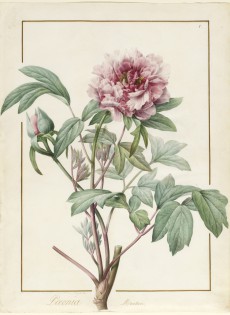 Pierre-Joseph Redouté (1759-1840) is the greatest botanical artist of all time. His drawings and watercolours of flowers and plants are unsurpassed in both scientific precision and beauty. Redouté assuredly earned his nicknames, ‘the Raphael of flowers’ and ‘the Rembrandt of Roses’. Redouté started drawing flowers in Paris’s Jardin des Plantes at the end of the eighteenth century, when European scholarship was in the throes of a real mania for botany. He provided illustrations of rare and exotic plants for books published by prominent scientists. These drawings made him so famous that he was able to publish two masterpieces of printing under his own name: Les Liliacées and Les Roses. Redoubté also gained royal recognition from none other than Queen Marie-Antoinette, and later from Empress Joséphine, Napoleon’s wife. No one could equal Redouté’s pictures of their opulent gardens with their glorious profusion of blooms. This exhibition is the first in the Netherlands to provide a variegated overview of
his work, with, at its heart, the beautiful books that the Teylers Museum
purchased immediately after their publication.
Exhibition | Life and Death in Pompeii and Herculaneum
If today has you thinking about ashes . . . The exhibition includes, incidentally, an exceptional bit of programming: the first live cinema event ever produced by a museum, offering an exclusive private view of the major exhibition on the 18 and 19 of June:
The British Museum will stage two unique live broadcasts to cinema audiences across the UK and Ireland with a special offer to school groups. Introduced by British Museum director Neil MacGregor this event will use a line-up of expert presenters to create a one-off experience including contributions from historian Mary Beard, Rachel de Thame revealing life in the garden, Giorgio Locatelli in the kitchen and Bettany Hughes in the bedroom. . .
◊ ◊ ◊ ◊ ◊
Press release from the British Museum:
Life and Death in Pompeii and Herculaneum
British Museum, London, 28 March — 29 September 2013
 In Spring 2013 the British Museum will present a major exhibition on the Roman cities of Pompeii and Herculaneum, sponsored by Goldman Sachs. This exhibition will be the first ever held on these important cities at the British Museum, and the first such major exhibition in London for almost 40 years. It is the result of close collaboration with the Archaeological Superintendency of Naples and Pompeii, will bring together over 250 fascinating objects, both recent discoveries and celebrated finds from earlier excavations. Many of these objects have never before been seen outside Italy. The exhibition will have a unique focus, looking at the Roman home and the people who lived in these ill-fated cities.
Neil MacGregor, director of the British Museum said “This will be a major exhibition for the British Museum in 2013, made possible through collaboration with the Archaeological Superintendency of Naples and Pompeii which has meant extremely generous loans of precious objects from their collections, some that have never travelled before. I am delighted that Goldman Sachs is sponsoring this important exhibition and am extremely grateful to them for their support.”
“It is a privilege to be partnering with the British Museum for this incredibly exciting exhibition, which offers a fascinating insight into daily life at the heart of the Roman Empire”, said Richard Gnodde, Co Chief executive of Goldman Sachs International. “We recognize the importance of supporting cultural platforms such as this and we are delighted to offer our support to help bring this unique experience to London.”
Pompeii and Herculaneum, two cities on the Bay of Naples in southern Italy, were buried by a catastrophic volcanic eruption of Mount Vesuvius in just 24 hours in AD 79. This event ended the life of the cities but at the same time preserved them until rediscovery by archaeologists nearly 1700 years later. The excavation of these cities has given us unparallelled insight into Roman life.
Owing to their different locations Pompeii and Herculaneum were buried in different ways and this has affected the preservation of materials at each site. Herculaneum was a small seaside town whereas Pompeii was the industrial hub of the region. Work continues at both sites and recent excavations at Herculaneum have uncovered beautiful and fascinating artefacts. These include treasures many of which will be displayed to the public for the first time, such as finely sculpted marble reliefs, intricately carved ivory panels and fascinating objects found in one of the main drains of the city.
 The exhibition will give visitors a taste of the daily life of the people of Pompeii and Herculaneum, from the bustling street to the family home. The domestic space is the essential context for people’s lives, and allows us to get closer to the Romans themselves. This exhibition will explore the lives of individuals in Roman society, not the classic figures of films and television, such as emperors, gladiators and legionaries, but businessmen, powerful women, freed slaves and children. One stunning example of this material is a beautiful wall painting from Pompeii showing the baker Terentius Neo and his wife, holding writing materials showing they are literate and cultured. Importantly their pose and presentation suggests they are equal partners, in business and in life.
The emphasis on a domestic context also helps transform museum artefacts into everyday possessions. Six pieces of wooden furniture will be lent from Herculaneum in an unprecedented loan by the Archaeological Superintendency of Napels and Pompeii. These items were carbonized by the high temperatures of the ash that engulfed the city and are extremely rare finds that would not have survived at Pompeii – showing the importance of combining evidence from the two cities. The furniture includes a linen chest, an inlaid stool and even a garden bench. Perhaps the most astonishing and moving piece is a baby’s crib that still rocks on its curved runners.
The exhibition will include casts from in and around Pompeii of some of the victims of the eruption. A family of two adults and their two children are huddled together, just as in their last moments under the stairs of their villa. The most famous of the casts on display is of a dog, fixed forever at the moment of its death as the volcano submerged the cities.
Follow updates on the exhibition via Twitter on #PompeiiExhibition and the Museum’s Twitter account @britishmuseum.
◊ ◊ ◊ ◊ ◊
Paul Roberts, Life and Death in Pompeii and Herculaneum (New York: Oxford University Press, 2013), 320 pages, ISBN: 978-0199987436, £16 / $45.
Happy Mardi Gras
If today has you thinking about food and drink . . .
From the University of Chicago Press:
E. C. Spary, Eating the Enlightenment: Food and the Sciences in Paris, 1670-1760 (Chicago: University of Chicago Press, 2012), 368 pages, ISBN: 978-0226768861, $45.
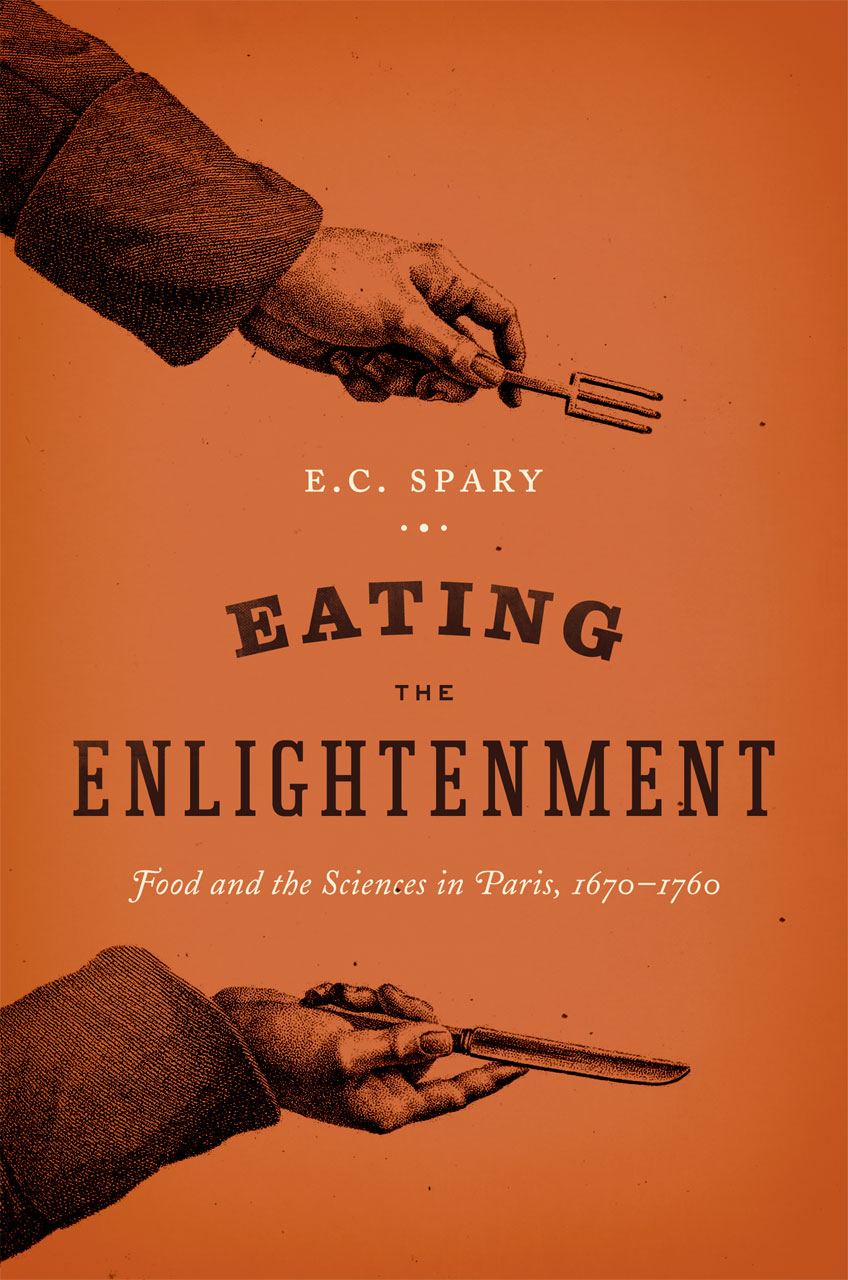 Eating the Enlightenment offers a new perspective on the history of food, looking at writings about cuisine, diet, and food chemistry as a key to larger debates over the state of the nation in Old Regime France. Embracing a wide range of authors and scientific or medical practitioners—from physicians and poets to philosophes and playwrights—E. C. Spary demonstrates how public discussions of eating and drinking were used to articulate concerns about the state of civilization versus that of nature, about the effects of consumption upon the identities of individuals and nations, and about the proper form and practice of scholarship. En route, Spary devotes extensive attention to the manufacture, trade, and eating of foods, focusing upon coffee and liqueurs in particular, and also considers controversies over specific issues such as the chemistry of digestion and the nature of alcohol. Familiar figures such as Fontenelle, Diderot, and Rousseau appear alongside little-known individuals from the margins of the world of letters: the draughts-playing café owner Charles Manoury, the “Turkish envoy” Soliman Aga, and the natural philosopher Jacques Gautier d’Agoty. Equally entertaining and enlightening, Eating the Enlightenment will be an original contribution to discussions of the dissemination of knowledge and the nature of scientific authority.
◊ ◊ ◊ ◊ ◊
From ACC Distribution:
Robin Butler with Noel Riley, Great British Wine Accessories, 1550-1900 (Brown & Brown Books, 2013), 288 pages, ISBN: 978-0956349804, £65 / $125.
 Great British Wine Accessories 1550-1900 covers all domestic wine accessories from corkscrews and bin labels to coasters and decanters – and so much more besides during the period of its title. While there are monographs on decanters, corkscrews and other disciplines within the subject, this book not only gives a good overview of these areas, but also sets the whole subject in context. The easy style of writing belies the in-depth knowledge imparted within this book.
Contents: Bottles; Bin Labels; Corkscrews; Tasters; Coolers and Cisterns; Wine Funnels; Decanters and Carafes; Wine Jugs; Wine Labels; Coasters and Decanter Trolleys; Glasses Goblets & Cups Misc; Fakes & Problems.
Robin Butler has been an antiques dealer and lecturer since 1963. This is his fourth book, following The Arthur Negus Guide to English Furniture (1976), The Book of Wine Antiques (1986), and The Albert Collection (2009). Robin has made antique wine accessories a separate subject within the antiques world, following his exhibition in 1978 as part of the BADA 60 festival of exhibitions. His Internet business, Butler’s Antiques solely deals in antique wine accessories.










 Enfilade
leave a comment