Fellowships | University of Sydney Postdoctoral Fellowships
The 2014 University of Sydney Research Fellowship Scheme is now open.
The University of Sydney Postdoctoral Fellowships were established in 1996 to support excellence in full-time research undertaken in the University. The Fellowships are extremely prestigious and highly competitive internationally in line with equivalent externally funded fellowships. They are intended to support early career researchers. Applicants must have an outstanding track record relative to opportunity in order to be short-listed. Successful applicants are expected to be based full-time at the University for the duration of the Fellowship, which is for a maximum period of three years.
There is an Expression of Interest process for intending applicants within the humanities and social sciences with a deadline of Friday 3 May (the EoI form is available on the above webpage). For those applicants who progress beyond the EoI stage, the closing date for full applications is Friday 31 May.
This year we would like to make a special effort to recruit exceptional applicants in Art History, among other fields. As a guide, most applicants who progress to the stage of submitting a full application are onto their second book project and/or have a series of articles around a specific research area. This is often an applicant’s second postdoc, although that is not expected. All applicants must have received their PhD between 1 Jan 2008 and 31 Dec 2012.
Kind regards,
Jennifer
______________________________________
JENNIFER MILAM | Professor of Art History
Pro Dean Research | Faculty of Arts and Social Sciences
Call for Papers | HECAA Session at UAAC
Thanks to Christina Smylitopoulos, HECAA will be represented at this year’s UAAC Conference! Details and a full list of panels are available here»
◊ ◊ ◊ ◊ ◊
Universities Art Association of Canada / l’association d’art des universités du Canada
The Banff Centre, Banff, Alberta, 17-20 October 2013
Proposals due by 4 June 2013
HECAA Open Session (Historians of Eighteenth-Century Art and Architecture)
As the first HECAA-spsonored UAAC panel, this open session welcomes proposals for papers that consider any aspect of art and visual culture of the eighteenth-century. Please email proposals for 20-minute papers to Prof. Christina Smylitopoulos: csmylito@uoguelph.ca.
Call for Panel Proposals | ASECS 2014, Williamsburg
Exhibition | Time and Navigation
Press release (10 April 2013) for a new permanent exhibition at the National Air and Space Museum:
Time and Navigation: The Untold Story of Getting from Here to There
Smithsonian National Air and Space Museum, Washington, D.C., opening 12 April 2013
Curated by Paul Ceruzzi, Roger Connor, Andrew Johnston, and Carlene Stephens

Bond Chronometer, 1812. This was the first American-made marine timekeeper taken to sea. William Cranch Bond, a 23-year-old Boston clockmaker, crafted it during the War of 1812 (Smithsonian, National Museum of American History)
If people want to know where they are, they need a reliable clock. It might seem surprising, but knowing the accurate time is essential for determining position. A major exhibition opening April 12, Time and Navigation: The Untold Story of Getting from Here to There, explores how revolutions in timekeeping over three centuries have influenced how people find their way. This project is a unique collaboration between two of the Smithsonian’s largest and most popular museums: the National Air and Space Museum and the National Museum of American History.
“Time and Navigation is an ambitious exhibit because it traces the development of very complicated technologies and makes us think about a subject we now take for granted,” said Gen. J.R. “Jack” Dailey, director of the museum. “Today, the technology needed to accurately navigate is integrated into mobile computers and phones: hundreds of years of technological heritage tell your handheld device where you are in a seamless manner. This opens up new possibilities and challenging questions for the next generation of scientists and explorers who visit this exhibit to start thinking about.”
The gallery is organized into five sections and spans three centuries of efforts to travel on Earth and through the solar system. In each section the visitor will learn about pioneer navigators facing myriad issues, but one challenge always stands out: the need to know accurate time.
Navigating at Sea is an immersive environment that suggests a walk through a 19th-century sailing vessel. Visitors will learn how centuries ago navigators at sea relied on chronometers and measurements of celestial objects to determine location. This section includes a mariner’s astrolabe, dating from 1602; a Ramsden sextant and dividing engine; several chronometers; a model of Galileo’s pendulum clock, as well as the earliest sea-going marine chronometer made in the United States, produced by Bostonian William Cranch Bond during the War of 1812. It also features an interactive display that allows visitors to use a sextant to navigate with the stars. (more…)
Call for Papers | 2014 Society of Architectural Historians, Austin
From SAH:
Annual Conference of the Society of Architectural Historians
Austin, Texas, 9-13 April 2014
Proposals due by 1 June 2013
 The Society of Architectural Historians is now accepting abstracts for its 67th Annual Conference in Austin, TX, April 9-13, 2014. Please submit abstracts no later than June 1st for one of the 30 thematic sessions or open sessions. Sessions have been selected to cover topics across all time periods and architectural styles. SAH encourages submissions from architectural, landscape, and urban historians; museum curators; preservationists; independent scholars; architects; and members of partner organizations. (more…)
Symposium | Georges Hoentschel in Context
Although I noted back in February this BGC exhibition, Salvaging the Past: Georges Hoentschel and French Decorative Arts, I didn’t include any programming details. My apologies for the short notice; it’s an exciting slate of talks! -CH
◊ ◊ ◊ ◊ ◊
From the BGC:
Symposium: Georges Hoentschel in Context
Bard Graduate Center, New York, 18-19 April 2013
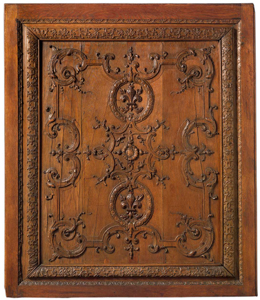
Panel from the shutters formerly in the Chapel at Versailles, carved by Jules Degoullons and associates after designs by Robert de Cotte, ca. 1710
Carved oak, originally painted and gilded
The Metropolitan Museum of Art, Gift of J. Pierpont Morgan, 1906 (07.225.145b)
Organized in conjunction with the exhibition Salvaging the Past: Georges Hoentschel and French Decorative Arts from The Metropolitan Museum of Art, on view at the Bard Graduate Center Gallery from April 4 through August 11, 2013, this international symposium brings together scholars and conservators to examine the Hoentschel collection in the context of the history of collecting in France and America. In April 1906, the celebrated Parisian decorator Georges Hoentschel (1855-1915) sold his French eighteenth-century panelling, seat furniture, painted overdoors, assorted objects, and medieval art to the powerful New York financier and collector J. Pierpont Morgan (1837-1913). Morgan, then president of The Metropolitan Museum of Art, presented the eighteenth-century objects immediately to the Museum but initially only offered to lend the earlier artworks. These were later donated by his son Jack Morgan in 1916. Hoentschel was also involved in the contemporary art world of his day, designing an Art Nouveau pavilion for the Universal Exposition in Paris in 1900, as well as intriguing stoneware vessels. The Hoentschel material constitutes one of the most significant collections from the early period of The Metropolitan Museum of Art. The exhibition at the Bard Graduate Center presents an unprecedented opportunity to explore its important role in disseminating the taste for eighteenth-century and Medieval French art in the United States.
◊ ◊ ◊ ◊ ◊
T H U R S D A Y , 1 8 A P R I L 2 0 1 3
Flaminia Gennari-Santori (Consulting Curator, Vizcaya Museum and Gardens, Miami, Florida) — ’There Was Money in the Air’: John Pierpont Morgan and the European Collecting Tradition
Light refreshments will be served at 5:45 pm. The presentation will begin at 6:00 pm. RSVP is required. To reserve you place at Thursday’s evening session, please click on the registration link at the bottom of this page or contact academicevents@bgc.bard.edu. Please note that a separate RSVP is required for the all-day session on Friday, April 19, 2013. Also note that our Lecture Hall can only accommodate a limited number of people, so please come early if you would like to have a seat in the main room. Registrants who arrive late will be seated in an overflow viewing area.
F R I D A Y , 1 9 A P R I L 2 0 1 3
9:30-5:00
Thomas Stammers (Lecturer in the Cultural History of Modern Europe, University of Durham), “Reinventing the Old Regime: Collectors and Scavengers in Nineteenth-Century Paris”
Anne Forray-Carlier (Chief Curator, Department of 17th and 18th Centuries, Musée des Arts Décoratifs), “Émile Peyre: The Unknown Collector”
Evelyne Possémé (Chief Curator, Department of Art Nouveau, Art Déco, and Jewelry, Musée des Arts Décoratifs), “Hoentschel’s Pavilion for the Exposition Universelle of 1900, Then and Now”
Charlotte Vignon (Associate Curator of Decorative Arts, The Frick Collection), “French Style in Early Twentieth-Century America: The Roles of Art Dealers and Interior Decorators”
Vincent Bouvet (Head of the Publication Department, École Nationale Supérieure des Arts Décoratifs, Paris), “Hoentschel and his Contemporaries: Parisian Interior Design Firms (1880-1920)”
Christina Hagelskamp, Mecka Baumeister, Nancy Britton, Beth Edelstein, and Pascale Patris (Sherman Fairchild Center for Objects Conservation, The Metropolitan Museum of Art), “The Conservator’s Perspective: Case Studies from the Furniture and Furnishings in the Hoentschel Collection”
Moderator of Morning Session, Deborah L. Krohn (Bard Graduate Center)
Moderator of Afternoon Session, Daniëlle Kisluk-Grosheide (Curator of European Sculpture and Decorative Arts, The Metropolitan Museum of Art)
Friday’s Afternoon Session will end with a panel discussion featuring the speakers and moderators.
RSVP is required. To reserve you place at Friday’s all-day session, please click on the registration link or contact academicevents@bgc.bard.edu. Please note that our Lecture Hall can only accommodate a limited number of people, so please come early if you would like to have a seat in the main room. Registrants who arrive late will be seated in an overflow viewing area.
Visiting the Anna Maria Garthwaite House, Spitalfields
I earlier noted the Huguenots of Spitalfields Festival taking place now in London (8-21 April), but Alicia Weisberg-Roberts usefully draws our attention to this gem, the Anna Maria Garthwaite House, by Christ Church, which will be open for visits on Tuesday, 16 April, in conjunction with the festival (the celebration is occasioned by the 250th anniversary of Garthwaite’s death). Photographs of the interior are available at Spitalfields Life, an amazing blog generally. For details and tickets see the Huguenots of Spitalfields Festival.
◊ ◊ ◊ ◊ ◊
From Spitalfields Life:
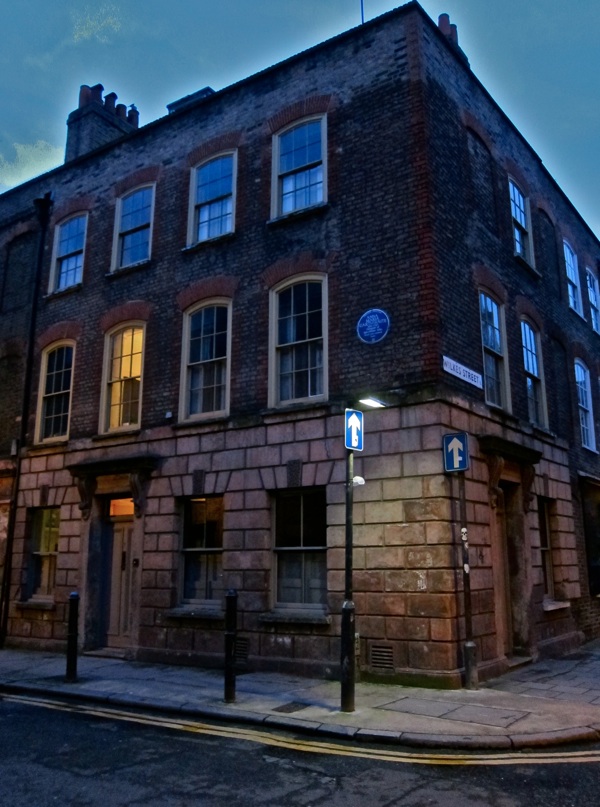 Anna Maria Garthwaite, the most celebrated texile designer of the eighteenth century, bought this house in Spitalfields when she was forty years old in 1728, just five years after it was built. Its purchase reflected the success she had already achieved but, living here at the very heart of the silk industry, she produced over one thousand patterns for damasks and brocades during the next thirty-five years.
The first owner of the house was a glover who used the ground floor as a shop with customers entering through the door upon the right, while the door on the left gave access to the rooms above where the family lived. For Anna Maria Garthwaite, the ground floor may also have been used to receive clients who would be led up to the first floor where commissions could be discussed and deals done. The corner room on the second floor receives the best light, uninterrupted by the surrounding buildings, and this is likely to have been the workroom, most suited to the creation of her superlative designs painted in watercolours – of which nearly nine hundred
are preserved today at the Victoria & Albert Museum. . . .
Keep reading here»
Conference | Lust und Last der Antike: Antikenrezeption in der Skulptur
Lust und Last der Antike: Antikenrezeption in der Skulptur von Bernini bis Canova
Bibliotheca Hertziana, Max-Planck-Institut für Kunstgeschichte, Rome, 3-4 May 2013
Programm und Organisation: Carina Bauriegel und Anna Sophie Rath
Villino Stroganoff, Via Gregoriana 22
In der Frührenaissance wird das Interesse der Bildhauer für die römischen Antiken neu geweckt. Durch Nachzeichnungen und Stichwerke wird das antike Erbe sukzessive erschlossen und konstituiert einen Kanon, der die Entwicklung der Skulptur nachhaltig prägt. Noch 1730 verweist Lione Pascoli in der Vita des Camillo Rusconi auf die Korrektivfunktion der antiken Vorbilder, deren Aufgabe es sei, die »vivezza, l’espressività, e la bizzaria de’ moderni« zu filtern und zu strukturieren.
Seit Mitte des 18. Jahrhunderts grenzen sich die Bildhauer bewusst von ihren Vorgängern und deren Umgang mit dem antiken Erbe ab. Kritik üben Johann Joachim Winckelmann mit seinem Urteil über Gianlorenzo Berninis Stil als »verderbten Geschmack« sowie Quatremère de Quincy in seiner Warnung an Antonio Canova, falschen Vorbildern zu folgen und ein »Bernini à l‘antique« zu werden.
Dennoch ist die Skulptur beider Epochen untrennbar durch die Rezeption der Antike miteinander verbunden. Bis Mitte des 19. Jahrhunderts bleibt der im Seicento aufgestellte Kanon von Laokoon, Antinoos, Apoll von Belvedere über die Venus Medici bis zu den Philosophen- und Kaiserbildnissen gültig. Lediglich die ästhetischen und wissenschaftlichen Ansprüche an die Skulptur verändern sich, wie exemplarisch an der Rezeption des Apoll von Belvedere bei Bernini, Rusconi und Canova deutlich wird.
Einen kritischen Gegenpart zu den Künstlern bilden Autoren wie Gian Pietro Bellori, Giovanni Battista Passeri, Winckelmann und Carl Ludwig Fernow. Diese beurteilen unter anderem, wie nah die Bildhauer dem antiken Ideal hinsichtlich Invention, Komposition und Originalität kommen oder dieses sogar übertreffen. Dabei werden bewusst Dichotomien mit Blick auf die Qualität der Antikenrezeption einzelner Künstler eingeführt, wie Bernini/Algardi oder Canova/Thorvaldsen. Dies spiegelt sich auch in der Querelle des Anciens et des Modernes wider, die durch den gleichnamigen Vortrag Charles Perraults an der Académie Royale in Paris 1687 erneut aufflammt und bis Mitte des 19. Jahrhunderts im Zentrum der Kunstgeschichtsschreibung steht. Im Rahmen eines Studientages soll epochenübergreifend über den Umgang mit der Antike in der italienischen Skulptur und deren Rezeption in der zeitgenössischen Kunstliteratur reflektiert werden.
◊ ◊ ◊ ◊ ◊
F R E I T A G , 3 M A I 2 0 1 3
10:00 Museo Gregoriano Profano (Viale Vaticano) — Besichtigung (fakultativ)
14:00 ELISABETH KIEVEN (Bibliotheca Hertziana, Max-Planck-Institut für Kunstgeschichte, Rom), Begrüßung
14:10 ANNA SOPHIE RATH und CARINA BAURIEGEL (Bibliotheca Hertziana, Max-Planck-Institut für Kunstgeschichte, Rom), Einführung
TRANSFORMATION, Moderation: ELISABETH KIEVEN
14:30 BJÖRN STATNIK (Universität Würzburg), Winckelmanns „großer Bernini“. Die griechisch-antikischen Kunstideale Winckelmanns und Berninis bildhauerisches Frühwerk
15:10 CARINA BAURIEGEL (Bibliotheca Hertziana, Max-Planck-Institut für Kunstgeschichte, Rom), „A perfezione come gl’originali“. Antikenkopie bei Massimiliano Soldani Benzi
Kaffeepause
16:30 REGINA DECKERS (Bibliotheca Hertziana, Max-Planck-Institut für Kunstgeschichte, Rom), Venezianità, Spätbarock oder Früh-klassizismus? Stilbildung in der venezianischen Skulptur des Settecento
17:10 FABIEN BENUZZI (Università Ca’ Foscari, Venedig), Alle radici di Canova. Il recupero dell’antico nella scultura Veneziana del Settecento
17:50 JOHANNES MYSSOK (Kunstakademie Düsseldorf), „Un Bernin antique“. L’imitazione paradossale dell’antico di Antonio Canova
FESTVORTRAG
19:00 SEBASTIAN SCHÜTZE (Universität Wien), Gli scultori e il discorso di antichi e moderni. Testimonianze letterarie, argomenti visivi e qualche osserva-zione di metodo
S A M S T A G , 4 M A I 2 0 1 3
INSTRUKTION UND EXPOSITION, Moderation: GIOVANNA CAPITELLI (Università della Calabria)
9:00 ANGELA CIPRIANI (Accademia di San Luca, Roma), Dalla citazione all’invenzione. Il mutare della percezione dell’antico nei bassorilievi dei concorsi accademici
9:40 CHIARA GAUNA (Università di Torino), La difficile libertà dell’antico all’Accademie de France
10:20 CRISTIANO GIOMETTI (Università di Firenze), Nel solco dell’Accademia. Studio e pratica dell’antico nella scultura romana di primo Settecento
Kaffeepause
11:30 MARIO GUDERZO (Gipsoteca Canoviana, Possagno), Dal Fauno Barberini all’Endimione dormiente. Canova e l’antico
12:10 ELENA GRANUZZO (Università di Verona), Antonio Canova – Leopoldo Cicognara. Dialogo sull’antico
Mittagspause
INSPIRATION Moderation: SEBASTIAN SCHÜTZE
15:00 MALCOM BAKER (University of California, Riverside), Both British and Antique? Perceiving Difference in Portrait Busts by British Sculptors Working in Italy around 1760
15:40 STEFANO GRANDESSO (Rom), L’antico e i soggetti di genere nella scultura classicista. Da Ridolfo Schadow e Thorvaldsen ai pensionnaires francesi
16:20 ANNA SOPHIE RATH (Bibliotheca Hertziana, Max-Planck-Institut für Kunstgeschichte, Rom), Vice and Virtue. La visione dell’antico di John Gibson
17:00 Zusammenfassung und Schlussdiskussion
New Book | Paris 1650-1900: Decorative Arts in the Rijksmuseum
With the Rijksmuseum open once again, this book is especially timely. It’s due out in May from Yale UP:
Reinier Baarsen, Paris 1650-1900: Decorative Arts in the Rijksmuseum (New Haven: Yale University Press, 2013), 608 pages, ISBN: 978-0300191295, $275.
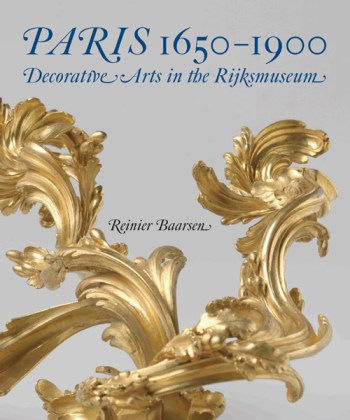 From 1650 to 1900 Paris was the undisputed center of fashion and taste in Europe. Home to a unique concentration of artists, designers, patrons, critics, and a keen buying public, Paris was the city where trends were made and where novel types of objects, devised for new ways of life, were invented. This book traces the wonderful story of Parisian decorative arts from the reign of Louis XIV to the triumph of art nouveau, through a selection of 150 breathtaking, and often little-known, masterpieces from the collection of the Rijksmuseum in Amsterdam. It features an exhilarating mixture of furniture, gilt bronze, tapestries, silver, watches, snuff-boxes, jewellery, Sèvres porcelain, and other ceramics, as well as some design drawings and engravings. Specially taken photographs reveal the daring design and beautiful execution of the work of some of the greatest artists and craftsmen of their time. Reinier Baarsen discusses the history and significance of each object, presenting the findings of much new research.
Reinier Baarsen is senior curator of furniture at the
Rijksmuseum.
Christie’s Object Lessons: Flower Holders of the 18th Century
As we transition from still to moving images, it’s interesting to see people (and institutions) exploring possibilities — in this case for educational and marketing purposes. Note the inclusion of music behind the narration of Jody Wilkie, a ceramics specialist at Christie’s and a regular appraiser on Antiques Roadshow. Does the music enhance or detract? I can report, from first-hand experience, that art historians working on similar projects are debating precisely this question. Do your lectures and articles come with soundtracks — either real or imagined? -CH
◊ ◊ ◊ ◊ ◊
From Christie’s Object Lessons series:










 Enfilade
leave a comment