Non-Stipendiary Research Fellowships at BGC
Non-Stipendiary Research Fellowships, 2013-14
The Bard Graduate Center, New York
Applications due by 15 May 2013
The Bard Graduate Center invites applications for up to four non-stipendiary research fellowships lasting from 3 to 9 months. Since its founding in 1993, the Bard Graduate Center has aimed to become the leading institute for study of the cultural history of the material world through its MA and PhD programs, scholarly exhibitions, and publications, seminars, and symposia. Its activities draw on methodologies and approaches from art, architecture and design history, economic and cultural history, history of technology, philosophy, anthropology, and archaeology. Fellowships are for researchers working in these and allied areas. We provide office space, and rental accommodation may be available at Bard Hall. Visiting scholars are expected to participate in the public intellectual life of the BGC, and to give one more talks on their current work The Research Fellow may take up residence at any point after 15 August 2013.
Applications should include a statement of interest, curriculum vitae, sample publication (SASE), and a list of three references, and should be sent by 15 May 2013 to Dean Elena Pinto Simon/Visiting Scholar Search Committee, Bard Graduate Center: Decorative Arts, Design History, Material Culture, 38 W. 86th Street, New York, NY 10024. No electronic applications. The BGC is an AA/EOE employer.
Exhibition | Close to the Heart: British Miniatures
Press release from the The Barber Institute:
Close to the Heart: 17th- 19th-Century British Miniatures from UK Private Collections
The Barber Institute of Fine Arts, University of Birmingham, 1 February — 5 May 2013
Curated by Robert Wenley
 A tiny, exquisite portrait of 18th-century British actor, playwright and impresario David Garrick – set in one of the actor’s favourite rings – has gone on display at the Barber Institute of Fine Arts, University of Birmingham, this weekend, as part of a new exhibition of portrait miniatures. Believed never to have been displayed in public before, the oval portrait – barely 1cm tall and painted in the traditional sepia favoured for posthumous portraits – was commissioned following Garrick’s death in 1779 by his wife, the German singer Eva Marie Viegel, and then set in one of his rings, fashioned in a pink alloy. The item remained in Garrick’s family, passing from Mrs Garrick to the actor’s grandniece initially – until it was given, in 1897, to the unnamed private family collection in which it remains today.

Peter Cross, The Actress Anne Oldfield as Fame, ca. 1710
(Daphne Foskett Collection)
The miniature is one of 50 masterpieces of British portraiture from two outstanding private art collections on display at the Barber Institute of Fine Arts in the exhibition Close to the Heart: 17th- to 19th–century British Portraits from UK Private Collections. The long-term loan of the two collections – the Daphne Foskett collection and an unnamed private cache well known to experts – to the Barber Institute forms one of the finest, and largest, displays of miniatures in the UK outside of London.
Close to the Heart features miniatures ranging in date from around 1600 to 1850, include exquisite examples by leading names in the field such as Peter Oliver, George Engleheart, Richard Cosway, Sir William Ross and Richard Crosse. The exhibition, supported by auction house Bonhams, forms part of the year-long celebratory programme marking the 80th anniversary of the foundation of the Barber, the art gallery and original concert hall for the University of Birmingham.

Richard Crosse, Two Unknown Boys, possibly a self-portrait of the artist and one of his brothers (Daphne Foskett Collection)
Another gem is Richard Crosse’s tender and unusual watercolour on ivory, Portrait of Two Boys – thought to be a self-portrait with a brother – of 1759. Crosse was born a deaf-mute, and for many years relied on his older brother, James, to communicate with clients. It is believed that either James or a younger brother, Edward, is depicted here with Crosse.
Portrait miniatures were given as presents to close friends and family, exchanged during courtship and used to commemorate important events, such as an engagement, marriage or a long separation. They were often set in a gold pendant locket or frame, and worn on a chain or as a brooch pinned to the chest – symbolically close to the heart – or hanging from the waist. The reverse might feature the sitter’s initials in seed pearls or a lock of their hair arranged in a fancy design. If not worn, miniatures were kept in leather cases and stored in drawers. Larger ‘cabinet’ miniatures, sometimes with biblical or other ‘history’ subjects, were hung on walls like small-scale paintings.
Close to the Heart includes works ranging from the first few decades of the 17th century, by which time the form was well established, through its golden age from around 1760, when exhibiting societies were established, to later examples from t he 1840s – just before the emergence of photography, which all but killed off the form. The display also includes a handful of beautiful and fascinating foreign examples.
Exhibition curator Robert Wenley, the Barber’s Head of Collections and Learning, said: ‘The lenders have most generously placed their collections on long-term loan here, so, in future, we shall also be able to have differently themed annual displays of this fascinating form of painting, combining them with examples from the Barber’s own small collection of miniatures and other related paintings. We are also hoping to show these historical miniatures alongside a contemporary artist’s response to this traditional format, which should make for a very exciting intervention.’
Conference | Baroque Art and Culture of the Danube
From the conference program, which includes speakers and presentation titles:
Barocke Kunst und Kultur im Donauraum
Passau und Linz, 9-13 April 2013
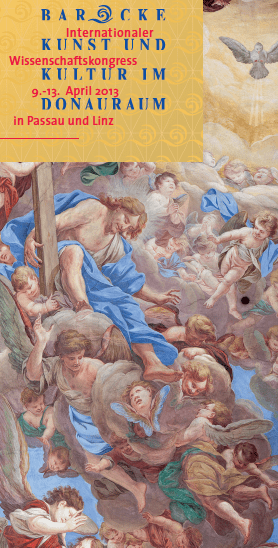 Im Jahr 1662 zerstörte ein verheerender Stadtbrand die mittelalterliche Passauer Bischofskirche. Der anschließende Wiederaufbau in barocken Bauformen vor nunmehr 350 Jahren gehört zu den wichtigsten Großbauprojekten dieser Epoche im gesamten Donauraum. Dies bildet den Anlass zur Veranstaltung eines Wissenschaftskongresses, der über das lokale Geschehen hinaus „Barocke Kunst und Kultur im Donauraum“ ganz allgemein in den Blick nimmt.
Dabei gilt es zunächst der Frage nach der „Konstituierung des ‚Donauraums‘ in der Barockzeit als Kunst- und Kulturlandschaft“ nachzugehen – Thema der ersten Sektion des Kongress. Die Entstehung des Donauraumes ist in geographischer, geschichtlicher, kultureller und religiöser Hinsicht von der Vielfalt nationaler Identitäten und Zugehörigkeiten bestimmt. Sie verkörpern als differenzierte Einheit den Reichtum dieser Kulturlandschaft. Zudem ist in der Vielfalt eine Gegensätzlichkeit begründet, die eine bis heute wirksame Abgrenzung von Okzident und Orient bestimmt und in einer entsprechenden kulturgeographischen Differenzierung zum Ausdruck kommt. Der gesamte Flusslauf, von der Quelle bis zur Mündung , ist hier Gegenstand der Überlegungen. Im Mittelpunkt stehen die Territorien Bayerns und Österreichs sowie die eng mit dem habsburgischen Kaiserhaus verbundenen landesherrlichen Gebiete des Königreichs Böhmen, der Markgrafschaft Mähren, Schlesiens und des Königreichs
Ungarn. Das einst von Passau aus gelenkte „Donaubistum“ bildete einen wichtigen Ankerpunkt gemeinsamer kultureller und religiöser Identität in diesem Raum. (more…)
New Title | Venetian Engravers of the Eighteenth Century
From Fondazione Giorgio Cini:
Rodolfo Pallacchini, Gli incisori veneti del Settecento: Venezia 1941 (Verona: Scripta Edizioni, 2012), 403 pages, ISBN: 9788896162514, $47.50. available from ArtBooks.com
 Il volume ripresenta, in edizione anastatica, il catalogo della mostra Gli incisori veneti del Settecento, organizzata da Rodolfo Pallucchini a Venezia, al teatro del “Ridotto” nel 1941. Solo 94 erano tuttavia le illustrazioni, a fronte di 613 opere esposte. Al fine di poter offrire uno strumento di lavoro adeguato sia per gli studiosi sia per i collezionisti dell’incisione veneta del Settecento, si è deciso di riprodurre qui integralmente tutte le incisioni presentate a quella mostra memorabile, incentrata su un aspetto eccezionale di creatività in ambito europeo, indagato da Pallucchini con l’abituale intelligenza critica in questo studio pionieristico.
Study Day | Objects From Abroad: The Life of Exotic Goods
Objects From Abroad: The Life of Exotic Goods
in France and the United States (18th-20th Centuries)
New York University, 25 April 2013
Register by 19 April 2013
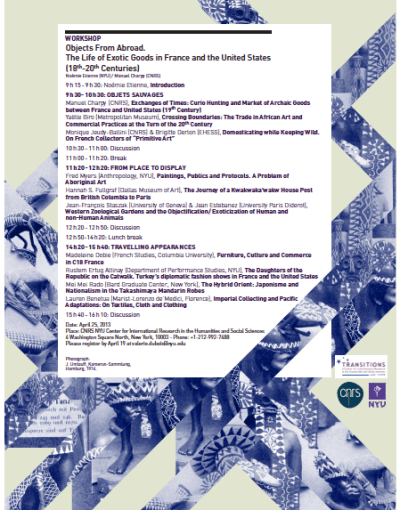 9:15 Noémie Etienne, Introduction
9:30 O B J E T S S A U V A G E S
• Manuel Charpy (CNRS), Exchanges of Times: Curio Hunting and Market of Archaic Goodsbetween France and United States in the 19th Century
• Yaëlle Biro (Metropolitan Museum), Crossing Boundaries: The Trade in African Art and Commercial Practices at the Turn of the 20th Century
• Monique Jeudy-Ballini (CNRS) and Brigitte Derlon (EHESS), Domesticating While Keeping Wild: On French Collectors of ‘Primitive Art’
11:00 Break
11:20 F R O M P L A C E T O D I S P L A Y
• Fred Myers (Anthropology, NYU), Paintings, Publics, and Protocols: A Problem of Aboriginal Art
• Hannah S. Fullgraf (Dallas Museum of Art), The Journey of a Kwakwaka’wakw House Post from British Columbia to Paris
• Jean-François Staszak (University of Geneva) and Jean Estebanez (University Paris Diderot), Western Zoological Gardens and the Objectification / Exoticization of Human and Non-Human Animals
12:50 Lunch break
14:20 T R A V E L L I N G A P P E A R A N C E S
• Madeleine Dobie (French Studies, Columbia University), Furniture, Culture, and Commerce in 18th-Century France
• Rustem Ertug Altinay (Department of Performance Studies, NYU), The Daughters of the Republic on the Catwalk: Turkey’s Diplomatic Fashion Shows in France and the United States
• Mei Mei Rado (Bard Graduate Center, New York), The Hybrid Orient: Japonisme and Nationalism in the Takashimaya Mandarin Robes
• Lauren Benetua (Marist-Lorenzo de’Medici, Florence), Imperial Collecting and Pacific Adaptations: On Textiles, Cloth, and Clothing
◊ ◊ ◊ ◊ ◊
NYU Center for International Research in the Humanities and Social Sciences, 4 Washington Square North, New York, 10003 – Phone: +1-212-992-7488. Please register by April 19 at valerie.dubois@nyu.edu.
Exhibition | Mexican Art at the Louvre
From The Louvre:
Le Mexique au Louvre: Chefs-d’oeuvre de la Nouvelle Espagne, XVIIe et XVIIIe siècles
Musée du Louvre, Paris, 7 March — 3 June 2013
Curated by Guillaume Kientz and Jonathan Brown
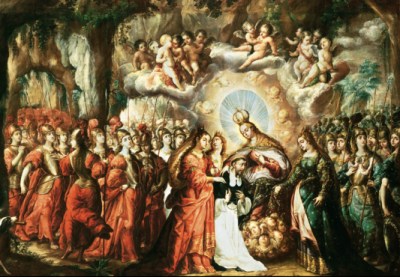
Cristobal de Villalpando, La Lactacion de Santo Domingo, © Rafael Doniz / Conaculta-INAHSinafo-Mex.
Mexican art, an area in which the Louvre’s Hispanic collection is intended to expand, will be showcased at the museum this spring. A selection of some ten of the finest works from this ‘sister’ school will be exhibited among the Spanish paintings. Among others, the monumental ‘Zurbaranesque’ work of José Juárez, the Baroque dynamism of Cristóbal Villalpando and the softness and delicacy of Rodríguez Juárez will introduce visitors to the many facets of New World art during this period and give them an understanding of its close yet independent relationship with Spanish art.
Although represented in national museums, Latin American art remains little known in France. The book that accompanies this exhibition, based on inventory work conducted by the Louvre and the French National Institute of Art History (the BAILA project), provides an overview of the major Latin American works in French museums, and explores the origins and evolution of this artistic school.
The Louvre’s press release (14 February 2013) is available here»
New Title | The Books That Shaped Art History
From Thames & Hudson:
Richard Shone and John-Paul Stonard, eds., The Books That Shaped Art History: From Gombrich and Greenberg to Alpers and Krauss (London: Thames & Hudson, 2013), 268 pages, ISBN: 978-0500238950, £25 /$35.
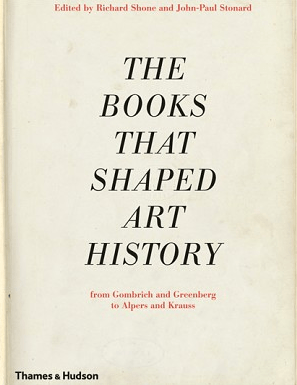 It provides an invaluable roadmap of the field by reassessing the impact of several of the most important works of art history. Each chapter, focusing on a single title, is written by a leading art historian, curator or one of the promising scholars of today, presenting a varied and invaluable overview
of the history of art, told through its seminal texts.
It provides an invaluable roadmap of the field by reassessing the impact of several of the most important works of art history. Each chapter, focusing on a single title, is written by a leading art historian, curator or one of the promising scholars of today, presenting a varied and invaluable overview
of the history of art, told through its seminal texts.
The sixteen books include Nikolaus Pevsner’s gospel of Modernism, Pioneers of the Modern Movement, Alfred Barr’s now legendary monograph on Matisse, E.H. Gombrich’s Art and Illusion, Clement Greenberg’s Art and Culture, which had a seismic impact when it was published in 1961, and Rosalind Krauss’s The Originality of the Avant-Garde and Other Modernist Myths, which introduced structuralist and poststructuralist thinking into art historical study.
Each chapter – with writers including John Elderfield, Boris Groys, Susie Nash and Richard Verdi – analyses a single major book, setting out its premises and argument and mapping the intellectual development of its author, discussing its position within the field of art history, and looking at its significance in the context both of its initial reception and its legacy. An introduction by John-Paul Stonard explores how art history has been forged by these outstanding contributions, as well as by the dialogues and ruptures between them. Supplementary documentation summarises the achievements of each art historian and provides a detailed publication history of their texts, with suggestions for further reading.
Richard Shone is Editor of The Burlington Magazine. He is the author of a number of books on French and British art, including Bloomsbury Portraits, The Post-Impressionists, Walter Sickert and Sisley. He contributed to the exhibition catalogue for ‘Sensation’ at London’s Royal Academy and organised ‘The Art of Bloomsbury’ for the Tate Gallery.
John-Paul Stonard is an art historian and former Contributing Editor of The Burlington Magazine. His book Fault Lines: Art in Germany 1945–55 was published in 2007. He has worked as a Visiting Lecturer at the Courtauld Institute of Art, and from 2010–11 was a Senior Fellow at the National Gallery of Art, Washington, DC. He has published widely on modern and contemporary German and British art, and is a regular contributor to The Burlington Magazine, the Times Literary Supplement and Artforum.
Call for Papers | Gall and Guts: Entrails and Digestion
Gall and Guts: Entrails and Digestion in the Long Eighteenth Century
Paris, 21-22 March 2014
Proposals due by 31 May 2013 (final papers due 15 July 2013)
In his recent book, Versailles, l’ordre et le chaos, Michel Jeanneret describes the representations of Molière’s Monsieur de Pourceaugnac. The play wittily mixes the underbelly and the underworld: Parisian purse-snatchers confront provincial narrow-mindedness in a farce whose emblems are the clyster and the “obscure and polluted area of the entrails.” The farcical catharsis is enabled by the purgation of Pourceaugnac’s allegedly diseased body. Jeanneret underlines the close relation between this play and Le Malade imaginaire (The Imaginary Invalid), another of Molière’s comedies in which the bowels and their evacuation are at the very centre of the scatological farce. At Versailles, Le Malade imaginaire was played in front of the setting of the artificial cave of Thetis and Jeanneret sees the valetudinarian obsessed with his entrails as being echoed by the man-made grotto “which opens onto marine depths, buried in the bowels of the earth, imitating the labyrinth of the viscera.”
The representation of the entrails, the belly and the bowels is not limited to the anatomical descriptions that have influenced the caricatures and the apprehension of the body in the eighteenth century (Mandressi, 2003). The bodily functions associated with the bowels — digestion and evacuation — were used as metaphors throughout the period. They are also linked to medical practices that rely on entrails for diagnosis and treatment. The examination of excrement or the frequent prescription of enemas and emetics also confirm the central position of the belly in the perception of the body. Untainted by metaphors, patients’ narratives and case-descriptions underline the materiality of digestion. (more…)
Gale Announces New Platform, Artemis
Press release from Gale (2 April 2013) . . .
Gale, part of Cengage Learning and a leading publisher of research and reference resources for libraries, schools and businesses, today announced plans to unify, over the coming years, its extensive digital humanities collections on one state-of-the-art platform, creating the world’s largest online curated primary source and literary collection. The new research experience, Artemis, named for the Greek goddess who symbolizes new ideas, discovery, power and “the hunt,” will enable researchers to make connections and realize relationships among content that has never before been possible.
“Artemis represents a significant investment in our products and new technology. No other publisher offers this combination of rich full-text content, metadata, and intuitive subject indexing – all enhanced by revolutionary work-flow and analytical technology that breathes new life into the study of the humanities,” said Frank Menchaca, executive vice president, research solutions, Cengage Learning. “We are creating the most valuable curated digital humanities collection in the world through this integrated research environment.”
Artemis moves beyond the limitations of simple search and retrieve – it offers users the ability to search across both primary and secondary materials as well as different subjects and genres. It also adds term clusters and term-graphing tools to allow users to conduct new kinds of analysis on familiar content sets, thematic subject indexing to aid in content discovery, and interface updates that conform to today’s design standards, including sharing and collaboration tools. Overall, Artemis will transform the way students and researchers explore material, giving them the ability to challenge assumptions and create new theories and academic debate. (more…)
Exhibition | Napoleon and Europe
As noted at Art Daily:
Napoléon et l’Europe
Musée de l’Armée, Hôtel National des Invalides, Paris, 27 March — 14 July 2013
Curated by Émilie Robbe
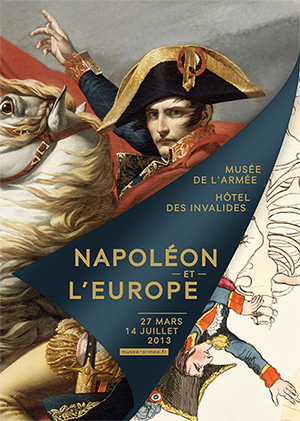 Napoleon Bonaparte (1769-1821) had a deep and lasting effect on the history of Europe, despite remaining in power for a mere fifteen years. The exhibition Napoléon et l’Europe [Napoleon and Europe], at the Musée de l’Armée from 27 March to the 14 July 2013, bears witness to Napoleon Bonaparte’s European ambitions between 1793 and 1815. The visit reveals his ambitious policies for expansion in Europe and the subsequent reactions by the various European countries, whether in support of, or against, such policies. The exhibition also highlights the consequences and the deep scars that such a conquest left on Europe.
Far removed from stereotype and biased opinion, this exhibition aims to present an influential episode in French and European history in a different manner; by combining the diverse, often-times opposing viewpoints of Napoleon’s contemporaries, on themes such as war, politics, diplomacy, the government, currency, propaganda and the arts… In order to recount or retrace this chapter of history, 250 artworks, objects and documents have been gathered together, on loan from fifty or so European museums and institutions, with more than half of these coming from outside France. Since the retrospective exhibition Napoléon held in 1969 at the Grand Palais, Paris, no other exhibition of this scope and ambition has been organized in France.
Conquest and Resistance
The entire exhibition is punctuated by or structured around two viewpoints that both question and mirror the other: the progressive and concrete creation of Napoleon’s Empire on the one hand, and the reactions of certain peoples and the main European powers to this direct quest for domination, on the other hand. From alliances to battles, from treaties to reform, this incredibly rapid succession of events is recounted in chronological fashion and explained in context. (more…)










 Enfilade
leave a comment