Enfilade

Restoration of the Queen’s House at Versailles

Posted in museums by Editor on November 18, 2013

800px-Maison_de_la_Reine_(1)

Maison de la Reine au hameau, Versailles
Photo: Wikimedia Commons, 2011

◊  ◊  ◊  ◊  ◊

From The Art Newspaper:

Claudia Barbieri Childs, “Dior to Fund Versailles Makeover,” The Art Newspaper (14 November 2013).
Fashion house to help restore Marie Antoinette’s rustic hideaway, where the French queen enjoyed the simple things in life

The fashion house Dior is to sponsor the restoration of the Queen’s House in Versailles. The deal was announced last month by Catherine Pégard, the director of the Palace of Versailles. The house was Marie Antoinette’s rustic hideaway, where Louis XVI’s queen played out a fantasy life as a simple milkmaid until the revolution of 1789 imposed a sterner reality. The house was abandoned after the revolution. . .

The full article is available here»

Exhibition | Bernardo Bellotto Paints Europe

Posted in exhibitions by Editor on November 17, 2013

With his younger brother Pietro the focal point of an exhibition in Venice, Bernardo Belotto, the pupil and nephew of the more famous ‘Canaletto’ will be the subject of a major show in Munich next fall:

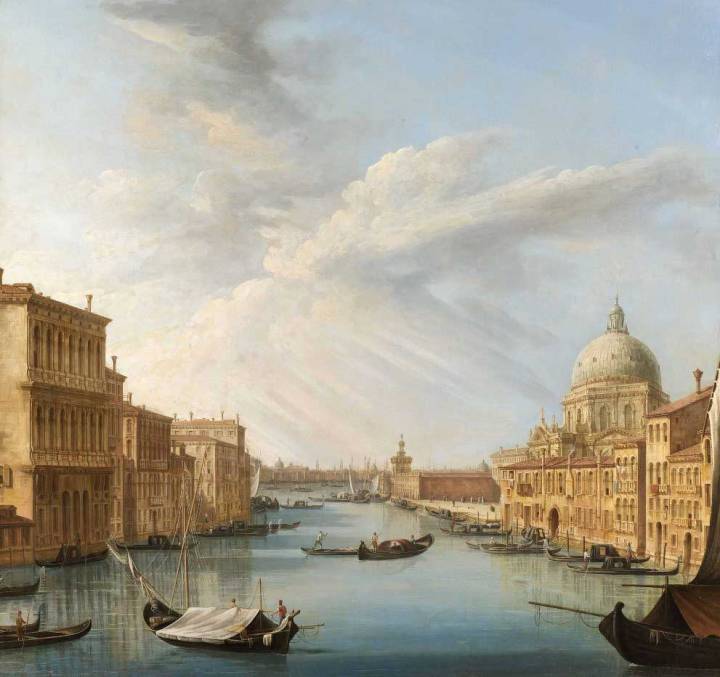
Canaletto, Bernardo Bellotto Paints Europe / Bernardo Bellotto Malt Europa
Alte Pinakothek, Munich, 17 October 2014 — 19 January 2015

4577_97971

Bernardo Bellotto, View of Munich from the East, 1761
© Bayerische Staatsgemäldesammlungen, Munich

◊  ◊  ◊  ◊  ◊

With around 80 loans from public and private collections in Europe and the USA, this exhibition will be the first comprehensive show of Bellotto’s work in Germany for almost 50 years and will provide a unique opportunity to accompany the Venetian vedute painter on his journey through 18th-century Europe.

Bernardo Bellotto, known as Canaletto, worked for several months in Munich in 1761 and painted a broad panorama of the city and two views of Nymphenburg Palace for Maximilian III, Elector of Bavaria. Thanks to a comprehensive restoration programme, the three large-format paintings will regain their original lustre over the next few months. These are among the artist’s major works and are also unique historical documents.

The exhibition shows Bellotto’s pictures of Munich for the first time within the context of exemplary paintings and drawings from all his creative phases. Views of royal cities, palaces and villas will form the focus of attention and bring to life the places where Bellotto worked — from Venice and Rome to Dresden, Vienna and Warsaw. In addition, groups of works, such as landscapes and the artist’s fanciful capricci that have so far been paid less attention, will also form thematic highlights in the projected exhibition.

Exhibition | Pietro Bellotti: Another Canaletto

Posted in exhibitions by Editor on November 17, 2013

From Ca’ Rezzonico:

Archives of Landscape Painting | Pietro Bellotti: Another Canaletto
Ca’ Rezzonico, Museum of 18th-Century Venice, 7 December 2013 — 28 April 2014

Curated by Charles Beddington, Alberto Craievich, and Domenico Crivellari

01-pietro-bellotti1

◊  ◊  ◊  ◊  ◊

This year sees the start of a new and fascinating investigation at Ca’ Rezzonico, the symbol of 18th-century Venice, into landscape painting. This important genre developed during the 18th century in Venice, which provided an extraordinary source of inspiration for its exponents.

Among the leading figures of the genre, which is at the centre of a necessary re-evaluation, was Pietro Bellotti, Canaletto’s nephew and the younger brother of Bernardo Bellotti. Born in Venice in 1725, he developed a manner that was very different to that of the Canaletto ‘clan’ of which he was a part and despite exploiting the fame of his uncle (especially in France, where he lived for 50 years, calling himself ‘le Sieur Canalety’ or ‘Pietro Bellotti di Caneletty’). After moving to Toulouse with his family, he stayed for a brief apprenticeship in his brother’s workshop and then was active in Besançon, Nantes, Lille and Paris and, at least for a brief period, in England. Adopting an autonomous, personal style, he developed Canaletto’s inventions, producing numerous views of Europe’s most important cities, together with some architectural capriccios, some of which realised with the collaboration of other landscape painters.

The exhibition will offer a survey of the painter’s long working life, bringing together the few of his works conserved in public collections, such as at the Yale Center for British Art and the Mauritshuis in The Hague, and about 40 other pictures, including signed works in private European collections.

Exhibition | Claude-Joseph Vernet’s ‘The Fishermen’

Posted in museums by Editor on November 16, 2013

From the Norton Museum of Art:

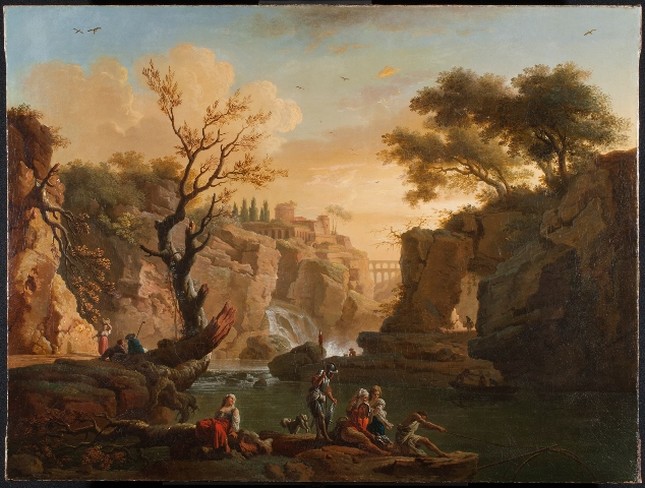
A Masterpiece Rediscovered: Claude-Joseph Vernet’s The Fishermen
Norton Museum of Art, West Palm Beach, Florida, 10 October — 8 December 2013

galleria_NORTON_EXHIBITION_VernetFull05

Claude-Joseph Vernet, The Fishermen, 1746 (Nortom Museum of Art)

◊  ◊  ◊  ◊  ◊

The exhibition will focus on the recent gift of The Fishermen (1746), a spectacularly beautiful painting of an idyllic Roman campagna scene by Claude-Joseph Vernet (1714–1789), the leading 18th-century French painter in Rome. One of eight canvases specially commissioned in 1746 by the Marquis Pierre Charles de Villette, it is one of only two known to have survived to modern times. Key explanatory texts and detailed images will allow visitors to follow its progress from authentication through conservation. A discussion of Vernet, Roman 18th-century painting, and the phenomenon called ‘The Grand Tour’ will give visitors the opportunity to place The Fishermen in the broader context of European landscape painting. Artworks from the same period by French, Italian, and Flemish artists such as Giovanni Paolo Panini, Giovanni Battista Piranesi, Bartolomeo Cavaceppi, Jan Frans van Bloeman and Jean-Baptiste Lallemand will put The Fisherman in context.

Exhibition | Regatta Boats

Posted in exhibitions by Editor on November 15, 2013

From Ca’ Rezzonico:

Imbarcazioni da Regata / Regatta Boats
Ca’ Rezzonico, Museum of 18th-Century Venice, 31 May — 10 September 2013, extended until 24 November

Curated by Alberto Craievich

02-imbarcazioni-regata1

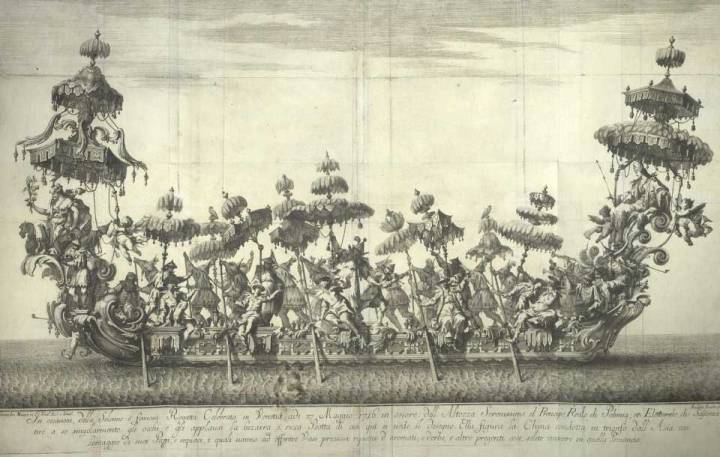
Gaspare Diziani e Andrea Zucchi,
La Cina condotta in trionfo dall’Asia

◊  ◊  ◊  ◊  ◊

Among the most spectacular ceremonies Venice used to organise in the past were the regattas arranged by the Serenissima in honour of princes and rulers visiting the city. The most important artists of the 18th century assisted in the making of the extravagant vessels bearing such exotic names as bissone, malgarote, peote: specialists in the field, like Andrea Urbani or the Mauro family, together with leading artists, including Giambattista, Tiepolo, Francesco Guardi, Giambattista Piranesi, Gaspare Diziani and Francesco Zugno.

Freed of any functional constraints, the fantasy of the artists could be unleashed in the creation of bold inventions with ornamental motifs, mythological scenes and allegorical figures. These boats were designed to last the duration of a ceremony, and are documented today only through preparatory drawings or prints conveying a sense of their extravagant decoration and exceptional design.

One of the most important collections of prints and drawings dedicated to this specifically Venetian aspect of ephemeral baroque art is conserved in the Gabinetto dei disegni e delle stampe in Museo Correr and is now displayed after a long period out of public sight, at Ca’ Rezzonico.

At Auction | Thomas Hudson’s Portrait of Flora MacDonald

Posted in Art Market by Editor on November 14, 2013

From the Bonhams press release:

Flora MacDonald

Thomas Hudson, Portrait of Flora MacDonald, oil on canvas
126 x 101 cm. (50 x 40 inches).

A portrait of Flora MacDonald, a heroine of the Jacobite risings, who helped Bonnie Prince Charlie escape after the Battle of Culloden is to be sold at Bonhams Scottish pictures sale in Edinburgh on Thursday, 5 December. It is estimated at £7,000–10,000.

Following his defeat at Culloden on 16 April 1746, Charles Edward Stuart — Bonnie Prince Charlie — fled the field and went into hiding. Pursued by the army of George II, whose claim to the British throne he had challenged, the Prince took refuge on the Hebridean island of Benbecula, which was under the control of the government. The MacDonalds — secretly sympathetic to the Jacobite cause — agreed to help Prince Charles escape. Flora was given official permission to leave the island accompanied by a manservant, an Irish spinning maid — actually the Prince in disguise — and six oarsmen. After landing on the Isle of Skye, the Prince made good his escape. Flora however had aroused suspicion and was arrested. She was taken to London, initially imprisoned in the Tower, and later kept under house arrest.

Though Flora is celebrated in song, on screen, in paintings and even on shortbread tins, portraits of her drawn from life are rare. This depiction by the respected English artist Thomas Hudson is likely to have been painted after she was completely freed under the Act of Indemnity in 1747 when she became something of a celebrity.

Flora is depicted wearing a satin dress and tartan bow and holding a rose which is how she usually appears in portraits. Despite the romantic story attached to her name she claimed to have been motivated more by charity than politics, telling George II’s son, the Duke of Cumberland and merciless victor at Culloden, that she would have been equally ready to help him had he been in distress.

Virtual Images of Sculpture in Time And Space

Posted in Calls for Papers by Editor on November 14, 2013

As noted at BARS:

VISTAS is an acronym for Virtual Images of Sculpture in Time And Space. Founded by Hester Diamond, Jon Landau and Fabrizio Moretti, VISTAS will subsidize the publication of new scholarship on European sculpture of the late Gothic, Renaissance and Baroque periods, 1250–1780.

VISTAS will combine old and new. We will marry the most innovative technology to the highest standard of traditional book publishing — all in support of sound, new scholarship. We will produce dual publications, one part in print, the other online. Each will supplement the other, not copy it.

Our target audience is the intelligent lay reader in addition to curators, art historians and students. One of our goals is to provide an enjoyable experience for the reader.

Each book will be paired with an online publication with remarkable digital graphic material. The text will be enhanced by very high-resolution photography and — most exceptionally — 360º photography, panoramic photography and video.

Our Editorial Board will approve books for publication by VISTAS. The books in print will be scholarly, well written and well produced. VISTAS’ books will be readable. VISTAS will emphasize serious original scholarship about visually significant works of art, rather than documents or theoretical analyses. The website will provide a more vivid experience of the sculpture than we have ever had before.

Xavier Salomon Appointed Chief Curator of The Frick Collection

Posted in museums by Editor on November 13, 2013

Press release (4 November 2013) from The Frick:
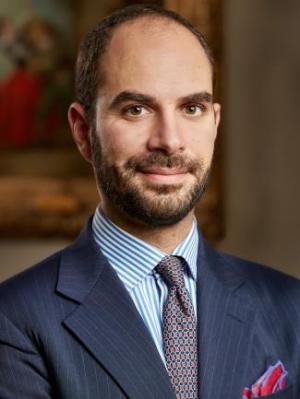
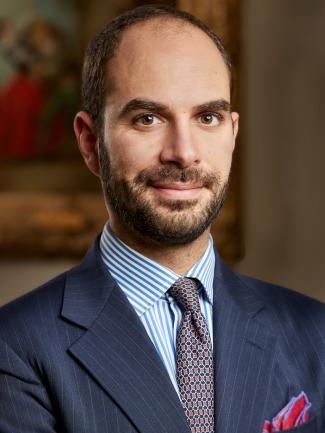
img-xavier-salomon_160136298892.jpg_x_325x433_cXavier F. Salomon has been appointed to the position of Peter Jay Sharp Chief Curator of The Frick Collection, taking up the post in January of 2014. Dr. Salomon―who has organized exhibitions and published most particularly in the areas of Italian and Spanish art of the sixteenth through eighteenth century―comes to The Frick Collection from The Metropolitan Museum of Art, where he is a curator of in the Department of European Paintings. Previously, he was the Arturo and Holly Melosi Chief Curator of Dulwich Picture Gallery, London. Salomon’s two overall fields of expertise are the painter Paolo Veronese (1528–1588) and the collecting and patronage of cardinals in Rome during the early seventeenth century. Born in Rome, and raised in Italy and the United Kingdom, Salomon received his Ph.D. from the Courtauld Institute of Art, University of London. A widely published author, essayist, and reviewer, Salomon sits on the Consultative Committee of The Burlington Magazine and is a member of the International Scientific Committee of Storia dell’Arte.

Comments Frick Director Ian Wardropper, “We are thrilled to welcome Salomon to the post of Peter Jay Sharp Chief Curator. He is a remarkable scholar of great breadth and vitality, evidenced by his résumé, on which you will find names as far ranging as Veronese, Titian, Carracci, Guido Reni, Van Dyck, Claude Lorrain, Poussin, Tiepolo, Lucian Freud, Cy Twombly, and David Hockney. At the same time, he brings to us significant depth in the schools of painting at the core of our Old Master holdings, and he will complement superbly the esteemed members of our curatorial team. Salomon has experience as a department head, and he has curated marvelous shows, among them a mutually rewarding collaboration with the Frick. He was a highly productive and inspiring participant in the Frick’s Andrew W. Mellon Curatorial Fellowship program, leaving his mark already on the institution through an acclaimed Veronese exhibition as well as various other projects of distinction. In Salomon’s work, collecting has remained a critical line of art historical inquiry since the defense of his dissertation on the patronage of Cardinal Pietro Aldobrandini [1571–1621]. This focus resonates beautifully with us, as the institution is widely known for the interpretation of our history, holdings, exhibitions, publications, programs, and the innovative activities of the Frick Art Reference Library’s Center for the History of Collecting.”

Xavier Salomon adds, “It is a great honor for me to be appointed the Peter Jay Sharp Chief Curator of The Frick Collection. I organized my first exhibition at the Frick as an Andrew W. Mellon Curatorial Fellow. It is therefore a huge pleasure for me to return to an institution to which I feel deeply indebted and that I greatly admire. The Frick has a unique collection of outstanding masterpieces, and its holdings in the fields of painting, sculpture, decorative arts, and drawings are of stupendous quality. It will be a pleasure to work with the staff of noted colleagues in the fields of curatorial, conservation, and education, all of whom are leading authorities in their areas of expertise. Over the years and under the guidance of my predecessors, Edgar Munhall and Colin B. Bailey, the Frick has led the way with inspirational programming and groundbreaking exhibitions. I look forward to working on the institution’s upcoming projects, sharing, as I do, the Frick’s belief in the fundamental importance of museum research as well as in presenting wide-ranging, vibrant, and engaging offerings to the broad public and scholarly community alike.”

A Superb Résumé of Acclaimed Exhibitions

Salomon’s recent exhibitions have focused on areas of the fine arts well represented at the Frick: Spanish, Italian, and Flemish sixteenth- through eighteenth-century painting. A sought-after Veronese scholar, he is curator of a forthcoming monographic exhibition on this artist at The National Gallery, London (2014). At The Metropolitan Museum of Art, he organized Velázquez’s Portrait of Duke Francesco I d’Este: A Masterpiece from the Galleria Estense, Modena (2013). At Dulwich, he curated Van Dyck in Sicily, 1624–25: Painting and the Plague (2012) and collaborated with Nicholas Cullinan on Twombly and Poussin: Arcadian Painters (2011). He co-curated, with Helen Langdon and Caterina Volpi, Salvator Rosa (1615–1673): Bandits, Wilderness, and Magic (which went to Dulwich and the Kimbell Art Museum, Fort Worth, Texas, 2010–11). Salomon and his predecessor at the Frick, Colin B. Bailey (since June, the Director of the Fine Arts Museums of San Francisco), organized Masterpieces of European Painting from Dulwich Picture Gallery, which was shown to critical acclaim at the Frick in 2010. His exhibition Paolo Veronese: The Petrobelli Altarpiece was shown at Dulwich, the National Gallery of Canada, Ottawa, and the Blanton Museum of Art, Austin, Texas (2009–10). Best of British. The Story of the British Collection at Dulwich Picture Gallery (2009) was preceded by The Agony and the Ecstasy: Guido Reni’s Saint Sebastians (co-curated with Piero Boccardo and featured first at the Musei di Strada Nuova, Palazzo Rosso, Genoa, followed by Dulwich, 2007–08). As the Frick’s Andrew W. Mellon Curatorial Fellow, he was praised for his exhibition Veronese’s Allegories: Virtue, Love, and Exploration in Renaissance Venice (2006). He also contributed to Masterpieces of European Painting from The Cleveland Museum of Art (2006–7), From Callot to Greuze: French Drawings from Weimar (2005), Gardens of Eternal Spring: Two Newly Conserved Mughal Carpets (2005), and Raphael’s Fornarina (2004–5).

A Prolific Scholar and Speaker

Much in demand as a writer, Salomon has contributed myriad essays and entries to publications produced by institutions internationally, including the Kunsthistorisches Museum, Vienna; Palazzo Venezia, Rome; and the Royal Academy of Arts, London. Among the journals that have published his research are The Metropolitan Museum of Art Journal, Apollo, The Burlington Magazine, Master Drawings, The Medal, The Art Newspaper, and the Journal of the History of Collections. He is a frequent reviewer in The Burlington Magazine, with up to seven appearing annually. Salomon has delivered conference papers and lectures at the Musée du Louvre; The Metropolitan Museum of Art; The Frick Collection; the Morgan Library & Museum; the universities of Rome and Padua; the Musei di Strada Nuova, Genoa; Cambridge University; Dulwich Picture Gallery, and the National Gallery, London, among other institutions.

Call for Article Proposals | Arts of Display in the Netherlands

Posted in Calls for Papers by Editor on November 13, 2013

From CODART:

Arts of Display
Netherlands Yearbook for History of Art / Nederlands Kunsthistorisch Jaarboek 65

Proposals due by 1 January 2014

Works of art and their display have always been closely connected. Most art was and is created for exhibition in one form or another, and the history of the display of an art object often forms a meaningful part of its story. Exhibiting art involves strategies, techniques and devices that have much in common with other fields of presentation: theatre, advertising, interior design, book design, the display of goods in shops and shop windows.  These display strategies use techniques that are partly culturally determined, and partly rooted in a biological determination of human perception, as Gombrich, among others, made clear. How we perceive patterns, prefer symmetry and note differences of scale between an object and its surroundings all have a direct bearing on the way art was and is shown. Moreover, changing modes of display and viewing conditions can create new narratives and can even lead to active or performative relationships between the displayed object and the viewer, resulting in playful (or sometimes aggressive) interactions. Finally, rules of decorum and rhetoric often play an important role in the art of display. (more…)

Restoration of Schloss Mirow

Posted in site information by Editor on November 12, 2013

The December 2013 issue of Architectural Digest teasingly includes this news in the column “AD Hears. . .”

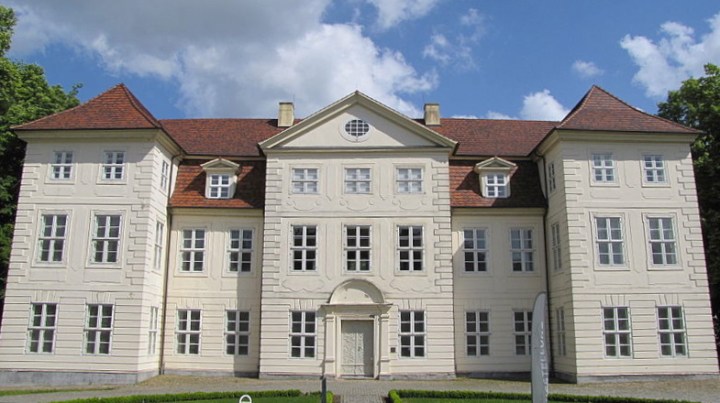
that architecture aficionados are agape at the flamboyant plasterwork concealed behind the modest façade of Germany’s Schloss Mirow—the birthplace of Charlotte of Mecklenburg-Strelitz, wife of England’s King George III—currently under renovation (48).

With a small amount of online searching, I found only a little more about the project; readers should feel free to chime in with more information. Presumably, we’ll hear more in the coming months. -CH

800px-Schloss_Mirow_5_2011

Schloss Mirow, Wikimedia Commons, 2011

◊  ◊  ◊  ◊  ◊

From the Mecklenburg website:

Das Mirower Schloss befindet sich in der Endphase seiner hochkarätigen Restaurierungsarbeiten. Höchst komplex sind die zahlreichen Methoden, die am Schloss zum Einsatz kommen. Die hohe Qualität und die Besonderheit der Restaurierungsarbeiten in Mirow haben das Schloss nun zum “Hot Spot” werden lassen. Die für den Dreh beauftrage Produktionsfirma Spiegel TV begleitete und interviewte einen Tag lang verschiedene Experten bei ihrer Arbeit – sie gehören zu den absoluten Spezialisten des Landes.

Das Fimteam traf in Mirow auf ganz unterschiedliche Gewerke: Bauhistoriker Dr. Tilo Schöfbeck verschaffte einen reizvollen Eindruck von den Techniken zur Altersbestimmung von Gebäudeelementen, während Diana von Stietencron einen spannenden Einblick in die geheimen Rezepturwelten von Vergoldern und Fassmalern des 18. Jahrhunderts gab. Bildhauer Bernhard Lankers wusste davon zu berichten mit welcher Genialität die Schnitzer im Rokoko gearbeitet haben. Einzigartig ist auch das Rekonstruktionsprojekt, bei dem eine handgestickte Tapete vom Atelier Twist in Berlin wieder zum Leben erweckt wird. . . .