Exhibition | Ships, Clocks, and Stars: The Quest for Longitude
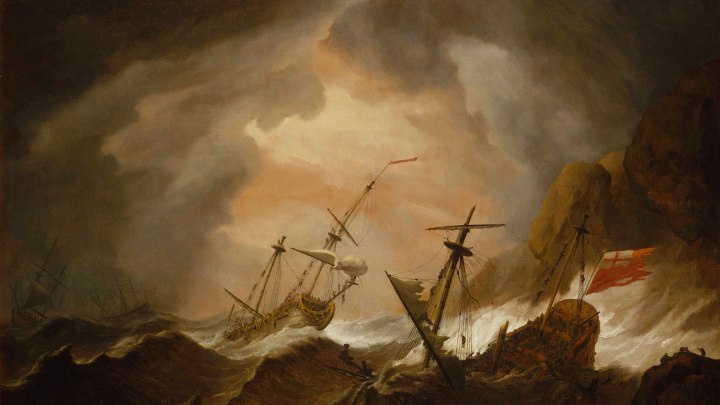
Willem van de Velde, the Younger, Two English Ships
Wrecked in a Storm on a Rocky Coast, ca. 1700
(London: National Maritime Museum)
Press release (21 March 2014) for the current exhibition:
Ships, Clocks, and Stars: The Quest for Longitude
National Maritime Museum, Greenwich, 11 July 2014 — 4 January 2015
Mystic Seaport, Mystic, Connecticut, 19 September 2015 — 28 March 2016
Curated by Richard Dunn and Rebekah Higgitt
To mark the tercentenary of the Longitude Act of 1714, Ships, Clocks, and Stars: The Quest for Longitude, a major new exhibition at the National Maritime Museum, tells the extraordinary story of the race to determine longitude at sea and how one of the greatest technical challenges of the eighteenth and nineteenth centuries was eventually solved. The exhibition draws on the latest research to shed new light on the history of longitude—one of the great achievements of the Georgian age—and how it changed our understanding of the world.

John Harrison, H1 Marine Timekeeper, 1730–35
(London: National Maritime Museum)
In recent years, John Harrison has been cast as the hero of the story, not least in Dava Sobel’s seminal work Longitude: The True Story of a Lone Genius Who Solved the Greatest Scientific Problem of His Time. Ships, Clocks, and Stars provides a new perspective on this famous tale. While John Harrison makes a good story and his marine sea-watch was vital to finally solving the problem of longitude, this was against a backdrop of almost unprecedented collaboration and investment. Famous names such as Galileo, Isaac Newton, James Cook, and William Bligh all feature in this fascinating and complex history. Crucially, it was Astronomer Royal Nevil Maskelyne’s observations at the Royal Observatory in Greenwich, his work on the Nautical Almanac and the Board of Longitude that demonstrated the complementary nature of astronomical and timekeeper methods, ultimately leading to the successful determination of longitude at sea.
Highlights from the exhibition include all five of John Harrison’s famous timekeepers. H1, H2, H3 and H4 will move from the Royal Observatory Greenwich to be displayed in the National Maritime Museum for the first time in nearly 30 years. H5 is being loaned from the Worshipful Company of Clockmakers. Also featured is the original Longitude Act of 1714, which has never been on public display before; an intricate 1747 model of the Centurion, the ship which carried out the first proper sea trial of Harrison’s H1, and the elegant, padded silk ‘observing suit’ worn by Nevil Maskelyne at the Royal Observatory during the 1760s.
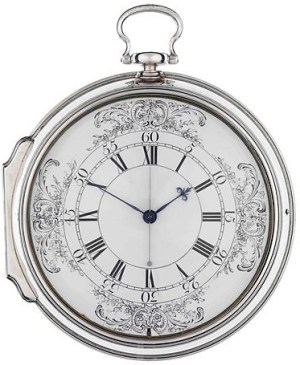
John Harrison, H4 Marine Timekeeper, 1755–59
(London: National Maritime Museum)
Passed by the British government in July 1714, the Longitude Act aimed to solve the problem of determining a ship’s longitude (east-west position) at sea. For a maritime nation such as Britain, investment in long distance trade, outposts and settlements overseas made the ability to determine a ship’s longitude accurately increasingly important. As different nations, including Spain, the Netherlands and France, sought to dominate the world’s oceans, each offered financial rewards for solving the longitude problem. But it was in Britain that the approach paid off. With life-changing sums of money on offer, the challenge became the talk of London’s eighteenth-century coffee-houses and captured the imaginations and talents of astronomers, skilled artisans, politicians, seamen and satirists; many of whom came up with ingenious methods and instruments designed to scoop the Board of Longitude’s tantalising rewards and transform seafaring navigation forever.
The Royal Observatory in Greenwich was founded in 1675 specifically to carry out observations ‘to find out the so much desired longitude of places for the perfecting of the art of navigation’. Under the 1714 Longitude Act, successive Astronomers Royal became leading voices on the Board of Longitude, judging proposals and encouraging promising developments.
As solutions were developed, the Royal Observatory also became a testing site for marine timekeepers and the place at which the astronomical observations needed for navigational tables were made. The significance of this work eventually lead to Greenwich becoming the home of the world’s Prime Meridian in 1884.
◊ ◊ ◊ ◊ ◊
The catalogue is published by Harper Collins:
Richard Dunn and Rebekah Higgitt, Ships, Clocks, and Stars: The Quest for Longitude (London: Collins, 2014), 256 pages, softcover ISBN: 978-0007940523, £15 / hardcover, ISBN: 978-0062353566, $75.
 A tale of eighteenth-century invention and competition, commerce and conflict, this is a lively, illustrated, and accurate chronicle of the search to solve ‘the longitude problem’, the question of how to determine a ship’s position at sea—and one that changed the history of mankind.
Ships, Clocks, and Stars brings into focus one of our greatest scientific stories: the search to accurately measure a ship’s position at sea. The incredible, illustrated volume reveals why longitude mattered to seafaring nations, illuminates the various solutions that were proposed and tested, and explores the invention that revolutionized human history and the man behind it, John Harrison. Here, too, are the voyages of Captain Cook that put these revolutionary navigational methods to the test.
Filled with astronomers, inventors, politicians, seamen, and satirists, Ships, Clocks, and Stars explores the scientific, political, and commercial battles of the age, as well as the sailors, ships, and voyages that made it legend—from Matthew Flinders and George Vancouver to the voyages of The Bounty and The Beagle. Featuring more than 150 photographs specially commissioned from Britain’s National Maritime Museum, this evocative, detailed, and thoroughly fascinating history brings this age of exploration and enlightenment vividly to life.
Richard Dunn is Senior Curator and Head of Science and Technology at Royal Museums Greenwich. Rebekah Higgitt is Lecturer in History of Science at the University of Kent.
◊ ◊ ◊ ◊ ◊
Note (added a few hours after the original posting appeared) — I should have noted that Jeremy Wear plans to chair a session on the theme of longitude at the 2015 ASECS conference in Los Angeles. –CH
From the Call for Papers:
Longitude at 300
Jeremy Wear, Dept. of English, U. of Illinois at Urbana-Champaign, 608 S. Wright St., Urbana, IL 61801; wear3@illinois.edu
July 2014 witnesses the tercentenary of the passage of the Longitude Act (1714). Although the act was passed to solve the age’s preeminent navigational problem, it was not until over fifty years later during Captain Cook’s voyages that the longitude problem was considered solved. Following the passage of the act, rival methods of measurement emerged, but it was ultimately John Harrison’s marine chronometers that were deemed the most reliable—and allowed Cook to make the first truly accurate European charts of the South Seas. This panel seeks innovative, interdisciplinary approaches reexamining the significance of the search for longitude and its ‘discovery’ during the eighteenth century. What sort of cultural changes did longitude—and the corollary technologies of accurate clocks and maps—cause? Papers for this panel might examine longitude’s impact in fields of early modern science like navigation, cartography, and horology, or consider longitude in its imperial contexts. How does the quest for and advent of longitude transform, challenge, or reconfirm the way people in the eighteenth century thought about space and sovereignty? How might Harrison’s chronometers create new ways of thinking about time that influence subjectivity and narrative theory in the novel and travel literature, or fields like stadial theory? In what ways do longitude and its technologies influence conceptions of race and gender? Finally, given longitude’s status as an eighteenth-century ‘project’, papers might also investigate what exactly the numerous satires produced on longitude were meant to lampoon.










 Enfilade
leave a comment