Conference | Houses as Museums / Museums as Houses
From H-ArtHist:
Houses as Museums / Museums as Houses
The Wallace Collection, London, 12–13 September 2014
Registration due by 31 August 2014
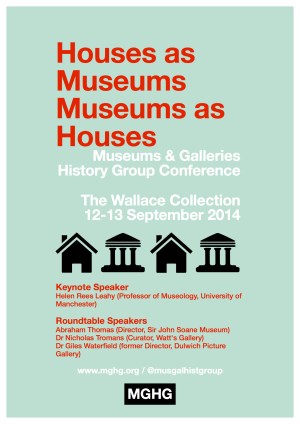 The relationship between museums and domestic spaces is a long and complex one. Museums were born in the houses of collectors, while the reconstruction of the house or domestic room—of ‘home’, effectively—continues to be an influential if controversial model for museum display. On the other hand, museums have at times invested heavily in the idea of their spaces as public, scientific and definitively non-domestic. The line between house and museum is therefore also one between public and private, scientific and domestic; and house-museums/museum-houses have acted both to confirm, to alter, and to undermine this line completely.
The 2014 Museums and Galleries History Group (MGHG) conference seeks to understand the historical development of this relationship by investigating the ways in which museums have acted as houses, and houses have acted as museums. It will also explore the ways in which house-museums and museum-houses have been positioned in boundary zones of space and time, and what effect they have had on those boundaries. The programme
can be viewed and tickets can be purchased here.
◊ ◊ ◊ ◊ ◊
F R I D A Y , 1 2 S E P T E M B E R
10.00 Registration and refreshments
10.30 Introduction
10.45 1: The Early Modern Legacy (Chair: Stephanie Bowry)
• Theda Jurjens, ‘Artists’ houses: spaces of knowledge, artistic production and social reputation’
• Cristiano Guarneri (IUAV University, Venice), ‘A private display for a public space: The Statuario Pubblico (1587–96), a Venetian approach to the display of ancient sculpture’
• Thomas Schauerte (City of Nuremberg Art Collections), ‘From memorial to museum: The Dürer house in Nuremberg’
12.15 Curator’s introduction to the Great Gallery rehang
12.30 Private view of Great Gallery
13.15 Lunch break
14.30 2: Architecture and Museums / Houses (Chair: Sarah Longair)
• Jeremy Aynsley (University of Brighton), ‘Curating Bauhaus houses, 1923–2019’
• Maria D’Annibale Williams (Ohio University), ‘Museum space in Fascist Verona and the display of social identity: A case study’
• Jane Whittaker (Bowes Museum), ‘Mrs Bowes’s mansion and galleries at Barnard Castle, Durham’
16.00 Tea and coffee
16.30 Roundtable: ‘Curating Houses as Museums’ with Abraham Thomas, Nicholas Tromans, and Giles Waterfield (Chair: Mark Westgarth)
17.30 Wine reception
S A T U R D A Y , 1 3 S E P T E M B E R
10.00 Tea and coffee
10.30 Keynote lecture by Helen Rees Leahy, ‘The pleasures and paradoxes of house museums’
11.30 3: Concepts and Approaches (Chair: Elena Greer)
• Sophie Forgan (Captain Cook Memorial Museum), ‘Interpretation and anthropological approaches to the historic house museum’
• Lydia Brandt (University of South Carolina), ‘George Washington’s Mount Vernon: America’s First House (museum)’
• Helen Williams (Northumbria University), ‘The literary house museum: An eighteenth-century invention?’
13.00 Lunch break
14.15 4: Modern Spaces, Art and Houses / Museums (Chair: Barbara Lasic)
• Flaminia Gennari Santori (Syracuse University Florence), ‘Tropical baroque – Vizcaya: A Venetian-inspired house museum in Miami’
• Angela Bartholomew (VU University Amsterdam), ‘Chambres d’amis and the mediation of site (1986)’
• Louise Shannon (V&A), ‘Creating “Tomorrow”: Norman Swann moves into the V&A’
15.45 Tea and coffee
16.15 5: Science at Home and on Display (Chair: Ilja Nieuwland)
• Elisabeth Hoffman (University of Kassel), ‘Art and science: the interior of Wilhelm von Humboldt’s home as a museological and epistemological concept’
• Helen McCormack (Glasgow School of Art), ‘The anatomist at home: The Great Windmill Street Anatomy School and Museum’
• Caroline Morris (University of the West of England), ‘”…Fit like a snail to its shell”‘
All conference sessions except the Great Gallery view take place in the lecture theatre. Tea and coffee are provided in the Meeting Room. Wine reception takes place in the Café. Lunch is not provided, but there are many places for lunch very close to the Wallace Collection. The Wallace collection opens at 10.00 so please do not arrive earlier.
New Book | Visions of Britain, 1730–1830
From Palgrave Macmillan:
Sebastian Mitchell, Visions of Britain, 1730–1830: Anglo-Scottish Writing and Representation (Basingstoke: Palgrave Macmillan, 2013), 304 pages, ISBN: 978-1137290106, $90.
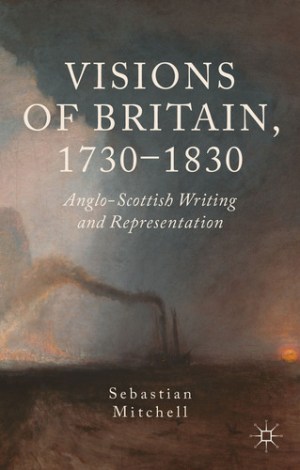 Visions of Britain is an inquiry into the literary and visual representation of Great Britain in the eighteenth century and early nineteenth century. The book considers the inter-relationship of text and image for the purposes of national projection. It analyses an extensive range of poems, novels, journals, drawings, satirical prints, portraits, landscapes, and history paintings. The study follows recent discussions of Anglo-Scottish writing in this period in the attempt to determine the salient characteristics of the imaginative depiction of the Kingdom of Britain, but challenges their more confident claims for the development of a progressive integrated nationhood. It argues instead that the most engaging literary and visual accounts of Britain in this era subject their imagery to extensive artistic pressure, threatening to dismantle the national vision at the moment of its construction.
Sebastian Mitchell is Lecturer in English Literature at the University or Birmingham.
◊ ◊ ◊ ◊ ◊
C O N T E N T S
List of Illustrations
Acknowledgments
1. Introduction
2. Thomson’s Vision of Britannia
3. Smollett and Dialectical Nationalism
4. Ramsay, Hume, and British Portraiture
5. Ossian, Wolfe, and the Death of Heroism
6. Boswell: Self, Text, Nation
7. Scott, Turner, and the Vision of North Britain
Bibliography
Index
Display | Fancy Pants

The Great Master of the Fashionable Hair Style, mid-18th century, hand-colored etching by an unidentified artist. The Minnich Collection, The Ethel Morrison Van Derlip Fund, 1966 P.17,468
From the MIA:
Fancy Pants: Beyond the Gray Flannel Suit
Minneapolis Institute of Arts, 19 July — 14 December 2014
Let’s face it: men’s fashion is pretty boring. But, it wasn’t always so. There was an age when men used their clothing to stand out rather than to fit in. Often that meant ruffles, embroidery, wigs, slashed sleeves, stuffed shirts, jerkins, leggings, jewels, and cod pieces. This exhibition may inspire you to clear your closet of muted garb to make room for a little self-expression.
New Book | Re-imagining Heritage Interpretation (& Happy 4th)
Anyone anticipating a proper Fourth of July posting might have a look back at the notice posted in May for Magna Carta: Cornerstone of Liberty, which just opened at Boston’s MFA. Less directly, this book from Ashgate might stimulate broader thoughts on issues of heritage interpretation, a field that in the United States too rarely comes into art historical conversations. In any case, a happy Fourth of July to all of you who mark the day. -CH
◊ ◊ ◊ ◊ ◊
Russell Staiff, Re-imagining Heritage Interpretation: Enchanting the Past-Future (Aldershot: Ashgate, 2014), 202 pages, ISBN: 978-1409455509, $110.
 This book challenges traditional approaches to heritage interpretation and offers an alternative theoretical architecture to the current research and practice. Russell Staiff suggests that the dialogue between visitors and heritage places has been too focused on learning outcomes, and so heritage interpretation has become dominated by psychology and educational theory, and over-reliant on outdated thinking. Using his background as an art historian and experience teaching heritage and tourism courses, Russell Staiff weaves personal observation with theory in an engaging and lively way. He recognizes that the ‘digital revolution’ has changed forever the way that people interact with their environment and that a new approach is needed.
Russell Staiff holds a PhD in art history from the University of Melbourne where he was the foundation lecturer in the postgraduate visual arts and tourism program. He began his life in heritage and tourism as a guide in Italy. Currently, he teaches in the heritage and tourism program at the University of Western Sydney and Silpakorn University, Bangkok. He researches the various intersections between cultural heritage, communities and tourism with a particular emphasis on Southeast Asia.
◊ ◊ ◊ ◊ ◊
C O N T E N T S
Prologue: the known, the unknown and other ruminations
1 Anecdotes and observations
2 Tilden: beyond resurrection
3 The somatic and the aesthetic: embodied heritage experiences
4 Visual cultures: imagining and knowing through looking
5 Narratives and narrativity: the story is the thing
6 Digital media and social networking
7 Conversing across cultures
8 Enchantment, wonder and other raptures: imaginings outside didacticism
Call for Papers | River Cities: Historical and Contemporary
From H-ArtHist (with the full call for papers available as a PDF file here). . .
River Cities: Historical and Contemporary
Dumbarton Oaks, Washington, D.C., 8-9 May 2015
Proposals due by 14 September 2014
The dynamic relationships between cities and their rivers, a landscape of potentially critical adaptability and resilience, is the focus of the 2015 Garden and Landscape Studies Symposium at Dumbarton Oaks. Building on the emergence of urban humanities and urban landscape history, we propose to consider the urban river as a city-making landscape deserving of careful reading and analysis: past, present, and future.
The subject of this symposium builds on a new multi-year initiative in urban landscape studies, which Dumbarton Oaks is launching in 2015 with support from the Andrew W. Mellon Foundation. Its principal goal is to create a dialogue between designers and scholars to address the landscape consequences of advancing urbanization. With this task in mind, the 2015 symposium aims to bring together the work of contemporary designers with the historical perspectives of scholars, encouraging practitioners and historians to bridge the gaps between their modes of thinking. We consider historians to include those in art history, urban history, and architectural history among others. We would particularly welcome proposals for collaborative or paired presentations by designers and historians working on similar topics or the same city.
Please submit a 300-word abstract to Thaisa Way (tway@uw.edu) by September 14, 2014 to be considered for the 2015 Dumbarton Oaks Garden and Landscape Studies symposium: River Cities: Historical and Contemporary. If accepted, full papers will be due on March 1, 2015 for presentation in May 2015 (most likely May 8–9, 2015). For more information, contact Thaisa Way, University of Washington, tway@uw.edu.
New Book | Vincennes and Early Sèvres Porcelain
From the V&A:
Joanna Gwilt, Vincennes and Early Sèvres Porcelain from the Belvedere Collection (London: V&A Publishing, 2014), 256 pages, ISBN: 978-1851777730, £60 / $80.
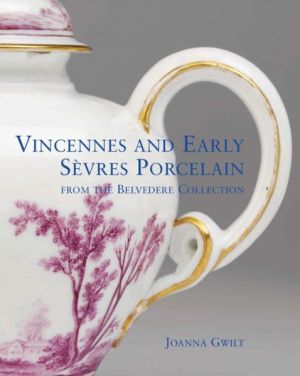 The opulent wares of the renowned Sèvres manufactory are prominently displayed in palaces and art galleries throughout the world. By contrast, the comparative delicacy and simplicity of the beautiful wares of the Vincennes porcelain works, from which the Sèvres factory evolved, remain relatively unknown, even to porcelain experts, who will find much that is alluring and surprising in this remarkable book. Detailed photographs and lavish illustrations reveal the rich variety of styles and increasingly complex gilding that mark out the products of Vincennes and early Sevres, including such innovations as the introduction of sculptural figures during the late 1740s. Much of these novel designs were initially inspired by the work of leading artists of the time—including François Boucher. The ebook that accompanies the printed version contains additional photographs, showing every piece in close detail, making it perfect for scholars, collectors and enthusiasts.
Joanna Gwilt is a specialist in eighteenth-century French decorative arts and formerly the Assistant Curator at the Royal Collection and also of the Wallace Collection, London. She is the author of French Porcelain for English Palaces: Sèvres from the Royal Collection (2009).
A digital preview is available here»
New Book | Place-making for the Imagination, Strawberry Hill
From Ashgate:
Marion Harney, Place-making for the Imagination: Horace Walpole and Strawberry Hill (Aldershot: Ashgate, 2013), 326 pages, ISBN: 978-1409470045, £50 / $100.
 Drawing together landscape, architecture and literature, Strawberry Hill, the celebrated eighteenth-century ‘Gothic’ villa and garden beside the River Thames, is an autobiographical site, where we can read the story of its creator, Horace Walpole. This ‘man of taste’ created private resonances, pleasure and entertainment—a collusion of the historic, visual and sensory. Above all, it expresses the inseparable integration of house and setting, and of the architecture with the collection, all specific to one individual, a unity that is relevant today to all architects, landscape designers and garden and country house enthusiasts. Avoiding the straightforward architectural description of previous texts, this beautifully illustrated book reveals the Gothic villa and associated landscape to be inspired by theories that stimulate ‘The Pleasures of the Imagination’ articulated in the series of essays by Joseph Addison (1672–1719) published in The Spectator (1712). Linked to this argument, it proposes that the concepts behind the designs for Strawberry Hill are not based around architectural precedent but around eighteenth-century aesthetics theories, antiquarianism and matters of ‘Taste’.
Using architectural quotations from Gothic tombs, Walpole expresses the mythical idea that it was based on monastic foundations with visual links to significant historical figures and events in English history. The book explains for the first time the reasons for its creation, which have never been adequately explored or fully understood in previous publications.
The book develops an argument that Walpole was the first to define theories on Gothic architecture in his Anecdotes of Painting (1762–71). Similarly innovative, The History of the Modern Taste in Gardening (1780) is one of the first to attempt a history and theory of gardening. The research uniquely evaluates how these theories found expression at Strawberry Hill. This reassessment of the villa and its associated landscape reveals that the ensemble is not so much a part of the conventionally-conceived linear progression of eighteenth-century architectural style but, rather, is an original essay in contemporary aesthetics.
Marion Harney is Director of Studies, Conservation of Historic Gardens and Cultural Landscapes at the University of Bath.
◊ ◊ ◊ ◊ ◊
C O N T E N T S
Preface: Walpole Moves from Strawberry Hill to Connecticut
Introduction: ‘Things Come to Light’: Experiment and Experience, The Philosophical and Cultural Context
1. ‘The Pleasures of the Imagination’: Tropes of Taste
2. ‘Giving an Idea of the Spirit of the Times’: Anecdotes and Antiquarianism
3. ‘I Am Going to Build a Little Gothic Castle at Strawberry Hill’: Creation of a Seat, part 1
4. ‘The Art of Creating Landscape’: Creation of a Seat, part 2
Epilogue: ‘A Genius is Original, Invents. Taste Selects, Perhaps Copies with Judgement’
Call for Panel Proposals | CAA in Washington, D.C., 2016
From the College Art Association:
104th Annual Conference of the College Art Association
Washington, D.C., 3–6 February 2016
Proposals due by 12 September 2014
The CAA 104th Annual Conference will take place February 3–6, 2016, in Washington, DC. The Annual Conference Committee invites session proposals that cover the breadth of current thought and research in art, art and architectural history, theory and criticism, pedagogical issues, museum and curatorial practice, conservation, and developments in technology. Deadline: Friday, September 12, 2014. In order to submit a proposal, you must be a current CAA member. For full details on the submission process for the conference, please review the information available here.
Call for Papers | Political, Religious, and Aesthetic Transgressions
As noted at H-ArtHist:
LUCAS International Graduate Conference 2015
Breaking the Rules! Cultural Reflections on Political, Religious, and Aesthetic Transgressions
Leiden University Center for the Arts in Society, 29–30 January 2015
Proposals due by 15 October 2014
Society, religion and art have always been defined and governed by certain (un-)written rules. Yet there have always been those who willingly transgressed communal norms. Throughout history, from Antiquity, through the Middle Ages, up to the present day, these transgressors have met with either praise or disapproval. Some have been heralded as heroes, great thinkers or revolutionary artists, while others have been branded as exiles, sinners or outcasts. In Greek mythology, Prometheus was punished for defying the Gods and gifting humanity with fire; Christianity, Judaism and Islam condemn Adam and Eve’s transgression of divine command. The legacy of prominent rule-breakers, such as Socrates, Jeanne d’Arc, Pablo Picasso and Martin Luther King, can still be felt today.
This multi-disciplinary conference focuses on the wide range of cultural reflections on the violation of laws, traditions and conventions in the political, religious and aesthetic domains. Central questions, applicable to all three domains, include: Who breaks the rules? What are the aims of the offender: identification, protest or innovation? How can the authority of rules be undermined? How has transgression been perceived through the ages? Is the rule breaker punished or praised? To what extent is an act of rule breaking a confirmation of the existence of certain rules? What role does gender play in rule breaking? How do various cultures define transgression?
Papers in the political domain may focus on artistic perspectives on social taboos, the ethics of rule breaking, revolt, emancipation, disobedience, identity through rule breaking, the absence of rules (anarchy, freedom), protest through art or any other topic related to this domain. Papers in the religious domain may deal with cultural perspectives on the various aspects of religious rule breaking, such as sin, confession, penance, damnation, redemption, heresy and inquisition, as well as iconoclasm and idolatry. Other topics include, but are not limited to, sin as a political instrument, religious taboos and forbidden pleasures. Papers in the aesthetic domain may focus on boundaries of what is considered to be art, changing perceptions of beauty/ugliness in art, deviations from stylistic conventions and artistic traditions, plagiarism, the tension between resisting convention and embracing innovation or any other topic related to this domain. Creative and engaging ideas which fall outside the three domains described above will also be considered.
The LUCAS Graduate Conference aims to reflect the institute’s interdisciplinary and international character. As such, this two-day conference will provide a platform for PhD students in the humanities, from Leiden as well as other universities in the Netherlands and abroad, to present and exchange their ideas in an international and interdisciplinary environment. The organising committee invited two internationally renowned senior academics from different disciplines to act as keynote speakers, participate in the discussions and provide feedback to the papers presented at the conference.
Confirmed Keynote Speakers
Lorraine Daston, Professor and Executive Director of the Max Planck Institute for the History of Science (MPIWG) in Berlin
Barbara H. Rosenwein, Professor of History at Loyola University Chicago
Proposals
The LUCAS Graduate Conference welcomes papers from all disciplines within the humanities. The topic of your proposal may address the concept of rule breaking/transgression from a cultural, historical, classical, artistic, literary, cinematic, political, economic, religious or social viewpoint. Possible themes for papers may revolve around, but are not limited to, the following concepts:
• Heresy, Agnosticism, Sin, Adultery, Immorality, Redemption
• Rebellion, Revolt, Revolution, Conflict, Anarchy, Emancipation
• Corruption, Criminality, Outlawry, Oath Breaking
• Innovation, the Sublime, Supernaturalism, Ugliness, Obscenity
• Illegal Migration, Crossing Borders, Exile, Nomadism, Exclusion
• Cultural or Sexual Hybridity, Creolization
• Exoticism, Orientalism, Barbarism, Savagism
Please send your proposal (max. 300 words) to present a 20-minute paper along with a brief bio (150 words) before 15 October, 2014 to lucasconference2015@gmail.com. You will be notified whether or not your paper has been selected by 1 November, 2014. Should you have any question regarding the conference and/or the proposal, please do not hesitate to contact the organizing committee at the same email address. The conference website can be found here. A selection of papers will be published as conference proceedings in the Journal of the LUCAS Graduate Conference. For those who attend the conference, there will be a registration fee of €50 to cover the costs of lunches, coffee breaks, excursions and other conference materials. Unfortunately, we cannot offer financial support for travel or accommodation expenses.
The Organizing Committee
Nouzha Baba
Cui Chen
Katarzyna Durys
Wieneke Jansen
Thijs Porck










 Enfilade
leave a comment