New Book | Style and Satire: Fashion in Print, 1777–1927
From Artbooks.com:
Catherine Flood and Sarah Grant, Style and Satire: Fashion in Print, 1777–1927 (London: V&A Publishing, 2014), 80 pages, ISBN: 978-1851778034, £13 / $20.
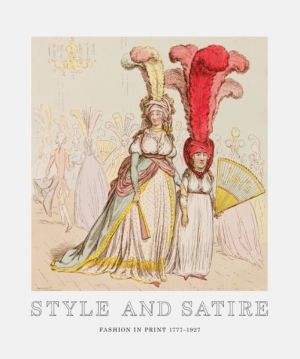 From the sky-high coiffures of Marie Antoinette to Victorian hoop skirts, from the sheer gowns of Pride and Prejudice era to the flat-chested 1920s flapper, Style and Satire tells the story of European fashion and its most extreme trends through lavish fashion plates and the glorious satirical prints they inspired.
Beautifully printed, hand-colored fashion plates first appeared in magazines and for sale individually in the late 18th century. At the same time (and often by the same artists), satirical prints gloried in the absurdities of fashion, presenting an alternative, often humorously exaggerated, vision of the fashionable ideal. Both forms were a product of the same print market, and both documented modern life. Lavishly illustrated, Style and Satire presents a witty and original history of fashion trends.
Catherine Flood is a prints curator, and Sarah Grant is a curator in the Word and Image Department of the V&A.
A digital preview is available here»
New Book | Wallpaper in Ireland, 1700–1900
As noted in Wallpaper News, Issue #5 (September 2014), an occasional newsletter edited by Robert Kelly, Churchill House Press has recently published this book by David Skinner, with proceeds benefitting the Irish Georgian Society:
David Skinner, Wallpaper in Ireland, 1700–1900 (Churchill House Press, 2014), 216 pages, ISBN: 978-0955024672, €45 / £35.
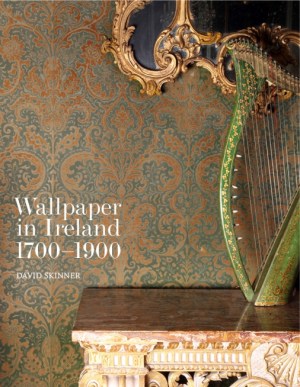 This lavishly illustrated book is the first devoted to the subject of the manufacture and use of wallpaper in Ireland. Drawing on his extensive experience both as a maker and a researcher of historic wallpapers, David Skinner has compiled a detailed survey of the patterns used to decorate Irish houses from the early eighteenth century until the demise of the Irish ‘paper-staining’ trade at the close of the nineteenth century. Journals, letters, invoices and newspaper advertisements are among the sources explored to chart the history of wallpaper in Ireland, the role of emigrant Irish artisans in developing wallpaper manufacture in France and North America, the tax on wallpaper, and the trade in smuggled wallpaper between Ireland and Victorian England.
The book will provide an invaluable guide to researchers, architects and those involved in the study of historic interiors. Many of the rooms illustrated are published here for the first time, and include little-known examples of the sumptuous wallpapers imported from China and France, set alongside the
products of native ‘paper-stainers’.
Robert O’Byrne provides a brief review in The Irish Times
(5 July 2014).
Exhibition | Wallpaper from the Deutschen Tapetenmuseums
As noted in Wallpaper News, Issue #5 (September 2014), an occasional newsletter edited by Robert Kelly:
Wandlust: Schaufenster Deutsches Tapetenmuseum
Westpavillon der Orangerie, Kassel 17 July 2014 — 28 June 2015
Mit der Ausstellung Wandlust lädt das Deutsche Tapetenmuseum zu einem Gang durch die Geschmacksgeschichte ein. Aus der international beachteten Sammlung wird eine Auswahl an Papiertapeten und Musterbüchern vom Rokoko bis zu aktuellen Trends gezeigt und mit zeitgenössischem Mobiliar kombiniert. Neben Meisterleistungen des 18. und 19. Jahrhunderts aus Frankreich, wie einer Arabesken- und Panoramatapete, wird auch Kassel mit einem Biedermeierdekor aus der einstigen Arnold’schen Tapetenfabrik und einem Exemplar der 1972 von Niki de Saint Phalle für die documenta 5 entworfenen Künstlertapete „Nana“ als traditionsreicher Tapeten- und Documenta-Standort gewürdigt.
Die Veränderungen oder sogar Wiederholungen der Motive im Laufe der Geschichte können in der Schau gut nachvollzogen werden. Klassische Muster des 18. und 19. Jahrhunderts sind ebenso vertreten wie die charakteristischen zarttonigen Dessins der Fifties oder die psychedelischen Farben der Seventies. Abschließend hat der Besucher Gelegenheit, in aktuellen Musterbüchern zu blättern. Diese eröffnen ihm neben modernen Kreationen auch facettenreiche „Retro“-Trends, deren historische Vorbilder in der Ausstellung aufgespürt werden können. Dabei können Wiederaufnahmen der Geschmacksgeschichte entdeckt werden, die vielleicht an die eigene Wohnvergangenheit erinnern.
New Book | Material Goods, Moving Hands
From Manchester University Press:
Kate Smith, Material Goods, Moving Hands: Perceiving Production in England, 1700–1830 (Manchester: Manchester University Press, 2014), 208 pages, ISBN: 978-0719090677, £70 / $105.
 In eighteenth-century Britain, greater numbers of people entered the marketplace and bought objects in ever-greater quantities. As consumers rather than producers, how did their understandings of manufacturing processes and the material world change?
Material Goods, Moving Hands combines material culture and visual culture approaches to explore the different ways in which manufacturers and retailers presented production to consumers during the eighteenth century. It shows how new relationships with production processes encouraged consumers, retailers, designers, manufacturers and workers to develop conflicting understandings of production. Objects then were not just markers of fashion and taste, they acted as important conduits through which people living in Georgian Britain could examine and discuss their material world and the processes and knowledge that rendered it.
Kate Smith was a Research Fellow on The East India Company at Home, 1757–1857, a 3-year Leverhulme Trust-funded research project based in the Department of History at the University of Warwick (2011–12) and University College London (2012–14).
She is now Lecturer in Eighteenth-Century History at the
University of Birmingham.
◊ ◊ ◊ ◊ ◊
C O N T E N T S
Introduction
1. New ways of looking
2. Visual access to production
3. Listening in to the manufacturing world
4. Picturing production and embodying knowledge
Conclusion
Bibliography
Index
New Book | Art, Artisans, and Apprentices
From Oxbow Books:
James Ayres, Art, Artisans, and Apprentices: Apprentice Painters and Sculptors in the Early Modern British Tradition (Oxford: Oxbow Books, 2014), 536 pages, ISBN: 978-1782977421, £35.
 Before the foundation of academies of art in London in 1768 and Philadelphia in 1805, most individuals who were to emerge as artists trained in workshops of varying degrees of relevance. Easel painters began their careers apprenticed to carriage, house, sign, or ship painters, whilst a few were placed with those who made pictures. Sculptors emerged from a training as ornamental plasterers or carvers. Of the many other trades in a position to offer an appropriate background were ‘limning’, staining, engraving, surveying, chasing, and die-sinking. In addition, plumbers gained the right to use oil painting and, for plasterers, the application of distemper was an extension of their trade. Central to the theme of this book is the notion that, for those who were to become either painters or sculptors, a training in a trade met their practical needs. This ‘training’ was of an altogether different nature to an ‘education’ in an art school. In the past, prospective artists were offered, by means of apprenticeships, an empirical rather than a theoretical understanding of their ultimate vocation.
James Ayres provides a lively account of the inter-relationship between art and trade in the late 17th to early 19th centuries, in both Britain and North America. He demonstrates with numerous, illustrated examples, the many cross-overs in the ‘art and mystery’ of artistic training, and, to modern eyes, the sometimes incongruous relationships between the various trades that contributed to the blossoming of many artistic careers, including some of the most illustrious names of the ‘long 18th century’.
More information is available here»
◊ ◊ ◊ ◊ ◊
C O N T E N T S
Acknowledgements
Introduction
I. Crafts, Trades, Artisans, and Guilds
1. Art and mystery
2. The guilds and livery companies
3. Guild regulation and training
4. Indentured apprenticeships
5. The craft trades and the visual arts
II. Painters
6. The art of picture craft
7. The materials of painters
8. Painter stainers
9. The painters: mechanic and liberal
10. Easel painting
11. The trade of painting in oil: House and decorative painting, Sign painting and making, Coach painting, Marine painting
12. Size painting: Stained hangings, Stained transparencies, Scene painting for the theatre, The plasterers
13. Limning and watercolour painting
III. Sculptors, Carvers, and Related Trades
14. Sculpture
15. Modelling and casting in plaster: Modelling in clay, Casting in plaster
16. The pointing machine
17. Carving: Woodcarving, Stone and marble carving
18. Metalwork and related trades: The foundry, Chasers and chasing, Die-sinking and seal-cutting
IV. Academies of Art and the Foundations of Artistic Professions
19. The origin and function of academies of art
20. Conclusion
Appendices
I. Indenture of 1788: Isaac Dell
II. Advertisement for a Stationer and Picture Dealer, c. 1750–1759
III. Samuel Wale (?–d. 1786) as sign painter
IV. Charles Catton (1728–1798) ‘The Prince of Coach Painters’
V. John Baker RA (1736–1771), coach painter
VI. Luke (Marmaduke) Cradock (1660–1717) the ‘Ornamental Painter’
VII. Sign painting in Colonial and early Federal America
VIII. Prices of house painters’ work of 1799
IX. Stained hangings: early seventeenth and eighteenth century
X. A sampling of individual painters or sculptors who left the English Provinces for Apprenticeships in London, Westminster, or Southwark
XI. Some of the many woodcarvers who later worked in stone and marble
XII. The construction of an armature in John Flaxman’s studio
XIII. Prices in 1797 for ship-carving on Royal Navy vessels in relationship to tonnage
XIV. Price list for lead statuary
XV. Some members of the St Martin’s Lane Academy
XVI. Proposed accommodation and prospectus for the Royal Academy Schools
XVII. Part of Gustav Waagen’S (1794–1868) evidence before the Select Committee of the House of Commons in 1834, on the value of Academies of Art
Glossary
Bibliography
Index
New Book | Art and Migration: Netherlandish Artists on the Move
From Brill:
Frits Scholten, Joanna Woodall and Dulcia Meijers, eds., Art and Migration: Netherlandish Artists on the Move, 1400–1750 (Brill, 2014), 384 pages, ISBN: 978-9004270534, €120 / $154. [Netherlands Yearbook for History of Art / Nederlands Kunsthistorisch Jaarboek 63 (2013)]
 Since the Middle Ages artists from the Low Countries were known to be fond of travelling, as Guicciardini in his Descrittione di tutti i Paesi Bassi (Antwerp, 1567) and Karel van Mander in his 1604 Schilderboeck, already noticed. Much more mobile than their colleagues from other European countries, many Netherlandish artists spread all over Europe; a remarkable number among them achieved great fame as court artists, as the careers of Claus Sluter in Burgundy, Anthonis Mor in Spain, Bartholomeus Spranger or Adriaen de Vries in Prague, Giambologna and Jacob Bijlevelt in Florence demonstrate. Moreover, they exerted considerable influence on the artistic production of their time. Nevertheless, most of them sank into oblivion soon after they died. Dutch art history neglected them for a long time as they did not fit into the traditional canon of the Low Countries; nor were they adopted by the art histories of their new homelands. This new NKJ volume is an
attempt to change this.
C O N T E N T S
1. Frits Scholten and Joanna Woodall, Introduction
2. Filip Vermeylen, Greener pastures? Capturing artists’ migrations during the Dutch Revolt
3. Hope Walker, Netherlandish immigrant painters and the Dutch reformed church of London, Austin Friars, 1560–1580
4. Arjan de Koomen, ‘Una cosa non meno maravigliosa che honorata’: The expansion of Netherlandish sculptors in sixteenth-century Europe
5. Franciszek Skibiński, Early-modern Netherlandish sculptors in Danzig and East-Central Europe: A study in dissemination through interrelation and workshop practice
6. Aleksandra Lipińska, Eastern outpost: The sculptors Herman Van Hutte and Hendrik Horst in Lviv, c. 1560–1610
7. Gert Jan van der Sman and Bouk Wierda, Wisselend succes: De loopbanen van Nederlandse en Vlaamse kunstenaars in Florence, 1450–1600
8. Marije Osnabrugge , From itinerant to immigrant artist: Aert Mytens in Naples
9. Abigail D. Newman, Juan de la Corte in Madrid: ‘branding’ Flanders abroad
10. Judith Noorman, A fugitive’s success story: Jacob van Loo in Paris, 1661–1670
11. Isabella di Lenardo, Carlo Helman, merchant, patron and collector, and the role of family ties in the Antwerp–Venice migrant network
12. Saskia Cohen-Willner, Between painter and painter stands a tall mountain: Van Mander’s Italian Lives as a source for instructing artists in the ‘deelen der consten’
Exhibition | Habsburg Splendor
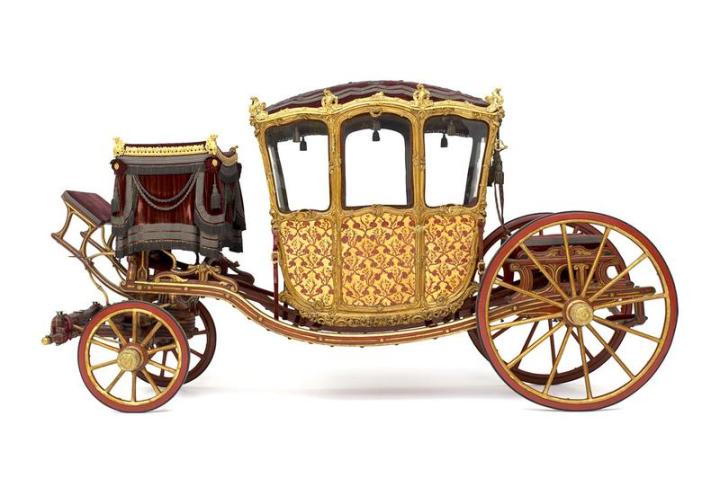
The Prince’s Dress Carriage, ca. 1750–55
(Vienna: Kunsthistorisches Museum)
◊ ◊ ◊ ◊ ◊
It’s still too early to get a good sense of what’s included from the eighteenth century, but we’re sure to hear lots more about the exhibition in the coming months, particularly if you live anywhere near Minneapolis, Houston, or Atlanta. It really should be an extraordinary show. –CH
Press release (18 April 2014) from the MFAH:
Habsburg Splendor: Masterpieces from Vienna’s Imperial Collections
Minneapolis Institute of Arts, 15 February — 10 May 2015
Museum of Fine Arts, Houston, 14 June — 13 September 2015
High Museum of Art, Atlanta, 18 October 2015 — 17 January 2016
Curated by Monica Kurzel-Runtscheiner
In 2015, a major American collaboration will bring masterworks amassed by one of the longest-reigning European dynasties to the United States. Habsburg Splendor: Masterpieces from Vienna’s Imperial Collections showcases masterpieces and rare objects from the collection of the Habsburg Dynasty—the emperors of the Holy Roman Empire and other powerful rulers who commissioned extraordinary artworks now in the collection of the Kunsthistorisches Museum in Vienna. The exhibition, largely composed of works that have never traveled outside of Austria, will be on view at the Minneapolis Institute of Arts (MIA); the Museum of Fine Arts, Houston (MFAH); and the High Museum of Art, Atlanta.
Debuting in Minneapolis in February 2015 before traveling to Houston and Atlanta, Habsburg Splendor: Masterpieces from Vienna’s Imperial Collections explores the dramatic rise and fall of the Habsburgs’ global empire, from their political ascendance in the late Middle Ages to the height of their power in the 16th and 17th centuries, the expansion of the dynasty in the 18th and 19th centuries to its end in 1918 with the conclusion of World War I. The 93 artworks and artifacts that tell the story include arms and armor, sculpture, Greek and Roman antiquities, court costumes, carriages, decorative-art objects, and paintings by such masters as Correggio, Giorgione, Rubens, Tintoretto, Titian, and Velázquez. Key masterpieces that have never before traveled to the United States include:
• The Crowning with Thorns (c. 1602/04) by Caravaggio
• A portrait of Jane Seymour (1536), Queen of England and third wife to Henry VIII, by Hans Holbein the Younger
• Jupiter and Io (c. 1530/32) by Correggio . . . .
Habsburg Splendor: Masterpieces from Vienna’s Imperial Collections chronicles the Habsburgs’ story in three chapters, each featuring a three-dimensional “tableau”—a display of objects from the Habsburgs’ opulent court ceremonies—as context for the other works on view.
D A W N O F T H E D Y N A S T Y
The first section features objects commissioned or collected by the Habsburgs from the 13th through the 16th centuries. In this late medieval/early Renaissance period, Habsburg rulers staged elaborate commemorative celebrations to demonstrate power and to establish their legitimacy to rule, a tradition that flourished during the reigns of Maximilian I and his heirs. Works from this era—including sabres and armor, tapestries, Roman cameos and large-scale paintings—illustrate the significance of war and patronage in expanding Habsburg influence and prestige.
Tableau: Suits of armor displayed on horseback, and jousting weapons from a royal tournament.
Highlights include:
• Armor of Emperor Maximilian I (c. 1492) made by Lorenz Helmschmid
• Bronze bust of Emperor Charles V (c. 1555) by Leone Leoni
• A rock crystal goblet made for Emperor Frederick III (1400–1450)
G O L D E N A G E
The second and largest section of the exhibition highlights the apex of Habsburg rule, the Baroque Age of the 17th and 18th centuries. The dynasty used religion, works of art and court festivities to propagate its self-image and claim to rule during this politically tumultuous time. Paintings by Europe’s leading artists demonstrate the wealth and taste of the Habsburg rulers, while crucifixes wrought in precious metals and gems, as well as sumptuous ecclesiastical vestments, reflect the emperor’s role as defender of the Catholic faith.
Tableau: A procession featuring a Baroque ceremonial carriage and sleigh, with carvings by master craftsman Balthasar Ferdinand Moll.
Highlights include:
• An ivory tankard (1642) by Hans Jacob Bachmann
• Infanta Maria Teresa (1652–53), a portrait of the daughter of Philip IV of Spain and eventual wife of Louis XIV of France, by Velázquez
• An alchemical medal (1677), illustrated with portraits in relief of the Habsburgs, by Johann Permann
T W I L I G H T O F T H E E M P I R E
The exhibition concludes with works from the early 19th century, when the fall of the Holy Roman Empire gave rise to the hereditary Austrian Empire—a transition from the ancien régime to a modern state in which merit determined distinction and advancement. Franz Joseph, who would reign longer than any previous Habsburg, saw the growth of nationalism and ultimately ruled over a dual monarchy of Austria-Hungary. As heir to the Habsburg legacy—and in the spirit of public education and enrichment—he founded the Kunsthistorisches Museum in 1891. Reflecting the modernization of the Habsburg administration, the exhibition ends with a spectacular display of official court uniforms and dresses.
Tableau: Uniforms and women’s gowns from the court of Franz Joseph.
Highlights include:
• Campaign uniform of Franz Joseph (1907)
• A velvet dress made for Empress Elisabeth (c. 1860/65)
• An evening gown made for Princess Kinsky (c. 1905)
• Ceremonial dress of Crown Prince Otto for the Hungarian Coronation (1916)
The exhibition is curated by Dr. Monica Kurzel-Runtscheiner, director of the Imperial Carriage Museum, Vienna. The hosting curator at the Minneapolis Institute of Arts is Kaywin Feldman, director. At the Museum of Fine Arts, Houston, the lead hosting curator is Dr. David Bomford, director of conservation; his curatorial team comprises Dr. Helga Aurisch, curator, European art, and Christine Gervais, associate curator, decorative arts and Rienzi. At the High Museum of Art, the hosting curator is Dr. David A. Brenneman, director of collections and exhibitions and Frances B. Bunzl Family Curator of European art.
A full-color catalogue is being published by the Museum of Fine Arts, Houston, with essays by Dr. Monica Kurzel-Runtscheiner, director of the Imperial Carriage Museum, Vienna; Dr. Franz Pichorner, deputy director, Kunsthistorisches Museum, Vienna; and Dr. Stefan Krause, curator of arms and armor, Kunsthistorisches Museum. Additionally, a virtual exhibition of additional pieces will be viewable online, deepening the visitor experience and providing further opportunities for the public to engage with the art and its history.
A Brief History of the Habsburgs
The noble House of Habsburg rose to prominence in the late Middle Ages through strategic marriages, political alliances and conquest. In 1273, count Rudolph IV gained control of Germany as King of the Romans, and Habsburg domains continued to grow leading up to Pope Nicholas V’s coronation of Frederick III as Holy Roman Emperor in 1452. Under Frederick’s son Maximilian I and his successor, Charles V, the Habsburgs achieved world-power status, assuming the title of emperor without papal consent and enfolding Spain and Burgundy into the Habsburg-controlled territories. The dynasty split into Spanish and Austrian branches shortly thereafter, and in the 17th and 18th centuries the male lines died out, resulting in the loss of Spain.
In 1740, Maria Theresa—the sole female Habsburg ruler, who reigned for a remarkable 40 years—seized control of the Austrian line to become the final ruler of the House of Habsburg. The early 19th century witnessed the final demise of the Holy Roman Empire and the establishment of the main Habsburg line’s successors: the House of Habsburg-Lorraine. A hundred years later, in 1916, Emperor Charles I inherited a dual Austro-Hungarian monarchy upon the death of longtime Emperor Franz Joseph. More than 600 years of Habsburg sovereignty came to an end in 1918 with the close of World War I.
◊ ◊ ◊ ◊ ◊
Scheduled for February publication with distribution by Yale UP:
Monica Kurzel-Runtscheiner, Franz Pichorner, and Stefan Krause, Habsburg Splendor: Masterpieces from Vienna’s Imperial Collections (New Haven: Yale University Press, 2015), 296 pages, ISBN: 978-0300210866, $60.
This beautiful book tells the fascinating story of the Habsburg dynasty, which ruled most of central Europe, Spain, Belgium, and parts of Italy for nearly six hundred years, from the 15th through the 20th century. Charles V (1500–1558) once remarked that the sun never set on the Habsburg Empire, and for most of its history, Vienna served as its capital. The Habsburgs were acclaimed collectors and generous patrons of the arts. Franz Joseph I (1830–1916), the penultimate emperor of the dynasty, created the Kunsthistorisches Museum in Vienna to house the artistic treasures of the empire. Today, this museum possesses one of the most renowned collections in the world of Western art. An extraordinarily wide-ranging survey of the Habsburgs’ collections, this volume features classical Greek and Roman works, medieval arms and armor, tapestries, early modern painting and craftwork, ceremonial gilded carriages, and opulent costumes. Together, they reveal the splendor and the spectacle of the Habsburg court.
Copyright © artdaily.org
Copyright © artdaily.org
Copyright © artdaily.org
“Habsburg Splendor: Masterpieces from Vienna’s Imperial Collections” showcases masterpieces and rare object
Conference | Scholars’ Monuments
From Vienna’s Institut für Kunstgeschichte:
Scholars’ Monuments: Historical Meaning and Cultural Significance
Institut für Kunstgeschichte, Universität Wien, Vienna, 24–26 September 2014
Registration due by 17 September 2014
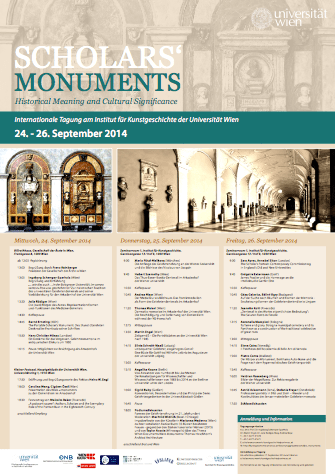 Der Arkadenhof der Universität Wien stellt mit seinen über 150 Gelehrtendenkmälern eine der größten und qualitätsvollsten Ehrenhallen Europas dar. Aus welcher Tradition heraus entstand dieser akademische Gedenkort? Welche Repräsentationsformen nutzten die Künstler, um die Wissenschaftler zu charakterisieren? Und welche zeitgemäße Darstellungsform eignet sich zur überfälligen Ehrung von weiblichen Gelehrten?
Im Rahmen dieser internationalen Tagung am Institut für Kunstgeschichte werden aktuelle, kunst- und kulturhistorische Forschungspositionen zu Gelehrtendenkmälern zusammengetragen und im Spiegel des Arkadenhofs der Wiener Universität reflektiert. Die Tagungsbeiträge nähern sich der Gelehrtenmemoria aus unterschiedlichen methodischen Richtungen und Disziplinen (Kunstgeschichte, Zeitgeschichte, Wissenschaftsgeschichte, cultural memory studies, gender studies). In diesem Rahmen wird nicht nur die Tradition universitärer Ehrenhallen als Funktionsgedächtnis sichtbar, sondern anhand der Auswahl (und Ausgrenzung) von WissenschaftlerInnen lassen sich zeit- und wissenschaftshistorische Konflikte aufdecken. Diese zeigen sich besonders markant bei politisch-ideologisch und gender-spezifisch motivierter Ausgrenzung. So beleuchtet die Tagung nicht nur die lange Wissenschaftstradition der Universität Wien, sondern wirkt mit ihrem Interesse für die Zukunft dieses Gedenkorts auch identitätsstiftend für die scientific community des 21. Jahrhunderts.
Um Anmeldung wird gebeten unter scholarsmonuments.kunstgeschichte@univie.ac.at.
◊ ◊ ◊ ◊ ◊
M I T T W O C H , 2 4 S E P T E M B E R
12:00 Registrierung
13:00 Begrüßung durch Franz Kainberger, Präsident der Gesellschaft der Ärzte in Wien
13:05 Ingeborg Schemper-Sparholz (Wien), Begrüßung und Einführung „… wie dies auch …in der Bologneser Universität, im campo santo zu Pisa usw. geschehen ist.“ Zur italienischen Tradition des universitären Gelehrtendenkmals und seiner Vorbildwirkung für den Arkadenhof der Universität Wien.
13:50 Julia Rüdiger (Wien), Die (zwei) Körper des Arztes. Repräsentationsformen und -funktionen des Medizinerdenkmals
14:30 Kaffeepause
14:45 Bernd Ernsting (Köln), The Portable Scholar’s Monument. Des (Kunst-)Gelehrten Denkmal im Frontispiz seiner Schriften
15:30 Hans Christian Hönes (London), Ein Denkmal für das Vergessen. Gelehrtenmemoria im antiquarischen Diskurs um 1800
16:15 Pause / Möglichkeit zur Besichtigung des Arkadenhofs der Universität Wien
17:30 Eröffnung und Begrüßungsworte des Rektors
18:00 Caroline Mang, Cigdem Özel (Wien), Präsentation des Wikis u:monuments zu den Denkmälern im Arkadenhof
18:30 Festvortrag: Malcolm Baker (Riverside), “A puissant spurre”: Authors, Scholars and the Exemplary Role of the Portrait Bust in the Eighteenth Century
D O N N E R S T A G , 2 5 S E P T E M B E R
9:00 Maria Pötzl-Malikova (München), Die Anfänge der Gelehrtenehrung an der Wiener Universität und die Bildnisse des Nicolaus von Jacquin
9:45 Hubert Szemethy (Wien), Das Thun-Exner-Bonitz-Denkmal im Arkadenhof der Wiener Universität
10:30 Kaffeepause
10:45 Andrea Mayr (Wien), Der Medailleur als Bildhauer. Das Porträtmedaillon als Form des Gelehrtendenkmals im Arkadenhof
11:30 Thomas Maisel (Wien), Damnatio memoriae im Arkadenhof der Universität Wien. Die Beschädigung und Entfernung von Denkmälern während der NS-Herrschaft
12:15 Mittagspause
13:30 Martin Engel (Wien), Zeitgemäß – Die Porträtbüsten an der Universität Wien nach 1945
14:15 Silvia Schmitt-Maaß (Leipzig), Unbequemer Gelehrter, eingehegtes Genie? Eine Büste für Gottfried Wilhelm Leibniz im Augusteum der Universität Leipzig
15:00 Kaffeepause
15:15, Angelika Keune (Berlin), Von Alexander von Humboldt bis Lise Meitner. Denkmalsetzungen für Wissenschaftler und Wissenschaftlerinnen von 1883 bis 2014 an der Berliner Universität Unter den Linden
16:00 Sigrid Ruby (Gießen), Konventionen, Besonderheiten und das Prinzip der Serie: Gelehrtengedenken in der Universitätsstadt Gießen
16:45 Pause
18:00 Podiumsdiskussion: Formen der Gelehrtenehrung im 21. Jahrhundert — Moderation: Mechtild Widrich (Basel/Chicago), Impulsreferate von der Künstlerin Marianne Maderna (Wien) zu ihrer Installation Radical Busts: 33 Büsten berühmter Frauen – gegenüber den Büsten honorierter Männer (2015) und von Taylor Acosta (Minneapolis) über das Thema When Documents Were Monuments: Thomas Hirschhorn’s Archival Architecture
F R E I T A G , 2 6 S E P T E M B E R
9:00 Sara Ayres, Annabel Elton (London), The Scholar’s Portrait: Contemporary Commissioning in England’s Old and New Universities
9:45 Grégoire Extermann (Genf), James Pradier und die Hommage an die intellektuelle Genfer Elite
10:30 Kaffeepause
10:45 Géza Galavics, Bálint Ugry (Budapest), Auf der Suche nach Räumen und Formen der Memoria – Erscheinungsformen der Gelehrtendenkmäler in Ungarn
11:30 Jeanette Kohl (Riverside), „Denkmal in des Wortes eigentlichster Bedeutung“: The Salutati Tomb in
Fiesole
12:15 Antonella Mampieri (Bologna), To Fame and Glory: Bologna Municipal Cemetery and Its Pantheon as a Continuation of the Traditional Celebration of Great Men
13:00 Mittagspause
14:15 Elena Catra (Venedig), Il Pantheon dell’Accademia di Belle Arti di Venezia
15:00 Pietro Conte (Mailand), Der Körper als Monument. Benthams Auto-Ikone und die Frage nach dem hyperrealistischen Gelehrtenporträt
15:45 Kaffeepause
16:00 Heidrun Rosenberg (Wien), Bilder der Magnifizenz. Zur Rektorengalerie der Wiener Universität
16:45 Astrid Ackermann (Jena), Stefanie Freyer (Osnabrück), Professorenporträts in Bild und Stein – Wandel und Kontinuitäten der Jenaer materiellen Gelehrtenmemoria
17:30 Schlussdiskussion
Wedgwood Appeal: Donate to Save the Collection
From Save the Wedgwood Collection:

Josiah Wedgwood, The First Day’s Vase, c.1769 (Wedgwood Museum). Inscribed ‘artes Etruriae renascuntur’ (‘the arts of Etruria are reborn’).
The Wedgwood Collection, one of the most important industrial archives in the world and a unique record of over 250 years of British art, is under threat of being separated and sold off.
The Art Fund now has the opportunity to purchase it for the nation intact, provided the final £2.74m of a total £15.75m fundraising target can be raised by 30 November 2014. This is the only chance to keep the collection in one piece and on public display, preserving this unique record of British history and global commerce.
The collection is the major asset of the Wedgwood Museum Trust, which inherited £134m of pension debt as a result of the UK subsidary of Waterford Wedgwood Plc going into administration in 2009. The debt transferred from company to Trust because the two had been linked through a shared pension fund. Although the Pension Protection Fund (PPF)—the industry body set up by the government to compensate individual pensioners in the event of a company insolvency—will absorb the liability, it has a duty to claw back as much as it can from sale of assets.
In December 2011 the High Court ruled that the Wedgwood Collection was indeed an asset of the Wedgwood Museum Trust that should be sold in order to repay some of the debt owed, and in March 2012 the Attorney General upheld this ruling. Since then, the Art Fund and other partners have looked at all options to prevent the Collection from being broken up and sold on the open market. However, after exploring several avenues, all parties have now agreed that the only option is for the Art Fund to raise the necessary funds to purchase the Collection on behalf of the nation. In order to protect the Collection from ever being at risk again, if the money can be raised, the Art Fund plans to gift it to the Victoria & Albert Museum, the national museum of art and design. Without needing to move it, but with its ownership secure in perpetuity, the V&A intends to assign it on long-term loan to the Wedgwood Museum at Barlaston, which will lie at the heart of a major new visitor experience as part of Waterford Wedgwood Royal Doulton’s (WWRD) £34m redevelopment of the site—set for completion in spring 2015.
The Art Fund has launched an appeal to raise the full £15.75m needed for the purchase, in order to keep this irreplaceable Collection together and on display. Thanks to major support from the Heritage Lottery Fund, the Art Fund and a number of private trusts and foundations, over £13m has already been raised. The campaign has until 30 November to find the remaining £2.74m necessary to purchase—and save—the Collection.
The future of the remarkable Wedgwood Collection has never looked brighter—provided the funds can be raised.
Donate to the appeal online or text WEDGWOOD to 70800 to give £10.
Mark Brown’s coverage for The Guardian (1 September 2014) is available here»
A. N. Wilson’s essay “Wedgwood: The Legacy Must Live On” appears in the Autumn 2014 issue of Art Quarterly and is also available at Save the Wedgwood Collection (4 September 2014).
Exhibition | Pehr Hilleström: The 18th Century Observed

Pehr Hilleström, Three Women Telling Fortune in Coffee, 1780s, 80 x 110cm
(Stockholms universitets konstsamling, J. A. Berg Collection #158)
◊ ◊ ◊ ◊ ◊
From The Sinebrychoff Art Museum:
Pehr Hilleström: The 18th Century Observed / Välähdyksiä 1700-luvun elämästä
The Sinebrychoff Art Museum, Helsinki, 4 September 2014 — 11 January 2015
Curated by Mikael Ahlund
The life of the bourgeoisie in Stockholm in the Age of Enlightenment will be on display in the Sinebrychoff Art Museum. The paintings of the Swedish artist Pehr Hilleström (1732−1816) give us a unique view directly of ordinary life in the 18th century, of how the bourgeoisie lived in Stockholm. Hilleström portrayed the whole strata of life in the Gustavian period: the life and ceremonies of the court, idle young ladies in elegant drawing rooms, servant girls carrying on with their domestic tasks, theatre, peasant culture, foundries and mines. Fifty paintings representing his most important topics will be on display. Pehr Hilleström’s work has never been exhibited this widely in Finland. The exhibition has been created in cooperation with the Nationalmuseum of Stockholm.
Exhibition publication: Mikael Ahlund, Pehr Hilleström – Välähdyksiä 1700-luvun elämästä | 1700-talet i blickpunkten (editors Kirsi Eskelinen, Reetta Kuojärvi-Närhi).
A selection of high-resolution images are available here»
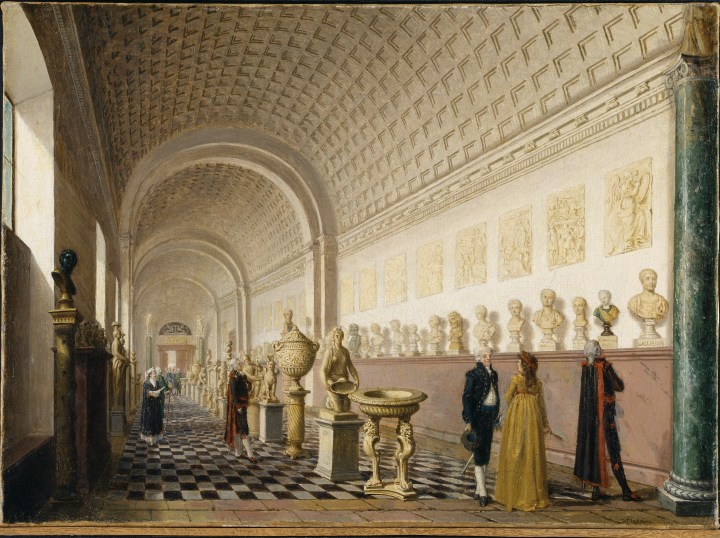
Pehr Hilleström, The Inner Gallery of the Royal Museum at the
Royal Palace, Stockholm, 1796 (Nationalmuseum, Stockholm)
◊ ◊ ◊ ◊ ◊
Press release (1 September 2014) from Stockholm’s Nationalmuseum:
Nationalmuseum has made a major loan of works to the Pehr Hilleström exhibition at the Sinebrychoff Art Museum in Helsinki. The loan comprises some twenty works by this artist best known for his documentary paintings of 18th-century Stockholm.

Pehr Hilleström, Self-Portrait, 1771 (Stockholm: Nationalmuseum; photo by Erik Cornelius)
This is the first time that a Finnish gallery has mounted a comprehensive exhibition of works by the Swedish artist Pehr Hilleström (1732–1816). Nationalmuseum in Stockholm has contributed some twenty paintings by Hillestrom, one of Sweden’s most highly regarded artists of the 18th century. The works on loan include Testing Eggs, Kitchen Scene, Card Game at the Home of Elis Schröderheim, Public Banquet at Stockholm Castle New Year’s Eve 1779, plus two self-portraits and an enigmatic portrait of Carl Michael Bellman. In all, fifty of Hilleström’s best-known paintings are on display. The exhibition was planned by Nationalmuseum’s Mikael Ahlund, who also wrote the commentary for the accompanying book.
Pehr Hilleström portrayed the entire spectrum of life in the Gustavian era, from idle young ladies in elegant drawing rooms to industrious working-class wives going about their domestic chores. He is famous for his almost documentary depictions of city fires and official ceremonies in 18th-century Stockholm. His wide range of motifs includes industry, landscapes and scenes from the theatre. In his later years, he
also turned to historical and religious motifs.










 Enfilade
leave a comment