Exhibition | Painting Paradise: The Art of the Garden
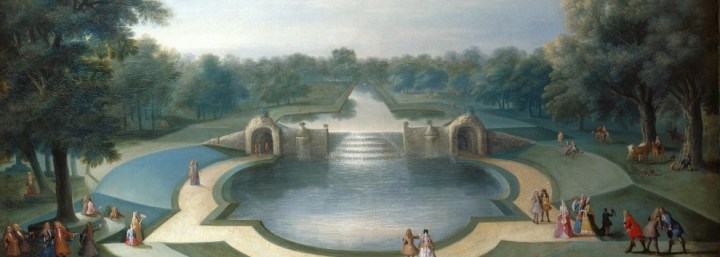
Studio of Marco Ricci, A View of the Cascade, Bushy Park Water Gardens (detail),
ca. 1715 (Royal Collection Trust)
◊ ◊ ◊ ◊ ◊
Press release (9 October 2014) from the Royal Collection Trust:
Painting Paradise: The Art of the Garden
The Queen’s Gallery, Buckingham Palace, 20 March — 11 October 2015
The Queen’s Gallery, Palace of Holyroodhouse, Edinburgh, 5 August 2016 — 26 February 2017
Curated by Vanessa Remington
Whether a sacred sanctuary, a place for scientific study, a haven for the solitary thinker or a space for pure enjoyment and delight, gardens are where mankind and nature meet. A new exhibition at The Queen’s Gallery, Buckingham Palace will explore the many ways in which the garden has been celebrated in art through over 150 paintings, drawings, books, manuscripts and decorative arts from the Royal Collection, including some of the earliest and rarest surviving records of gardens and plants. From spectacular paintings of epic royal landscapes to jewel-like manuscripts and delicate botanical studies, Painting Paradise: The Art of the Garden reveals the changing character of the garden and its enduring appeal for artists from the 16th to the early 20th century, including Leonardo da Vinci, Rembrandt van Rijn and Carl Fabergé.
The idea of an earthly paradise—an enclosed space with orchards, flowing water, shade and shelter—can be traced back to Persia in the 6th century BC. The painted miniature Seven Couples in a Garden, c.1510, from the earliest illustrated Islamic manuscript in the Royal Collection, shows a beautiful Persian garden with an octagonal pool, plane and cypress trees, and elaborately tiled pavilions laid with floral carpets.
Before the 15th century, most European images of gardens appeared in illuminated religious manuscripts. The Book of Genesis, with its references to the Tree of Life, Tree of Knowledge and Four Rivers, provided a framework for artists to create images of Eden, as in Hartmann Schedel’s woodcut of 1493. In Adam and Eve in the Garden of Eden, 1615, Jan Brueghel the Elder relegates the main protagonists and the Tree of Knowledge to the middle distance in an abundant woodland landscape rich in flora and fauna. As court painter to the Habsburg Archdukes Albert and Isabella, Breughel was able to study botanical specimens in the palace garden in Brussels.
Until the 16th century, gardens in paintings and manuscripts remained largely those of the imagination. Henry VIII’s Great Garden at Whitehall Palace, seen in the background of the painting The Family of Henry VIII, c.1545, is the first real garden recorded in British art. By the Renaissance, gardens had become status symbols to be employed in royal propaganda. The wealth of a garden’s owner could be demonstrated through elaborate horticultural features such as obelisks, pergolas, knot designs and topiary. Although in the painting Pleasure Garden with a Maze by Lodewijk Toeput (Pozzoserrato), c.1579–84, the water labyrinth is the artist’s invention, it is inspired by contemporary descriptions of 16th-century Italian formal gardens.
By the 17th century, aristocratic gardens were created on a previously unimaginable scale. The intense rivalry between the French and English kings, Louis XIV and William III, produced two of the largest and most elaborate royal gardens ever made. The exhibition includes a panoramic view by Jean-Baptiste Martin of the French king’s gardens at Versailles, c.1700, and A View of Hampton Court, by Leonard Knyff, c.1702–14, the greatest surviving Baroque painting of an English garden.
With their amphitheatres, cascades and fountains, statuary, exotic birds and aviaries, Baroque gardens offered much to engage artists. The only surviving pair of sundials by the great 17th-century horologist, Thomas Tompion, are shown in the exhibition. The fashion for parterres (ornamental flower gardens) is reflected in An Exact Prospect of Hampton Court, an etching by Sutton Nicholls, c.1700, while A View of Bushy Park Water Gardens by the studio of Marco Ricci, c.1715, shows a large cascade, a rare feature in an English landscape.
By the 18th century, gardens took on a more natural, informal style, inspired in part by the poet John Milton’s romantic description of a wild and untamed Eden in Paradise Lost, 1667. An oil painting of Kew by the Swiss artist Johan Jacob Schalch, 1759, is from a series of views of the gardens designed for Frederick, Prince of Wales by William Kent and William Chambers. The distant pagoda is the only obvious sign of human intervention among the gently sloping hills, grazing sheep and lake.
In the 19th century the garden became a symbol of wholesome and virtuous family life, and a necessary ingredient of ordered domestic harmony. In a portrait of Queen Victoria and Prince Albert by Edwin Landseer, commissioned only two months after their marriage in 1840, the royal couple are set against a view of the East Terrace garden at Windsor Castle. William Leighton Leitch’s 1855 watercolour of the Swiss Cottage, created by Prince Albert for his children in the garden of Osborne House, reflects the informal and private existence enjoyed by the family on the Isle of Wight.
The 16th and early 17th centuries saw the birth of botanical illustration, florilegia (flower books) and still-life painting. Leonardo da Vinci was the first artist to produce true botanical studies, and the exhibition includes a number of exquisite examples by the artist. The only surviving painted flower book from 17th-century England is by the English gardener and botanical artist Alexander Marshal. Produced over a period of 30 years, it includes rare specimens, such as Auriculas (Primula x pubescens), grown only in the finest gardens of the time.
Flower designs on porcelain, silver, furniture and textiles, such as the vine-covered tapestry of a pergola by Jacob Wauters, c.1650, brought the garden inside the home. In the 19th century, the ‘language of flowers’ was translated into precious luxury items, such as the brooch presented by Prince Albert to Queen Victoria in celebration of their betrothal in 1839. In the form of orange blossom, symbolising chastity, it was the first of a suite of flower jewellery given to the Queen over several years. The skill of replicating the charm and beauty of flowers in three-dimensional objects reached new heights in the workshops of Carl Fabergé, the great Russian jeweller and goldsmith. Fabergé’s Bleeding Heart, c.1900, carved in nephrite, rhodonite and quartzite, has its flowers suspended from gold stems, so that they can move gently, as if blown by the wind.
◊ ◊ ◊ ◊ ◊
Published by the Royal Collection and distributed by The University of Chicago Press:
Vanessa Remington, Painting Paradise: The Art of the Garden (London: The Royal Collection Trust, 2015), 312 pages, ISBN: 9781909741089, $75.
 The garden is of perennial interest to artists. Yet, as cultural attitudes toward the garden and how we enjoy it have changed, so too have the ways in which it has been represented in art. From a space for solitary communion with nature to the backdrop for a budding romance, and from a place for scientific study to the source of the foods we eat, Painting Paradise looks at why the garden has remained such a seductive artistic subject.
For centuries, gardens have prompted reflection on the relationship between nature and man. They have also been considered representations of the divine, as in Flemish master Jan Brueghel’s famous Adam and Eve in the Garden of Paradise. Their ability to carry messages about their creator’s status will be clear to all who have had the pleasure of walking the grounds of meticulously manicured palaces or stately homes, but they are also evocative of prevailing cultural values and a desire to better understand, classify, and collect elements of the natural world. By the sixteenth century, artists were also attempting to bring the garden indoors as a source of design elements in the decorative arts, from seventeenth-century Flemish Pergola tapestries to handcrafted flowers from the Russian House of Fabergé.
Tracing these and other themes that attracted the attention of artists from the fifteenth to the early twentieth century, Painting Paradise explores how these ideas came to be expressed in ways characteristic to a particular place and time, including works in both the Eastern and Western traditions. The curator of an accompanying exhibition opening at Buckingham Palace, Vanessa Remington has weeded through the Royal Collection to cultivate a selection of paintings, drawings, manuscripts, tapestries, and jewelry of exceptional value and extraordinary beauty. With more than three hundred color illustrations—including many treasures that have been previously unpublished—the book will be of great interest to artists, art and design historians, and all who find inspiration in the beauty of the garden.
Vanessa Remington is Senior Curator of Paintings, Royal Collection Trust, and the author of several books highlighting its collection, including Victorian Miniatures in the Collection of Her Majesty The Queen.
The Menokin Glass House: A Revolutionary Project
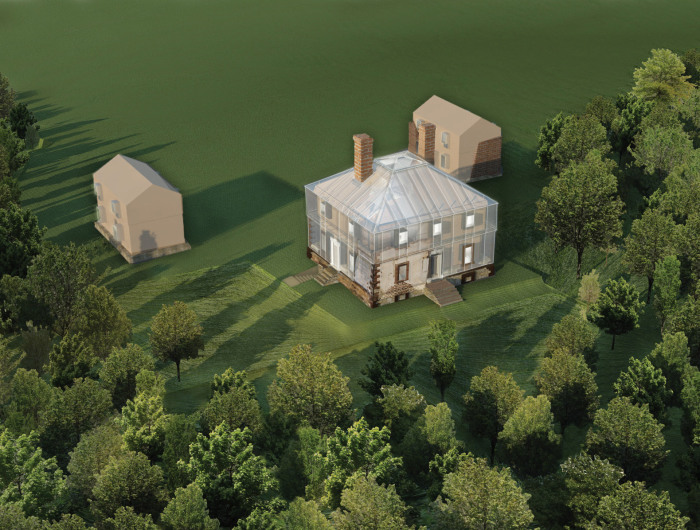
Proposed ‘Glass House’ Restoration for Menokin in Warsaw, Virginia
from the website Menokin: Rubble with a Cause
◊ ◊ ◊ ◊ ◊
From the blog of the National Trust for Historic Preservation:
Meghan O’Connor, “Eighteenth-Century House Ruin to Be Restored…With Glass,” Preservation Nation Blog (3 December 2014).
What some people see when they look at Menokin is a collapsed house, an old ruin, a testament to the perils of ignoring preservation. What the staff and Board at Menokin see, however, is a cutting-edge preservation opportunity.
The Menokin Foundation does not want to restore the house to its original condition. Instead, the Foundation believes Menokin is more valuable to the public in pieces. Menokin was home to Declaration of Independence signer, Francis Lightfoot Lee. The land was given to Lee and his wife Rebecca Tayloe by his father-in-law as a wedding gift. The house was built around 1769. . . .
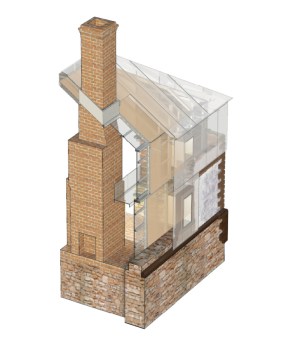
Re-imagining a Ruin: Exterior Structure Cutaway View
Dubbed the “Glass House Project,” the Foundation floated the idea around the preservation community. Pope says, “We started getting really positive responses to it. We got some raised eyebrows, believe me, but we came to [the] consensus that this was an approach worth pursuing.”
To design the Glass House Project, the Foundation hired world-renowned architecture firm Machado and Silvetti Associates in 2012. Designing projects ranging from an addition to the Bowdoin College Museum of Art to the expansion of the Getty Villa, Machado and Silvetti focus on creating contemporary and innovative designs that merge with historic contexts. . . .
The Foundation is currently developing and implementing Phase 1 of the Glass House Project — to build a glass shell around the current remaining structure.
Menokin’s innovation does not just stop at glass. The Foundation’s ultimate goal for the site is to be an internationally known learning and teaching center. In a departure from many historic house museum models, Menokin does not want to focus solely on one story or one time period. The site will not just be a colonial relic, but a place that can have modern implications for, and showcase in a revolutionary way, preservation, history, architecture, and natural resources. . .
Meghan O’Connor is the member services assistant at the National Trust. She enjoys learning, writing, and talking about museums, art, architecture, and anything historic. She worked with Menokin on the museum’s historical interpretation as part of a graduate school class.
◊ ◊ ◊ ◊ ◊
Note (added 15 December 2014) — The original version of this posting included a photo from the original concept team; the current photos comes from the Menokin blog.
Seventeenth- and Eighteenth-Century Funiture, Pegs and ’Tails
For anyone who’s ever dreamed of being able to look over the shoulder of someone who understands eighteenth-century furniture at the level of materials, design, construction, and afterlife, I’m glad to recommend Pegs and ‘Tails, the blog of Jack Plane, a retired antiques dealer and self-taught woodworker, formerly from the UK who now lives in Australia.
His reproduction pieces are fascinating, and he’s especially helpful for things at auction (the good and the bad). His blog includes a fine bibliography, and there’s a book is in the works. –CH
◊ ◊ ◊ ◊ ◊
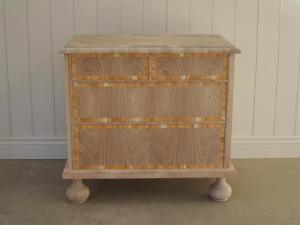
The first chest of drawers is typical of small four-drawer William and Mary chests made around 1695. The carcase is made of pine and veneered with walnut, and the drawer fronts are additionally crossbanded with yew. Jack Plane.
. . . I now believe a monograph on late seventeenth- and eighteenth-century chests of drawers would be a better introduction to those with an interest in case pieces and all manner of furniture from this period. The book’s contents may vary as I work my way through it, but the projected chapters are as follows:
• The Development of the Chest of Drawers
• A William and Mary Walnut Veneered Chest, circa 1695
• A Queen Anne Walnut Veneered Chest, circa 1705
• A George I Virginia Walnut Chest, circa 1720
• A George II Mahogany Chest, circa 1740
• A George III Mahogany Chest, circa 1765
• Reproduction finishing
◊ ◊ ◊ ◊ ◊
The blog began 14 September 2009 with this inspired posting:
It’s on a somewhat gloomy note that I begin this blog…
Q. Traditionally speaking, what are the principal differences between carpenters, joyners and cabinetmakers?
A. Nails, pegs and dovetails!
Sadly, carpenters predominantly employ air-powered ‘phittunks’ these days, joyners have largely disappeared from the vernacular and cabinetmakers assemble built-in bathroom, bedroom and kitchen units from man-made board.
Looking up ‘cabinetmakers’ in the ‘phone directory and Google reveals numerous entries for kitchen fitters and very few makers of fine furniture. It seems makers of fine furniture are now known as ‘woodworkers’—a very unhappy reflection and a far cry from the eighteenth-century heyday when cabinetmakers ranked second only to upholsterers in the furniture trades hierarchy.
This is my blog concerning pegs and dovetails.
Jack Plane.
West 86th, Fall–Winter 2014
The eighteenth century in the current issue of West 86th:
West 86th: A Journal of Decorative Arts, Design History, and Material Culture 21 (Fall–Winter 2014).
Charles Alan Watkins, “The Tea Table’s Tale: Authenticity and Colonial Williamsburg’s Early Furniture Reproduction Program,” pp. 155–91.

The CW-8 Tea Table as it appeared in Kittinger’s 1940 catalogue Colonial Williamsburg Incorporated Approved Reproductions of Furniture by Kittinger Company.
In July 1936 Tomlinson of High Point, a mid-priced North Carolina furniture manufacturer, began a franchising and marketing concept called the Williamsburg Galleries that gained broad national acceptance in stores and among consumers. Outraged by Tomlinson’s actions and unwilling to abandon the retail market to those it felt were interlopers, Colonial Williamsburg set up a subsidiary corporation, Williamsburg Craftsmen, Inc., that licensed manufacturers to create reproductions of objects owned by the Restoration. Furniture was the most important part of the plan, and Williamsburg licensed the Kittinger Company of Buffalo, New York, as the manufacturer. Selected department stores were encouraged to build sales spaces that were period replicas of Raleigh Tavern rooms, and craft shops were developed in the historic area to promote the work of the various manufacturers. Because a number of stores sold both Tomlinson and Kittinger products, Williamsburg developed the concept of ‘authenticity’ to distinguish the copies being made by Kittinger from Tomlinson’s generic eighteenth-century adaptations. Virtually handmade, said the Restoration, these Kittinger pieces were line-by-line reproductions, inside and out, of originals on display in Williamsburg, Virginia. Regardless of what Colonial Williamsburg said and believed, however, recent examination of individual pieces of Kittinger furniture made for the Restoration reveals that the New York factory relied far more on modern machine production methods than on craft methods of the eighteenth century.
Charles Alan Watkins holds a PhD in American cultural history and museum studies from the University of Delaware. Until his recent retirement from teaching, he was professor and coordinator of Salve Regina University’s Cultural and Historic Preservation Program in Newport, Rhode Island, and, prior to that, was the director of the graduate and undergraduate public history programs at Appalachian State University in Boone, North Carolina.
◊ ◊ ◊ ◊ ◊
Alain Schnapp, as translated by Martina Dervis, “The Birth of the Archaeological Vision: From Antiquaries to Archaeologists,” pp. 216–29.

Greek antiquities of Anne Claude Philippe, Comte de Caylus, Recueil d’antiquités égyptiennes, étrusques, grecques et romaines, vol. 1 (Paris: Desaint & Saillant, 1761), facing p. 85. INHA, Paris.
Focused on a series of French scholars and travelers, this article proposes that a distinct approach to history and antiquarianism developed in France during the seventeenth and eighteenth centuries emphasizing the importance of artifacts as bearers of historical evidence. Beginning with the circle around Nicolas-Claude Fabri de Peiresc, the article introduces aspects of the work of the Marquis de Nointel, Jacob Spon, Bernard de Montfaucon, Michel Fourmont, the Comte de Caylus, and the scholars who accompanied Napoleon’s expedition to Egypt in 1798. The article concludes with a discussion of Abel Blouet’s expedition to the Peloponnese (Morea) in Greece in 1829–31 that, in its scientific management of fieldwork, can be regarded as a landmark in the development of modern archaeological research.
Alain Schnapp is professor of Greek archaeology at the University of Paris 1 (Panthéon-Sorbonne). In 1999, he was the founding director of the Institut national d’histoire de l’art (INHA), the premier research center for art history in France. He has held many visiting professorships, including those at the universities of Princeton, Naples, Cambridge, and Heidelberg. The history of archaeology is one of his primary interests, on which he has published widely, including La conquête du passé: Aux origines de l’archéologie (Paris: Éditions Carré, 1993), which was translated into English as The Discovery of the Past (London: British Museum Press, 1994).
Exhibition | Bon Boullogne
Press release for the exhibition:
Bon Boullogne (1649–1717): A Master of the Grand Siècle / Un chef d’école au Grand Siècle
Musée Magnin, Dijon, 5 December 2014 — 5 March 2015
Curated by Rémi Cariel and François Marandet
 This retrospective aims to rediscover the work of Bon Boullogne who, alongside Charles de La Fosse, Jean Jouvenet, Antoine Coypel and Louis de Boullogne, was one of the five most celebrated history painters at the end of the reign of Louis XIV. No paintings by Bon Boullogne was displayed during the exhibitions Les Peintres du Roi-Soleil (1968), Les Amours des Dieux (1990) and La Peinture française au Grand Siècle (1994). The art of Jouvenet, La Fosse and Coypel are known through many works; the Department of Prints and Drawing at the Musée du Louvre devoted an exhibition to the drawings of Louis de Boullogne in 2010. As for his brother, Bon, he has never been the subject of an in-depth investigation, undoubtedly because of the difficulty in bringing together his work. In fact, in 1745 Dézallier d’Argenville noted the multi-faceted character of Bon Boullogne’s creations. While it is true that his work tends to elude classification methods, he nevertheless adopted a relatively constant manner: after the 1690s a genuinely formal repertoire began to emerge. This has led to roughly thirty of his works being identified in French museums and private collections.
Bon Boullogne’s works are varied, in terms of both genre and technique. Sometimes he imitated the Bolognese School; sometimes he created pastiches of the lesser masters from the Dutch Golden Age. This unusual aspect will appear in the exhibition, as well as the considerable role that Boullogne played in teaching the next generation of painters. Not only did he shape the majority of French painters working at the turn of the century in his studio, but by increasing the numbers of mythological subjects populated with nudes, Boullogne established the artistic taste that would dominate the first half of the 18th century. This exhibition will enhance our perception of history of art, in whose name a break is said to have taken place from the time of the French Regency period. As the paintings of Bon Boullogne show, this transformation was already under way in the 1690s.
Organised by the Réunion des Musées Nationaux—Grand Palais and the Musée Magnin
Curators
Rémi Cariel, chief curator, director of the Musée Magnin; François Marandet, art historian, Bon Boullogne expert
The Burlington Magazine, December 2014
The eighteenth century in The Burlington:
The Burlington Magazine 156 (December 2014)
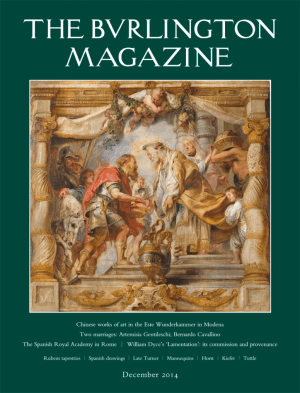 A R T I C L E S
• Pilar Dies del Corral, “The Beginnings of the Real Academia de España in Rome: Felipe de Castro and Other Eighteenth-Century Pioneers,” pp. 805–10.
R E V I E W S
• Marjorie Trusted, Review of David Bindman, Warm Flesh, Cold Marble: Canova, Thorvaldsen and their Critics (Yale University Press, 2014), pp. 824–25.
• Todd Longstaffe-Gowan, Review of Beth Fowkes Tobin, The Duchess’s Shells: Natural History Collecting in the Age of Cooke’s Voyages (The Paul Mellon Centre for Studies in British Art, 2013), pp. 827–28.
• James Ayres, Review of the exhibition Silent Partners: Artist and Mannequin from Function to Fetish (The Fitzwilliam Museum, Cambridge, 14 October 2014 — 25 January 2015; and Musée Bourdelle, Paris, 31 March — 12 July 2015), pp. 840–41.
• Xavier F. Salomon, Review of three Veronese exhibitions in the Veneto, including Veronese Inciso: Stampe da Veronese dal XVI al XIX Secolo (Museo della Stampa Remondini, Bassano del Grappa,14 September 2014 — 19 January 2015), pp. 842–43.
Exhibition | Prints after Veronese
From the Remondini Museum in Bassano:
Veronese Inciso: Stampe da Veronese dal XVI al XIX Secolo
Museo della Stampa Remondini, Bassano del Grappa, 14 September 2014 — 19 January 2015
Curated by Giuliana Ericani
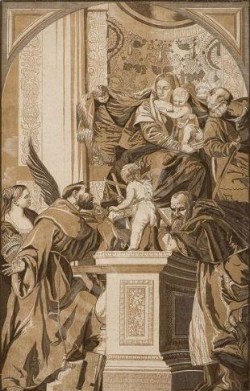 Si inserisce nell’itinerario Scopri il Veneto di Paolo Veronese con altre 5 mostre e 32 siti intitolati al grande artista del Cinquecento Veneto la mostra che i Musei civici di Bassano del Grappa dedicheranno a settembre alla fortuna di Veronese nella stampa “di traduzione.” Sarà così segnalata con larga evidenza l’enorme fama dell’artista e le capacità tecniche degli incisori di rendere con i tratti segnati sulla lastra la felicità e l’esuberanza del colore del Caliari.
La scelta di 58 fogli consente di riconoscere quasi tutti i capolavori del grande artista, alcuni irrimediabilmente perduti, opere riprodotte tra acqueforti e xilografie, tra la fine del Cinquecento fino a tutto il Settecento, a partire dalle acqueforti contemporanee di Agostino Carracci. Un paio di secoli più tardi, in pieno Neoclassicismo, la produzione più corrente dei Remondini non esita a tradurre nei segni fortemente inchiostrati la magniloquenza del disegno più che la felicità del colore, documentando per il mercato un artista la cui fama, complici il barocco e Tiepolo, non aveva mai visto flessioni.
Nella seconda metà del Settecento Giuseppe Remondini raccoglie una consistente collezione di incisioni a paragone, modello e supporto tecnico della produzione calcografica e tipografica della più grande stamperia dell’epoca, prima in Europa—è l’Encyclopédie a ricordarlo—per numero di addetti e quantità della produzione. Tale fondo, donato nel 1847 alla città dall’ultimo erede, Giambattista, è il nucleo fondante per il più recente tra gli antichi musei bassanesi—premio ICOM 2010—prezioso giacimento di questa e delle altre mostre che il Museo della stampa Remondini va via via proponendo dal 2007.
Posto d’onore in mostra per i legni xilografici incisi, con tecnica da lui inventata, dall’inglese John Baptist Jackson, tutti ceduti a Giuseppe Remondini, che saranno esposti assieme ad una selezione dei fogli da lui eseguiti sulle opere di Veronese. Una chicca che, in mezzo a stampe multiple, da sola vale il viaggio a Bassano, per gli addetti ai lavori e per chi vuole capire come le immagini si propaghino grazie alla forza espressiva delle immagini stesse.
Giuliana Ericani, ed., Veronese Inciso: Stampe da Veronese dal XVI al XIX Secolo (Naples: Arti Grafiche Zaccaria, 2014), 90 pages, ISBN: 978-8885821446, €10.
Writing for The Burlington 156 (December 2014), Xavier Salomon judges the catalogue “an essential contribution to the subject and complements Paolo Ticozzi’s catalogue of 1977” (p. 843).
Exhibitions Mark the 250th Birthday of the Hermitage

The river-god Ilissos. Marble statue from the West pediment of the Parthenon, Athens, Greece, 438–32 BCE (British Museum 1816,0610.99). Photo by Marie-Lan Nguyen, 2007, Wikimedia Commons.
◊ ◊ ◊ ◊ ◊
Founded by Catherine the Great in 1764, the Hermitage Museum celebrates its 250th anniversary this year (though it opened to the public only in 1852). In connection with events marking the occasion, The British Museum has loaned the marble Ilissos from the Parthenon—the first time a portion of the Elgin Collection has ever been loaned. The work will will be on display from 6 December until 18 January. The press release stresses the Enlightenment origins of both museums:
The British Museum opened its doors in 1759, just five years before the Hermitage. Sisters, almost twins, they are the first great museums of the European Enlightenment. But they were never just about Europe. The Trustees of the British Museum were set up by Parliament to hold their collection to benefit not only the citizens of Great Britain, but ‘all studious and curious persons’ everywhere. The Museum today is the most generous lender in the world, sending great Assyrian objects to China, Egyptian objects to India and Iranian objects to the United States—making a reality of the Enlightenment ideal that the greatest things in the world should be seen and studied, shared and enjoyed by as many people in as many countries as possible. . .
Noted (added 6 December 2014) — The AFP (Agence France-Presse) reports on Greek dissatisfaction with the loan, quoting a statement from Prime Minister Antonis Samaras: “The British Museum’s decision constitutes an affront to the Greek people.” The full article is available art Art Daily.

St Andrew Service, Germany, Meissen Manufactory, porcelain with overglaze painting, gilding, 1744–45 (The Hermitage State Museum)
◊ ◊ ◊ ◊ ◊
Also on view is this exhibition:
Gifts from East and West to the Imperial Court over 300 Years
State Hermitage Museum, St Petersburg, 3 December 2014 — 8 March 2015
The gifts from Eastern and Western countries presented at the exhibition in the General Staff Building reflect the history of Russia’s relations with the West and the East from 18th century till the fall of the Russian Empire.
The tradition of giving the diplomatic gifts had existed for centuries. They commemorated military victories, conclusions of peace, events important for the court and official visits. Presented to the Imperial court precious metal works, porcelain, arms, coins, tapestries, books, exotic objects, works of fine art are records of the history of Russia.
Exhibition | Remembering Radcliffe
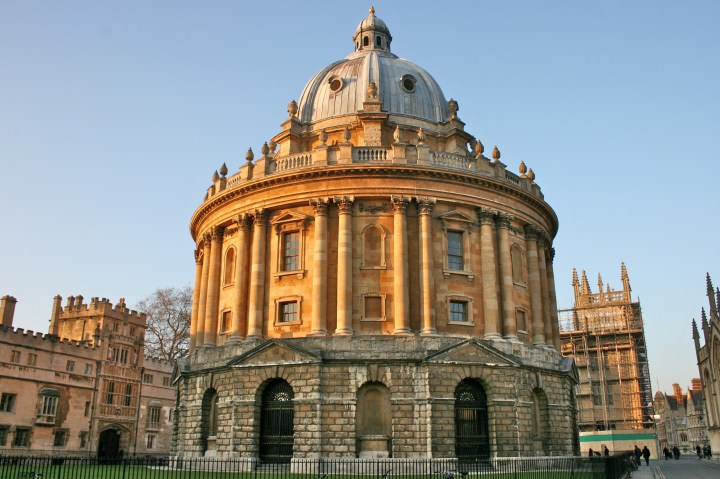
James Gibbs, Radcliffe Camera, Oxford, 1735–49
(Photo: Mike Peel, December 2007, Wikimedia Commons)
◊ ◊ ◊ ◊ ◊
From the Bodleian:
Remembering Radcliffe: 300 Years of Science and Philanthropy
Bodleian Library, Oxford, 28 November 2014 — 20 March 2015
Curated by Stephen Hebron
A new exhibition at the Bodleian Libraries explores the life and legacy of John Radcliffe, the doctor and philanthropist who gave Oxford some of its most iconic buildings. Remembering Radcliffe: 300 Years of Science and Philanthropy opens on 28 November and marks the 300th anniversary of the physician’s death.
 John Radcliffe (bap. 1650–1714) was the most successful doctor of his day and was sought after as a physician to the royal family. On his death he left the bulk of his fortune to charitable causes. With beautiful engravings, watercolours, and architectural drawings, the Bodleian’s free exhibition tells the story of the Oxford landmarks funded by Radcliffe’s legacy: the Radcliffe Camera (the first circular library in Britain), the Radcliffe Observatory, and the Radcliffe Infirmary (the precursor of the modern John Radcliffe Hospital). The exhibition also looks at Radcliffe’s ongoing legacy in the work of The Radcliffe Trust.
“This is a wonderful opportunity for people to learn more about this remarkable physician and philanthropist,” said Richard Ovenden, Bodley’s Librarian. “John Radcliffe’s legacy lives on today—not only in Oxford’s stunning buildings but through his legacy’s investment in scientific research and its support for UK heritage and crafts, and classical music performance and composition through The Radcliffe Trust.”
Exhibition Highlights
• Architectural designs by Nicholas Hawksmoor and James Gibbs for Dr Radcliffe’s Library, which later became the Radcliffe Camera, part of the Bodleian Library
• A 3D scale model of the Radcliffe Camera from 1735
• Rare and first edition books from the first collection of books housed in the Radcliffe Camera
• Early photographs and maps of Oxford including the buildings that bear Radcliffe’s name
• Watercolours, sketches, and engravings of the Radcliffe Camera, Radcliffe Observatory, and Radcliffe Infirmary
• Medical instruments, prescriptions, and records from Radcliffe’s medical career
• Letters, diary entries, and other materials related to Radcliffe’s life and death
• Silverware, stone carvings, and basket weavings produced by contemporary artists supported by The Radcliffe Trust
“The exhibition explains how an 18th-century doctor became one of Oxford’s greatest benefactors,” said curator Stephen Hebron. “Visitors can discover the story behind one of Oxford’s most famous buildings, the Radcliffe Camera, including its origins, its design, how it was built, and its role as a university library.”
On his death in 1714 Radcliffe left the bulk of this fortune to the University of Oxford, including £40,000 for the construction of the Radcliffe Camera, funds for an extension to University College and provision for two travelling fellowships in medicine. He stipulated that the residue of his estate be used for charitable purposes, forming the basis of The Radcliffe Trust. The Trust continues to this day and supports classical music performance and training as well as the UK’s heritage and crafts sector. To celebrate their tercentenary, The Radcliffe Trust has generously supported the Bodleian Libraries’ Remembering Radcliffe exhibition.
“If the amazing Dr Radcliffe had done no more than create the Radcliffe Camera as a monument to his memory this would have been an extraordinary achievement,” said Felix Warnock, Chairman of The Radcliffe Trust. “As it is, his endowment of The Radcliffe Trust was if anything even more visionary: the Trust, one of the very first grant-making charities, now stands on the threshold of a remarkable fourth century of philanthropic giving. We welcome you to the exhibition and accompanying events and hope you leave enriched and inspired by this truly original and remarkable benefactor.”
◊ ◊ ◊ ◊ ◊
Distributed by The University of Chicago Press:
Stephen Hebron, Dr Radcliffe’s Library: The Story of the Radcliffe Camera in Oxford (Oxford: Bodleian Library, 2015), 104 pages, ISBN: 978-1851244294, $25.
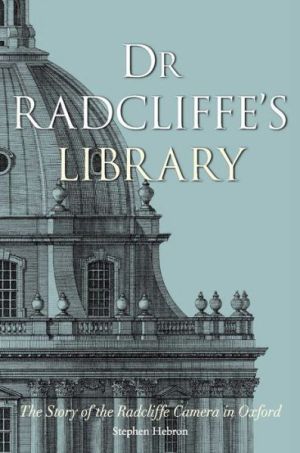 The Radcliffe Camera is one of the most celebrated buildings in Britain. Named for the physician John Radcliffe—who directed a large part of his fortune to its realization at the heart of the University of Oxford in the early eighteenth century—the circular library is instantly recognizable, its great dome rising amidst the Gothic spires of the university. Drawing on maps, plans, photographs, and drawings, Dr Radcliffe’s Library tells the fascinating story of the building’s creation over more than thirty years. Early designs for the Radcliffe Camera were drawn by the brilliant architect Nicholas Hawksmoor, who conceived the shape so recognizable today: a great rotunda topped by the University of Oxford’s only dome. From there, it would take decades to acquire and clear the site between the University Church of St Mary’s and the Bodleian. After Hawksmoor’s death, the project was taken on by the Scottish architect James Gibbs who refined the design and supervised the library’s construction. Published to accompany an exhibition opening in November at the Bodleian Library, Dr Radcliffe’s Library tells the fascinating story of the making of this architectural masterpiece.
Stephen Hebron is a curator working in the Department of Special Collections at the Bodleian Libraries. He is the author, most recently, of Marks of Genius: Masterpieces from the Collections of the Bodleian Libraries.
New Book | British Romanticism and Italian Old Masters
From Ashgate:
Maureen McCue, British Romanticism and the Reception of Italian Old Master Art, 1793–1840 (Ashgate, 2014), 204 pages, ISBN: 978-1409468325, $110.
 As a result of Napoleon’s campaigns in Italy, Old Master art flooded into Britain and its acquisition became an index of national prestige. Maureen McCue argues that their responses to these works informed the writing of Romantic period authors, enabling them to forge often surprising connections between Italian art, the imagination and the period’s political, social and commercial realities. Maureen McCue examines poetry, plays, novels, travel writing, exhibition catalogues, early guidebooks and private experiences recorded in letters and diaries by canonical and noncanonical authors, including Felicia Hemans, William Buchanan, Henry Sass, Pierce Egan, William Hazlitt, Percy Shelley, Lord Byron, Anna Jameson, Maria Graham Callcott and Samuel Rogers. Her exploration of the idea of connoisseurship shows the ways in which a knowledge of Italian art became a key marker of cultural standing that was no longer limited to artists and aristocrats, while her chapter on the literary production of post-Waterloo Britain traces the development of a critical vocabulary equally applicable to the visual arts and literature. In offering cultural, historical and literary readings of the responses to Italian art by early nineteenth-century writers, McCue illuminates the important role they played in shaping the themes that are central to our understanding of Romanticism.
Maureen McCue is a Lecturer in English Literature at Bangor University.
◊ ◊ ◊ ◊ ◊
C O N T E N T S
Introduction
1. Attempting ‘To Engraft Italian Art on English Nature’
2. Connoisseurship
3. Making Literature
4. Samuel Rogers’s Italy
Conclusion
Bibliography
Index










 Enfilade
leave a comment