Call for Panels and Papers | Fashion
From the conference website:
Fashion, the 84th Anglo-American Conference of Historians
Senate House, London, 2–3 July 2015
Proposals due by 15 December 2014
In a major collaboration with the Victoria and Albert Museum, the IHR is taking Fashion as the theme for its annual conference in summer 2015. Fashion in history is a topic which has come of age in recent years, as scholars have turned to addressing what is chic and what is style over the ages and across different cultures. The history of fashion, and the role of fashion in history, is not just confined to the study of dress and costume, but encompasses design and innovation, taste and zeitgeist, treats as its subjects both people and objects, and crosses over into related disciplines such as the history of art and architecture, consumption, retailing and technology. And across the world, fashion brings together museums, graduate teaching programmes, learned societies and the fashion profession around a common set of interests and concerns. The IHR conference next year we hope will be a perfect showcase and a meeting-point for the wide spectrum of specialists in this exciting field.
Our plenary speakers include Christopher Breward (Edinburgh), Beverly Lemire (Alberta), Ulinka Rublack (Cambridge) and Valerie Steele (Fashion Institute of Technology, New York). Proposals for panels on the themes of dress, imitation and emulation, taste and style, body-art, the fashion-industry and its media, fashionability and trend-setting, catwalks, fairs and exhibitions, innovation in interior design, architecture and public space, fashion education and technology will be accepted down to the middle of December. Individual paper proposals will also be accepted. Panels should comprise three papers and a chair, and proposals must include the name and affiliation of the speakers, the title of the panel and the titles of the individual papers. Please send proposals by 15th December toIHR.Events@sas.ac.uk Decisions will be made known once the Programme Committee has met in early January 2015.
Conference | The Legacy of Carlo Fontana
As posted at H-ArtHist:
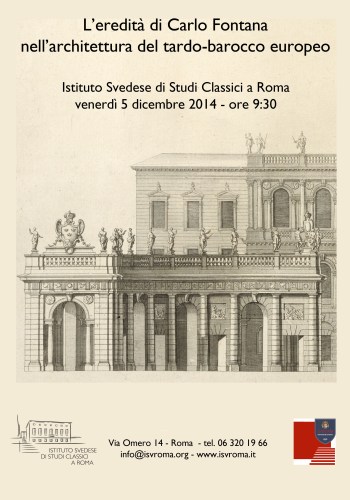
L’eredità di Carlo Fontana nell’architettura del tardo-barocco europeo
Istituto Svedese di Studi Classici, Rome, 5 December 2014
Convegno organizzato da: Istituto Svedese di Studi Classici, Roma -Svenska Institutet i Rom.
Con la collaborazione di: Università degli Studi di Camerino; Dipartimento di Ingegneria dell’Impresa, Università di Roma “Tor Vergata”
 9:30 I sessione | La famiglia Fontana e l’Europa
Coordina Elisabeth Kieven (Bibliotheca Hertziana)
• Giuseppe Bonaccorso (Università degli Studi di Camerino), I Fontana dopo Fontana. L’epilogo di una dinastia familiare: da Mauro Fontana ai numerosi “nipoti” in Europa
• Antonio Russo (La Sapienza, Università di Roma), Architettura e scenografia negli altari a tabernacolo di Carlo Fontana: persistenze, innovazione e fortuna
• Jasenka Gudelj (Università di Zagabria), Carlo Fontana e l’Adriatico orientale: il caso di Dubrovnik
• Andrzej Betlej (Jagiellonian University, Kraków), The Current State of Research on the Influence of Carlo Fontana and His Pupils on Art in the Polish-Lithuanian Commonwealth
• Francesco Amendolagine, Abdul Kader Moussalli (Università degli studi di Udine), La famiglia Fontana all’estero: architetture e decorazione in terra polacca
14:00 II sessione | Cultura e professione architettonica nel Settecento europeo
Coordina Aloisio Antinori (Università degli Studi del Molise)
• Martin Olin (Istituto Svedese di Studi Classici), Architectural Culture in Northern Europe During the Eighteenth Century
• Aloisio Antinori (Università degli Studi del Molise), Circolazione e uso delle stampe romane di architettura al tempo di Carlo Fontana e durante il XVIII secolo
• Mauro Volpiano (Politecnico di Torino), Formazione e aggiornamento degli architetti sabaudi a Roma tra Seicento e primo Settecento
• Simonetta Ciranna (Università degli Studi dell’Aquila), L’eredità di Carlo Fontana nella formazione dell’architetto-ingegnere di fine Settecento. Disegno e geometria nel lavoro di un professionista
integrale
18th- and 19th-Century American Galleries Reopen at Delaware
Press release (24 November 2014) from the Delaware Art Museum:

Raphaelle Peale, Portrait of the Reverend Absalom Jones, 1810 (Delaware Art Museum, Gift of Absalom Jones School)
The Delaware Art Museum is pleased to unveil its renovated and reinstalled 18th- and 19th-century American Art galleries—Galleries 1, 2, and 3—to the public on Friday, November 28. Just in time for the holiday season, the beautifully redesigned space will display over 50 works of art, including many permanent collection objects that have not been on view for over 10 years. As part of this reinstallation, the galleries will highlight 150 years of portraiture, sculpture, landscape painting, still life, and history painting.
“I am excited to be able to present our regional history within the context of the dynamic national art scene,” explains Heather Campbell Coyle, Curator of American Art at the Delaware Art Museum. “The product of more than two years of research and planning, the redesigned space gives us the opportunity to showcase the Museum’s outstanding collection of American art to the local community, visitors, and school groups in new and exciting ways.”
The first gallery presents portraits that span 1757 through 1856, featuring familiar favorites by Benjamin West (1738–1820), Thomas Sully (1783–1872), and Raphaelle Peale (1774–1825). Two images of Delawarean women, five-year-old Anna Walraven (1846–1927) and Sally Ann Ross Paynter (1812– 1866), will also be on view. These portraits, all produced within a 50-mile radius of the Delaware Art Museum, reflect the aspirations and accomplishments of local families.
The second gallery introduces landscape painting, which became very popular during the mid-1800. The loan of Michele Felice Cornè’s romantic overmantel painting (circa 1800), which hung in the main house at Mount Cuba Center in recent decades, provides a prelude to the meticulous landscape paintings of the Hudson River School. These evocative landscapes are joined by history paintings, sculptures, and a luscious still life by Severin Roesen (1815–1872).
In the third gallery, the story of landscape painting continues with works by George Inness (1825–1894) and John Twachtman (1853–1902), which now hang near an early painting by Robert Henri (1865–1929) and a pair of etchings by Thomas Moran (1837–1926) and local printmaker Robert Shaw (1859–1912). One wall has been hung salon-style, creating an interesting juxtaposition of 16 works of art from the Museum’s 12,500-object permanent collection and select loans.
In November 2013, the Museum underwent a major renovation and reinstallation of its gallery dedicated to contemporary American art, which nearly doubled the amount of objects on view from the permanent collection. The reinterpretation of the permanent collection galleries allows the Museum to find new ways to present its history and material culture to visitors of all ages.
About the portrait of Absalom Jones:
The Reverend Absalom Jones was the prominent minister of St. Thomas African Episcopal Church in Philadelphia. Born a slave in Sussex, Delaware, Jones eventually won his freedom, became a founding member of the Free African Society, was ordained the first African American minister of the Episcopal denomination, and helped to organize a school for African American children. His church congregation may have commissioned this painting from noted Philadelphia painter Raphaelle Peale.
Cooper Hewitt to Reopen on December 12th

With the newly renovated Cooper Hewitt opening December 12th, you’ll have to visit the museum’s website to make sense of it all, everything from a specially commissioned typeface (Cooper Hewitt, which you can download for free here) to an interactive pen. I’ve noted one exhibition below, but presumably there are lots of eighteenth-century attractions. –CH
From Cooper Hewitt:
 Caroline Baumann, director of Cooper Hewitt, Smithsonian Design Museum (formerly Cooper-Hewitt, National Design Museum), has announced plans for the opening of the renovated and restored Carnegie Mansion and the 10 exhibitions that will inaugurate the revamped and expanded gallery spaces. The nation’s only museum devoted exclusively to historic and contemporary design, Cooper Hewitt will open its doors to the public on Friday, December 12. The museum will boast 60 percent more gallery space to present its important collection and temporary exhibitions and will offer an entirely new and invigorated visitor experience, with interactive, immersive creative technologies.
Cooper Hewitt’s renovation provides the opportunity to redefine today’s museum experience and inspire each visitor to play designer before, during and after their visit. Visitors will explore the museum’s collections and exhibitions using groundbreaking technologies that inspire learning and experimentation. This new participatory experience is specifically designed to engage all audiences—students, teachers, families, young children, designers and the general public.
All visitors will be given a newly developed interactive Pen to collect and create. They will be able to digitally collect design objects on view, as well as additional objects from the ultra-high-definition interactive tables. Visitors will become designers in their own right by creating their own designs with the Pen. Symbolizing and embodying human creativity, the Pen is a key part of every visitor’s experience. With it, they will be able to record their visit, which can be viewed and shared online and supplemented during future visits. . .
The largest initiative in Cooper Hewitt’s history, the renovation and expansion of the entire campus on New York’s Museum Mile—the Carnegie Mansion, Arthur Ross Terrace and Garden and the museum’s two townhouses on East 90th Street—have been achieved through a successful $91 million capital and endowment campaign.
“With four floors of exhibition galleries that can now stay open 12 months of the year, free garden access, extended garden and café hours, an inviting new street entrance and the digitization of our collections, Cooper Hewitt will reach a broader audience and be more accessible than ever before,” said Baumann. “We have created a 21st-century museum that will bring our collections to life and make design even more relevant and exciting to today’s audiences, while continuing to respect the history of this museum and the integrity of the much-treasured Carnegie Mansion.”
In addition to Cooper Hewitt’s physical transformation, the museum now has a new name, graphic identity, website and custom typeface. Formally the “Cooper-Hewitt, National Design Museum,” the museum has been renamed “Cooper Hewitt, Smithsonian Design Museum,” emphasizing the museum’s heritage. The museum has taken on a bold new graphic identity designed by Pentagram and the typeface “Cooper Hewitt” designed by Chester Jenkins of Village [available for free download here; see Michael Silverberg’s discussion here] . . . .
◊ ◊ ◊ ◊ ◊
About The Models & Prototypes Gallery:

Staircase model, France, late 18th century; Joined, bent and carved pear, wrought brass wire; 75 x 67.3 x 67 cm (NY: Cooper Hewitt, Smithsonian Design Museum; photo by James Hart)
This new second-floor gallery will be home to rotating installations showcasing the important role of design models and prototypes. For the opening installation, the gallery will present the exceptional 18th- and 19th-century models of staircases and some significant architectural models donated to Cooper Hewitt by Eugene V. and Clare E. Thaw (16 models altogether with four accompanying drawings).
The models represent a range of design styles and techniques, but most of the staircase models were designed in the compagnonnage tradition. Compagnonnage, meaning ‘group of companions’, is a type of design practice that combined formal study with practical training from masters. Apprentices honed their skills in a workshop during the day, taking courses in the art of geometrical drawing and design in the evening, living together in a boarding house. First, concepts were taught, then the handiwork, both of which became increasingly sophisticated. Each successful member made a ‘tour de France’, working and studying under masters in major cities. At each stage of the learning process (acceptance, reception, mastership), apprentices created models, leading them to become masters of their craft and design. Most of the staircase models produced in this tradition were made by masters of woodworking—joiners, cabinetmakers, and/or carpenters.
Pure Judgment
After five years, I hope you’ll indulge me as I ask a small favor that has nothing to do with HECAA or the eighteenth century. A former student and now friend of mine has recently launched a blog, and I would be grateful if you have a look. Pure Judgment—related to the eighteenth century only in owing its title to Kant—reports on juried awards in a variety of cultural fields, with an emphasis on the arts. The site’s editor, Anna Hanchett, was good enough to put up with me in a handful of classes, including January term trips to Venice and London. She’s currently working as an assistant to a particularly fine bookbinder (and in this capacity does handle an enviable share of eighteenth-century material culture). –CH
Here’s the link and more information:
 In contrast to the thousands of blogs built around highlighting an individual’s tastes, preferences, and recommendations, Pure Judgment reports on juried standards of excellence. Covering a wide range of cultural production—including literature, the visual arts, music, fashion, film and food—the site aims to inform readers of people whose work has been recognized by experts within a given field as outstanding. Among the award-winners recently highlighted are David Titlow (Taylor Wessing Prize), Uxua Casa Hotel (Smith Hotel Award), Richard Flanagan (Man Booker Prize), Paper Airplanes (CinefestOz Film Award), and Iris Van Herpen (Andam Prize).
While other sites report on particular areas of cultural production, Pure Judgment is exceptional for its expansive scope . . . because you shouldn’t have to know about a particular award to care about the category or the winner. Pure Judgment aims to broaden the horizon for all of us.
Exhibition | Marks of Genius: Drawings from the MIA
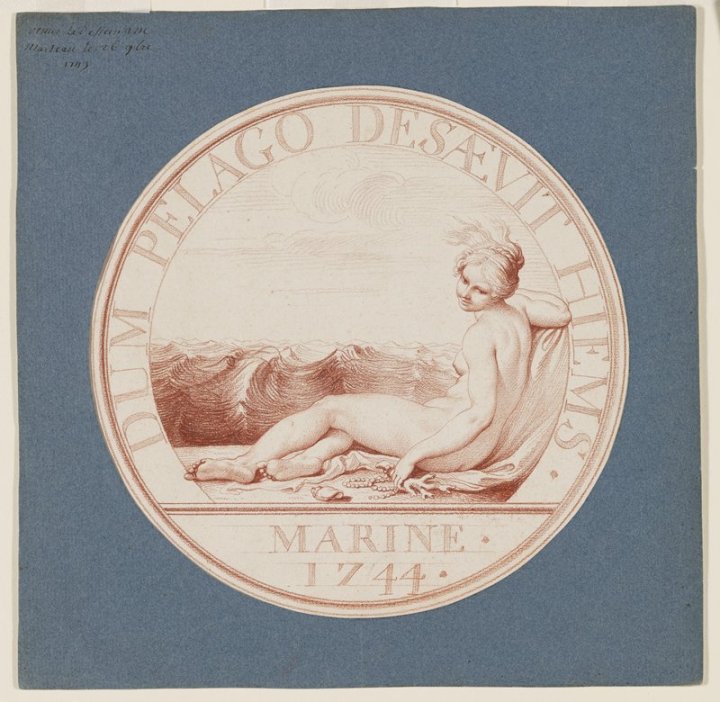
Edme Bouchardon, Design for a Token: Marine, 1744,
ca. 1743, red chalk (Minneapolis Institute of Arts)
◊ ◊ ◊ ◊ ◊
Press release (7 May 2014) from the MIA:
Marks of Genius: 100 Extraordinary Drawings from the Minneapolis Institute of Arts
Minneapolis Institute of Arts, 13 July — 21 September 2014
Grand Rapids Art Museum, 26 October 2014 — 18 January 2015
North Carolina Museum of Art, Raleigh, TBA
Joslyn Art Museum, Omaha, Nebraska, TBA
Curated by Rachel McGarry
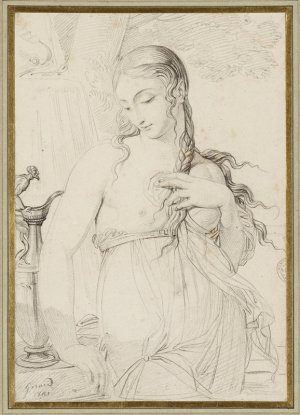
Louis Lafitte, Young Woman in Classical Dress, Study for the Month of Thermidor, ca. 1804–05, black chalk, partially incised (Minneapolis Institute of Arts).
This summer, the Minneapolis Institute of Arts (MIA) showcases an exemplary selection of its rarely seen, superb drawings collection in Marks of Genius: 100 Extraordinary Drawings from the Minneapolis institute of Arts. This special exhibition marks the first time this selection of drawings, which spans over 500 years, will be seen together by the public. Featured artist include celebrated masters such as Ludovico Carracci, Guercino, Thomas Gainsborough, Eugène Delacroix, Edgar Degas, Gustav Klimt, Egon Schiele, René Magritte, and Georgia O’Keeffe. Marks of Genius opens at the MIA and will then travel to the Grand Rapids Art Museum in Michigan, the North Carolina Museum of Art, Raleigh, and the Joslyn Art Museum in Omaha, Nebraska. A fully illustrated catalogue.
“Due to their sensitivity to light, drawings are exhibited for only short periods of time and are otherwise kept in dark storage,” says exhibition curator Rachel McGarry. While works from the museum’s large paper collection—over 40,000 prints and drawings—can be seen by appointment in the Herschel V. Jones Print Study, Marks of Genius is a rare opportunity for the public to see the cream of this collection.

Nicolas-Bernard Lépicié, Standing Male Nude, 1760s–80s, red chalk (Minneapolis Institute of Arts)
Marks of Genius is exhibited at an apropos time. The MIA’s ‘treasury’ of drawings, which includes over 2,600 works, has increased by 20 percent since 2009. Several of these recent additions will be on view for the first time in this show. The exhibition brings to life the immediacy of drawings and explores its multiple roles as a means of study, observation, problem solving, a record of the artist’s imagination, and a medium for creating finished works of art.
The thematic display highlights these different aspects of drawing:
• Spark of Creation features ‘first draft’ sketches and inventions. This portion of the exhibition, showcasing the immediacy of the artistic process, features works such as Giuseppe Bazzani’s Pan and Syrinx, c. 1760, and George Romney’s Study for ‘The Lapland Witch,’ completed c. 1775–77.
• From Life is a section which features various observational studies drawn from nature throughout history. Notable works include Käthe Kollwitz’s c. 1903 Two Studies of a Woman’s Head and Pierre-Joseph Redouté’s Amaryllis lutea. c. 1800-06.
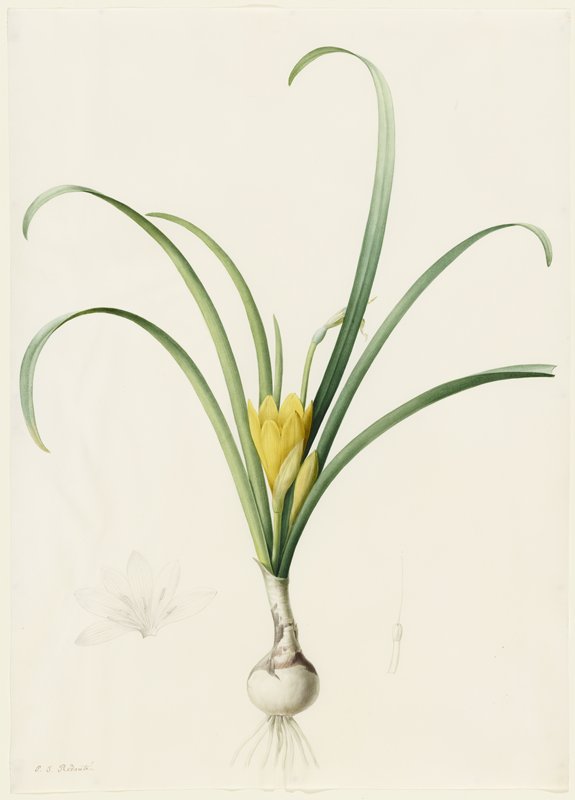
Pierre-Joseph Redouté, Amaryllis lutea, ca. 1800–06, watercolor and graphite on vellum (Minneapolis Institute of Arts)
• Portrait Drawings presents works such as Lovis Corinth’s Self-Portrait completed in 1908 and Egon Schiele’s Standing Girl, c. 1910.
• Figural Abstraction a section which documents artists’ studies of human forms and expression. Works featured in this section include Guercino’s Hercules, (1641–42) and Ernst Kircher’s Seated Woman in the Studio, completed in 1909.
• Storytelling presents drawings with a narrative theme, such as Arthur Rackham’s Little Red Riding Hood, 1909, and Ludovico Carracci’s Judith Beheading Holoferenes, c. 1581–85.
• Other themes include Sense of Place with Emil Nolde’s Heavy Seas at Sunset, c. 1930–35, and Appropriation with Roy Lichtenstein’s 1962 Bratatat!
◊ ◊ ◊ ◊ ◊
From the MIA@Artbook:
Rachel McGarry and Thomas Rassieur, Master Drawings from the Minneapolis Institute of Arts (Minneapolis: Minneapolis Institute of Arts, 2014), 300 pages, ISBN: 978-0989371841, $60.
 This lavishly illustrated book presents one hundred significant drawings from the 15th to the 21st century, including new discoveries and works by both celebrated masters and others who deserve to be better known. Among the artists represented are Annibale and Ludovico Carracci, Guido Reni, Giovanni Domenico Tiepolo, Antoine Watteau, Jean-Honoré Fragonard, Pierre-Paul Prud hon, Thomas Gainsborough, George Romney, Edgar Degas, Henri Matisse, Lovis Corinth, Ernst Ludwig Kirchner, Käthe Kollwitz, Otto Mueller, Emil Nolde, Egon Schiele, Edward Hopper, John Marin, Grant Wood, Roy Lichtenstein, Jasper Johns, Andy Warhol, and Edward Ruscha.
Catalogue entries for each drawing include complete documentation, provenance, and bibliography. The text provides important new scholarship and attributions; examines a variety of themes, such as connoisseurship, patronage, materials and techniques, watermarks, and collectors’ stamps; and discusses how a work fits into the artist’s oeuvre or represents larger developments in artistic movements or trends in artistic production
New Book | Mariette and the Science of the Connoisseur
From Ashgate:
Kristel Smentek, Mariette and the Science of the Connoisseur in Eighteenth-Century Europe (Aldershot: Asghate, 2014), 342 pages, ISBN: 978-1472438027, £70 / $120.
 Celebrated connoisseur, drawings collector, print dealer, book publisher, and authority on the art of antiquity, Pierre-Jean Mariette (1694–1774) was a pivotal figure in the eighteenth-century European art world. Focusing on the trajectory of Mariette’s career, this book examines the material practices and social networks through which connoisseurs forged the idea of art as an object of empirical and historical analysis. Drawing on significant unpublished archival material as well as on histories of science, publishing, collecting, and display, this book shows how Mariette and his colleagues’ practices of classification and interpretation of the graphic arts gave rise to new conceptions of artistic authorship and to a history of art that transcended the biographies of individual artists. To follow Mariette’s career through the eighteenth century is to see that art was consolidated as a specialized category of intellectual inquiry—and that style emerged as its structuring analytic device—in the overlapping spaces of the collector’s cabinet, the connoisseur’s portfolio, and the dealer’s shop.
Kristel Smentek is Associate Professor of Art History in the Department of Architecture at MIT.
◊ ◊ ◊ ◊ ◊
C O N T E N T S
Introduction: Art History and the 18th-Century Connoisseur
Knowledge Economies of the Print Trade
The Making of a Drawings Connoisseur
The Collector’s Cut
Origins: Of Antiquarianism, Aesthetics, and History
Conclusion: The Mariette Sales
Select Bibliography
Index
At Auction | Un Moment de Perfection: Furniture & Paintings

One of a pair of Italian walnut commodes, ca. 1784–85, designed and mounted by Luigi Valadier. Estimate: £600,000–1 million (Lot 30; click here for additional images and audio description).
◊ ◊ ◊ ◊ ◊
Press release (26 November 2014) from Christie’s:
Un Moment de Perfection: An Important Private Collection of French
18th-Century Furniture and Old Master Paintings, Sale 10199
Christie’s, London, 3 December 2014
 Christie’s will present a superb collection of French paintings and decorative arts in Un Moment de Perfection: An Important Private Collection of French 18th-Century Furniture and Old Master Paintings on 3 December 2014 [Sale 10199]. Formed by an erudite and sophisticated collector of both French and Spanish origins, the quality and breadth of this collection demonstrate the distinguished gentleman’s deep understanding of art and history, which developed and matured through endless curiosity, extensive travels and friendships formed in the art world. Comprising 83 lots, the wide array of important treasures include a pair of Italian walnut commodes designed and mounted by Luigi Valadier (estimate: £600,000–1 million); a pair of impressive ormolu candelabra attributed to the ciseleur-doreur Pierre Gouthière (estimate: £350,000–500,000); and a pair of capricci of Rome by Hubert Robert depicting the Forum with the Temple of Antoninus and Faustina and the Temple of Saturn (estimate: £200,000–400,000). The sale offers new and established collectors the opportunity to acquire works of exceptional quality from this magnificent group. The collection will be available to view from Friday 28 November at Christie’s King Street.
European Furniture
The sale is led by an elegant pair of Italian walnut commodes, circa 1784–85, designed and mounted by Luigi Valadier (estimate: £600,000–1 million) which corresponds almost exactly to a pair of commodes in a drawing from the workshop of Luigi Valadier which, along with other papers, is now in the Pinacoteca Civica. Other notable pieces of European furniture include a late Louis XV ormolu-mounted tulipwood, amaranth and fruitwood marquetry commode by Pierre-Antoine Foullet, circa 1770–75, which belongs to a group of case furniture stamped or attributed to Pierre-Antoine Foullet, all of which share the distinctive neo-classical oval frame mounts and Transitional form of this commode (estimate: £70,000–100,000); a French pale-grey painted and parcel-gilt cast-iron centre table from the second quarter of the 19th century (estimate: £15,000–25,000); and a French ormolu and gilt-varnished metal gueridon, attributed to Maison Jansen, late 19th century, in the manner of Adam Weisweiler (estimate: £6,000–9,000). Regarded as one of the most prominent interior decorating companies of the 20th century, Maison Jansen, founded in 1880 also designed and made furnishings for the interiors they conceived, the designs for which ranged from a revival of Louis XV, XVI and Empire styles to modern taste, creating a dialogue between the historical and the contemporary. Some of the firm’s most important commissions were for the Duke and Duchess of Windsor’s residence in Paris, the White House for Jacqueline and John F. Kennedy and the March family residences in Spain.
European Objects
Formerly in the collection of Archibald Philip Primrose, 5th Earl of Rosebery (1847–1929) at Mentmore Towers, a magnificent pair of candelabra attributed to the celebrated ciseleur-doreur Pierre Gouthière, may be regarded as one of the most accomplished models executed in the ‘goût à l’Etrusque’ (estimate: £350,000–500,000). They are thought to be after a design by Jean-Demosthène Dugourc, made by Gouthière and supplied by the celebrated marchand-mercier Dominique Daguerre who collaborated closely with Gouthière on various important commissions. Further highlights range from a pair of Louis XVI ormolu-mounted Sèvres ‘beau bleu’ porcelain vases, the mounts attributed to Pierre-Philippe Thomire, circa 1785, which were also almost certainly supplied by Dominique Daguerre (estimate: £200,000–300,000); to a pair of restoration ormolu-mounted porphyry and blued-steel brûle parfums, circa 1820-30, after the model by Mathew Boulton (estimate: £30,000–50,000); a Louis XVI oval marble bas-relief of a vestal virgin, attributed to Louis-Simon Boizot, circa 1777, which is almost certainly the marble bas-relief depicting Une Vestale that Boizot exhibited in the Paris Salon of 1777 (estimate: £8,000–12,000).

Old Master Paintings
Leading the offering of Old Master paintings is one of the top lots of the sale, a pair of capricci of Rome by Hubert Robert depicting the Forum with the Temple of Antoninus and Faustina and the Temple of Saturn (estimate: £200,000–400,000, Lot 36). In the collection of HRH The Duchess of Kent at Derby House between 1940 and 1947, this pair of views are a vibrant demonstration of Robert’s fascination with the ancient world and of the palpable influence of Giovanni Paolo Panini. Other key works include a striking portrait of Don Lourenço José Xavier de Lima, 1st Count of Mafra by Louis Gauffier’s a beautifully preserved example of the artist’s small full-length portraiture, the genre that dominated his oeuvre until his death in 1801 and for which he would ultimately be most celebrated (estimate: £150,000–250,000).
19th-Century Paintings
A three-quarter length Portrait of Empress Alexandra Feodorovna of Russia, née Princess Charlotte of Prussia by Scottish born Christina Robertson is likely to be of particular Russian interest (estimate: £ 30,000–50,000). Robertson travelled to St Petersburg in 1839 to paint the Empress and the Imperial Court, and became her favoured court artist, painting a number of portraits of her. She returned again in 1849 where she remained until her death in 1854. The largest concentration of her work is in the collection of the Hermitage Museum. Amongst her distinguished patrons were the Duke and Duchess of Northumberland, Lord Powerscourt, and influential European families including the Rothschilds and Pototskis. Lady with a fan by Roberto Bompiani was exhibited at the Esposizione di Belle Arti in Turin in 1880 where it was highly praised (estimate: £30,000–50,000). Nicknamed ‘the Italian Bouguereau’, for his pictures of religious and mythological subjects which were evocative of the great French Academic artist, Bompiani was also known as a history and portrait painter who frequently represented members of the Italian aristocracy, such as the Borghese family.










 Enfilade
leave a comment