Call for Papers | CAA in Washington, D.C., 2016
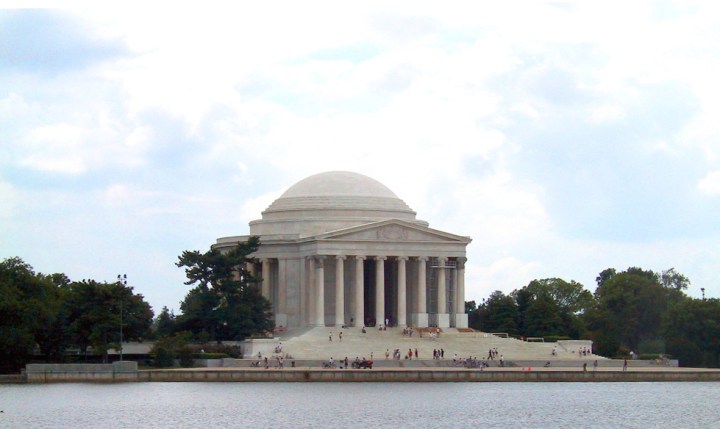
The Jefferson Memorial in Washington, D.C., from across the Tidal Basin of the Potomac River
(Wikimedia Commons, Rdsmith4, 2005)
◊ ◊ ◊ ◊ ◊
The following selection of panels may be of interest for scholars of the eighteenth century, though readers are encouraged to consult the full Call for Papers. HECAA members are asked to pay special attention to the session on pastels chaired by Iris Moon and Esther Bell and the one on Eros and Enlightenment chaired by Nina Dubin and Hérica Valladares. -CH
◊ ◊ ◊ ◊ ◊
104th Annual Conference of the College Art Association
Washington, D.C., 3–6 February 2016
Proposals due by 8 May 2015
The 2016 Call for Participation for the 104th Annual Conference, taking place February 3–6 in Washington, D.C., describes many of next year’s sessions. CAA and the session chairs invite your participation: please follow the instructions in the booklet to submit a proposal for a paper or presentation. This publication also includes a call for Poster Session proposals.
◊ ◊ ◊ ◊ ◊
Historians of Eighteenth-Century Art and Architecture
Pastel: The Moment of a Medium in the Eighteenth Century
Iris Moon, The Metropolitan Museum of Art; and Esther Bell, Fine Arts Museums of San Francisco, imoon.moon@gmail.com and esthersusanbell@gmail.com.
This panel explores pastel as the “medium of the moment” in the long eighteenth century in order to pose questions about the temporality of artistic media and how materially unstable works of art shaped the period’s aesthetic discourse. Described by Denis Diderot as “precious powder that will fly from its support, half of it scattered in the air and half clinging to Saturn’s long feathers,” the volatile matter of pastel provoked a sense of physical movement that transformed the viewing process into a charged moment of encounter. We invite considerations on the making and unmaking of pastel practitioners, the critical language around the medium developed by connoisseurs and collectors, and inquiries that situate pastel’s distinctive properties within debates on color and line, touch and sight, viewer and object.
◊ ◊ ◊ ◊ ◊
American Society for Eighteenth-Century Studies
Eros and Enlightenment
Nina Dubin, University of Illinois at Chicago, dubin@uic.edu; and Hérica Valladares, University of North Carolina at Chapel Hill, herica.valladares@gmail.com
What would it mean to consider the eighteenth century through the lens of its evolving discourse on love? The explosion of a novel-reading public; the Enlightenment’s often nervous inquiry into love’s place among the ‘moral sentiments’ and its status in relation to the equally unstable category of friendship; the expansion of epistolary culture and the attendant vogue for love letter pictures; the libertine conceptualization of love as a ‘commerce’; homoeroticism as a cultural leitmotif; the ubiquitous presence of Cupid, even in such unexpected contexts as financial literature; the fixation on ancient notions of eros, from Ovid’s persistently popular Ars Amatoria to the unearthed remains of erotic frescoes: these and other phenomena suggest that love played a central yet complicated role in period self-imaginings, in ways that iconographic accounts of the era’s visual arts have perhaps not fully registered. This ASECS-sponsored panel seeks papers on all aspects of visual and material culture that expand, challenge, and enliven our understanding of eros in the eighteenth century (due date is 31 May).
◊ ◊ ◊ ◊ ◊
The Modernities of French Art and Its History, 1780 to the Present
Natalie Adamson, University of St Andrews; and Richard Taws, University College London, na14@st-andrews.ac.uk and r.taws@ ucl.ac.uk.
From now-canonical studies that helped lay the methodological foundations of art history as a discipline to the extraordinary popularity of French art and ideas outside of the academy, the history of French art has become an influential tradition that has often been presented as synonymous with modernism itself. This session proposes a critical interrogation of the diverse histories of French art since 1780 to the present day. We welcome papers that look outside of, challenge, or run counter to hegemonic narratives. What critical possibilities (if any) remain for the study of French art’s modernities? We encourage approaches that interrelate the histories of specific images, objects, or narratives with reflection on the writing of those histories, or on broader historiographical tendencies, so that a set of fresh perspectives may emerge on this enduring yet highly mutable relationship between art history and modern France.
◊ ◊ ◊ ◊ ◊
Taking Stock: Future Direction(s) in the Study of Collecting
Christina M. Anderson, University of Oxford, cm.anderson@usa.net.
The study of collecting is at a crossroads. “Collection” has often meant “art collection,” overlooking the broader range of objects and behaviors involved. Fascination with the Wunderkammer has centered attention on European models, even when objects themselves were not European. The rise of museum studies, furthermore, has shifted attention away from the individual practice of collecting to institutional concerns about conservation and deaccession. Recent approaches to collecting, intended to broaden its study, include cross-cultural encounters, the circulation of knowledge, the cultural biographies and social lives of things, the art market, and the collecting practices of particular social groups. This panel explores the current and future states of the field through case studies that utilize innovative and forward- looking methodologies. Presentations may, for example, challenge the dominance of traditional sources such as inventories and biographies; present new interpretations or applications of terms like “connoisseurship”; or explore potential insights offered by the study of synesthesia or semiotics.
◊ ◊ ◊ ◊ ◊
Landscape into History
John Beardsley, Dumbarton Oaks Research Library and Collection; Jennifer Raab, Yale University, beardsleyj@doaks.org and jennifer.raab@yale.edu.
Art history and landscape studies have a common origin and shared scholarly trajectories, yet the extent of their reciprocal influence is by no means certain. This session will look both forward and back, exploring the fluctuating and sometimes problematic historical connections between art history and landscape studies while investigating the potential for more productive interchange between the two disciplines in the future. In what ways could the close attention paid by landscape historians to environment, physical and social experience, spatial analysis, and mapping enhance the methods of art history? How might art-historical emphases on materiality, viewing, cultural context, and artistic process contribute to landscape studies? What models do landscape studies have to offer that could address pressing ecological issues while also engaging with questions of representation and aesthetics? Papers should consider this not just as a theoretical challenge but as one to be worked through by a discussion of specific landscapes.
◊ ◊ ◊ ◊ ◊
Beyond Featherwork: Mexican Visual Identity between Conquest and Independence
Aliza M. Benjamin and Bradley J. Cavallo, Temple University, tua63451@temple.edu and tuc70074@temple.edu.
Colonial Mexican society of ca. 1650–1800 produced a sophisticated aesthetic that blurred distinctions between Old and New World visual identities. Such criollismo transformed indigenous traditions into something independent yet reminiscent of European preferences, a process of incorporation that rarely produced clearly enunciated cases of syncretism. More often, the characteristic signs of the original cultural traces remained present but indistinct, negotiations of the cognitive dissonance experienced by a people acutely aware of their foundation in both Aztec and Spanish pasts. This session examines the multicultural fusion of European and indigenous art-making traditions surviving in the evidence of postconquest, pre-Independence architecture and movable art objects. We invite papers of methodological diversity that illustrate how artists, patrons, and audiences instantiated the era’s newly developing cultural identity within Mexican society or projected it outward as part of the transmission of knowledge about material production and aesthetic processes that developed across the network of transatlantic trade routes.
◊ ◊ ◊ ◊ ◊
The Art of Animal Activism: Critical Parameters
Alan C. Braddock, College of William and Mary; and Keri Cronin, Brock University, acbraddock@wm.edu and keri.cronin@ brocku.ca.
Today nonhuman animals figure more prominently in cultural, ethical, and scientific inquiry than ever before, thanks to recent research that has forced a significant reassessment of human exceptionalism, or speciesism. Lately some art historians have begun to consider these issues as well. All of this has taken place amid growing popular fascination with animals and backlash against their egregious, often concealed abuse in factory farming, entertainment, laboratories, and other areas. Animals have become subjects of vision, imagination, and activism—but also exploitation— like never before. This session examines the critical parameters of animal activism and advocacy in art since the eighteenth century. Papers should address important landmarks and historical contours of such art, assessing creative techniques used to advance particular goals. Consideration of why the discipline of art history has been slow to map this tradition and challenges involved in visualizing the interests of other beings are also encouraged.
◊ ◊ ◊ ◊ ◊
Afrotropes
Huey Copeland and Krista Thompson, Northwestern University, h-copeland@northwestern.edu and krista-thompson@ northwestern.edu.
This session focuses on the aesthetic, historical, and theoretical terrain opened up by the “afrotrope.” This neologism refers to those visual forms that have emerged within and become central to the formation of African diasporic culture and identity in the modern era, from the slave ship icon produced by the Society for Effecting the Abolition of the Slave Trade (1788) to the “I AM A MAN” signs famously held up by striking Memphis sanitation workers (1968). The recurrence of such afrotropes makes palpable how subjects have appropriated widely available representational means only to undo their formal contours or to break apart their significatory logic. The afrotrope thus offers a vital heuristic through which to understand how visual motifs take on flesh over time and to reckon with what remains unknown or cast out of the visual field. We solicit papers that not only identify key afrotropes but also theorize how they elucidate new models of temporality, authorship, and cultural transmission.
◊ ◊ ◊ ◊ ◊
The Meaning of Marginalia in Early Modern Art and Theory, 1500–1800
Stephanie S. Dickey, Queen’s University, dickeys@queensu.ca.
This session seeks case studies exploring the practice of ann tation in early modern art and art criticism. The concern is not with printed marginalia (an established literary form) but with handwritten notes, a record of individual response bridging the published and the private. Artists annotated their own drawings and those of others they acquired. Connoisseurs jotted comments and sketches in the margins of treatises and sale catalogues. Familiar cases range from the postille added by Federico Zuccaro, Annibale Carracci, and other readers to copies of Vasari’s Vite (ca. 1568–1620) to Rembrandt’s inscribed drawing of Raphael’s Portrait of Baldassare Castiglione auctioned in Amsterdam (1639) and Gabriel de Saint-Aubin’s sketches in Basan’s catalogue of the Mariette collection (ca. 1778), but there is much more to discover. How can marginalia contribute to our understanding of specific artists and art lovers: their activities, ideas, networks? How do such notes trace fluctuations in market value or trends in taste and art theory?
◊ ◊ ◊ ◊ ◊
Taking Stock: Early Modern Art Now
Hanneke Grootenboer, University of Oxford; and Amy Knight Powell, University of California, Irvine, hanneke.grootenboer@ rsa.ox.ac.uk and amy.powell@uci.edu.
The relatively recent shift from the period terms “Renaissance” and “Baroque” to the more capacious “early modern” has coincided with an interrogation of the field’s relevance to the present. The new nomenclature insists that early modernity and our own (post-post) modernity share something. Investigation of precisely what they share has been among the most significant undertakings in the field over the past few decades. Far from being a turn away from history, this project of redefinition, at its best, has sought to recuperate the concept of history, wresting it from restrictive forms of historicism. It is now time to take stock of this work. We are particularly interested in projects that move beyond traditional historical paradigms, consider the relationship between history and theory, question modernism’s art-historical narrative, or demonstrate the critical and philosophical potential of early modern works of art.
◊ ◊ ◊ ◊ ◊
Museum Committee
New Studies in Museum, Gallery, and Exhibition History
Antoniette M. Guglielmo, Getty Leadership Institute; and Anne Manning, The Baltimore Museum of Art, toniguglielmo@yahoo.com and AManning@artbma.org
In support of the scholarly mission of the CAA to serve institutions in which art is exhibited, collected, studied, and interpreted, the Museum Committee offers this session for international scholarship addressing the history of museums, galleries, exhibitions, and related topics. This session also presents an opportunity to assess the demand for future sessions on new and emerging scholarship on this topic. We invite papers that explore the history of institutions and exhibitions, the work of individual pioneers in the formation of museums and galleries, and the evolution and professionalization of museum practices. Studies of associated social and cultural phenomena including the history of collecting and philanthropy are encouraged. We also welcome investigations of related entities such as commercial galleries and auction houses, in addition to historiographies of these topics and research questions associated with them. Submissions may be case studies or comparative analyses.
◊ ◊ ◊ ◊ ◊
Copy That: Painted Replicas and Repetitions before the Age of Appropriation
Valerie Hellstein, Willem de Kooning Foundation, vhellstein@gmail.com.
Marcel Duchamp’s Boîtes-en-valise, which contained “authorized ‘original’ copies” of his previous works, makes a farce out of the modern myth of authenticity. We now recognize the critique of originality inherent in the reproducibility and multiplicity of certain media, but what of painting? Artists from Jacques-Louis David and Gilbert Stuart to Henri Matisse and Clyfford Still have copied and made variations of their own paintings. Originals, copies, imitations, replicas, variants, versions all circulate in art-historical discourse, carrying different meaning, significance, and value depending on the time period and area of study. This panel seeks papers on art from any era up to the rise of postmodernity that explore autograph replicas of paintings. In what ways might such an inquiry change ingrained notions of painting? In what ways do the art market and other factors contribute to the production of such copies? How have countries or cultures handled autograph replicas and repetitions differently?
◊ ◊ ◊ ◊ ◊
Design Studies Forum
Design on Display: Staging Objects in the Museum and Beyond
Anca Lasc, Pratt Institute; and Paula Lupkin, University of North Texas, alasc@pratt.edu and Paula.Lupkin@unt.edu.
The theory and practice of object display has a long history, from cathedral crypts and early modern cabinets of curiosities to nineteenth- and twentieth-century museums, universal exhibitions, theme parks, chambers of horror, and department stores. Historians, curators, artists, entrepreneurs, and designers engage in complex experiential, pedagogical, and technological challenges involved in the design of environments for education, entertainment, and consumption. This panel explores evolving practices of presentation and display including but not limited to exhibition, retail and interior design, historical house museums, period rooms, and art installations. Seeking to chart a history of display design, we invite papers that examine the cross-fertilization of ideas and practices related to the display of objects in different historical contexts and spatial layouts. What does the history and theory of presentation and display teach us about the design of interior environments, and what emergent trends might shape the future of display?
◊ ◊ ◊ ◊ ◊
American Society for Hispanic Art Historical Studies
Polychrome Sculpture in Iberia and the Americas, 1200–1800
Ilenia Colón Mendoza, University of Central Florida, Ilenia. ColonMendoza@ucf.edu.
This panel focuses on aspects of polychrome sculpture produced in Iberia and Colonial Latin America from 1200 to 1800 that are specifically related to writing and literature. Of interest is the production and technique of polychrome sculpture in wood, wax, and mixed media through the study of treatises and their relationship to the production of sculpture. Research related to primary-source documentation of contracts and patronage is also welcome. Papers may address how mystical writings and liturgical practices influenced image making and how these images were understood in the context of religious pageantry and procession. Contemporary accounts describing sculpture in literature and plays that reveal the social and cultural status of sculpture are also relevant.
◊ ◊ ◊ ◊ ◊
Connoisseurship—or Connoisseurs?
Catherine B. Scallen, Case Western Reserve University, cbs2@case. edu
Connoisseurship is a practice in the history of art that has been theorized, valorized, vilified, rejected, and renewed. Several sessions at the annual CAA conference over the past twenty years have been devoted to its study. But is it appropriate to discuss connoisseurship as an objectifiable practice when it can be argued that by its very nature it is an individualized pursuit? The problematic nature of group connoisseurship, entered into so optimistically in the 1960s by the Rembrandt Research Project, was demonstrated by the many critiques of the results of this group, its internal discord, and its subsequent reorganization under the leadership of one connoisseur, Ernst van de Wetering. In this session we will consider whether connoisseurship as a practice is best understood through the study of individual connoisseurs, whose connoisseurship can be problematized in light of their relationships with other art-world participants, such as art dealers, museum professionals, private collectors, and art critics.
◊ ◊ ◊ ◊ ◊
The Mystery of Masonry Brought to Light: Freemasonry and Art from the Eighteenth Century until Now
Reva Wolf, State University of New York at New Paltz, wolfr@newpaltz.edu.
Recent studies by the historians Margaret Jacob, Paul Kléber Monad, and others have drawn attention to the significance of Freemasonry, with its unique blend of reason and mystery, in eighteenth-century thought and politics. Art held an important, if as yet underappreciated, position in the evolution of Freemasonry, the very name of which reflects the fundamental place of architecture in its vision. To what effect were the arts enlisted to present Freemasonry’s promotion of constitutional government or to portray its cryptic symbols? Of what consequence were the satires that mocked Freemasonry (including by Hogarth, himself a Freemason)? What impact did Freemasonry’s advocacy of religious tolerance have on art (was Goya a Freemason?)? Proposals are invited for papers exploring the role of art, and of individual artists, in the rise, development, self-image, and/or criticism of Freemasonry, whether in Europe, the Americas, or elsewhere.
◊ ◊ ◊ ◊ ◊
Note (added 2 April 2015) — The original version of this posting did not include the session on Eros and Enlightenment.
The Chelsea Antiques Fair, March 2015
As noted at ArtDaily:
The Chelsea Antiques Fair
Chelsea Old Town Hall, Kings Road, London, 18–22 March 2015
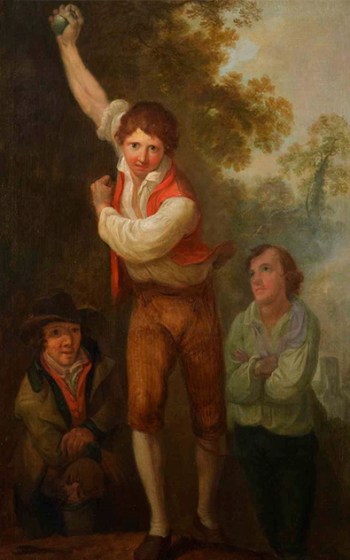
Irish Road Bowlers, ca. 1790s
The earliest known depiction of Irish Road Bowling will be offered by Bagshawe Fine Art at The Chelsea Antiques Fair, which opens the day after St Patrick’s Day at the Chelsea Old Town Hall on Wednesday, 18th March 2015 and runs until Sunday, 22nd March (it coincides with The BADA Fair, just half a mile away). Dr Fintan Lane, the Irish historian and author of Long Bullets: A History of Irish Road Bowling, has stated that in his opinion this is the earliest known visual depiction of the sport.
Nicholas Bagshawe explains: “This fascinating picture depicts the Irish sport of road bowling. This sport, possibly of Dutch origin, has been played in Ireland since the 17th century and is still played today, predominantly in the counties of Armagh and Cork. The sport consists of a contest between two or more players who attempt to throw a metal ball down a country road course of a specific length. The winner is the one who completes the course in the fewest throws.”
The Irish Road Bowling historian, Fintan Lane, states that the earliest painting known before this discovery was by Daniel MacDonald (1821–1853), which dates from circa 1847. According to Bagshawe “it is not yet totally certain who the artist of this picture is, but we are becoming increasingly convinced that it is the work of Nathaniel Grogan Junior (Irish, ca. 1765–1820).” The oil on canvas measures 47 x 33 inches and is dateable from the style of painting and the costumes of the players to the years around 1790 to 1800.
Bagshawe explains that “in English terms it appears to have an affinity with the styles of George Morland, Francis Wheatley or even the portraitist John Opie. But it is none of these directly, and given the specifically Irish nature of the subject, we must be looking for an Irish artist. The Grogans, both senior and junior, seem the most likely candidates; and, when we consider that they were both Cork artists, this becomes a very strong possibility. As art historians start to differentiate their work more accurately, it seems that Nathaniel Grogan senior, while a better known and seemingly more prolific artist, might not have been capable of painting a large front-of-stage figure with quite the fluency shown here. It is more likely that we are looking at the work of his son. Grogan Junior was, like his father, a Cork painter, and he must have started out as a pupil and collaborator of the older artist. However, such few documented sketches as we know to exist by the younger man do show a greater fluency with the figure, and he must be the most likely candidate for this picture. When we add to that the fact that he is known to have exhibited a picture in his lifetime called The Bowl Players, this attribution becomes all the more plausible. There is more to learn about this intriguing picture, but without doubt it already presents itself as a fascinating piece of Irish social history.”
The painting shows two young men, jackets off, competing with each other. The third figure, with hat and coat, is likely to be the ‘road-shower’. This man would have marked the point (the ‘tip’) where the previous shot had stopped and thus the place from where the bowler would take his next throw. The bowler holds the metal ball (probably still a cannon-ball at this stage) high in the air, from where he would bring it down in a fast underarm action. This high-arm action, sometimes known as the ‘windmill’ style was a technique favoured by players in the Cork area; therefore, it is felt that the scene depicted in the painting is taking place in Co. Cork.
The BADA Antiques & Fine Art Fair, March 2015
Press release for this year’s BADA Fair:
The BADA Antiques & Fine Art Fair
Duke of York Square, off Sloane Square, London, 18–24 March 2015

George I period scarlet japanned bureau cabinet, attributed to John Belchier and Daniel Massey, English, ca. 1720.
Long-regarded as the premier national fair in the UK, The BADA Antiques & Fine Art Fair is the leading event for sourcing antiques and fine art of assured quality and authenticity. It is the only event on the international art calendar exclusive to members of the British Antique Dealers’ Association and will see the display of a diverse range of important furniture, objet d’art, and paintings. Before the BADA Fair opens to the public, all these items are subject to a rigorous vetting process. Encompassing both antique and contemporary items, the BADA Fair allows buyers of all tastes and experience to add to their collections. In recent years the BADA Fair has seen a steady growth in international visitors and an increase in sales above £100,000.
Ninety-eight of the most renowned art and antiques dealers from around the country, representing a variety of specialisms, have confirmed their attendance at the BADA Fair. Returning Exhibitors include leading dealers Godson & Coles, Harris Lindsay, Thomas Coulborn & Sons, Lennox Cato, Frank Partridge, Anthony Woodburn Ltd., Trinity House, The Taylor Gallery, Sandra Cronan Ltd., and Holly Johnson Antiques. The demand for stands at the BADA Fair has increased and amongst the new Exhibitors at the upcoming edition are: Beaux Arts London, Philip Mould & Company, Michael Hughes, Peter Lipitch Ltd. and Ted Few.
The exquisite range of jewellery brought by various dealers has always been a highlight at the BADA Fair, and this year is no exception. Amongst the offerings from Sandra Cronan Ltd. is an important pair of diamond ‘waterfall’ earrings dating from c. 1940, each featuring 8 pear cut diamonds, and smaller baguette cut diamonds. New Exhibitor John Joseph will bring a beautiful Art Deco coral and diamond brooch and Anthea A G Antiques will display a bold coral ring in 18 carat gold, made by Kutchinsky and dating from the 1970s.
There are several trends that have emerged amongst the items being submitted by the dealers for the upcoming BADA Fair. These include a rise of European furniture and objects designed in an Oriental style. Godson & Coles, specialist in 18th- and 19th-century furniture, as well as Modern British art, will bring a rare George I period, scarlet japanned bureau cabinet, signed by maker Daniel Massey (pictured). Frank Partridge will devote his entire stand to Chinoiserie items. Another prevalent style in furniture will be fine pieces in English Oak as seen on the stands of Wakelin & Linfield, Witney Antiques and Shaw Edwards Antiques.
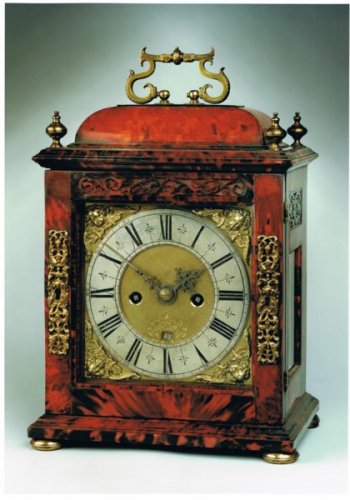
William and Mary turtle shell and gilt table clock, ca.1695
A further notable category is clocks, which are always well represented at the BADA Fair. Anthony Woodburn will bring a magnificent William and Mary turtle shell and gilt table clock dating from c.1695 as well as a remarkably preserved Charles II walnut and marquetry longcase clock. Yet again the fine art at the BADA Fair encompasses some wonderful British examples, ranging from 18th-century watercolours from John Spink and Guy Peppiatt Fine Art, to modern British sculpture including Elisabeth Frink’s Assassins II from Beaux Arts London, and contemporary works by artist Jonathan Pike, to whom Julian Simon Fine Art will devote their stand.
A new development that will benefit collectors is the introduction by the British Antique Dealers’ Association (BADA) of Certificates of Provenance, which members may now choose to include with the sale of an object. This is the first time Certificates of Provenance will have been available for objects sold at the BADA Fair. The Certificates will demonstrate that an object has been bought from a member of the BADA, which will be recorded as part of its permanent provenance.
In order to broaden the audience at the BADA Fair, there are several initiatives to attract new visitors and collectors. One of the most positive has been the Interior Designers’ Selection run by House & Garden. This year four acclaimed interior designers will each choose three highlights amongst the items displayed at the BADA Fair, and their exhibitors will receive a showcard to denote the selected object. Similarly the programme of talks and events will cover themes from cross collecting to Hollywood Style – Jewellery and Fashion from 1929 to 1959, appealing not just to antique aficionados but to a range of people from interior designers to jewellery enthusiasts.
The BADA Fair has a long tradition of supporting charitable causes, and has raised over £3 million for a variety of charities over the years. This year the BADA Fair is delighted to announce The Haven Trust as its beneficiary. The Haven Trust is an award- winning breast cancer charity, offering support and complimentary therapy to patients. The BADA Fair will host a Charity Gala Dinner for The Haven Trust on the evening of Thursday 19th March in the Cellini Restaurant, within the BADA Fair.
Following the success of the catering at last year’s BADA Fair, the upcoming edition will see the return of celebrated caterers Absolute Taste running both the Cellini restaurant and Duke of York Brasserie. World-renowned and family-owned champagne house Taittinger will once more be sponsoring the Champagne Bar.
New Book | The Sixtus Cabinet at Stourhead
Available from Philip Wilson and the National Trust (with a preview at Emile de Bruijn’s Treasure Hunt). . .
Simon Swynfen Jervis and Dudley Dodd, Roman Splendour, English Arcadia: The English Taste for Pietre Dure and the Sixtus Cabinet at Stourhead (London: Philip Wilson, 2015), 304 pages, ISBN: 978-1781300244, £45.
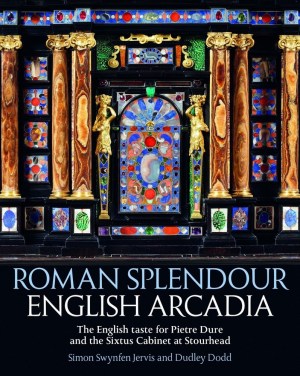 At Stourhead in Wiltshire, the Palladian mansion contains an extraordinary Roman cabinet glittering with gilt-bronze mounts, semi-precious stones and elaborate architectural ornament. Its façade conceals over 125 more-or-less secret drawers. The cabinet was brought to Stourhead in 1740 by Henry Hoare ‘the Magnificent’, of the Hoare banking dynasty; he had purchased it in Rome as made for Pope Sixtus V, the great rebuilder, whose papacy, from 1585–90, coincided with the Spanish Armada. The superb quality of the ‘Sixtus Cabinet’ became apparent during restoration in 2006–7 and this prompted an investigation into its history.
This book commences with a comprehensive account of the insatiable English taste for Italian pietre dure, from the 16th to the 20th centuries, and follows with a survey of the Roman pietre dure industry, hitherto unjustly neglected by comparison with Florence. A description and stylistic analysis of the cabinet itself precedes a trail of detection which takes it back to Pope Sixtus’s Roman villa, and then explores its tortuous descent through the Pope’s family to sale in 1740. Henry Hoare’s grand tour and his purchase of the cabinet led to its installation in a cabinet room at Stourhead, surrounded by Old Masters and with a new pedestal of triumphal arch form, incorporating reliefs of Pope Sixtus and his Roman monuments. Later his great-nephew, Sir Richard Colt Hoare created a new cabinet room, with embellishments by Thomas Chippendale the Younger. Horace Walpole and William Beckford were among the admirers of the cabinet, the focus of this remarkably wide-ranging study of Italian and English artistry, patronage and taste.
Call for Papers | Altarpieces in the Ibero-American Context

◊ ◊ ◊ ◊ ◊
From the conference website:
O Retábulo no espaço Iberoamericano: forma, função e iconografia
Faculdade de Ciências Sociais e Humanas, UNL, Lisbon, 26–27 November 2015
Proposals due by 30 April 2015
O Instituto de História da Arte da Faculdade de Ciências Sociais e Humanas da Universidade Nova de Lisboa encontra-se a organizar o I Simpósio de História da Arte—O Retábulo no espaço Iberoamericano: Forma, função e iconografia, que terá lugar na Faculdade de Ciências Sociais e Humanas, a 26 e 27 de Novembro de 2015.
O Simpósio O Retábulo no espaço Iberoamericano: forma, função e iconografia pretende divulgar a recente investigação desenvolvida em Portugal, Espanha, Brasil, México, Uruguai, Perú e Colômbia. Neste encontro de carácter científico, a eleição das três vertentes de análise—forma, função e iconografia—constituirá o mote para a abordagem histórico-artística da arte retabular. Quem eram os artistas ou oficinas capazes de idealizar as imponentes ‘máquinas’ retabulares que adornam todo o espaço iberoamericano? Quais foram os principais mecenas e agentes do mercado artístico intervenientes na execução das obras? Que materiais estavam disponíveis para a conceção dos retábulos? Que leituras podemos construir perante a complexidade dos seus programas iconográficos? Por conseguinte, o debate contemplará a caracterização da dimensão arquitetónica, ornamental e simbólica do retábulo, procurando salientar as especificidades autóctones e as divergências sócio-culturais, a fim de aferir as transferências artísticas operadas durante o período compreendido entre os séculos XVI–XVIII. (more…)
Plans for a Reader on Eighteenth-Century Book Illustration
Dear Colleagues,
We—Christina Ionescu and Leigh Dillard—are engaged in the planning stages of a reader on eighteenth-century book illustration that would encompass various traditions (English, French, German, Spanish, etc.). In order to best position the reader, we would be most grateful if those of you who work on book illustration (and perhaps also teach courses on the subject) could provide some feedback on our preliminary ideas. You could write to us directly (cionescu@mta.ca and Leigh.Dillard@ung.edu).
1) Would you use such a reader in a course? What type of course would you consider using it in? Would your library be interested in purchasing it?
2) Would you be interested in contributing a chapter? The deadline for submission of chapters will likely be December 2016.
3) Do you have any suggestions about its contents? Any specific texts that you believe should be included? Any translations of seminal texts that we should commission?
This is what is currently on our list:
• Relevant excerpts from nineteenth-century texts (Dibdin, the Goncourt brothers, etc.)
• Reprints and translations of key chapters from important 1980s/1990s studies on eighteenth-century book illustration (Edward Hodnett, Philip Stewart, etc.)
• Theoretical approaches to book illustration as it pertains to the chosen time frame (e.g. book illustration and word and image, book illustration and book history)
• The mechanics of book illustration (etching, woodcut, copperplate engraving, frontispieces, colour plates, etc.)
• Illustrators (Stothard, Marillier, Chodowiecki, Gravelot, Hogarth, Cochin, etc.)
• Genres (illustrated travelogues, gothic novels, sentimental fiction, erotica, etc.)
• Examples of eighteenth-century illustrated bestsellers (The Sentimental Journey, La Nouvelle Héloïse, etc.)
• Overviews by geographical region (illustration in England, France, Spain, etc.)
Many thanks,
Christina and Leigh
Christina Ionescu (Associate Professor of French, Mount Allison University)
Leigh Dillard (Assistant Professor of English, University North Georgia)
◊ ◊ ◊ ◊ ◊
Note (added 14 December 2016) — The call for proposals was advertised on the SHARP listserv.
Proposals are invited for the first installment in a multi-volume collection, titled A Companion to Eighteenth-Century Literary Illustration. The first volume is designed for students and established researchers seeking an introduction to approaches in this field; it can also be used for book illustration scholars seeking to extend their theoretical and methodological tool kit. Contributions should provide an introduction to pertinent theoretical terms and concepts, a practical demonstration, and suggestions for further reading. When possible, examples should be chosen from more than one national tradition. We invite proposals on the following topics to fill gaps in our existing commitments:
• Book illustration and consumer culture
• Book illustration and post-colonial theory
• Book illustration and fashion studies/costume studies
• Book illustration and visual rhetoric
• Book illustration and art history
• Book illustration and literary history
Please send 300–500 word proposals to Christina Ionescu (cionescu@mta.ca) and Leigh Dillard (leigh.dillard@ung.edu) by January 20, 2017. The deadline for the submission of completed chapters will be December 15, 2017.
New Book | British Models of Art Collecting and the American Response
From Ashgate:
Inge Reist, ed., British Models of Art Collecting and the American Response: Reflections Across the Pond (Aldershot: Ashgate, 2014), 282 pages, ISBN: 978-1472438065.
 British Models of Art Collecting and the American Response: Reflections Across the Pond presents 14 essays by distinguished art and cultural historians. Collectively, they examine points of similarity and difference in the approaches to art collecting practiced in Britain and the United States. Unlike most of their Continental European counterparts, the English and Americans have historically been exceptionally open to collecting the art made by and for other cultures. At the same time, they developed a tradition of opening private collections to a public eager for educational and cultural advancement. Approximately half the essays examine the trends and market forces that dominated the British art collecting scene of the nineteenth century, such as the Orléans sale and the shift away from aristocratic collections to those of the new urban merchant class. The essays that focus on American collectors use biographical sketches of collectors and dealers, as well as case studies of specific transactions to demonstrate how collectors in the United States embraced and embellished on the British model to develop their own, often philanthropic approach to art collecting.
Inge Reist, PhD Columbia University, is Director of the Center for the History of Collecting, The Frick Collection and Frick Art Reference Library, New York.
◊ ◊ ◊ ◊ ◊
C O N T E N T S
Introduction, Inge Reist
Part I—Reflections Across the Pond
1 Pictures across the Pond: Perspectives and Retrospectives, Sir David Cannadine
2 The Revolving Door: Four Centuries of British Collecting, James Stourton
Part II—The British Model: Conversing with History
3 The Orléans Collection arrives in Britain, Jordana Pomeroy
4 James Irvine: Picture Buying in Italy for William Buchanan and Arthur Champernowne, Hugh Brigstocke
5 Aristocrats and Others: Collectors of Influence in 18th-Century England, Arthur MacGregor
6 A Decade of Change and Compromise: John Smith (1781–1855) and the Selling of Old Master Paintings in the 1830s, Julia Armstrong-Totten
7 ‘Le Goût Rothschild’: The Origins and Influences of a Collecting Style, Michael Hall
8 The 4th Marquess of Hertford and Sir Richard Wallace as Collectors: Chalk and Cheese? Or Father and Son?, Jeremy Warren
9 Collecting and Connoisseurship in England, 1840–1900: The Case of J. C. Robinson, Jonathan Conlin
Part III—Americans Embrace and Embellish the British Model
10 British Aspirations on the Chesapeake Bay: Robert Gilmor, Jr (1774–1848) of Baltimore and Collecting in the Anglo-American Community of the New Republic, Lance Humphries
11 The London Picture Trade and Knoedler & Co: Supplying Dutch Old Masters to America, 1900–1914, M. J. Ripps
12 The One That Got Away: Holbein’s Christina of Denmark and British Portraits in The Frick Collection, Ross Finocchio
13 The Long Good-bye: Heritage and Threat in Anglo-America, Neil Harris
14 Henry E. Huntington: An American Model for Collecting Art and Instituting Cultural Philanthropy, Shelley Bennett
Bibliography
Index
Call for Papers | Printmaking in Scotland in the 18th Century
From H-ArtHist:
Printmaking in Scotland in the 18th Century
University of St Andrews, 4 December 2015
Proposals due by 1 June 2015
This conference will explore the rich world of printmaking and its development in Scotland in the 18th century. While a good deal of research exists on printmaking in England there is very little on the relationships between artists, printmakers, publishers and collectors in Scotland.
Besides contributions on the work of individual artists, we seek in particular to explore the development of a market for prints. We invite papers on all aspects of the subject, but we are especially interested in contributions that will address the following questions:
• Who were the engravers and etchers, the teachers, publishers, dealers, collectors of prints and suppliers of materials?
• How was the print trade between Scotland, London, and the Continent supported?
• Were there printmakers working outside Edinburgh and Glasgow?
• Where could artists see the work of other printmakers?
• What kind of prints were they making: landscapes and prospects, antiquities, portraits, satires, drawing manuals, book illustrations and book plates, trade cards?
• In what ways did prints contribute to the ‘discovery’ of Scotland, the Jacobite cause?
To submit a proposal for a 20-minute presentation, please send an abstract not exceeding 300 words and a one-page CV to avg1@st-andrews.ac.uk. A selection of papers will be edited for publication by the conference organisers. For further details, contact: Ann Gunn, School of Art History, University of St Andrews: avg1@st-andrews.ac.uk.
New Book | The Portrait Bust and French Cultural Politics
From Brill:
Ronit Milano, The Portrait Bust and French Cultural Politics in the Eighteenth Century (Leiden: Brill, 2015), ISBN: 978-9004276246 / E-ISBN: 978-9004276253, 125€ / $174.
 In The Portrait Bust and French Cultural Politics in the Eighteenth Century, Ronit Milano probes the rich and complex aesthetic and intellectual charge of a remarkably concise art form, and explores its role as a powerful agent of epistemological change during one of the most seismic moments in French history. The pre-Revolutionary portrait bust was inextricably tied to the formation of modern selfhood and to the construction of individual identity during the Enlightenment, while positioning both sitters and viewers as part of a collective of individuals who together formed French society. In analyzing the contribution of the portrait bust to the construction of interiority and the formulation of new gender roles and political ideals, this book touches upon a set of concerns that constitute the very core of our modernity.
Ronit Milano is a faculty member in the Department of the Arts, Ben-Gurion University of the Negev, Israel. She has published several articles on the French pre-Revolutionary portrait bust and is currently writing a book on contemporary art installations in eighteenth-century sites.
◊ ◊ ◊ ◊ ◊
C O N T E N T S
List of Illustrations
Acknowledgments
Introduction
1 ‘He is a Philosopher’: Individual versus Collective Identity
2 Decent Exposure: Bosoms, Smiles and Maternal Delight in Female Portraits
3 Between Innocence and Disillusion: Representations of Children and Childhood
4 Transitional Identities: Family Structure, the Social Order, and Alternative Masculinities at the Dawn of Modernity
5 The Face of the Monarchy: Court Propaganda and the Portrait Bust
Conclusion
Bibliography
Index
Exhibition | Asia in Amsterdam
From the Rijksmuseum:
Asia in Amsterdam: The Asian Culture Shock of the Golden Age
Rijksmuseum, Amsterdam, 16 October 2015 — 17 January 2016
Peabody Essex Museum, Salem, Massachusetts, 2016
At the start of the Golden Age, Dutch merchants used their business acumen to establish lucrative trade agreements with Asia. This trade saw all sorts of exotic treasures, such as porcelain, lacquerware, ebony, ivory and silk, arriving in the Dutch Republic, where no one had ever seen such design and materials before. Asia in Amsterdam shares the sensation that these luxury items caused, while also presenting the history behind this first global market. When Dutch ships sailed the entire globe, when young men risked their lives to become rich in Batavia, and when the phrase Made in China meant something else altogether. Amsterdam plaid a central role in the story: the capital city became the marketplace for Asian luxury goods. And not just for the Republic, but for all of Europe. The Peabody Essex Museum in Salem, Massachusetts has one of the most beautiful Asian export art collections in the world and is the Rijksmuseum’s partner for this exhibition.










 Enfilade
leave a comment