Exhibition | Napoleon’s Artists in Australia
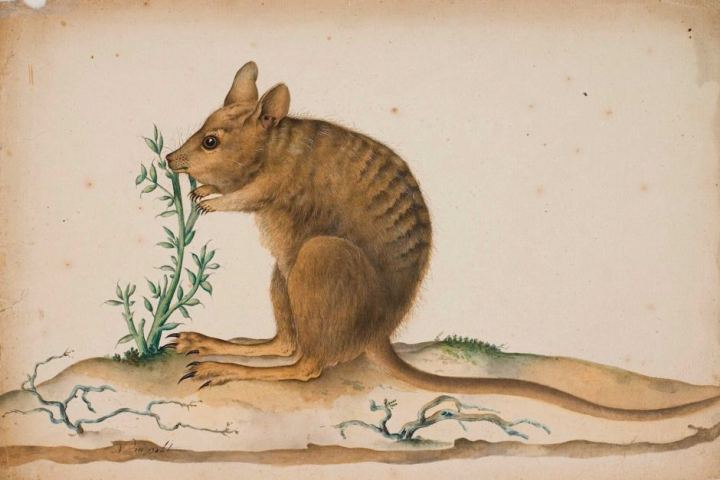
Lagostrophus fasciatus (Banded Hare Wallaby), Péron and Lesueur, 1807, Watercolour and ink on paper, Western Australia (Muséum d’Histoire Naturelle du Havre).
◊ ◊ ◊ ◊ ◊
Press release (15 May 2015) from the National Museum of Australia:
Napoleon’s Artists in Australia
South Australian Maritime Museum, Adelaide, from July 2016
Tasmanian Museum and Art Gallery, Hobart, from early 2017
National Museum of Australia, Canberra, from September 2017
TBA
Exquisite illustrations by French artists made during Nicolas Baudin’s exploration of Australia will come to Australia as the result of a deal clinched in Canberra between the Museum of Natural History in Le Havre, France and six Australian museums. Under the Memorandum of Understanding (MOU) between the French and Australian museums, stunning original watercolours and drawings by Baudin expedition artists Charles-Alexandre Lesueur and Nicolas-Martin Petit will be showcased at venues across the country.

New Holland – Mororé, Nicolas-Martin Petit, Pierre noire or charcoal and sanguine on paper (Muséum d’Histoire Naturelle du Havre)
The French artists explored Australian waters between 1800 and 1804 with the expedition of Baudin, who was commissioned by Napoléon Bonaparte, First Consul of France, to investigate Nouvelle Hollande—particularly its uncharted southern coast. As Baudin’s two ships charted the continent’s coastline, the artists captured the wonders of a new land in vivid watercolours of animals, people, and landscapes.
The working title of the planned exhibition is Napoleon’s Artists in Australia. Most of the anticipated 100 illustrations have never been displayed in Australia before. The project was instigated by the Museum of Natural History in Le Havre and the South Australian Maritime Museum (Adelaide). It also involves the Australian National Maritime Museum (Sydney), the Western Australian Museum (Perth), the Queen Victoria Museum and Art Gallery (Launceston), the Tasmanian Museum and Art Gallery (Hobart), and the National Museum of Australia (Canberra).
Minister for the Arts, Senator the Hon George Brandis QC, welcomed the collaboration. “This partnership will allow audiences across the country to see unique depictions of life in Australia though French eyes,” said Senator Brandis.
National Museum of Australia director Mathew Trinca said that the illustrations are a rare window into the lives of the First Australians before European settlement. “These illustrations provide unique insights into life in Australia before European colonisation and I’m excited to be involved in bringing them to the country,” said Dr Trinca.
A delegation from France, led by the Mayor of Le Havre, Edouard Philippe, was on hand in Canberra to sign the MOU.

New Holland – Mororé, Nicolas-Martin Petit, Pierre noire or charcoal and sanguine on paper (Muséum d’Histoire Naturelle du Havre)
Museum of Natural History director, Cedric Cremiere said: “It is wonderful that after that first French encounter with Australia more than 200 years ago, we can share these discoveries and sense of wonder with Australian audiences.”
The French Ambassador to Australia, Christophe Lecourtier, said Lesueur was a magnificent artist, a pioneering naturalist and an astute observer.
“These extraordinary illustrations will be showcased in six Australian museums thanks to a fruitful partnership with the Muséum d’Histoire Naturelle du Havre—which was created to house Lesueur’s work—and for which we have the pleasure to thank, the Mayor of Le Havre, Mr Edouard Philippe. Mr Philippe is here with us today on his first ever visit to Australia. This is an extraordinary opportunity for the public to discover Australia, as the first explorers and French navigators did, more than 200 years ago,” said Ambassador Lecourtier.
Illustrations featured in the exhibition will include: evocative portraits of Indigenous Australians in NSW and Tasmania; images of Indigenous baskets and watercraft; whimsical watercolours of strange marine invertebrates; highly accurate profiles of the coastline; and drawings of Australian mammals such as Kangaroo Island’s dwarf emu, which have now disappeared. The exhibition will open in Adelaide in July 2016, before touring the country until May 2018. It will open in Canberra at the National Museum of Australia in September 2017.
Commemorating the Aboriginal Warrior Pemulwuy

This engraving by Samuel John Neele of James Grant’s image of ‘Pimbloy’ is believed to be the only known depiction of Pemulwuy. It was published in Grant’s The Narrative of a Voyage of Discovery, Performed in His Majesty’s Vessel the Lady Nelson, of Sixty Tons Burthen, with Sliding Keels, in the Years 1800, 1801 and 1802, to New South Wales, 1803 (State Library of New South Wales Q80/18).
◊ ◊ ◊ ◊ ◊
Press release (20 March 2015) from the National Museum of Australia in Canberra:
Defining Moment in Australia’s History
National Museum Honours Aboriginal Warrior Pemulwuy
The life of Aboriginal warrior Pemulwuy is commemorated today at the National Museum of Australia as part of its Defining Moments project, which explores key dates that have defined the country’s history over more than 50,000 years.
As Australia’s first Aboriginal resistance leader and a member of the Bidjigal people, Pemulwuy fought the British at Sydney from 1792 by leading attacks on farms, burning crops and dispersing stock in an attempt to starve the settlers out. After surviving a number of battles he was finally killed by settlers in June 1802 at the age of about 52 years. His body was dishonoured with the removal of his head, which was sent to the naturalist Joseph Banks in England. It has yet to be found. The National Museum is working in collaboration with the Ministry for the Arts Museums and Repatriation unit, to undertake research into the possible whereabouts of Pemulwuy’s remains.
The National Museum today [20 March 2015] unveils a plaque in its Main Hall, commemorating Pemulwuy’s campaign of resistance.
The Minister for Education and Training, Christopher Pyne, representing the Australian Government at the ceremony, said Pemulwuy was a figure of Aboriginal defiance, and his legacy remains an important part of Indigenous culture in Australia. “For some years I have been working with Alex Hartman, a member of the National Museum of Australia Council to help find and repatriate the remains of Pemulwuy,” Pyne said. “Pemulwuy’s story is an important one and he deserves to be commemorated in this way.”
National Museum director Mathew Trinca said Pemulwuy was a hero to Aboriginal people. “Pemulwuy’s daring leadership impressed enemies and comrades alike and the story of his concerted campaign of resistance against British colonists should be more widely known,” said Trinca.
Bidjigal elder Uncle Vic Simms said, “What the Museum is doing is so important for getting the history right about Pemulwuy as a Bidjigal man, who resisted and rebelled against the settlers and stood up against them when they were giving blackfellas such a hard time.”
Defining Moments is a National Museum project supported by patrons, the Hon Michael Kirby AC CMG and Mr Michael Ball AM. Under the project, the National Museum is releasing online content for an initial list of 100 Defining Moments and is encouraging people to contribute their own ideas on historical dates of importance. The Museum’s list is a starting point for discussions and is not intended to be definitive.
Smithsonian American Art Museum Fellows, 2015–16
Among this upcoming year’s 14 new Smithsonian American Art Museum Fellows is
• Emily Casey, Terra Foundation Predoctoral Fellow in American Art, University of Delaware; “Waterscapes: Representing the Sea in the American Imagination, 1760–1815.”
A full list is available here»
Since 1970, the museum has hosted more than 565 scholars who now occupy positions in academic and cultural institutions across the United States and in Australia, Asia, the Caribbean, Europe, the Middle East and South America. Fellowship opportunities include the Joe and Wanda Corn Fellowship for research that spans American art and American history; the Douglass Foundation Fellowship; the Patricia and Phillip Frost Fellowship; the George Gurney Fellowship; the James Renwick Fellowship in American Craft; the Sara Roby Fellowship in 20th-Century American Realism; the Joshua C. Taylor Fellowship; the Terra Foundation for American Art Fellowships for the cross-cultural study of art of the United States; the William H. Truettner Fellowship; and the Wyeth Foundation Predoctoral Fellowship for the study of excellence in all aspects of American art. The museum also hosts fellows supported by the Smithsonian’s general fellowship fund. For additional information, call (202) 633-8353 or email americanartfellowships@si.edu. The deadline for applications is December 1, 2016.
Conference | Orientality: Beyond Foreign Affairs

◊ ◊ ◊ ◊ ◊
From the conference website:
Orientality: Beyond Foreign Affairs
National Portrait Gallery, London, 2–3 June 2015
A biennial conference series developed by the Orientalist Museum, Doha
The inaugural conference Orientality: Cultural Orientalism and Mentality took place at Cambridge University in 2013. The subsequent conference is scheduled for the National Portrait Gallery, London, 2015. The only conference of its kind, Orientality gives international art and museum professionals an opportunity to come together and discuss the art, history, politics and future of the Orientalist art movement. The conference aims to develop understanding between east and west, and showcase the continued vibrancy of the Orientalist art movement in the 21st century.
The conference title orientality is a combination of two terms—orientalism and mentality. The term orientalism has been used in art history since the early nineteenth century in association with works of art on Middle Eastern and North African subjects pioneered by French artists. The term mentality is defined as “way of thinking of a person or a group,” and can be metaphorically translated as an “opinion,” formed and shaped, in our case, under various historical, political, social and cultural circumstances and environments, what allows the orientalism to be seen and interpreted in various ways by different societies. The theme of cultural orientalism and mentality captured the scholarly imaginations largely because we were able to articulate the dialog in both artistic and sociological terms, spanning the geographical area of orientalism and widening its historical borders.
We hope that our interpretation of orientality will influence many other disciplinary areas in the social sciences, humanities and beyond. Orientalism as a historical and cultural event has been uniting various aspects of cultural life for a number of centuries—literature, fine arts, architecture, music, philosophy—and generating an exotic image within our consciousness, one that had a right to its own existence.
Entry to the conference is free, and all are welcome. We do ask that you register your attendance ahead of time to ensure we have adequate seating available.
◊ ◊ ◊ ◊ ◊
T U E S D A Y , 2 J U N E 2 0 1 5
8:30 Coffee and registration
9:30 Opening and welcome
9:45 Art and Nation Building
• The Somerset House Painting of 1604: How a Turkey Carpet Became a Symbol of British Imperialism, Gerald MacLean
• Design Reform at the British Embassy: James Wild’s Arabesque Hall in Qajar Tehran, Moya Carey
• Ottoman Photography and Late Nineteenth-Century Modernity, Zeynep Çelik
11:45 Lunch break
13:15 Diplomatic Gifts
• Across Religious Borders: Diplomatic Gifts at the Mamluk Court, Doris Behrens-Abouseif
• Pearls, Bezoar Stones, Carpets and Diplomatic Gifts: The Portuguese Luxury Trade in the North of the Indian Ocean and the Gulf, Jean Michel Massing
• Illustrated Manuscripts as Persian Diplomatic Gifts to the Russian Court, Firuza Melville
W E D N E S D A Y , 3 J U N E 2 0 1 5
8:30 Coffee and registration
9:30 Opening and welcome
9:45 Art and Politics
• Bellini, Bronze and Bombards: Sultan Mehmed II’s Requests Reconsidered, Antonia Gatward Cevizli
• Collecting Arts for Imperial Needs: Acquisitions of Russian Military Men and Diplomats in Levant during the Russo-Turkish war of 1768–1774, Elena Borisovna Smilyanskaya
• The Von Celsing Family History and the Eighteenth-Century Collection of Ottoman Art at Biby, Anna-Sophia von Celsing
• Searching for the Meaning of the Rare Mughal Animal Carpet in David Wilkie’s Painting The Preaching of Knox before the Lords of the Congregation, 10th June 1559, Dorota Chudzicka
12:25 Lunch break
14:00 Oriental Encounters
• ‘Speak of Me as I Am’: A Portrait of a Moorish Ambassador to Queen Elizabeth I, Sophie Bostock
• Iconographies of the Levant, ca. 1800, Paolo Girardelli
• Mme Lucas-Robiquet’s Artistic Portrayal of Late Nineteenth-Century Algeria, Mary Healy
New Book | Voltaire, Siècle de Louis XIV, volumes 1–6
From the Voltaire Foundation:
Voltaire, Siècle de Louis XIV, volumes 1–6, edited by Diego Venturino, et al. (Oxford: Voltaire Foundation, 2015–17).

Attributed to Antoine Benoist (1632–1717), Portrait of Louis XIV, lead pencil, sanguine and white chalk (Château de Versailles)
2015 marks the 300th anniversary of the death of Louis XIV (1638–1715), the Sun King, whose reign defined the era of the ‘Grand Siècle’ and saw France rise to become the dominant player on the European stage. To mark this anniversary, the Voltaire Foundation, in collaboration with the Château de Versailles, is publishing Voltaire’s seminal account of his reign, the Siècle de Louis XIV (1751), the first major overall account of the reign of Louis XIV. This text is the starting-point for any reflection on the political and cultural history of the era of the Sun King, and is a monument of eighteenth-century historiography, paving the way for both modern historiography and literary history. The lasting success of this flagship work is due to the depth of Voltaire’s insight into the people and events that he is describing and to his historical method, which was remarkable for its day. The emphasis on first-hand accounts from those who witnessed events and on the perspective of the age as a whole rather than a parade of facts bears the stamp of Voltaire. This edition is the first-ever full critical edition, and will be published in volumes 11–13 of the Complete Works of Voltaire. It takes as its base text the last version of the work that Voltaire authorised (1775), and gives variant readings from all preceding versions of the text. It will include the Catalogue des écrivains français qui ont paru dans le siècle de Louis XIV, an important and fascinating work in its own right. The edition will be supplied with an index with full names and dates of all persons mentioned in the text. These volumes are published with the support of the Centre de recherche du château de Versailles.
See “The Sun King and Voltaire: 300 Years On” for an overview of good reading relating to Louis XIV and his era, along with our Siècle de Louis XIV blog pieces: “Picturing the Reign of Louis XIV” and “Shadows at the Court of the Sun King.”
◊ ◊ ◊ ◊ ◊
• Œuvres complètes de Voltaire, tome 11 | Siècle de Louis XIV (I): Introduction, Textes annexes, Index (Oxford: Voltaire Foundation, 2017), ISBN: 978-0729411462.
• Œuvres complètes de Voltaire, tome 12 | Siècle de Louis XIV (II): Listes et Catalogue des écrivains (Oxford: Voltaire Foundation, 2016), ISBN: 978-0729411479.
• Œuvres complètes de Voltaire, tome 13A | Siècle de Louis XIV (III): Chapitres 1–12 (Oxford: Voltaire Foundation, 2015), ISBN 978-0729409650.
• Œuvres complètes de Voltaire, tome 13B | Siècle de Louis XIV (IV): Chapitres 13–24 (Oxford: Voltaire Foundation, 2015), ISBN: 978-0729411561.
• Œuvres complètes de Voltaire, tome 13C | Siècle de Louis XIV (V): Chapitres 25–30 (Oxford: Voltaire Foundation, 2015), ISBN: 978-0729411578.
• Œuvres complètes de Voltaire, tome 13D | Siècle de Louis XIV (VI): Chapitres 31–39 (Oxford: Voltaire Foundation, 2016), ISBN: 978-0729411554.
Colloquium | Perception Machines
From the University of Geneva:
Machines à Percevoir / Perception Machines
Université de Genève, 29–30 May 2015
Organised by Marie Theres Stauffer and Stefan Kristensen
Le colloque traite des différents types de machines construites entre le 17e et le 20e siècle et dont la fonction consiste à produire des expériences esthétiques. Il sera question, d’une part, des processus et phénomènes perceptifs déclenchés par les machines et, d’autre part, de la conception souvent complexe de ces dispositifs. La période historique très large, qui est envisagée, permettra de dégager des liens thématiques et structurels, de localiser des processus d’innovation et de discuter la signification de la conception, de l’usage et des transformations de l’usage de ces machines dans une perspective d’histoire des savoirs. Enfin, il s’agit également de dégager les différences entre les objets particuliers et leurs contextes historiques.
Le colloque réunira des perspectives de l’histoire des arts visuels et scéniques, de l’histoire des techniques, ainsi que de la philosophie. Il est organisé par l’Unité d’histoire de l’art et la Société suisse de théorie de la culture et de sémiotique.
L’entrée est libre et toute personne intéressée est la bienvenue.
◊ ◊ ◊ ◊ ◊
F R I D A Y , 2 9 M A Y 2 0 1 5
9:30 Welcome
9:45 Julia Zons, Universität Konstanz: Qui a tué le beau monstre noir? Life and death of the pantelegraph (1855–1867)
10:30 Veronica Peselmann, Freie Universität Berlin: The Kaiser-Panorama. Mobilizing spaces of perception in the late 19th century
11:15 Break
11:45 Benoît Turquéty, Université de Lausanne: Machines imageantes, machines- images
12:30 Lunch break
14:30 Guillaume Sibertin-Blanc, Université de Toulouse: Désir et perception chez Deleuze et Guattari
15:15 Bianca Westermann, Ruhr-Universität Bochum: Biomorphic automats in the 18th century
16:00 Break
16:30 Marie Theres Stauffer, Université de Genève: La reconstruction de machines catoptriques. L’intérêt et ses défis
17:15 Philip Ursprung, ETH Zürich: Olafur Eliasson’s machines
18:15 Assemblée générale de l’ASSC
S A T U R D A Y , 3 0 M A Y 2 0 1 5
9:30 Nina Zschokke, ETH Zürich: Machines, instructions, skills, rewards. Jon Kessler’s The Web (2012) and the production of perception in the 21st century
10:15 Dieter Dietz, EPF Lausanne: Immersive devices. The expanded eye in space
11:00 Break
11:30 Holle Rössler, Herzog August Bibliothek Wolffenbüttel: Spectacular Delusions. Perception Machines and the Perception of Machines in the History of Theater
12:15 Lunch break
14:00 Stefan Kristensen, Université de Genève: Les « machines à influencer » entre esthétique et psychopathologie
14:45 Felix Thürlemann, Universität Konstanz: Le miroir-transparent chez Lee Friedlander ou l’alternative rendue simultanée
15:30 Closing remarks
Sir John Soane’s Private Apartments and Model Room
From Sir John Soane’s Museum:
Soane Tour: Private Apartments and Model Room
Sir John Soane’s Museum, London, starting May 19
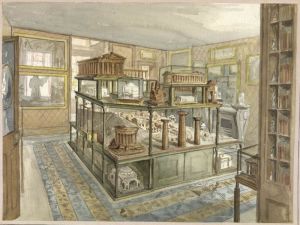
Sir John Soane’s Model Room, watercolour by C. J. Richardson ca. 1834–35
Explore Soane’s unique house-museum with our expert staff on the Soane Highlights Tour. Be transported back to Regency London as we guide you through Sir John Soane’s extraordinary home, including Soane’s fully-restored private apartments and Model Room, not seen by the public for 160 years. Offering a fascinating insight into his work and family life, the tour will show you the highlights amongst the many treasures on display, including paintings by Canaletto and J.M.W. Turner, the 3,000 year-old sarcophagus of Egyptian King Seti I, and William Hogarth’s complete A Rake’s Progress. Tuesday, Thursday, Friday, Saturday, 12:00, £10.
Coverage from The Guardian is available here»
Exhibition | Unbuttoning Fashion

◊ ◊ ◊ ◊ ◊
Now on view at Les Arts Décoratifs:
Déboutonner la mode
Les Arts Décoratifs, Paris, 10 February — 19 July 2015
For the first time, the Déboutonner la mode exhibition at Les Arts Décoratifs is unveiling a collection of over 3,000 buttons unique in the world, and also featuring a selection of more than 100 female and male garments and accessories by emblematic couturiers such as Paul Poiret, Elsa Schiaparelli, Christian Dior, Jean Paul Gaultier and Patrick Kelly. Acquired in 2012, this collection was classified as a Work of Major Heritage Interest by the Consultative Commission on National Treasures.

Button, late eighteenth century, wax on painted metal
(Paris: Les Arts Décoratifs)
Although small in size, the priceless materials and skills involved in making these pieces dating from the 18th to the 20th century can make them fully-fledged objets d’art. Produced by artisans ranging from embroiderers, soft furnishers, glassmakers and ceramicists to jewellers and silversmiths, they crystallise the history and evolution of these skills. The button has also fascinated famous painters, sculptors and creators of jewellery, inspiring them to produce unique miniature creations for the great couture houses.
This collection, gathered by Loïc Allio, is exemplary in its variety, richness and eclecticism. Its exceptional pieces include a portrait of a woman in the Fragonard manner, a trio of buttons inspired by La Fontaine’s fables by the silversmith Lucien Falize, a set of eight birds painted on porcelain by Camille Naudot, and a series of 792 pieces by the sculptor Henri Hamm. The jewellers Jean Clément and François Hugo and the artists Jean Arp and Alberto Giacometti all produced pieces for the famous fashion designer Elsa Schiaparelli, as did Maurice de Vlaminck for the couturier Paul Poiret. Couture houses such as Dior, Balenciaga, Mme Grès, Givenchy, Balmain and Yves Saint Laurent enlisted the talents of the jewellers Francis Winter and Roger Jean-Pierre, and the exhibition also features creations by Sonia Delaunay and Line Vautrin.
Structured chronologically, the exhibition reveals the incredible history of the button, showing via this extraordinary collection how it perfectly reflects the creativity and humour of a period. Pictures, engravings, drawings and fashion photographs emphasize its importance on the garment and how crucial it is in creating the balance of a silhouette.

Button, attributed to Fragonard, late eighteenth century, miniature on ivory (Paris: Les Arts Décoratifs)
Since its appearance in the 13th century, the button has maintained its key role on the garment. Its production and use gradually developed but the golden age of the button in France did not come until the late 18th century, when it became a luxury item often more expensive than the garment itself. More than a mere ornament, it was also a means of conveying penchants and opinions, via humorous, intimate and even political messages (portraits of the royal family, scenes showing storming of the Bastille, etc.). However, not until around 1780 and the French craze for all things English, did the button appear in female fashion, on dresses and bodices with cuts inspired by male garments.
In the 19th-century male wardrobe the art of the button gave way to the art of buttoning. Now smaller and more discreet, the button came to denote the degree of refinement of a garment or level of distinction of its wearer. The attention paid to its positioning is particularly apparent on that most essential component of the male wardrobe, the waistcoat. With the industrial revolution in the second half of the 19th century button manufacturing developed into a full-scale industry mass-producing all sizes and colours of buttons for every type of garment and accessory.
Women’s buttons remained much more modest in size but their number increased. They now also appeared on ankle boots, gloves and eventually lingerie as the number of undergarments increased around 1850. Their number was precisely noted in fashion magazines and their description in contemporary literature established them as objects of coquetry and even seduction. In parallel, silversmiths and jewellers created valuable buttons, sometimes presented in caskets like jewellery and reflecting the artistic movements of the period, especially Art Nouveau.
The first floor of the exhibition ends with the 1910s and the return of the so-called ‘Empire’ line under the influence of the avant-garde-inspired couturier Paul Poiret, for whom the importance of a detail, for instance a button and its precise positioning, is dictated by a “secret geometry that is the key to aestheticism.”
The exhibition continues with the fashion of the 20s, featuring Art Deco buttons and the emergence of the paruriers, creators of accessories, jewellery and buttons, each with their own style and preference for different materials. Their close collaborations with the great couturiers are highlighted in a display featuring creations for Elsa Schiaparelli, Jean Clément and Jean Schlumberger. François Hugo’s designs for Schiaparelli include uncut stones set in bent and compressed metal. He also enlisted the talents of artists such as Pablo Picasso and Jean Arp for original creations. The decline of the button began in the 80s as couturiers returned to more minimal creations in which the button regained its original use.
In counterpoint to creations by artists, the exhibition emphasizes the manner in which certain couturiers creatively used and interpreted the button in their own way, ranging from Gabrielle Chanel and Christian Dior to Cristobal Balenciaga and the ‘jewellery buttons’ of Yves Saint Laurent. And of course there are also exquisite 21st-century examples, notably Jean Paul Gaultier’s trouser suit entirely covered with small mother-of-pearl buttons, and the coats by Céline subtly revisiting double-breasted buttoning.
Despite the emergence and increasing use of new types of fastenings such as the zip, the pressure button and velcro, the button is ever-present and still has many years to come.
◊ ◊ ◊ ◊ ◊
From Les Arts Décoratifs:
Véronique Belloir, ed., Déboutonner la mode (Paris: Les Arts Décoratifs, 2015), 164 pages, ISBN: 978-2916914541, 45€.
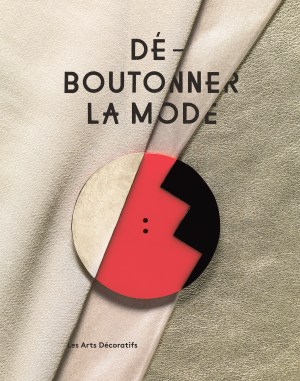 Il est des objets avec lesquels nous entretenons des rapports tout en délicatesse, entre conscience et émotion. À plus d’un titre, le bouton est de ceux-là, de ceux que l’on conserve parfois, sans bien savoir pourquoi, au fond d’une poche ou dans une boîte. Sur un vêtement, qu’il soit masculin ou féminin, son rôle est loin d’être anodin : élément structurant l’équilibre des formes, il entre en résonance avec une ligne, celle d’une boutonnière, d’une couture ou celle du vêtement lui-même. L’histoire du bouton révèle bien d’autres aspects méconnus. Qu’il soit modeste et utile ou précieux et décoratif, sa place évolue au fil du temps en fonction des convenances, des règles de savoir-vivre ou des variations de mode.
Sous la direction de Véronique Belloir, chargée de collections au musée Galliera. Auparavant conservatrice au musée des Arts décoratifs, en charge des collections mode 1800-1940, elle a fait classer la collection de boutons de Loïc Allio en 2012. Textes de Loïc Allio, Véronique Belloir, Raphaèle Billé, Farid Chenoune, Michèle Heuzé, Geoffrey Martinache, Sophie Motsch, Hélène Renaudin. Photographies de Patrick Gries. Référence dans le milieu de l’édition d’art, il excelle dans la photographie d’objets complexes, monumentaux ou minuscules, en répondant à de nombreuses commandes pour le monde du luxe, du design et de l’art contemporain.
Exhibition | Gilbert Stuart: From Boston to Brunswick
From the Bowdoin College Museum of Art
Gilbert Stuart: From Boston to Brunswick
Bowdoin College Museum of Art, Brunswick, Maine, 9 July 2015 — 3 January 2016
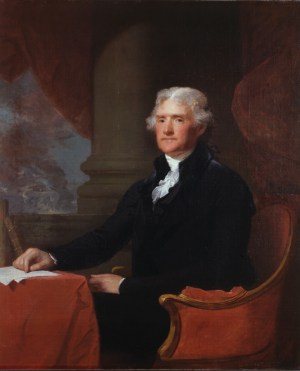
Gilbert Stuart, Portrait of Thomas Jefferson
(Bowdoin College Museum of Art)
This exhibition brings together a selection of oil paintings by Gilbert Stuart (1755–1828) from the Museum’s collection, including his famous portraits of Thomas Jefferson and James Madison.
The preeminent portraitist of the early republic, Stuart created fashionable likenesses of the period’s most important political, military, and social figures. Each of works included in the exhibition was completed after Stuart’s move to Boston in 1805. Collectively, they provide insight into the artist’s relationship with other artists and collectors in the region, including members of the Bowdoin family.
New Book | James Thomson’s The Seasons
From Rowman & Littlefield:
Sandro Jung, James Thomson’s The Seasons, Print Culture, and Visual Interpretation, 1730–1842 (Bethlehem, PA: Lehigh University Press, 2015), 318 pages, ISBN: 978-1611461916 (hardback), ISBN: 978-1611461923 (ebook), $80 / £53.
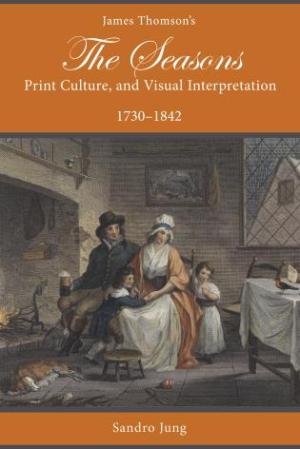 Drawing on the methods of textual and reception studies, book history, print culture research, and visual culture, this interdisciplinary study of James Thomson’s The Seasons (1730) understands the text as marketable commodity and symbolic capital which throughout its extended affective presence in the marketplace for printed literary editions shaped reading habits. At the same time, through the addition of paratexts such as memoirs of Thomson, notes, and illustrations, it was recast by changing readerships, consumer fashions, and ideologies of culture. The book investigates the poem’s cultural afterlife by charting the prominent place it occupied in the visual cultures of eighteenth- and early nineteenth-century Britain. While the emphasis of the chapters is on printed visual culture in the form of book illustrations, the book also features discussions of paintings and other visual media such as furniture prints. Reading illustrations of iconographic moments from The Seasons as paratextual, interpretive commentaries that reflect multifarious reading practices as well as mentalities, the chapters contextualise the editions in light of their production and interpretive inscription. They introduce these editions’ publishers and designers who conceived visual translations of the text, as well as the engravers who rendered these designs in the form of the engraving plate from which the illustration could then be printed. Where relevant, the chapters introduce non-British illustrated editions to demonstrate in which ways foreign booksellers were conscious of British editions of The Seasons and negotiated their illustrative models in the sets of engraved plates they commissioned for their volumes.
Sandro Jung is research professor of early modern British literature and founding director of the Centre for the Study of Text and Print Culture at Ghent University.










 Enfilade
leave a comment