Conference | Representing the Habsburg-Lorraine Dynasty, c. 1618–1918
From the conference programme:
Representing the Habsburg-Lorraine Dynasty in Music,
Visual Media, and Architecture, c. 1618–1918
Institute of History of Art and Musicology, Austrian Academy of Sciences, Vienna, 8–10 June 2015
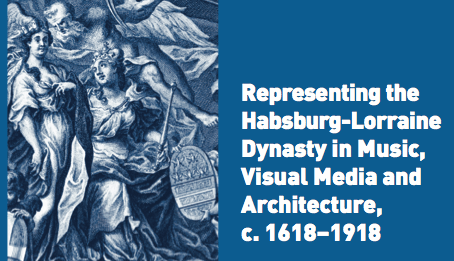 This international conference will take place in Vienna from the 8th to the 10th of June 2015. It will be devoted to the new interdisciplinary research program ‘Representing Habsburg’—one of the main current research fields of the Institute for History of Art and Musicology (IKM) of the Austrian Academy of Sciences focusing on the history of fine arts and music in Austria and Central Europe in their general European context. Please register at:
kunstgeschichte@oeaw.ac.at.
◊ ◊ ◊ ◊ ◊
M O N D A Y , 8 J U N E 2 0 1 5
10:30 Registration
11:00 Opening, Werner Telesko, Director of the Institute of History of Art and Musicology
11:30 Topics and Media of Representation
Chair: Alexander Rausch, Werner Telesko
• Andrea Lindmayr-Brandl, University of Salzburg | Vom Volkslied zur Kaiserhymne: „Gott erhalte, Gott beschütze / unsern Kaiser, unser Land!“
• Friedrich Polleroß, University of Vienna | Repräsentation und Reproduktion. Der „Kaiserstil“ in den zeitgenössischen „Massenmedien“
13:00 Lunch Break
14:30 Topics and Media of Representation, Part 2
• Adriana De Feo, Mozarteum Foundation, Salzburg | Selbstdarstellung und höfische Repräsentanz: dramatische Sujets zur Glorifizierung des Geschlechts der Habsburger in der barocken Librettistik
• Irena Veselá, Moravian Museum, Brno | „Venga quel dì felice!“ Dynastisch-politische Botschaften in musikali- schen Huldigungswerken für Karl VI. und Elisabeth Christine (1723)
• Allison Goudie, The National Gallery, London | Habsburg Portraiture face-to-face with the French Revolution
• Olivia Gruber Florek, Delaware County Community College | The Absent Empress: Photomontage, the Habsburg Monarchy, and Celebrity in the Nineteenth Century
18:30 Evening Lecture
• Michael Yonan, University of Missouri, Columbia | Interdisciplinary Material Culture Studies and the Problems of Habsburg Representation
T U E S D A Y , 9 J U N E 2 0 1 5
9:00 Dynasty, State, and Nation
Chair: Richard Kurdiovsky, Stefan Schmidl
• Andrea Baotic-Rustanbegovic, University of Sarajevo | Presentation of the Habsburg Dynasty in Bosnia and Herzegovina under the Austro-Hungarian Rule, 1878–1918: The Case of Public Monuments
• Nataša Ivanovic, ́Research Institute for Visual Culture, Ljubljana | State and National Representation in the Case of Ljubljana Town Hall
• Timo Hagen, Kunsthistorisches Institut in Florenz | K.u.k. Militärbauten als Repräsentanten der Gesamtmonarchie in der siebenbürgischen „Peripherie“
• András Gero, Eötvös Loránd University, Budapest | Francis Joseph: The Hungarian Hero
12:30 Lunch Break
14:00 Agencies and Networks
Chair: Anna Mader-Kratky, Stefan Schmidl
• Milan Pelc, Institute of Art History, Zagreb | Leopold I. in der Sammlung Valvasor – Ikonographie des Kaisers aus der Perspektive eines Zeitgenossen
• Stefan Seitschek, Austrian State Archives, Vienna | Der Wiener Hof in den Tagebüchern Kaiser Karls VI.
• Martin Krummholz, The Czech Academy of Sciences, Prague | Habsburgische Propaganda in Rom zur Zeit des Botschafters Johann Wenzel von Gallas
• Jana Perutková, Masaryk University, Brno | Die von der mährischen Aristokratie in der ersten Hälfte des 18. Jahrhunderts veranstalteten musikdramatischen Aufführungen als Spiegel der musikalischen Feste am Wiener Kaiserhof
W E D N E S D A Y , 1 0 J U N E 2 0 1 5
9:00 Ceremonial Spaces and the „Public“
Chair: Elisabeth Hilscher, Herbert Karner
• Thomas Hochradner, Mozarteum University Salzburg | Spielball der Repräsentation? Überlegungen zur Kirchenmusik von Johann Joseph Fux
• Andrea Zedler, University of Regensburg / Michael Pölzl, University of Vienna | Tafelzeremoniell, „Schau-Essen“ und Musik als Mittel der Repräsentation im Zuge der Hochzeitsfeierlichkeiten von Erzherzogin Maria Amalia und Kurprinz Karl Albrecht in Wien (1722)
• Mirjana Repanic ́-braun, Institute of Art History, Zagreb | Representation of Habsburgs in the Croatian Historical Lands: Public Spaces and Art as Political Apparatus
• Anne-Marie Wurster, University of Freiburg i.B. | „Unter Trompetten- und Paucken-Schall“: Die Fronleichnamsfeierlich- keiten zur Zeit Maria Theresias als Demonstration imperialer Macht
12:30 Lunch Break
14:00 Ceremonial Spaces and the „Public,“ Part 2
• Peter Konecný – Miroslav Lacko, Slovak Academy of Sciences, Bratislava | Der Herrscher im Bergwerk: Die Visitationsreisen der Habsburg- Lothringer in die ungarischen (slowakischen) Bergstädte (1751–1852)
• Filip Šimetin Šegvic, University of Zagreb | Zagreb/Agram als zeremonieller Raum im Jahr 1895: Kaiser Franz Joseph und die dynastische Repräsentation
15:30 Concluding Discussion
New Book | Perspectives on the Honours Systems
From The Royal Swedish Academy:
Antti Matikkala and Staffan Rosén, eds., Perspectives on the Honours Systems: Proceedings of the Symposiums Swedish and Russian Orders 1700–2000 and the Honour of Diplomacy (Stockholm: The Royal Swedish Academy of Letters, History and Antiquities, 2015), 322 pages, ISBN: 978-9174024302, 311SEK.
 Perspectives on the Honours Systems opens new multidisciplinary avenues for research on both historical and current methods by which monarchs, heads of state and governments have honoured individuals in different contexts, primarily in the Nordic countries and Russia. The essays are mostly based on papers given at two symposiums (in Stockholm 2009 and in Helsinki 2011).
The essays have been arranged in six thematic and broadly chronological parts. The first part analyses the foundation of the Swedish orders of knighthood and the background debates beginning in the 1690s. The second part looks at the orders of knighthood as instruments of diplomacy from the late Middle Ages mostly up to the Napoleonic period, while the third part approaches the material aspect of honours. The fourth part is chronological, concentrating on the first half of the twentieth century from the perspective of diplomacy as well as the wearing of orders and decorations. The fifth part, with emphasis on the Far East, discusses honorific contacts with Denmark and Russia. The sixth and last part describes the current diplomatic use of Finnish and Swedish orders as well as the Russian award system of today.
By taking a long perspective, 14 historians, archivists, museum curators, officers of orders and diplomats address fundamental questions related to honours: why honours systems have been established, what kind of role they have played in different historical situations and their current relevance in modern societies.
Antti Matikkala is a historian specializing in the honours systems. He was Fellow at the Helsinki Collegium for Advanced Studies, University of Helsinki, 2009–2012.
Staffan Rosén is Vice Chancellor and Secretary of the Swedish Royal Orders of Knighthood. He is retired Professor of Korean Studies at Stockholm University and a member of the Royal Swedish Academy of Letters, History and Antiquities.
Clandon Park House Gutted by Fire

The Marble Hall at Clandon following the fire, showing a marble relief by John Michael Rysbrack still over the chimneypiece. ©National Trust/John Millar.
◊ ◊ ◊ ◊ ◊
As reported by BBC News (2 May 2015). . .
The investigation into the cause of a fire that ravaged Clandon Park House “will take some time” owing to its complexity, Surrey fire service said. The blaze at the Grade I listed National Trust property near Guildford on Wednesday [April 29] left the structure gutted.
Structural assessments of the building are continuing and will inform what happens to the 18th-century mansion in the future. The trust said it was too early to discuss a restoration of Clandon. But a “significant amount” of the Palladian mansion’s collection had been saved according to Dame Helen Ghosh, the trust’s director general.
“Although the house was pretty well burned out, the operation rescued a significant amount of the collection, and we are hopeful there will be more to recover when our specialists are able to get inside the building and start the painstaking archaeological salvage work,” she said.
“But there is a lot that we will never recover.”
“The immediate sense of shock and loss amongst staff working at the property has quickly been replaced by a steely determination,” Dame Helen added. “When the overall impact of the fire is clearer, we will be able to decide on the longer term future of the house.”
About 80 firefighters tackled the blaze at its height and crews managed to save a “significant” number of valuable antiques, that have now been “safely” put into storage. . .
The full article is available here»
Additional information is available at Emile de Bruijn’s Treasure Hunt: National Trust Collections.
Call for Papers | CAA in Washington, D.C., 2016
Here’s a reminder that proposals for 2016 CAA panels are due this Friday, May 8. Details on selected sessions relevant to the eighteenth century are available here.
◊ ◊ ◊ ◊ ◊
104th Annual Conference of the College Art Association
Washington, D.C., 3–6 February 2016
Proposals due by 8 May 2015
The 2016 Call for Participation for the 104th Annual Conference, taking place February 3–6 in Washington, D.C., describes many of next year’s sessions. CAA and the session chairs invite your participation: please follow the instructions in the booklet to submit a proposal for a paper or presentation. This publication also includes a call for Poster Session proposals.
Call for Papers | Sculpture and Parisian Decorative Arts in Europe
From H-ArtHist:
The Role of Sculpture in the Design, Production, Collecting,
and Display of Parisian Decorative Arts in Europe, 1715–1815
Mons, Belgium, 29 August 2015
Proposals due by 14 May 2015
An international conference on the occasion of Mons European Capital of Culture 2015 and Waterloo 1815–2015 on Saturday, 29 August 2015
Potential speakers are invited to submit proposals for conference papers. These should be limited to a maximum of 300 words, should be accompanied by a brief CV (no more than a few lines), and should be sent to the Low Countries Sculpture Society (info@lcsculpture.org), arriving no later than Thursday, 14 May 2015. A scientific committee drawn from the Society and invited scholars will make a decision on selected speakers shortly after that date. Proposals must be in English or French, which will be the conference languages. For foreign participants, one hotel night in Mons and modest travel expenses can be covered.
Between 1715 and 1830 Paris gradually became the capital of Europe, “a city of power and pleasure, a magnet for people of all nationalities that exerted an influence far beyond the reaches of France,” as Philip Mansel wrote, or as Prince Metternich phrased it, “When Paris sneezes, Europe catches cold.” Within this historical framework and in a time of profound societal change, the consumption and appreciation of luxury goods reached a peak in Paris. The focus of this one-day international conference will be the role of the sculptor in the design and production processes of Parisian decorative arts—from large-scale furniture and interior decoration projects to porcelain, silver, gilt bronzes, and clocks.
In the last few years a number of studies were carried out under the auspices of decorative arts museums and societies such as the Furniture History Society and the French Porcelain Society. It now seems appropriate to bring some of these together to encourage cross-disciplinary approaches on a European level and discussion between all those interested in the materiality and the three-dimensionality of their objects of study. The relationships between, on the one hand, architects, ornemanistes and other designers, and on the other sculptors, menuisiers, ébénistes, goldsmiths, porcelain manufacturers, bronze casters, and other producers, as well as the marchands merciers, will be at the heart of the studies about the design processes.
A second layer of understanding of the importance of sculpture in the decorative arts will be shown in the collecting and display in European capitals in subsequent generations, particularly those immediately after the French Revolution, as epitomised by King George IV. Overall, the intention of this conference is to shed light on the sculptural aspect of decorative arts produced in Paris in the long 18th century and collected and displayed in the capitals of Europe. Without pretending to be exhaustive, this study day—and its publication—hopes to bring together discussions about the histories and methodologies that could lead to furthering the study of hitherto all too often neglected aspects of the decorative arts.
Research questions may include (non-exhaustive list):
• What are the specificities of the Parisian approach to three-dimensional sculptural design that made it collectable, or was it only collectable in Europe due to its availability at vastly reduced prices when the art market was flooded by the revolutionary auctions?
• What relationships can be established between the ‘Frenchness’ of sculptural designs produced in Paris and the large number of ‘foreign’ designers and craftspeople there (coming in particular from the Low Countries and Germany)?
• What was the impact of public authorities (e.g. guilds and schools), intermediaries (marchands merciers, agents, etc.), private salons, societies, and other networks on the three-dimensional design aspect decorative arts produced in Paris?
• Taste leaders: the role of the monarch, the court, Paris vs. Versailles, and their interest in ‘sculptural’ decorative arts
• Taste disseminators: the role of prints and treatises regarding ‘sculptural’ decorative arts
• The collaborative efforts between architects, designers, sculptors, cabinet makers, ‘porcelainiers’, bronze casters, goldsmiths, engravers, etc.—were they specific to luxury items produced in Paris? Were certain disciplines more appropriate for ‘sculptural design’?
• How do case studies inform us about the role of sculptors in the design and production processes for decorative arts?
• How is sculptural illusionism in painted decorative panels, such as those by Tournai-born Piat-Joseph Sauvage (1744–1818) or in the Casa del Labrador at the royal palace of Aranjuez, related to the design and perception of Parisian decorative arts?
• What was the impact of collectors of old/existing Parisian decorative arts on the design of spaces to display these in European capitals?
• Are centre-periphery theories applicable to the interpretation of decorative arts produced in Paris and its hinterland? Is the work of Abraham Roentgen and his bronze casters an appropriate case study for this?
A dossier exhibition will be especially organised on the occasion of our international conference: Drawn to Be Sculpted: Unknown Designs for 18th-century Decorative Arts / Dessiné pour être sculpté: dessins inconnus du XVIIIe siècle pour les arts décoratifs.
New Book | Textual Vision
From Rowman & Littlefield:
Timothy Erwin, Textual Vision: Augustan Design and the Invention of Eighteenth-Century British Culture (Lewisburg, PA: Bucknell University Press, 2015), 310 pages, ISBN: 978-1611485691 (hardback), ISBN: 978-1611485707 (ebook), $95 / £60.
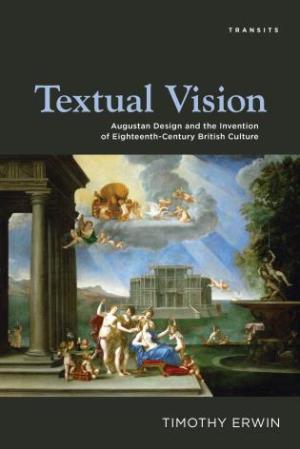 A stylish critique of literary attitudes towards painting, Textual Vision explores the simultaneous rhetorical formation and empirical fragmentation of visual reading in enlightenment Britain. Beginning with an engaging treatment of Pope’s Rape of the Lock, Timothy Erwin takes the reader on a guided tour of the pointed allusion, apt illustration, or the subtle appeal to the mind’s eye within a wide array of genres and texts, before bringing his linked case studies to a surprising close with the fiction of Jane Austen.
At once carefully researched, theoretically informed and highly imaginative, Textual Vision situates textual vision at the cultural crossroads of ancient pictura-poesis doctrine and modernist aesthetics. It provides reliable interpretive poles for reading enlightenment imagery, offers vivid new readings of familiar works, and promises to invigorate the study of Restoration and eighteenth-century visual culture.
Timothy Erwin is professor of English at the University of Nevada, Las Vegas.
◊ ◊ ◊ ◊ ◊
C O N T E N T S
List of Illustrations
Acknowledgments
Abbreviations and Short Titles
Introduction: Image, Ekphrasis, and Verbal Coloring
1 Bold Design in Alexander Pope
2 Promise and Performance in Johnson’s Life of Savage Plates Gallery
3 Visual Discourse in Hogarth, the Early Novel, and History
4 Picturing Jane Austen
Bibliography
Index
Chrisman-Campbell to Deliver The Huntington’s Robert Wark Lecture
From The Huntington:
Robert Wark Lecture | Fashion Victims: Dress at the Court of Louis XVI and Marie Antoinette
The Huntington Art Gallery, San Marino, CA, 7 May 2015
 Fashion historian Kimberly Chrisman-Campbell discusses one of the most exciting, controversial, and extravagant periods in the history of fashion: the reign of Louis XVI and Marie-Antoinette in 18th-century France. She explores the exceptionally imaginative and uninhibited styles of the period leading up to the French Revolution, as well as fashion’s surprising influence on the course of the Revolution itself. A book signing and coffee reception will follow the lecture. Thursday, 7 May, at 7:00pm, Rothenberg Hall.
The Cafe will be open for light suppers prior to this event. From 5:30pm until the start of the program, attendees can enjoy selected items including artisan pizzas, sushi, cheeses and charcuterie, and beer or wine in the new dining venue overlooking the gardens.
New Book | The Danish Country House
Published by Museum Tusculanum Press and distributed by The University of Chicago Press:
John Erichsen and Mikkel Venborg Pedersen, The Danish Country House (Copenhagen: Museum Tusculanum Press, 2014), 253 pages, ISBN: 978-8763543064, 51€ / $80.
 Denmark’s many manors are a treasure trove of natural and cultural riches. As well as the scenic beauty and magnificent architecture they have to offer, they also stand as monuments to more than five centuries of Danish history. The landscapes and buildings of Denmark’s manors form a fascinating universe and a key part of the country’s cultural heritage. Denmark’s famous fairytale author Hans Christian Andersen and the internationally renowned storyteller Karen Blixen (Isak Dinesen) were both fascinated by the unique atmosphere of the Danish country house, which—as their fairy tales and stories reveal—was a lasting source of inspiration in their writings. Also today, the cultural and natural environment of the manor appeals to the heart and soul. This book provides the reader with the key to understanding and experiencing this cultural heritage. More than one hundred of Denmark’s 700 manors are now partially or wholly open to the public. This book is your guide to them all.
John Erichsen, M.A. in History and Art History, is the former director of The Museum of Copenhagen and Vice Director of The National Museum of Denmark. Since 1997 he has run the cultural history research and publishing company HISTORISMUS. He has published extensively, also on the cultural history of the manor.
Mikkel Venborg Pedersen, PhD and DPhil. in European Ethnology and Cultural History. Senior researcher at The National Museum of Denmark. He has worked professionally with both elite and mass culture in Early Modern Europe, and has published extensively on cultural history, as well as on ethnological and historical theory and methodology.
Call for Papers | Antoine Galland et l’Orient des Savants
From H-ArtHist:
Antoine Galland et l’Orient des Savants
Société Asiatique, Paris, 3–4 December 2015
Proposals due by 31 May 2015
Parmi les savants qui ont marqué l’histoire de l’orientalisme, Antoine Galland (1646–1715) représente sans doute l’une des figures les plus remarquables et les plus attachantes. Il a laissé un nombre important de travaux, a tenu au quotidien un journal et accompli de longs voyages dans l’empire ottoman. Mais il suffit ici de rappeler deux écrits, assez différents l’un de l’autre, pour donner une idée de sa culture, de sa vision et de son impact sur ses contemporains: d’une part, son «Discours pour servir de préface», dans la Bibliothèque orientale, ou Dictionnaire universel contenant généralement tout ce qui regarde la connaissance des peuples de l’Orient, ouvrage de référence de Barthélemy d’Herbelot (m. 1695), publié après deux années de travail en 1697 par Antoine Galland (voir http://gallica.bnf.fr/ark:/12148/bpt6k82422h); d’autre part, ses Mille et une nuits, Contes arabes, dont il a assuré la première traduction de 1704 à 1717 dans une langue européenne. Sa participation à la Bibliothèque orientale marque son implication profonde dans le tissu savant de l’époque, et sa préface fournit une très belle synthèse de l’ouvrage encyclopédique, signifiant l’ampleur de son érudition.
Elle indique aussi cependant ses engagements personnels à propos des religions ou de l’histoire de l’humanité, ou plus simplement à propos du rôle de la poésie, comme lorsqu’il écrit : « Et l’on peut compter comme une marque de la délicatesse de leur esprit, le nombre considérable de leurs poètes (…) Car en quelque nation que ce soit, la poésie a cela par-dessus la prose, qu’elle s’exprime plus noblement (…) ». En ce qui concerne sa traduction des Mille et une nuits, il n’est pas besoin de s’étendre sur son impact, qui a affecté très rapidement toute l’Europe du XVIIIe siècle.
Les compétences et les intérêts d’Antoine Galland pour l’Orient ont été en effet multiples, et c’est cette multiplicité que ce colloque entend traiter, non seulement avec le monde arabe, turc ou persan, mais bien au-delà, y compris par exemple le monde grec, à travers les médailles, ou le monde arménien à travers les manuscrits, ou bien encore à travers des phénomènes de société passés d’Orient en Occident, comme le café. Ajoutons à cela que rien ne qualifiait au départ Antoine Galland, né à Rollot en Picardie d’une famille des plus modestes, à devenir au terme de sa carrière professeur au Collège royal et membre de l’Académie.
Cela permet de proposer un certain nombre de thèmes pour intervenir à ce colloque : Devenir orientaliste au XVIIe siècle (qui ? comment ?); les voyages de Galland et son journal ; ses travaux sur les textes narratifs (Kalîla et Dimna, Mille et une nuits) ; ses traités et anthologie (De l’origine et du progrès du café, Les paroles remarquables) ; la collecte des médailles et manuscrits ; la Bibliothèque orientale et l’érudition ; les Académies, les sociétés savantes et leurs organes de diffusion.
Les propositions de communication de dix à vingt lignes, accompagnées d’une brève présentation du conférencier (fonctions, coordonnées, bibliographie), doivent être envoyées sous forme d’un fichier texte word ou équivalent avant le 31 mai sur l’adresse: antoinegalland2015@gmail.com. Elles seront évaluées avant le 30 juin et une réponse sera envoyée au plus tard à cette date à tous les participants. La durée de chaque communication est de 20 mn. Les frais éventuels de transport et de séjour sont à la charge des participants. Pour plus d’informations n’hésitez pas à contacter: antoinegalland2015@gmail.com.
At Sotheby’s | Sale of Exceptional Louis XVI Vases
From Sotheby’s:
A Mansion: A Private Collection (L15318)
Sotheby’s, London, 28 April 2015
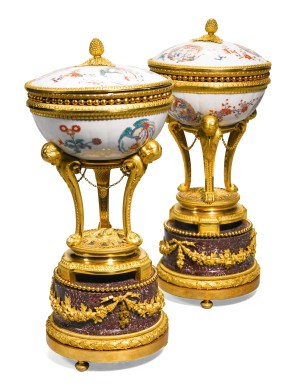 This week at Sotheby’s London a pair of exceptional vases once owned by Louis XVI sold for 10 times the estimate at a staggering £1,985,000 (lot 112, estimate: £150,000–250,000), a worldwide record price for a Louis XVI gilt bronze mounted porcelain work of art. Telling the tale of both French Royalty and revolution, the Brûle Parfums once formed part of the collection of Louis XVI, who bought them in 1782 with the intention of placing them in the Louvre Museum. With his demise. . . the vases were then taken to the State repository, the Dépôt de Nesle. The Dépôt was one of the cornerstones of the revolutionary drive to reorganize cultural properties and was fundamental to the success of the creation of national and provincial museums. Given their importance, in 1797 these vases were exchanged for a significant natural history collection. Decorated with delicate phoenix birds and dragons, this exquisite 18th-century Japanese porcelain is of the finest quality. The gilt-bronze-mounts, later added by the great connoisseur the Duc d’Aumont, were executed by Pierre Gouthière probably to a design by François-Joseph Belanger and date to Louis XVI, circa 1770–75. The auction launched a series of exceptional house sales taking place this year. Exceeding the high estimate, the sale totalled £6,631,065.
More information about the vases is available here»










 Enfilade
leave a comment