Exhibition | Fragonard in Love: Suitor and Libertine
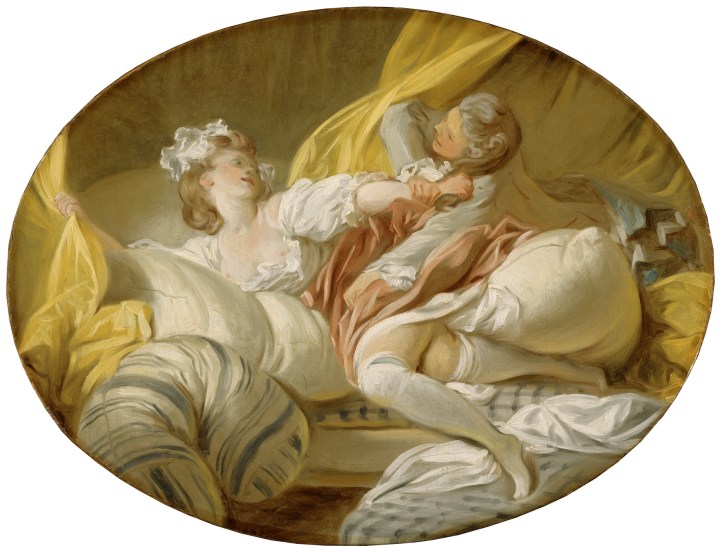
Jean-Honoré Fragonard, Useless Resistance, 1770–73,
18 × 24 inches, 45 × 60 cm (Stockholm: Nationalmuseum)
◊ ◊ ◊ ◊ ◊
Opening next month at the Musée du Luxembourg:
Fragonard Amoureux: Galant et Libertin
Fragonard in Love: Suitor and Libertine
Musée du Luxembourg, Paris, 6 September 2015 — 24 January 2016
Curated by Guillaume Faroult
According to the Goncourt brothers, the eighteenth century was an era of seduction, love and intrigue, and Jean-Honoré Fragonard (1732–1806) might have been its main illustrator, if not its main agent. Indeed, the inspiration of love runs through Divine Frago’s protean and generous work, from his early bucolic compositions to the love allegories found in his later works. In turn gallant, libertine, daringly lustful or conversely concerned with new love ethics, his art spans half a century of artistic creativity with ardour and elegance, endlessly reinventing itself to better capture the subtle variations of emotion and love impulse.
Presenting Fragonard’s work for the first time through this love prism, this exhibition at the Musée du Luxembourg focuses on the mid-eighteenth century, a time when the spirit of Enlightenment was deeply influenced by English sensualism. The topic of how to delicately express sensuality and emotion was then at the heart of philosophical, literary and artistic concerns. Strongly imbued with these questions as he emerged from François Boucher’s studio, the young Fragonard already brings to fashionable pastoral and mythological compositions a fresh sensitivity, unquestionably marked by sensuality, yet more profound than the strict libertine strategy.

Jean Honoré Fragonard, The Stolen Kiss, ca. 1760, 19 x 25 inches, 48.3 x 63.5 cm (New York: Metropolitan Museum of Art)
At the same time, his study of Flemish masters encourages him to transition from sophisticated eroticism to rustic scenes that take on an unequivocal carnal dimension, such as The Stolen Kiss from The Metropolitan Museum of Art. Talented illustrator of La Fontaine’s least restrained Tales, Fragonard, like his colleague, miniaturist and libertine Pierre-Antoine Baudoin, displays an audacity that often matches that of many progressive writers and intellectuals of his time, such as Diderot in The Indiscreet Jewels. Indeed, forceful yet allusive ‘secret’ works for licentious amateurs, created at the beginning of the 1760, contributed to portraying Fragonard as a libertine and painter of ladies’ salons and other intimate scenes. This impish inspiration transpires through a great variety of expressions, from the naughty Useless Resistance in the Nationalmuseum in Stockholm to the sensual yet delicate Kiss (private collection).
In parallel with this independence of mind—or free licence—Fragonard strove to renew with great poetry the theme of fête galante, inherited from Watteau, as the timeless Île d’amour (on loan from the Fondation Calouste Gulbenkian) testifies. Later, in the 1770 and 1780s, following in the steps of the famous The Lock from the Louvre and as de Laclos’s Liaisons Dangereuses knelled the end of literature’s libertine inspiration, his art reached a decisive turning point as he began to explore the true feeling of love through allegories swept by a most delicate lyricism. With infinite subtlety, Fragonard dealt with the mystical dimension of profane love, at the root of what was to become ‘romantic love’.
 S E C T I O N S
Introduction
The Gallant Shepherd
The Loves of the Gods
Rustic and Popular Eros
Fragonard, Illustrator of Libertine Tales
Pierre-Antoine Baudouin, A Libertinist Master
Fragonard and Licentious Imagery
Dangerous Reading
The Revival of the Fête Galante
Love Moralised
Heroic Passion
Romantic Allegory
Curators: Guillaume Faroult, Head of Conservation, Paintings Department, Musée du Louvre, 18th-century French paintings Manager.
Scenography: Jean-Julien Simonot
This exhibition is produced by the Réunion des Musées Nationaux-Grand Palais.
The catalogue is available from Artbooks.com:
Guillaume Faroult, ed., Fragonard Amoureux: Galant et Libertin (Paris: Musées Nationaux, 2015), 288 pages, ISBN: 978-2711862344, 45€ / $75.
Exhibition | Élisabeth Louise Vigée Le Brun (1755–1842)
Opening next month in Paris at the Grand Palais:
Élisabeth Louise Vigée Le Brun (1755–1842)
Grand Palais, Paris, 23 September 2015 — 11 January 2016
The Metropolitan Museum of Art, New York, 9 February — 15 May 2016
National Gallery of Canada, Ottawa, 10 June — 12 September 2016
Curated by Joseph Baillio and Xavier Salmon
This first retrospective devoted to the works of Elisabeth Louise Vigée Le Brun presents an artist whose life stretched from the reign of Louis XV to that of Louis-Philippe—one of the most eventful and turbulent periods in European and above all French history of modern times.
 Self-portraits by Vigée Le Brun abound: paintings, pastels and drawings that elegantly associate feminine grace and pride. With the Ancien Régime and its School of Fine Arts coming to an end, she supplanted most of her rival portrait artists. Vigee Le Brun used self-portraits to assert her status, circulate her image and show people the mother she had become despite the constraints of a career.
She made her greatest coup de force at the 1787 Exhibition where she presented two paintings that cannot be dissociated. First, a Portrait of Queen Marie-Antoinette posing for a portrait surrounded by her children in an attempt to rectify the image of an extravagant libertine; secondly, the portrait of a female artist hugging her daughter Julie to her chest in an effusive Raphael-like manner. The latter is one of the finest and most popular of the many works by this painter owned by the Louvre and has remained the emblem of «maternal tenderness» since it was first exhibited to the public. The culture of the Enlightenment and the influence of Rousseau obliged the artist to take on this role, which she did happily and with resounding success. As a counterpoint, she painted the Portrait of Hubert Robert. These paintings are absolute icons illustrating the joy of life and creative genius, complementing and communicating with each other.
What is even more remarkable was her determination to overcome obstacles hindering her career. Born in Paris in 1755, she came from a relatively modest background, her mother a hairdresser and her father a talented portrait artist. Her father died when she was a young adolescent. Drawing inspiration from his example, the brilliant young artist was accepted as a master painter at the Academy of Saint-Luc. In 1776, she married the most important art dealer of her generation, Jean Baptiste Pierre Le Brun (1748–1813), but this prevented her from being accepted at the Royal Academy of Painting and Sculpture because its regulations formally forbid any contact with mercantile professions. However, this union had a beneficial effect on her career. When the price of Flemish paintings soared, she learnt how to master the magic of colours and the fine craftsmanship of Rubens and Van Dyck. Her clientèle had mainly been the bourgeoisie but in 1777, she started working for the aristocracy, descendants of royal blood and finally Queen Marie-Antoinette. However, it was not until 1783 and the intervention of the Queen’s husband, Louis XVI, that the portrait artist was able to join the Royal Academy of Painting after much polemic.
Organized by the Réunion des musées nationaux/Grand Palais in Paris, The Metropolitan Museum of Art in New York, and the National Gallery of Canada in Ottawa.
The exhibition booklet is available here»
Details on the catalogue to follow later.
New Book | Then and Now: Collecting and Classicism
From McGill-Queen’s University Press:
Jean Coutu, Then and Now: Collecting and Classicism in Eighteenth-Century England (Montreal: McGill-Queen’s University Press, 2015), 340 pages, ISBN: 978-0773545434, $100.
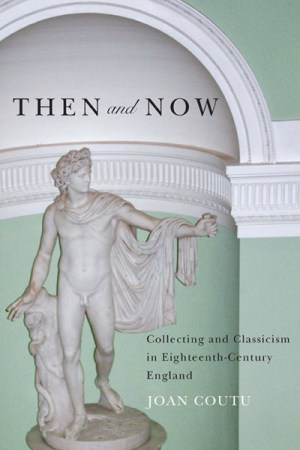 In the mid-eighteenth century, English gentlemen filled their houses with copies and casts of classical statuary while the following generation preferred authentic antique originals. By charting this changing preference within a broader study of material culture, Joan Coutu examines the evolving articulation of the English gentleman.
Then and Now consists of four case studies of mid-century collections. Three were amassed by young aristocrats—the Marquis of Rockingham, the Duke of Richmond, and the Earl of Huntingdon—who, consistent with their social standing, were touted as natural political leaders. Their collections evoke the concept of gentlemanly virtue through example, offering archetypes to encourage men toward acts of public virtue. As the aristocrats matured in the politically fractious realm of the 1760s, such virtue could become politicized. A fourth study focuses on Thomas Hollis, who used his collection to proselytize his own unique political ideology.
Framed by studies of collecting practices earlier and later in the century, Coutu also explores the fluid temporal relationship with the classical past as the century progressed, firmly situating the discussion within the contemporaneous emerging field of aesthetics. Broadening the focus beyond published texts to include aesthetic conversations among the artists and the aristocracy in Italy and England, Then and Now shows how an aesthetic canon emerged—embodied in the Apollo Belvedere, the Venus de’ Medici, and the like—which shaped the Grand Manner of art.
Joan Coutu is associate professor of art history and visual culture at the University of Waterloo, and author of Persuasion and Propaganda: Monuments and the Eighteenth-Century British Empire.
◊ ◊ ◊ ◊ ◊
C O N T E N T S
Figures
Acknowledgments
Introduction
1 Temporal Elision and Sculpture Collections in the First Half of the Eighteenth Century
2 An “Old Whig”: The 2nd Marquis of Rockingham and His Collections
3 The 3rd Duke of Richmond and His Sculpture Gallery in Whitehall: Munificence Worthy of a Prince
4 The 10th Earl of Huntingdon and the Arcadian Plains of Leicestershire
5 Thomas Hollis and His Life Plan
6 Conclusion: The Nuances of the Classical Archetype
Notes
Bibliography
Index
Lecture | Fit for a King: Louis XIV and the Art of Fashion
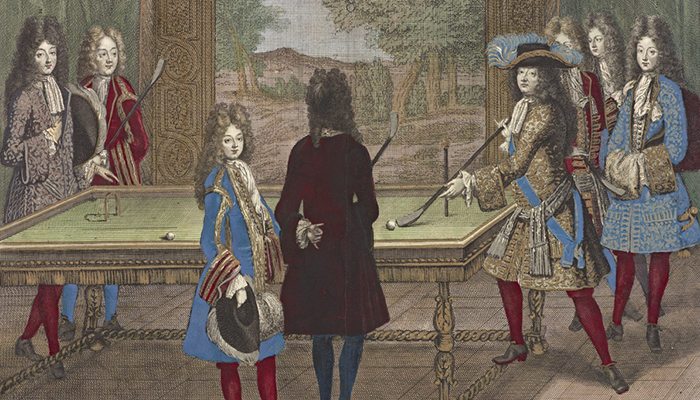
Antoine Trouvain, Third Apartment (detail), 1694. Hand-colored engraving and etching. From Appartements ou amusements de la famille royale à Versailles, a suite of 6 plates (The Getty Research Institute, 2011.PR.20)
◊ ◊ ◊ ◊ ◊
From The Getty:
Kimberly Chrisman-Campbell | Fit for a King: Louis XIV and the Art of Fashion
The Getty Center, Los Angeles, 23 August 2015
Louis XIV recognized fashion’s propaganda value as well as its economic importance, and he was deeply invested in establishing the technical and aesthetic superiority of France’s clothing and textile industries. Through prints, fashion plates, and his own oft-reproduced image, he set the standard of elegant dress and deportment throughout Europe. Art historian Kimberly Chrisman-Campbell examines the Sun King’s lasting contributions to French fashion as well as his own exquisite (and extravagant) taste. Sunday, August 23, 2:00pm.
This lecture complements the exhibition A Kingdom of Images: French Prints in the Age of Louis XIV, 1660–1715, organized in special collaboration with the Bibliothèque nationale de France and on view in the Getty Research Institute from June 16, 2015, to September 6, 2015.
Kimberly Chrisman-Campbell is an independent art historian specializing in fashion and textiles. She has worked as a curator, consultant, and educator for museums and universities around the world. Following the lecture, she will sign copies of her book, Fashion Victims: Dress at the Court of Louis XVI and Marie-Antoinette (Yale University Press, 2015), which will be available for purchase.
New Book | From Invention to Perfection
Published by Arnoldsche and available from Artbooks.com:
Sarah-Katharina Andres-Acevedo and Hans Ottomeyer, eds., From Invention to Perfection: Masterpieces of Eighteenth-Century Decorative Art (Stuttgart: Arnoldsche, 2015), 352 pages, ISBN: 978-3897904422, 78€.
 One hundred masterpieces of European art and arts and crafts of the eighteenth century form a panorama of innovation, design and expert realisation. In their sumptuous design, the porcelain, furniture, bronzes and silver objects are all miracles of the luxury craftsmanship found in court art. Such sophisticated design was the driving force behind the quickly successive styles of classicism, naturalism and the exotic design of the Rococo period. André-Charles Boulle, Jakob Philipp Hackert, Johann Joachim Kaendler, Alexandre-Jean Oppenordt und Jean-Baptiste François Pater are just some of the renowned artists featured in this catalogue. The artworks are opulently presented, interpreted in detail and arranged according to context. Thus the colourful image of a great era in art emerges, one that relied on creative energy and the power of the imagination.
With contributions by Sarah-K. Andres-Acevedo, Christine Cornet, Melitta Kunze-Köllensperger, Georg Lechner, Claudia Lehner-Jobst, Claudia Nordhoff, Hans Ottomeyer, Ulrich Pietsch, Christina Pucher, David Ranftl, Michael Röbbig-Reyes, Max Tillmann and Alfred Ziffer.
New Book | William Hunter’s World
From Ashgate:
E. Geoffrey Hancock, Nick Pearce, and Mungo Campbell, eds., William Hunter’s World: The Art and Science of Eighteenth-Century Collecting (Farnham: Ashgate Publishing, 2015), 424 pages, ISBN: 978-1409447740, $140.
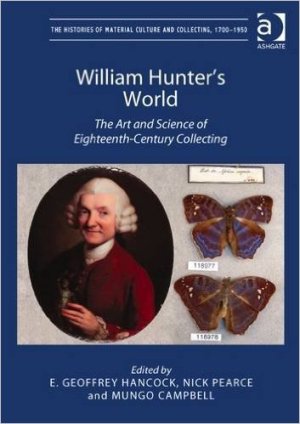 Despite William Hunter’s stature as one of the most important collectors and men of science of the eighteenth century, and the fact that his collection is the foundation of Scotland’s oldest public museum, The Hunterian, until now there has been no comprehensive examination in a single volume of all his collections in their diversity. This volume restores Hunter to a rightful position of prominence among the medical men whose research and amassing of specimens transformed our understanding of the natural world and man’s position within it.
This volume comprises essays by international specialists and are as diverse as Hunter’s collections themselves, dealing as they do with material that ranges from medical and scientific specimens, to painting, prints, books and manuscripts. The first sections focus upon Hunter’s own collection and his response to it, while the final section contextualises Hunter within the wider sphere. The volume includes references to The Hunterian’s web pages and on-line databases, enabling searches for items from Hunter’s collections, both from his museum and library.
Locating Hunter’s collecting within the broader context of his age and environment, this book provides an original approach to a man and collection whose importance has yet to be comprehensively assessed.
E. Geoffrey Hancock, an entomologist with a career in various British museums, is currently Honorary Curator of Entomology and a Research Fellow in The Hunterian Museum. His interests include the history of museums and their collections.
Nick Pearce holds the Sir John Richmond Chair of Fine Art at the University of Glasgow, where he specialises in the arts of China. His career has spanned both museums and universities, including the Victoria & Albert Museum, The Burrell Collection in Glasgow and the universities of Durham and Edinburgh.
Mungo Campbell worked at the National Galleries of Scotland until 1997 and is now Deputy Director of The Hunterian. Curating several major loan exhibitions culminated recently in Allan Ramsay: Portraits of the Enlightenment (2013), and he edited the accompanying publication.
◊ ◊ ◊ ◊ ◊
C O N T E N T S
Foreword, David Gaimster
Introduction, Mungo Campbell
Part I—William Hunter: Developing His Museum
1 The Great Windmill Street Anatomy School and Museum, Helen McCormack
2 Anatomy and the ‘museum oeconomy’: William and John Hunter as collectors, Simon Chaplin
Part II—William Hunter: Anatomy in Practice
3 William Hunter’s sources of pathological and anatomical specimens, with particular reference to obstetric subjects, Stuart W. McDonald and John W. Faithfull
4 ‘An universal language’: William Hunter and the production of The Anatomy of the Human Gravid Uterus, Caroline Grigson
5 The anatomist and the artists: Hunter’s involvement, Anne Dulau Beveridge
6 William Hunter’s anatomical and pathological specimens, Stuart W. McDonald
Part III—William Hunter: Collector
7 Animal specimens in William Hunter’s anatomical collection, Stuart W. McDonald and Margaret Reilly
8 William Hunter’s zoological collections, Margaret Reilly
9 The shaping role of Johann Christian Fabricius: William Hunter’s insect collection and entomology in 18th-century London, E. Geoffrey Hancock
10 Dr John Fothergill: Significant donor, Starr Douglas
11 The mineral collection of William Hunter: Assembly and function, John W. Faithfull
12 A collection without a catalogue: Captain John Laskey and the missing vertebrate fossils from the collection of William Hunter, Jeff Liston
13 Archaeological objects in William Hunter’s collection, Sally-Anne Coupar
14 William Hunter’s parade shield: A memento of Leonardo’s Milan?, Martin Kemp
15 Ethnographic treasures in the Hunterian from Cook’s voyages, Adrienne L. Kaeppler
16 ‘At last in Dr Hunter’s library’: William Hunter’s Chinese collections, Nick Pearce
17 William Hunter’s numismatic books, Donal Bateson
18 The ‘Hunterian orchard’: William Hunter’s library, David Weston
Part IV—William Hunter: The Wider World
19 On the way to the museum: Frederich The Great’s Bildergalerie in the park of Sanssouci in the context of other painting collections in 18th-century Germany, Heiner Krellig
20 Dr Black goes down to town: The 1788 tour to Ireland and England, Robert G. W. Anderson
21 For ‘instruction and delight’: The enfilade of nature at Sir Ashton Lever’s museum, Leicester House, London, 1775–86, Clare Haynes
22 David Ure (1749–98): The enlightened fossil collector, Neil D. L. Clark
Index
Exhibition | About Face: Human Expression on Paper
Press release (28 July 2015) for the exhibition:
About Face: Human Expression on Paper
The Metropolitan Museum of Art, New York, 27 July — 13 December 2015

Charles Antoine Coypel, Medea, ca. 1715, pastel, 12 x 8 inches / 29.4 x 20.6 cm (NY: The Metropolitan Museum of Art)
The representation of human emotion through facial expression has interested Western artists since antiquity. Drawn from The Metropolitan Museum of Art’s collection of drawings, prints, and photographs, the diverse works in About Face: Human Expression on Paper—portraits, caricatures, representations of theater and war—reveal how expression underpinned narrative and provided a window onto the character and motivations of the subjects, the artists, and even their audiences.
Using Charles Le Brun’s illustrations for Expressions of the Passions and Guillaume-Benjamin-Armand Duchenne de Boulogne and Adrien Tournachon’s photographic series as touchstones, the approximately 60 works dating from the 16th through the 19th century show how artists such as Hans Hoffmann, Francisco Goya, Jean-Baptiste Greuze, and Thomas Rowlandson explored the animated human face.
Expression was at one time thought to reveal elements of individual character and was codified through the influential publications on physiognomy by the French artist Charles Le Brun (1619–1690). In 1668 Le Brun delivered a lecture to the French Academy entitled Conférence sur l’expression générale et particulière (Lecture on General and Particular Expression). When published in 1698, the text was illustrated with engravings based on the artist’s drawings—images of facial expressions that range from calm to states of agitation. Le Brun’s rational approach and precise titles were scientific in tone and distilled the chaotic variety of nature into a coherent form that had a lasting influence on European artists. The writings, which came to be known as Expressions of the Passions, were translated into different languages and influenced art theory and practice for the next two centuries. The study of expression became a key component of artistic training in art schools and academies across Europe—so much so, in fact, that by the late 18th century it had also become a rich subject of caricature and other satirical works.
In the mid-19th century, the pioneering French neurologist and physiologist Guillaume-Benjamin-Armand Duchenne de Boulogne conducted experiments involving the application of electrical current to stimulate the animation of the face. Wishing to move beyond abstract theory and into a scientific foundation for the study of facial expression, Duchenne published a scientific grammar of human emotions to be used as study material by artists at the École des Beaux-Arts. For this purpose, Duchenne collaborated with Adrien Tournachon (brother of the famous Nadar), a photographer who specialized in portraiture, to use the evidentiary power of photography to record his experiment precisely. The resulting series of gripping photographic portraits, made between 1854 and 1856, directly follow the physiognomic tradition of Le Brun and occupy a unique place at the intersection of art, science, and sentiment. Some 30 of these portraits are presented in the installation.
About Face: Human Expression on Paper is a collaboration between the Met’s Department of Drawings and Prints, and its Department of Photographs. The exhibition is made possible by The Horace W. Goldsmith Foundation.
Call for Papers | Framing the Face: New Perspectives on Facial Hair
From the conference website:
Framing the Face: New Perspectives on the History of Facial Hair
Friend’s Meeting House, London, 28 November 2015
Proposals due by 30 September 2015
Over the past five centuries, facial hair has been central to debates about masculinity. Over time, changing views of masculinity, self-fashioning, the body, gender, sexuality and culture have all strongly influenced men’s decisions to wear, or not wear, facial hair. For British Tudor men, beards were a symbol of sexual maturity and prowess. Throughout the early modern period, debates also raged about the place of facial hair within a humoural medical framework. The eighteenth century, by contrast, saw beards as unrefined and uncouth; clean-shaven faces reflected enlightened values of neatness and elegance, and razors were linked to new technologies. Victorians conceived of facial hair in terms of the natural primacy of men, and new models of hirsute manliness. All manner of other factors from religion to celebrity culture have intervened to shape decisions about facial hair and shaving.
And yet, despite a recent growth in interest in the subject, we still know little about the significance, context and meanings of beards and moustaches through time, or of its relationship to important factors such as medicine and medical practice, technology and shifting models of masculinity. We therefore welcome papers related to, but by no means limited to the following questions:
• To what extent were beards a symbol of masculinity and what key attributes of masculinity did they symbolise?
• To what extent did the profession of the barber influence beard styles and the management of facial hair?
• To what extent were beard trends led by the elite and by metropolitan fashion?
• How far did provincial trends influence metropolitan trends through migration?
• What impact did changing shaving technologies have on beard fashions/trends?
• How were beards understood within the medical frameworks of different eras?
• How have women responded to facial hair in different eras?
• How has the display of facial hair by women been viewed as both a medical and cultural phenomena?
Please send abstracts of up to 300 words, by 30th September 2015, to framingtheface@gmail.com. For further information please contact the organisers: Dr Alun Withey, University of Exeter, A.Withey@exeter.ac.uk, and Dr Jennifer Evans, University of Hertfordshire J.evans5@herts.ac.uk.
Conference | The Artist’s Studio in Eighteenth-Century Britain
From the Paul Mellon Centre for Studies in British Art:
The Painting Room: The Artist’s Studio in Eighteenth-Century Britain
Sotheby’s Institute of Art, London (Thursday), and Gainsborough’s House, Sudbury, Suffolk (Friday), 29–30 October 2015
 This two-day conference, sponsored by the Esmée Fairbairn Collections Fund and the Paul Mellon Centre for Studies in British Art, examines the role and character of artists’ painting rooms in the long eighteenth century. It is organised in association with an exhibition focusing on the painting room that is to be held at Gainsborough’s House between October 2015 and January 2016.
The conference aims to bring together current scholarship on the nature of the painting room, primarily in Britain but also in France, which was a constant model for British artists. The first day, to be held at the Sotheby’s Institute of Art, considers the varying character and function of the painting room in London, Bath and Paris: how it was used, how it was seen by outsiders, and how artists exploited it to create spaces for the display and sale of their work. Detailed studies of the painting rooms of Joshua Reynolds and Joseph Wright of Derby will help to illustrate these arguments. The second day of the conference, which will take place at Sudbury, will focus more particularly on the example of Thomas Gainsborough. Speakers will consider technical issues such as the use of materials, lay figures, drapery and costumes within the painting room, together with the role of the copy. This second day will also feature a discussion of the relationship between the painting room and the modern-day artist’s studio.
The aim of the conference as a whole is to explore the distinctive world of the Georgian painting room, and to complement the innovative recreation of such an environment within the exhibition at Gainsborough’s House.
Confirmed Speakers
Mark Bills (Gainsborough’s House)
Spike Bucklow (Hamilton Kerr Institute)
Matthew Craske (Oxford Brookes University)
Edwina Ehrman (Victoria & Albert Museum)
Karen Fielder (Portsmouth University)
Rica Jones (Independent Scholar)
Kristina Mandy (Hamilton Kerr Institute)
Peter Moore (Gainsborough’s House)
Jane Munro (Fitzwilliam Museum)
George Shaw (Artist)
Susan Sloman (Independent Scholar)
Hannah Williams (Queen Mary, University of London)
Jonathan Yarker (Lowell Libson Ltd)
Tickets
£30 Standard Ticket (for both days)
£20 Concession Ticket (students and senior citizens, for both days)
Tickets include refreshments, lunch and a drinks reception on both days. Tickets will not be sold separately for each day; attendees must commit to both days.
Please note your ticket does not include your travel to Sudbury on Day 2 and we kindly ask you to make your own way there. If you are travelling from London to Sudbury, the conference organisers will be travelling on the train stated on the timetable, if you wish to join them.
Funding the Larson Historic Fashion Collection for the FIDM Museum
$4 for 400 Years of Fashion: Helen Larson Social Media Fundraising Campaign
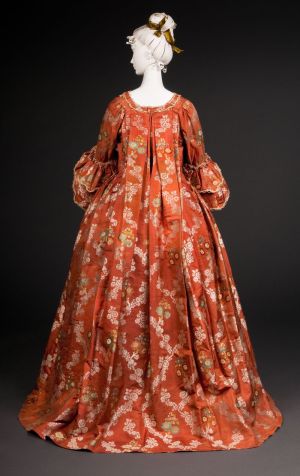
Robe volante, France, ca. 1745 (Helen Larson Historic Fashion Collection)
The Fashion Institute of Design and Merchandising Museum is fundraising to acquire a truly remarkable collection of rare historical fashion, ranging from a man’s red velvet jerkin dating to 1600 to stunning couture creations of the twentieth century. These pieces were collected by Helen Larson, a collector and successful entrepreneur who understood the importance of fashion history. The Helen Larson Historic Fashion Collection encompasses more than 1,400 pieces representing 400 years of history—but this critically important collection could be broken up and lost forever. The Museum has until the end of 2015 to raise the remaining $2 million needed to purchase the collection for our institution. Without these funds, the collection will be dispersed or absorbed into another private collection, inaccessible to students, researchers, and the general public.
On August 4, 2015, the FIDM Museum will launch the #4for400 project, a social media fundraising campaign to keep the Larson Collection at a public institution. The Museum’s Facebook, Twitter, and Instagram accounts will ask supporters to text MUSEUM to 243-725 and donate just $4 to save more than 400 years of fashion. Our hope is that a momentum will build, resulting in #4for400 posts being shared, liked, re-tweeted, and re-grammed, creating a flurry of donation activity. In conjunction with the launch, the Museum will host an Open House event from 3–7 pm, allowing the public to join in the excitement of the fundraising campaign with refreshments, raffles, music, and gallery tours.
The #4for400 campaign has the power to keep this one-of-a-kind cultural treasure at an academic institution in downtown Los Angeles, where it can be appreciated by museum visitors and used for research and inspiration by generations to come.
You can also donate by clicking here»










 Enfilade
leave a comment