Exhibition | Supernatural Shakespeare
Marking the 400th anniversary of the Bard’s death, Shakespeare 400 promises “a year of celebrations” in 2016, not only in the UK but around the world. The AIC will be among those participating:
Supernatural Shakespeare
Art Institute of Chicago, 11 April — 10 October 2016
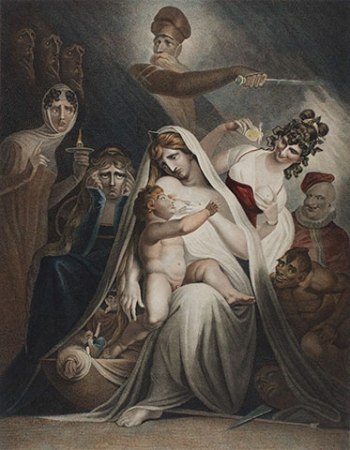
Moses Haughton II, after Henry Fuseli, The Nursery of Shakespeare, 1810 (Art Institute of Chicago, Gift of Chalkley Hambleton)
The title characters of William Shakespeare’s plays might get the most name recognition, but the Bard’s meddling witches and mischievous faerie folk often steal the scenes and have rightly become some of his most memorable characters. This focused Shakespeare 400 installation features three atmospheric engravings of fantastical Shakespearian scenes by various artists emulating works by the renowned Gothic artist Henri Fuseli (1741–1825). Fuseli himself favored heroic subjects taken from Shakespeare along with other celebrated writers including Dante Alighieri and John Milton. Fuseli’s theatrical paintings hang in the nearby gallery: his macabre Head of a Damned Soul from Dante’s ‘Inferno’ (1770/78) and his mystical Milton Dictating to His Daughter (1794) among them.
The selections for the intimate Supernatural Shakespeare presentation copy several paintings Fuseli created for the 1790s Boydell Shakespeare Gallery in London, one of the catalysts for the Romantic revival of Shakespeare in the early 1800s. The Nursery of Shakespeare (1810) depicts the baby Bard already beset by host of phantasmal inspirations. The Witches Appear to Macbeth and Banquo (1798) portrays the three sorceresses getting ready to triple the antihero’s toil and trouble, while Titania and Bottom with Ass’s Head (1796) features the enchanted odd couple carousing in their sylvan bower.
On May 1, these fantastical characters and prints are joined by song as musicians from the Chicago Symphony Orchestra play selections from Felix Mendelssohn’s beloved A Midsummer Night’s Dream in the Art Institute’s Fullerton Hall.
New Book | Venetian Painting Matters, 1450–1750
Forthcoming from Brepols:
Jodi Cranston, ed., Venetian Painting Matters, 1450–1750 (Turnhout: Brepols, 2015), 200 pages, ISBN: 9782503535265, $115.
 This book brings together essays about painting in Venice during three centuries of remarkable artistic production, influence, and exchange. The chronological scope of the anthology reflects the crucial interrelationship between the life of the arts and the republic, but also indicates the longevity of the distinctive, but not in the least isolated, mode of making and looking that engaged painters and viewers both inside and outside of Venice. The focused themes that emerge in the essays—the artist’s self-perception, the role of innovation and tradition in formal and material aspects of pictorial composition, the artistic exchange between Venice and other cities, both east and west, and the unique political and social pressures on artistic production and reception—reflect the Venetian engagement with many of the central concerns that preoccupied early modern artists. The dialogue established between Venetian art and society underpins all of the essays in the anthology; however, their critical focus remains on the formal, stylistic, and structural aspects of the pictures and how these visual mechanisms express meaning and shape viewer response.
Conference | The Matter of Mimesis
From the conference website:
The Matter of Mimesis: Studies on Mimesis and Materials in Nature, Art, and Science
CRASSH, Cambridge, 17–18 December 2015

Adam Ludwig Wirsig, Marmora Et Adfines Aliquos Lapides Coloribus Suis Exprimi (Nürnberg 1775)
This interdisciplinary conference aims to bring together scholars from the sciences, social sciences and humanities in order to address material practices of mimesis. Aristotle, in one of the first definitions of the concept, argues that mimesis, or the imitation of nature, refers to both form and material. Thus far, scholarship has mostly focused on the role of form in mimetic practices, while the mimetic role of materials, despite the many disciplines in which these are central to making and knowing, remains significantly understudied.
Materials play a fundamental role in mimetic practices, from the earliest known examples to some of the most recent. Ancient ceramic vessels, for instance, some nearly four millennia old, imitate the visual appearance of other materials like metal or straw, while medieval artisans gave wood the costly appearance of marble, or made paper seem like gilded leather. The industrial revolution and chemical innovation created many new opportunities for material mimesis, crowned with the invention of plastics, which can be transformed into almost anything imaginable. Today, computer science allows us to flip pages of digital paper and navigate the visible world in three dimensions, while material science has invented biomaterials that replace the cells of our bodies, smart materials that can assume the appearance of their surroundings, and drugs that imitate the material of neurotransmitters, to name but a few. The role of materials in mimesis is by no means limited to the past: the practice will continue to have an impact in the future which cannot be foreseen.
Conveners
Emma Spary (University of Cambridge)
Marjolijn Bol (University of Amsterdam and Max Planck Institute for the History of Science)
◊ ◊ ◊ ◊ ◊
T H U R S D A Y , 1 7 D E C E M B E R 2 0 1 5
9.30 Registration and Coffee
10.00 Welcome and Introduction, Marjolijn Bol and Emma Spary
10.15 Session 1: Substitution
• Ann-Sophie Lehmann (University of Groningen), Closing the mimetic gap, or the galalithe problem: Material imitation as scientific, creative, and social practice
• Zuzanna Sarnecka (University of Cambridge), Firing porphyry in the Renaissance ceramic kiln
• Jenny Rampling (Princeton University), Substituting alchemy: the quid pro quo of experimental reconstruction
• Hanna Wirta Kinney (Oxford University), The fleshiness of bronze: eighteenth-century copies by Massimiliano Soldani Benzi and Pietro Cipriani
12.30 Lunch
13.45 Session 2: Making Material Knowledge
• Pamela Smith (Columbia University), Transforming matter and making art in a sixteenth-century workshop
• Marta Ajmar (Victoria and Albert Museum), A culture of material mimesis: thinking and making trans-materially in Italy, 1400–1600
• Lisbet Tarp (Aarhus University), Fertile stones: hybrid stones between matter and form in the collection of Ole Worm (1588–1654)
15.30 Coffee
16.00 Session 3: Added-value
• Erma Hermens (University of Glasgow), Mimicking the ‘real thing’: material manifestations
• Richard Checketts (University of Leeds), ‘Without intellect or will’: materials and mimesis in the Cappella Altieri in S. Maria Sopra Minerva in Rome
• Jack Lynch (Rutgers University), Real fakes and fake fakes: materiality in literary forgery
18.00 Keynote Lecture
• Mark Miodownik (University College London), Bio-inspired materials
19.30 Conference Dinner
F R I D A Y , 1 8 D E C E M B E R 2 0 1 5
10.00 Session 4: Materializing the Impossible
• Miri Rubin (Queen Mary, University of London), Title to be confirmed
• Valentina Pugliano (University of Cambridge), Fake specimens in the Renaissance
• Britta Dümpelmann (Freie Universität Berlin), ArtFiction. Materiality and material mimesis as the genuine language of nonpolychrome Northern Renaissance sculpture
• Maria Lumbreras (Johns Hopkins University), “Con el oro e matizes de la dicha ymagen”: sacred matter and its replicas in early modern Seville
12.15 Lunch
13.45 Session 5: Preservation
• Jeroen Stumpel (Utrecht University), Patterns of endurance: material and survival in the history of art
• Anna Maerker (King’s College London), Title to be confirmed
• Sophie Kromholz (University of Glasgow), Things aren’t what they seem: material compromises in the conservation of ephemeral art
15.00 Coffee
15.30 Session 6: Mimesis Beyond ‘Matter’?
• Pietro Conte (University of Lisbon), Excessive similarity? Hyperrealism and its materials in phenomenological perspective
• Emilie Gehl Skulberg (University of Copenhagen), The Illustris Project: mimesis and the simulation of the cosmos
• Erik Rietveld (University of Amsterdam), The skillful body and affordances for material mimesis
• Leah Anderson (l’École cantonale d’art du Valais), Reflections on place
17.30 Closing Remarks
Exhibition | Living for the Moment: Japanese Prints
Press release (5 October 2015) from LACMA:
Living for the Moment: Japanese Prints from the Barbara S. Bowman Collection
Los Angeles County Museum of Art, 11 October 2015 — 1 May 2016

Suzuki Harunobu, Lucky Dream for the New Year: Mt. Fuji, Falcon, and Eggplants, ca. 1768–69 (promised gift of Barbara S. Bowman, Museum Associates/LACMA).
The Los Angeles County Museum of Art (LACMA) presents Living for the Moment: Japanese Prints from the Barbara S. Bowman Collection. The exhibition features over 100 prints of transformative promised gifts of Japanese works to LACMA, representing the work of 32 artists. Included are examples of rare early prints of the ukiyo-e genre (pictures of the floating world); works from the golden age of ukiyo-e at the end of the eighteenth century by Suzuki Harunobu, Kitagawa Utamaro, and Katsukawa Shunshō; and nineteenth-century prints by great masters such as Utagawa Hiroshige, Katsushika Hokusai, Utagawa Kuniyoshi, and others.
Barbara S. Bowman (née Safan) was born in Los Angeles in 1925 and attended the University of Southern California (USC) for a degree in fine art. Barbara became captivated by Japanese woodblock prints early on after receiving two prints as a gift from her mother. She and her husband Morton visited Japan for the first time in 1962, and by 1978 she began actively collecting Japanese woodblock prints. Never intending to have an encyclopedic collection, Barbara sought out scenic designs in superb condition with stellar impressions, as she held the printing process in high esteem. The power of line and the importance of color were and remain defining factors of the collection. Assembled over 35 years, the Barbara S. Bowman Collection includes some of the finest impressions available.
“Living for the Moment represents a momentous gift to the Japanese Art Department of LACMA, in that we can now present the history of Japanese prints with high-quality works of art,” remarks Hollis Goodall, Curator of Japanese Art at LACMA.
Living for the Moment is presented in two locations at LACMA. Commercially printed ukiyo-e, mostly produced in Edo (modern Tokyo), will be displayed chronologically and by artistic group in the Ahmanson Building, level 2. Privately published surimono and theatrical prints of Osaka are installed in the Pavilion for Japanese Art, level 3.
Ukiyo-e developed as an independent genre in painting and book illustration by the late 1600s. The idea of the ‘floating world’ (ukiyo), initially based on a Buddhist phrase referring to the transience of life, was adopted by popular writers to evoke fleeting moments of beauty and pleasure that provided distraction from the cares of a regimented society. Book illustrations on these topics gained such popularity that artists began creating single-sheet woodblock prints to sell. Edo became the center for the production of ukiyo-e prints. In response to government restrictions placed on floating world subject matter in the early 1800s, artists explored new topics such as travel and heroes of ancient lore. Prints were also a perfect medium for artistic experimentation. After a breakthrough by Suzuki Harunobu in 1765, which allowed the production of multiblock color prints, artists explored realism, nature, perspective, framing, and light with a level of intensity that spread their influence not only across Japan but also, after the country opened to foreign trade in 1868, to Europe. There, the Impressionists, struck by the Japanese printmakers’ use of color, atmosphere, and composition, created a watershed style embarking upon Modernism.
The artist Utagawa Hiroshige (1797–1858) was from a samurai family with an inherited position as a fire man in Edo Castle. In 1823 he passed on this job to a relative and became a full-time artist, having been trained by the Utagawa school master, Toyohiro (1773–1828). Hiroshige excelled at evoking the human experience of the landscape, with its varying seasons, times of day, and weather events. His sensitivity toward shifting light is best seen in early impressions of prints where he supervised color choice, as exemplified by his finest print in the Bowman collection entitled, Minowa, Kanasugi, and Mikawashima (1857). In this print, a broad strip of pink marks the horizon. The still-dark middle ground indicates light at daybreak which has not reached the nearby plains, and roofs in the distance already reflect the growing daylight. In his late years, Hiroshige developed a unique viewpoint, looking beyond an object set close at hand to a landscape which receded into deep distance. His framing of subjects directly influenced the Impressionists and Post- Impressionists in Europe, and later Frank Lloyd Wright in the United States.
The majority of ukiyo-e prints were produced by publishers for general sale. Government censors enforced laws restricting the subject matter of prints and their price, by limiting the number of blocks and quality of pigments. These laws were not applied to private groups, who made prints called surimono (printed things) for distribution to a specified clientele. These groups mostly consisted of poets of kyōka (mad verse), which was based on courtly poetry but played with the rules of language and content. Fan clubs for musicians and actors also occasionally commissioned surimono. The heyday of surimono lasted from the late 1700s through the first third of the 1800s, with the majority produced after 1800. These prints were most frequently distributed at the New Year to kyōka group members and would often bear poems related to that season. Printed on thick, luxurious paper, surimono often featured richly hued dyes too expensive for general use and metals such as brass, tin, and copper. Viewing these prints closely, one may also detect exquisite embossed details and areas that mimic the appearance of lacquer.
Surimono artists, led by Katsushika Hokusai (1760–1849), his followers, and contemporaries, drew designs based on the poetry to be printed on the surimono, either portraying, embellishing, or playfully skewing the content with their illustrations. The design was there for the enhancement of the poetry, rather than vice versa. Hokusai’s Salt Shells (Shiogai) from 1821, for example, is a still life that depicts a box of open salt cakes, a pipe case and tobacco pouch attached to a netsuke container, and a small pine tree planted in a bowl. The work is from a series of 36 surimono that included verse by many followers of the noted contemporary poet Yomo no Magao. The series title and poem refer to the New Year game of matching bifurcated shells, each containing a segment of the same poem.
◊ ◊ ◊ ◊ ◊
The catalogue is published by Prestel:
Hollis Goodman with an essay by Joan B. Mirviss, Living for the Moment: Japanese Prints from the Barbara S. Bowman Collection (London: Prestel, 2015), 184 pages, ISBN: 978-3791354729, $65 / £35.
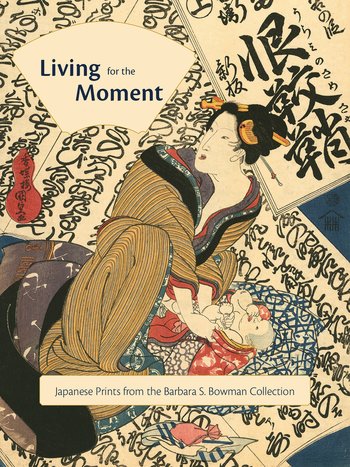 Spanning the late 18th and early 19th centuries, the exquisite examples of Japanese prints included in this book offer insights into the history of an art form and vision that is distinctively Japanese and was highly inspirational to later European painters. Polychrome prints, or ukiyo-e, first appeared in Japan in the late 18th century. Delicately hued and intricate, they depicted landscapes, scenes, and figures that epitomized the country’s idea of ‘the floating world’: a place whose denizens lived for the moment and appreciated the pleasures of the natural world. This volume surveys the prominent Barbara S. Bowman collection of prints notable for a number of reasons: an excellently preserved print of Lucky Dream for the New Year: Mount Fuji, Falcon, and Eggplants by Suzuki Harunobu; a number of surimono, or privately published prints that were created with unusually luxurious materials; and numerous works by Hiroshige and Hokusai, who are considered the masters of the art form. Each of the over one hundred prints in this book is reproduced in large color plates that highlight their subtle beauty and charm and are accompanied by extensive analysis of the pieces’ remarkable qualities. This comprehensive overview of the collection by LACMA curator Hollis Goodall addresses the significance and history of the Bowman collection and the many ways it enhances the museum’s extensive holdings of Japanese art.
Hollis Goodall is curator of Japanese art at the Los Angeles County Museum of Art.
New Book | Sir Joshua Reynolds: Propos sur l’art
Forthcoming from Brepols:
Jan Blanc, Sir Joshua Reynolds: Propos sur l’art (Turnhout: Brepols, 2015), 800 pages, ISBN: 978-2503543376, 175€.
Réunis pour la première fois et présentés de façon systématique et comparative, ces textes offrent une révision complète des théories et des pratiques artistiques du peintre, sir Joshua Reynolds.
 Après la mort de sir Joshua Reynolds, les premiers visiteurs de son atelier y ont découvert, en plus de plusieurs tableaux inachevés et des œuvres de son abondante collection, un nombre considérable de manuscrits—plus de 2000 pages de sa main ou de celle de ses secrétaires. Certains de ces manuscrits ont fait l’objet de publications partielles, tout comme c’est le cas des quelques textes publiés par Reynolds tout au long de sa carrière—pour l’essentiel, ses trois articles pour l’Idler et ses quinze discours académiques. Il n’existait pourtant aucune édition complète de ses écrits, tant en anglais qu’en français.
Présentant pour la première fois l’intégralité des textes connus de sir Joshua Reynolds, qu’ils aient été publiés de son vivant et après sa mort ou restés à l’état de manuscrits, cet ouvrage propose ainsi une révision complète des théories et des pratiques artistiques du peintre, à l’aune de textes connus, méconnus et inconnus. Réunis pour la première fois et présentés de façon systématique et comparative, ceux-ci permettent de mieux éclairer une carrière et une pensée plus cohérentes qu’on ne l’a dit, moins conformiste qu’on ne l’a prétendu. Ils constituent surtout des documents capitaux pour une histoire artistique mais aussi culturelle, sociale, historique, littéraire, théâtrale et politique du Siècle des Lumières.
À travers une présentation strictement chronologique des différents documents, qui mêlent les textes publics ou publiés, les lettres privées ainsi que les notes demeurées confidentielles, il s’agit de souligner la cohérence des idées développées par le premier président de la Royal Academy tout autant que leur évolution et leur adaptation à des publics et des attentes différents. L’ensemble de ces sources fait l’objet d’une présentation qui permet d’en restituer les enjeux, d’en rappeler le contexte d’énonciation et d’en marquer les principaux apports. Par une série de renvois intertextuels, le lecteur pourra également mettre en relation les propos de l’artiste à différents moments de sa vie, afin de mesurer ce qui les sépare ou les réunit.
Par ailleurs, afin que ces textes ne soient pas réduits aux innombrables chapitres d’une théorie de l’art homogène et unifiée qui n’a jamais existé, et arrachée à la pratique d’un peintre qui a constamment cherché à la fonder sur les problèmes strictement artistiques, techniques et artistiques qui se posaient à lui, lorsqu’il concevait un portrait ou une peinture d’histoire, des éléments d’information concernant sa carrière, ses principales œuvres et les débats les entourant ont été insérés entre les textes afin d’en favoriser la compréhension et d’en saisir les enjeux circonstanciels.
Il serait vain, même en une longue préface, de résumer en quelques points des théories artistiques qui s’étalent sur près de 2000 pages et couvrent près d’un demi-siècle, du premier manuscrit connu de la main d’un Reynolds à peine entré dans l’adolescence—un arbre généalogique—à la dernière lettre que nous connaissons du peintre, écrite à peine un mois après avoir proposé—sans succès—sa démission de la Royal Academy. J’ai donc choisi la solution d’un dictionnaire, regroupant les principales notions et les personnages les plus importants que nous pouvons rencontrer au fil des pages écrites par Reynolds, tout au long de sa carrière. J’y insiste sur les problèmes de définition posés par des concepts dont les acceptions ne sont parfois qu’implicites, et sont le plus souvent flottantes, au gré des enjeux et des problèmes contextuels posés à la pratique du peintre. J’y montre aussi que, dans bien des cas, Reynolds fait constamment évoluer sa théorie, en la réélaborant en fonction de ses rencontres mais aussi des résistances ou des débats que ses idées font surgir au sein de l’institution académique, auprès de ses collègues ou dans la presse. Reynolds ne prétend jamais détenir une vérité qu’il cherche à imposer à ses auditeurs ou ses lecteurs—ou à lui-même. Bien au contraire, il trouve, à travers le travail de formulation par l’écrit et de formalisation par l’explicitation théorique les moyens de construire ou de déconstruire cette pensée. Tel est, sans doute, le principal enseignement d’une édition qui, je l’espère, contribuera à montrer que la pensée de sir Joshua Reynolds est l’une des plus audacieuses et des plus ouvertes de son temps.
Symposium | International Carriage Symposium
From the conference program:
Fifth CAA / CWF International Carriage Symposium
Colonial Williamsburg, 28–30 January 2016
We hope you’ll join the Carriage Association of America (CAA) and the Colonial Williamsburg Foundation (CWF) as we welcome fourteen leading European and North American scholars to our fifth biennial CAA / CWF International Carriage Symposium. You’ll hear lectures on a wide variety of topics that touch on horse- drawn transportation. And you’ll have several opportunities to explore everything that Colonial Williamsburg’s Revolutionary City has to offer and to meet the men and women who practice eighteenth-century trades.
To kick off the symposium, the CAA will hold its annual membership meeting and a welcome reception during the late afternoon on Wednesday, January 28. As a symposium attendee, you’ll enjoy thirteen educational lectures during the day on Thursday, Friday morning, and all day Saturday. You’ll have Friday afternoon free to explore Williamsburg’s Historic Area and to visit the stables and meet the CWF’s new director of the Coach & Livestock Department, Paul Bennett.
For more than fifty years, the CAA has studied, preserved, and shared the history and traditions of carriage driving. Through the CAA’s efforts, association members and the general public can learn about carriages and sleighs, harness, driving how-to, carriage- driving history, early American roads, traditional turnout and livery, carriage restoration and conservation, and so much more.
◊ ◊ ◊ ◊ ◊
T H U R S D A Y , 2 8 J A N U A R Y 2 0 1 6
• Monica Kurzel-Runtscheiner (Austria), And How the Visitors Gather: Equestrian Equipages at the Congress of Vienna, 1815
• David Sneed (United States), The Inside Story: An Overview of Technology in America’s Early Military Wagons and Western Vehicles
• Colin Henderson (Great Britain), From 4:00am to 5:00pm: The Royal Mews Undertakes a Grand Royal Event
Midday break
• Laurier Lacroix (Canada), Canadian Artist, Cornelius Krieghof: Immortalizing the Sleighs of the Canadian Habitant
• Andreas Nemitz (Germany), Alpine Adventures: Travels over the Alps by Coach and Five
F R I D A Y , 2 9 J A N U A R Y 2 0 1 5
• Kenneth Wheeling (United States), The Mountain House Coaches: Tours through New Hampshire’s Leafy Glens
• Michael Sanborn (United States), Beckoning Avalon: The Banning Family Carriages of Catalina Island
• SSG John S. Ford (United States), To Carry the Honored Dead: The Army Caissons at Arlington National Cemetery
Lunch, with the afternoon to explore the Historic Area
S A T U R D A Y , 3 0 J A N U A R Y 2 0 1 5
• Stephan Broeckx (Belgium), The Japanese Imperial Mews: The Emperor’s Ceremonial Horses and Carriages
• Alexander Sotin (Russia), On the Streets of Moscow: The Horse-drawn Turnouts of the Russian People
• Greg Hunt (United States), Military Tack: Harnesses for Army Escort Wagons and Artillery Teams
Midday break
• Josh Ruff (United States), Delancey Kane’s Tally-Ho: An Icon of American Road Coaching
• Bjørn Høie (Norway), Out and around the Norwegian Fjords: The Native Country Vehicles of Norway
• Richard C. V. Nicoll (United States), Address during the Banquet: Time I Hung up my Whip
The UK’s Carriage Foundation

Samuel Butler (designed by William Chambers), Gold State Coach, 1762 (Royal Collection, 5000048). The panels were painted by Giovanni Cipriani. (Photo: Wikimedia Commons, July 2009).
◊ ◊ ◊ ◊ ◊
From Salon: Society of Antiquaries Online Newsletter 352 (2 November 2015) . . .
Julian Munby FSA, Head of Buildings Archaeology at Oxford Archaeology (and, he says, “a Fellow who has written about Queen Elizabeth’s carriages, and studied the English coach in the Kremlin”), writes about a new venture to record historic carriages:
“Historic carriages are a curiously neglected part of our heritage, while they include some of the most superbly designed and decorated examples of furniture on wheels, whether in museums or private collections. The newly launched Carriages of Britain (COB) project aims to create an online database of all historic horse-drawn carriages in collections throughout the UK. On Friday 30 October, in a truly glittering event at the Royal Mews, standing beside the Gold State Coach (1762), Colin Henderson, lately the Queen’s Head Coachman, announced that The Carriage Foundation, founded by enthusiasts for horse-drawn vehicles in 1991, has become a registered charity to promote interest and expertise in carriages through educational resources, publications and study days. In addition to developing historical information through the COB database, the foundation will also explore the foundation of a national carriage museum. Those interested in supporting through membership and donation can contact The Carriage Foundation.”
◊ ◊ ◊ ◊ ◊
From In Harness (August/September 2015), p. 5:
[The Carriage Foundation] now aims to manage, support and seek funding for various carriage related projects. Initially a website will be created which will host the first major project: Carriages of Britain. The project will consist of a searchable and illustrated database of carriages within UK collections, essays, and a photographic archive. Initial work has identified over 1200 carriages in publically accessible collections which will all have an entry on the database. Carriages of Britain will become the first port of call for anyone wishing to research horse drawn vehicles. Further developing our work, The Carriage Foundation are hosting a series of study days through the winter as well as the two established study tours. Long term plans are to explore the possibility of founding a National Carriage Museum.
For more information, contact thecarriagefoundation@yahoo.co.uk.
‘Mr Foote’s Other Leg’ Onstage in London

Joseph Millson as David Garrick, Dervla Kirwan as Peg Woffington, and Simon Russell Beale as Samuel Foote; Mr Foote’s Other Leg, directed by Richard Eyre, Hampstead Theatre, London. Credit: Alastair Muir.
◊ ◊ ◊ ◊ ◊
Ian Kelly’s biography of Samuel Foote made Enfilade’s 2012 year-end gift guide. The eponymous play, Mr Foote’s Other Leg, has just moved to Theatre Royal, Haymarket. Writing for The Guardian, Michael Billington finds in it “a ramshackle vigour” with “a shining performance from Simon Russell Beale” as Foote. Reviewing the play while it was at the Hampstead Theatre, Sussanah Clap, also writing for The Guardian, found much to enjoy, singling out (among others) Dervla Kirwan: she “is enchanting—frilly and filthy—as Peg Woffington, in ‘breeches’ roles.” And here’s the beginning of Jane Shilling’s piece for The Telegraph (5 November 2015). . .
 It is curious that the reputation of Samuel Foote should be almost forgotten when so many of his less amusing 18th-century contemporaries are still remembered. A one-legged actor-manager with a fondness for appearing in extravagant female costume and a dangerous talent for satire, Foote bestrode (or rather, hopped commandingly across) the stage of the Theatre Royal, Haymarket—the venue to which Richard Eyre’s production of Ian Kelly’s play has transferred after a sell-out premiere at the Hampstead Theatre.
Kelly, who appears in his own play as the future King George III, published a biography of Foote in 2012, but evidently felt that his subject’s natural milieu was the stage rather than the page. His adaptation is a wild, picaresque romp through the theatrical,
social and scientific landscape of the 18th century. . . .
The full review is available here»
Call for Papers | HBA Young Scholar Session at CAA 2016
Historians of British Art Young Scholar Session
College Art Association, Washington, D.C., 5 February 2016
Proposals due by 18 December 2015
The Historians of British Art, a CAA-affiliated society, seeks papers for an upcoming mini-session of work by emerging scholars to be held during the HBA Business Meeting at CAA in Washington, D.C. (February 5, 2016). Current or recent graduate students are invited to submit proposals (if a Ph.D. recipient, the degree must have been earned within the past three years). Papers may address any topic related to British art, architecture, and visual culture and should be limited to fifteen minutes. This is an opportunity for informal presentations of new or ongoing research followed by open discussion.
To submit a paper for consideration, please send the following items to Craig Hanson, HBA President, at CraigAshleyHanson@gmail.com: (1) a one page abstract; (2) a C.V. (limited to two pages).; and (3) a brief cover letter explaining interest in the field. The deadline for submission is December 18, 2015. Upon selection, each presenter will be requested to join HBA if not already a member.
Attingham Offerings for 2016

George Barret the Elder, The West Front of Burton Constable,
oil on canvas, 1777
◊ ◊ ◊ ◊ ◊
Along with Attingham’s regular course offerings, next year’s study programme will be based in Denmark. More information and application form available at Attingham’s website. Applicants from the U.S. may contact Mary Ellen Whitford, admin@americanfriendsofattingham.org. Applicants from outside the U.S. may contact Rita Grudzień, rita.grudzien@attinghamtrust.org.
The London House Course, 19–25 April 2016
Applications due by 11 January 2016
This non-residential programme studies the development of the London house from the Renaissance to the present, as well as the history of planning and development in the city. Directed by Giles Waterfield and Sarah Nichols.
Attingham Study Programme: The Historic House in Denmark, 1–8 June 2016
Applications due by 24 January 2016
Commencing in Copenhagen this ambitious 8-day programme will concentrate on Denmark’s rich heritage of royal castles and manor houses virtually unknown outside the country. Ranging from the Middle Ages to the nineteenth century, a wide variety will be visited many still in private hands. The programme will be directed by Annabel Westman with the assistance of a Danish advisory committee.
The 65th Attingham Summer School, 30 June — 17 July 2016
Applications due by 31 January 2016
Directed by Elizabeth Jamieson and Andrew Moore, and accompanied by specialist tutors and lecturers, this intensive 18-day course will include visits to approximately 25 houses in Sussex, Nottinghamshire, Derbyshire and Yorkshire. The Summer School will examine the country house in terms of architectural and social history, and the decorative arts.
Royal Collection Studies, 4–13 September 2015
Applications due by 12 February 2016
Run on behalf of Royal Collection Trust, this strenuous 10-day course based near Windsor is directed by Giles Waterfield. The school will visit royal palaces in and around London with specialist tutors (many from the Royal Collection) and study the extensive patronage and collecting of the royal family from the Middle Ages onwards. The course is open to all but priority will be given to those with a professional or specialist knowledge of British architecture or history of the fine and decorative arts.
French 18th-Century Studies, 9–14 October 2016
Applications due by 30 April 2016
Directed by Helen Jacobson, and run for the fourth time, this 5-day non-residential program aims to foster a deeper knowledge and understanding of French eighteenth-century fine and decorative art. Based at the Wallace Collection with one full study day at Waddesdon Manor this course is intended primarily to aid professional development with object-based study, handling sessions and a look at behind-the-scenes conservation.










 Enfilade
leave a comment