Conference | European Portrait Miniatures
From the conference flyer:
European Portrait Miniatures: Artists, Functions, and Collections
The Tansey Miniatures Foundation, Bomann-Museum, Celle, 11–13 November 2016
 The conference is being held on the occasion of the opening of the sixth exhibition of the Tansey Miniatures Foundation and the publication of the accompanying catalogue Miniatures from the Baroque Period in the Tansey Collection.
Both conference venues are within walking distance (20 minutes) from the railway station. Trains from Hannover take approximately 25 to 45 minutes (Deutsche Bahn, Metronom, and S-Bahn).
For registration, please contact Juliane Schmieglitz-Otten, Head of the Residence Museum at Celle Castle, juliane.schmieglitz-otten@tansey-miniatures.com. For more information, please contact Bernd Pappe, Art Historian and Restorer, bernd.pappe@tansey-miniatures.com. Conception IT Coordination by Birgitt Schmedding, Photo Designer, birgitt.schmedding@tansey-miniatures.com.
◊ ◊ ◊ ◊ ◊
F R I D A Y , 1 1 N O V E M B E R 2 0 1 6
15:00 Registration
16:30 Welcome and opening of the exhibition Miniatures from the Baroque Period in the Tansey Collection
S A T U R D A Y , 1 2 N O V E M B E R 2 0 1 6
9:00 Objects, Agencies, and Social Practices
• Ulrike Kern (Frankfurt), The Limner’s Language: Words and Concepts Related to Miniature Painting in England
• Miranda L. Elston (Chapel Hill, North Carolina), Hilliard’s Miniatures: Enacted Desire within the Elizabethan Court
• Eloise Owens (New York), The Hand behind the Likeness: Women’s Practice as Portrait Miniaturists in Eighteenth-Century England
• Christoph Großpietsch (Salzburg), Portrait Miniatures of Mozart: Problems of Authenticity
• Violaine Joëssel (Geneva), A Quest for Legitimacy: The Practice of Miniature Painting in Colonial America
• Dimitri Gorchko (Moscow), ‘… et que tout ait un nom nouveau’: Portrait Miniatures of Napoleon’s Marshals, Generals, and Colonels: Analysis and Identification
13:00 Lunch
14:15 Politics and Representation
• Delia Schffer (Kassel), Power through Relations: Duke Louis of Württemberg‘s Family Ties in a Series of Miniature Portraits
• Sarah Grandin (Paris), Density in the ‘Boîte à Portrait’ under Louis XIV
• Stefanie Linsboth (Vienna), From Large-Scale Paintings to Precious Miniatures: Maria Theresa’s Portrait Miniatures
• Karin Schrader (Bad Nauheim), ‘Taking the Veil’: Miniatures of Royal Widows from the Sixteenth to the Nineteenth Centuries
16:30 Coffee
17:00 Special Techniques and Materials
• Tatjana Wischniowski (Dresden), Oil-Based Paint under a Layer of Water: Arnaud Vincent de Montpetit’s ‘Eludoric Painting’, a Rare Miniature Painting Technique
• Emma Rutherford, Alan Derbyshire, and Victoria Button (London), The Drawings of John Smart (1742–1811): Function, Purpose, and Line
S U N D A Y , 1 3 N O V E M B E R 2 0 1 6
9:00 Miniature Collections
• Lucy Davis (London), Famous Women in the Miniatures at The Wallace Collection
• Catherine Hess (San Marino, California), Up Close and Personal: Portrait Miniatures at The Huntington Art Collections
• Isabel M. Rodríguez-Marco (Madrid), The Collection of Portrait Miniatures and Small Portraits in the Museo Nacional de Artes Decorativas, Madrid
• Paul Caffrey (Dublin), European Enamels from the National Gallery of Ireland Collection
• Wladyslaw Maximowicz (Bergamo), The Portrait Miniature in Russian Provincial Collections
• Reetta Kuojärvi-Närhi (Helsinki), Small Treasures in Finland: Paul Sinebrycho as a Miniature Collector
13:00 Lunch
14:15 Miniature Painters
• Halgard Kuhn (Hannover), Peter Boy (c. 1650–1727): Medallions and Miniatures by the Frankfurt Baroque Goldsmith and Enamel Painter as Integrating Parts in Golden Jewellery
• Karen Hearn (London), The ‘Small Oil Colour Pictures’ of Cornelius Johnson (1593–1661)
• Marco Pupillo (Rome), Francesco Antonio Teriggi, a Miniaturist in the Service of Joseph Bonaparte
• Roger and Carmela Arturi Phillips (Ringwood), The True and Flawed Genius of John Engleheart
• Stephen Lloyd (Liverpool), Copying Portraits in Miniature in Regency England: The Work of William Derby (1786–1847) for the 13th Earl of Derby at Knowsley Hall
◊ ◊ ◊ ◊ ◊
The exhibition catalogue is distributed in North America and Japan by The University of Chicago Press (with information on the other five volumes published thus far from The Tansey Foundation). . .
Bernd Pappe and Juliane Schmieglitz-Otten, eds., Miniatures from the Baroque Period in the Tansey Collection / Miniaturen des Barock aus der Sammlung Tansey (Munich: Hirmer Publishers, 2016), 400 pages, ISBN: 978-3777426389, $64.
The Tansey miniatures, now held by the Bomann Museum in Celle, represent one of the most significant collections of European miniature paintings. This volume is the sixth in a series exploring the collection in key periods. Each volume presents new photographic reproductions of the miniatures at actual size and with close-up photographs that show important details. This volume covers portrait miniatures created throughout the Baroque period of the seventeenth-century, with more than one hundred representative works. Essays by specialists in the field offer insights into the artworks, their patrons, and the period. The resulting book is as informative as it is beautiful, a stunning testament to a bygone age and a once-popular form.
Conference | The Art Market, Collectors, and Agents
The first installment of the conference took place in July at the Warburg Institute in London. For the two days in Paris, I’ve included only the sessions most relevant to the eighteenth century. The full schedule is available from H-ArtHist:
The Art Market, Collectors, and Agents: Then and Now
Institut national d’histoire de l’art, Paris, 20–21 October 2016
The focus of the conference is to explore the changing and complex nature of the role of agent in the art market during the Early Modern Period. Papers will explore shifts in the dynamics of the market, the changing taste of collectors and the importance of writers, critics, museum curators and dealers in influencing these changes. The papers demonstrate how examining the role of agents through their correspondence with clients, day books or private records, bring new insights into the workings of the art world through the detailed evidence of how transactions were negotiated.
We would like to thank the speakers’ institutions and the Institut d’Etudes Supérieres des Arts for supporting the conference. The conference is free but to register for the lunches (20€ per day), please email a.turpin@iesa.edu.
Organised by the Collecting and Display Seminar Group London with the Centre André Chastel, INHA, Paris.
• Tamsin Foulkes (PhD Candidate, University of Nottingham), James Thornhill as an Agent-Collector in Early Eighteenth-Century Paris
• Corina Meyer (Institute of Art History, University of Stuttgart), ‘To See Once Again the Glorious Picture by Moretto before It Is Forever Lost for Rome’: Johann David Passavant’s (1787–1861) Recommendations and Selection of Paintings
• Tina Kosak (France Stele Institute of Art History, ZRC SAZU Ljubljana), Conquering New Art Markets: International Art Dealers and Local ‘Agents’ in Inner Austria in the Second Half of the Seventeenth Century
• Laura Popoviciu (PhD Candidate, Warburg Institute), Shaping the Taste of British Diplomats in Eighteenth-Century Venice
• Renata Schellenberg (Mount Allison University, Sackville, Canada), Commerce, Culture, and Connoisseurship: The Emergence of the Art Dealer in Eighteenth-Century Germany
NMAAHC Opens on Saturday

The Smithsonian National Museum of African American History and Culture
Wikimedia Commons (20 July 2016).
◊ ◊ ◊ ◊ ◊
As Lonnie Bunch, the MNAAHC’s director, repeatedly says, the museum aims, by addressing black experiences and contributions, to expand conceptions of what American history and identities are for all visitors. Part of that necessarily requires seventeenth- and eighteenth-century objects and interpretations. There are slave shackles, even an early nineteenth-century slave cabin, but there are also sources documenting service in the Revolutionary War, Freemasonry objects, and a portrait by Joshua Johnson, the earliest documented professional African American painter. Writing for The New York Times (15 September 2016), Holland Cotter calls it “more than just impressive. It’s a data-packed, engrossing, mood-swinging must-see.” Press release (2 February 2016) . . .
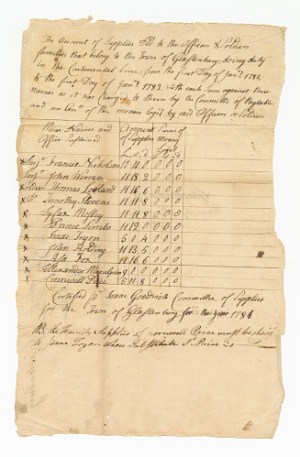
Ledger of supply costs for eleven Revolutionary War soldiers, 1782.
The Smithsonian today announced that the National Museum of African American History and Culture will open to the public Saturday, September 24. The opening will be the focus of a week-long celebration that begins with a dedication ceremony. The celebration continues with extended visiting hours and a three-day festival showcasing popular music, literature, dance and film. Also planned are events co-hosted by other museums around the country and in Africa.
“After 13 years of hard work and dedication on the part of so many, I am thrilled that we now have this good news to share with the nation and the world,” said Lonnie Bunch, the museum’s founding director. “In a few short months visitors will walk through the doors of the museum and see that it is a place for all people. We are prepared to offer exhibitions and programs to unite and capture the attention of millions of people worldwide. It will be a place for healing and reconciliation, a place where everyone can explore the story of America through the lens of the African American experience.”
“We look forward to the opening of this enormously important new museum,” said David Skorton, Smithsonian Secretary. “The National Museum of African American History and Culture furthers the Smithsonian’s commitment to telling America’s story in all its dimensions.”
President George W. Bush signed the legislation establishing the museum in 2003. In 2009, the museum’s architectural team of Freelon Adjaye Bond/SmithGroupJJR was selected, and in 2011 Clarke/Smoot/Russell was chosen as the construction firm. David Adjaye is the lead designer, and Phil Freelon is the lead architect. The landscape design is by the team of Gustafson Guthrie Nichol.
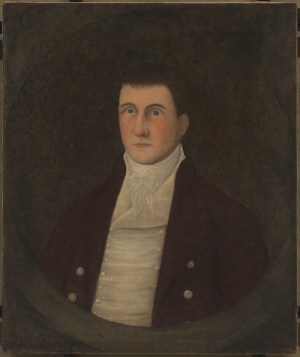
Joshua Johnson, Portrait of John Westwood, ca. 1807–08, oil on canvas (Washington, D.C.: Collection of the Smithsonian National Museum of African American History and Culture, 2010.25ab).
The Smithsonian broke ground for the museum 22 February 2012 on its five-acre site on Constitution Avenue between 14th and 15th streets N.W. The 400,000-square-foot building has five levels above ground and four below. The museum will have exhibition galleries, an education center, a theater, café, and store, as well as staff offices. Among the building’s signature spaces are the Contemplative Court, a water- and light-filled memorial area that offers visitors a quiet space for reflection; the Central Hall, the primary public space in the museum and the point of orientation to building; and a reflecting pool at the south entry of the museum, with calm waters meant to invite all to approach.
The museum also features a series of openings—’lenses’—throughout the exhibition spaces that frame views of the Washington Monument, the White House, and other Smithsonian museums on the National Mall. These framed perspectives remind visitors that the museum presents a view of American through the lens of the African American experience.
The museum will open with 11 inaugural exhibitions that will focus on broad themes of history, culture and community. The exhibitions have been designed by museum historians in collaboration with Ralph Appelbaum Associates. These exhibitions will feature some of the more that 34,000 artifacts the museum has collected since the legislation establishing it was signed in 2003. The museum’s collections are designed to illustrate the major periods of African American history. Highlights include: a segregation-era Southern Railway car (c. 1920), Nat Turner’s Bible (c. 1830s), Michael Jackson’s fedora (c. 1992), a slave cabin from Edisto Island, S.C. plantation (c. early 1800s), Harriet Tubman’s hymnal (c. 1876) and works of art by Charles Alston, Elizabeth Catlett, Romare Bearden, and Henry O. Tanner.
While under construction, the museum has had a gallery at the Smithsonian’s National Museum of American History. Since 2009, the museum has opened seven exhibitions in the space including Through the African American Lens: Selections from the Permanent Collection (on view now), The Scurlock Studio and Black Washington: Picturing the Promise, and Changing America: The Emancipation Proclamation, 1863 and The March on Washington, 1963. The museum’s first exhibition, Let Your Motto Be Resistance: African American Photographs, opened in 2007 at the International Center for Photography in New York and toured 15 cities.
In addition to exhibitions, the museum has also launched several education and research programs. Save Our African American Treasures was launched in Chicago in January 2008 and is one of the museum’s signature programs. Participants work with conservation specialists and historians to learn how to identify and preserve items of historical value, including photographs, jewelry, military uniforms, and textiles.
Call for Essays | Terra Foundation for American Art Essay Prize
Terra Foundation for American Art International Essay Prize
Submissions due by 15 January 2017
The Terra Foundation for American Art International Essay Prize recognizes excellent scholarship by a non-U.S. scholar in the field of historical American art. Manuscripts should advance the understanding of American art, demonstrating new findings and original perspectives. The prize winner will be given the opportunity to work toward publication in American Art, the Smithsonian American Art Museum’s scholarly journal. He or she will also receive a $1,000 cash award and a travel stipend of up to $3,000 to give a presentation in Washington, D.C., and meet with museum staff and fellows. This prize is supported by funding from the Terra Foundation for American Art.
Ph.D. candidates and above who have not published in American Art previously are eligible to participate in the competition. Essays may focus on any aspect of historical (pre-1980) American art and visual culture; however, architecture and film studies are not eligible. Preference will be given to submissions that address American art within a cross-cultural context and offer new ways of thinking about the material. A strong emphasis on visual analysis is encouraged.
Submissions for the 2017 prize must be sent to TerraEssayPrize@si.edu by January 15, 2017. For more information about eligibility and the format for submissions, please visit www.americanart.si.edu/research/awards/terra.
Exhibition | Drawings by William Stukeley
On view next month in Spalding:
Drawings by William Stukeley
Ayscoughfee Hall Museum, Spalding, 5–16 October 2016
Presented by the Spalding Gentlemen’s Society

John Stukeley, Stukeley’s House at Holbeach (Spalding Gentlemen’s Society).
These drawings by William Stukeley (1687–1765) have recently been cleaned, conserved, and mounted under a grant from the Heritage Lottery Fund. This is the first time they have ever been displayed in public. They are beautiful in their own right, examples of a drawing skill that used to be common before photography was invented in the nineteenth century.
Stukeley was born in Holbeach, a town he visited frequently as an adult. He was a founder member of the Spalding Gentlemen’s Society in 1710 and a noted antiquarian. The drawings on display are important for several reasons, not least for the light they shed on Stukeley’s role in shaping the evolution of garden design in Britain in the eighteenth century.
Display | ‘The Inspection of the Curious’: The Country-House Guidebook

Garden Front of Blenheim Palace, from Colen Campbell, Vitruvius Britannicus or the British Architect, the Plans, Elevations, and Sections of the Regular Buildings, both Publick and Private, in Great Britain . . . , 3 vols. (London: 1715–25), volume 1. For the display at The Mellon Centre, Campbell’s work is represented by a 1967 edition of the book; the image included above comes from Wikimedia Commons.
◊ ◊ ◊ ◊ ◊
Now on view at the Paul Mellon Centre:
‘The Inspection of the Curious’: The Country-House Guidebook, c. 1750–1990
Paul Mellon Centre for Studies in British Art, London, 5 September 2016 – 6 January 2017
Curated by Jessica Feather and Collections Staff
The fourth Drawing Room Display, curated by Jessica Feather (Brian Allen Fellow at the Paul Mellon Centre) and Collections staff, takes material from the Centre’s considerable holdings of Country House guidebooks to focus on three early adopters of the guidebook: Knole (Kent), Blenheim Palace (Oxfordshire), and Burghley (Lincolnshire/Northamptonshire).
The British country-house guidebook is a very specific genre of travel guide, with particular characteristics which have, arguably, remained relatively unchanged from beginnings in the mid-eighteenth century until the present day. Generally small in size, lightweight and inexpensive, they were intended to be portable in order to be carried round the house whilst visiting. The history of the country-house guidebook relates closely to the practice of visiting country houses.
It is a genre which only developed seriously in the later eighteenth century, some years after houses such as Chatsworth, Blenheim, and Burghley opened their doors. A subsequent rise in mass tourism by the mid-nineteenth century, and the appropriation of country houses as part of the national heritage, led to the production of an increased number of guidebooks before the decline in interest in visiting country houses from the 1880s onwards due to economic pressures and anti-aristocratic feeling. This saw a decline in visitor numbers and significant reduction in the number of new guidebooks produced and new editions of older ones. A revival in visiting country houses after the Second World War has been paralleled by the frequent publication of guidebooks in new editions at least up until the 1990s.
Examining the guidebooks of three great houses—Knole, Blenheim, and Burghley—not only allows us to consider the history of this genre, but also brings the historical narratives of these houses into the foreground.
The Paul Mellon Centre has been collecting country-house material and publications over a number of years both by purchase and donations, including material from the collections of Sir Howard Colvin and John Cornforth. For more information on the Library and Collections please click here.
The ‘Inspection of the Curious’ display coincides with the Art in the British Country House: Collecting and Display research project and the Art in the British Country House: Collecting and Display conference which takes place October 7.
Jessica Feather’s 21-page accompanying booklet is available digitally here»
Note (added 20 September 2016) — The original version of this posting mistakenly listed the opening date as 8 February 2017.
New Book | Technology in the Country House
Distributed by The University of Chicago Press:
Marilyn Palmer and Ian West, Technology in the Country House (London: Historic England Publishing, 2016), 272 pages, ISBN: 978-1848022805, $120.
 The country house has long been an important part of British cultural heritage, beloved not just for its beautiful architecture, furniture, and paintings, but also a means to reconnect with the past and the ways in which families and their households once lived. With Technology in the Country House, Marilyn Palmer and Ian West explore how new technologies began to change country houses and the lives of the families within them beginning in the nineteenth century. A wave of improvements promised better water supplies, flushing toilets, central heating, and communication by bells and then telephones. Country houses, however, were often too far from urban centers to take advantage of centralized resources and so were obliged to set up their own systems if they wanted any of these services to improve the comfort of daily living. Some landowners chose to do this, while others did not, and this book examines the motivations for their decisions.
Marilyn Palmer is emeritus professor of archaeology and president of the Association for Industrial Archaeology. She is the author or editor of many books, including, most recently, Industrial Archaeology: A Handbook. Ian West is an archaeologist and engineer.
Frick Announces Gift of Du Paquier Porcelain

Du Paquier Porcelain Manufactory, Elephant Wine Dispenser, ca. 1740 (New York: The Frick Collection, gift of the Melinda and Paul Sullivan Collection, 2016; photo by Michael Bodycomb).
◊ ◊ ◊ ◊ ◊
Press release from The Frick, via Art Daily (16 September 2016). . .
The Frick Collection announced a gift from Paul Sullivan and Trustee Melinda Martin Sullivan of porcelain produced by the Du Paquier manufactory in Vienna. The Sullivans generously permitted the Frick to choose fourteen superb examples from their collection, considered to be the finest private collection in the world from this important early Western manufactory. The objects, dating from about 1720 to 1740, perfectly complement the museum’s porcelain holdings, which have grown since Henry Clay Frick’s day to represent in depth some of the best productions of this prized material. Mr. Frick focused his porcelain collecting on Sèvres, which accompanied beautifully the eighteenth-century French paintings and furniture he acquired. In 1966, his collection of Chinese porcelain was augmented by some two hundred pieces through the bequest of his son, Childs. The museum’s holdings were again extended by recent and promised gifts of Meissen porcelain from Henry Arnhold. Now, the Sullivan’s gift of Du Paquier porcelain adds to the Frick’s already strong assemblage, which illustrates the Western fascination with Eastern models and represents the brilliant and distinctive tradition of porcelain production in Europe. Starting September 28, these stunning works will be on view in the Frick’s Reception Hall, remaining there through March of 2017.
Europe had long sought to duplicate the composition and physical qualities of the ceramics it imported from China; the feat was achieved only in the first decade of the eighteenth century at the Royal Meissen Manufactory outside Dresden, Germany, before being replicated by the Du Paquier manufactory in Vienna, then by the Sèvres manufactory in France, and elsewhere. In 1718, Claudius Innocentius du Paquier, an agent in the Imperial Council of War at the Vienna court, was granted a twenty-five year charter by Emperor Charles VI to operate a porcelain factory in Vienna. Although the secret of making porcelain by combining local clays containing kaolin with ground alabaster was jealously guarded by the Meissen manufactory, Du Paquier used his diplomatic connections to lure several key figures from Germany to Austria. These included Christoph Conrad Hunger, a porcelain painter; Just Friedrich Tiemann, an expert in kiln construction; and Samuel Stöltzel, the Meissen kiln master, who brought with him the formula for porcelain paste. Named for its founder, the Du Paquier manufactory produced a range of tablewares, decorative vases, and smallscale sculpture that found great popularity with the Hapsburg court and the Austrian nobility.
An early work of about 1725 testifies to the Viennese factory’s pride in its achievement. A tulip vase, part of a set of vessels called a garniture, features a fanciful view of Vienna and its spiritual center, St. Stephen’s Cathedral. Circling the frame of this scene is a Latin inscription that translates: “The bowls that Vienna formerly shipped here under a thousand perils of the sea, she now produces for herself.” The legend clearly signals the Du Paquier manufactory’s debt to Asian ware, which the Emperor Charles VI’s Ostend East-India Company had imported to the city since 1722.
A number of Asian motifs cover a Du Paquier tureen and stand of 1730–35, a form common in both European ceramic and silver dinner services of this period. Chinese-inspired handles in the form of leaping fish enliven the vessel. Its cobalt blue underglaze decorated with gold patterns and cherry blossoms reflect color combinations influenced by Imari ware, which was imported to Europe from Japan during the late seventeenth and eighteenth centuries. Within the fan-shaped cartouches, scenes of Chinese figures and temples have been adopted from German engravings published about 1720 in Amsterdam. The variety of sources and inventive adaptations characterize Du Paquier’s spirited production.
As the renown of the Du Paquier manufactory spread, commissions came from capitals throughout Europe; the emperor and members of his court also sent these prized objects as diplomatic gifts to their counterparts in foreign lands. A magnificent tureen—one of more than forty from an extensive service created in 1735 for Czarina Anna Ivanovna—illustrates porcelain’s role in cementing political and dynastic ties. In 1726, Austria and Russia had signed a treaty of mutual defense against military threats from the Ottoman Empire and subsequently were allies during the War of Polish Succession (1733–35). It is likely that to strengthen this alliance, Charles VI sent Anna Ivanovna the Du Paquier service, most of which is still in the State Hermitage Museum in St. Petersburg. The Russian imperial arms are emblazoned in the center of the tureen’s lid, beneath the finial, a gilded statuette of a cross-legged, turbaned man. These two features perfectly illustrate Du Paquier’s brilliant integration of flat, painted decoration with three-dimensional applied forms. Circling the body of the tureen is a modeled garland held in the mouths of grotesque masks, its brightly painted flowers popping from the surface. In contrast, geometrical bands of a type called Laub- und Bandelwerk accent the bottom of the tureen and the lid. This decorative motif consisting of infinite variations based on patterns of trelliswork, angled strapwork, and stylized foliage became a virtual signature of the Viennese porcelain. Painted in a distinctive palette of iron-red with purple, blue, and green, the designs highlight the factory’s use of exuberant colors.
While sculptural forms like fish handles and seated-man finials are a hallmark of Du Paquier’s production, some works take these features to the highest level. One of the most charming is a tankard of 1735–40, the handle of which is in the shape of a cooper. Identified by the leather apron he wears under his coat, the craftsman specialized in making barrels like that which forms the shape he holds. Designed to contain beer, Du Paquier tankards often had lids, but the cooper’s hands grasp the rim, preventing a top from being added. The lively expression of the man, the bold pattern of flowers set off by bands of Laub-und Bandelwerk, and the tankard’s exceptionally large size make it a superb example of these drinking vessels.
Among the rarest of Du Paquier’s sculptural vessels is the elephant wine dispenser featured on the front of this release, one of three known to survive. A colorfully glazed version, in the Hermitage, is part of an elaborate centerpiece made about 1740 for Anna Ivanovna. That elephant stands above a rotating silver platter on which eight dancing figures hold cups ready to receive wine from the elephant’s trunk. The elephant is ridden by a figure of Bacchus, who can be lifted to fill the cavity with wine. The pure white surface of the Frick elephant allows the animal’s sculptural details to be clearly seen. Although it is possible that it was prepared as a spare in the event of breakage during firing, close observation reveals that the figure was once cold-painted (meaning paint was applied to the surface of the object, but it was not fired afterward). Elephants were favorites of the Czarina, who received one as a gift from Persian emissaries in 1736 and who featured a full-size model in a festival she staged on the frozen Neva River in 1740.
The elephant wine service was among the last of the great works produced by the Du Paquier manufactory. By 1744, its founder was overcome with debt and was forced to sell the factory to Empress Maria Theresa. Over its three-decade history, Du Paquier produced a body of work that was inventive and often whimsical, a truly distinctive voice in the evolution of European porcelain.
Comments Frick Director Ian Wardropper, “It gives me great pleasure to see these works come to the Frick. In 1993, while I was the Eloise W. Martin Curator of European Decorative Arts and Sculpture at the Art Institute of Chicago, Melinda and her sister, Joyce Hill, offered to fund an acquisition in honor of their mother, Eloise. Several suggestions were made, one of which was a group of three exquisite pieces of Du Paquier porcelain that the department was very interested in acquiring. Melinda was smitten with these objects, and—after purchasing the group for the Art Institute—she and her husband, Paul, began to acquire their own Du Paquier works. As their collection grew, so too did their interest in the history of the manufactory and its production, which led them to underwrite the research for and publication of Fired by Passion, a definitive three-volume monograph released in 2009. To celebrate its publication, as the head of the Department of European Sculpture and Decorative Arts at The Metropolitan Museum of Art, I initiated an exhibition drawn from the Sullivan’s and the Met’s collection (Imperial Privilege: Vienna Porcelain of Du Paquier, 1718–44). We are now honored to have this exceptional selection of porcelains enter The Frick Collection owing to the Sullivans’ extraordinary generosity.”
Exhibition | A Century of French Elegance
On view this week in Paris from The State Hermitage Museum:
A Century of French Elegance / Un siècle d’élégance française
Grand Palais, Paris, 10–18 September 2016
Curated by Tamara Rappe

Julien Le Royi, Watch on a chatelaine, Paris, mid-18th century.
The State Hermitage Museum presents the exhibition A Century of French Elegance, organized within the frames of the 28th Biennale des Antiquaires. The exhibition presents 34 works—some on view for the first time—in an installation of important eighteenth-century masterworks from the institution’s renowned collection. For centuries, France represented a certain model of art de vivre for all of Europe and Russia; the eighteenth century was profoundly marked by this ‘French elegance’, found both in fashion and in furniture. The collection of French decorative arts at the Hermitage is considered one of the finest outside the country itself. This is explained by the close Russian-French ties over many centuries. Russian monarchs regularly visited Paris for the acquisition of objects in porcelain, silver and bronze, and were offered exceptional masterpieces as diplomatic gifts.
In 1717, Tsar Peter the Great laid the foundation for official Russian-French relations during a visit to Paris. The main achievement of this visit was that Peter attracted French craftsmen of various trades to Russia. In subsequent years, Russian monarchs almost exclusively took their cue from the French capital. During the reign of Elizabeth Petrovna, French goods arrived from Paris in a constant stream. It was in the period of Elizabeth’s reign that items made of porcelain came to Saint-Petersburg. It was a favourite material in France in the mid-18th century, and the ‘green service’—items of which are preserved at the Hermitage—proves this perfectly. The porcelain plaque with a portrait of Louis XV presented at the exhibition is a rare example of this type of work from the Sevres Manufactory. Under Elizabeth Petrovna, furniture was ordered for the Chinese Palace in Oranienbaum. This delivery included the famous filing cabinet that is now kept at the Hermitage.
However, the main items from Paris in the Hermitage collection date from the time of Catherine the Great. The Hermitage has a unique collection of commissions from David Roentgen dating from Catherine’s reign. The Empress royally rewarded her numerous favourites. The magnificent French porcelain service, the ‘cameo service’, was ordered for Grigory Potemkin. Catherine’s political ambitions were reflected in the works of decorative art connected with Russian military victories. Thus, the Chesma inkstand, a unique work from the second half of the eighteenth century, was designed as a memorial to the victory over the Turkish navy. The author of the inkstand, the goldsmith and enameller de Mailly, created an ensemble which symbolised in allegorical form the victories of the Russian navy in the war with the Turks.

Clock Vase, Sevres, 1780s.
We encounter the name of the renowned enameller de Mailly once again on the signed ‘Egg shaped Vase’ decorated with the scene of the ‘Sacrifice of hearts at the altar of Catherine the Great’. Silver table services were ordered in Paris for the provinces, so that each Russian province would have its own. The Kazan, Yekaterinoslav, Nizhny Novgorod and Moscow services were made by Robert-Joseph Auguste from 1776 to 1782. The attention of the Russian court was focused on the French capital where the empress and her circle placed their main orders. In a very brief period, first class collections of works of art, drawings and cameos were gathered. However, the decorative objects ordered in Paris were not intended to form collections, but were rather purchased to delight the eye and ensure that the imperial palace in Saint-Petersburg was the equal of its European counterparts.
The reign of Paul I was also marked by a keen fondness for everything French. The architect Vincenzo Brenner ordered most of the furniture for Saint Michael’s Castle, built for Paul I, from France. Thanks to this, the Hermitage holds a unique collection of decorative bronzes and furniture bought in Paris at the end of the 18th century. Among these pieces of furniture were the only known console table signed by Pierre-Philippe Thomire, lacquered furniture, and a fall front desk and its matching chest of drawers ornamented with Sevres plaques.
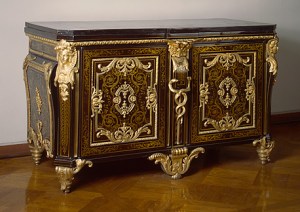
Medal Cabinet, Paris, 1723.
After the 1917 revolution, the fate of the Hermitage collection of decorative arts changed drastically. Through the National Museum Fund, the Hermitage received pieces from nationalized aristocratic collections, many of which had been converted into museums after the Revolution.
Another component of the museum collection comes from the Baron Stieglitz School of Technical Drawing the museum of which became attached to the Hermitage in 1924. The Russian patron Baron Stieglitz bequeathed an enormous sum of money to acquire items for the collection of the School’s museum founded in Saint-Petersburg in the last quarter of the nineteenth century.
Unfortunately, there was a period in the Hermitage’s history when, by order of the Soviet government, paintings and pieces of decorative arts were sold through the special agency called ‘Antiquariat’ established by the Government in order to export the museum objects. This is why porcelain pieces from the ‘Green’ and ‘Cameo’ services, silver from the Orlov, Paris and provincial services, and furniture by Charles Cressent can be found in museums in Europe and America. Despite all the historical vicissitudes, the Hermitage has a unique collection of French pieces of decorative arts. These works are displayed in the rooms of the Winter Palace and the Hermitage. Many of them can be seen at temporary exhibitions, both in Russia itself and abroad. At the Biennale, we are showing just 34 items of French decorative arts from the Hermitage collection, but they give an idea of the high level of our collection dating from the eighteenth century—the century of French elegance.
Call for Participants | Resembling Science: The Unruly Object
This working group will meet at the RBS-Mellon Conference Bibliography among the Disciplines in October 2017.
Resembling Science: The Unruly Object across the Disciplines
Philadelphia, 12–15 October 2017
Proposals due by 25 October 2016
Organizers: Meghan Doherty (Berea College), Dahlia Porter (University of North Texas), and Courtney Roby (Cornell University)
The task of transforming observation and experience into representational media is a constant concern in the long history of scientific knowledge. We might even argue that the history of of consolidating and communicating scientific thought is structured by a tension between two kinds of unruly objects: the objects we seek to represent, and the objects produced by representational media. Scientific media instantiate a wide range of representational modes, from drawings, tables, and diagrams to printed text and script in various languages. In this working group, we will examine the strategies deployed by writers and artists to transform material objects—whether a body, a specimen, a machine, or an observed phenomena—into knowledge that could be shared and disseminated materially as image, text, and/or book.
This working group will meet for four sessions over three days (see schedule below) to discuss the tension between the unruly material object and the equally unruly materiality of the objects used to represent it. In so doing, we seek to promote conversations about the tools, practices, and processes of scientific knowledge making across modern disciplinary divisions. What verbal and visual strategies are used to discipline objects of scientific study? How do the conventions of description and depiction render objects knowable to particular communities, or within a specific cultural context? Within any given context, is it possible to identify a ‘visual grammar’, or ‘regime of description’, on which scientific knowledge depends? How does the combination of text and image forward, or disrupt, the communication of scientific ideas? What methods of analysis or interpretive approaches might advance the study of images, texts, and objects across the history of science?
Interested scholars, librarians, curators, and members of the book trade are invited to send statements of interest describing a particular representational problem or proposing a case study that exemplifies the materiality of scientific knowledge. Statements may address any national tradition or time period from antiquity to the present; those focused on non-western representational traditions are particularly welcome.
Participants should be able to commit to attending all sessions of the working group:
Thursday, 12 October 2017, 2:00–5:00
Friday, 13 October 2017, 1:45–3:15
Saturday, 14 October 2017, 10:45–12:15
Participants should further be able to commit to meeting again within one year after the conference to work toward the final publication of the results of the working group. In their statements of interest, participants should indicate their availability to meet during the year following the conference (e.g., will you be abroad—if so, when, and do you anticipate that you will have sufficient internet connectivity to meet virtually?).
In order to be considered please submit proposals for participation by 25 October 2016 here. Proposals should include a statement of interest of no more than 250 words, outlining your relevant research, what you hope to contribute toward the group, and what you hope to take away from it.
Bibliography among the Disciplines, a four-day international conference, will bring together scholarly professionals poised to address current problems pertaining to the study of textual artifacts that cross scholarly, pedagogical, professional, and curatorial domains. The conference will explore theories and methods common to the object-oriented disciplines, such as anthropology and archaeology, but new to bibliography. The program aims to promote focused cross-disciplinary exchange and future scholarly collaborations. Bibliography among the Disciplines is supported by the Andrew W. Mellon Foundation, and organized by the Andrew W. Mellon Fellowship of Scholars in Critical Bibliography at Rare Book School.










 Enfilade
leave a comment