Online Exhibition | Memento Mütter

Papier-mâché eyeball model, late nineteenth century
(Philadelphia: The Mütter Museum, F1993.701)
◊ ◊ ◊ ◊ ◊
From The Mütter Museum:
Memento Mütter
Online exhibition, The Mütter Museum of The College of Physicians of Philadelphia, Launched in March 2016
Memento Mütter is an online exhibit that allows you to get uncomfortably close to the Mütter Museum in the comfort of your own home. The exhibit includes more than 60 items from the Museum’s collection, about half of which are not on public display.
The name for the exhibit comes from the Latin memento mori –’remember that you shall die’. From medieval times, artists created memento mori artwork that expressed the sentiment that life is short and that attachment to worldly pleasures is fleeting. Just as mementos mori invited the viewer to reflect on mortality, Memento Mütter stimulates reflection on the diversity of the human bodily experience and our attempts to understand our physical selves.
Memento Mütter invites you to view, magnify, rotate, and interact with tools and specimens like never before. Discover the full stories behind the objects, with access to photography collections and Historical Medical Library materials.
Writing for Hyperallergic (8 July 2016), Allison Meier notes the exhibition to highlight the anatomical work of Frederik Ruysch (1638–1731).
New Book | Georgian Gothic, 1730–1840
Scheduled for release in October from Boydell & Brewer:
Peter Lindfield, Georgian Gothic: Medievalist Architecture, Furniture and Interiors, 1730–1840 (Woodbridge: Boydell Press, 2016), 272 pages, ISBN: 978-1783271276, $99.
 The Gothic Revival—rich, ambitious, occasionally eccentric, but nonetheless visually exciting—is one of Britain’s greatest contributions to early modern design history, not least because for the most part it contravened approved taste: Classicism. Scholars have tended to treat Georgian Gothic as an homogenous and immature precursor to ‘high’ Victorian Gothic and centred their discussion around Walpole’s Strawberry Hill. This book, conversely, reveals how the style was imaginatively and repeatedly revised and incorporated into prevailing eighteenth-century fashions: Palladianism, Rococo, Neoclassicism, and antiquarianism. It shows how under the control of architects, from Wren to Pugin, Walpole and Cottingham, and furniture designs, especially those of Chippendale and Mayhew, a shared language of Gothic motifs was applied to British architecture, furniture and interiors. Georgian Britain was awash with Gothic forms, even if the arbiters of taste criticised it vehemently. Throughout, the volume reframes the Gothic revival’s expression by connecting it with Georgian understandings of the medieval past, and consequently revises interpretation of one of the most influential, yet lampooned, forms of material culture at the time.
Peter N. Lindfield is a Leverhulme Early Career Research Fellow at the University of Stirling.
◊ ◊ ◊ ◊ ◊
C O N T E N T S
Introduction: The Gothic Aesthetic in Britain and British Furniture, 1730–1840
Understanding Gothic Architecture in Georgian Britain
Creation of Classical Gothic Architecture, Furniture and Interiors
High Fashion and Fragments of the Past: The Omnipresence of Rococo Gothic
Fluctuating Tastes: Gothic in Later Eighteenth-Century Britain
The ‘Chaos of Modern Gothic Excrescences’: Regency to Revolution
Conclusion
Exhibition | 300 Years of the Cemetery for Foreigners in Rome

Rudolph Müller, The Protestant Cemetery in Rome with the Tomb of Julius August Walther von Goethe (1789–1830), ca. 1840s
(Klassik Stiftung Weimar)
◊ ◊ ◊ ◊ ◊
From Rome’s Non-Catholic Cemetery for Foreigners:
At the Foot of the Pyramid: 300 Years of the Cemetery for Foreigners in Rome
Ai piedi della Piramide, Il cimitero per gli stranieri a Roma – 300 anni
Am Fuße der Pyramide: 300 Jahre Friedhof für Ausländer in Rom
Casa di Goethe, Rome, 23 September — 13 November 2016
Curated by Nicholas Stanley-Price
“The most beautiful and solemn cemetery I have ever beheld” declared the poet Percy Bysshe Shelley. Since the height of the Grand Tour, non-Catholic foreigners dying in Rome have been buried in front of the pyramid-tomb of Caius Cestius. In 2016 the Protestant Cemetery (now officially the Non-Catholic Cemetery for Foreigners) in Rome will celebrate its 300th anniversary. For this occasion the Cemetery, in partnership with the Casa di Goethe, has planned an exhibition of paintings, drawings and prints from the 18th to early 20th centuries to illustrate the history of this place dedicated to citizens of Protestant faith who died in papal Rome.
The curator of the exhibition is Dr Nicholas Stanley-Price. It is sponsored by the 15 embassies that administer the Cemetery (Australia, Canada, Denmark, Finland, Germany, Greece, Ireland, Netherlands, Norway, Russia, South Africa, Sweden, Switzerland, the United Kingdom and the United States of America), under the Presidency of H.E. Peter McGovern, Ambassador of Canada in Italy.
The area of today’s cemetery was made available in 1716 by Pope Clement XI, initially to serve as a burial-ground for members of the Stuart court in exile from Britain. After a few decades, permission was given to erect funerary monuments to those buried there. The first such monument, which survives today, is to Georg Anton Friedrich von Werpup from Hanover, who died in 1765. His grave and that of the chamberlain to the Marquis of Ansbach, Wolf Carl Friedrich von Reitzenstein († 1775), are depicted in a drawing by Jacob Philipp Hackert (Vienna, Albertina).
They were followed by many others. It is the last resting-place not only of August von Goethe, son of the poet, but also numerous painters, sculptors, architects, as well as poets and scholars who lived in Rome or nearby. Among others, we mention Christopher Hewetson († 1799), the sons of Wilhelm von Humboldt († 1803 e 1807), John Keats († 1821) and Percy Bysshe Shelley († 1822), John Gibson († 1866), Gottfried Semper († 1879), Antonio Gramsci († 1937) and Gregory Corso († 2001).
Famous artists such as Giovanni Battista Piranesi, Bertel Thorvaldsen, William Wetmore Story and John Gibson designed funerary monuments for the Cemetery. Their fascination with the place has in turn inspired other artists to produce paintings, poems or monuments: from Goethe to Schinkel, from Oscar Wilde to d’Annunzio, and from Turner to Munch. The exhibition will, for the first time, provide a panorama of how European and American artists of different periods have depicted the Cemetery in paintings, drawings and prints, documenting at the same time the gradual changes in the appearance of the Cemetery. Some of the exhibits will be overall views of the area adjacent to the Pyramid and others of individual tombs. Various depictions of night-time funerals illustrate the difficult conditions in which the Protestants had to be buried. In addition to works by the artists already mentioned, there will be works by Jacques Sablet, Bartolomeo Pinelli, Salomon Corrodi, Walter Crane and others. The loans, already confirmed, come from different European museums and from private collections in Germany, Italy, Scandinavia, and the United States of America. The exhibition catalogue will be published in three different editions (English, German and Italian).
Exhibition | Everyday English: The Hooker Ceramics Collection

Bristol, Double-Ogee Cup and Saucer, ca. 1775; Hard-paste porcelain (Collection of the Dixon Gallery and Gardens, Gift of Mrs. Charlotte Stout Hooker, 2008.DA.2.31.2a, b)
◊ ◊ ◊ ◊ ◊
From Dixon Gallery and Gardens:
Everyday English: The Charlotte Stout Hooker Gift of English and Continental Ceramics
Dixon Gallery and Gardens, Memphis, 31 July — 9 October 2016
Everyday English considers the marketing and consumption of eighteenth- and nineteenth-century English porcelain through the Dixon’s Charlotte Stout Hooker Gift of English and Continental Ceramics. Everyday English also highlights Mrs. Hooker’s accomplishments as a collector, exhibiting both her popular useful wares and rare ornamental finds.
From Laura Gray McCann’s posting for Dixon’s blog (8 January 2016) . . .
In 2008, the Dixon received 384 pieces of eighteenth- and nineteenth-century English porcelain and pottery, and Asian and Continental ceramics from the collection of Mrs. Charlotte Stout Hooker. Mrs. Hooker’s collection was a natural fit for the Dixon—the nascence of her English porcelain came from her mother, Warda Stevens Stout, whose collection of eighteenth-century German porcelain came to the Dixon in 1985. Mrs. Hooker continued to collect, adding a more popular dimension to her collection. In 2003, Art & Antiques Magazine named her one of the top 100 collectors in the country.
Now, it is time to put the spotlight on the Hooker Collection! As we did with the Stout Collection, we are publishing a catalogue of the Hooker collection, The Charlotte Stout Hooker Gift of English and Continental Ceramics. The catalogue celebrates Mrs. Hooker’s achievements as a collector and provides the public with a record of the works in collection. The release of the catalogue will coincide with an exhibition of the Hooker Collection, Everyday English: The Charlotte Stout Hooker Gift of English and Continental Ceramics this summer. . .
New Book | Portrait of a Woman in Silk
Scheduled for September release from Yale UP:
Zara Anishanslin, Portrait of a Woman in Silk: Hidden Histories of the British Atlantic World (New Haven: Yale University Press, 2016), 432 pages, ISBN: 978-0300197051, $45.
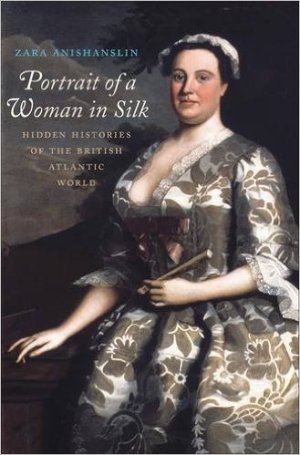 Through the story of a portrait of a woman in a silk dress, historian Zara Anishanslin embarks on a fascinating journey, exploring and refining debates about the cultural history of the eighteenth-century British Atlantic world. While most scholarship on commodities focuses either on labor and production or on consumption and use, Anishanslin unifies both, examining the worlds of four identifiable people who produced, wore, and represented this object: a London weaver, one of early modern Britain’s few women silk designers, a Philadelphia merchant’s wife, and a New England painter.
Blending macro and micro history with nuanced gender analysis, Anishanslin shows how making, buying, and using goods in the British Atlantic created an object-based community that tied its inhabitants together, while also allowing for different views of the Empire. Investigating a range of subjects including self-fashioning, identity, natural history, politics, and trade, Anishanslin makes major contributions both to the study of material culture and to our ongoing conversation about how to write history.
Zara Anishanslin is assistant professor of history and art history at the University of Delaware.
Exhibition | Art and Industry in Early America: Rhode Island Furniture
Opening in August at the Yale University Art Gallery:
Art and Industry in Early America: Rhode Island Furniture, 1650–1830
Yale University Art Gallery, New Haven, 19 August, 2016 — 8 January 2017
Curated by Patricia Kane
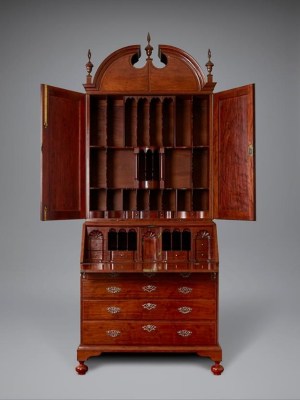
Christopher Townsend and Samuel Casey, Desk and Bookcase, Newport, R.I., 1745-50. Mahogany and sabicu (?) with silver hardware. Private collection.
This groundbreaking exhibition presents a comprehensive survey of Rhode Island furniture from the colonial and early Federal periods, including elaborately carved chairs, high chests, bureau tables, and clocks. Drawing together more than 130 exceptional objects from museums, historical societies, and private collections, the show highlights major aesthetic innovations developed in the region. In addition to iconic, stylish pieces from important centers of production like Providence and Newport, the exhibition showcases simpler examples made in smaller towns and for export. The exhibition also addresses the surprisingly broad reach of Rhode Island’s furniture production, from the boom of the export trade at the turn of the 17th century and its steady growth throughout the 18th century to the gradual decline of the handcraft tradition in the 19th century. Reflecting on one of New England’s most important artistic traditions, Art and Industry in Early America encourages a newfound appreciation for this dynamic school of American furniture making.
◊ ◊ ◊ ◊ ◊
And due out in October from Yale UP:
Patricia Kane with Dennis Carr, Nancy Goyne Evans, Jennifer Johnson, and Gary Sullivan, Art and Industry in Early America: Rhode Island Furniture, 1650–1830 (New Haven: Yale University Press, 2016), 504 pages, ISBN: 978-0300217841, $85.
 The most comprehensive publication available to date on the topic, Art and Industry in Early America examines furniture made throughout Rhode Island from the earliest days of the settlement to the late Federal period. This stunning volume features more than 200 illustrations of beautifully constructed and carved objects—including chairs, high chests, bureau tables, and clocks—that demonstrate the superb workmanship and artistic skill of the state’s furniture makers. Written by distinguished scholars, the book presents new information on the export trade, patronage, artistic collaboration, and the small-scale shop traditions that defined early Rhode Island craftsmanship. In addition to iconic, stylish pieces from important centers of production like Newport and Providence and by well-known makers such as John Goddard and Samuel and Joseph Rawson, Jr., the catalogue showcases simpler examples made in smaller towns. More than 100 catalogue entries detail marks and inscriptions, bibliography, and provenance and feature many new photographs, encouraging a deeper understanding of this dynamic school of American furniture making.
Patricia E. Kane is the Friends of American Arts Curator of American Decorative Arts at the Yale University Art Gallery.
Exhibition | Made in China: Cultural Encounters through Export Art
Press release for the exhibition now on view at the ROM:
Made in China: Cultural Encounters through Export Art
Royal Ontario Museum, Toronto, 5 September 2015 — 2 August 2016
Curated by Jian-fei He and Wen-chien Cheng

Soup plate (ROM European Collection)
Primarily originating from four renowned ROM collections, Made in China: Cultural Encounters through Export Art features nearly 100 objects including paintings, porcelain, lacquer, silver, and photography. Displayed over several rotations, these pieces were created in the 18th and 19th centuries for enthusiastic European and North American consumers. Placing the ‘Made in China’ trademark in historical context, the exhibition explores the cultural encounters between China and the West, revealing a dynamic history of export trade centered in the port city of Canton (Guangzhou). Dr. Jianfei He, the ROM’s James M. Menzies Chinese Research Fellow, is the exhibition guest curator. Dr. Wen-chien Cheng, the ROM’s Louise Hawley Stone Chair of Far Eastern Art, is curatorial supervisor.

Wallpaper detail (ROM, Gift of Noah Torno)
Chinese export art is associated with both Chinese art traditions and Western ideas. Like many products manufactured in China today, the works created centuries ago served as decorative art and souvenirs for foreigners. Examples of pith paper paintings, a materially demanding and technically complex art form, are among the highlights of this intimate exhibition. Derived from the ginseng family, pith paper is strong and, when damp, may be stretched and folded into nearly any shape. Watercolours and tempera are absorbed easily, creating a relief texture with a velvety visual depth. Rarely publicly displayed, these paintings are among the hidden treasures of the ROM’s Far Eastern holdings. Beyond this distinction, these works embody the exhibition’s theme: a lens through which extraordinary cultural encounters are witnessed. Scenes painted on the pith paper romanticized Chinese customs, daily life, landscapes, and exotic plants and insects—all serving to evoke fantasized images of China for Westerners.
Establishing that this tradition continues to this day is the inclusion of a set of contemporary hand-painted wallpaper commissioned especially for the ROM’s exhibition and created by a modern workshop in Shenzhen, China. A diverse group of specimens and objects from a number of different collections—from insects of the ROM’s entromology department corresponding to those seen in nearby pith paper paintings to a silver goblet from the Museum’s European Decocorative Arts Department depicting a dramatic scene—round out the display.
Jianfei He’s research fields and interests include ancient Chinese bronze mirrors as well as the embroidery, textile, and cultural heritage management of Southwest China and Southeast Asia. Wen-chien Cheng’s major area of research is premodern Chinese painting, and her research approach is a contextualized study of visual culture.
New Book | The Villa Laurentina of Pliny the Younger
From L’Erma di Bretschneider:
Jerzy Miziolek, The Villa Laurentina of Pliny the Younger in an 18th-Century Vision (Rome: L’Erma di Bretschneider, 2016), 250 pages, ISBN: 978-8891308443, €75 / $94.

The book deals with a paper reconstruction of Pliny the Younger’s (c. AD 61–112) villa near Ostia, some twenty kilometres from Rome. This unique work was created in Rome in the years 1777–78 by a young Pole, Count Stanisław K. Potocki (1755–1821) in cooperation with Giuseppe Manocchi and other outstanding artists of the time. The work, originally in the Potocki collection in Wilanów, is today housed in the iconographic collection of the National Library, Warsaw. It contains over thirty large-format, color drawings. In the late 18th century, probably during his last sojourn in Italy (1795–97), Count Potocki wrote a 24-page-long commentary to his work, entitled Notes et Idées sur la Villa de Pline. This hitherto unpublished manuscript commentary and reconstruction drawings of the villa are now published together with a virtual visualisation of the villa produced in 3D Studio Max 2014.
Jerzy Miziolek is professor of the visual arts and the classical tradition at the University of Warsaw (Institute of Archaeology). He is the author of seven books and more than 150 papers and reviews. He has delivered more than forty papers and lectures at foreign universities and international symposia concerning Early Christian, Renaissance, and neoclassical art.
◊ ◊ ◊ ◊ ◊
C O N T E N T S
Introduction
I. Stanislaw Kostka Potocki: Archaeology and Artistic Culture in the 2nd Half of the Eighteenth Century
1 The Fascination with Antiquity and Its Influence in the 2nd Half of the Eighteenth Century
2 Stanisław Kostka Potocki in the Memoirs of Eyewitness
3 Stanisław Kostka Potocki’s Studies at the Royal Academy in Turin
4 Stanisław Kostka Potocki’s Travels around Italy in 1774–82
5 In the Company of Princess Izabela Lubomirska: Stanisław Kostka Potocki’s Sojourn in Italy in 1785–86
II. The Laurentina: Pliny the Younger’s Seaside Villa and Its Reconstruction in the Pure Taste of the Century of Trajan
1 A Literary Portrait of the Laurentina: The Dwelling-Place of the Muses
2 The Owner of the Laurentina
3 The Search for the Remnants of the Laurentina in the Eighteenth Century and Later
4 Pliny ‘s Letter on the Laurentina in European Culture from the Renaissance to Neoclassicism
5 Artists Employed by Stanisław Kostka Potocki and Their Drawings
6 Reconstruction Drawings of the Laurentina and Remarks on the Notes et Idées sur la Villa de Pline
7 Reconstruction of Pliny ‘s Villa, Decoration of the Main Rooms, Patterns, and Inspirations
8 The Cryptoportico with Adjacent Pavilions and the Heliocaminus
9 Some notes on the Ideas Guiding the Plan for Pliny ‘s Villa by Potocki
III. The Third Dimension of Pliny the Younger ‘s villa: Virtual Reconstruction of the Laurentina
Instead of an Epilogue: The Laurentina of Potocki ‘s Vision and the Artistic Cultures of Neoclassical Warsaw
Appendices
Pliny the Younger, Letter to Gallus (2, 17)
Stanisław Kostka Potocki, Notes and Ideas on Pliny ‘s Villa
Notes and Explanations in the Portfolios Containing the Drawings
Bibliography
Exhibition | Of Beauty and Grandeur: Roman Portraits in the Baroque
From the Staatliche Kunstsammlungen Dresden:
Of Beauty and Grandeur: Roman Portraits and their Baroque Appropriation
Von Schönheit und Größe: Römische Porträts und ihre barocke Aneignung
Skulpturensammlung at the Albertinum, Dresden, 22 July — 6 November 2016
 The Dresden Antiquities Collection is one of the oldest collections amassed in Dresden by the kings and prince electors, and one of the oldest large collections of antiquities presented in a museum outside Italy. The items, on view behind glass in storage depots at the Albertinum, are currently waiting to be presented again in the eastern gallery of the Semperbau at the Zwinger. The sculptures from classical antiquity and the Baroque period have not been presented to the public in a fitting manner since 2002, the year of a major flood on the Elbe, followed by the reconstruction of the Albertinum and its reopening as a museum for modern art.
The collection displays a selection of some 50 classical and Baroque portraits and portrait statues. These portraits—sculptures combining authenticity and idealisation—played a crucial role in defining and communicating political, social and communal identities, sending out various messages to their audience in ancient times. One of the most important art genres of classical antiquity, portraits of children, women, politicians, military commanders and the ruling elite were a ubiquitous element of everyday Roman life. They were erected on public squares, influencing broad swathes of the public as a kind of mass media. In the 16th and 17th centuries, the works, which had often survived only as fragments, were elaborately and splendidly completed with busts made of coloured stone or reworked in the classical style. At the start of the 18th century, they came to Dresden from the Brandenburg Collection built up by Friedrich Wilhelm I (1688–1740) and the Roman Collection assembled by the House of Chigi.
This presentation shines the spotlight on the sculptures which make up the heart of the collection and which stand out in terms of their quality and quantity. Among the items there are some unusual works, such as the statue of the Roman Emperor Antoninus Pius (150–160 AD), the portrait of his wife Faustina (around 140 AD) on a magnificent Baroque bust of coloured marble, or the porphyry bust of the emperor known as Caligula (17th century), whose acquisition was of particular value to Augustus the Strong because of its precious material. Loans from the Grünes Gewölbe (Green Vault) include a showpiece by Johann Melchior Dinglinger and Balthasar Permoser: a cameo of a Roman emperor from classical antiquity set in a precious frame. In the 18th century this portrait was seen as that of the first Roman emperor, Augustus. Augustus the Strong saw himself as linked to his namesake by his own fame as a ruler and a patron of the arts.
New Book | Klassizismus in Aktion: Goethes ‘Propyläen’
Published by Böhlau with details from De Gruyter:
Daniel Ehrmann and Norbert Christian Wolf, eds., Klassizismus in Aktion: Goethes ‘Propyläen’ und das Kunstprogramm der Weimarer Klassik (Vienna: Böhlau Verlag, 2015), 458 pages, ISBN: 978-3205201540, 59€ / $83 / £45.
 Der Band setzt sich mit der von Johann Wolfgang Goethe von 1798 bis 1800 herausgegebenen Kunstzeitschrift Propyläen auseinander und nimmt dabei nicht nur bekannte Essays des Herausgebers, sondern auch Beiträge Friedrich Schillers, Johann Heinrich Meyers und Wilhelm von Humboldts in den Blick. Erstmalig wird so eine zentrale Programmschrift des deutschen Klassizismus in ihrem inneren Zusammenhang gemustert und in ihren zeitgenössischen Kontexten interdisziplinär untersucht. Dadurch kann die literaturhistorische und ästhetikgeschichtliche Bedeutung des publizistischen Projekts neu ermessen werden. Der Forschung soll so ein vertiefender Einblick in das innere Gefüge und die spannungsreiche Beschaffenheit des klassizistischen Weimarer Kunstprogramms eröffnet werden.
◊ ◊ ◊ ◊ ◊
I N H A L T S V E R Z E I C H N I S
EINLEITUNG
• Daniel Ehrmann / Norbert Christian Wolf, Klassizismus in Aktion. Zum spannungsreichen Kunstprogramm der Propyläen
KULTUR UND AUTONOMIE
• Sabine Schneider, »Ein Unendliches in Bewegung«. Positionierungen der Kunst inderKultur
• Hans-Jürgen Schings, Laokoon und La Mort de Marat oder Weimarische Kunstfreunde und Französische Revolution
• Daniel Ehrmann, Bildverlust oder Die Fallstricke der Operativität. Autonomie und Kulturalität der Kunst in den Propyläen
NATUR UND DIE KÜNSTE
• Elisabeth Décultot, Kunsttheorie als Übersetzung. Goethes Auseinandersetzung mit Diderots Versuch über die Mahlerey
• Dieter Borchmeyer, Weimarer Opernästhetik. Goethes Essay Ueber Wahrheit und Wahrscheinlichkeit der Kunstwerke
• Ernst Osterkamp, Das Drama und die Kunst des Klassizismus in den Propyläen
NORMATIVITÄT UND VIELSTIMMIGKEIT
• Johannes Grave Natur und Kunst, Illusion und Bildbewusstsein. Zu einigen Bildern in Goethes Beiträgen für die Propyläen
• Norbert Christian Wolf, Vielstimmigkeit im Kontext. Goethes ›kleiner KunstRoman‹
Der Sammler und die Seinigen in entstehungsgeschichtlicher und gattungstheoretischer Perspektive
• Martin Dönike, »Antike Kunstwerke«. Johann Heinrich Meyers altertumskundliche Beiträge zu den Propyläen
KLASSIZISTISCHE UND ANTIKLASSIZISTISCHE KUNSTPRAXIS
• Frank Büttner, Die Weimarischen Kunstfreunde und die Krise der Kunstakademien um 1800
• Johannes Rössler, Über das Helldunkel. Re exionen zu Druckgraphik und Reproduktionsmedien in den Propyläen
• York-Gothart Mix, ›Das Unendliche und das Endliche‹. Die Propyläen und die kunstphilosophische Debatte über die Arabeske als romantisches Erkenntnisbild
VOR UND NACH DEN »PROPYLÄEN«
• Gerrit Brüning, Glückliches Ereignis im Zeichen der Kunst. Die Propyläen als Frucht der Zusammenarbeit Goethes und Schillers
• Claudia Keller, Die ungeschriebenen Propyläen – Klassizismus im Experiment
• Peter Sprengel, Goethe-Nachfolge als Architekturphantasie. Zum Motiv der Propyläen im Werk Gerhart Hauptmanns
Abbildungen
Siglenverzeichnis
Verzeichnis der Beiträgerinnen und Beiträger
Personenregister










 Enfilade
leave a comment